
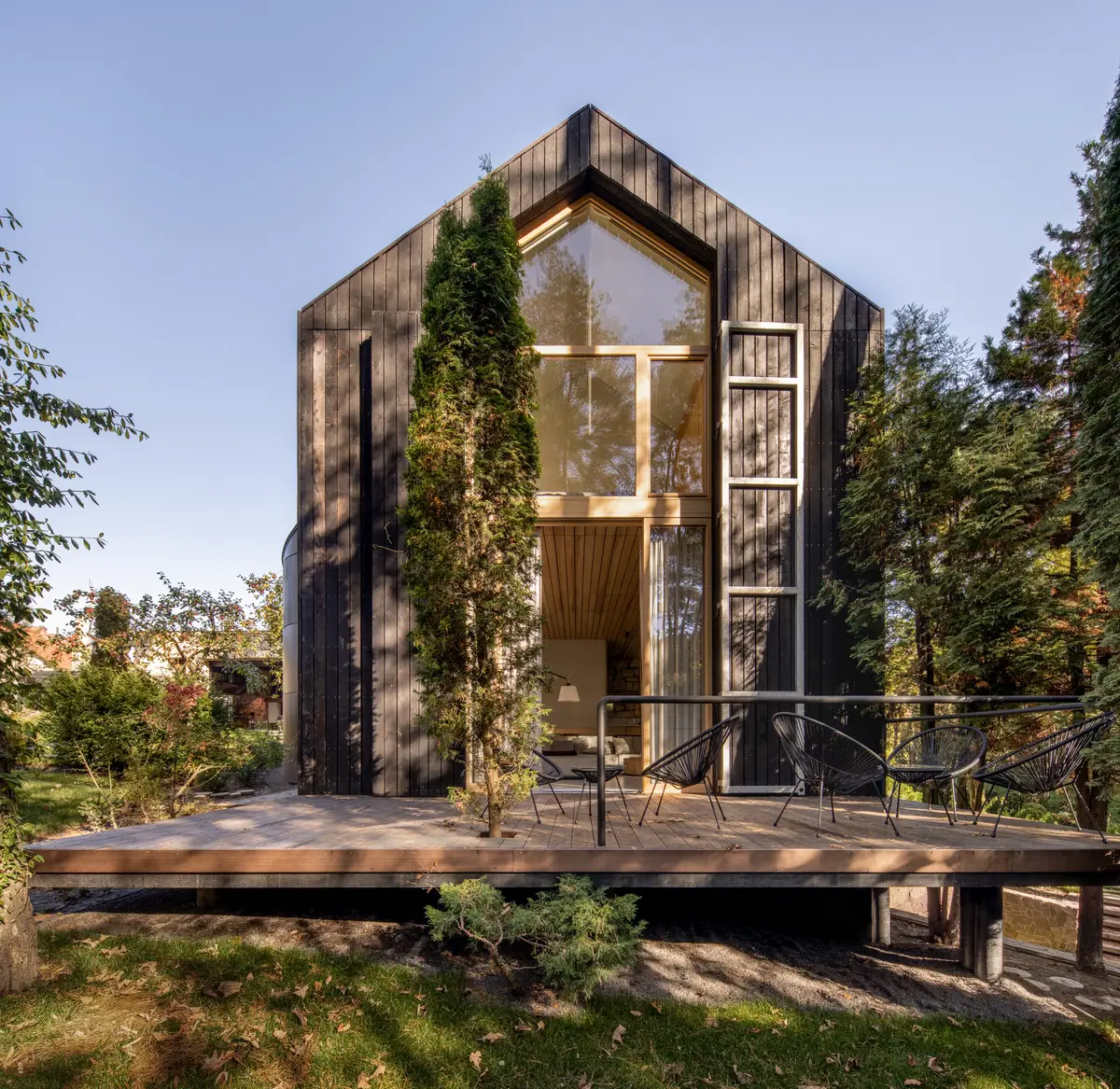
Replus Design Bureau Wraps a Forest Retreat Near Lviv in Charred Larch and Recycled Austrian Tile
OSLW House nestles into a pine forest outside Lviv, built almost entirely from Ukrainian materials and reclaimed heritage fragments.


The western fringes of Lviv dissolve into pine forest, and in one particular pocket, near an old recreation center and a lake locals call "Lviv's Switzerland," replus design bureau has turned a modest one-story cottage into something considerably more deliberate. OSLW House is a 220-square-meter vacation home that refuses to announce itself. Its charred timber walls and rough local stone merge with the tree trunks around it, and when the shutters close, the building all but disappears. The architect Dmytro Sorokevych describes the project as a house "without refined aesthetics," but that undersells it. There is enormous care in every joint, every material choice, every relationship between structure and ground.
What makes the project genuinely interesting is its sourcing logic. The concrete uses local crushed stone. The facade lining is Carpathian larch, shou sugi ban treated. The floors are Ukrainian oak, the windows Ukrainian pine, the fences clad in recycled tiles salvaged from old houses dating to the Austrian period, when Lviv was part of the Habsburg Empire. The stone comes from the village of Demnya. Nothing was imported that could be found locally, and the result reads less like a material palette and more like an inventory of regional identity. On a difficult, sloped, irregularly shaped site dense with trees, the house holds its ground without removing a single one.
A Dark Volume in the Pines
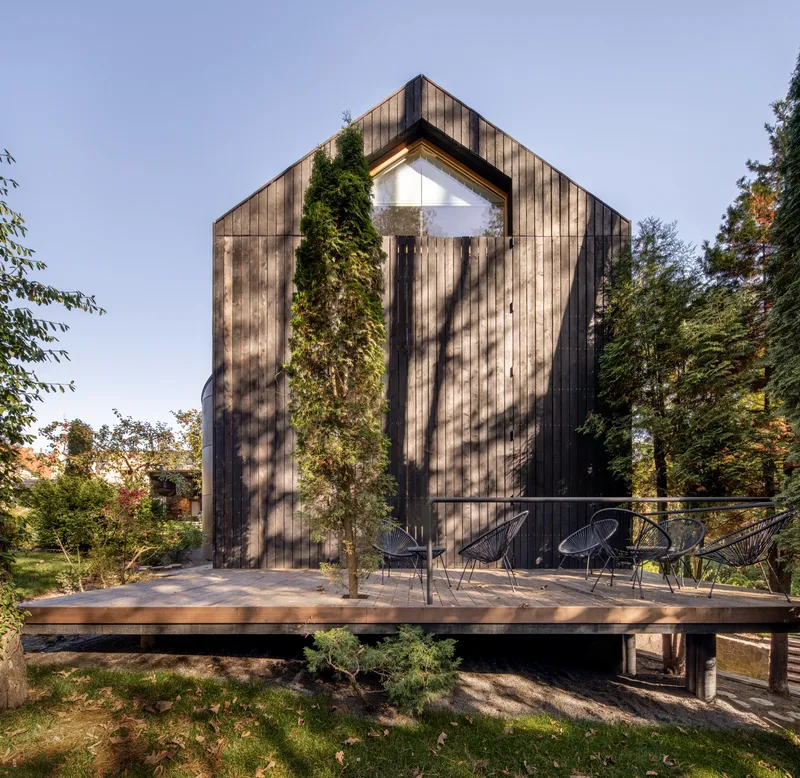
The primary volume is a gabled form clad in burnt vertical boards. The charring deepens the timber to near-black, which does two things simultaneously: it protects the wood from the moisture-heavy forest climate and it lets the house recede into the shadows cast by the surrounding pines. From a distance, the building reads as a dark silhouette rather than an object. Up close, the texture of the charred grain becomes almost geological, resonating with the rough stone walls that anchor the structure to the slope.
The roof sheathing uses the same burnt boards, so the boundary between wall and roof softens. There is no color change, no trim, no moment where one surface declares itself separate from another. The gable becomes a unified surface, punctured only by triangular glazing at the peak and a large opening that frames the forest canopy like a viewport.
Stone, Ground, and the Act of Anchoring
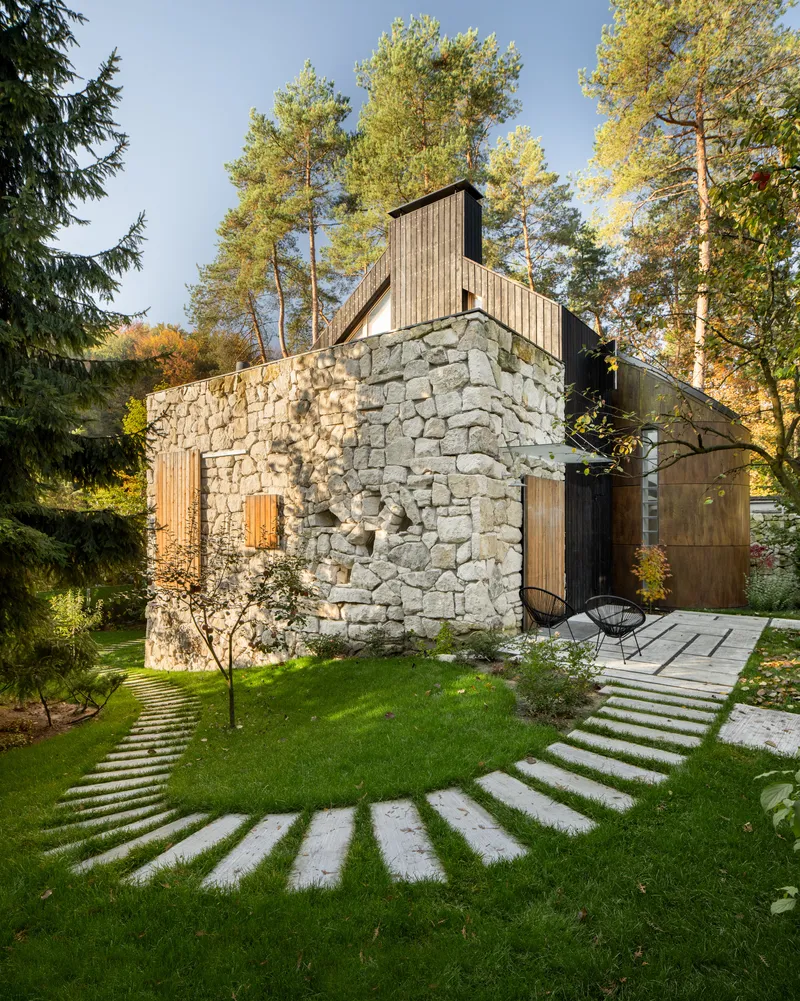
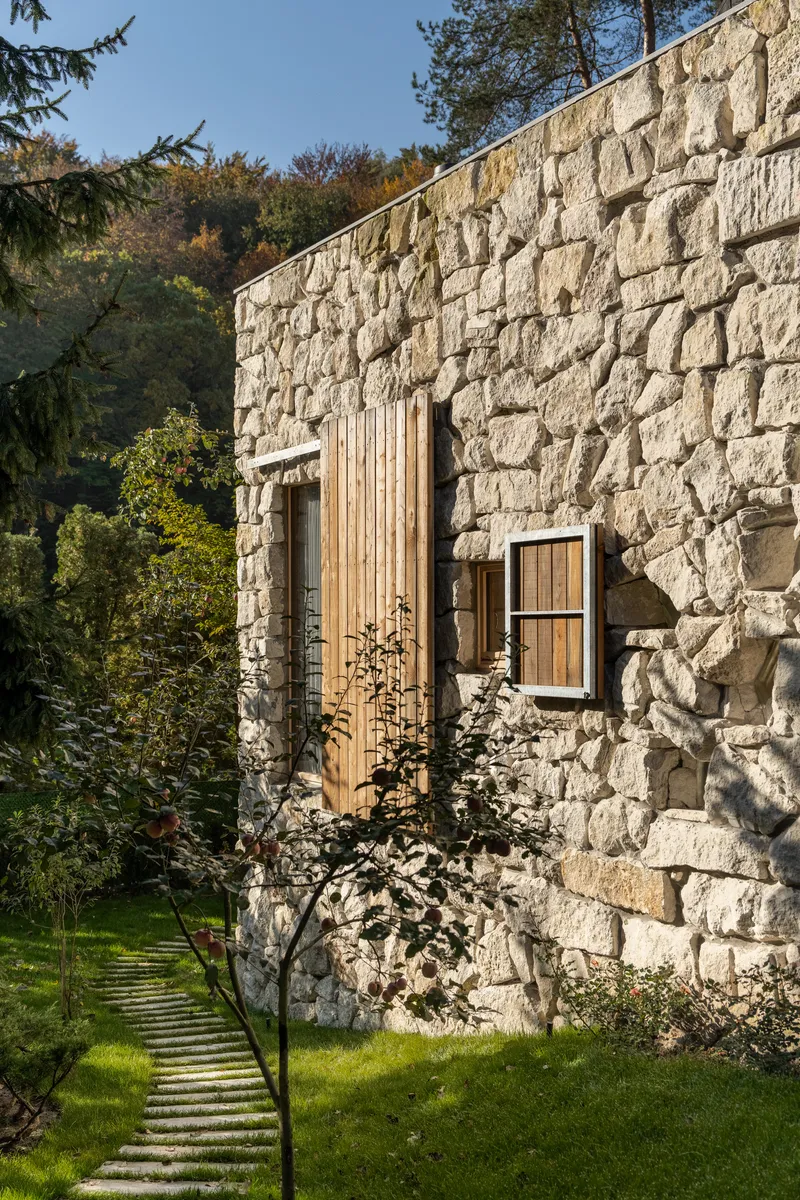
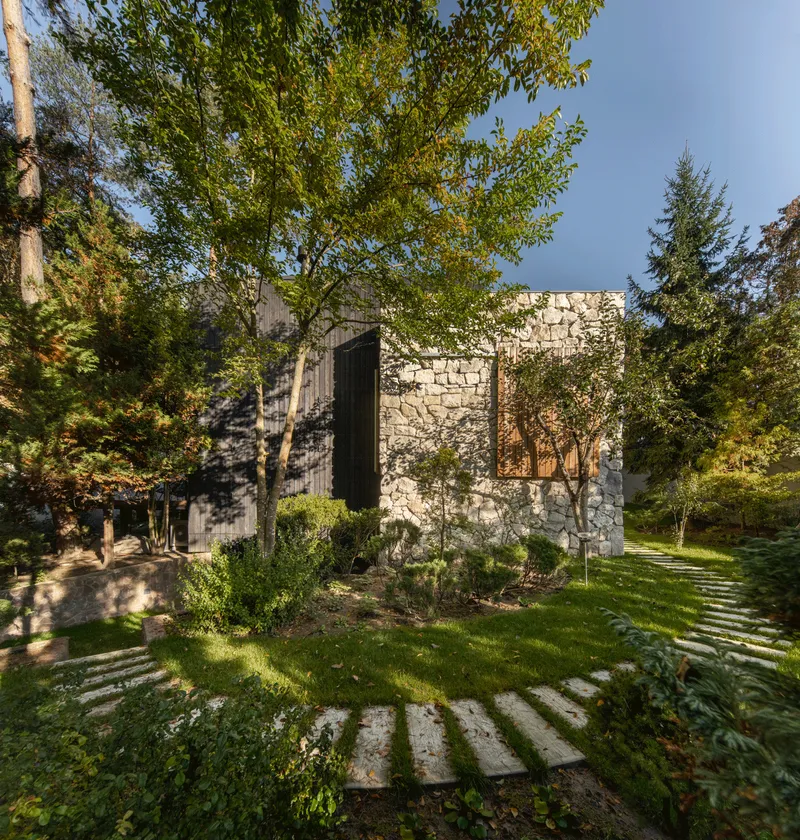
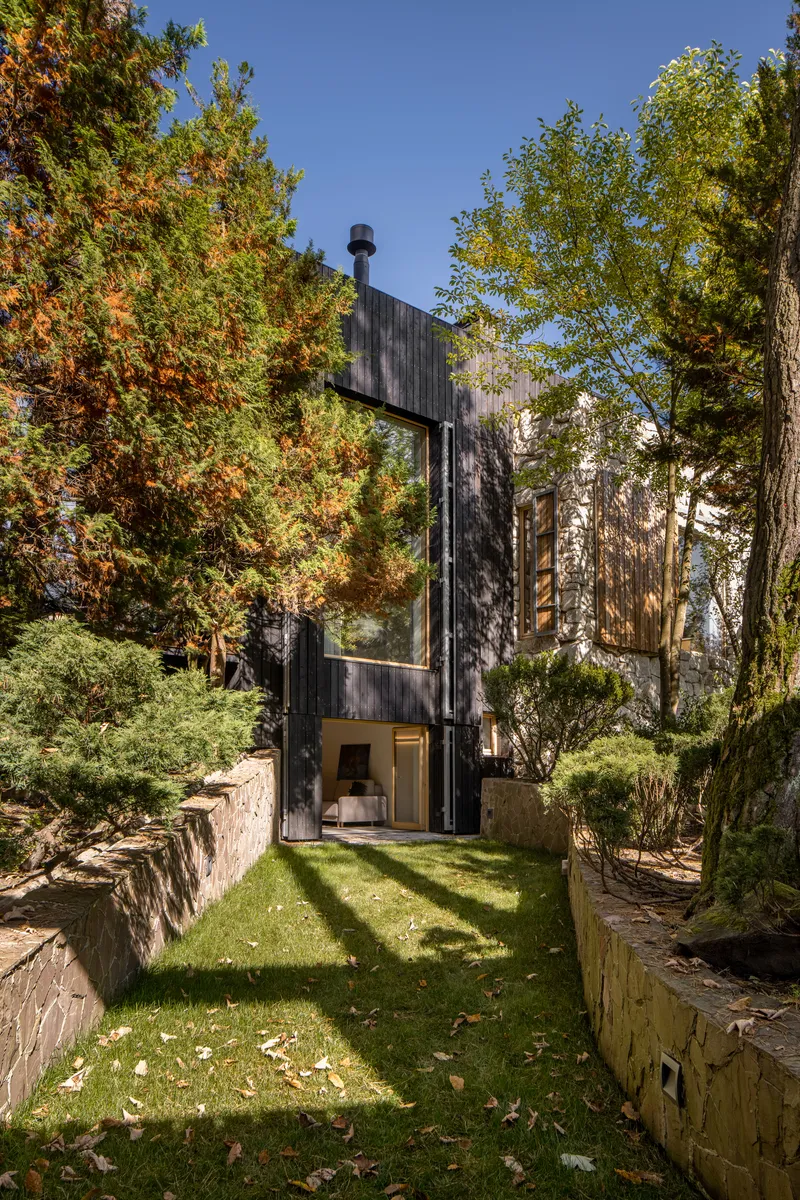
The stone base of the house is not decorative. It is structural and cultural. The Demnya stone, laid in rough courses, creates retaining walls that negotiate the site's complex relief, holding back earth on the uphill side and stepping down toward the lawn on the other. Where timber sits on top of stone, the transition is clean but unglamorous: two honest materials meeting at a line. The vertical timber cladding appears to grow upward from the masonry the way trees grow from the forest floor.
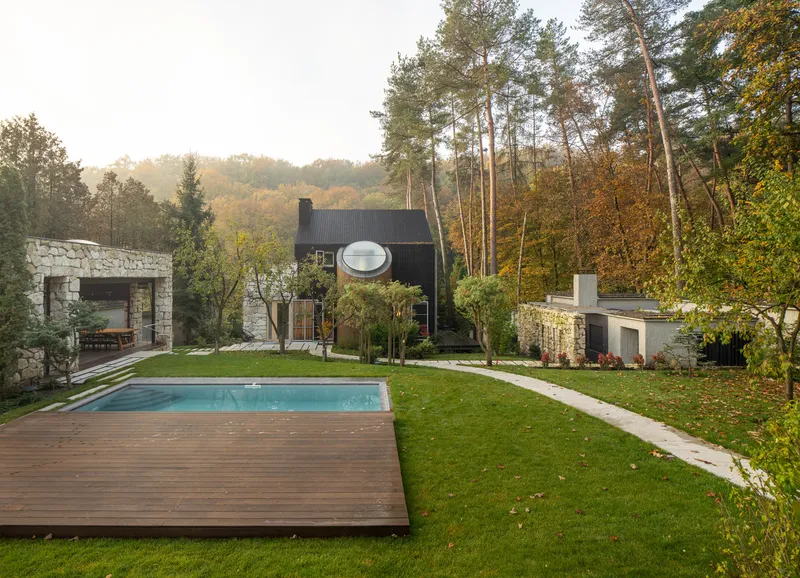
Concrete slab paths with built-in lighting and drainage channels wind through the garden, connecting the house to its outbuildings and pool. These paths sit slightly proud of the grass, hovering like stepping stones across a stream. The effect is deliberate: you never feel like you are walking on a surface imposed over the landscape. You are picking your way through it.
The Stone Pavilion and Outdoor Rooms
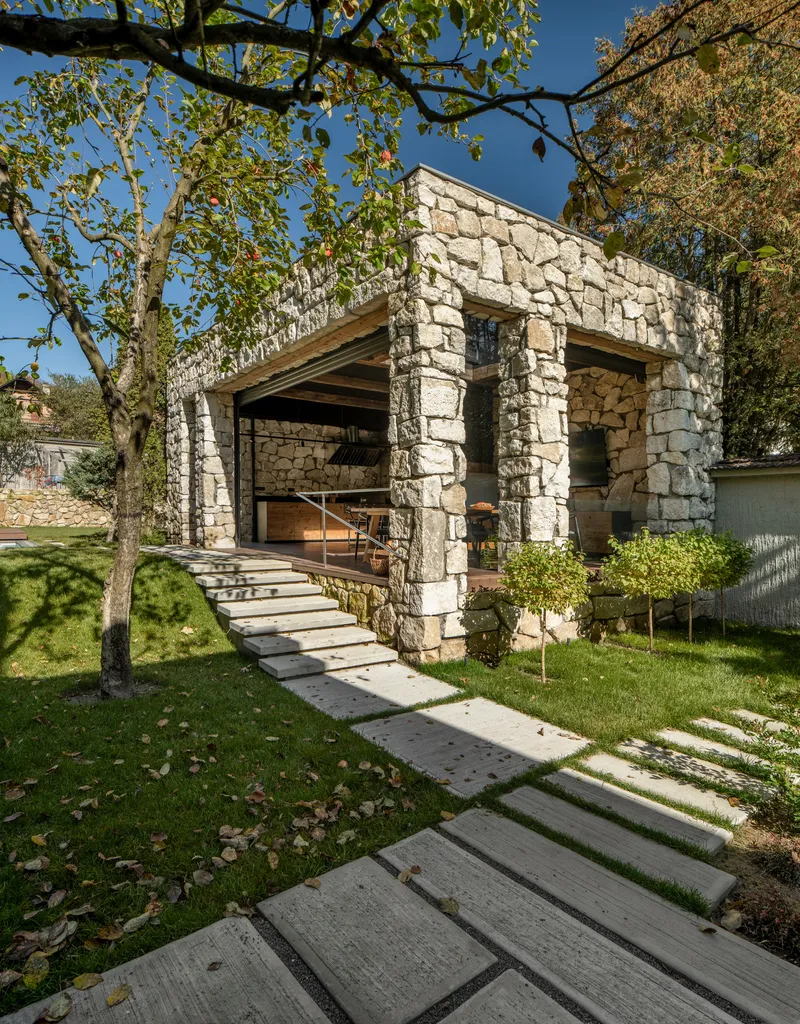
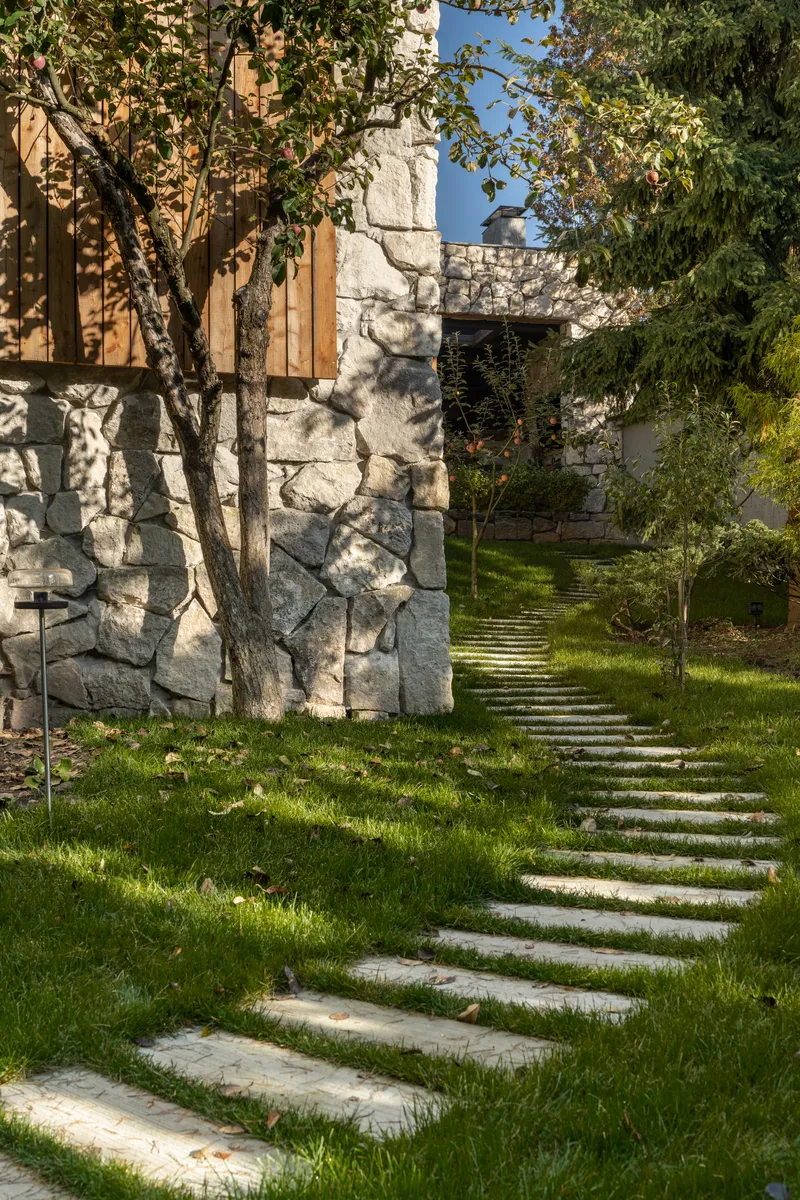
A separate stone pavilion with an exposed timber roof structure sits at the edge of the main lawn, functioning as a large gazebo. Its proportions are generous but its materials are blunt: rough stone piers, pine beams, no ceilings to speak of. The swimming pool, which can be covered by a removable terrace, occupies the space between the pavilion and the main house. When covered, the pool disappears, and the garden gains a deck. When open, the house gains a body of water that mirrors the pine canopy overhead.
Raised vegetable beds, climbing vines on the stone walls, and a parking area with two entrances complete the site program. The landscape plan treats the garden as a series of rooms rather than a single open space, and the sloping terrain makes each room feel distinct in elevation and enclosure.
Copper, Charcoal, and Autumn Color
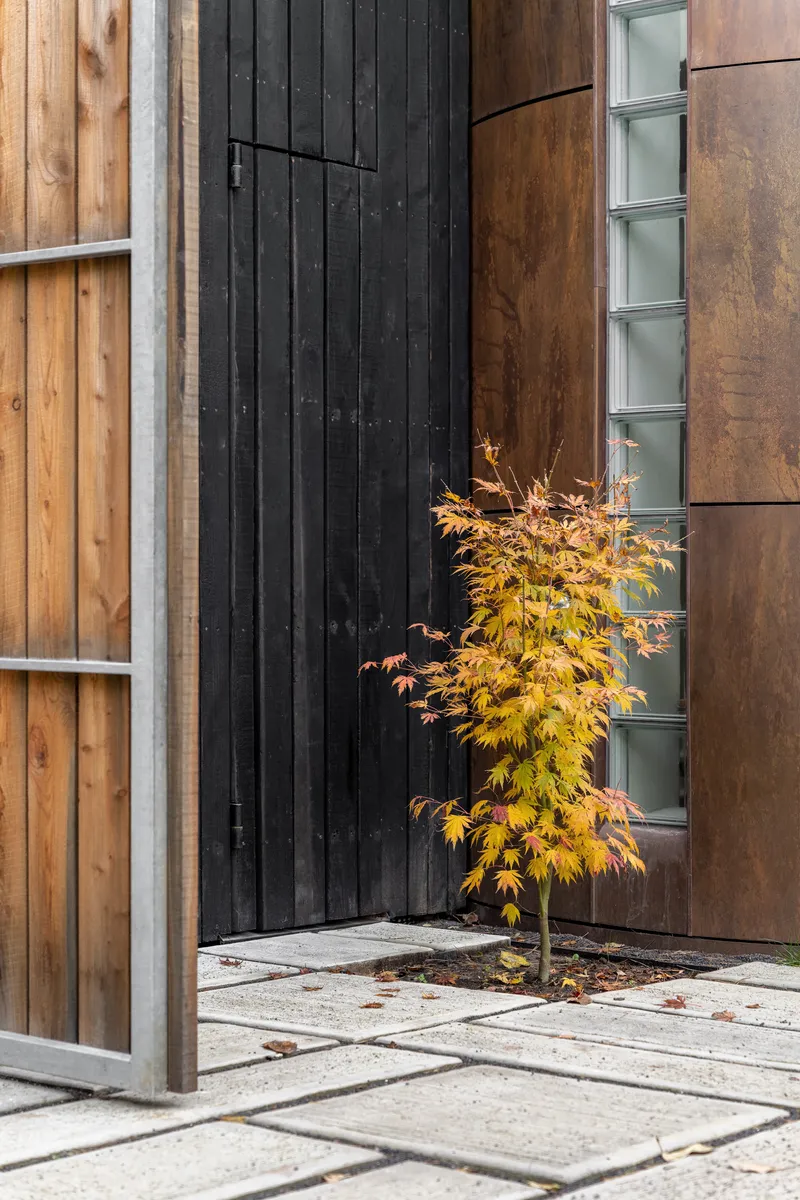
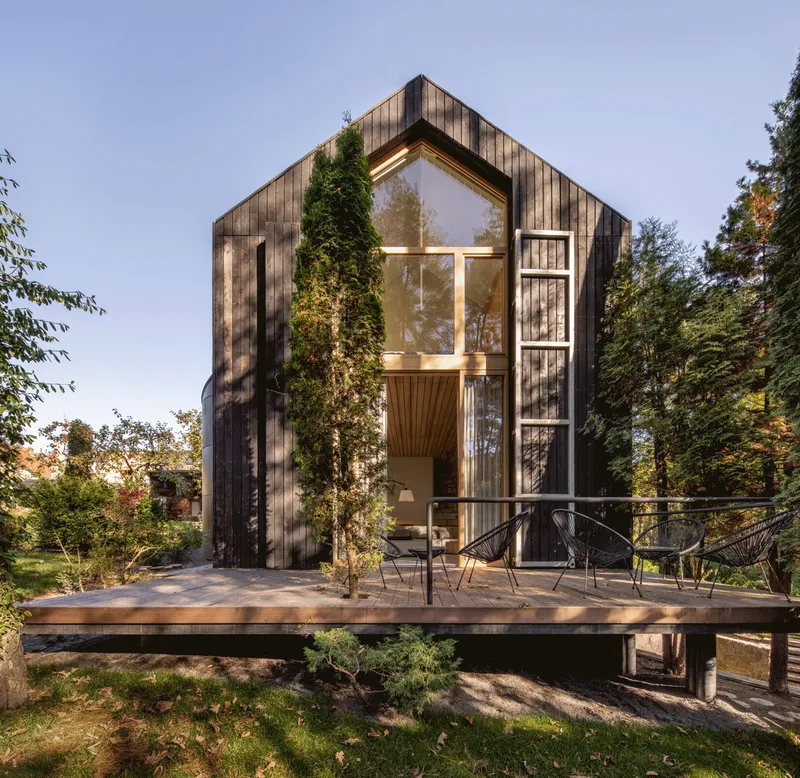
One of the most striking material moments occurs where charred vertical boards meet weathered copper panels beside a small maple tree. The copper has begun to patinate, shifting toward green, while the maple blazes red and gold. It is a collision of natural aging processes, all happening at different speeds. In a decade the copper will be fully green, the maple will be twice as tall, and the charred boards will have silvered. The house is designed to change alongside its setting, not to resist time.
At dusk, the large glazed opening in the gable transforms into a lantern. The interior warmth spills outward through the glass, and the dark timber envelope frames that glow with precision. The elevated deck below the opening serves as a threshold between forest and home, raised above the ground plane to keep the interior dry and to create the sensation of being slightly suspended among the trees.
Inside the Stone Shell
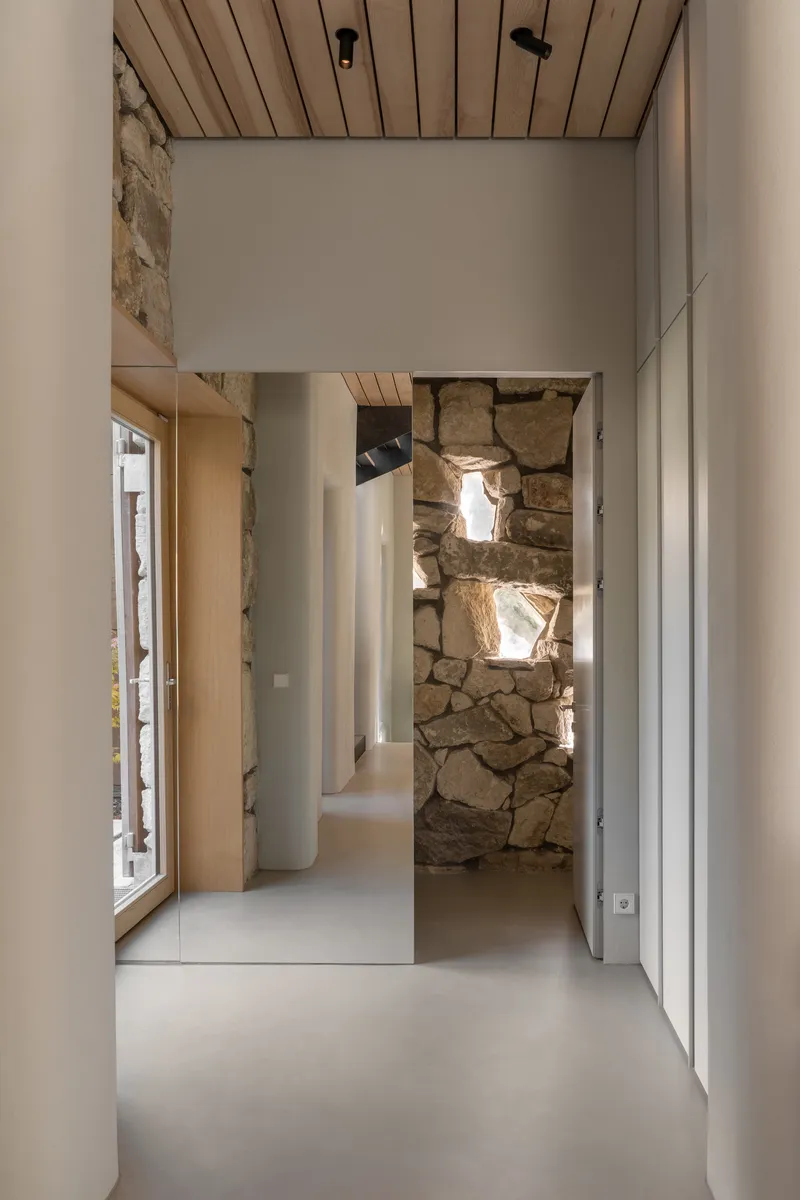
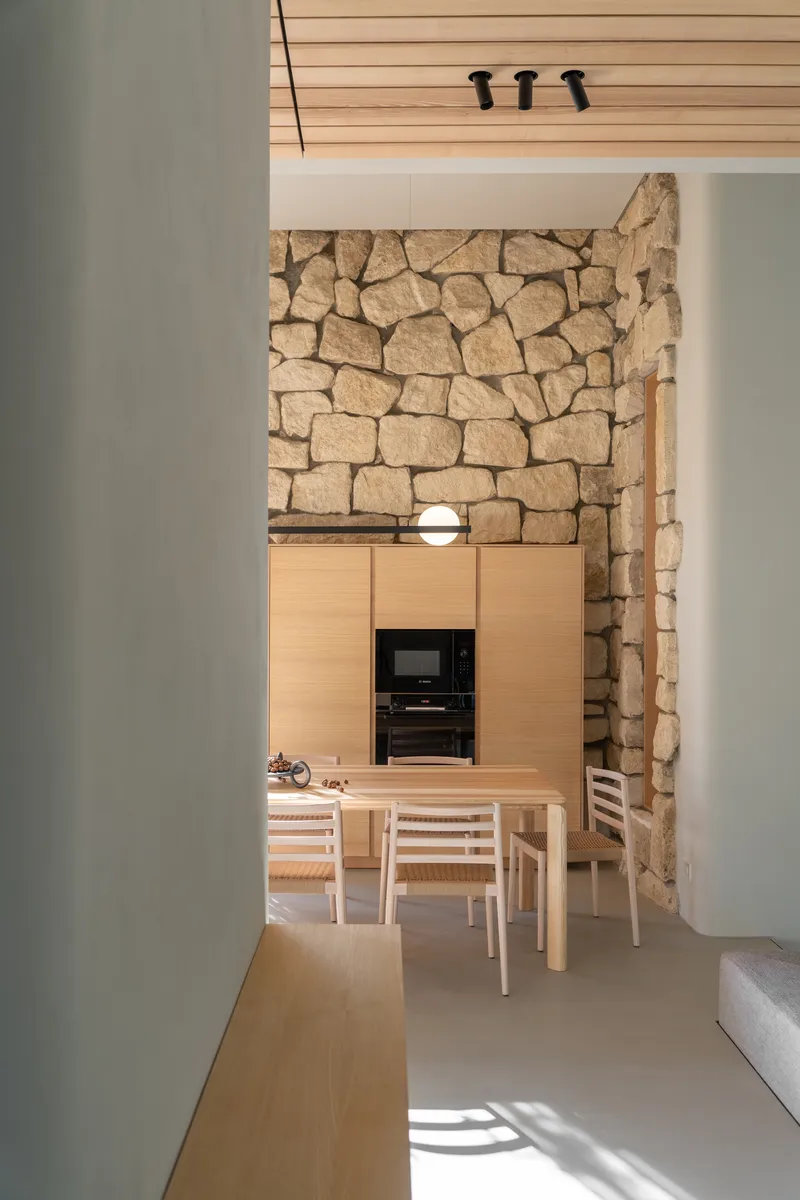
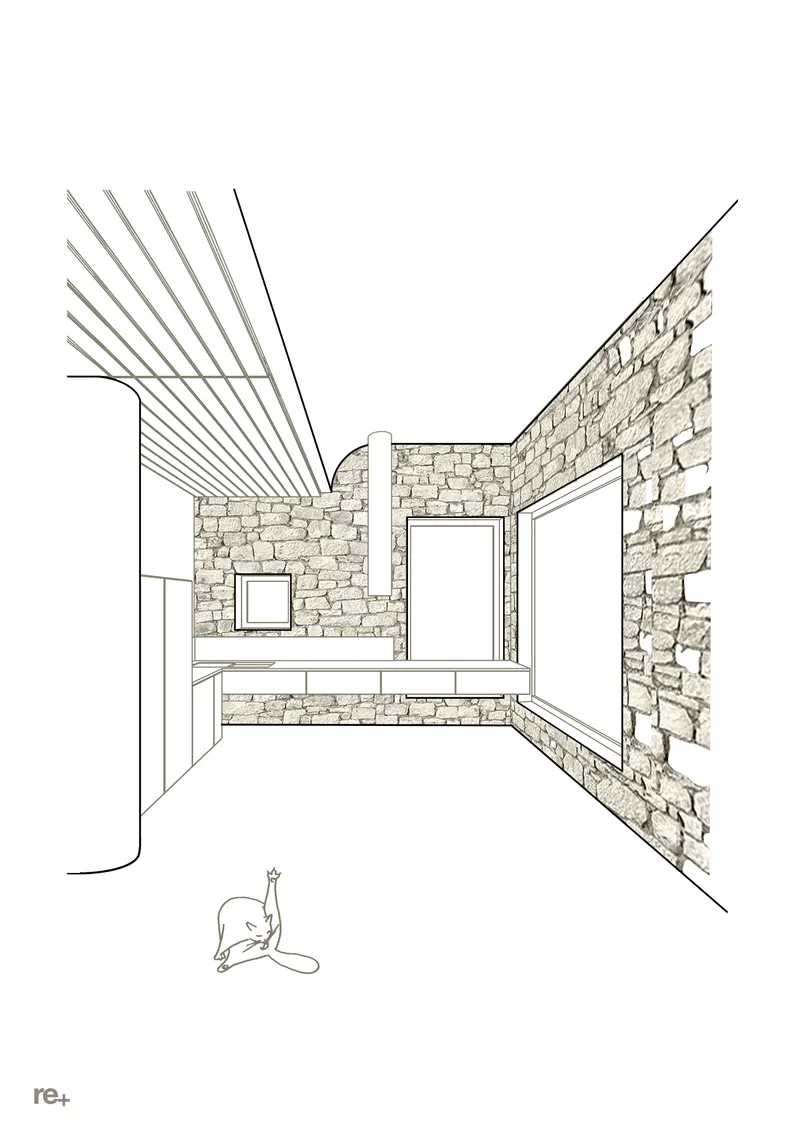
The interiors continue the material honesty of the exterior. A slatted timber ceiling runs through the hallway, filtering light into warm stripes. The exposed stone wall from outside reappears inside, unplastered and unapologetic, next to light wood cabinetry that provides contrast without competing. The first floor holds a rest area, kitchen, and terrace. Two bedrooms occupy the upper floor. A basement level contains a guest room and boiler room, tucked into the slope and invisible from the garden.
Smart home technologies are integrated throughout, as are built-in windows and shadow seams that refine the detail language. But none of these systems are visible in a way that breaks the material narrative. The oak veneer furniture, the pine window frames, and the stone walls all hold the foreground. Technology is infrastructure here, not expression.
Plans and Drawings
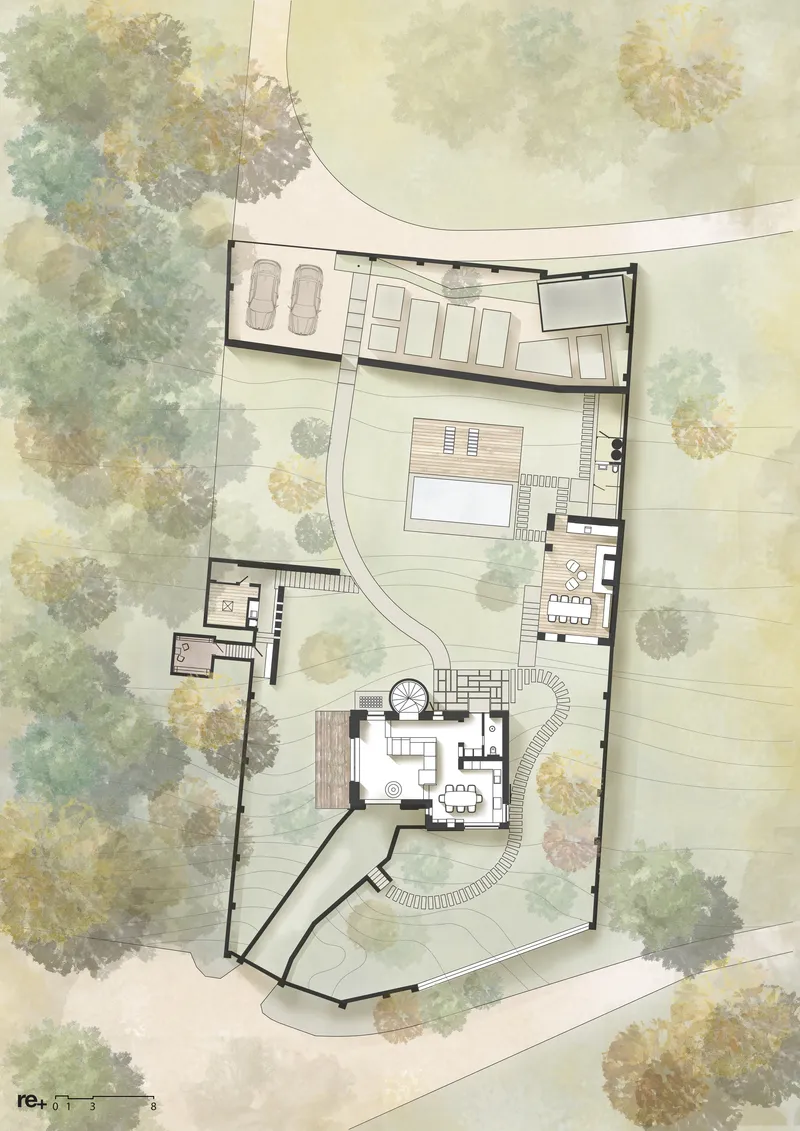
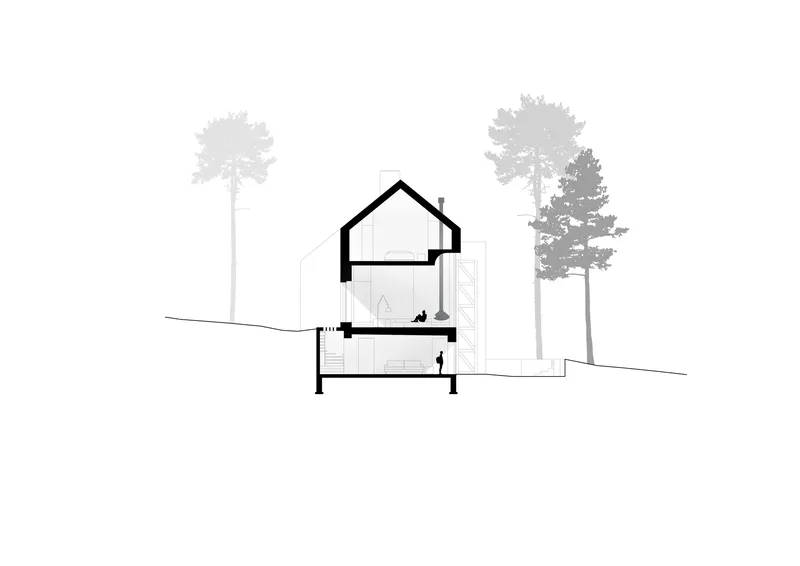
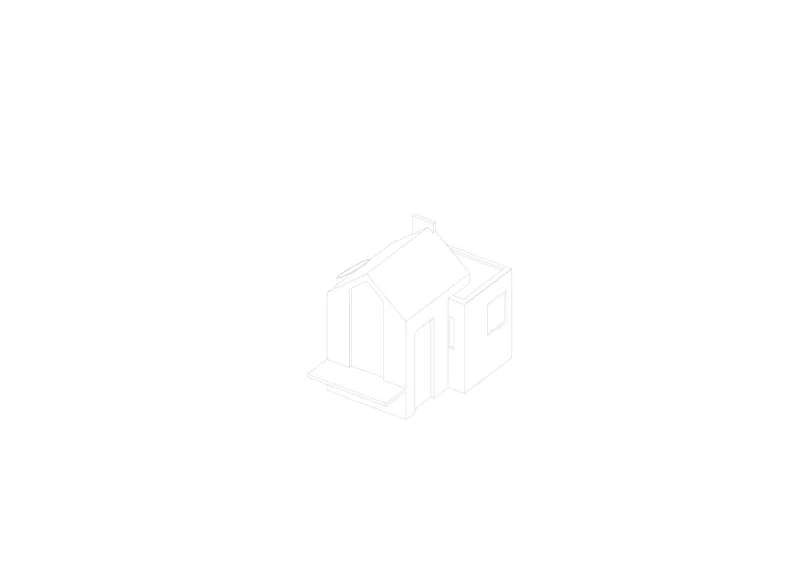
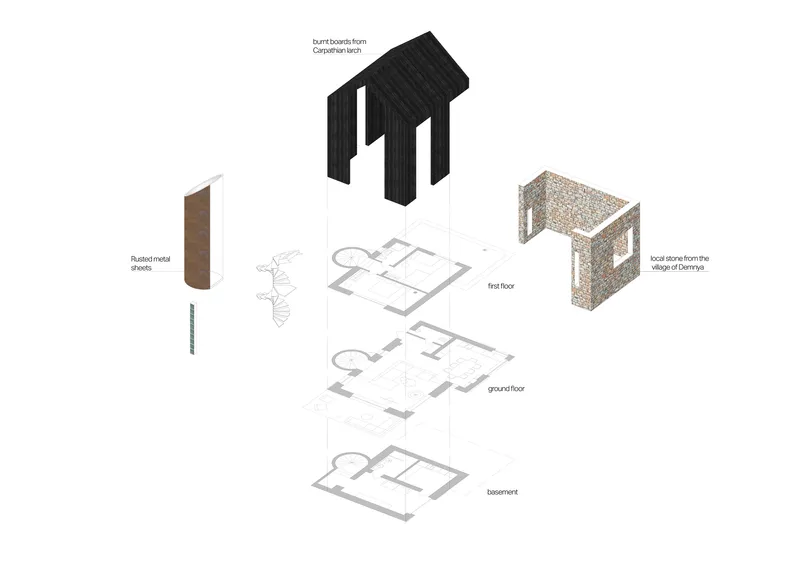
The site plan reveals the difficulty of the lot: an irregular shape carved between existing trees, with a curved access path and two structures positioned to maximize distance from the road. The section drawing confirms the steepness of the terrain and shows how the basement level is buried into the slope, with the gabled roof rising just above the surrounding tree line. The exploded axonometric is the most revealing drawing, pulling apart the stone construction walls, the timber roof structure, and the floor plans to expose the layered assembly of the building.
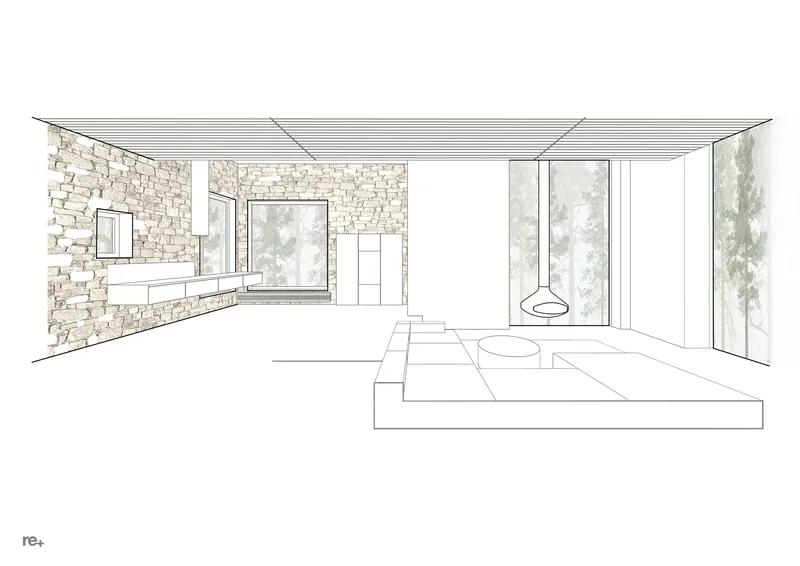
The interior perspective sketches are notable for their atmosphere. One shows a pendant fireplace hanging in a stone-walled room with trees visible through full-height glazing. Another depicts a figure seated on the floor beneath skylight beams, the stone walls catching angled light. These are not presentation renders. They are mood studies, and they communicate the architect's intent more honestly than any photograph: a house for sitting still, watching light move across rough surfaces, listening to a forest.
Why This Project Matters
OSLW House makes a quiet but forceful argument for radical locality. Every material decision traces back to a specific Ukrainian source: the Carpathian larch, the Demnya stone, the oak floors, the pine windows, the recycled Austrian-era tiles. In a global construction economy that defaults to imported products and homogenized finishes, this house is a counter-proposal. It says that a place can be built from itself, that the spirit of a region lives in its quarries and forests and even in the rubble of its colonial history.
It also matters because it treats impermanence as a design strategy rather than a problem. The charred boards will silver. The copper will green. The vines will climb higher. The house was never meant to look the way it looks today. It was designed to age alongside its forest, to become less and less distinguishable from its surroundings over time. In an architectural culture obsessed with the pristine image at the moment of completion, OSLW House is designed for the long photograph, the one taken twenty years from now when the building and the pines have grown into each other completely.
OSLW House by replus design bureau, lead architect Dmytro Sorokevych. Lviv, Ukraine. 220 m². Completed 2022. Photography by Andriy Bezuglov.
About the Studio
Share Your Own Work on uni.xyz
If projects like this are the kind of work you want to make, uni.xyz is a place to publish your own, find collaborators, and enter design competitions.


Popular Articles
Popular articles from the community


The Ocean Hive: Sustainable Architecture for a Self-Sufficient Civilization at Sea
The Ocean Hive imagines sustainable architecture at sea, where modular habitats, algae, wave power and ocean waste sustain a growing colony.

Lunar Spiral: Space Architecture Shaped by the Mathematics of the Universe
Lunar Spiral reimagines space architecture through Fibonacci geometry, lunar regolith, levitating habitats, and self-sustaining Moon living.

Play: Fragments of Their World
Familiar architecture becomes modular playground design, creating safe spaces where displaced children can learn, connect, imagine and play.

Conexión: Biophilic Design Reimagines High-Rise Living in Hong Kong
Conexión reimagines high-rise living in Hong Kong through biophilic design, green facades, shared spaces, daylight, water and nature within.

Similar Reads
You might also enjoy these articles

Bao Huynh Watercolor Atelier: A Serene Art Retreat in Hội An
Bao Huynh Watercolor Atelier in Hội An blends multifunctional art spaces, sustainable design, local materials, and family-friendly living in a serene environment.

Atelier Macri Concept Store Interior Design by CASE-REAL
Atelier Macri store features a "ko" counter, walnut wood details, cork displays, blending retail, gallery, and seamless customer experiences.

Manuel Vargas Izquierdo Stadium and High-Performance Sports Center: Architectural Excellence in Jalpa de Méndez
The Manuel Vargas Izquierdo Stadium blends sustainable design, inclusive sports facilities, and cultural-inspired architecture, revitalizing Jalpa de Méndez’s public spaces.

KAKR Buluh Awar Hall: Revitalizing Community and Ecology Through Bamboo Architecture
Community built bamboo hall revitalizes Buluh Awar village, empowering youth, restoring ecology, celebrating vernacular craftsmanship through sustainable architecture and culture.
Explore Residential Building Competitions
Discover active competitions in this discipline

Challenge to design a portable theatre

Challenge to design a portable music platform

Challenge to design an open learning module for the elderly

Challenge to design mud housing for contemporary communities
Comments (0)
Please login or sign up to add comments
No comments yet. Be the first to comment!