

REST Garden Restaurant by Pezo von Ellrichshausen
A mute monument of green concrete towers rises above a Korean botanical garden, turning a restaurant into a tectonic landscape.


Cornered against a protected forest on a gentle slope overlooking a botanical garden in Yangpyeong, South Korea, Pezo von Ellrichshausen's REST Garden Restaurant does not behave like a restaurant at all. It behaves like a ruin that arrived fully formed: a grid of green concrete towers punching through a horizontal slab, lifted above the ground on a colonnade that frames the landscape rather than competing with it. The project is 3,376 square meters of bold infrastructure that refuses to explain itself, choosing instead to establish its own geological presence on the hillside.
What makes this building genuinely interesting is the way it collapses the categories we usually apply to architecture. The towers are structure, envelope, and ornament simultaneously. The roof is a public terrace, the ground plane is a sheltered plaza, and the dining rooms sit between the two like organisms inhabiting a reef. Pezo von Ellrichshausen have always operated in this territory of irreducible form, but here the scale and programmatic casualness of a restaurant lets them push the idea further. You come for dinner. You stay because you cannot quite figure out where the building ends and the landscape begins.
A Forest of Towers
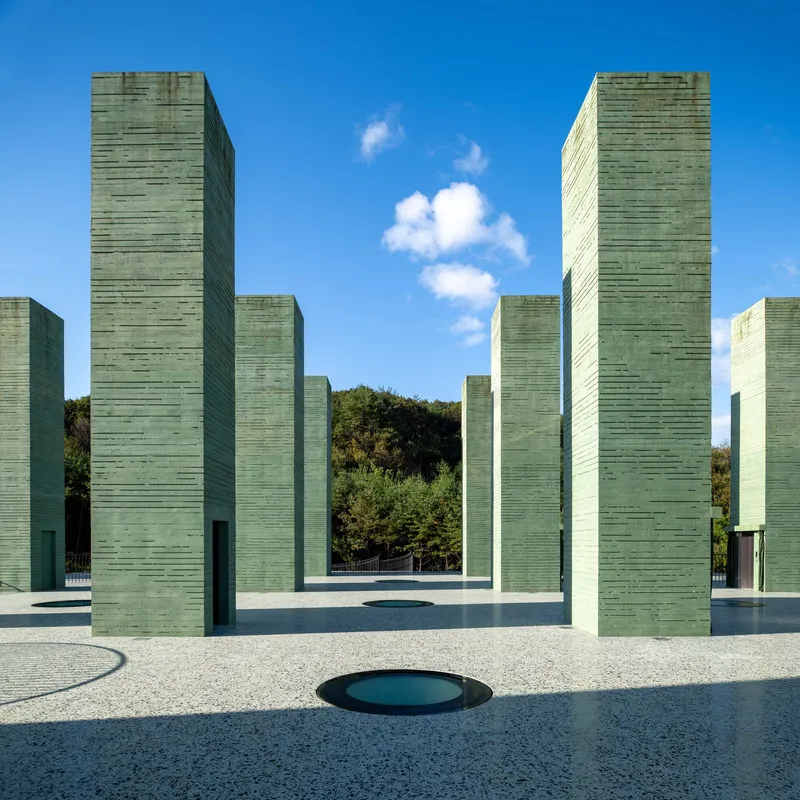
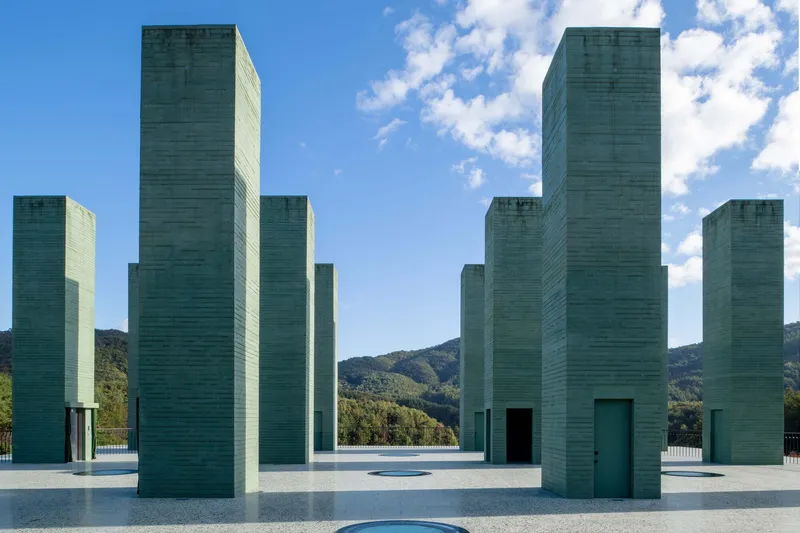
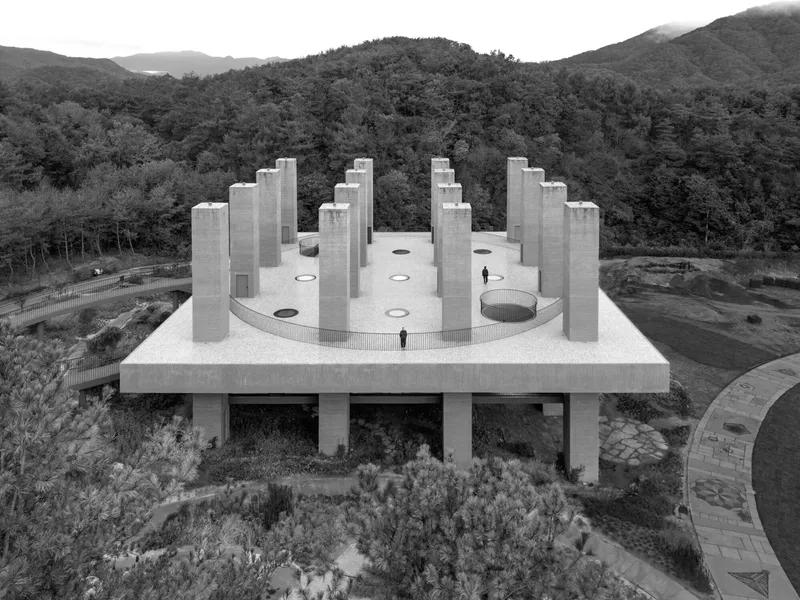
Seen from above or at a distance, the building reads as a congregation of vertical elements, a man-made forest answering the natural one behind it. The towers vary in height and cluster in loose groupings across the roof plane, their tops open to the sky. Circular apertures puncture the slab between them, pulling light down into the spaces below. The aerial view reveals an almost archaeological composition: a field of forms that could be excavated or could be growing.
The green pigmentation of the concrete is critical. It refuses the neutrality that most exposed concrete projects claim and instead ties the structure chromatically to the surrounding vegetation. It is a deliberate artificiality, a color that says: we know we are next to a forest, and we are not pretending to be invisible.
The Elevated Landscape
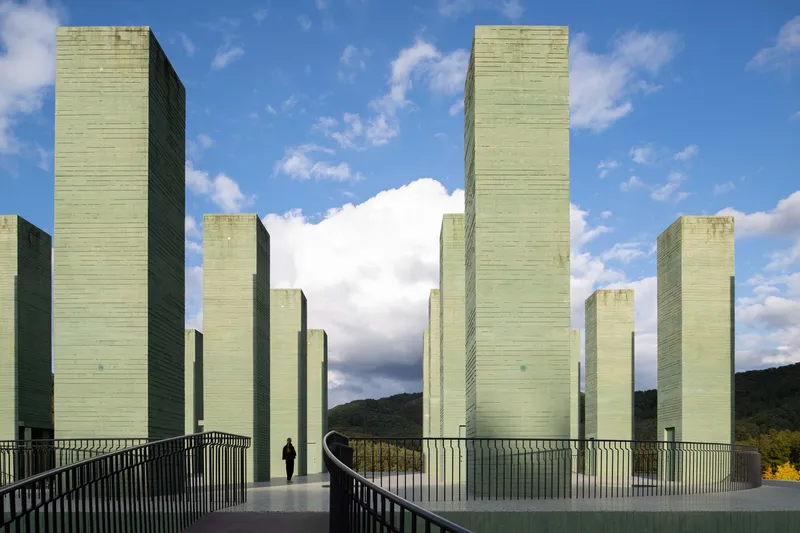

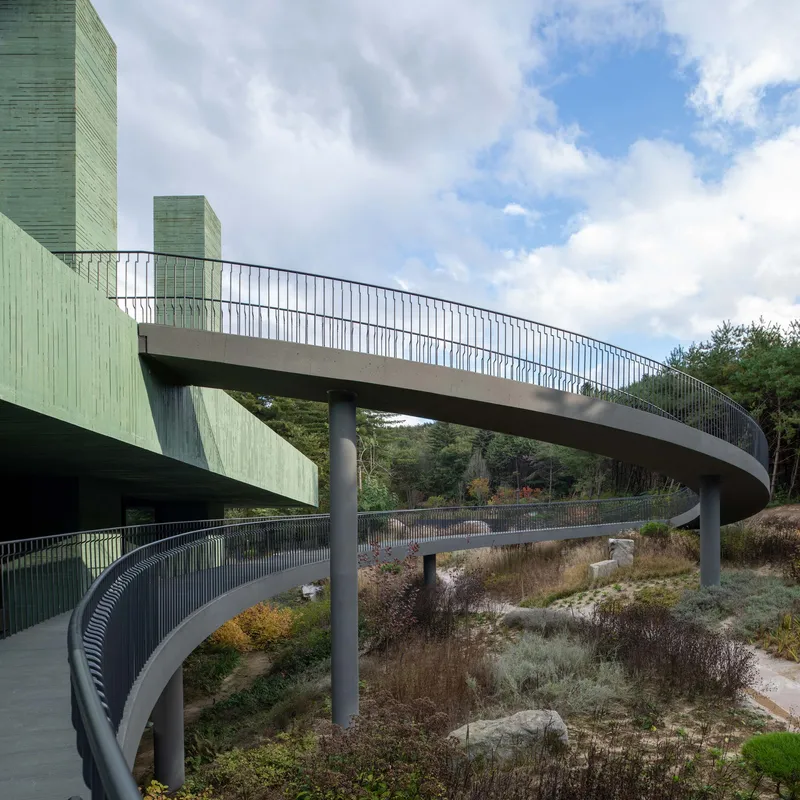
A curving ramp leads visitors up to the elevated platform, establishing the procession as something closer to ascending a hillside than entering a building. The metal railings are utilitarian, almost civic in character, reinforcing the sense that this is public infrastructure rather than a private dining venue. Once on the terrace, the towers surround you, and the views to the distant hills are framed between them like paintings in a gallery with no walls.
The concrete pedestrian bridge spanning between towers adds another layer to the circulation. Movement here is never simply functional. It is choreographed to oscillate between compression, when you are between the towers, and release, when the landscape opens up.
Ground Level: The Sheltered Plaza
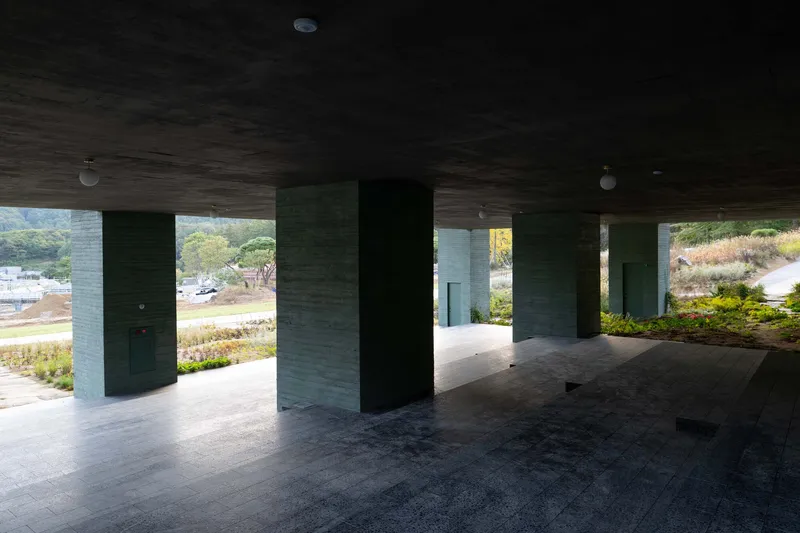
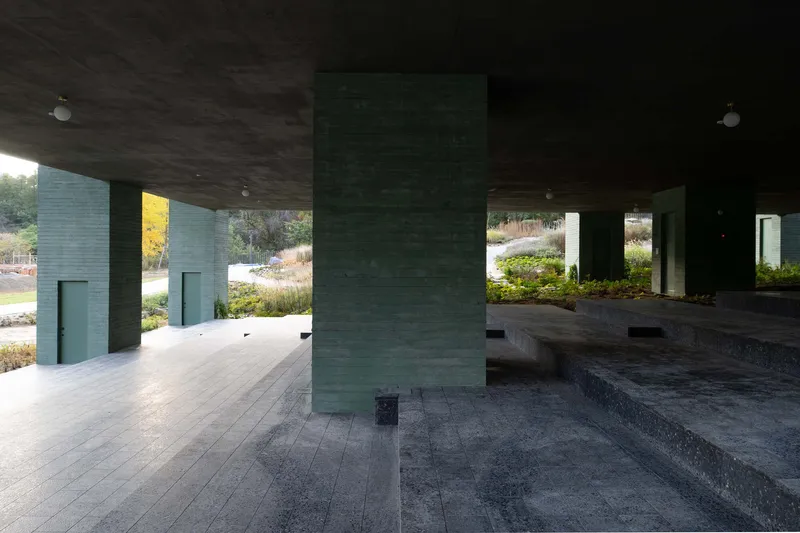
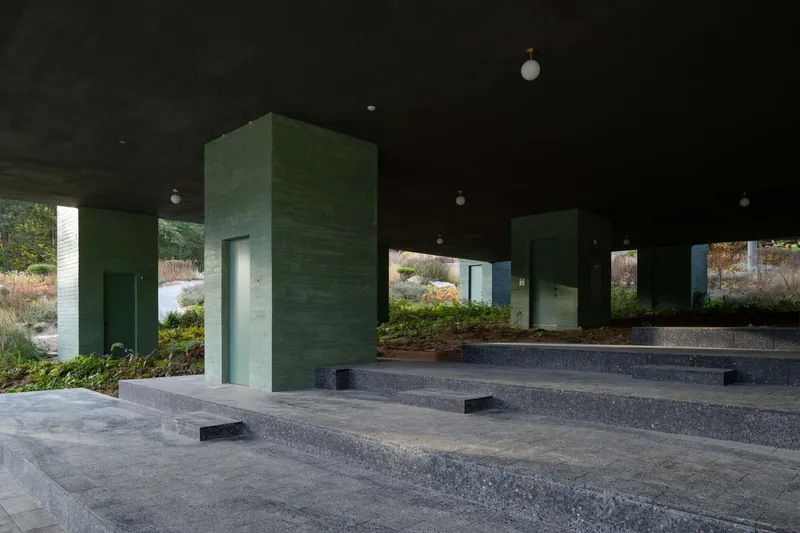
Beneath the raised slab, a generous ground-level space unfolds. Board-formed concrete columns stand like tree trunks, their textured surfaces catching raking light. The terrazzo paving extends in stepped platforms between the columns, and planted beds of ornamental grasses push right up against the structure. The distinction between inside and outside dissolves here. There are no doors, no thresholds, just a gradual transition from open garden to covered plaza.
The service towers, clad in the same green concrete, anchor the program vertically. They contain the practical necessities, kitchens, stairs, utilities, while the space between them remains fluid and uncommitted. It is a generous move: giving most of the ground plane back to the landscape and to gathering, rather than enclosing it.
Interior: Timber, Light, and Circular Voids
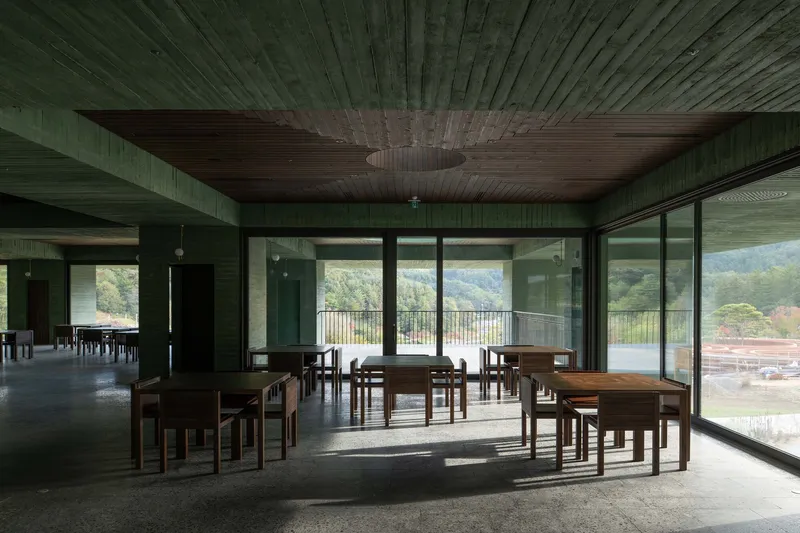
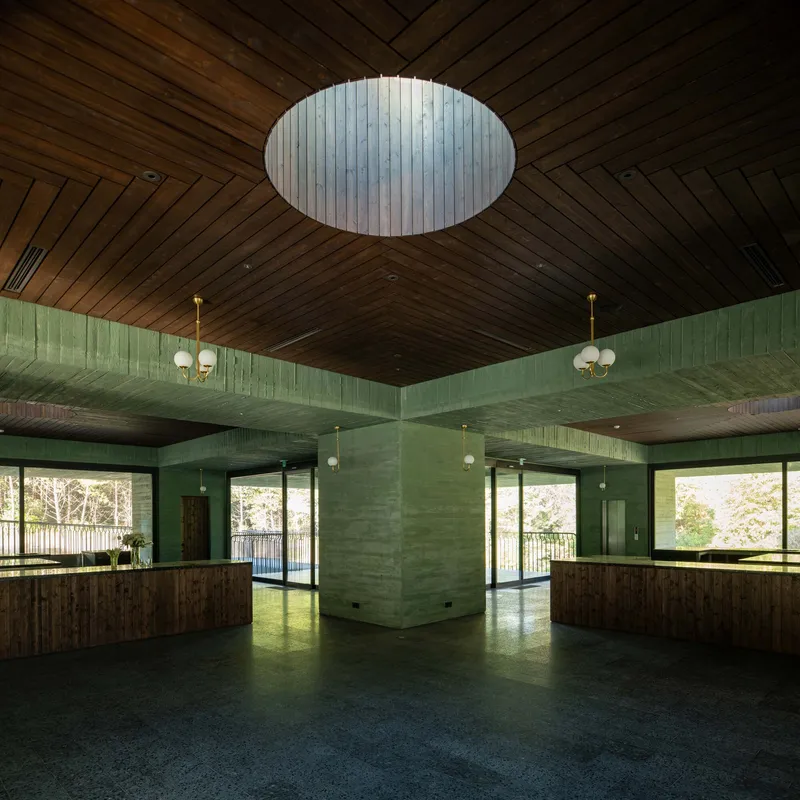
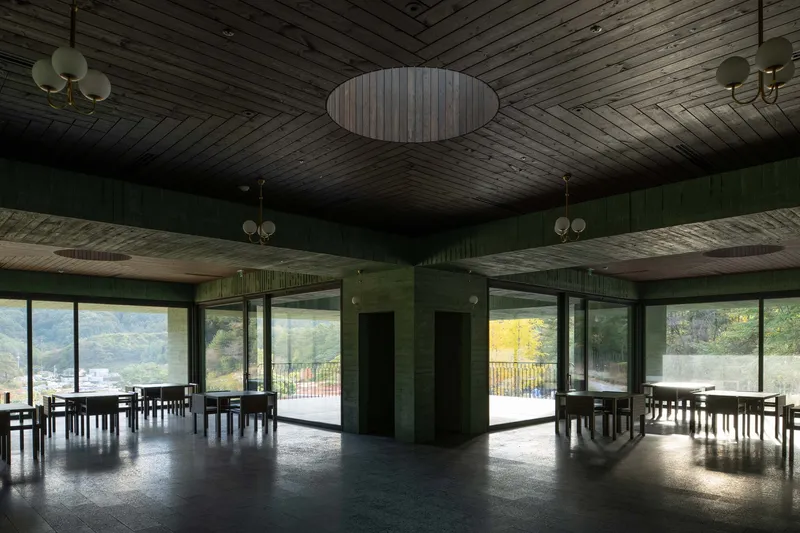
The dining spaces sit within the horizontal volume, wrapped in floor-to-ceiling glazing that makes the surrounding mountains a constant companion to every meal. The ceiling is the real event here: timber panels in a warm, dark tone that contrasts sharply with the green concrete columns rising through the room. Oval and circular skylights open up the ceiling plane, creating vertical shafts of light that shift throughout the day.
The furnishings are deliberately modest. Simple timber tables and chairs avoid competing with the architecture. The effect is closer to dining inside a land art installation than a conventional restaurant. The circular aperture in the ceiling of the main hall operates almost like an oculus, a reference point that orients you vertically even as the horizontal views pull your attention outward.
The Soffit and the Skylight
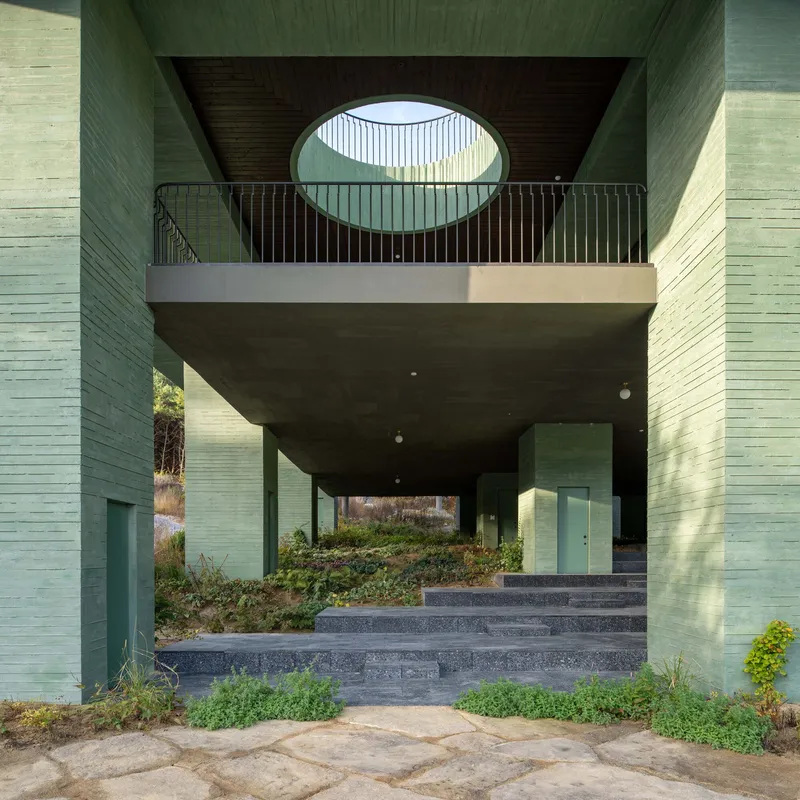
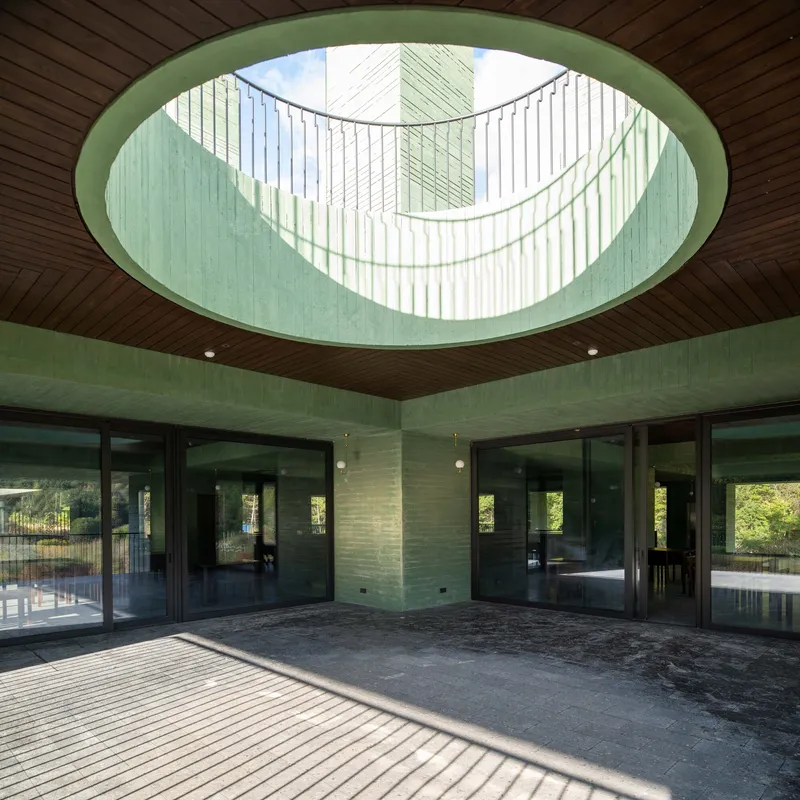

The covered terraces occupy an intermediate zone between the fully enclosed dining rooms and the open roof. Here, the dark wood-paneled soffit presses down, creating an intimate canopy effect, before a circular or oval skylight breaks through to reveal the sky. The vertical louvers around these openings filter light and create a moiré pattern of shadow that moves across the timber throughout the day.
These semi-outdoor spaces are arguably where the building is at its most compelling. They offer the full sensory experience of the landscape, wind, scent, ambient sound, while still providing the architectural framing that transforms casual observation into deliberate contemplation. It is architecture doing what only architecture can do: making you notice what was already there.
After Dark

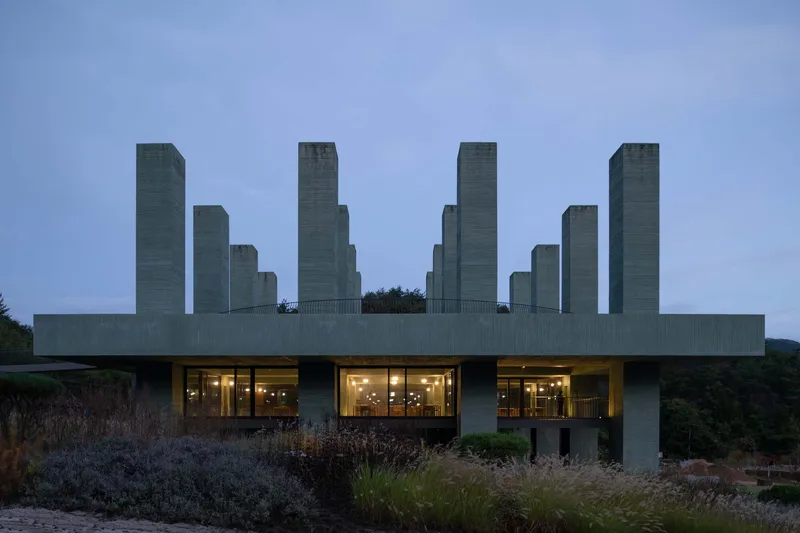
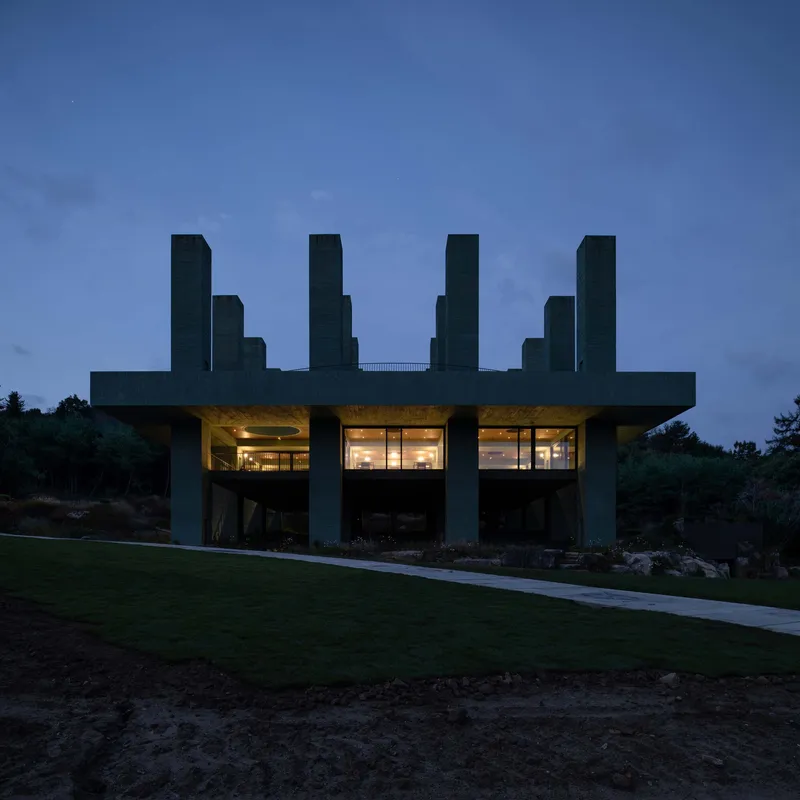
The building transforms at dusk. The towers, mute and opaque during the day, become silhouettes against the evening sky, while the glazed base glows from within. The inversion is complete: what appeared to be a heavy, grounded mass by day becomes a lantern floating above a dark garden at night. The boulders and ornamental grasses at the base catch the spill of interior light, extending the building's presence softly into the landscape.
The twilight views of the front elevation are particularly revealing. The horizontal datum of the raised platform becomes a sharp line dividing the illuminated human realm below from the silent tower realm above. It is a reading of the project that only time and light can produce.
Painted Renderings and Physical Models
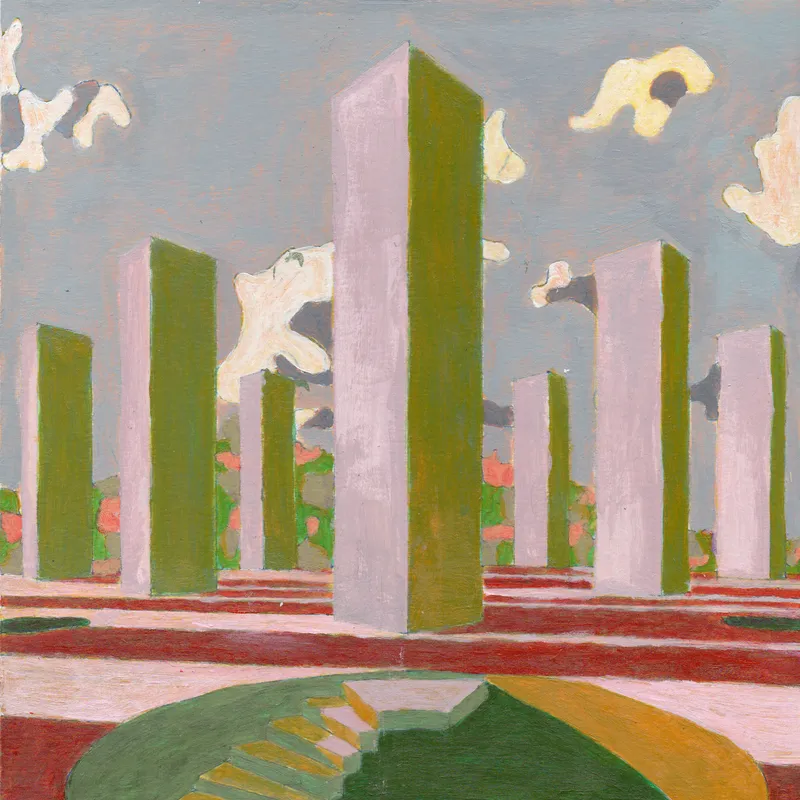
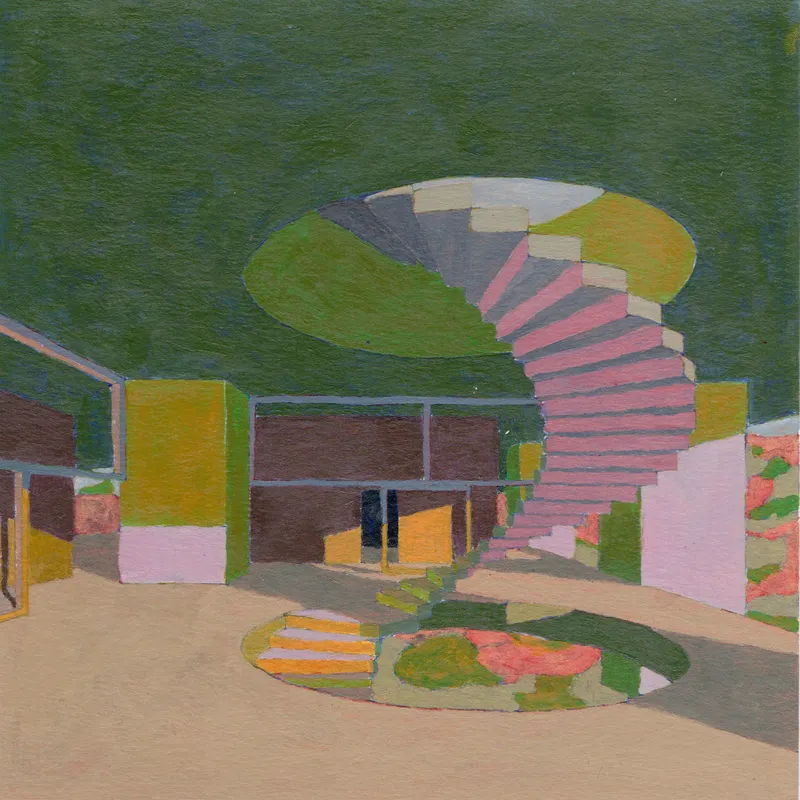
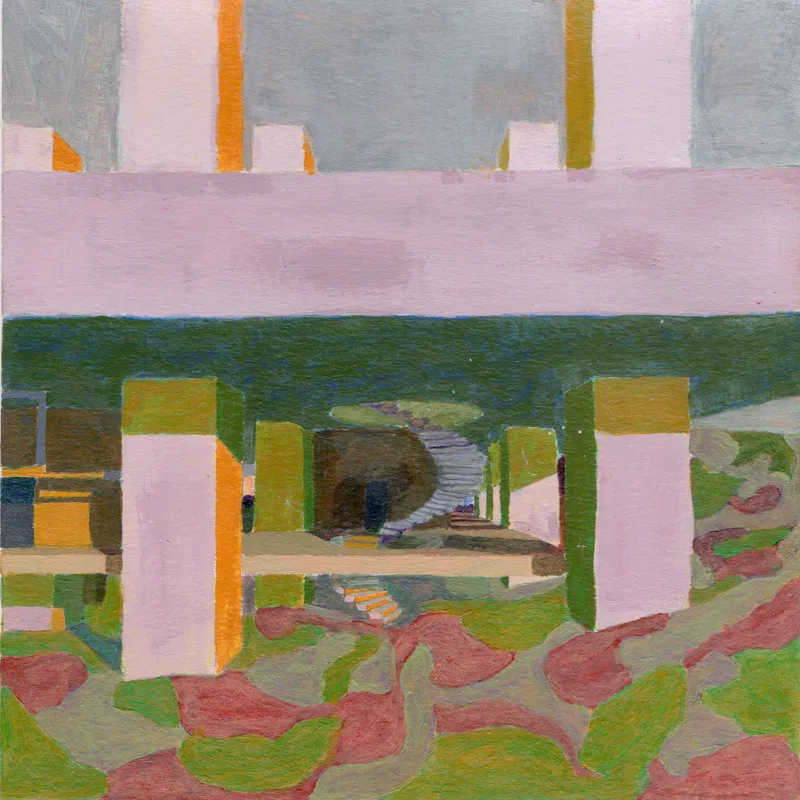
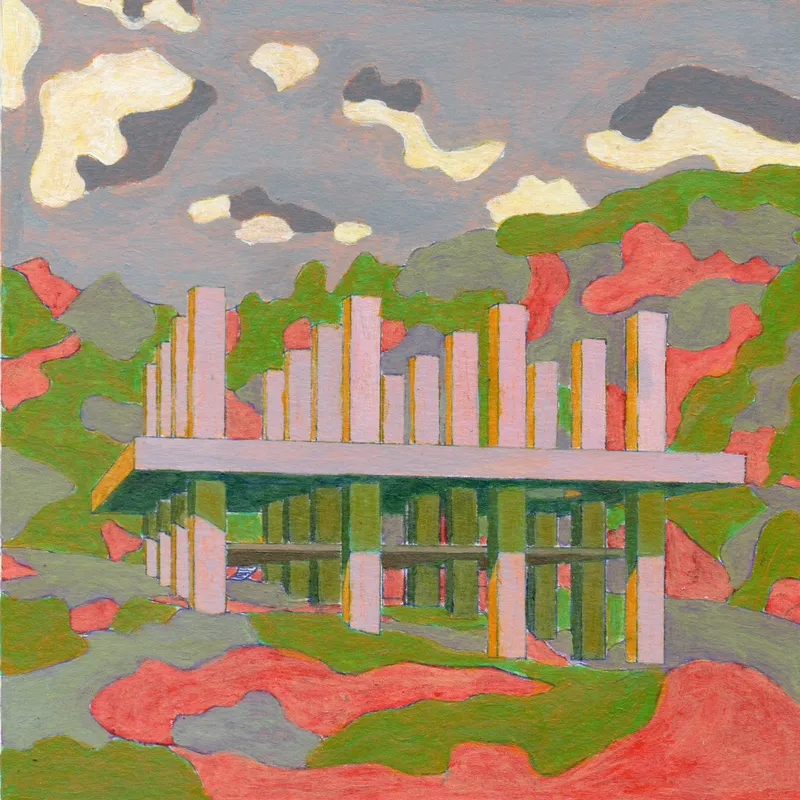
Pezo von Ellrichshausen's painted renderings deserve attention as artifacts in their own right. Rendered in alternating greens, pinks, and oranges, these images are not attempts at photorealism. They are compositional studies, closer to Giorgio de Chirico than to a visualization studio. The curving red staircase beneath a green dome, the colonnade reflected in still water: these are paintings about the emotional register of the spaces, not their material finish.
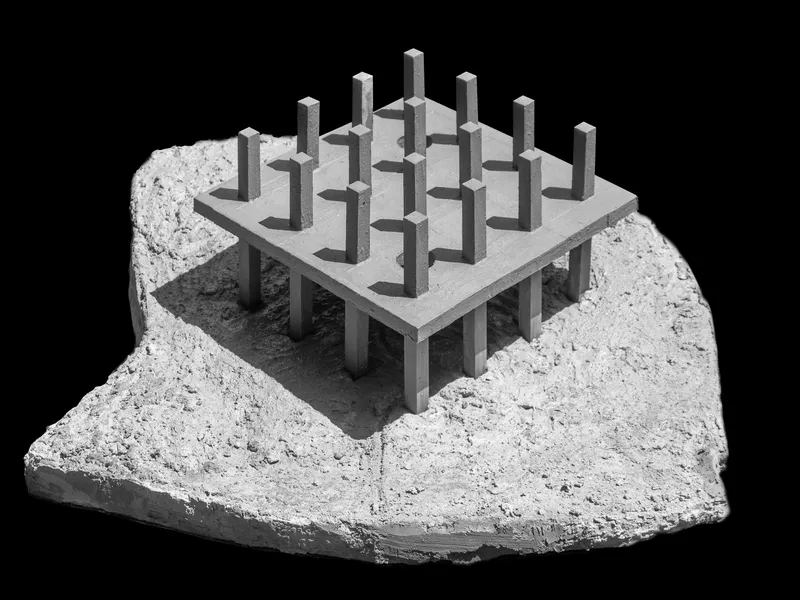
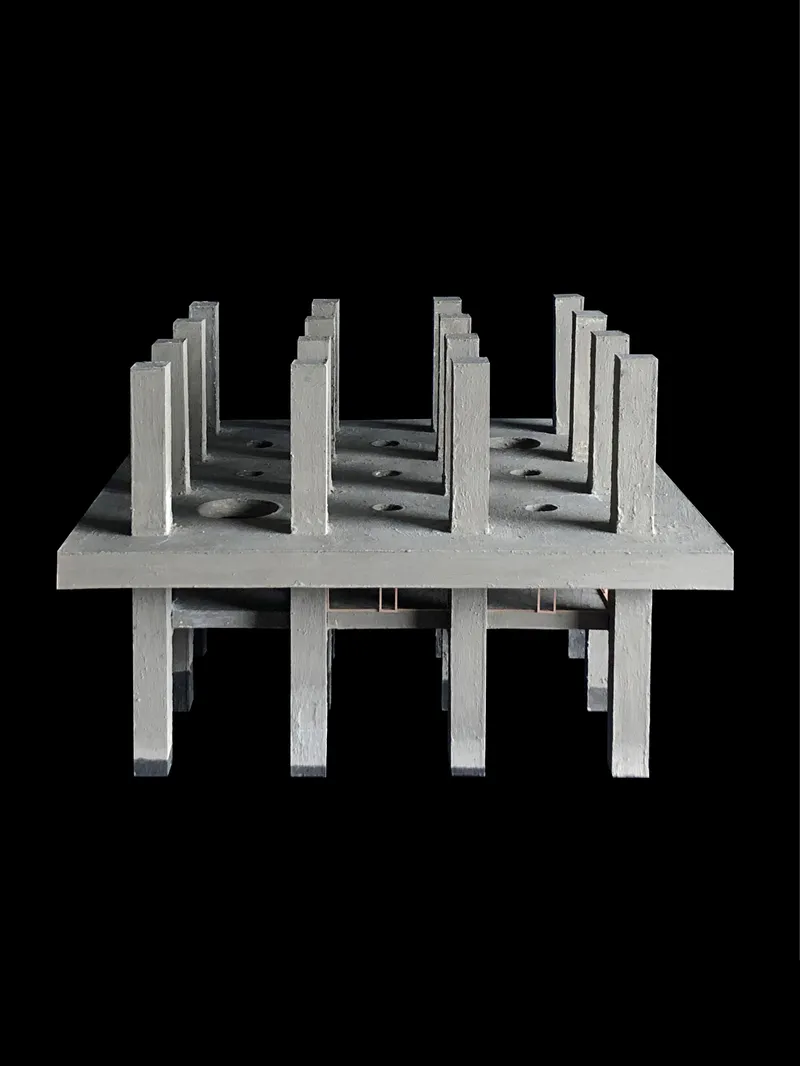
The physical models, mounted on rough limestone fragments, reinforce the geological reading of the project. They show the building not as an object placed on a site but as something that might have been carved from it. The rows of vertical fins casting shadows across the platform in the model are a preview of the real building's primary experiential quality: the constant, shifting interplay of solid and void, light and shade.
Plans and Drawings
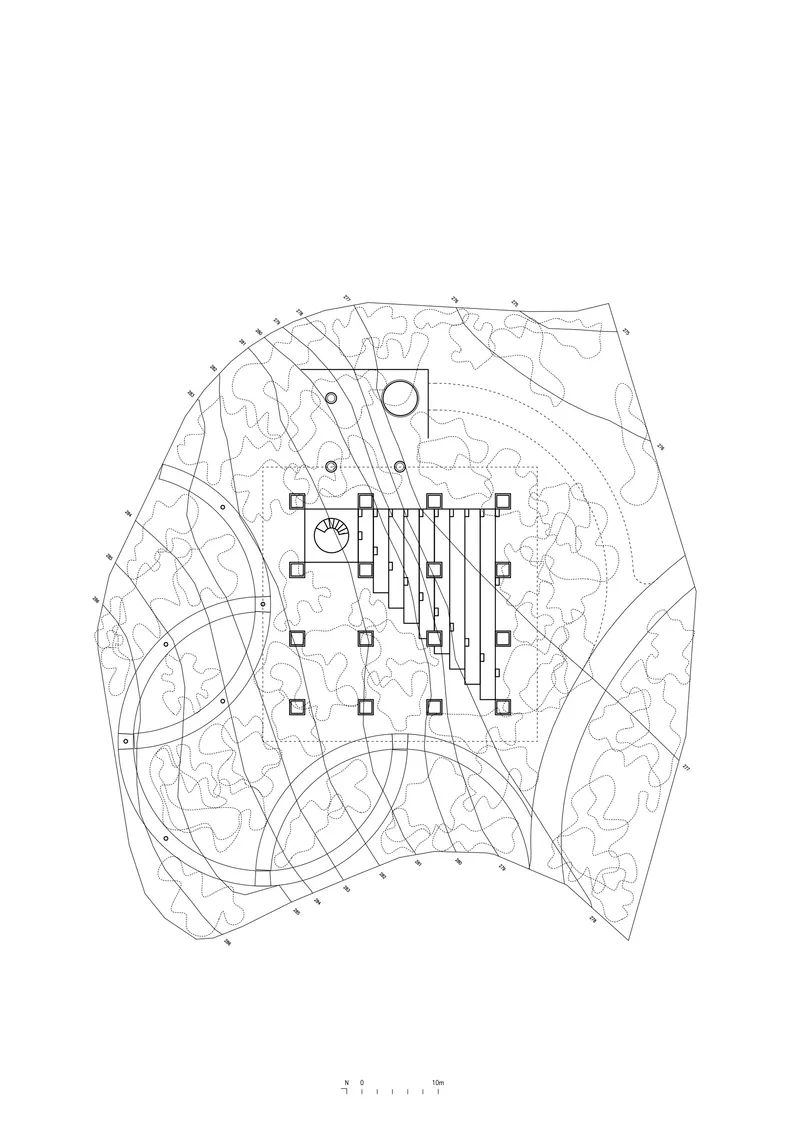
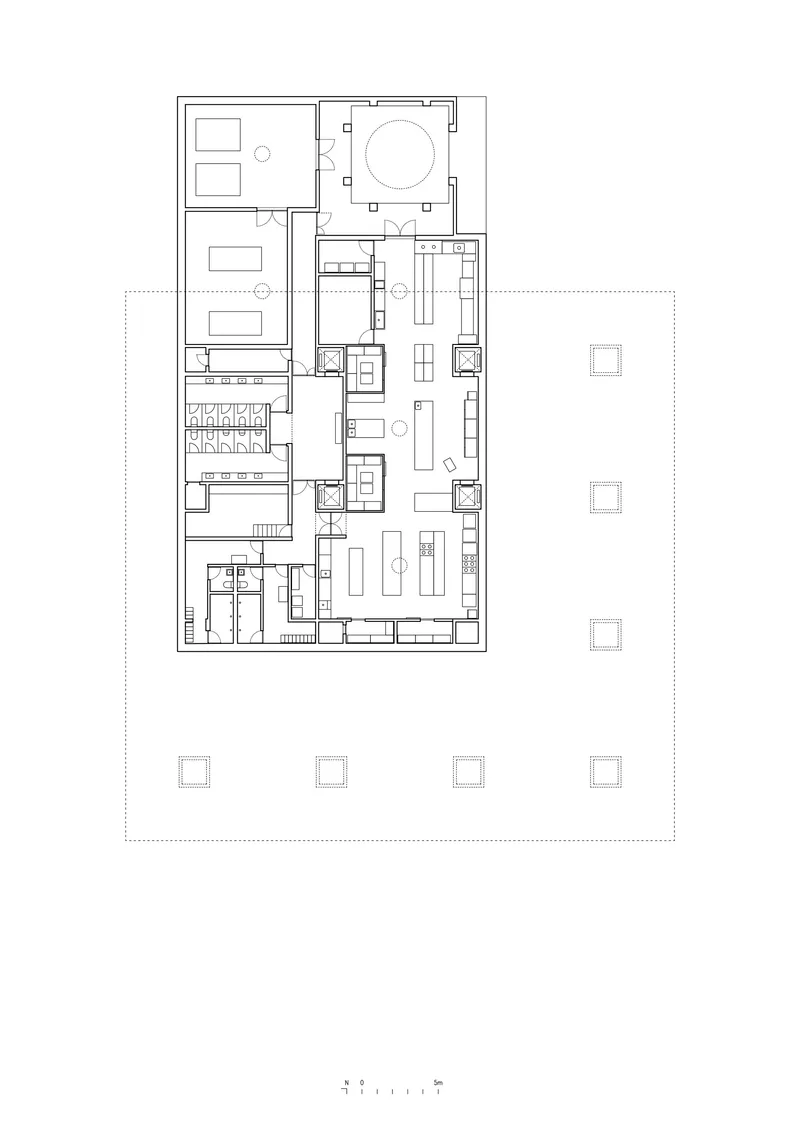
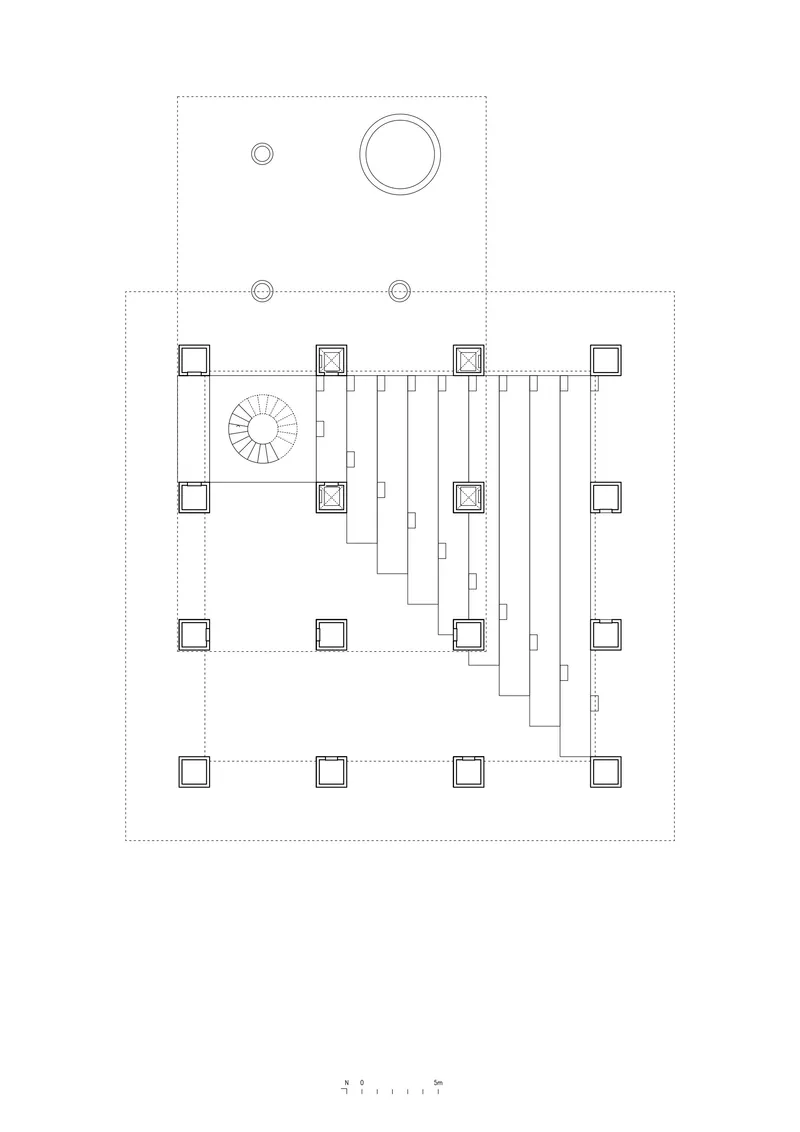

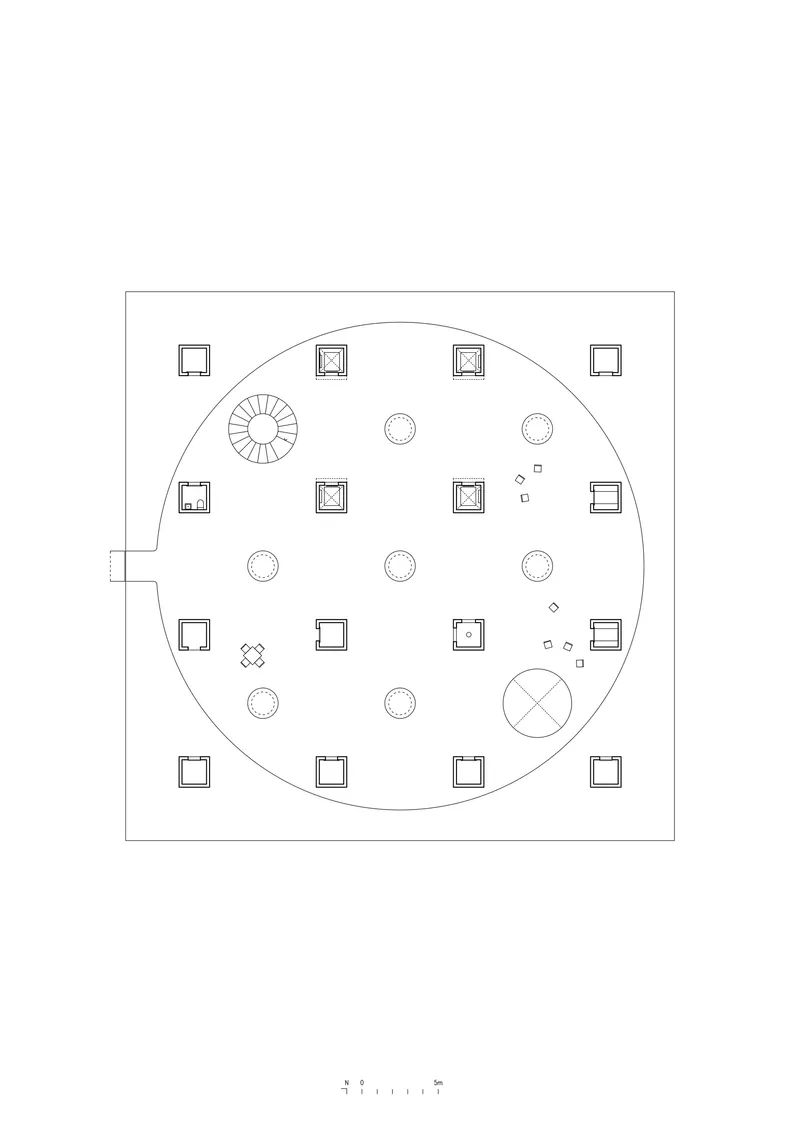
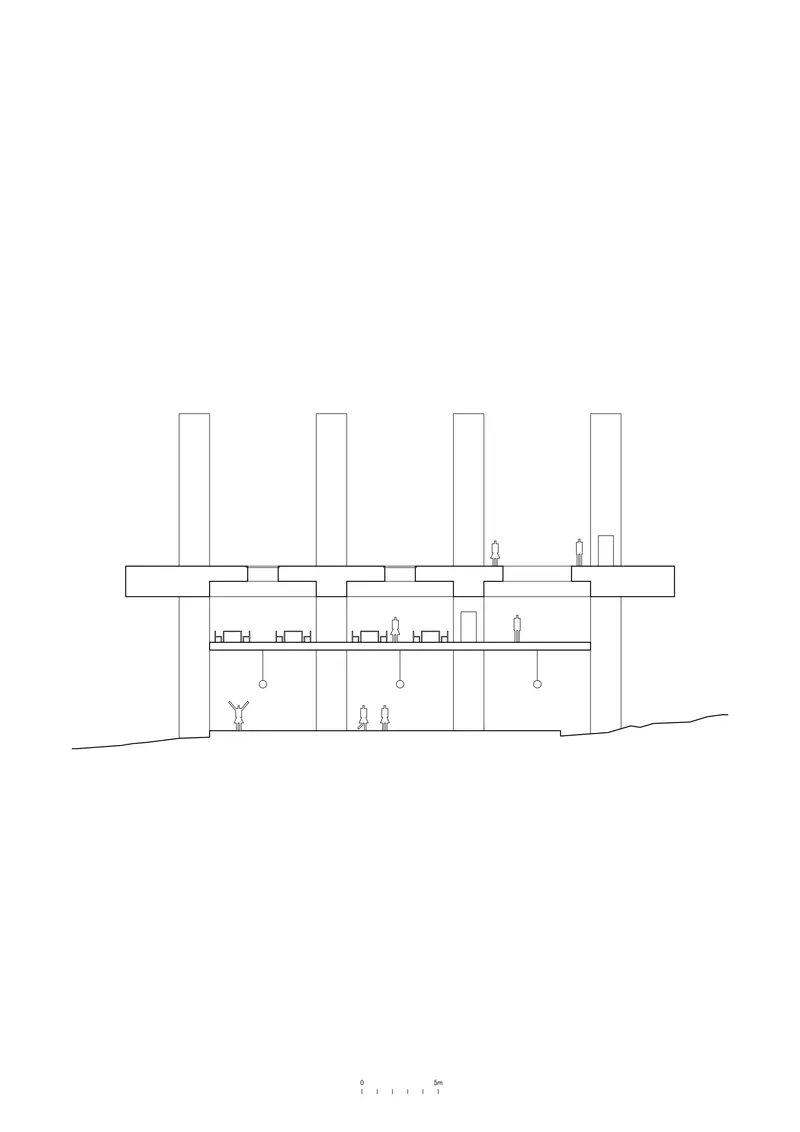
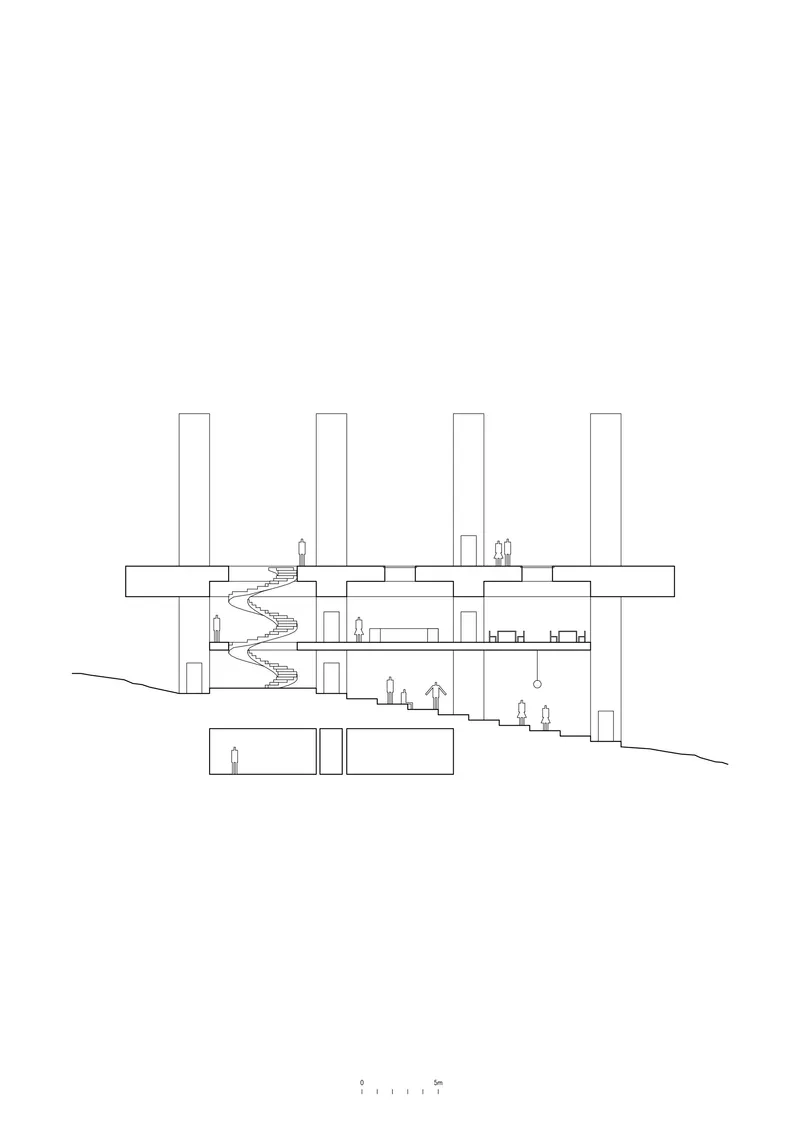
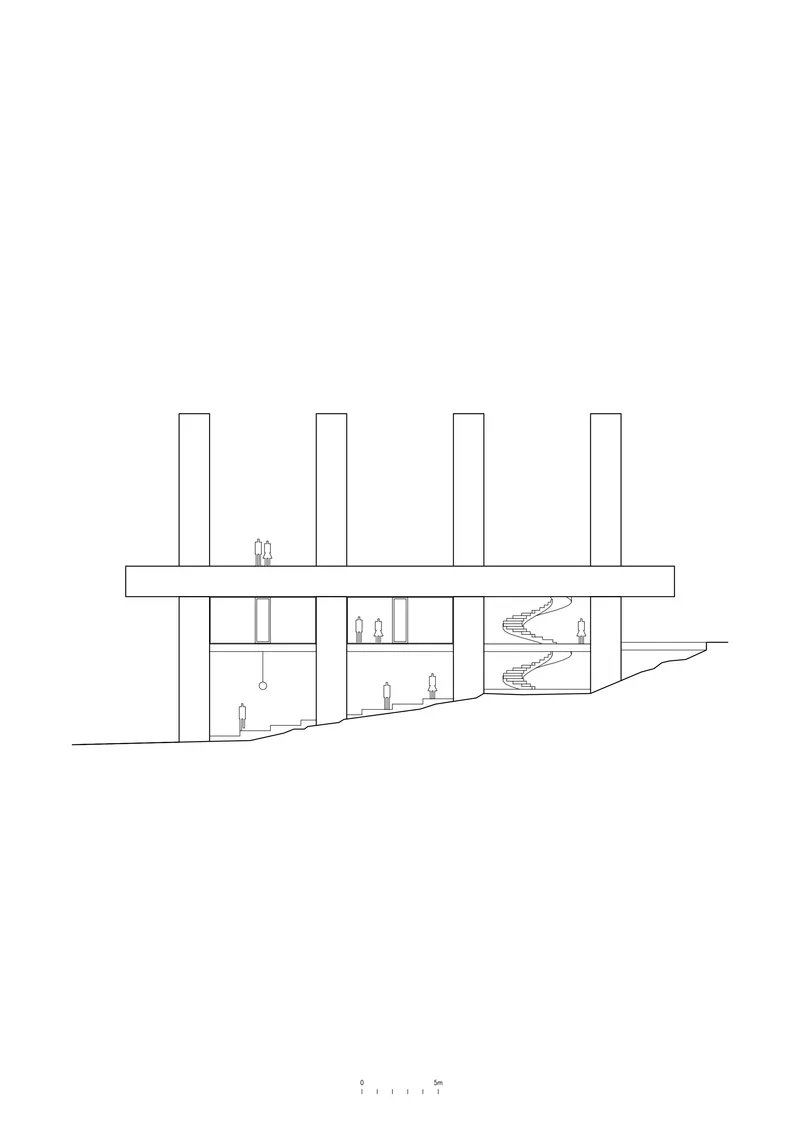
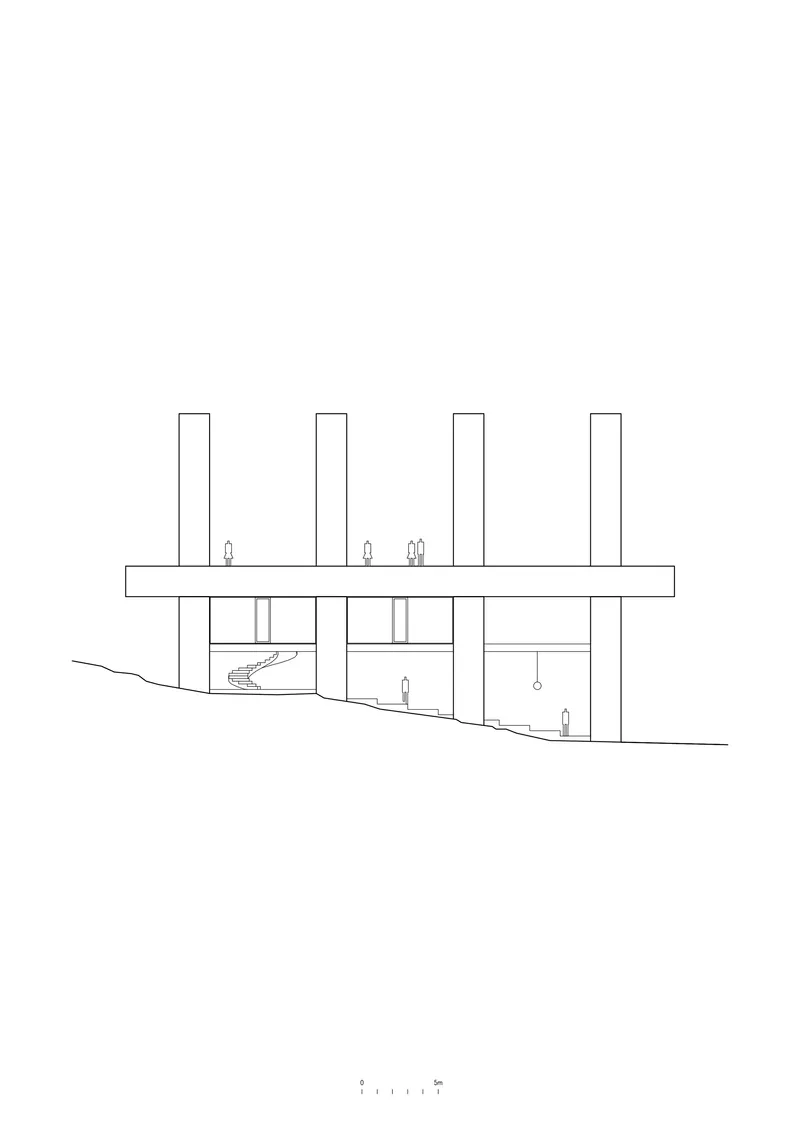
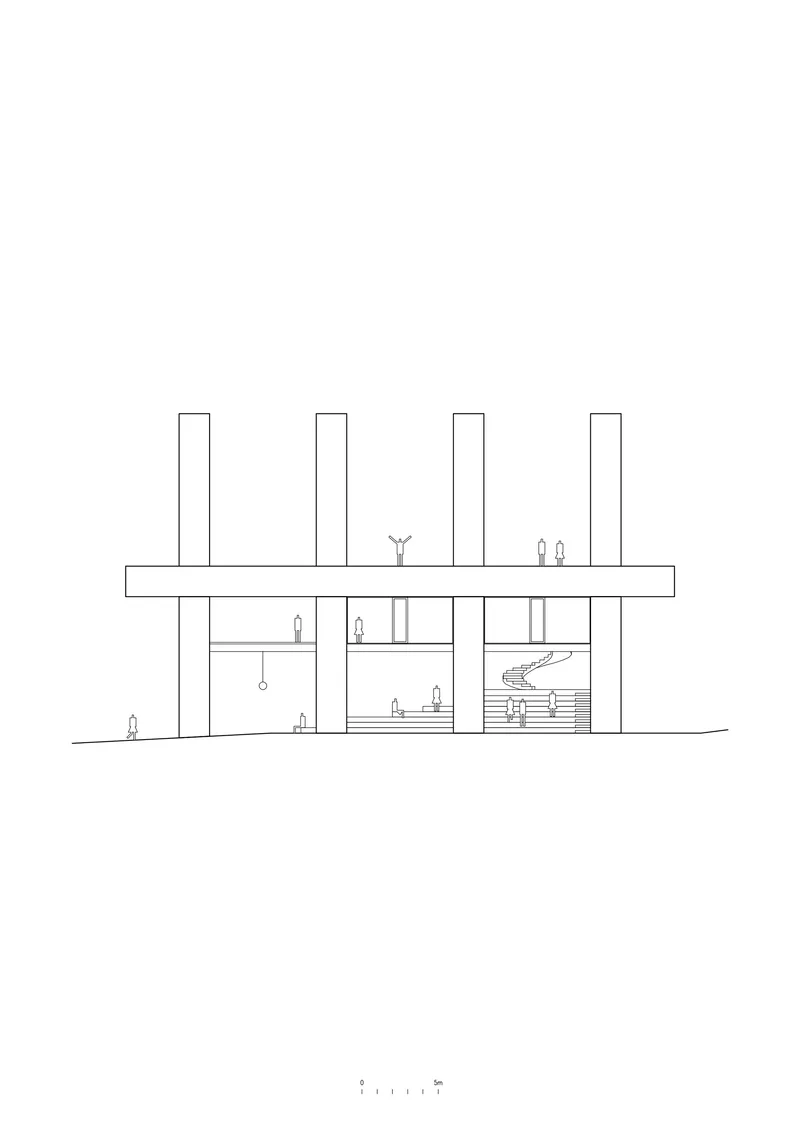
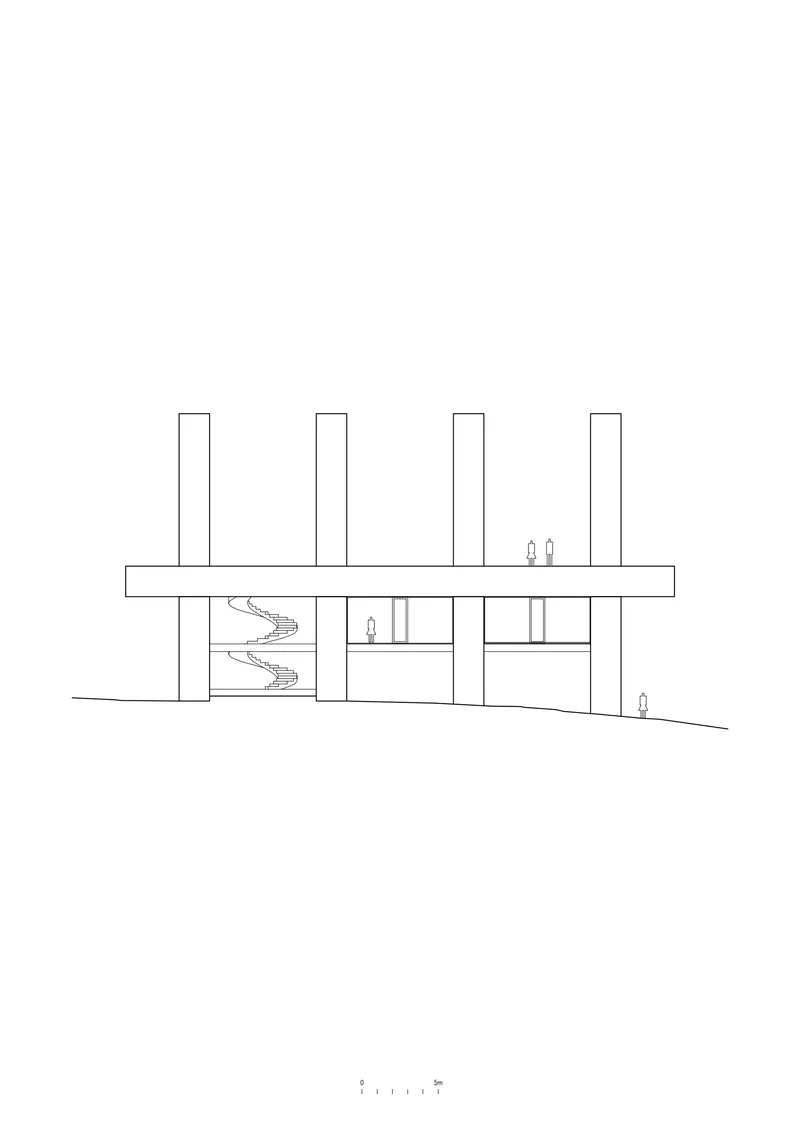
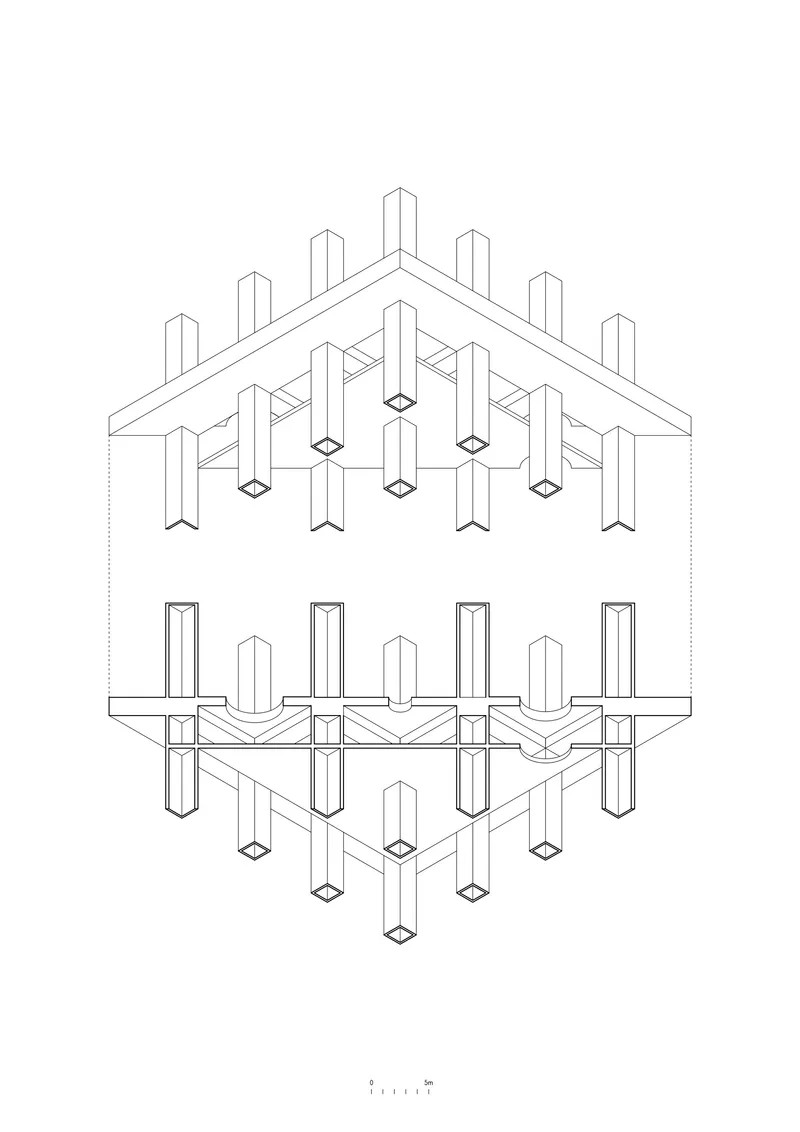
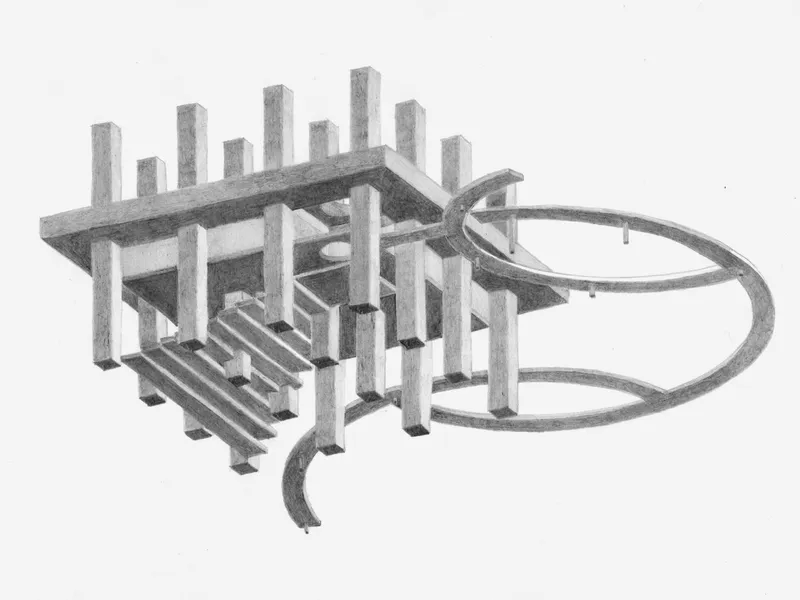
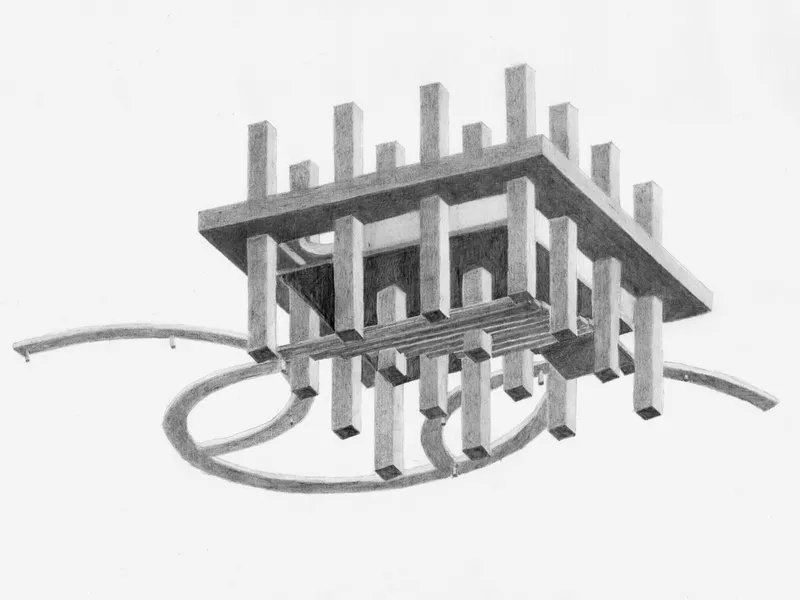
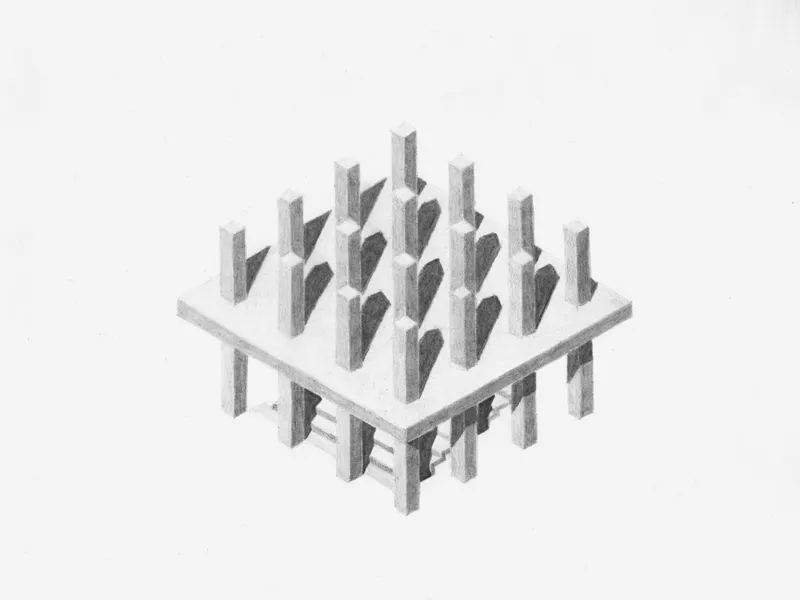

The drawings reveal the project's organizational logic with remarkable clarity. The site plan shows the building as a compact, almost square footprint set against sweeping contoured paths and planting beds. The ground floor plan organizes rooms around a circular atrium, while upper plans show dining areas clustered around courtyards with a spiral staircase threading through the levels. The sections are the most informative: they expose how the curved stair connects the ground plane to the roof terrace, moving through the glazed dining volume with an almost processional rhythm.
The axonometric drawings demonstrate the structural concept with diagrammatic force. Vertical columns penetrate horizontal slabs and continue upward as the rooftop towers. There is no decorative logic here; the towers are not applied. They are the structure itself, extended beyond the roof line to become the building's identity. The elevations confirm what the photographs suggest: a horizontal datum interrupted by a rhythmic field of verticals, a composition that is at once serene and insistent.
Why This Project Matters
REST Garden Restaurant matters because it demonstrates that a commercially programmed building, a restaurant, no less, can operate with the intellectual ambition and formal rigor of a museum or a monument. Pezo von Ellrichshausen have not compromised their architectural agenda for the sake of hospitality norms. They have instead proposed that the act of eating in a landscape should be framed by something as uncompromising as the landscape itself. The green concrete towers are not whimsical or decorative; they are a structural and spatial argument about how a building can become a new kind of terrain.
In a moment when most high-profile restaurant projects lean on interior styling and branded atmosphere, this building reminds us that architecture still has the power to define an experience without relying on furniture, finishes, or mood lighting. The space is the experience. The towers, the light wells, the ramps, the terraces: these are not background. They are the reason you go. That is a rare achievement, and it positions this project as one of the most significant restaurant buildings completed anywhere in recent years.
REST Garden Restaurant by Pezo von Ellrichshausen (Mauricio Pezo & Sofia von Ellrichshausen). Yangpyeong, South Korea. 3,376 m². Completed 2025. Photography by Pezo von Ellrichshausen.
About the Studio
Share Your Own Work on uni.xyz
If projects like this are the kind of work you want to make, uni.xyz is a place to publish your own, find collaborators, and enter design competitions.


Popular Articles
Popular articles from the community

Faces of the Soviet Avant-Garde: Turning Moscow's Street Names into an Open-Air Museum
A network of sculptural installations across a Moscow residential district transforms forgotten architect names into spatial encounters with cultural memor

The Amber Palace Opera: A Geological Fiction Surfaces on Tallinn's Baltic Waterfront
Pierre Brillard reimagines a Baltic legend as a public landscape, opera house, and waterfront promenade rooted in Tallinn's coastal identity.
Cloaked Colonization: A Mobile Underwater Habitat That Moves Like a Fish
Micah Abaya's shortlisted EHC Pacific entry reimagines ocean settlement as a dispersed network of self-sustaining architectural organisms.
Tsunami Convergenics: Turning Catastrophic Ocean Forces into Underwater Housing Infrastructure
A speculative underwater settlement off the coast of Onagawa, Japan, treats tsunamis and typhoons as energy sources rather than threats.

Similar Reads
You might also enjoy these articles

Pixel Gardens: One Repeated Module Stacked Into a Terraced Social Housing Tower for Famagusta
Salem Bader's shortlisted housing tower builds a vertical neighbourhood from one repeated module, offsetting units to carve terraces, light and air.

Bao Huynh Watercolor Atelier: A Serene Art Retreat in Hội An
Bao Huynh Watercolor Atelier in Hội An blends multifunctional art spaces, sustainable design, local materials, and family-friendly living in a serene environment.

Atelier Macri Concept Store Interior Design by CASE-REAL
Atelier Macri store features a "ko" counter, walnut wood details, cork displays, blending retail, gallery, and seamless customer experiences.

Manuel Vargas Izquierdo Stadium and High-Performance Sports Center: Architectural Excellence in Jalpa de Méndez
The Manuel Vargas Izquierdo Stadium blends sustainable design, inclusive sports facilities, and cultural-inspired architecture, revitalizing Jalpa de Méndez’s public spaces.

Comments (0)
Please login or sign up to add comments
No comments yet. Be the first to comment!