
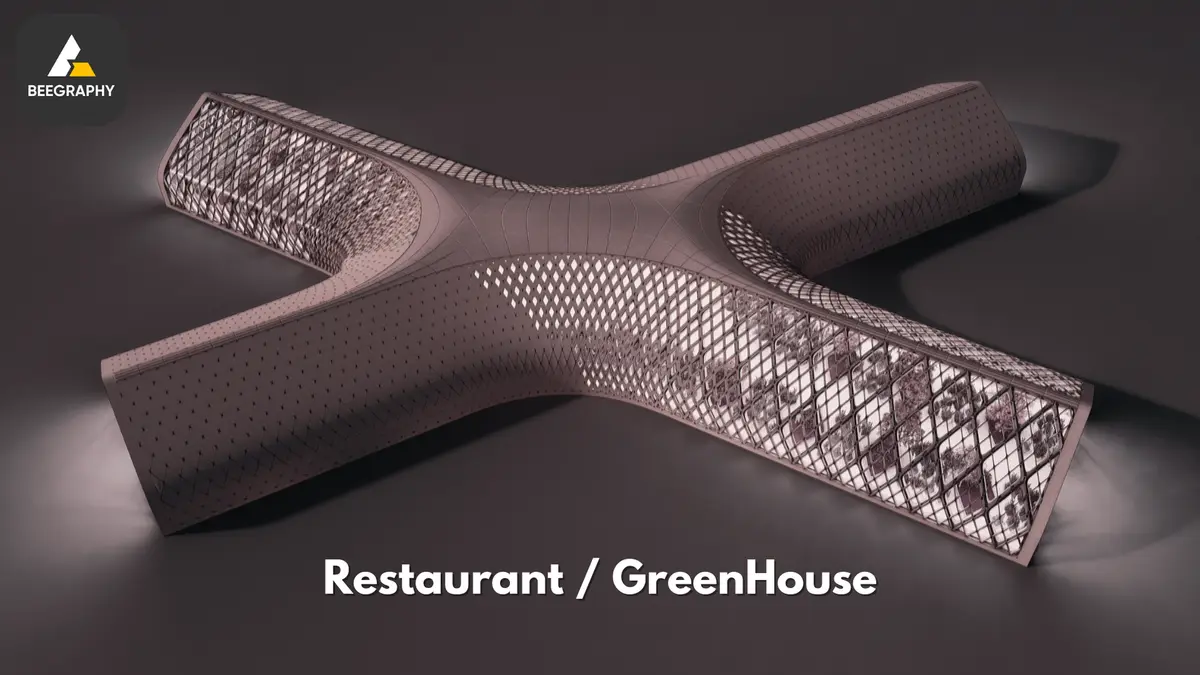
Restaurant by GreenHouse: A Diamond Lattice That Dissolves Architecture into Garden
Amir Ahmed's parametric dining concept fuses a diamond-patterned shell with living greenery, turning a restaurant into a breathing ecosystem.


What happens when a restaurant refuses to be a box and a greenhouse refuses to stay outside? You get a single organism: a diamond-lattice shell that transitions from solid grid to transparent glass, housing diners and suspended planters within the same curving envelope. Restaurant / GreenHouse treats structure as an environmental filter, modulating daylight, airflow, and visibility through one continuous geometric skin. The result is a space that breathes, grows, and casts shifting shadow patterns across its interior as the sun moves.
Designed by Amir Ahmed, the project was recognized as a Best in Category entry in the BeeGraphy Design Awards. Developed using BeeGraphy's parametric modeling tools, the concept begins with two traditionally separate programs, a restaurant and a greenhouse, and collapses them into a single blended form where each function sustains the other. It is conceptual work, still in progress, but it stakes out a clear position: dining architecture should be biophilic architecture.
Two Programs Collide into One Symbiotic Volume
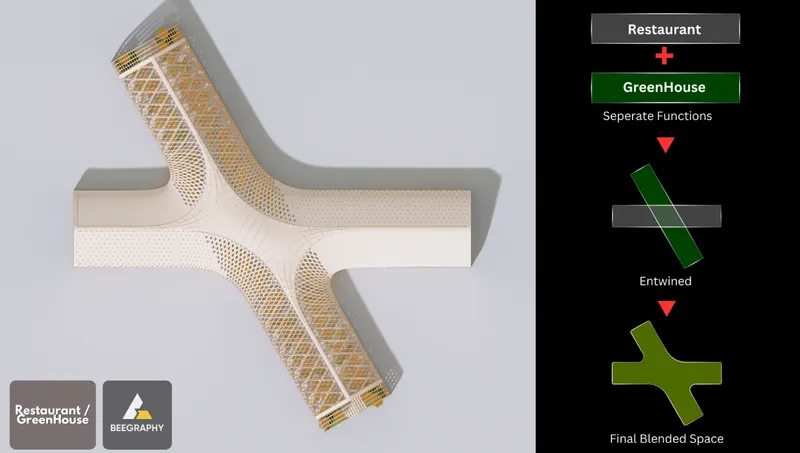
The axonometric drawing on a black background lays bare the design's logic. Two distinct volumes, one for dining and one for cultivation, intersect and merge. A programmatic diagram traces the evolution from parallel functions to a unified cross-shaped plan wrapped in perforated screens. The diagrammatic clarity here is valuable: it shows that the final form is not arbitrary but the product of a deliberate spatial argument. Restaurant and greenhouse share walls, air, and light. Neither is subordinate.
A Lattice Shell That Filters Light Like a Forest Canopy
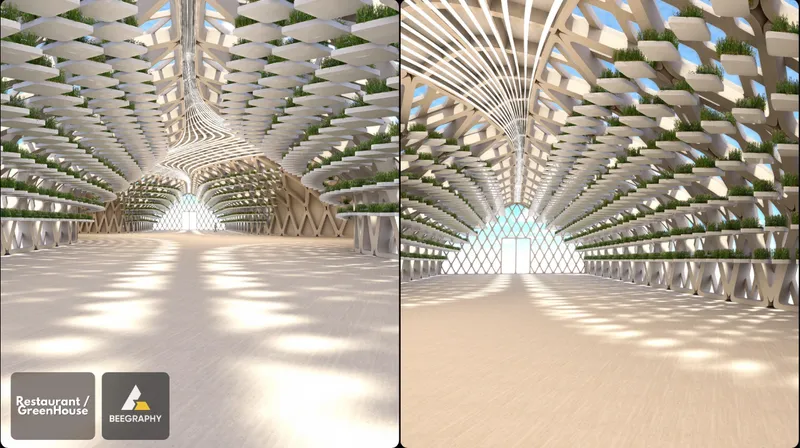
The interior rendering reveals the diamond-patterned lattice at work. Ribbed vaults curve overhead while diagonal shadow patterns stripe the floor, shifting through the day as sunlight angles change. Integrated planters hang from the structure, turning the ceiling into a living tapestry of greenery. The effect is less like entering a building and more like stepping beneath a canopy where geometry and botany coexist. Visitors move between clusters of vegetation, seating areas, and gathering zones along pathways framed by the rhythmic structure.
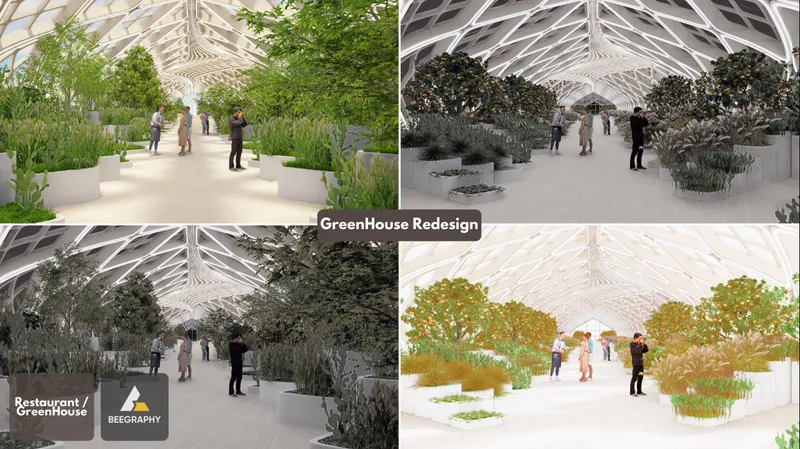
The four greenhouse interior views reinforce this reading. Planted beds sit directly beneath the latticed ceiling, receiving natural light filtered through the grid. The lattice is not decorative; it performs. It channels daylight to nurture the plants while creating a serene, immersive ambiance for diners. The space functions as a living ecosystem where the boundary between cultivation and occupation dissolves entirely.
Solid Wings, Perforated Core: Reading the Exterior
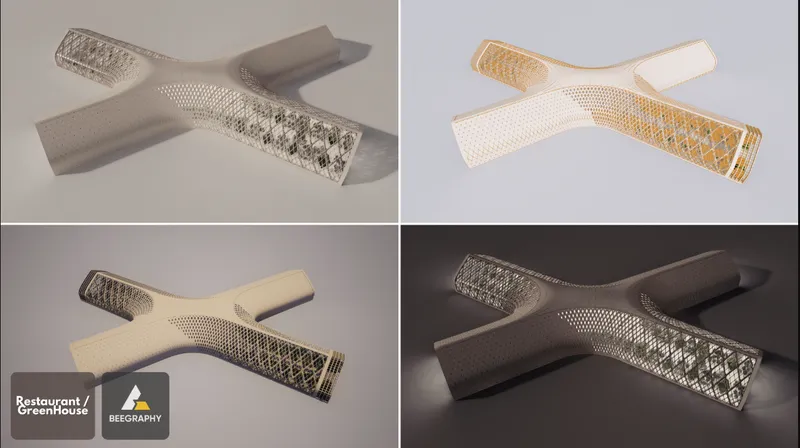
Four exterior renderings show the cross-shaped volume from different angles, and the material strategy becomes legible. Solid curved wings anchor the composition at its edges, providing enclosure and structural mass. Between them, the perforated mesh enclosure wraps the core, graduating from opacity to transparency. The lattice grid starts dense and architectural, then opens up into glass, echoing the conceptual transition from built form to natural openness. It is a building that appears to be in the process of becoming a garden.
Parametric Logic Driving Every Curve and Connection
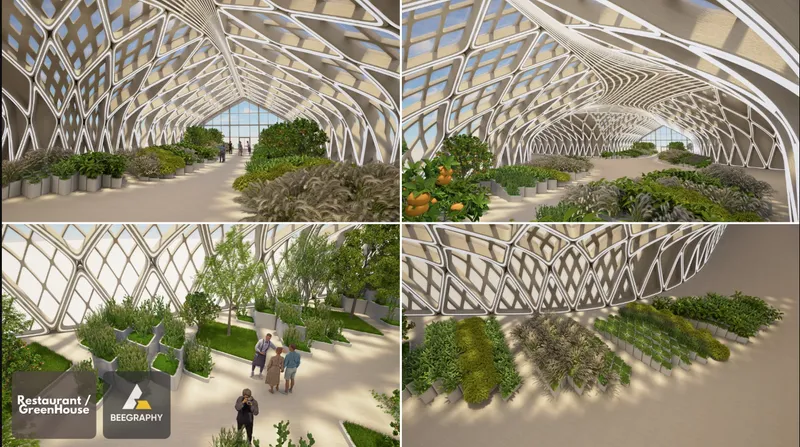
The final set of interior views shows planted beds bathed in light beneath the diagonal lattice glazing, and it is here that the computational design ambition becomes most tangible. Every curve, lattice angle, and structural connection is driven by performance criteria: optimizing daylight penetration, maintaining structural balance, and minimizing material waste. BeeGraphy's parametric tools allowed Amir Ahmed to generate a responsive geometry where organic intuition and computational logic meet. The architecture adapts to environmental inputs rather than imposing a static form upon them.
Why This Project Matters
Restaurant / GreenHouse proposes a new architectural typology. It argues that the act of dining can be an act of coexistence, that the envelope of a building can simultaneously shelter people and cultivate plant life, and that parametric tools can produce forms that are ecologically attuned rather than merely visually complex. For a conceptual project, it carries a surprisingly specific material and structural argument: the diamond lattice is not just pattern, it is performance.
As a prototype for future eco-architecture, the project reminds us that the most compelling sustainable design does not bolt greenery onto conventional buildings. It rethinks the building itself as a living system. Amir Ahmed's entry demonstrates that integration, between nature, program, and computational intelligence, is the productive ground where the next generation of architecture will take root.
View the Full Project
About the Designers
Designer: Amir Ahmed
Enter a Design Competition on uni.xyz
uni.xyz runs architecture and design competitions year-round that reward proposals with spatial conviction and real site intelligence.
Project credits: Restaurant / GreenHouse by Amir Ahmed BeeGraphy Design Awards (uni.xyz).


Popular Articles
Popular articles from the community

Cloaked Colonization: A Mobile Underwater Habitat That Moves Like a Fish
Micah Abaya's shortlisted EHC Pacific entry reimagines ocean settlement as a dispersed network of self-sustaining architectural organisms.

Manzana Morphosis: Stretching Barcelona's Grid into a Living Landscape for 2050
A radical reworking of the Eixample manzana turns density into a tool for generous public space, vertical ecology, and environmental performance.
Opera by the Sea Estonia: Three Shells Dissolving Architecture into Tallinn's Coastline
A winning opera house proposal replaces monumental form with interconnected shells that blur the boundary between building, park and Baltic Sea.
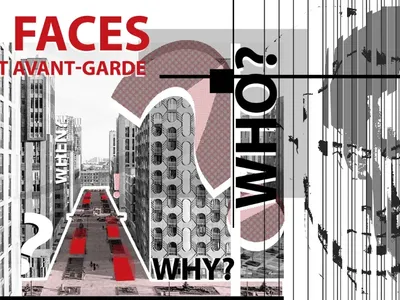
Faces of the Soviet Avant-Garde: Turning Moscow's Street Names into an Open-Air Museum
A network of sculptural installations across a Moscow residential district transforms forgotten architect names into spatial encounters with cultural memor

Similar Reads
You might also enjoy these articles

Play: Fragments of Their World: Remembered Architecture Rebuilt as a Modular Playground for Refugee Camps
Tom Gardner abstracts domes, arches and towers from the homelands of displaced families into a kit of child-scaled play parts for camp settlements.
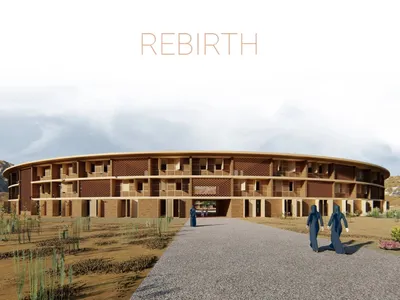
REBIRTH: A Circular Settlement Where Afghan Widows and Their Children Rebuild Life Together
A shortlisted Resile entry turns the circle into a protective ring of timber and brick, gathering homes, classrooms and gardens around a shared landscape.
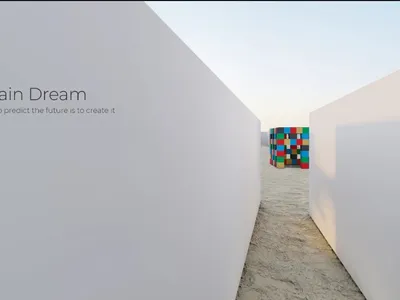
The Main Dream: A Recycled Plastic Kit That Lets Refugee Children Build Their Own Playground
Thirty-centimetre interlocking cubes that connect on three axes turn play into construction, letting children author the spaces they occupy.

Lunar Spiral: A Fibonacci-Driven Moon Settlement Rising from Shackleton Crater
Golden-spiral geometry organises buried infrastructure and orbiting habitable spheres into a lunar base designed to grow as life on the Moon expands.

Explore Green Houses Competitions
Discover active competitions in this discipline

Challenge to design luxury tourism on rails

VR headsets Storefront design competition

Designing a staircase for a client
Comments (0)
Please login or sign up to add comments
No comments yet. Be the first to comment!