
João Tiago Aguiar Adds a White Louvered Volume to a 1950s Lisbon Twin House in Restelo
A late mid-century residence on the Tagus estuary gains a new attic storey, indoor pool, and crisp aluminium facade that sharpens the dialogue between old


Restelo sits on one of Lisbon's western ridges, its postwar housing stock quietly oriented toward the Tagus estuary. The MGR House began life in the late 1950s as one half of a twin house: a basement, two storeys, and a modest garden. By the time João Tiago Aguiar, Arquitectos took on the renovation, the building needed more than a facelift. The brief called for an entirely new domestic programme, one that would triple the functional variety of the original plan without overwhelming its neighbourhood scale.
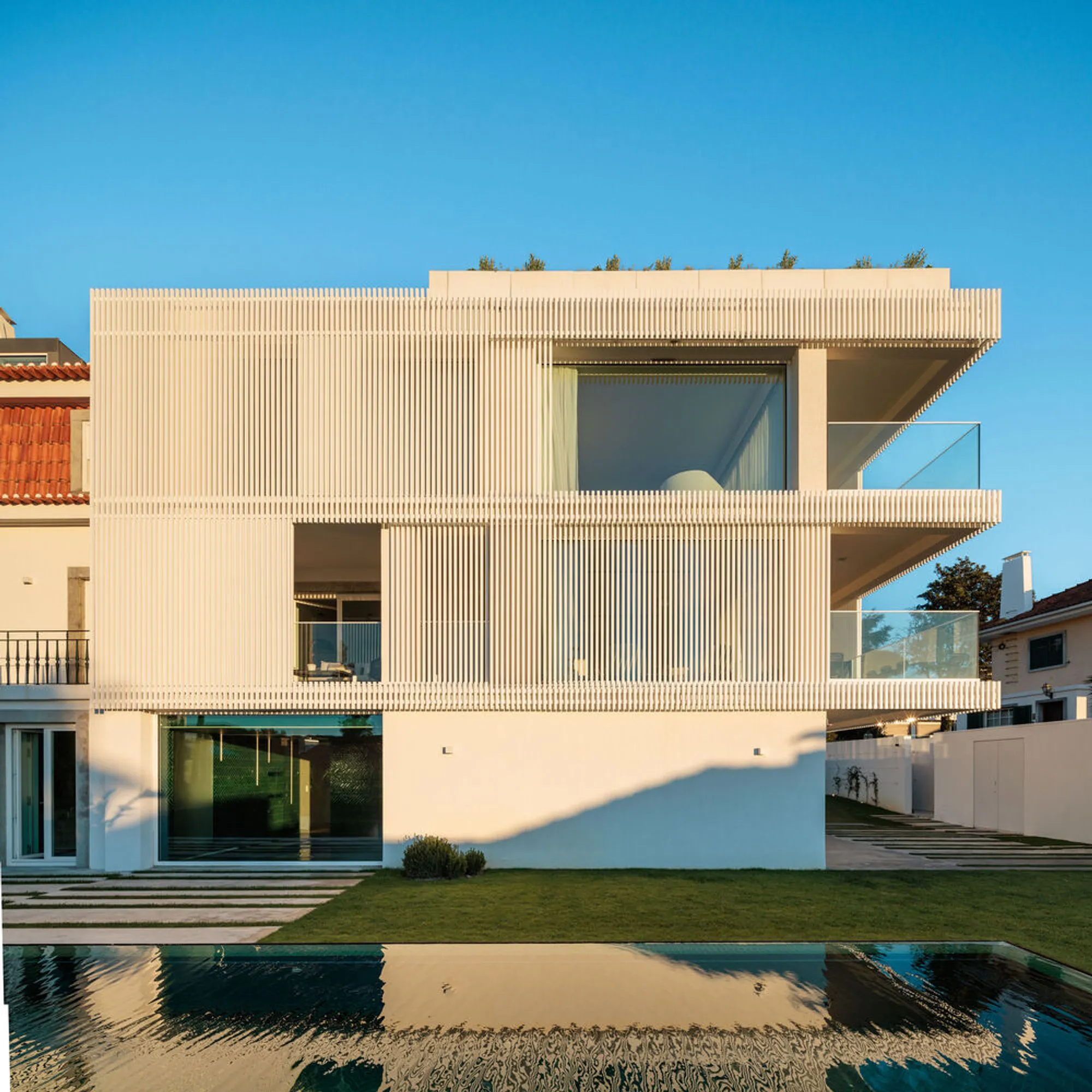
What makes this project worth studying is the way it resolves a tension that sinks most renovation work: how to add serious volume to a modest structure and still read as a single, coherent house. Aguiar's answer is material contrast. A new attic storey, clad in white lacquered aluminium slats, sits above the existing masonry walls like a precise mechanical insert. The slats integrate louvers, railings, and sliding panels into one system, so the extension never needs to borrow the language of the original. Old and new coexist because they speak different dialects of the same architectural grammar.
The Louvered Skin
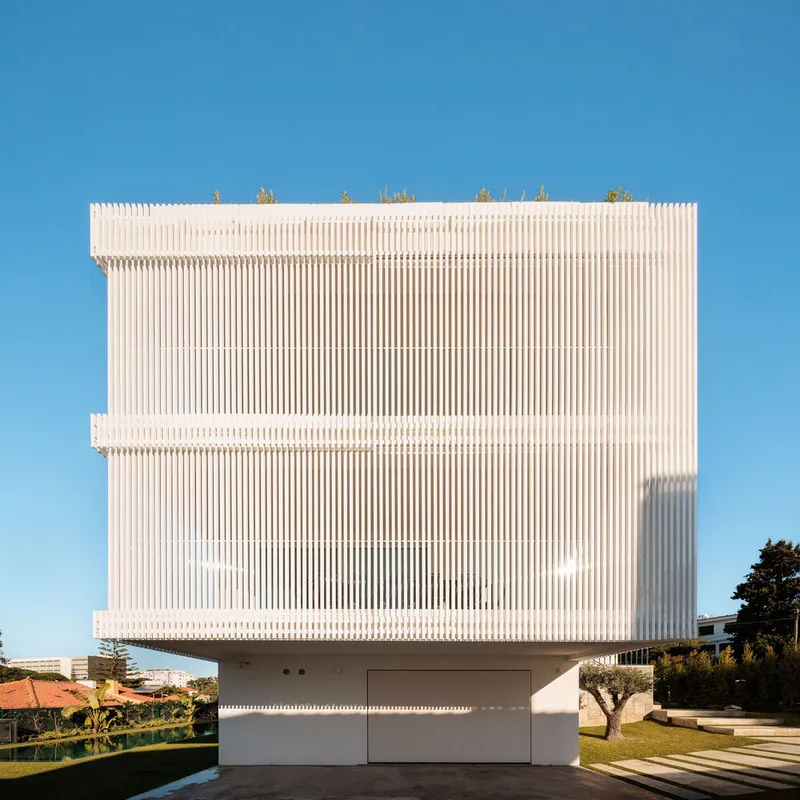
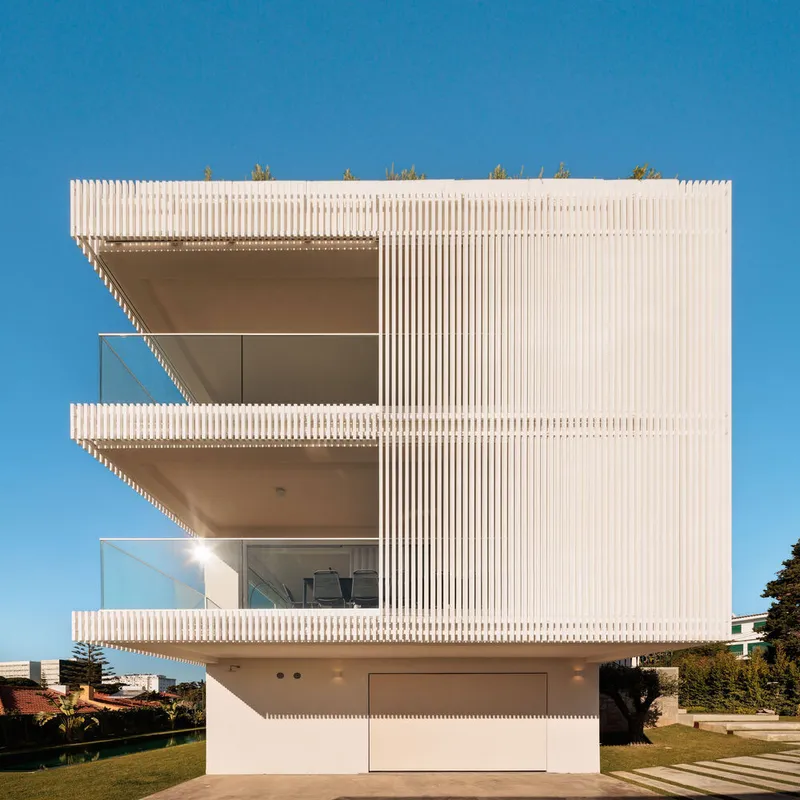
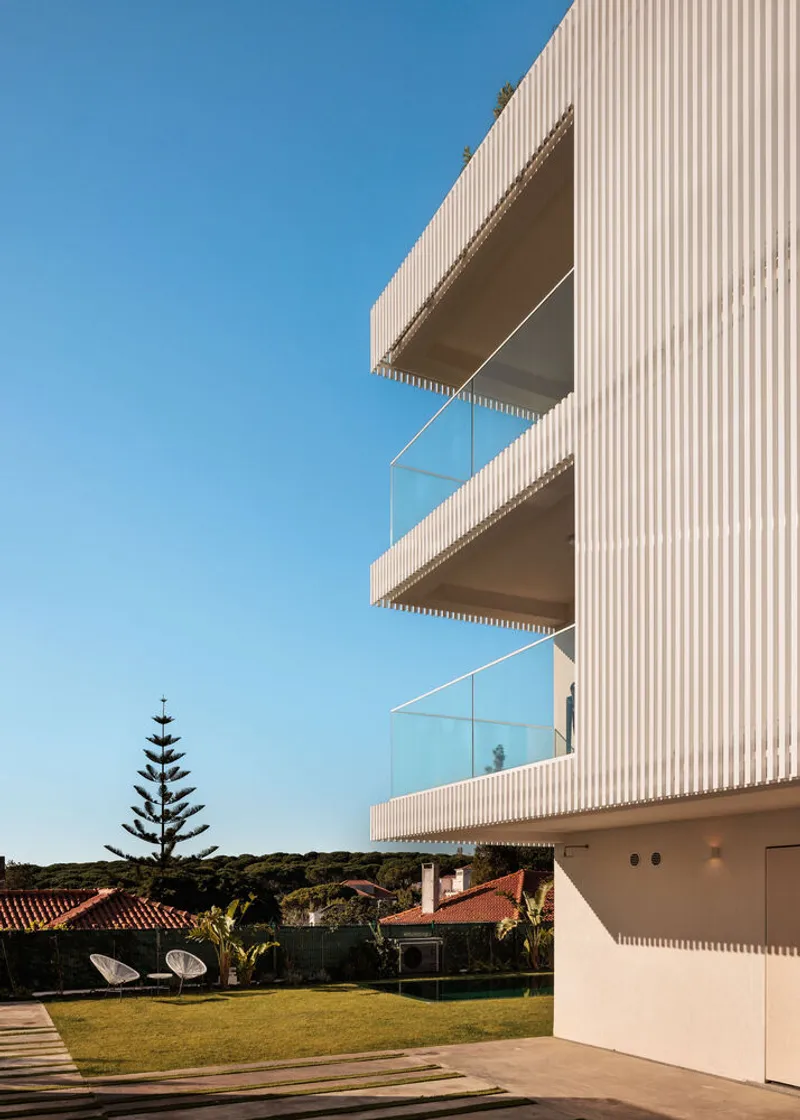
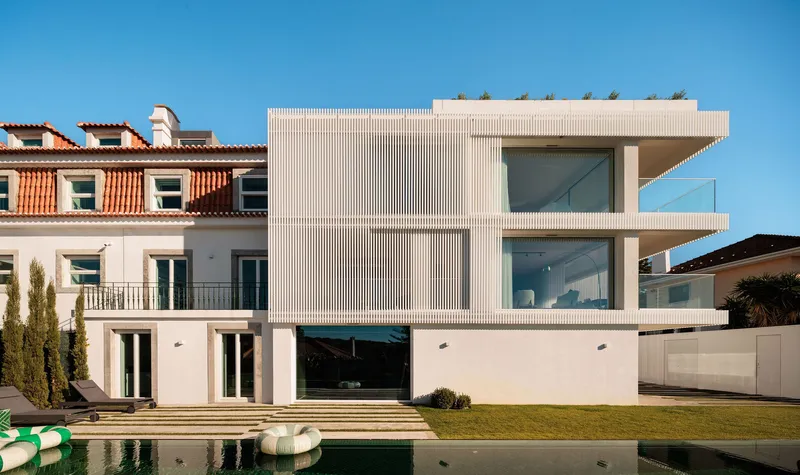
From the street, the intervention reads as a slender white box cantilevered above a recessed garage. Vertical aluminium slats wrap the upper storeys continuously, turning balconies, privacy screens, and ventilation openings into a single surface. The effect is graphic: a corrugated rhythm of light and shadow that changes with the sun's angle, giving the facade a kinetic quality that flat render could never achieve.
Sliding panels within the louvered system let residents modulate privacy and airflow without resorting to curtains or shutters. The functional cleverness is real, but it also serves a compositional purpose. Because every element, from railing to air intake, lives within the same slat module, the extension reads as a monolithic object rather than a collage of add-ons.
Old Walls, New Neighbours
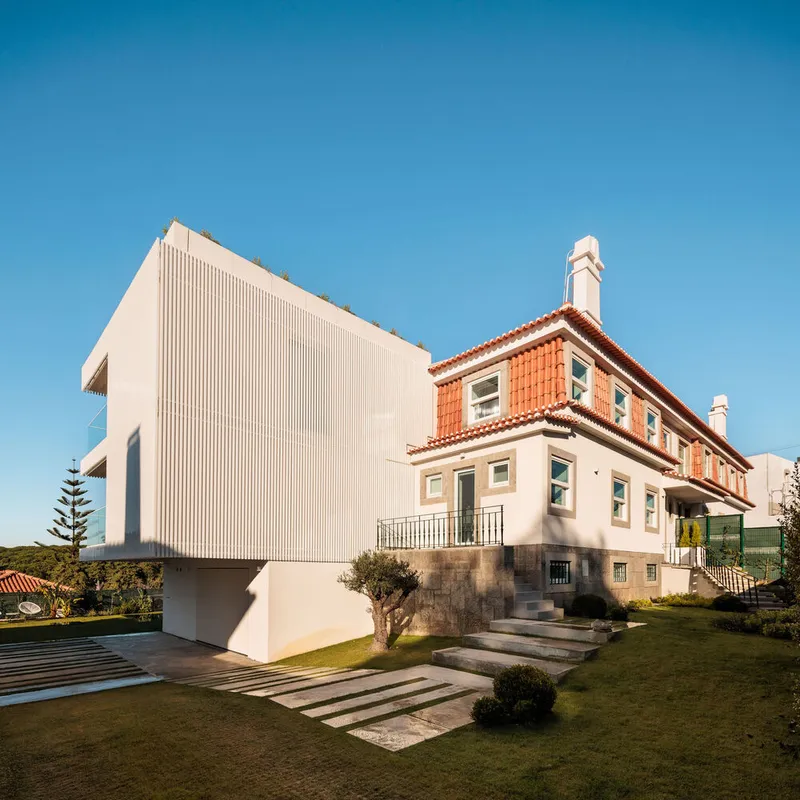
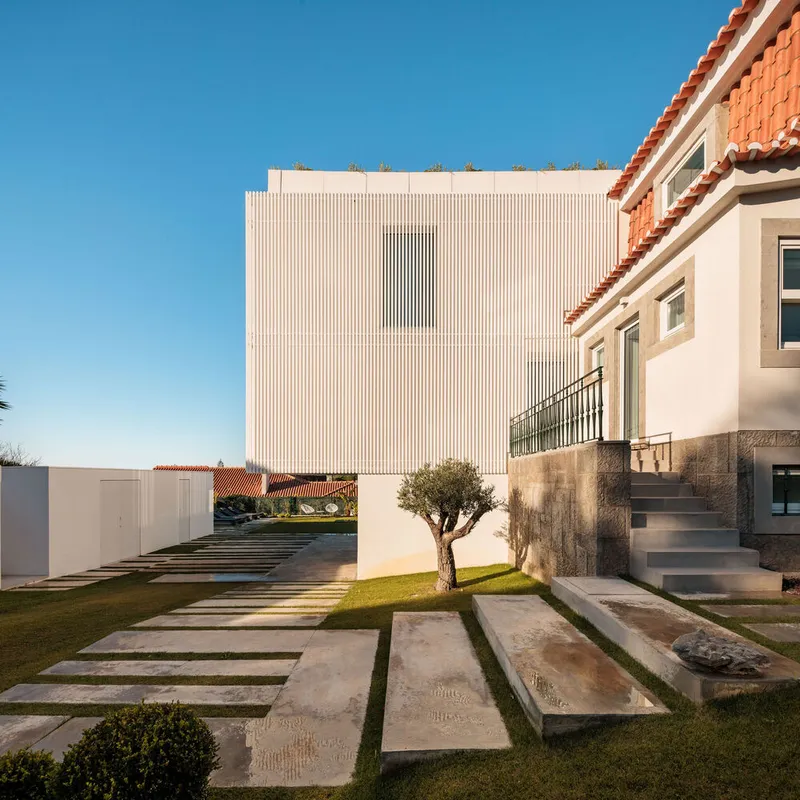
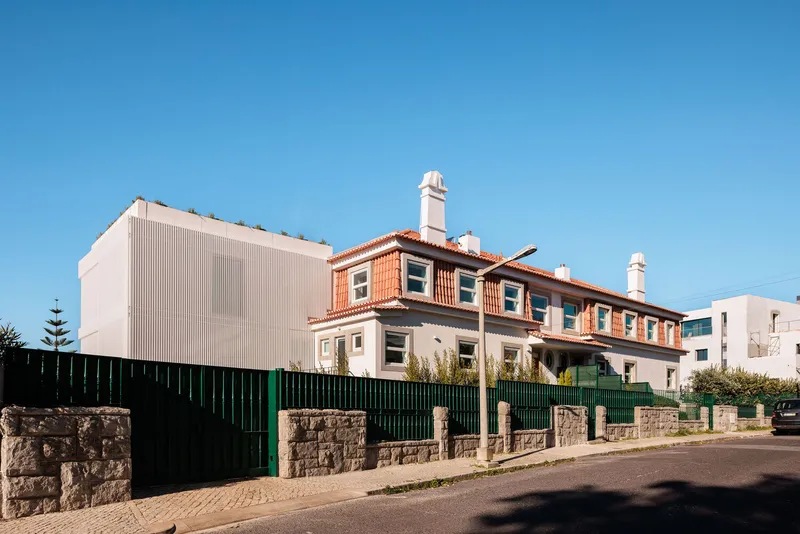
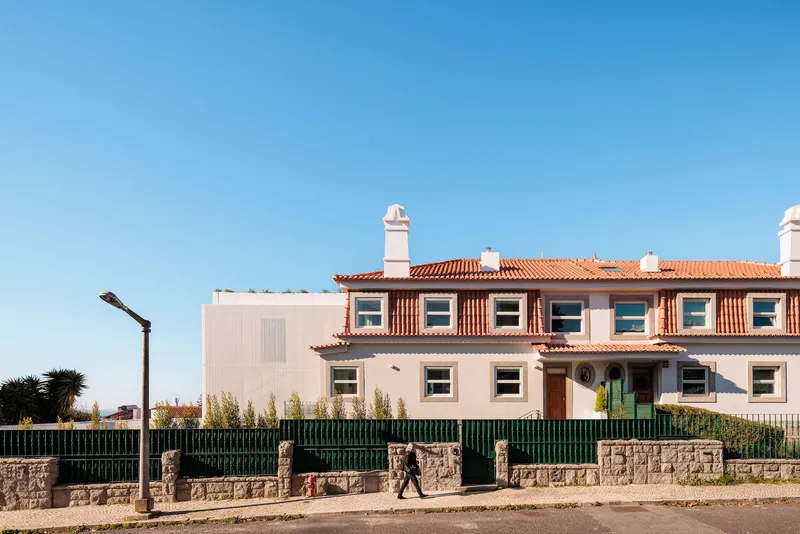
The lateral and rear views reveal the true character of the project: the white ribbed volume standing shoulder to shoulder with the surviving terracotta-roofed twin. One house retains its postwar plaster and orange tiles; the other has been wrapped in a precise aluminium sleeve. Neither attempts to imitate the other, and the resulting juxtaposition is more respectful than any pastiche would be.
Stone pavers and manicured lawn run along the boundary, softening the material shift at ground level. It is a neighbourhood strategy as much as an architectural one: by keeping the new volume's footprint aligned with the original, Aguiar avoids the kind of volumetric creep that erodes streetscape coherence in so many Lisbon renovation projects.
Living Between Fireplace and Estuary
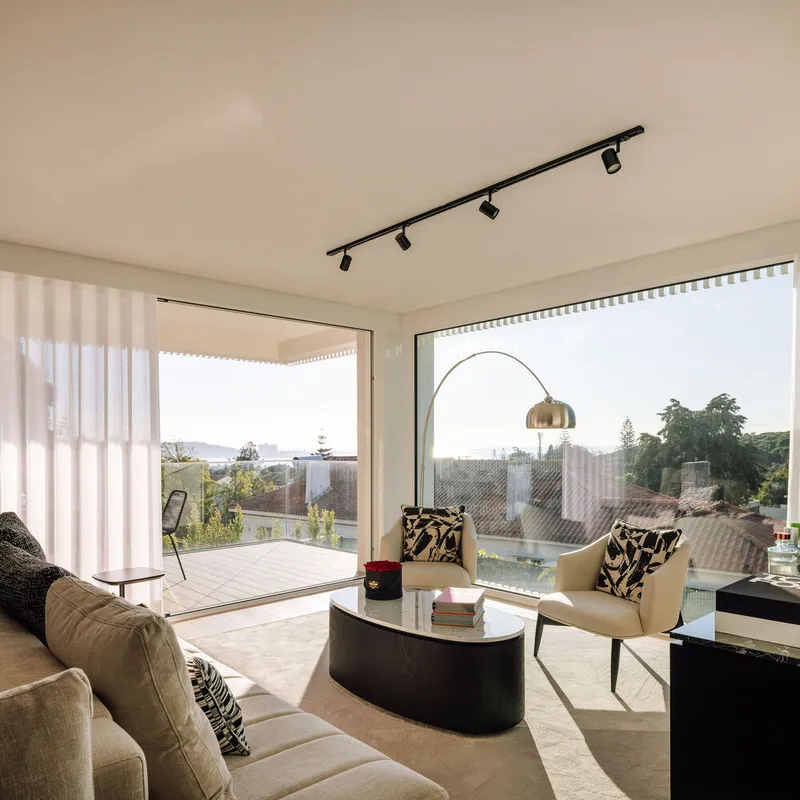
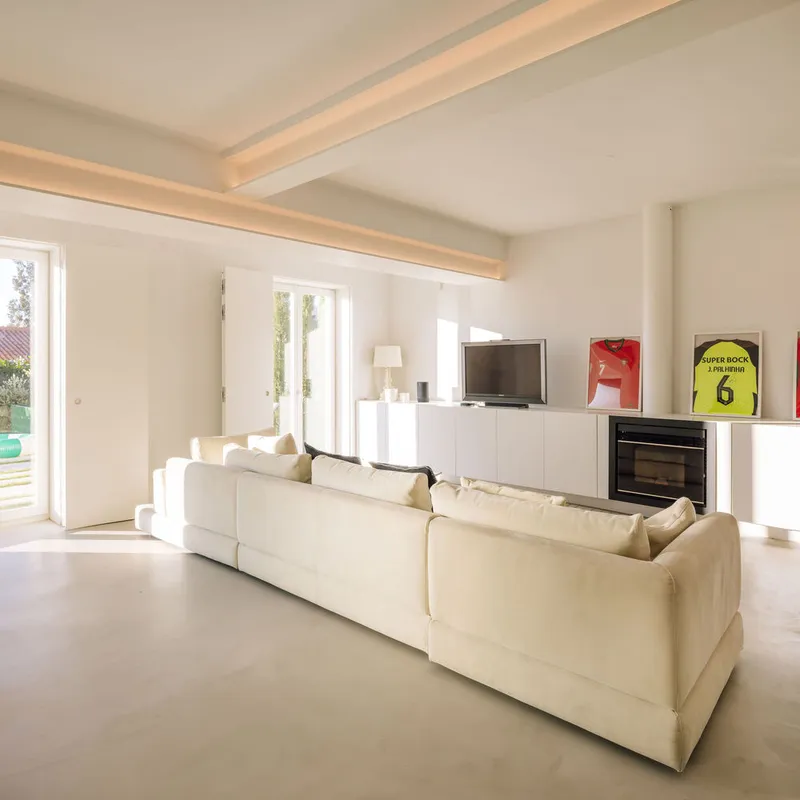
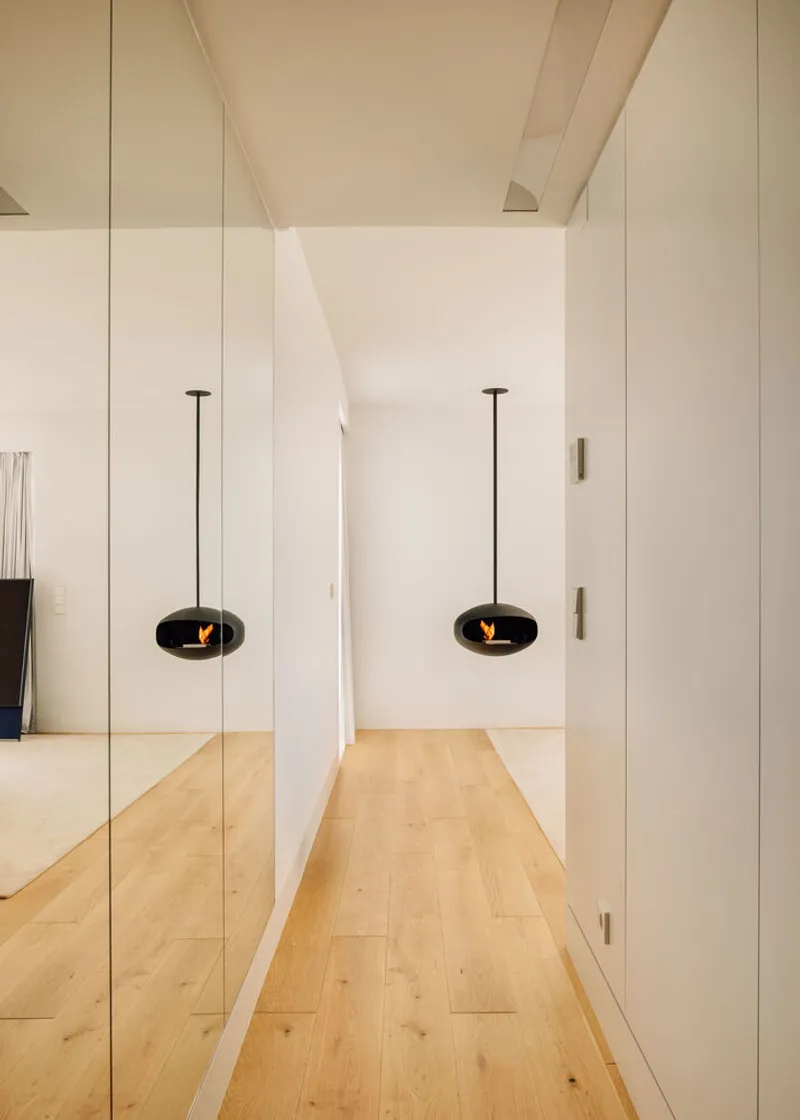
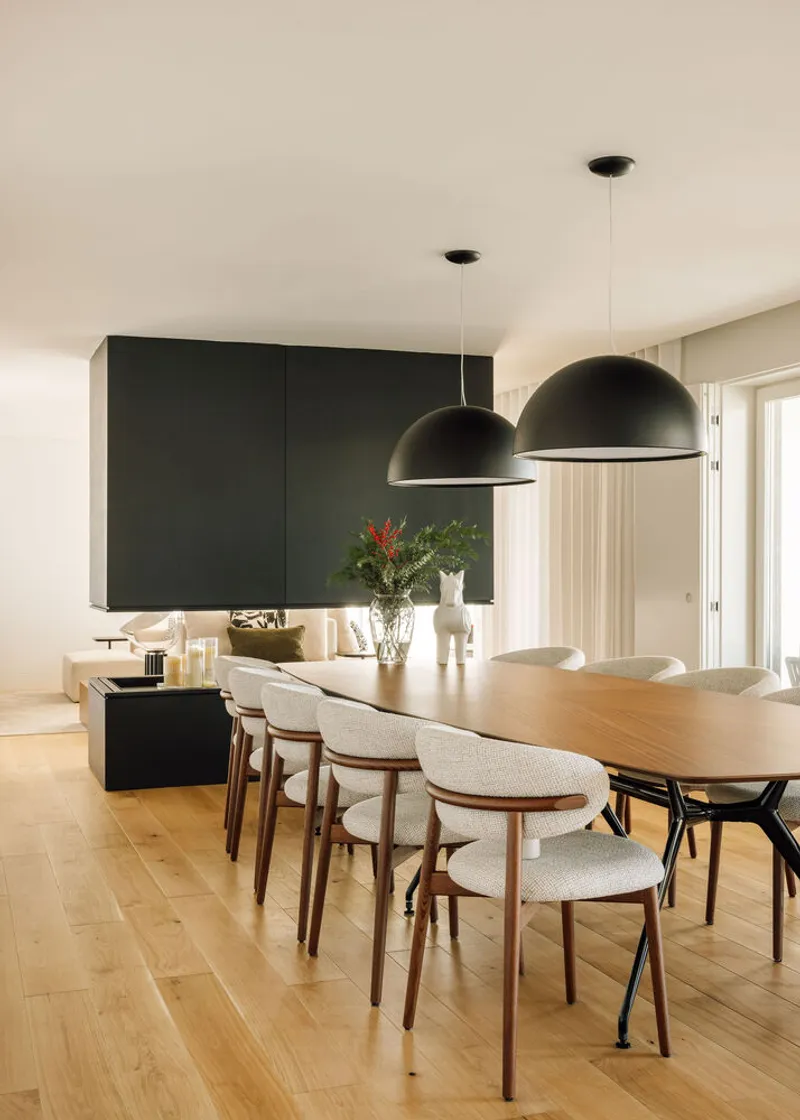
The ground floor living area occupies the southwest corner, a deliberate choice that maximises afternoon light and frames long views over the Tagus. Floor-to-ceiling glazing slides open to merge the room with a terrace, while a striking suspended fireplace defines the boundary between living and dining zones without closing either space off. The fireplace is an anchor point: dark, cylindrical, and unapologetically sculptural against the restrained palette of white walls and timber floors.
A mirrored corridor amplifies depth and reflects the fireplace into an almost surreal doubling. It is one of the project's bolder interior moves, using reflection not for glamour but to stretch the perceived dimensions of a relatively compact plan. At 6,458 square feet total, the house is generous but not enormous, and moments like this make the space feel larger than its numbers suggest.
Kitchen and Dining as Social Core
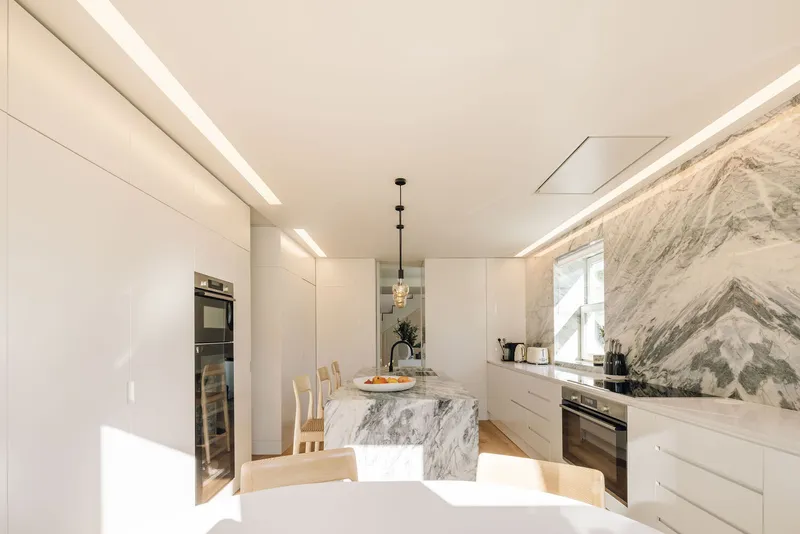
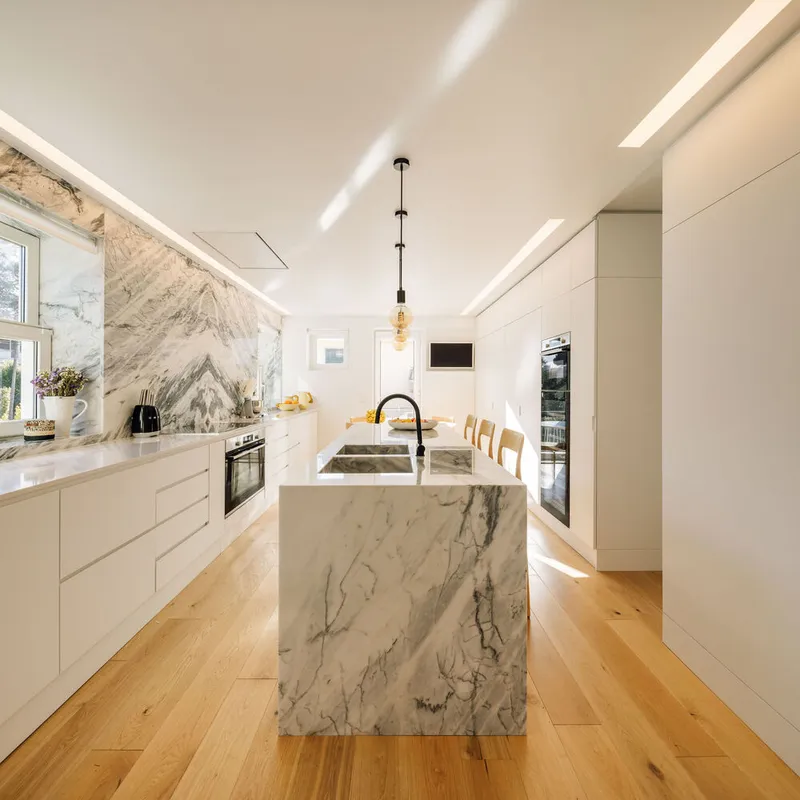
Aguiar treats the kitchen as the gravitational centre of the ground floor. A marble waterfall island doubles as prep surface and casual dining bar, its clean geometry set beneath a linear pendant that anchors the room's proportions. The backsplash continues the marble down to the counter, creating a material band that wraps the workspace in a single, unbroken surface.
What elevates the kitchen beyond a catalogue set piece is the concealment strategy. The entrance from the hall is integrated within surrounding cabinetry, so the room reveals itself only when you are already inside it. Storage compartments disappear behind flush panels. The result is a space that looks minimal but works hard, with every utilitarian element folded into the joinery.
The Staircase as Spine
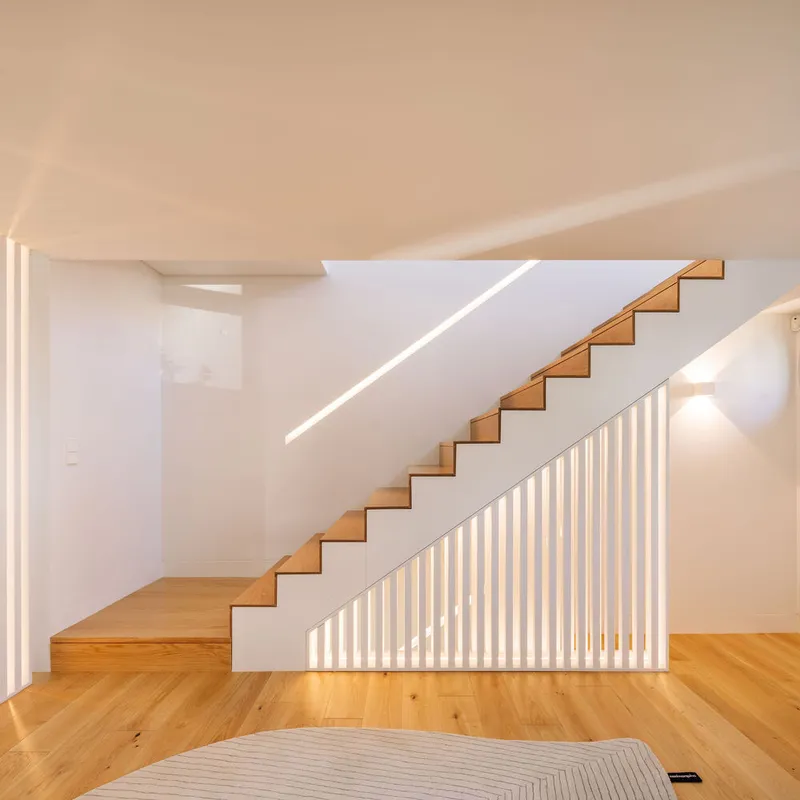
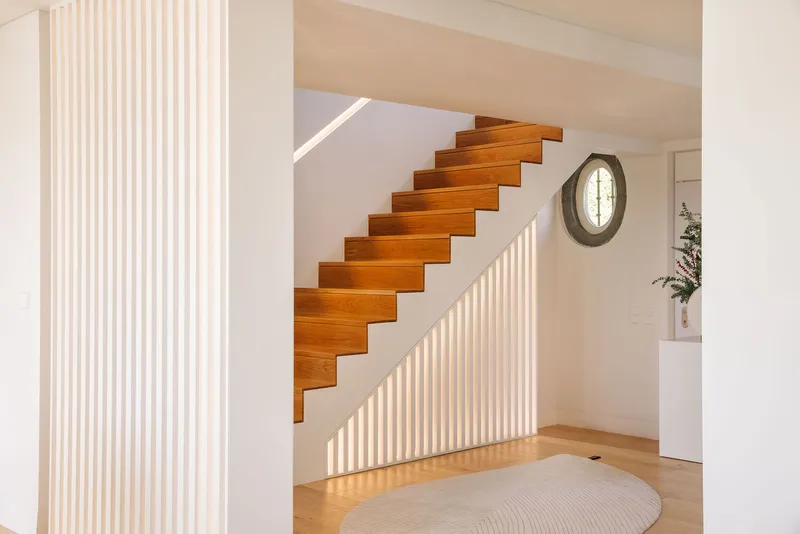
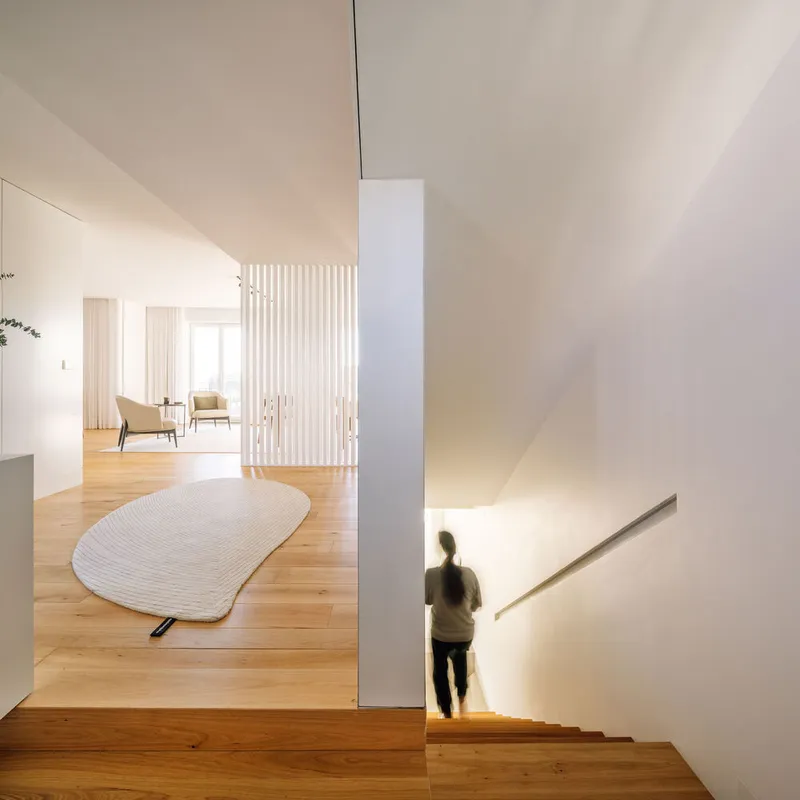
Connecting four levels of programme, the timber staircase is the project's circulatory spine. Its vertical slat balustrade echoes the aluminium louvers outside, establishing a material call-and-response between facade and interior. Integrated handrail lighting turns the stair into a lantern at night, while an oval window punches through the landing wall to borrow light from adjacent rooms.
The cantilevered treads float away from the wall with a confidence that belies the structural effort involved. Beneath a plywood ceiling that warms the vertical shaft, the staircase feels like a piece of furniture at building scale, detailed with the precision of cabinetwork rather than standard construction.
Green Tiles and Golden Light
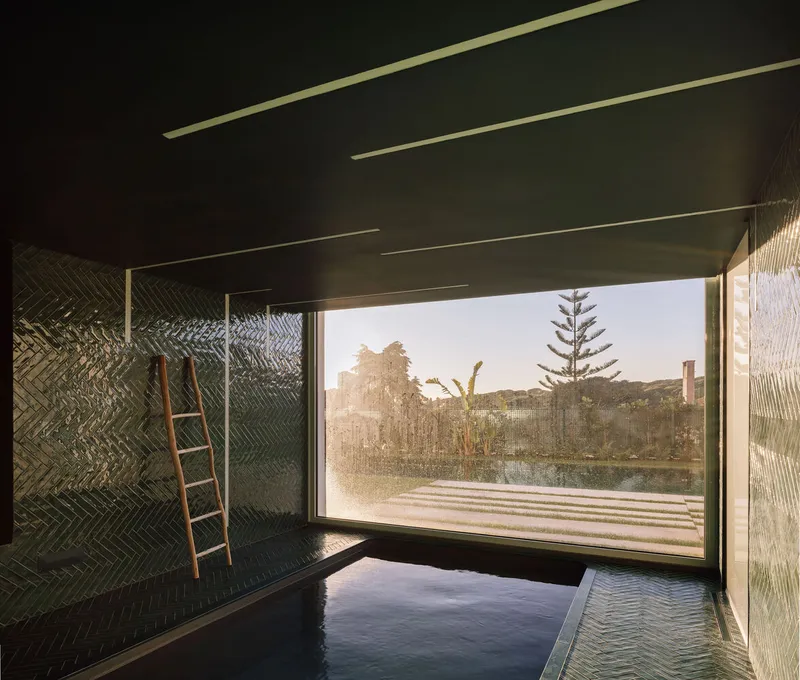
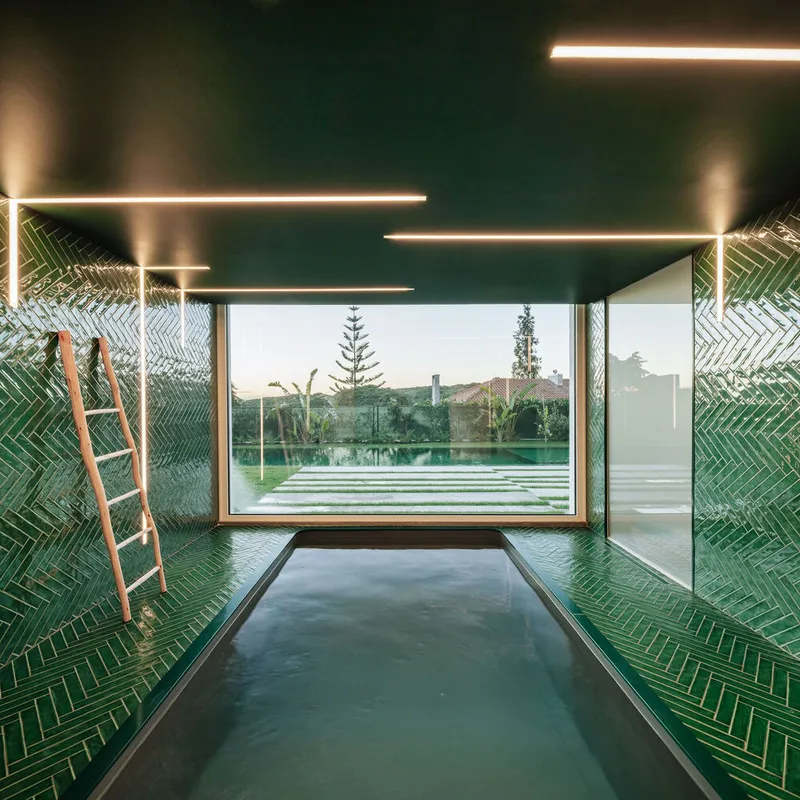
The basement indoor pool is easily the most atmospheric room in the house. Green handmade tiles, laid in a herringbone pattern, clad the walls and wrap the pool basin, their colour calibrated to echo the garden lawn visible through a panoramic window. At golden hour, the room floods with warm light, and the tile surface shifts from deep emerald to something closer to jade.
Counter-current swimming in a basement is not a new idea, but the treatment here is unusually considered. Recessed linear ceiling lights run the length of the pool, reinforcing the room's horizontal proportions and avoiding the clinical downlight arrays that plague most indoor pools. It is a space designed for daily use, not spectacle, which makes it all the more effective when spectacle arrives on its own terms through the window.
Terraces and the View Beyond
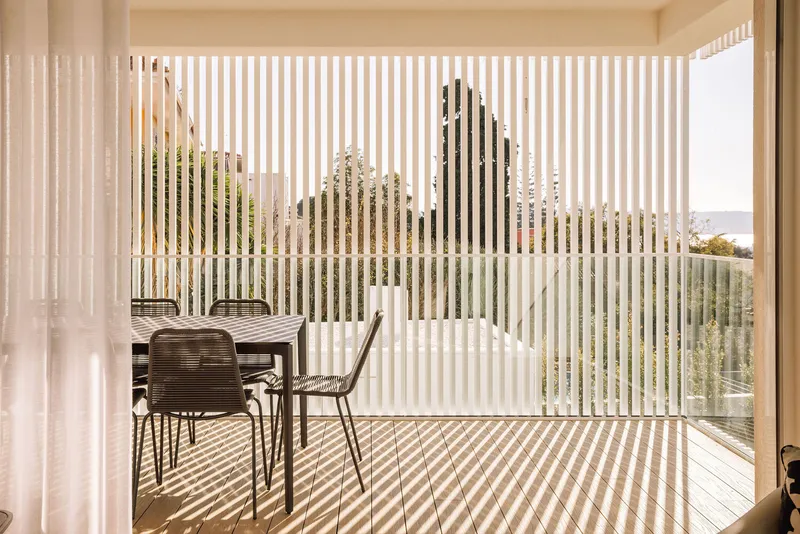
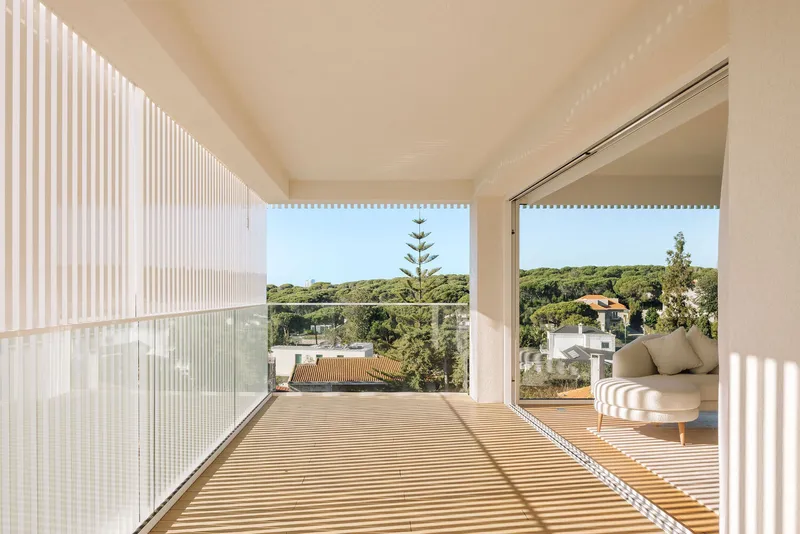
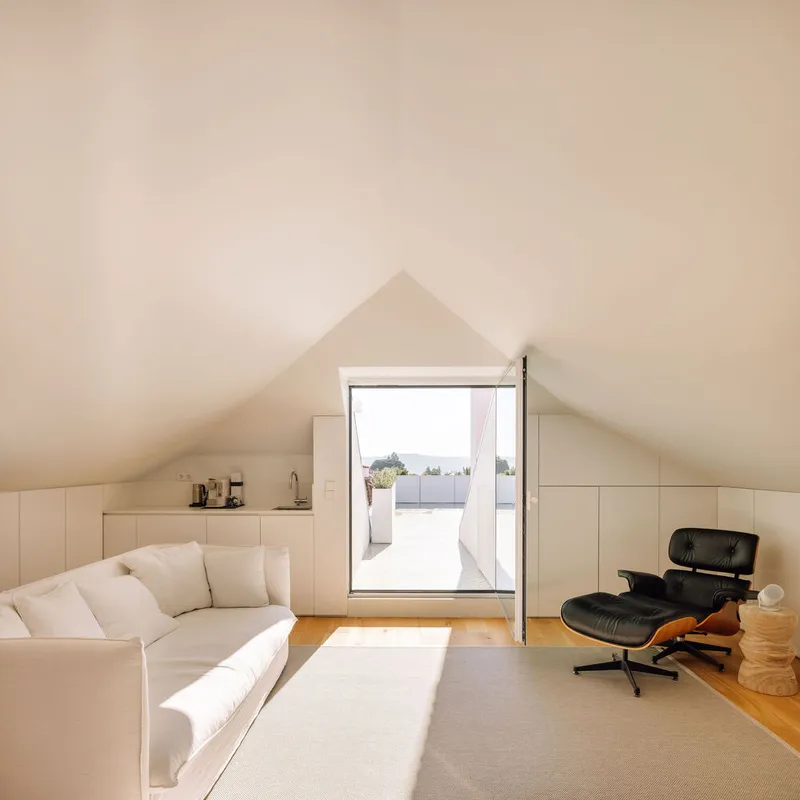
Every floor gets its own outdoor room. The ground floor veranda extends the social spaces into the garden; a first-floor terrace gives the master suite a private open-air buffer; and the attic opens onto a roof deck through a central glazed door. Slatted timber decking and louvered screens cast striped shadows across all three levels, tying the outdoor spaces together visually even as they serve very different programmes.
The stacking of terraces on the rear facade creates a sectional rhythm that is visible from the garden: pool, veranda, balcony, roof deck, each slightly recessed behind the one below. It is a reading of domesticity as vertical landscape, with the Tagus estuary sitting at the horizon as a shared backdrop for every level.
Private Quarters
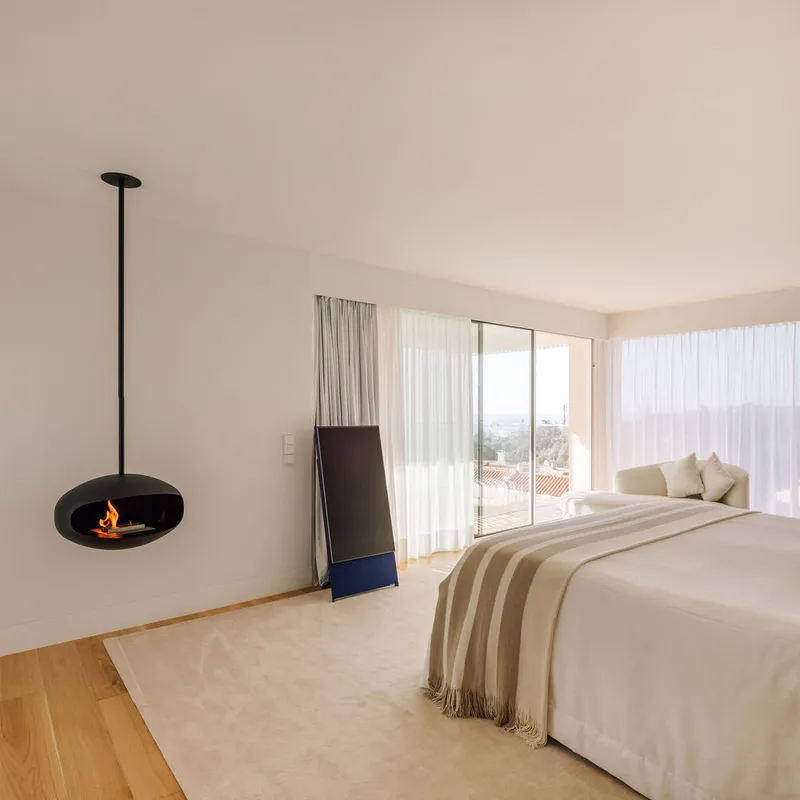
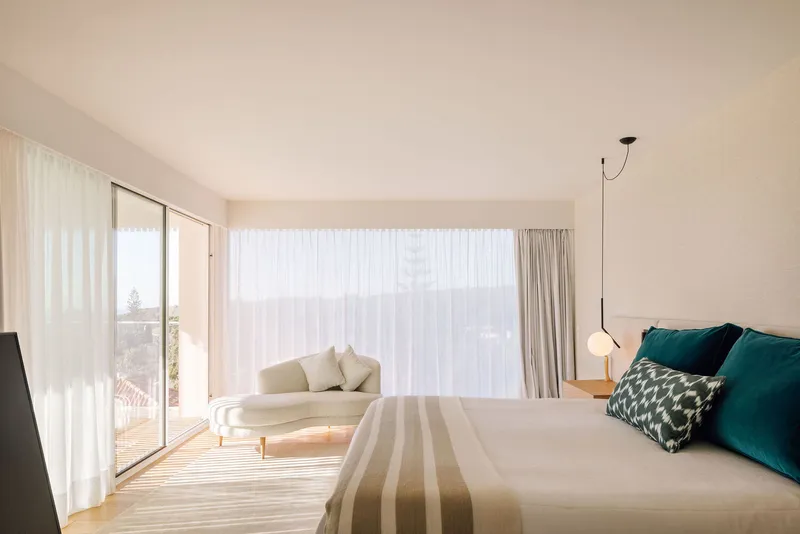
The first floor was reorganised from three bedrooms and two bathrooms into two ensuite bedrooms and a generous master suite. Southwest-facing windows in the master bedroom frame the estuary through sheer curtains, while a suspended black fireplace gives the room a gravity that most bedrooms lack. It is an unexpectedly bold gesture in a private space, turning the bedroom into something closer to a salon.
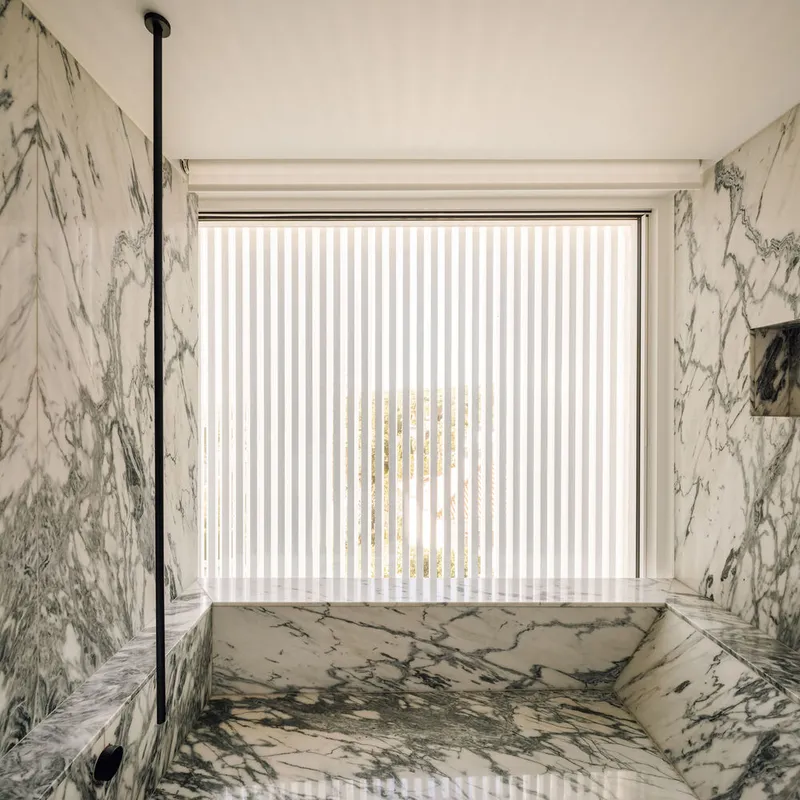
The bathroom continues the material restraint: a marble-clad bathtub niche sits against a window screened by vertical blinds that diffuse daylight into soft, even bands. Every surface is calm, tactile, and unadorned. The detailing is quiet enough to disappear, which is exactly what good residential bathrooms should do.
Garden and Pool at Dusk
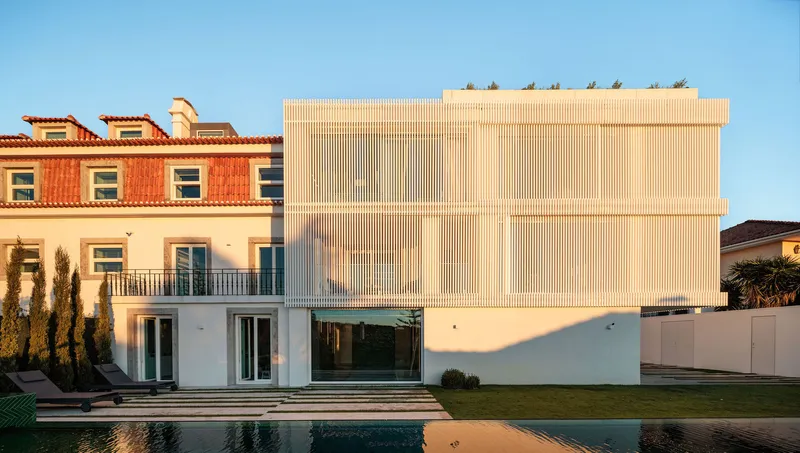
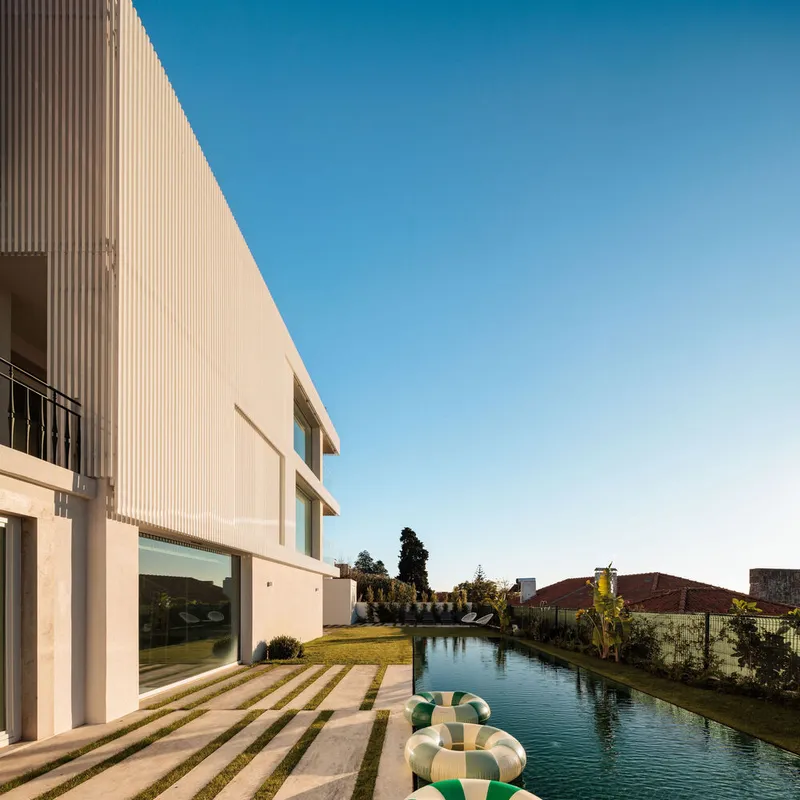
The rear garden is compact but layered: striped lawn, stone steps, a barbecue zone, and an outdoor swimming pool clad in the same green handmade tiles as the indoor pool. The tile choice unifies the two water features and ties both back to the garden's plant palette. At dusk, the louvered facade reflects in the pool's surface, doubling the building's vertical rhythm in a shimmering, liquid register.
Aguiar resisted the temptation to expand the garden footprint, keeping the outdoor spaces proportional to the house. The result is an exterior that feels curated rather than sprawling, with every square metre assigned a specific use. Neighbouring rooftops peek above the hedge line, a reminder that this is still a dense urban plot, not a country estate.
Plans and Drawings
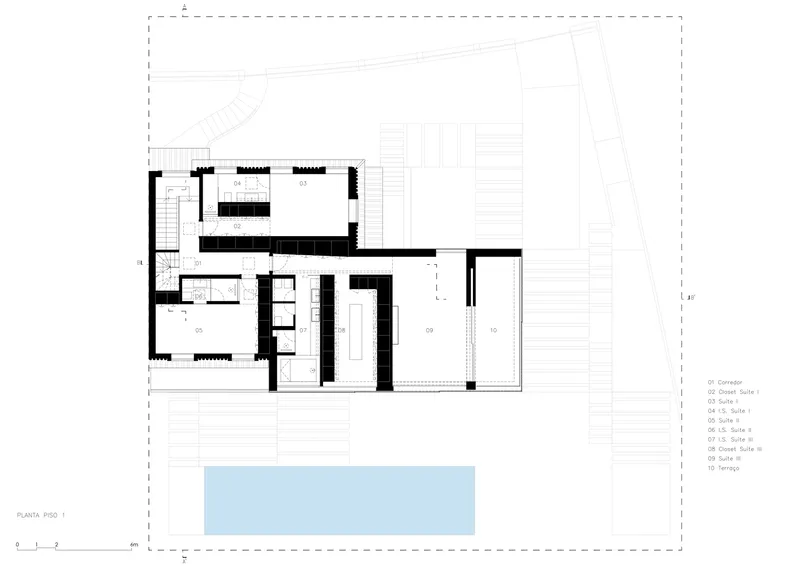
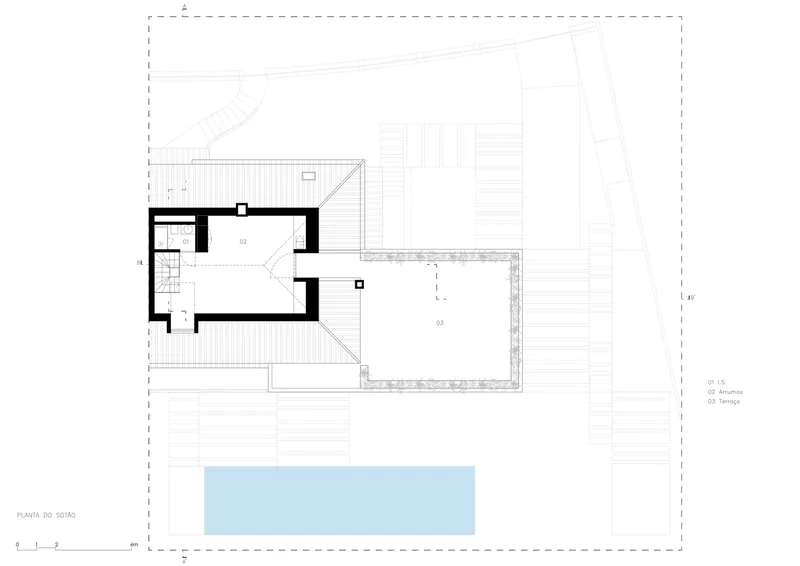
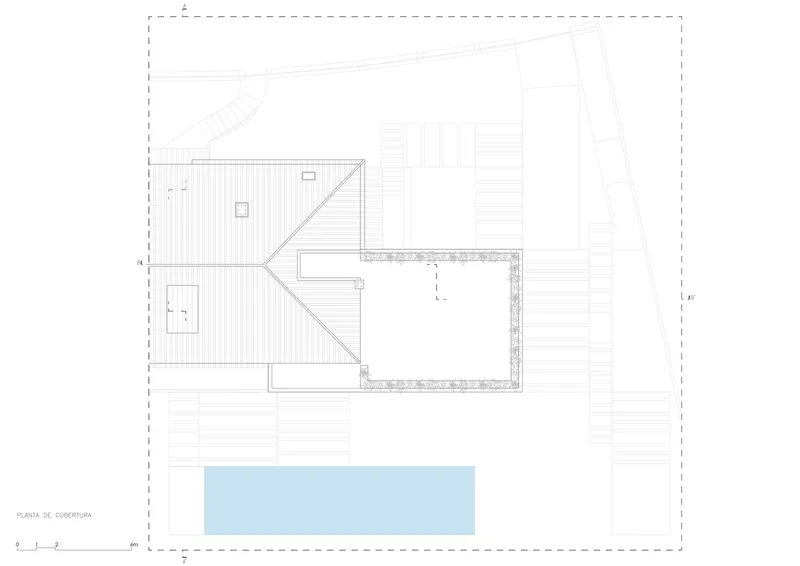
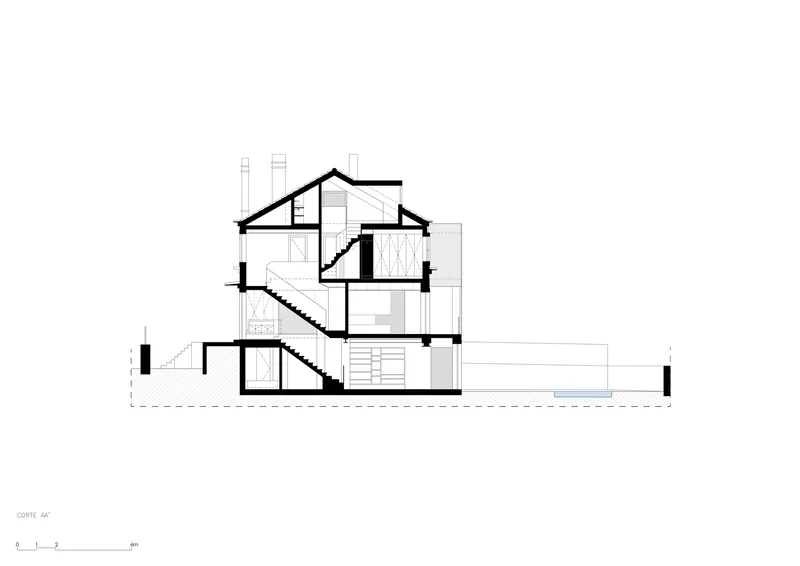
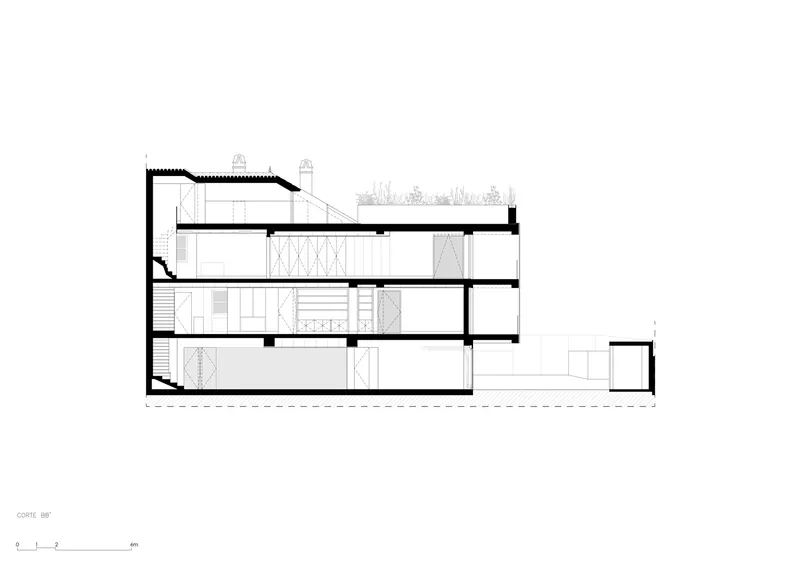
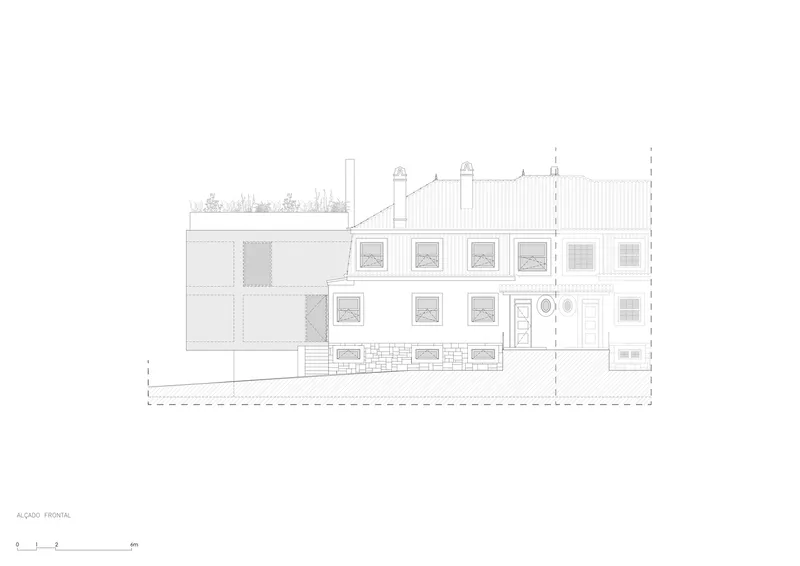
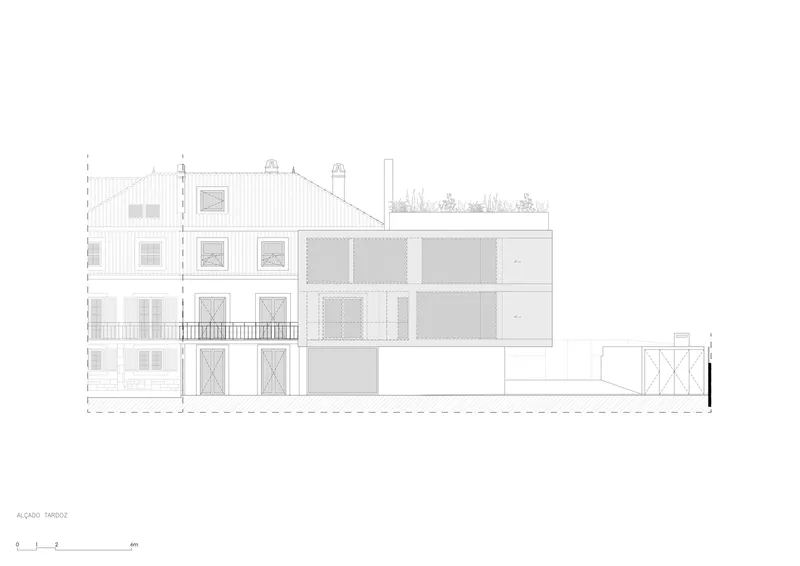
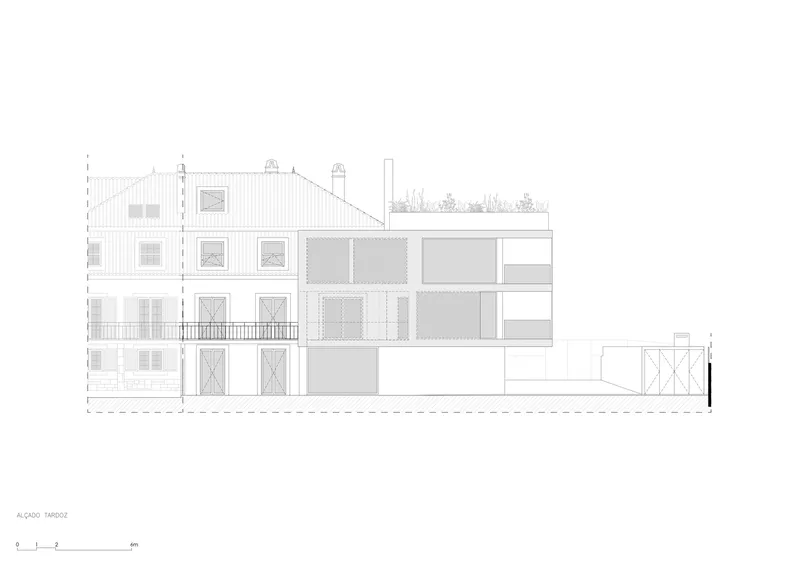
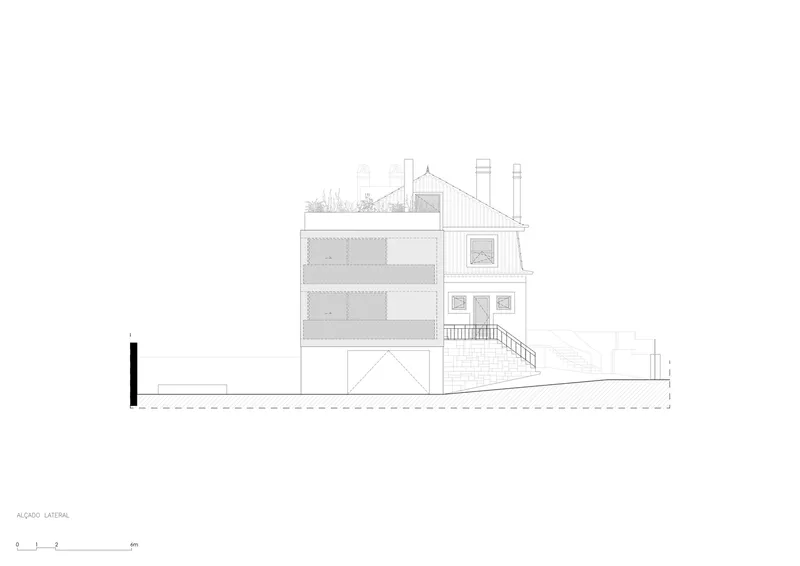
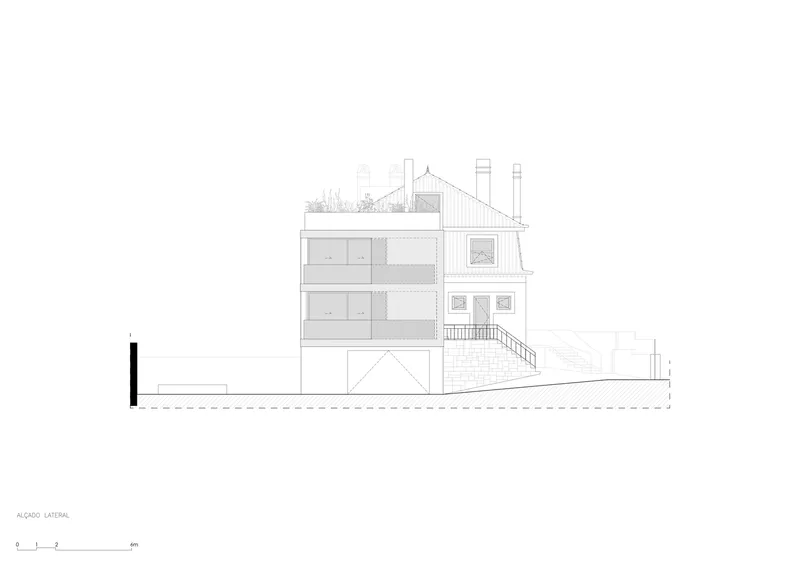
The floor plans confirm the density of programme packed into the existing footprint. Ground floor social spaces flow into the garden through large pocket windows; the upper plans show how the master suite colonises the new attic extension while keeping the staircase as a compact, centred core. The sections are the most revealing drawings: they expose the split-level logic that lets Aguiar stack parking, pool, cinema, kitchen, living rooms, bedrooms, and roof terrace into a four-storey sequence without any single floor feeling compressed.
The elevations illustrate the material strategy with precision. Front and rear drawings distinguish the original masonry volume from the aluminium-clad extension, showing how the new skin wraps around the existing structure without erasing its outline. Rooftop planting softens the upper profile and brings the section's greenery into the elevation, a small detail that reinforces the project's commitment to integrating landscape at every scale.
Why This Project Matters
Lisbon's residential renovation scene often defaults to one of two extremes: wholesale demolition behind a preserved facade, or timid cosmetic upgrades that avoid structural ambition. The MGR House charts a third path. It adds real volume, reconfigures circulation, and introduces a completely new material language, yet it does so in a way that the original house remains legible as a distinct architectural layer. The aluminium slats are not camouflage; they are a declaration that this is a 2024 intervention on a 1950s structure, and that honesty is what gives the project its coherence.
Beyond the facade, the project demonstrates how much programme a skilled architect can extract from a modest urban plot. Indoor and outdoor pools, a cinema, a wine cellar, four levels of living space, and multiple terraces all fit within a footprint that reads, from the street, as an ordinary rowhouse. That compression of ambition into restraint is the real achievement here, and it makes the MGR House a valuable reference for anyone working on mid-century housing stock in European cities.
Restelo MGR House, designed by João Tiago Aguiar, Arquitectos. Restelo, Lisbon, Portugal. 6,458 sq ft. Completed 2024. Photography by Francisco Nogueira.
About the Studio
Share Your Own Work on uni.xyz
If projects like this are the kind of work you want to make, uni.xyz is a place to publish your own, find collaborators, and enter design competitions.




Popular Articles
Popular articles from the community


Play: Fragments of Their World
Familiar architecture becomes modular playground design, creating safe spaces where displaced children can learn, connect, imagine and play.

Conexión: Biophilic Design Reimagines High-Rise Living in Hong Kong
Conexión reimagines high-rise living in Hong Kong through biophilic design, green facades, shared spaces, daylight, water and nature within.

Hill & Cross Opera: Sculptural Opera House Architecture Shaped by Tallinn’s Landscape and Identity
Hill & Cross Opera reimagines opera house architecture in Tallinn through its sculptural hill, civic plaza, glass wave and a luminous cross.

Riyadh For All: Intergenerational Urban Design for Active Aging in Rabat
Riyadh For All reimagines urban design in Rabat with intergenerational co-living, adaptive courtyards, and Moroccan cultural exchange today.


Similar Reads
You might also enjoy these articles


Bamboo Housing Challenge 2026: Design Affordable, Sustainable Homes Using Bamboo
An international design competition by Bamboo U and IBUKU inviting architects and designers to reimagine affordable housing using bamboo — with the winning design built full-scale in Bali.

Computational Design & Education: Beegraphy Design Awards Introduces 7th Category (Featuring Jiyun's Innovative Approach)
Dive into Beegraphy’s 7th Design Awards category, where computational design meets education to create immersive, interactive learning tools, inspired by Jiyun’s work.

From Parametric Lighting to Urban Furniture: Join the 2nd Workshop in Beegraphy’s Computational Design Series
Dive into Cutting-Edge Design Techniques and Practical Applications with Industry Experts

Last Call: Unleash Your Architectural Genius in SHAK's Kindergarten Design Competition
Urgent call for architects to join SHAK's kindergarten design competition before the looming deadline


Explore Architecture Competitions
Discover active competitions in this discipline



Challenge to reimagine the Iron Throne


Photograph architecture without architects


Illustrate the lost glory of Angkor Wat - Render Challenge


Design challenge to reuse E-waste
Comments (0)
Please login or sign up to add comments
No comments yet. Be the first to comment!