

More Than a Channel: An Edinburgh Flood Landscape That Changes Its Use With the Seasons
A runner-up at UnIATA '19, Tianyi Jiang's wetland park for Edinburgh's South East Wedge turns flood water into a park that changes with every season.


Most flood infrastructure is designed to be ignored: a culvert, a concrete trench, a fenced basin that only matters when it rains too hard. More Than a Channel refuses that invisibility. Its premise is in the title. A channel that carries storm water can also hold a concert on its banks, frame a view through a pair of binoculars, and freeze into a skating rink in January. The project treats hydrology as the generator of public life rather than a constraint to be engineered away.
Designed by Tianyi Jiang and awarded runner-up at UnIATA '19, the proposal sits in Edinburgh's South East Wedge, a suburban edge where city meets countryside. Jiang begins with a layered reading of the site's topography, soils, flood-prone zones, and existing biodiversity, then uses that analysis to reshape valleys, introduce wetlands and filtration zones, and stitch green corridors between urban and rural ground. What results is less a single building than a landscape system with a calendar built into it.
A Stepped Terrace and a Shaded Boardwalk Set the Scale of Everyday Use
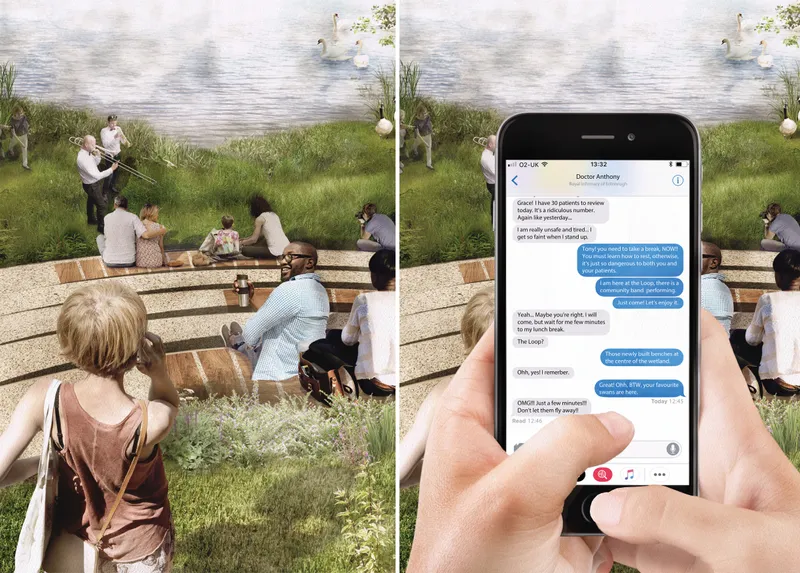

Jiang opens not with diagrams but with moments. A curved, stepped seating terrace drops toward the wetland edge, occupied by a trombone player, while a smartphone screen alongside hints at the informal, word-of-mouth gatherings the space is meant to host. In the companion view, timber lounge chairs sit on a boardwalk beneath a leafy tree, and a pair of binoculars frames a distant ruin and hill.
The split-view format is a smart rhetorical choice. Each image pairs the physical setting with the object a visitor would hold in their hand, which grounds the landscape in personal experience. The terrace works as an amphitheatre when the water is low and as a viewing platform when it rises, so the same steps accommodate both performance and flood. The binocular frame matters too: it reminds the viewer that this suburban wetland is not sealed off from its context but looks outward to the wider Edinburgh terrain.
A Meandering Section That Treats Water as Terrain
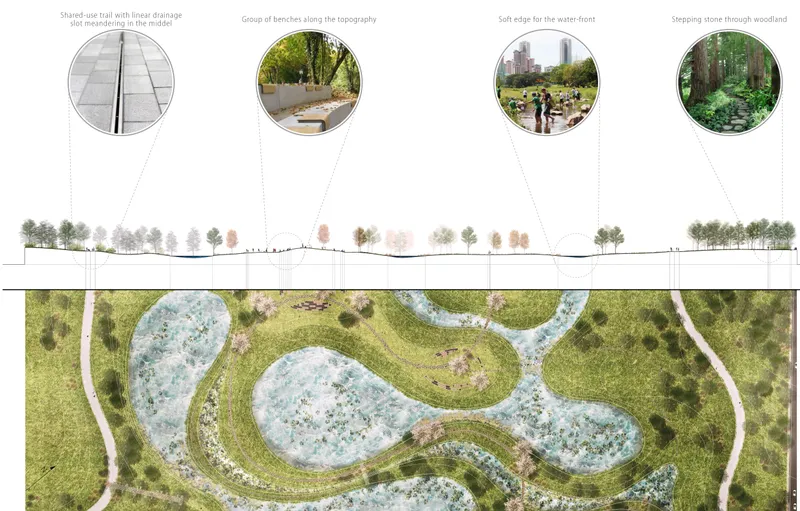
The first technical drawing pairs a section with a plan of a meandering wetland park, its ponds and paths threaded together and annotated with inset photographs of trails, benches, and stepping stones. The section is where the project's logic becomes legible: ground levels are sculpted so water collects in predictable low points, while circulation rides the higher shoulders. This is the redesigned-valley strategy in action, letting gravity rather than pipes direct flow.
The inset photos keep the drawing honest. Instead of exotic interventions, Jiang specifies familiar, low-cost elements that any parks department could build and maintain. That restraint strengthens the proposal; the ambition lies in the arrangement, not in the objects.
When the Ponds Freeze, the Flood Basin Becomes a Rink

The winter scene is the project's most persuasive image. People skate across a frozen pond while a worker hoses the surface to keep the ice smooth, and a leaflet in hand suggests an organised seasonal programme. The same shallow ponds that retain storm water and filter it through wetland planting become a civic winter amenity, which is a compelling answer to the question of what a flood landscape does when it is not flooding.
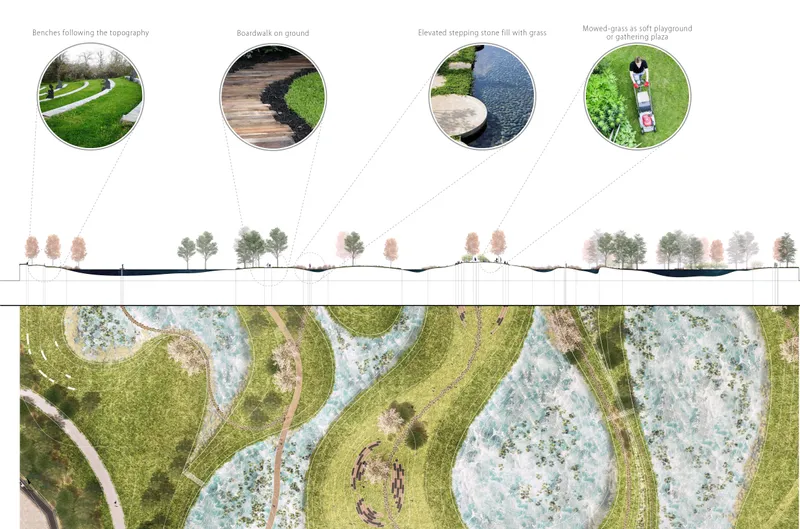
The accompanying section and plan show winding ponds, a boardwalk, and grass islands, again supported by insets of benches, stepping stones, and a mowed lawn. The grass islands are worth noticing: they act as dry refuges in wet months and as gathering pads in dry ones, giving the plan a flexible ground that shifts between land and water depending on the season and the rainfall.
One Landscape, Three Seasons, a Precise Kit of Edges


A black and white triptych lines up the three key scenes in sequence: skaters on ice, lounge chairs under a tree, and the stepped lakeside terrace. Read together, they make the case that recreation here is not fixed but timetabled by the water itself, the seasonal adaptability the masterplan promises.
The final section and plan names the components that make this possible. A roadside swale intercepts runoff before it reaches the park, a reed boardwalk carries visitors through the filtration zone without disturbing it, stepping stones offer a playful crossing at shallow points, and a mown grass path marks the driest, most accessible route. Each edge condition corresponds to a different water depth, so the drawing doubles as a gradient from street drainage to open wetland. It is the clearest demonstration in the entry of how flood management and public use are designed as one system.
A Site Plan That Reads as a Green Corridor
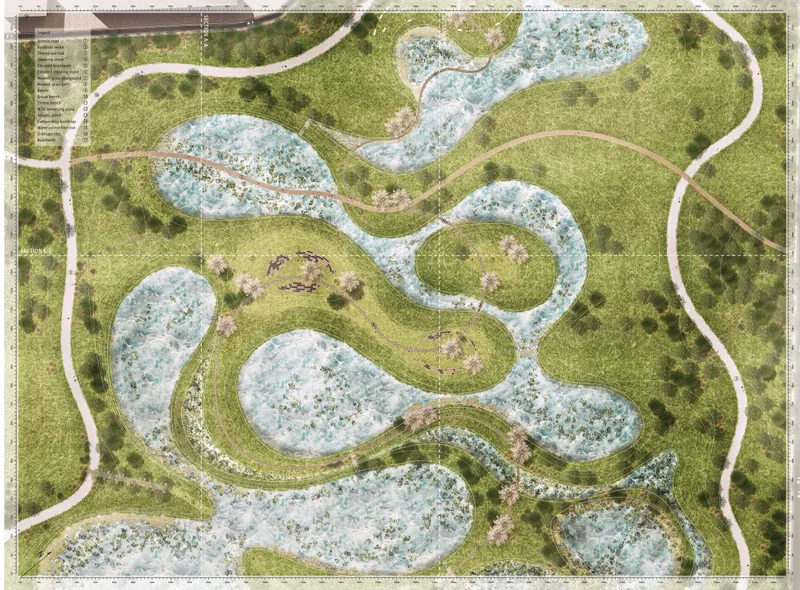
The rendered site plan pulls back to show winding ponds and grassy banks crossed by curving paths and scattered trees in summer green. At this scale, the project's "Green ID" becomes visible: a continuous ecological spine that links biodiversity hotspots and connects the urban fabric to the rural landscape beyond. The paths do not cut straight across the water; they follow its curves, so walking the park means tracing its hydrology.
Jiang's hydrological modelling sits beneath this plan, identifying which zones can safely hold people and which must be given over to water and habitat. The plan's soft, organic geometry could read as purely aesthetic, but it is the visible trace of those flow simulations, and that is what gives it credibility.
Why This Project Matters
Cities everywhere are being asked to absorb heavier rainfall without simply building bigger pipes. More Than a Channel offers a model that is modest in its materials and generous in its ambitions: swales, reed beds, boardwalks, and stepping stones arranged so that the infrastructure is also the park. The project's strongest move is temporal. By designing for winter skating, summer lounging, and year-round performance, it gives residents a reason to care about the landscape in every season, which is the best guarantee that it will be valued and maintained.
The entry also shows how to communicate a landscape proposal. Jiang balances the human-scale vignettes with rigorous sections and plans, so the reader understands both why the place would be loved and how it would work. For designers tackling edge-of-city sites, it is a useful reminder that resilience does not have to look like defence; it can look like a frozen pond on a winter afternoon.
View the Full Project
About the Designers
Designer: Tianyi Jiang
Enter a Design Competition on uni.xyz
uni.xyz runs architecture and design competitions year-round that reward proposals with spatial conviction and real site intelligence.
Project credits: More Than a Channel by Tianyi Jiang UnIATA '19 (uni.xyz).


Popular Articles
Popular articles from the community


LT2A and OPEN Architectes Thread a Brick and Glass High School Through a Wooded Belgian Campus
In Braine-l'Alleud, a 3,000 m² wing for Collège Cardinal Mercier pairs pale brick with a glazed colonnade, deferring to a small chapel and a dense wood.

David Macias Steps a Doorless Stone and Plaster House Down a Tropical Colombian Hillside
In the humid hills of Colombia, Threshold House replaces the front door with an open void and terraces its 850 m² down the slope instead of fighting it.

U.GA Architects Wraps an Oval Rooftop Pool in Curved Board-Formed Concrete on Busan's Jeollidan-gil
In Busan's Jeonpo-dong, a 454 m² mixed-use block stacks a neighborhood facility, guest rooms and an oval rooftop pool inside spiraling concrete walls.

Architekt Andreas Gruber Scatters 23 Dark Timber Chalets Across a South Tyrolean Forest Edge
In Molini di Tures, Amonti Chalets breaks a resort into a hamlet of gabled timber houses, with parking, storage and services pushed into the slope.

Similar Reads
You might also enjoy these articles

Hodi-Mandai Geram
Project Function: Preservation and revitalization of the Intangible heritage and socio-spatial identity of the Hodi by Housing, Cultural Memory Center, Sacred Grove, landscape, local tourism economy

Olio Towers: A Mid-Rise for Performers That Fuses Housing, Rehearsal, and Stage
Located blocks from Houston's Theater District, this modular tower stacks living units around a central performance atrium.
Oasis: Modular Green Housing Carved into Dhaka's Urban Fabric
A shortlisted Plugin Housing entry reclaims unauthorized settlements in Dhaka with stepped concrete volumes, green roofs, and ventilation-driven design.

Black Hole: A Floating Megastructure for the Post-Physical Era
Emiliano Mazzarotto envisions a spherical, self-scaling arena where e-sports, digital hotels, and holographic stadiums replace traditional public space.

Explore Landscape Urbanism Competitions
Discover active competitions in this discipline

Deconstructivism - Illustration Design Challenge

Challenge to illustrate a Contemporary Castle

Challenge to design a shop stop sunk in the city

Design challenge to equip cities with modern furniture
Comments (0)
Please login or sign up to add comments
No comments yet. Be the first to comment!