
Revolving around the core of gaming
The essence of gaming
“It’s not about pixels. It’s about people. Games bring people together”, said Phil Spencer, Head of Xbox. With that quote, many attributes built the foundations of our concept and design.
The first step we took in approaching the gaming center project had to be research and analysis. Upon reading the brief, what caught our attention was the term ‘open world games’. It fascinated us how people pursue games classified under the open world game category for the level of freedom the user gets. And so that’s how the birth of our concept design came to be. If users seek such games searching for freedom of movement, access or any attribute then why would they reach gaming centers to restrict themselves between a constrained 4 walled room.
The base of our concept initiated with wanting to reflect this digital experience of freedom users look for into a spatial aspect of reality. But how could you translate a virtual abstract element into actual tangible space?
The expansion of digital gaming offered communities experiencing different aspects of social connectivity and interactivity. Therefore, designing a gaming center for gamers of all ages and different gaming levels requires a certain approach to consider. The design needed to feature a futuristic façade in order to attract the youth and those who are interested in playing video games and watching viral tournaments live. The target is to get players out of their comfort zones and homes to find this destination as their place of comfort, recreation, and communication.
Only one thing we had reached at that point was concrete: Have gamers control space, instead of having the space control them. The aim was to have each and every user decide wherever they wanted to go, how they wanted to reach there, and even how they wanted to perform whatever activity they were doing without blocking anyone’s space or regulating their movement. This meant that more than one route had to lead to the same functional space whilst still connecting functions together for ease of accessibility.
At this stage, we started thinking of the limitations of a traditional gaming arena where spectators are cooped in a seat in the middle of a huge hall. The idea of spectators being prisoned to a specific seat lined in rows restricting them from moving or socializing with big groups didn’t match the concept of freedom we were going after. Traditional gaming arenas placed its users in a confined space such that if one moves or stands, another user’s watching experience gets disturbed. Not only that, conventional sports arenas which gaming arenas take after try and place the spectators as close to the event as possible which isn’t the most suited with gaming esport. In esport, the main event occurs inside a flat LED screen. Accordingly and based on several scientific recommendations, it is more suited to have the spectators all standing further away, at a safer distance from the screen. This helps them view the whole screen fulling intaking the complete event. Traditional gaming arenas not only fail in providing that to their users but also give an unequal and unfair experience to their users based on the row they get assigned to.
This is when we started thinking of ways to change the gaming arena into a more innovative space that provides all spectators an equitable watching experience. And so the idea of vertical viewing came to mind. The gaming arena that represents the heart of the project, was designed to have a spiral ramp pathway where spectators could sit or move up and down as they socialize or look for others while watching the main screen in the middle. Since the spiral ramp provided both vertical and horizontal circulation it gave users the freedom of movement and access through any floor they liked. The tricky aspect was to find enough space for this slight ramp inclination so that it would serve the function of comfortably moving around, socializing, or even just sitting and watching without losing balance. The ramp circulation inclined at less than 3 degrees for convenient roaming inside the arena while taking into consideration all types of visitors.
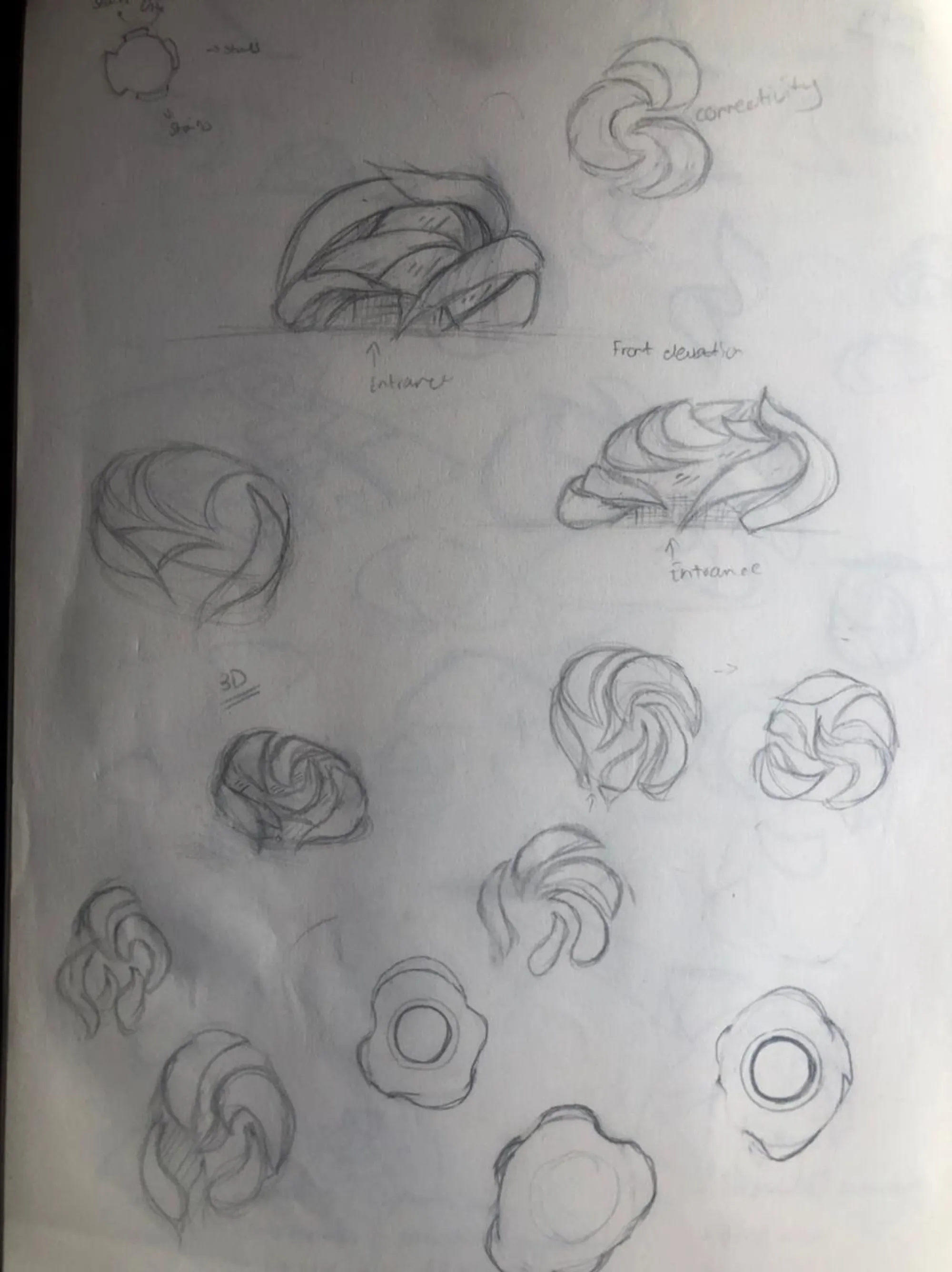
Since the surrounding buildings have the form of a central design, relevant dedications were implied to center the huge gaming arena as the heart of the whole building. This is when the form started to clear out a bit. With the gaming arena placed right in the middle representing the core of gaming, we wanted the design to feature flexible, random free movement reflecting the notion of open-world games that vigorously revolve around the core of gaming. Having the form not restricted to a certain path or shape but rather flow unpredictably was the main essence of gaming we were trying to capture. That to be said, the form is also specific to the site where patterns forming the shape are created with relation to the site where all similar facilities surround the area of study. Connections regarding traffic congestions, main and minor streets, and wind direction created the flowing arms enclosing the gaming center.
The final form achieved is described in four basic conceptual words: free, organic, random, vibrant. Dynamism to be clearly observed from the outside relates to the fascinating animations and colors that permit the vital experience of gamers.
The first iterations to play with form ended up with including large glazing areas making it unpractical and inefficient for our design. Enclosing the shape more required the usage of more coverage material with dynamic flow. For that reason, the choice of aluminum was highly recommended due to its lightweight specifications and adaptability for forming irregular curves. The unique feature of this building is its adaptability for future changes in terms of design, functions, and purposes.
As for the distribution of all different functions of the building, major contributes such as the best views and solar radiation penetration were taken into consideration to avoid any sort of discomfort. Going through the architectural planning process, the building was divided into three floors with the ground specifically organized for the public and the upper floor for office employees and professionals.


Popular Articles
Popular articles from the community


Conexión: Biophilic Design Reimagines High-Rise Living in Hong Kong
Conexión reimagines high-rise living in Hong Kong through biophilic design, green facades, shared spaces, daylight, water and nature within.

Riyadh For All: Intergenerational Urban Design for Active Aging in Rabat
Riyadh For All reimagines urban design in Rabat with intergenerational co-living, adaptive courtyards, and Moroccan cultural exchange today.

The Earth Pod: 3D Printed Homes for Resilient Refugee Communities
The Earth Pod reimagines refugee housing through 3D printed homes made from clay, combining resilience, self-sufficiency, and rapid shelter.

Co-life: Sustainable Architecture for Age-Friendly Community Living
Co-life reimagines sustainable architecture for seniors through courtyards, rammed earth, shared gardens, and spaces designed for belonging.

Similar Reads
You might also enjoy these articles
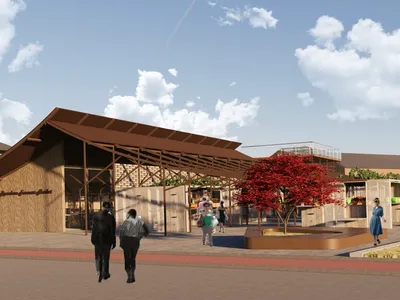
The Rhythm of Seasons
A Farmers' Market Connecting Nature and the City
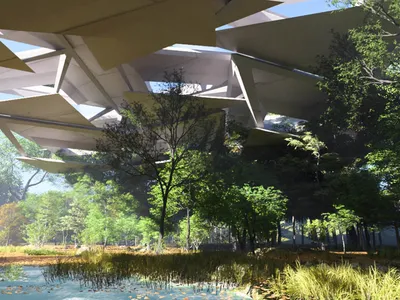

More Than a Building-Designing a Living System
More Than a Building-Designing a Living System
Base Beyond
DESERT COMPOUND ARID: TOURISM OF ABSENCE AND ABUNDANCE

Explore Extreme Architecture Competitions
Discover active competitions in this discipline


Challenge to design a shop stop sunk in the city


Challenge to reimagine the Iron Throne


Photograph architecture without architects


Illustrate the lost glory of Angkor Wat - Render Challenge
Comments (0)
Please login or sign up to add comments
No comments yet. Be the first to comment!