
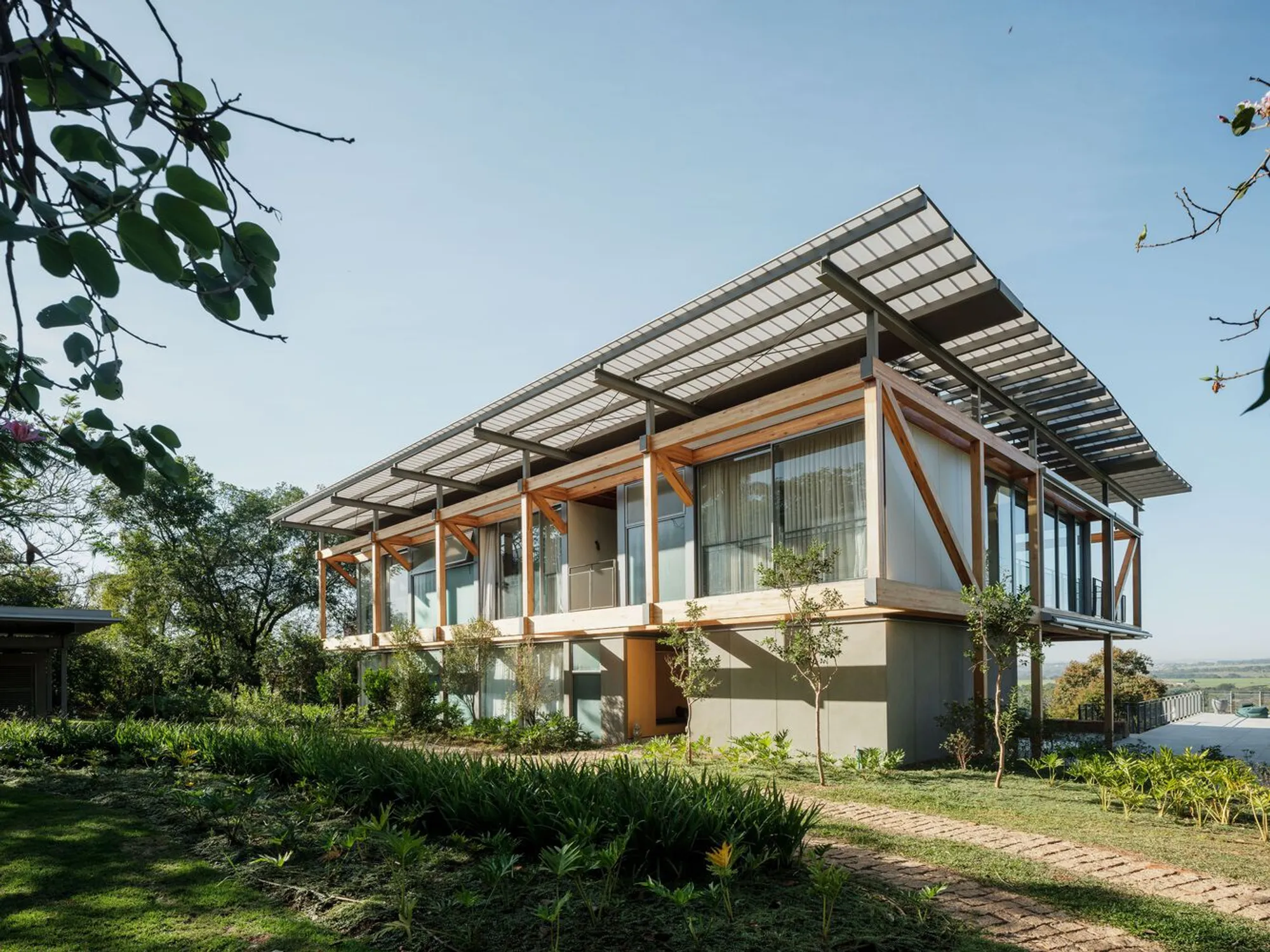
Andrade Morettin Lifts a Timber-Framed House Above the Brazilian Countryside on Solar Canopies
RF Residence in Brazil pairs exposed timber structure with translucent photovoltaic panels to create a home that generates its own energy while framing swe


There is a particular strain of Brazilian modernism that treats structure as spectacle, where the bones of a building do the heavy lifting of both engineering and expression. Andrade Morettin Arquitetos Associados works squarely in that tradition, and RF Residence is perhaps their most muscular demonstration of it. Set on a rolling green slope, the house reads as a piece of furniture scaled up to architecture: a legible timber post-and-beam frame, diagonal bracing laid bare, translucent photovoltaic roof panels floating above like a taut canopy. Nothing hides.
What makes the project genuinely interesting is not just its sustainability credentials, though those are real. It is the decision to make the sustainable systems visible and beautiful. The solar canopy is not a guilty afterthought bolted to a conventional roof. It is the roof, a luminous skin that filters daylight into the interiors while powering the house. The timber frame is not clad or concealed. It is the architecture. Every structural member participates in the spatial experience, and the result is a house that feels simultaneously open and sheltered, raw and refined.
A Structure You Can Read
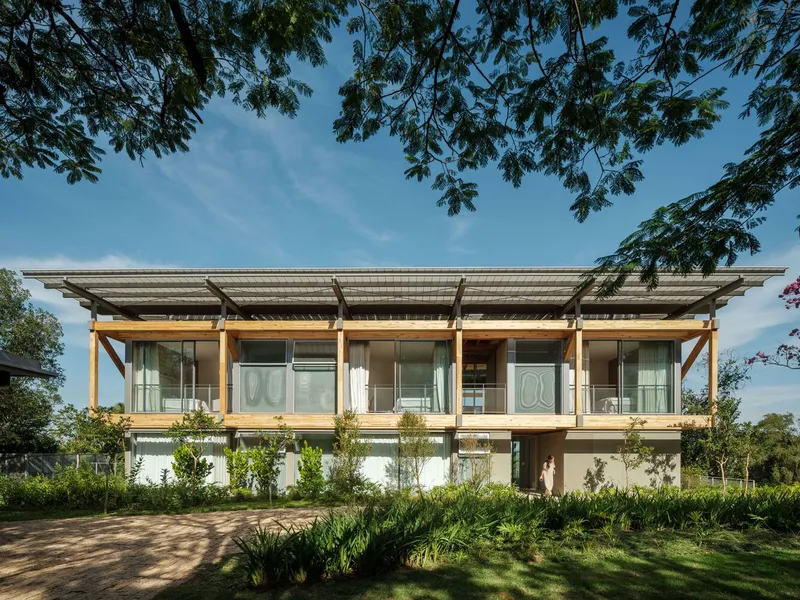
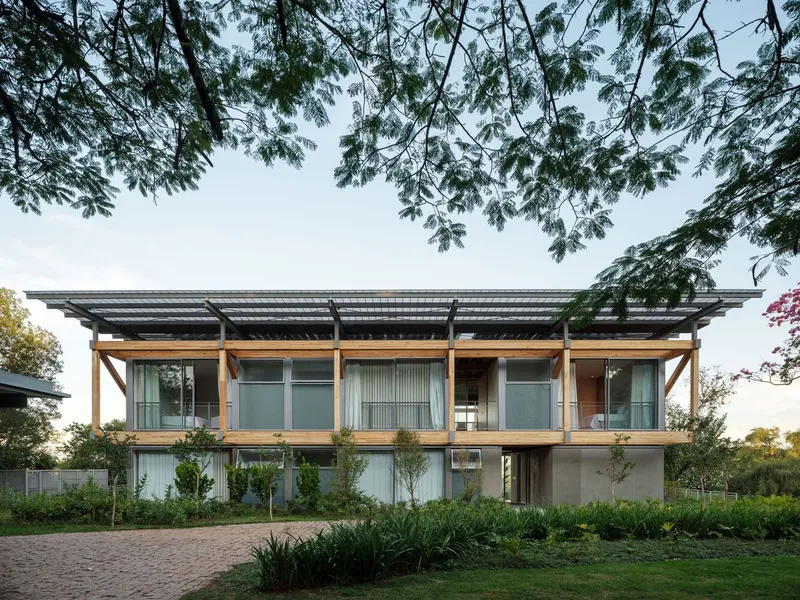
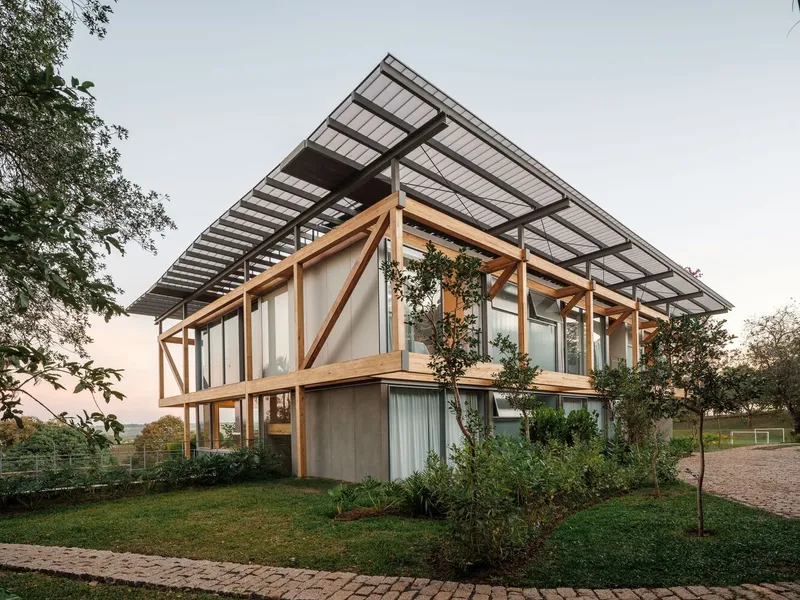
RF Residence wears its construction logic on its facade. The front elevation makes the hierarchy legible: a stone-clad ground floor anchors the house to its hillside, while a glazed upper level sits inside a fully exposed timber framework. Diagonal braces stiffen the frame at every bay, creating a rhythm that is more shipbuilding than domestic architecture. The whole assembly has the quality of a well-made instrument, where you can trace every force path from canopy to ground.
At dusk the effect intensifies. Warm interior light turns the glazed volume into a lantern, and the timber members read as dark silhouettes against the glow. The translucent solar panel canopy catches the last light of the sky above. It is a facade that rewards sustained looking, because the structural logic gives your eye a grid to follow even as the landscape stretches out behind it.
The Solar Canopy as Fifth Facade
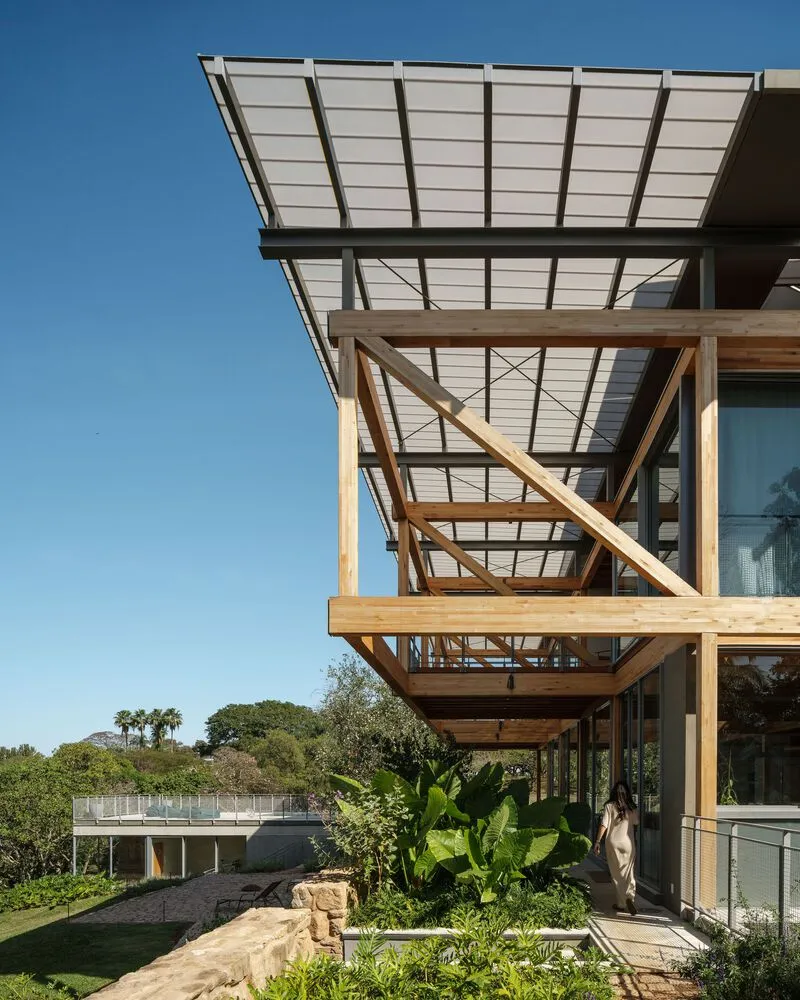
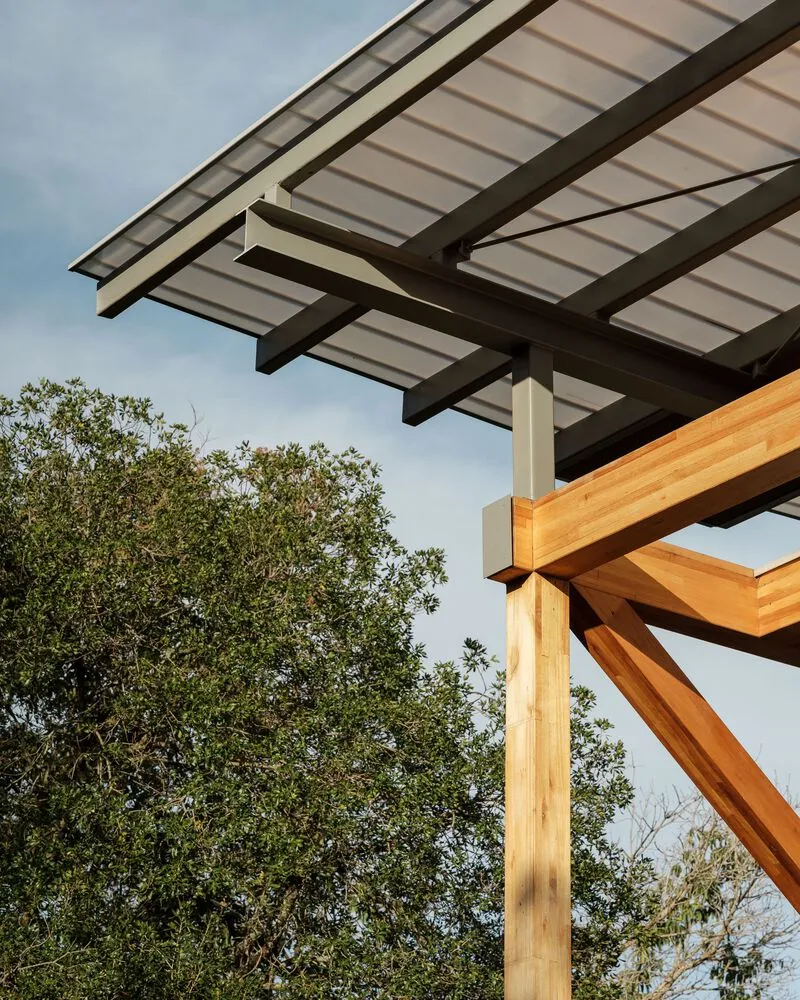
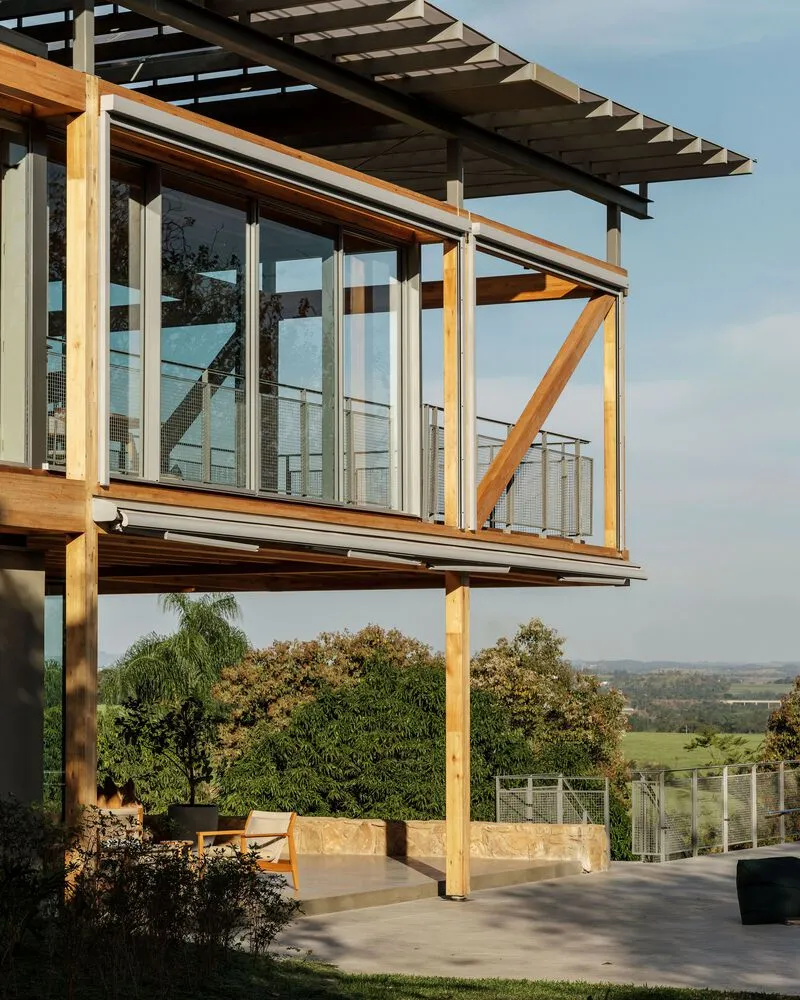
The translucent photovoltaic panels that form the roof deserve scrutiny. Unlike opaque solar arrays that seal a building off from the sky, these panels admit diffused light, turning the canopy into something closer to a Japanese shoji screen at architectural scale. Steel and timber beams support the panels in a grid that casts precise shadow patterns across the terraces and interior floors throughout the day. The energy-generating surface doubles as the primary daylighting strategy.
From below, the canopy hovers above the main volume with visible clearance, letting hot air escape and breezes move through. It extends well beyond the building envelope to shade outdoor terraces and planted courtyards. The detail where the canopy cantilevers past the timber frame against open sky is one of the project's most compelling moments: you see exactly how the load transfers from panel to beam to column, and the thinness of the assembly against the clouds is remarkable.
Living Inside the Frame
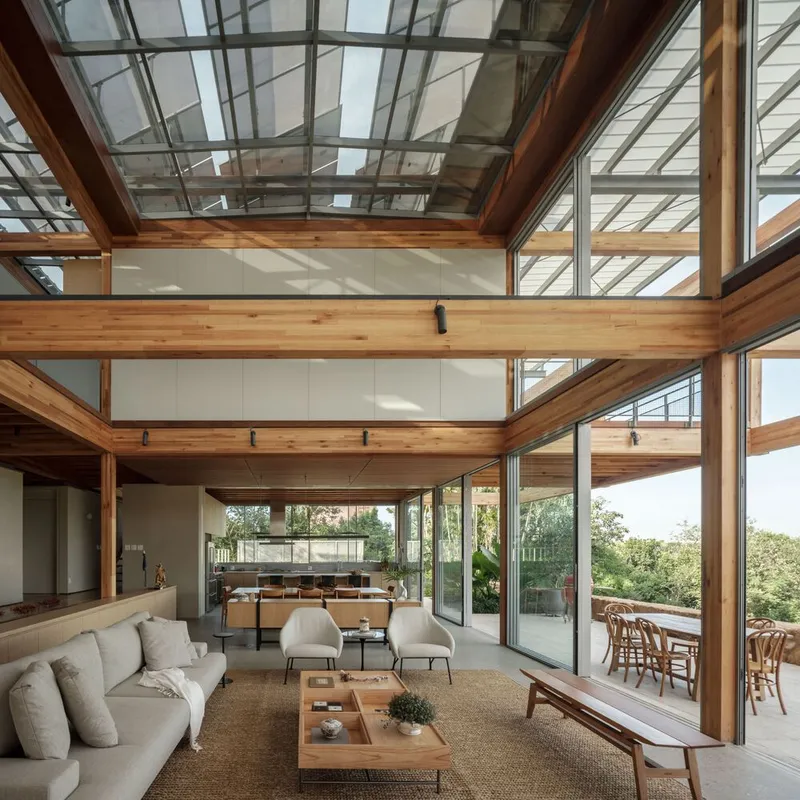
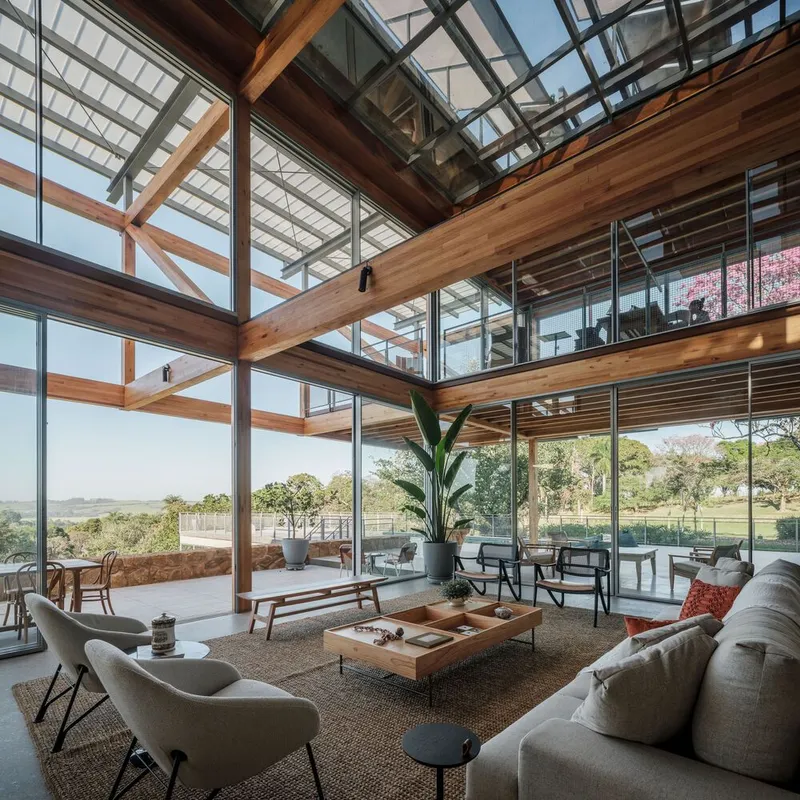
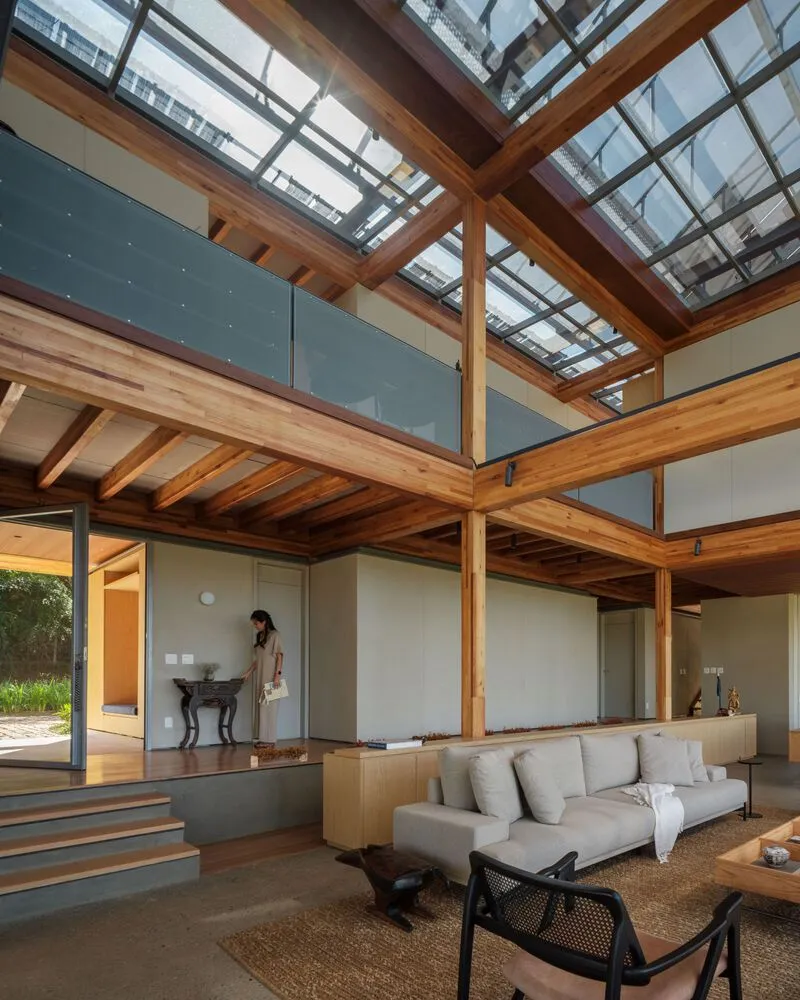
Inside, the double-height living space is the gravitational center of the house. Exposed timber beams and joists create a ceiling that feels both protective and permeable, with glass skylights and clerestory openings punching light through at strategic points. The mezzanine level, edged with a glass balustrade, overlooks this main volume and connects the private quarters to the communal heart of the house without walls or corridors.
Full-height glazing wraps the perimeter, dissolving the boundary between interior and landscape. At dusk, the living room becomes a viewing platform: timber columns frame the rolling countryside like a series of tall, narrow paintings. The split-level section introduces subtle shifts in floor height that define zones without partitions, allowing the eye to travel continuously from the sunken sitting area up through the mezzanine to the luminous canopy above.
Courtyards, Terraces, and the Space Between
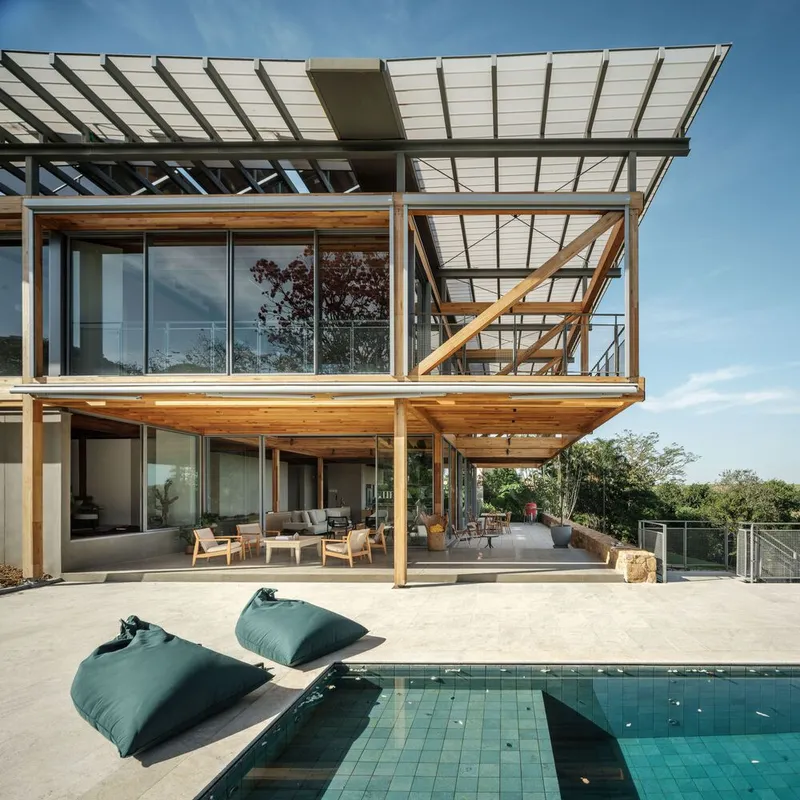
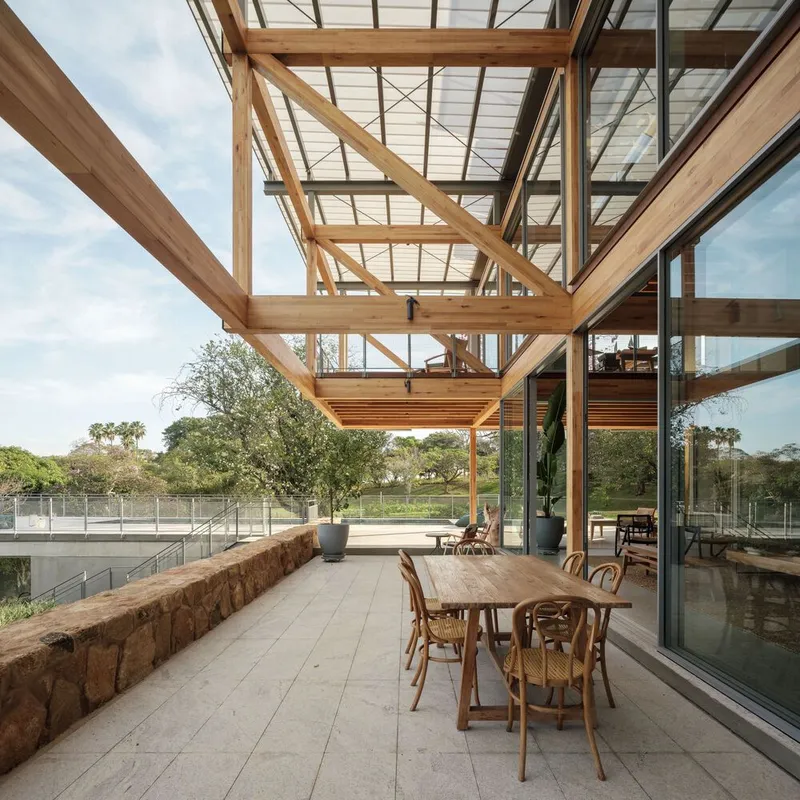
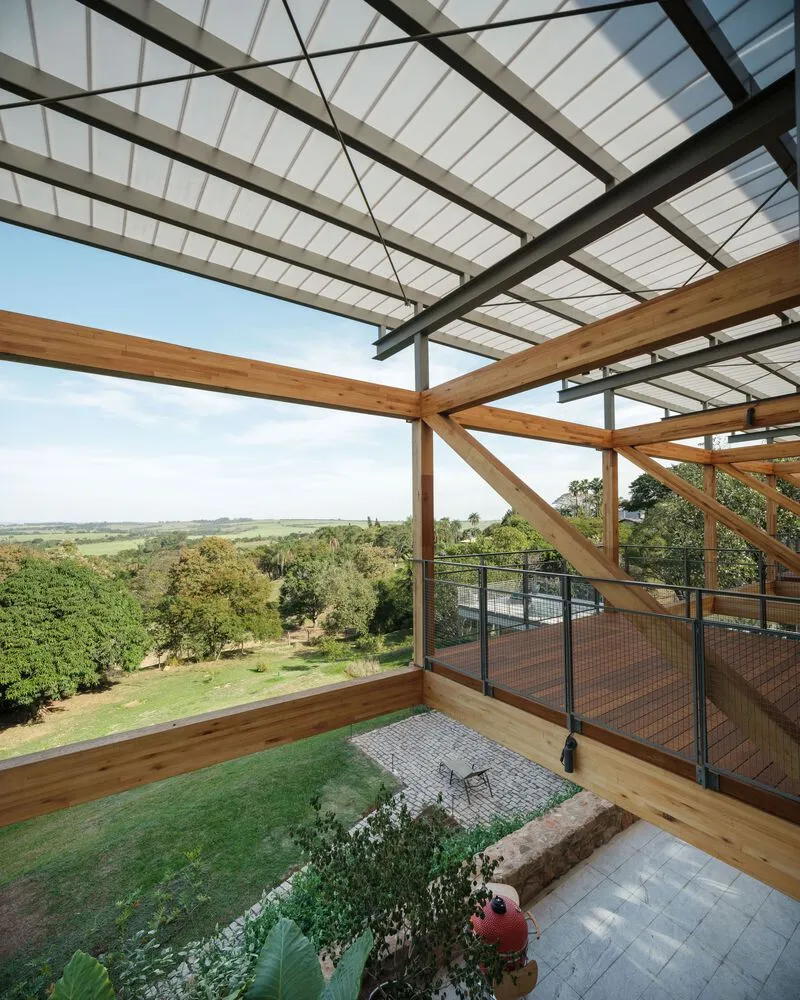
The house does not end at its glass walls. A series of terraces, courtyards, and covered outdoor rooms extend the living space into the garden and hillside. The swimming pool terrace, sheltered beneath stacked timber frames and the solar canopy, functions as an outdoor living room with the same spatial generosity as the interior. Stone planters and planted beds weave through these transitional zones, blurring the threshold between architecture and landscape.
One of the most effective moves is the planted courtyard beneath the glazed roof, where timber beams and steel cross-bracing frame views of the open countryside beyond vegetation. It is a space that belongs neither fully inside nor out, exactly the kind of ambiguous threshold that makes tropical and subtropical houses come alive. The pergola structure overhead provides shade without enclosure, allowing the house to breathe.
Timber, Steel, and Honest Material Choices
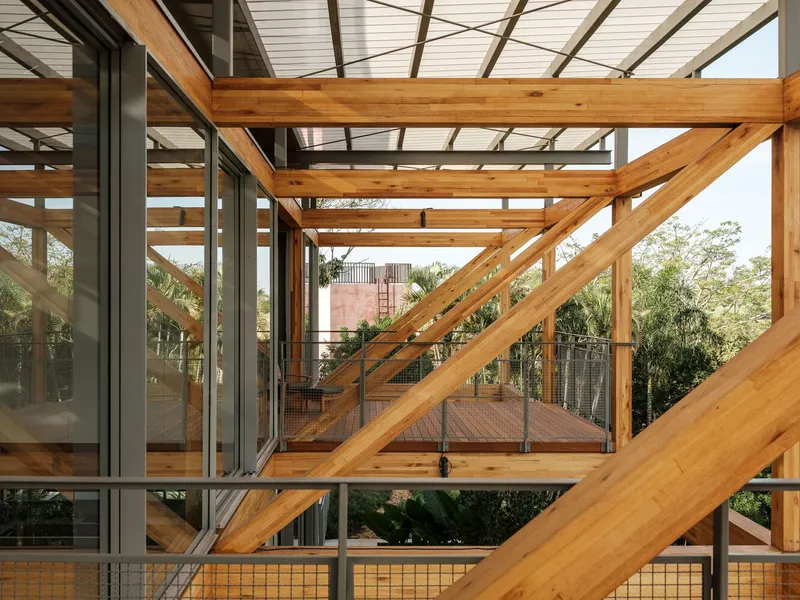
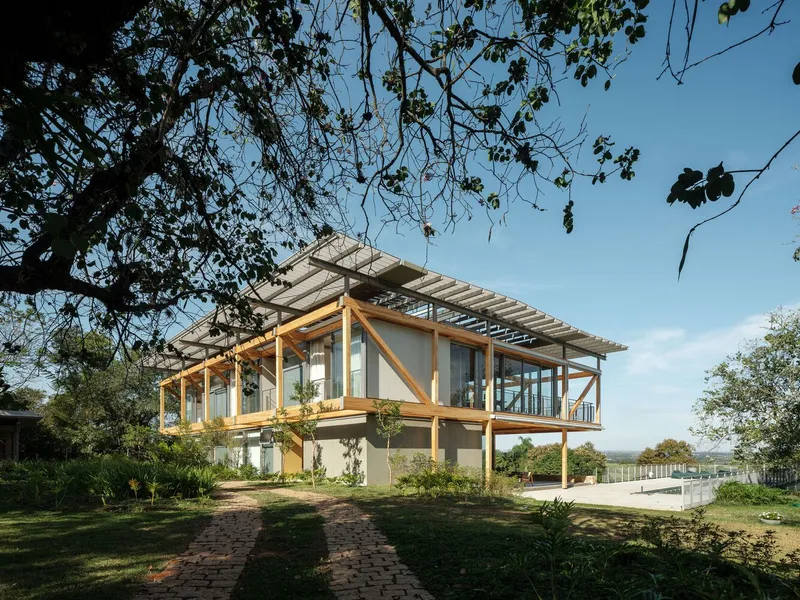
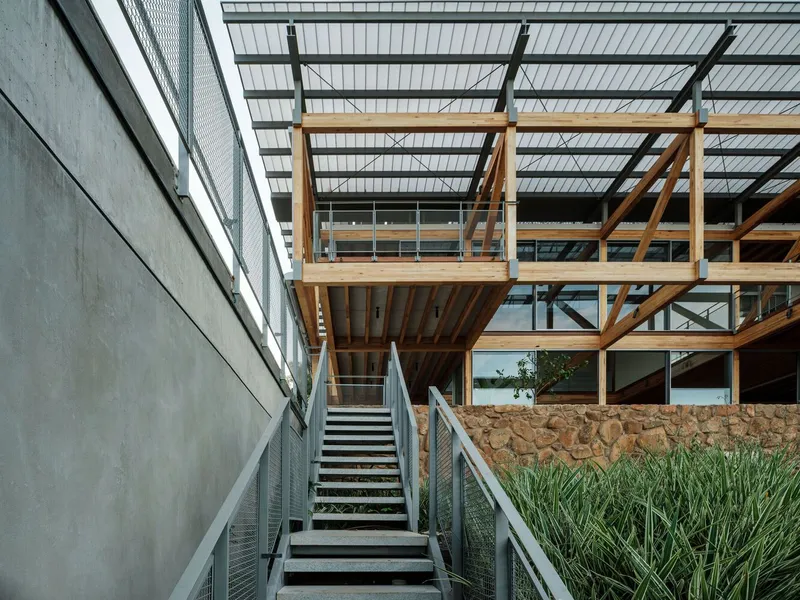
The material palette is deliberately limited: timber for the primary structure, steel for connections and secondary bracing, concrete for the retaining walls, stone cladding at grade, and glass everywhere else. Each material does exactly one job and is visible doing it. The diagonal timber braces that stiffen the frame are the dominant motif, repeating at every scale from the main facade to the elevated walkways connecting interior volumes.
An exterior staircase ascending between a concrete retaining wall and the timber frame captures this honesty in miniature. You walk alongside the structure, close enough to touch the joinery, with a planted bed on one side and the exposed bones of the house on the other. It is a promenade that rewards you with an understanding of how the building works, not just how it looks.
Domestic Spaces Within the Grid
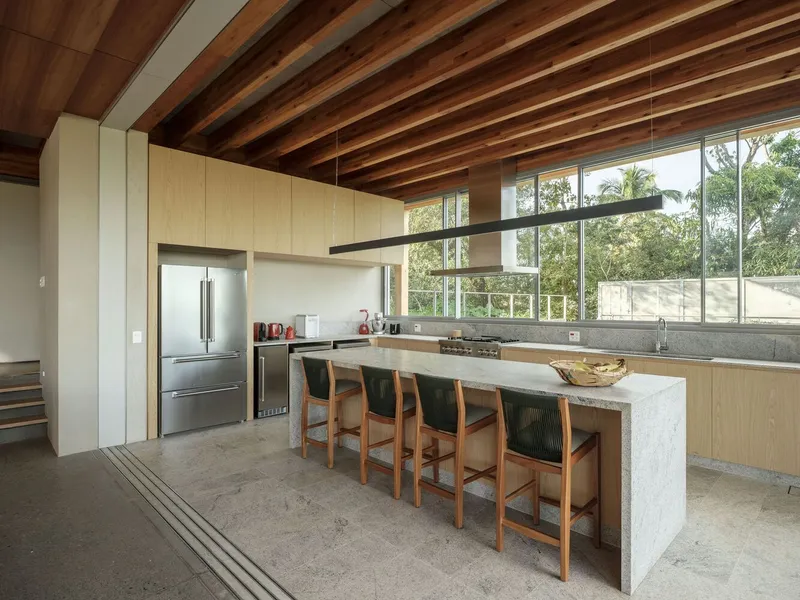
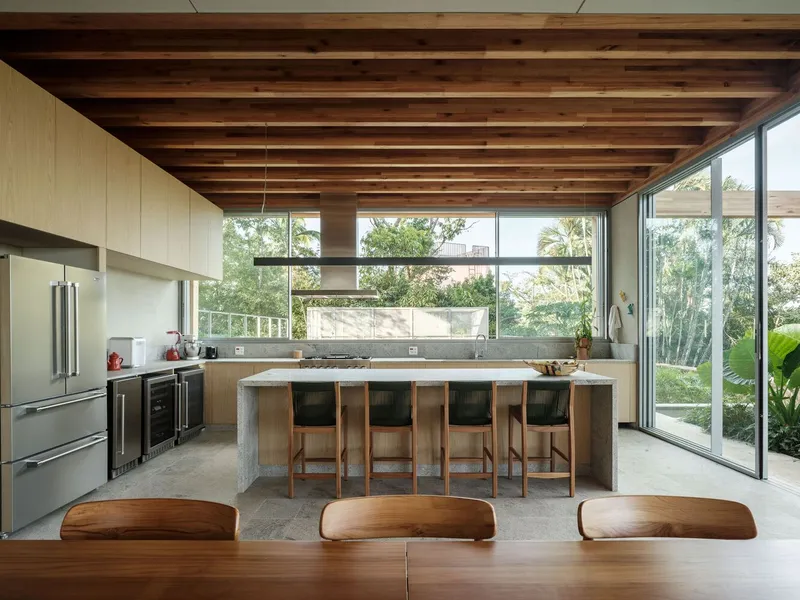
For all its structural ambition, RF Residence never forgets that it is a house. The kitchen, with pale wood cabinetry and a marble island beneath clerestory windows, is a calm, well-proportioned room that happens to sit inside a grand timber frame. The open plan dining and living areas flow into each other beneath the rhythm of exposed ceiling joists, with furniture groupings rather than walls defining program.
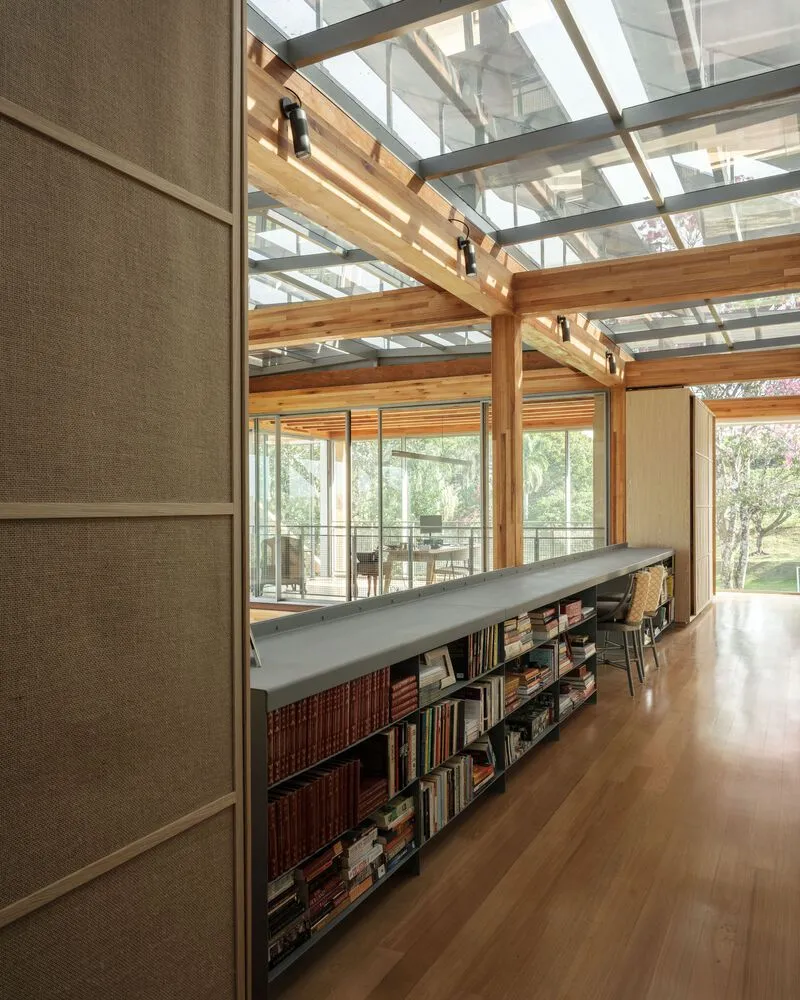
A low bookshelf along the hallway acts as both storage and spatial divider, letting you glimpse the garden through glazed roof panels above. These quieter moments, a desk tucked beneath the mezzanine with views through diagonal bracing to the distant hills, a reading nook beside the timber columns, give the house its lived-in texture. The structural spectacle becomes background, and domesticity takes over.
Landscape as Context and Collaborator
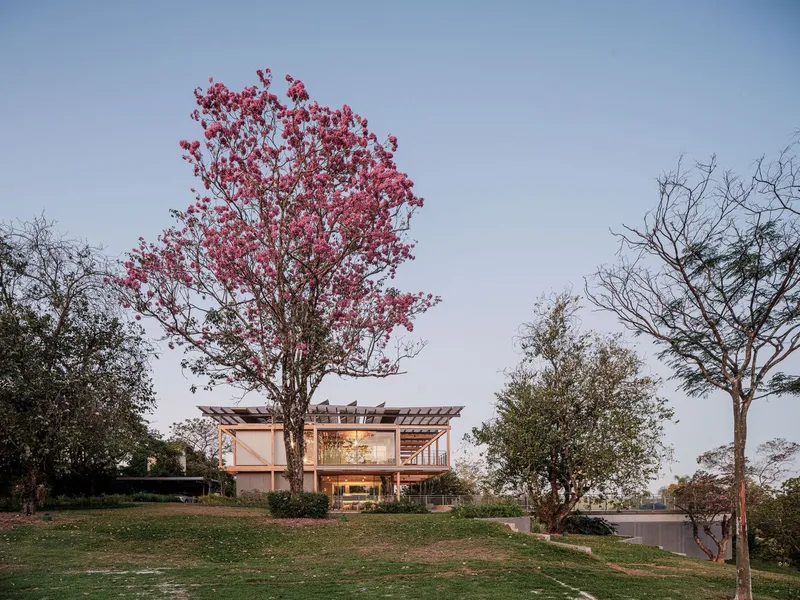
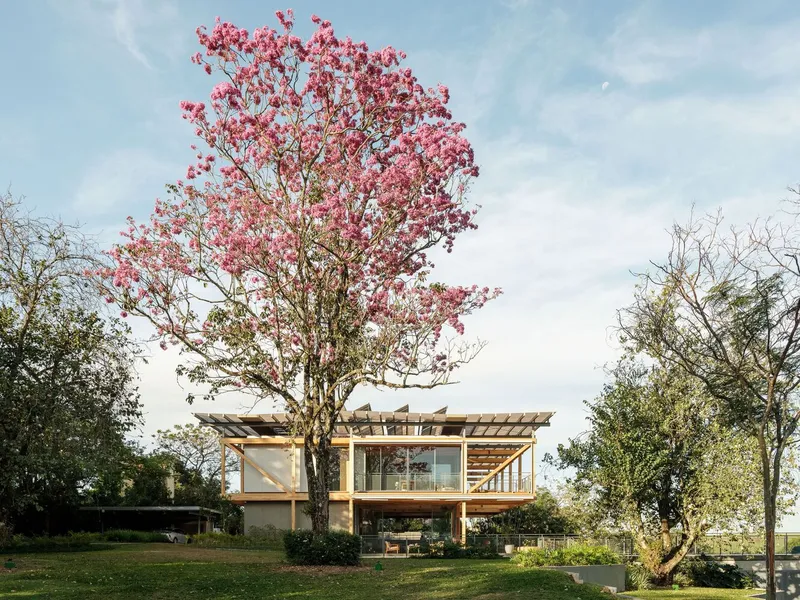
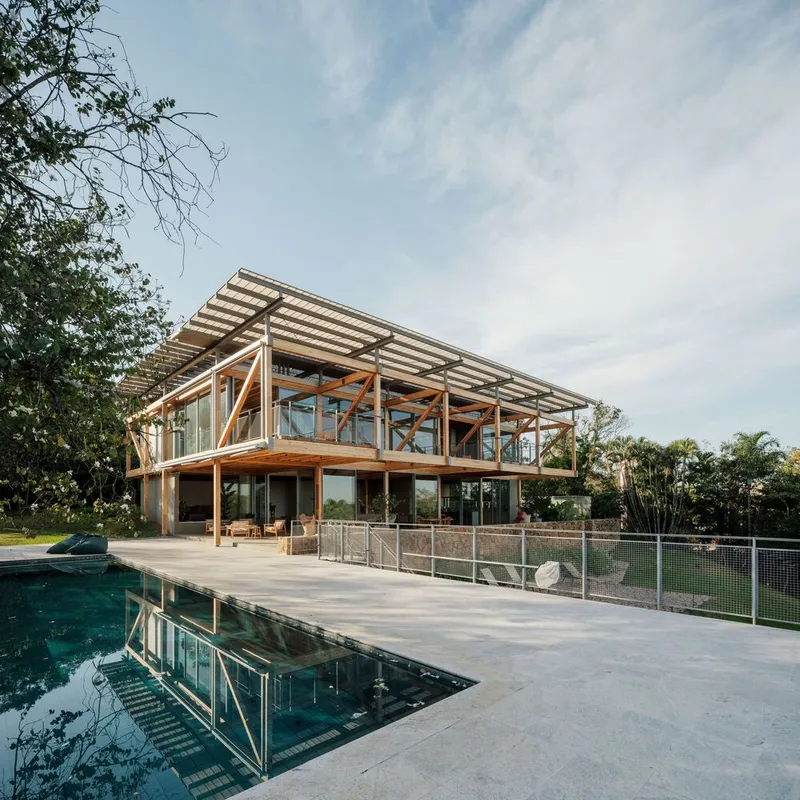
Seen from a distance, RF Residence sits comfortably on its grassy slope, framed by flowering trees and bordered by open fields. A blooming pink tree beside the facade brings a burst of organic color against the disciplined geometry of the timber frame. The reflecting pool at the rear terrace mirrors the sky and the house in equal measure, anchoring the architecture to its site with a thin sheet of water.
The landscape strategy is restrained. Young trees planted in a row along the front will eventually soften the elevation, and garden beds are integrated into the terraces rather than applied around the perimeter. The house does not impose on its site; it lifts itself above the ground plane and lets the countryside flow beneath and around it. The relationship is reciprocal: the landscape gives the house its views, and the house gives the landscape a focal point without dominating it.
Why This Project Matters
RF Residence matters because it refuses to treat sustainability and design ambition as separate conversations. The translucent solar canopy is not a technical appendage; it is the defining architectural gesture. The exposed timber frame is not a style choice; it is a commitment to legible, honest construction that reduces material waste and celebrates craft. In a moment when green technology often arrives as an invisible add-on, this house makes its sustainable systems the most visible and compelling elements of the design.
More broadly, the project demonstrates that residential architecture in rural settings does not need to choose between openness and shelter, between structural expression and domestic comfort, between energy performance and spatial poetry. Andrade Morettin has found a way to hold all of these ambitions in a single, legible frame. The result is a house that teaches you how it works while making you want to sit down and stay.
RF Residence by Andrade Morettin Arquitetos Associados, Brazil. Photography by Pedro Kok.
About the Studio
Share Your Own Work on uni.xyz
If projects like this are the kind of work you want to make, uni.xyz is a place to publish your own, find collaborators, and enter design competitions.




Popular Articles
Popular articles from the community


The Musturak Paradise: Senior Living Architecture for a Connected Future in Temara, Morocco
The Musturak Paradise reimagines senior living architecture in Temara via private homes, social spaces, culture, community, and shared care.
EW PARK: Sustainable Architecture Reimagines the Future of Urban Parking
EW PARK reimagines city parking as a modular wooden tower combining automation, solar energy, electric mobility, and adaptable urban design.

Conexión: Biophilic Design Reimagines High-Rise Living in Hong Kong
Conexión reimagines high-rise living in Hong Kong through biophilic design, green facades, shared spaces, daylight, water and nature within.

Co-Life: Senior Housing Design That Reconnects Older Adults With the City
Co-Life reimagines senior housing design through healing gardens, shared streets, workshops, and a sustainable community across generations.


Similar Reads
You might also enjoy these articles


Hodi-Mandai Geram
Project Function: Preservation and revitalization of the Intangible heritage and socio-spatial identity of the Hodi by Housing, Cultural Memory Center, Sacred Grove, landscape, local tourism economy


Olio Towers: A Mid-Rise for Performers That Fuses Housing, Rehearsal, and Stage
Located blocks from Houston's Theater District, this modular tower stacks living units around a central performance atrium.

Oasis: Modular Green Housing Carved into Dhaka's Urban Fabric
A shortlisted Plugin Housing entry reclaims unauthorized settlements in Dhaka with stepped concrete volumes, green roofs, and ventilation-driven design.

Black Hole: A Floating Megastructure for the Post-Physical Era
Emiliano Mazzarotto envisions a spherical, self-scaling arena where e-sports, digital hotels, and holographic stadiums replace traditional public space.


Explore Architecture Competitions
Discover active competitions in this discipline



Challenge to reimagine the Iron Throne


Photograph architecture without architects


Illustrate the lost glory of Angkor Wat - Render Challenge


Design challenge to reuse E-waste
Comments (0)
Please login or sign up to add comments
No comments yet. Be the first to comment!