

RKW Architektur and KAAN Architecten Build a 25-Meter Atrium Campus for Munich's Werksviertel
Three prefab concrete volumes linked by glass bridges form a new creative hub beside Munich's Ostbahnhof station.


Munich's Werksviertel district, a former industrial zone beside the Ostbahnhof train station, has been steadily reinventing itself as a mixed-use quarter where architectural ambition is not optional. iCampus Munich, a 39,000 square meter office ensemble completed in 2022, is one of the district's clearest statements of intent. Designed by RKW Architektur + for structure and floorplans, with KAAN Architecten responsible for facades, bridges, and atrium roofs, and interiors by HENN, the project delivers three buildings (i5, i6, and i7) that read as a single organism: rigorous on the outside, generous on the inside.
What makes iCampus genuinely interesting is the decision to sacrifice a permitted sixth floor in exchange for nearly four-meter ceiling heights and towering atriums that reach over 25 meters. That trade, floor area for spatial quality, is the kind of move clients almost never approve. Rohde & Schwarz did, and the result is a campus now occupied by Serviceplan, one of Germany's largest communication agencies, who call it the "House of Communication." The nickname is earned: every design decision, from the 11-meter bridges connecting the buildings to the inside-out planning logic that starts at the social heart and works toward the facade, privileges encounter over enclosure.
A Concrete Frame with Industrial Memory
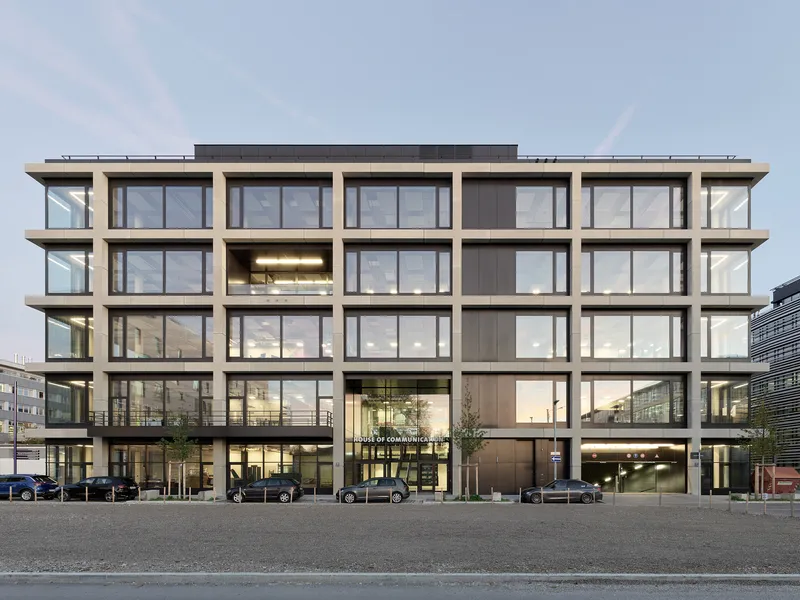
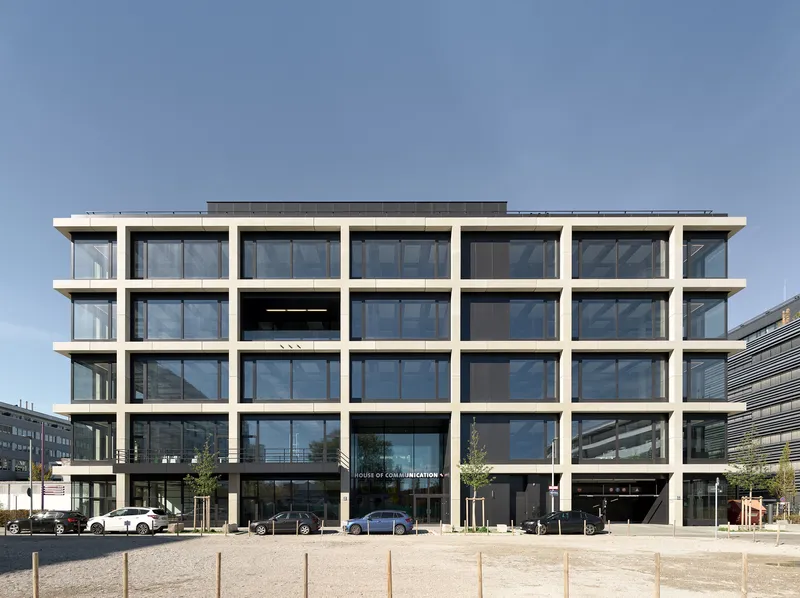
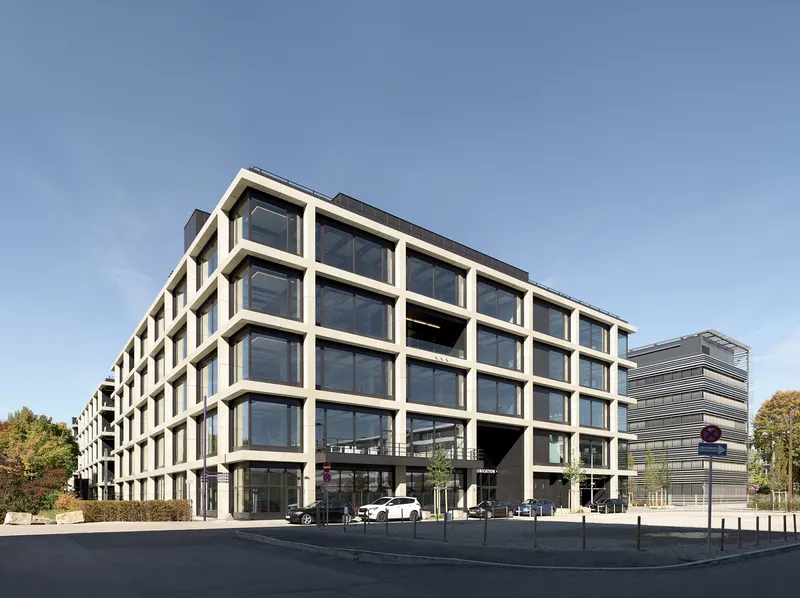
The facades are composed of over 800 large prefabricated concrete elements, designed by KAAN Architecten and produced by Hemmerlein Ingenieurbau GmbH. The sheer size of each panel minimizes structural joints and mounting time, a construction strategy that serves both economy and aesthetics. The resulting grid is calm and rhythmic, with deep reveals framing floor-to-ceiling glazing that keeps the interior visible from the street.
The rational, repetitive language is deliberate. Werksviertel's heritage includes the Rhenania company's 1920s administrative building, a listed landmark nearby. RKW and KAAN anchor iCampus in that industrial lineage without mimicking it: the proportions are generous, the openings are oversized, and the gray concrete reads less as brutalist assertion than as disciplined backdrop. Dark metal cladding marks the entrances and technical zones, giving the ground plane a different register from the stacked office floors above.
The Courtyard and Its Bridges
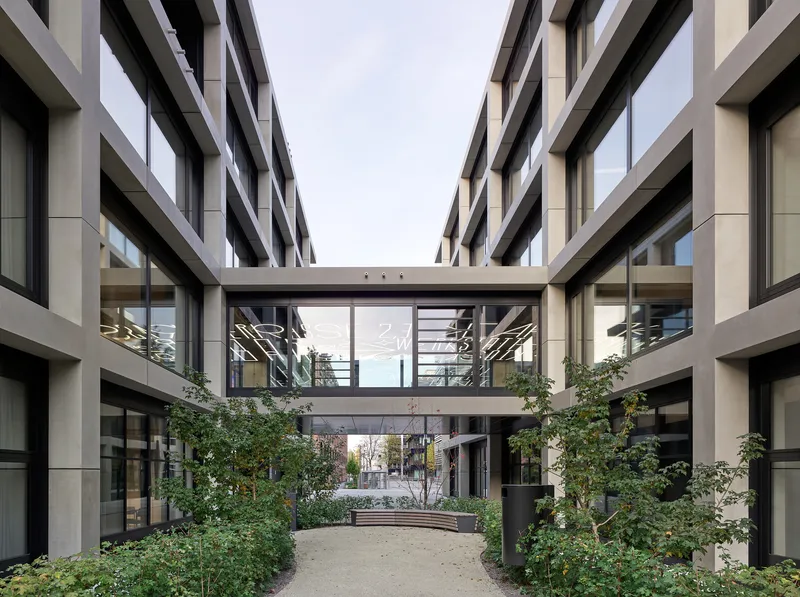

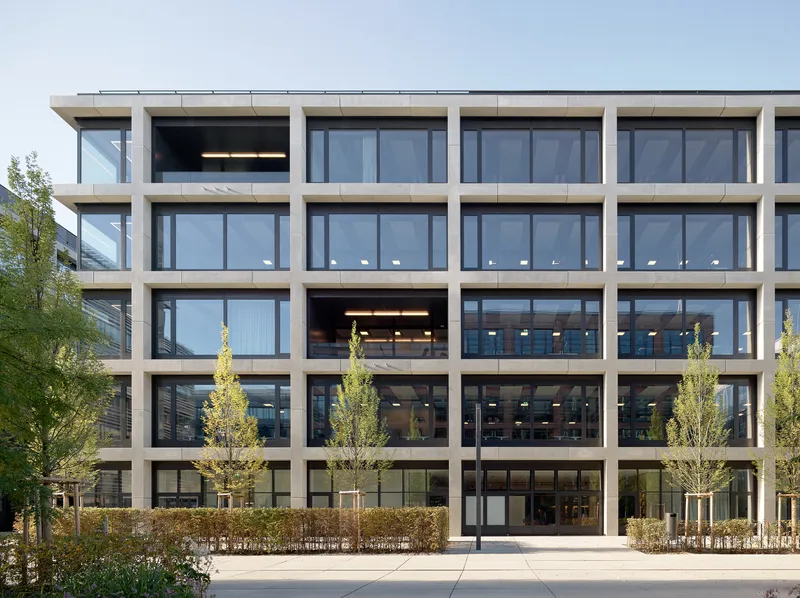
Between the three volumes, a landscaped courtyard activates the ground level with planted beds and young trees. Two cantilevered glass bridges span 11 meters at the first floor, stitching the buildings into a continuous loop that the campus calls the "iTrack." At dusk, the courtyard becomes particularly legible: the gridded facades glow with interior light, and the bridges read as transparent connectors floating between solid masses.
The courtyard is not decorative. It resolves a real circulation problem: how to make three separate structures feel like one workplace without burying people in underground corridors. The bridges keep movement visible and daylit, reinforcing the campus's broader commitment to transparency. Bicycles parked below confirm what the architecture already suggests: this is a place designed for people who walk, cycle, and bump into each other.
25 Meters of Shared Air
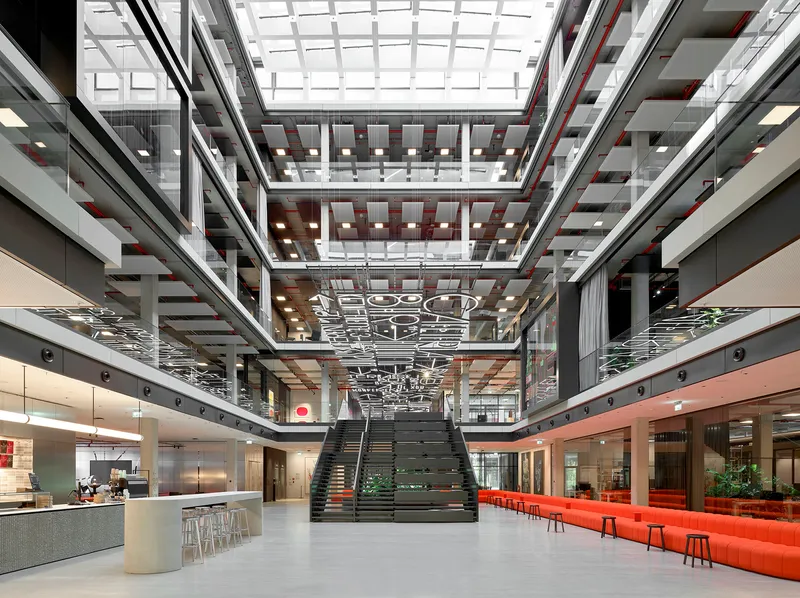
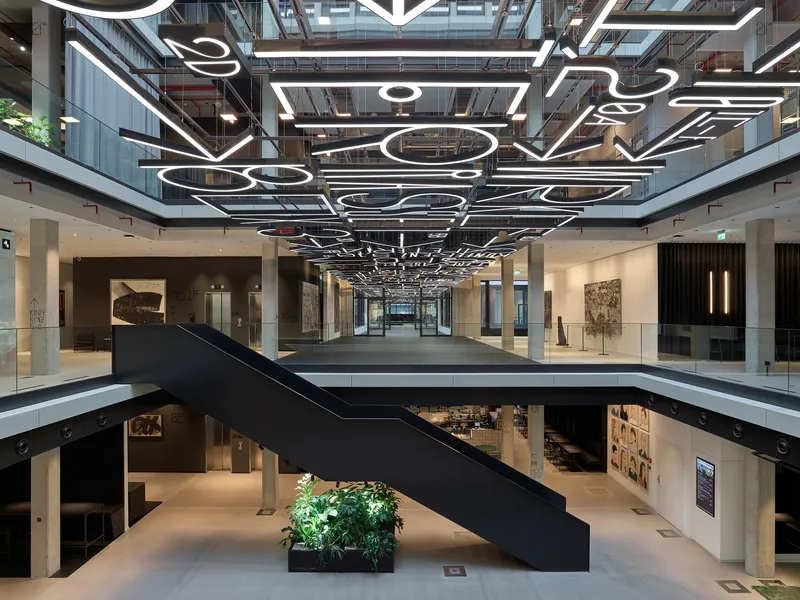

The central atriums are the project's defining spatial move. Rising through all five floors to laminated timber beam roof structures with a simple 2x2 meter grid, they flood deep floor plates with daylight while creating a vertical social space visible from every level. Suspended custom light fixtures, black steel staircases, and gallery-width balconies turn each atrium into an inhabited section drawing.
Planning from the inside out is a phrase architects use often and execute rarely. Here it is tangible: the atrium is not leftover space between office wings but the generative center from which everything else follows. Floors can be subdivided into 400 square meter occupancy units thanks to the rational concrete grid and core placement, meaning the loft-like spaces can accommodate a single large tenant or many small ones without losing the communal quality the atrium provides.
Looking Up Through the Grid
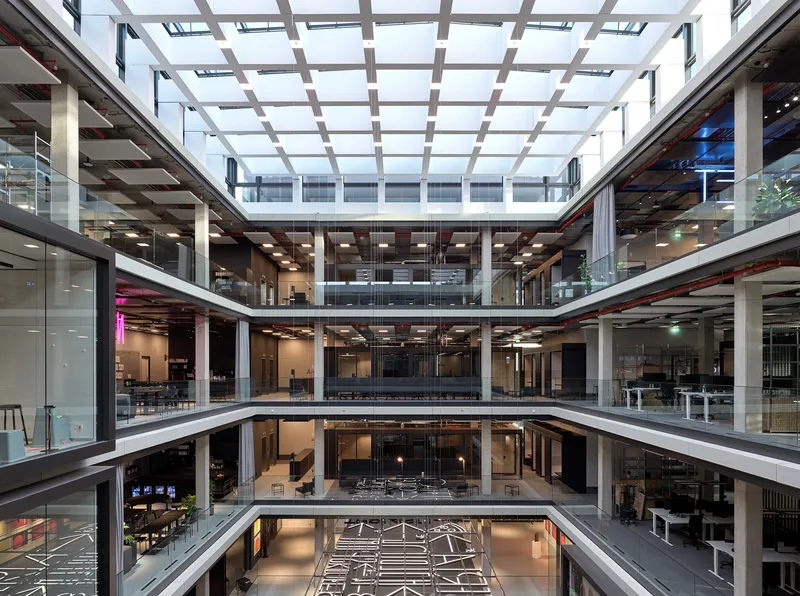
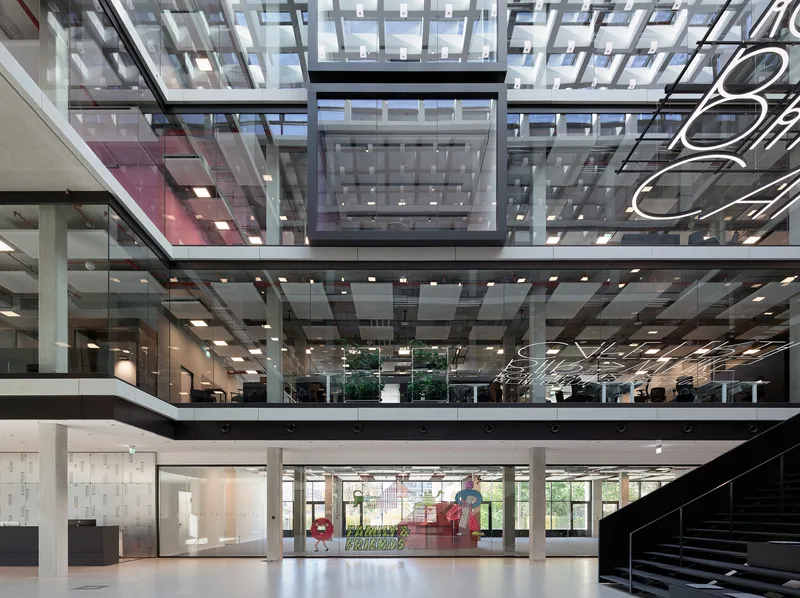

The atrium roofs deserve their own discussion. Built from laminated timber beams rather than steel, they achieve a warmth that tempers the concrete and metal palette below. Integrated sunscreens prevent heat accumulation while maximizing daylight entry, a passive strategy that matters in a building where the atrium is the primary daylighting device for interior zones far from the perimeter facade.
From the ground floor, looking straight up through four levels of stacked floor plates, planted greenery, and the gridded glass ceiling, the effect is cinematic. Neon signage on upper floors and graphic white light fixtures add visual density without clutter. It is a space that rewards the vertical glance, and the architects clearly knew it.
Ground Level: Where the Work Meets the Street

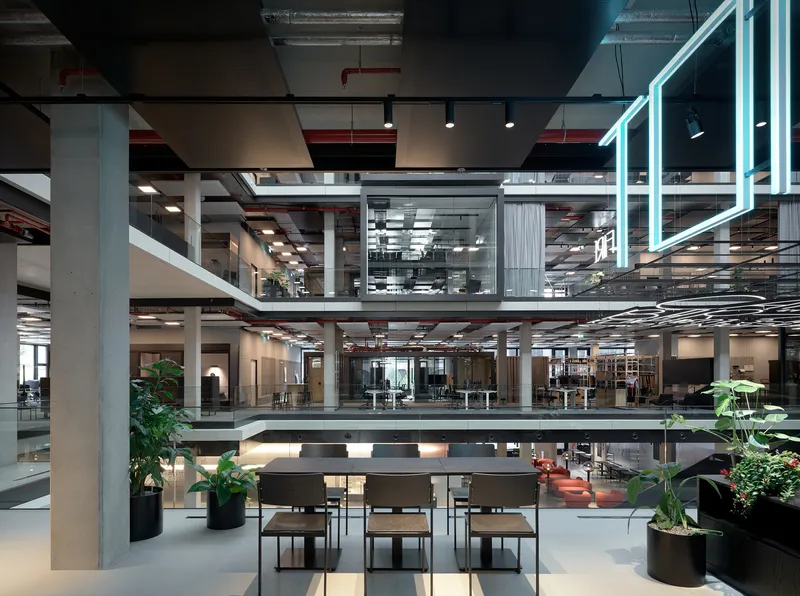

At grade, the atriums become informal gathering spaces. Long orange upholstered benches, exposed concrete columns, and planters create a territory that sits somewhere between hotel lobby and coworking lounge. The nearly four-meter floor-to-ceiling heights give these areas a generosity that typical office ground floors lack. You sense immediately that this is not a pass-through space but a destination.
Cantilevered corner volumes with floor-to-ceiling glazing reveal green furnishings and informal meeting zones from the street, blurring the line between inside and outside. Spacious loggias on upper floors extend this logic vertically, offering workable outdoor space when weather permits and, on clear days, views toward the Alps from the rooftop terraces.
Plans and Drawings
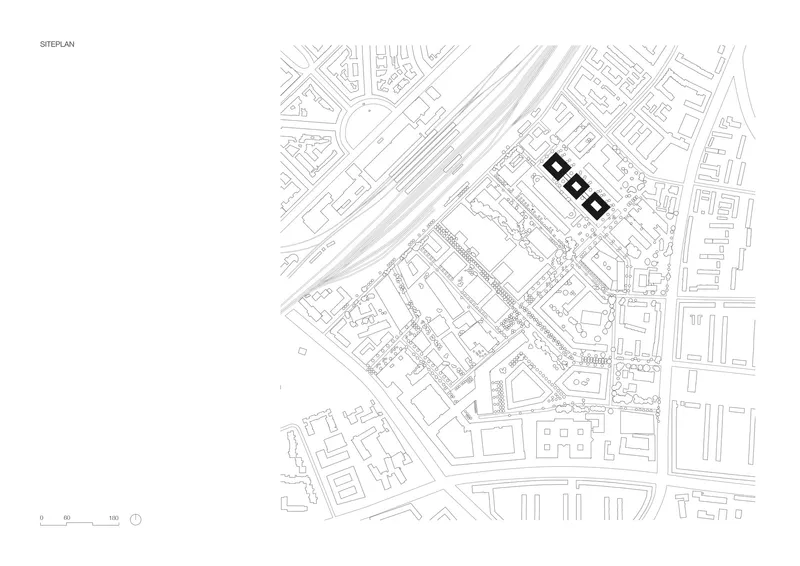
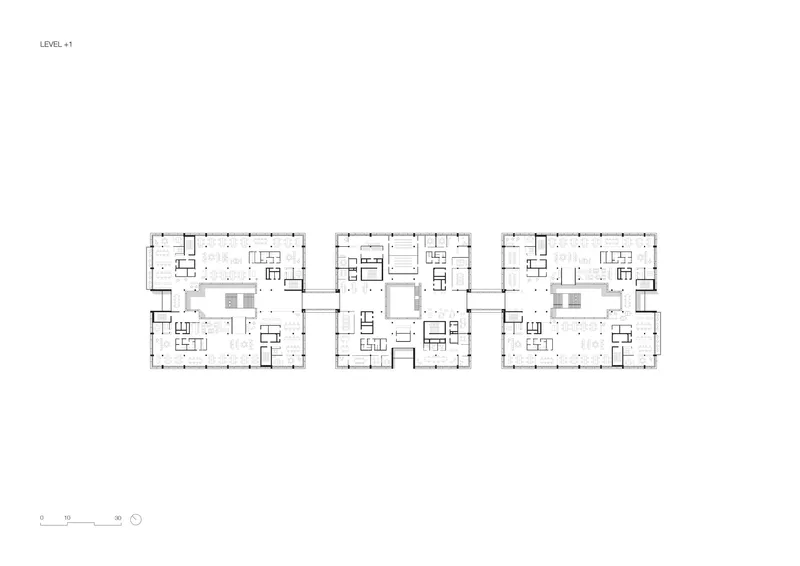
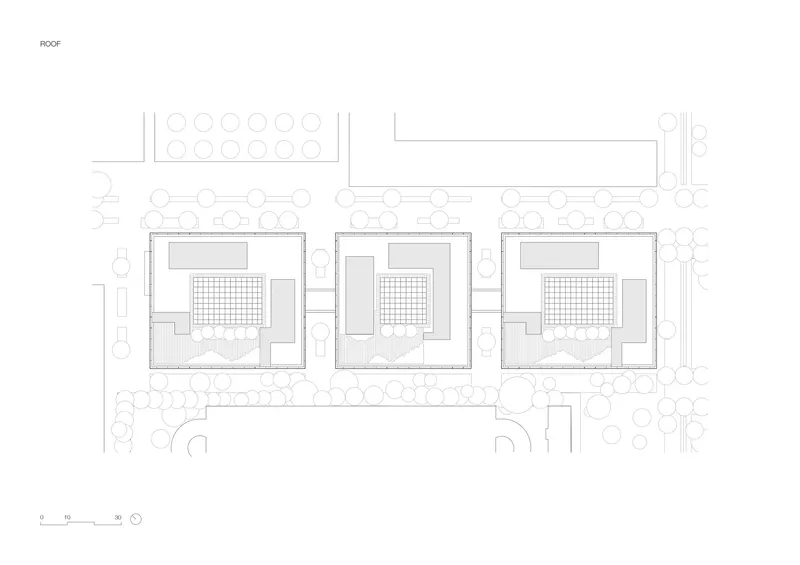
The site plan reveals the project's urban logic clearly: three rectangular volumes aligned parallel to diagonal railway tracks, creating a coherent campus edge while carving out the central courtyard. The floor plans show how each building wraps open office space around a central void, with cores positioned to allow flexible subdivision into 400 square meter units. The roof plan confirms generous planted terraces within each volume's perimeter.
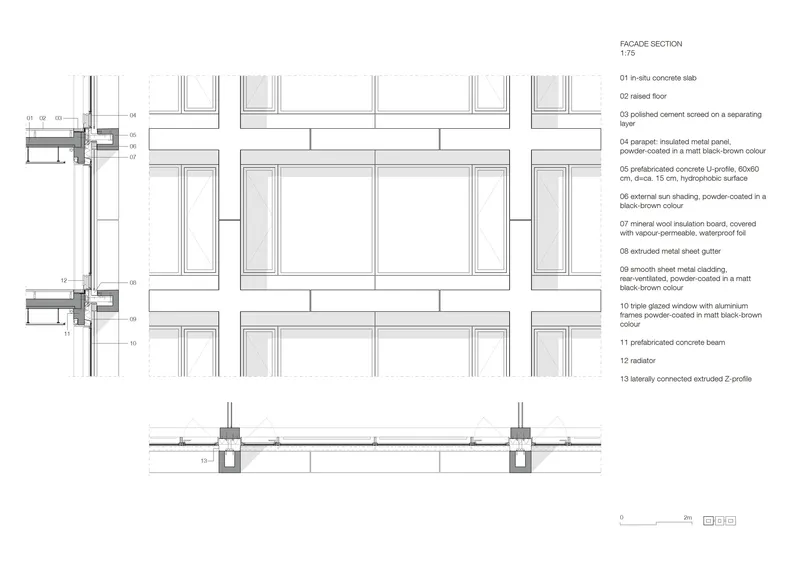
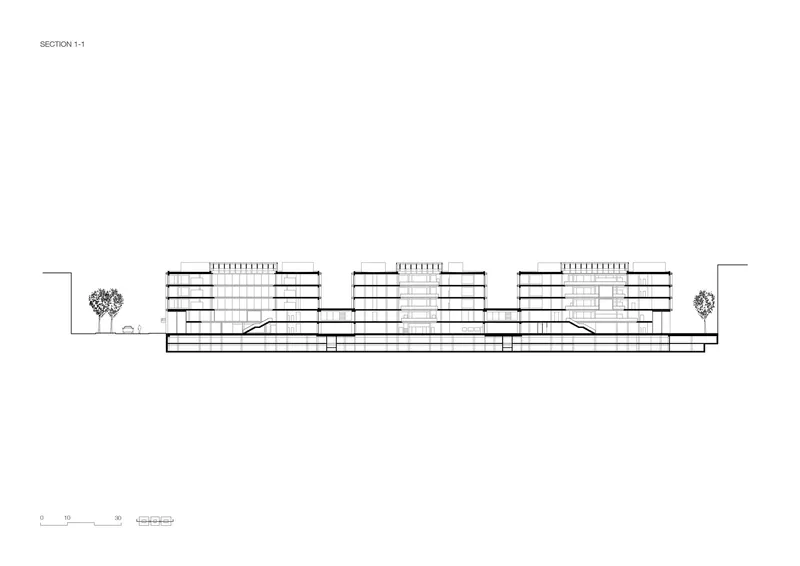
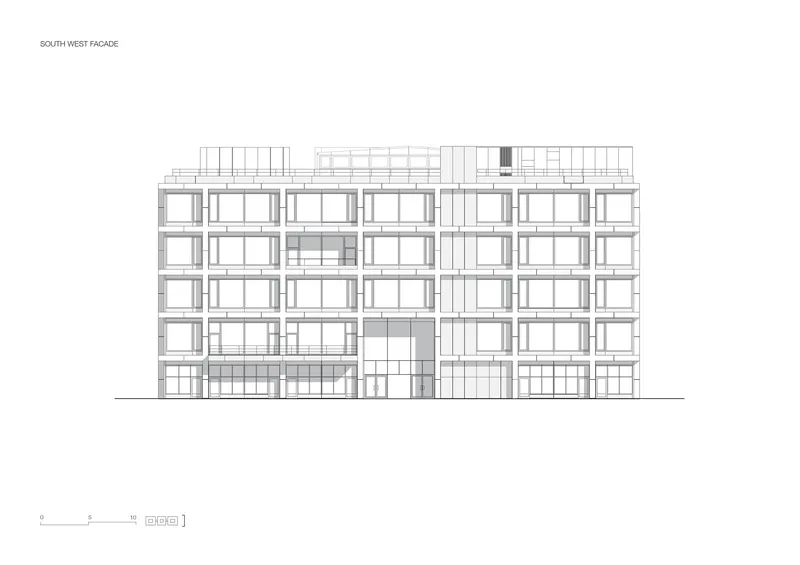
The facade section exposes the layered wall assembly: insulated metal panels and triple-glazed windows set within the prefab concrete grid. The building section is perhaps the most telling drawing, showing the three mid-rise volumes connected by a lower plinth with trees at grade and the full height of the atriums visible in section. The elevation drawing reinforces what the photographs show: a disciplined fenestration rhythm with a central recessed entrance bay that gives each building a legible front door.
Why This Project Matters
iCampus Munich demonstrates that prefabricated construction and spatial generosity are not mutually exclusive. The decision to build five floors instead of six, trading leasable area for livable volume, is the kind of client-architect agreement that produces architecture rather than real estate. The 25-meter atriums, the timber-beam roofs, the 11-meter bridges: these are not gestures. They are structural commitments that cannot be value-engineered away after the fact.
The collaboration model is worth noting too. RKW Architektur + handled the structural planning and floorplates, KAAN Architecten shaped the facades and connective elements, and HENN designed the interiors. In many multi-firm projects, the seams show. Here, the rational concrete grid belongs equally to the facade, the structure, and the interior, creating a coherence that makes the division of labor invisible. For a district still finding its architectural identity, iCampus sets a useful benchmark: rigorous enough to age well, open enough to accommodate whatever work looks like next.
iCampus Munich (i5, i6, i7) by RKW Architektur + and KAAN Architecten, with interiors by HENN. Munich, Germany. 39,000 m². Completed 2022. Lead architects: Lars Klatte, Tanja Frink Interior. Photography by Yohan Zerdoun.
About the Studio
Share Your Own Work on uni.xyz
If projects like this are the kind of work you want to make, uni.xyz is a place to publish your own, find collaborators, and enter design competitions.


Popular Articles
Popular articles from the community


Opera by the Sea Estonia: Three Shells Dissolving Architecture into Tallinn's Coastline
A winning opera house proposal replaces monumental form with interconnected shells that blur the boundary between building, park and Baltic Sea.

Extended Shell: Retrofitting Kolkata's Balconies as Living Urban Thresholds
A modular retrofit system recovers the social and environmental intelligence of Kolkata's historic verandas for contemporary Park Street residents.

Cloaked Colonization: A Mobile Underwater Habitat That Moves Like a Fish
Micah Abaya's shortlisted EHC Pacific entry reimagines ocean settlement as a dispersed network of self-sustaining architectural organisms.

Tsunami Convergenics: Turning Catastrophic Ocean Forces into Underwater Housing Infrastructure
A speculative underwater settlement off the coast of Onagawa, Japan, treats tsunamis and typhoons as energy sources rather than threats.

Similar Reads
You might also enjoy these articles

Pixel Gardens: One Repeated Module Stacked Into a Terraced Social Housing Tower for Famagusta
Salem Bader's shortlisted housing tower builds a vertical neighbourhood from one repeated module, offsetting units to carve terraces, light and air.

Bao Huynh Watercolor Atelier: A Serene Art Retreat in Hội An
Bao Huynh Watercolor Atelier in Hội An blends multifunctional art spaces, sustainable design, local materials, and family-friendly living in a serene environment.

Atelier Macri Concept Store Interior Design by CASE-REAL
Atelier Macri store features a "ko" counter, walnut wood details, cork displays, blending retail, gallery, and seamless customer experiences.

Manuel Vargas Izquierdo Stadium and High-Performance Sports Center: Architectural Excellence in Jalpa de Méndez
The Manuel Vargas Izquierdo Stadium blends sustainable design, inclusive sports facilities, and cultural-inspired architecture, revitalizing Jalpa de Méndez’s public spaces.

Explore Campus Competitions
Discover active competitions in this discipline

Challenge to reimagine the Iron Throne

Photograph architecture without architects

Illustrate the lost glory of Angkor Wat - Render Challenge

Design challenge to reuse E-waste
Comments (0)
Please login or sign up to add comments
No comments yet. Be the first to comment!