
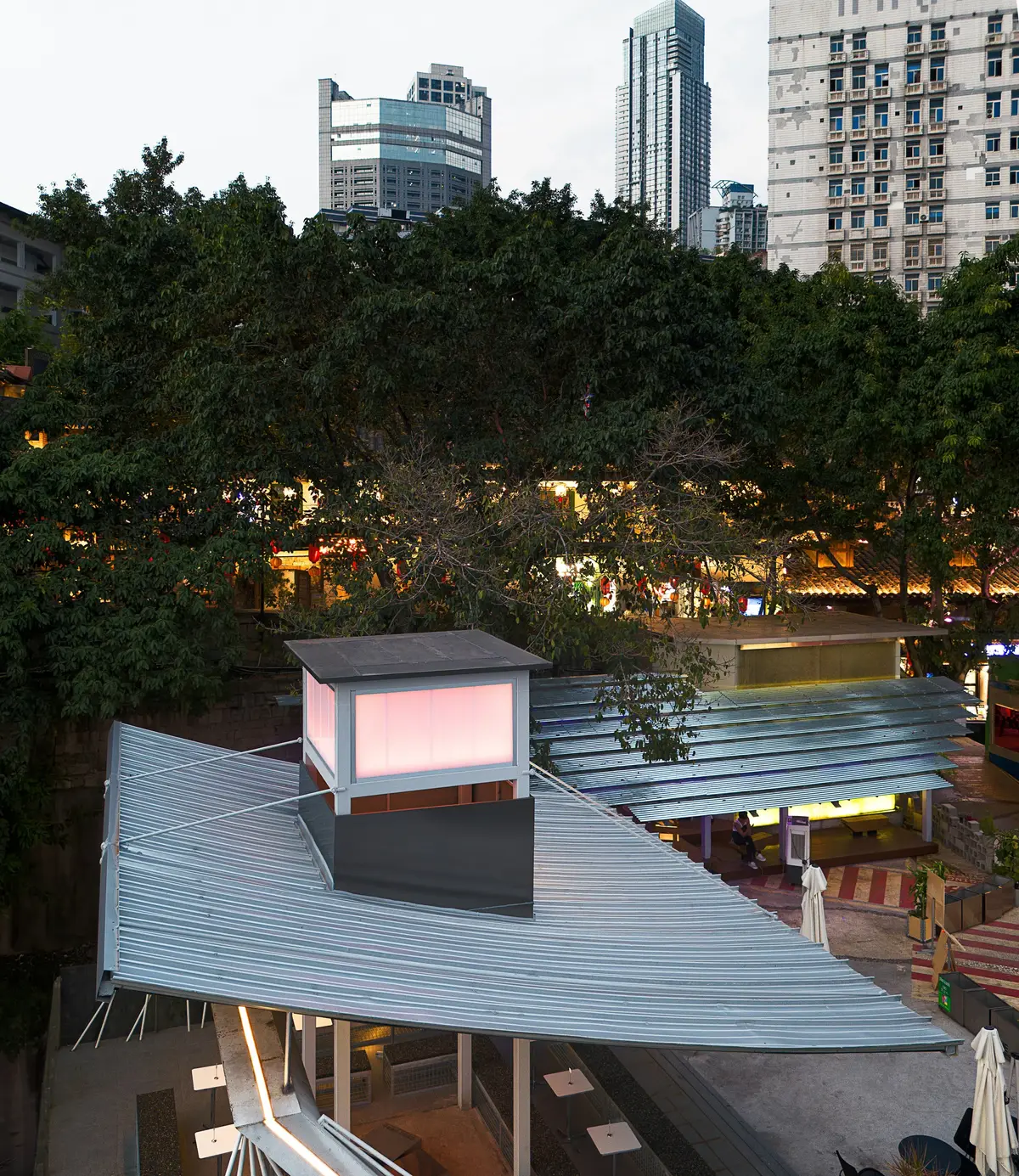
RY+P Architects Perch Two Tea Pavilions on a Chongqing Rooftop Above the Yangtze
A 120 square meter rooftop along Chongqing's historic Mountain Alley becomes an aerial garden for tea, views, and slow city life.


Chongqing's Mountain Alley is one of those vertical neighborhoods that makes the city feel like it was designed by M.C. Escher after a few cups of strong tea. Stone steps climb through dense, layered urbanism, and at the top of one particular flight, visitors used to arrive at a flat, open platform with nothing but a panorama of bridges and the Yangtze River. RY+P Architects, led by Yang Ren, saw that raw exposure as an opportunity: not to build walls, but to shape an aerial garden from corrugated aluminum, painted steel, and the roots of a banyan tree already claiming the site.
What makes this 120 square meter intervention genuinely interesting is the restraint with which it treats spectacle. The project could have been a glass box maximizing the view, or a sculptural landmark competing with the bridges below. Instead, the two pavilions and a pink bar counter together create a rooftop choreography of pausing and wandering, where the act of drinking tea is given the same spatial dignity as the sweeping river vista. The design is small, specific, and unapologetically about tempo.
Corrugated Canopies and the Chongqing Skyline
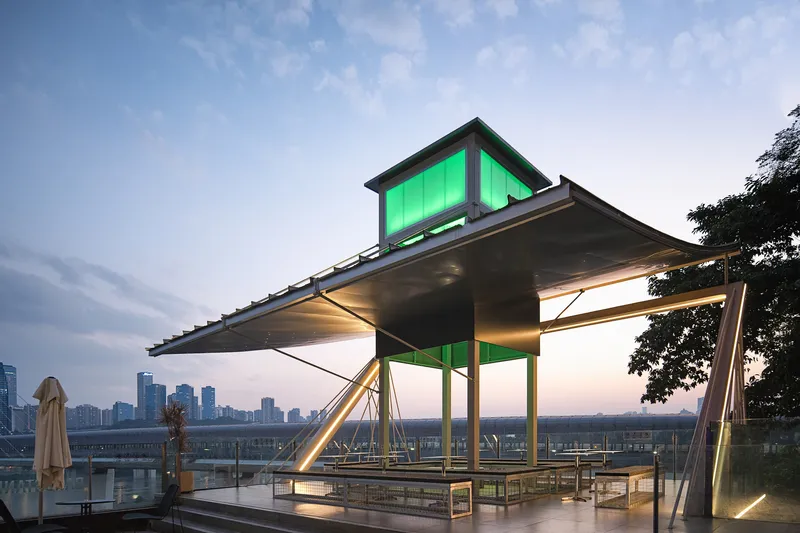
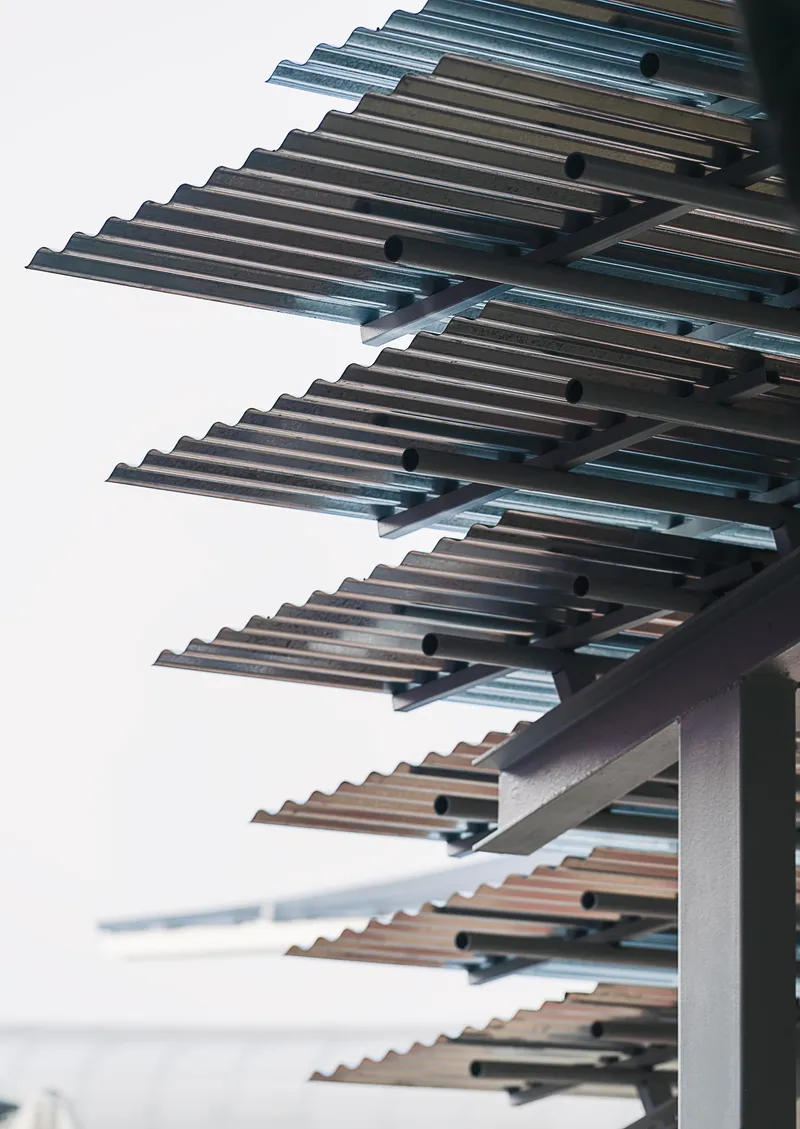
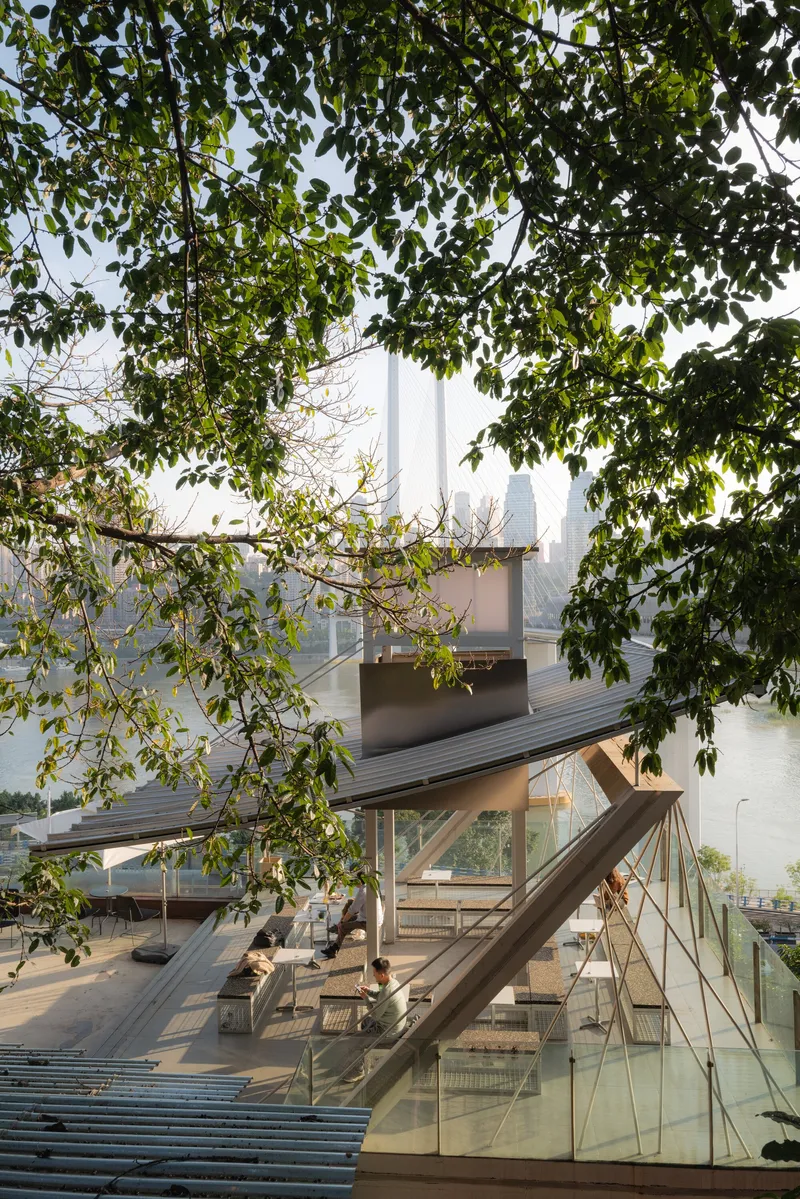
The corrugated aluminum panels that clad both pavilions do a lot of work for a humble material. Their ribbed profile catches light differently throughout the day, shifting from matte grey in the morning haze to a warm metallic glow at dusk. The cantilevered canopy of the second pavilion extends outward in a wing-like profile, providing shade while maintaining spatial continuity with the open terrace. This is not decorative: in Chongqing's humid subtropical climate, overhead cover that still lets air circulate is a functional necessity.
The curved roof of one pavilion echoes the existing steel structure of the building beneath it, a move that reads as structural sympathy rather than mimicry. Exposed painted steel frames are left visible, giving the pavilions an honest, lightweight quality that avoids pretending to be permanent architecture. They sit on this rooftop like well-made furniture, not monuments.
The Character 回: Seating as Spatial Idea
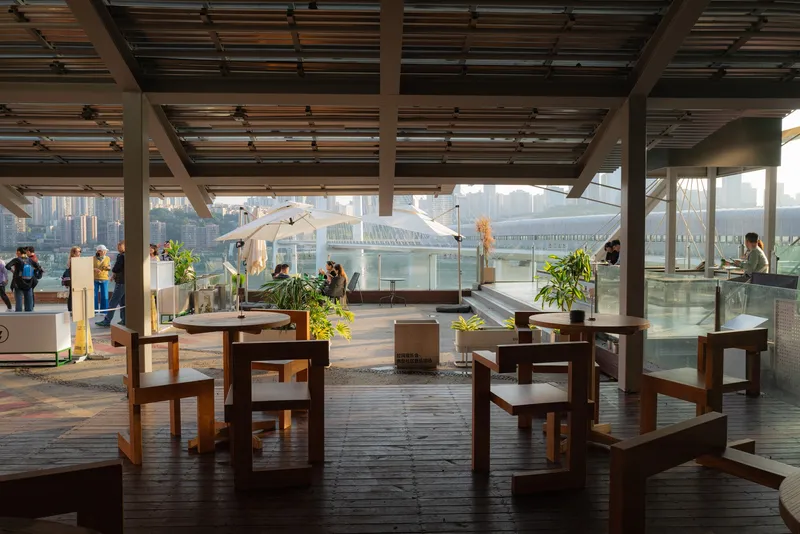
The first pavilion arranges its seating in a square configuration inspired by the Chinese character 回, which literally means "to return" and visually represents a space within a space. Visitors sitting along the perimeter can face outward toward the city or turn inward toward each other. It is a simple organizational diagram, but it produces real behavioral flexibility: a solo visitor gazing at the Yangtze and a group of friends sharing a pot of tea can occupy the same pavilion without conflict.
Timber furniture under slatted ceilings completes the material palette. The waterfront panorama is framed rather than displayed, visible through the steel bracing and between the timber battens. The architects clearly understand that a view gains value when it is partially concealed.
Banyan Roots and the Second Pavilion
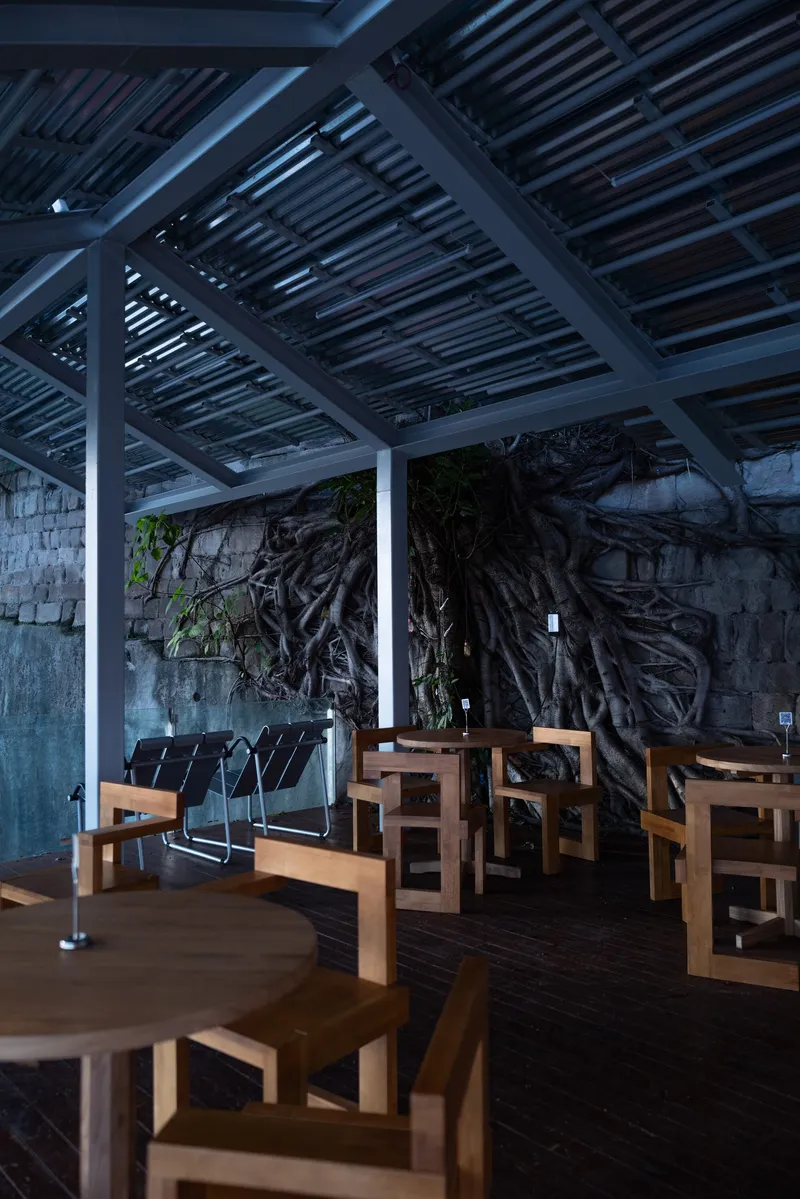
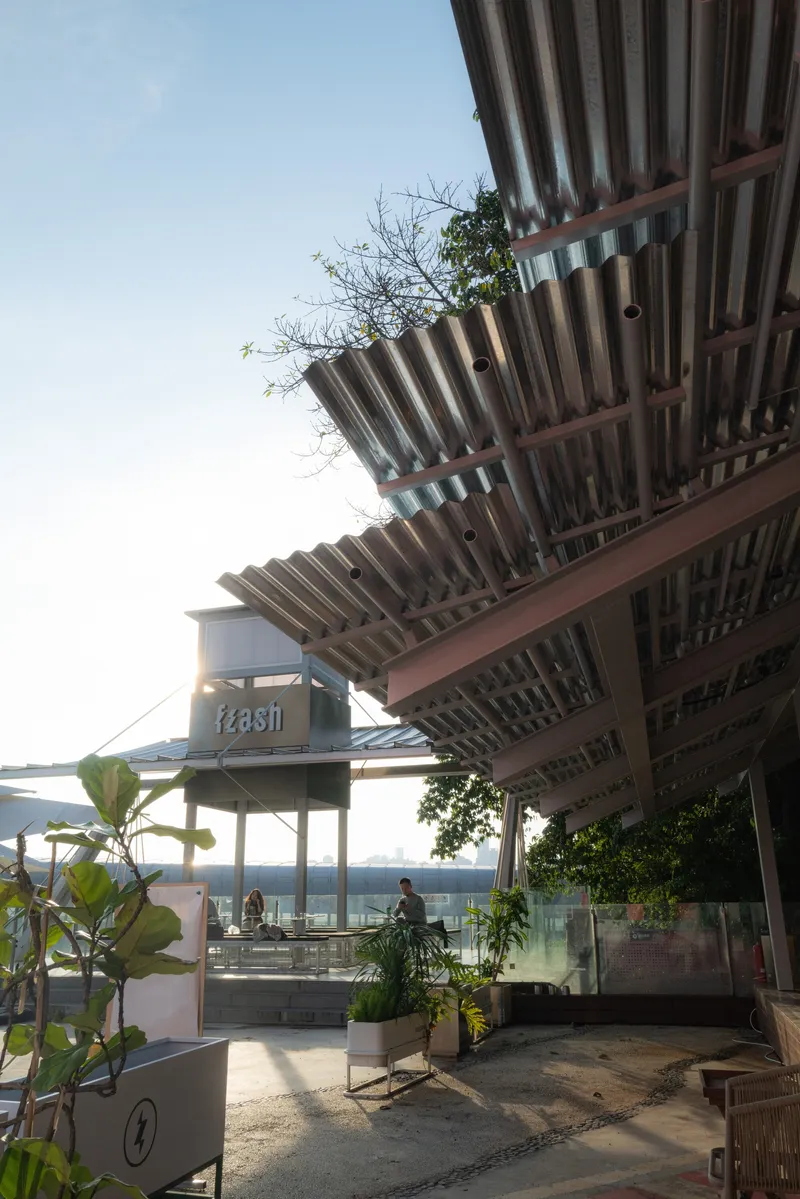
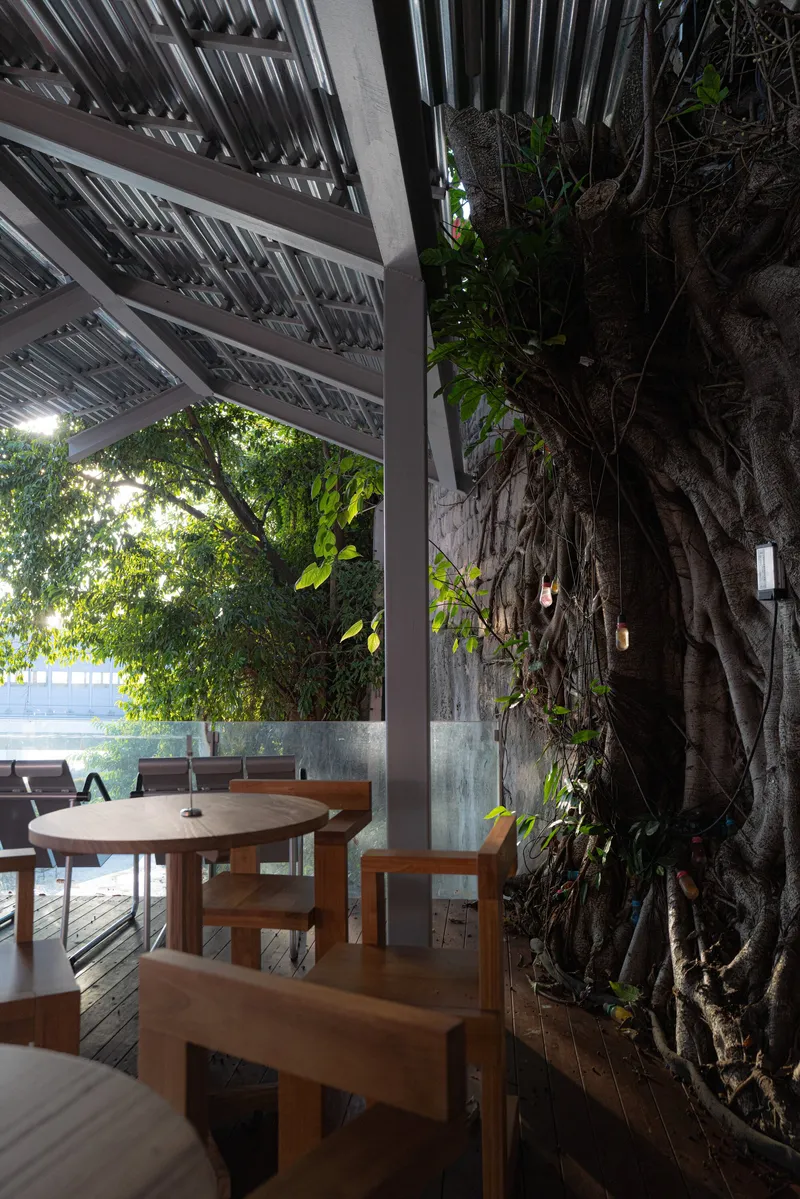
The second pavilion takes the opposite spatial approach: a looser layout where visitors can occupy the space freely, sitting, standing, or simply passing through. Its defining feature is not a design gesture but a biological one. Large banyan tree roots extend into the pavilion, climbing the walls and intertwining with the structure. Rather than removing or concealing them, the architects built around them, creating a quiet, intimate atmosphere where nature is not a backdrop but a co-inhabitant.
The tropical plantings beneath the corrugated canopy reinforce this sense of a garden suspended in mid-air. Morning haze filters through the tree branches and glass balustrades, softening the boundary between built form and landscape. It is a space that rewards patience, which is exactly the right quality for a teahouse.
The Pink Bar and Social Choreography

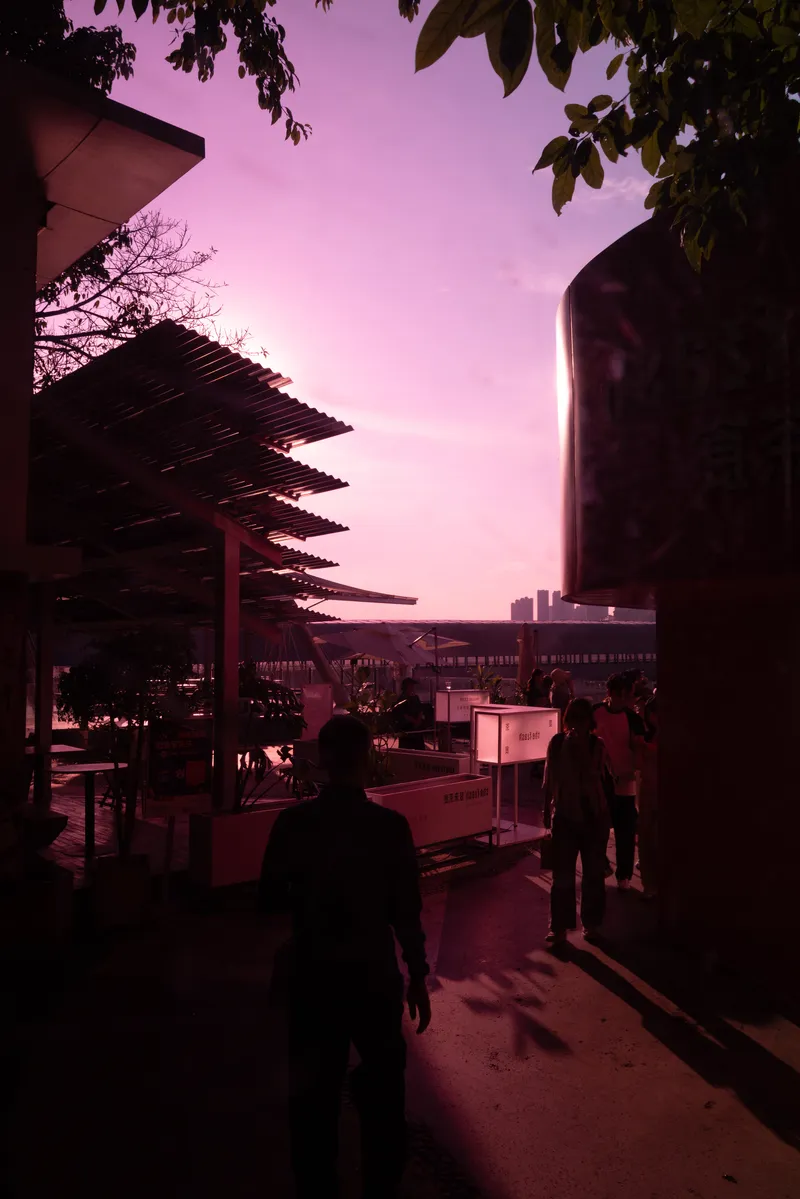
Between the two pavilions sits a pink bar installation that serves drinks and light food. Its pure pink surface and gently curved entrance make it the most overtly playful element on the rooftop, functioning as a social hub that draws visitors into the center before they disperse toward the quieter zones. The color choice is bold enough to register as intentional without overwhelming the muted palette of aluminum and timber surrounding it.
The three volumes together, two pavilions and one bar, are arranged to create a gentle sense of enclosure on what was previously a wide open platform. They frame views toward the surrounding city while shaping distinct zones for sitting, resting, and wandering. The rooftop becomes a sequence of rooms without walls, a miniature garden in the air where movement is slow and deliberate.
Dusk, Bridges, and the River Below
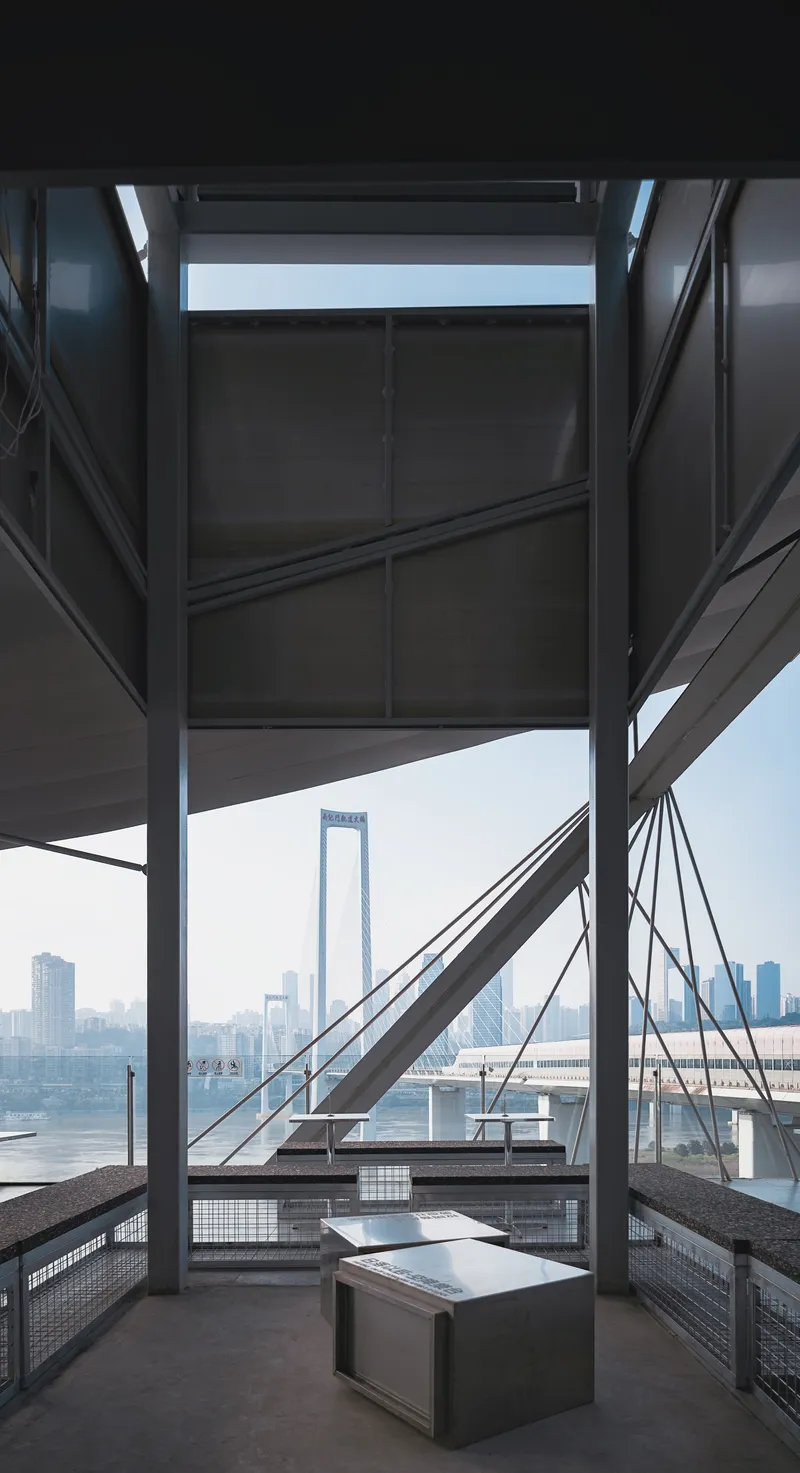
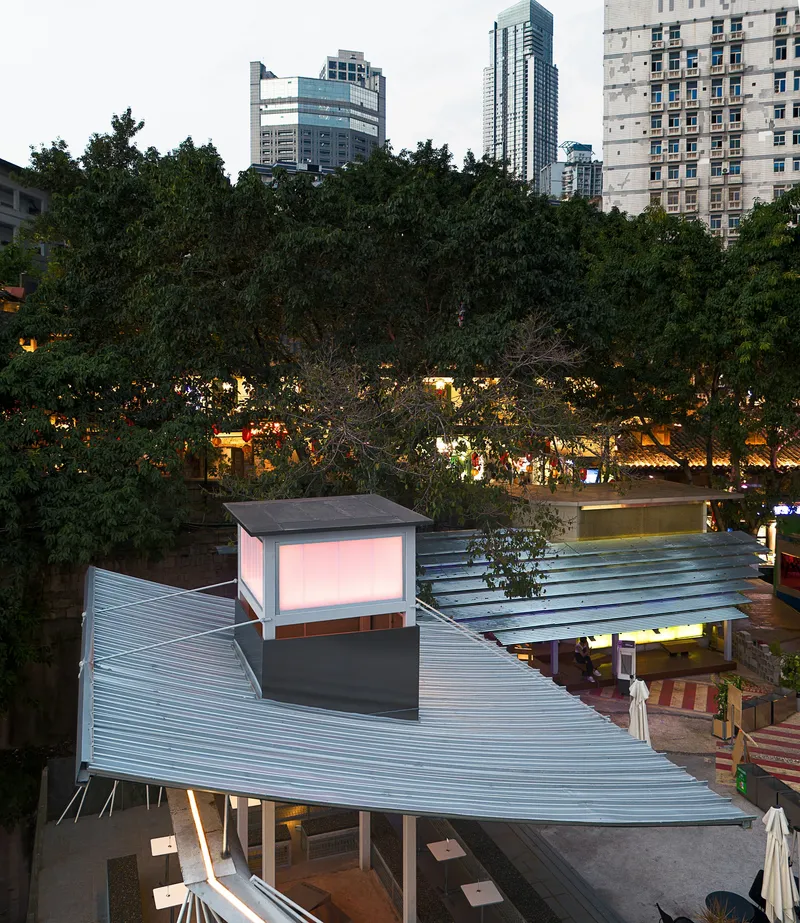
The best photographs of this project are taken at twilight, and that is not a coincidence. Chongqing is a city that transforms at dusk, its layered topography suddenly legible in the pattern of lights climbing hillsides and strung along bridge cables. From this rooftop, the view through steel structural bracing toward the waterfront bridges under a misty sky collapses the distance between intimate interior and vast urban landscape. The green glow of the upper volume at night turns the pavilion into a quiet beacon on the Mountain Alley skyline.
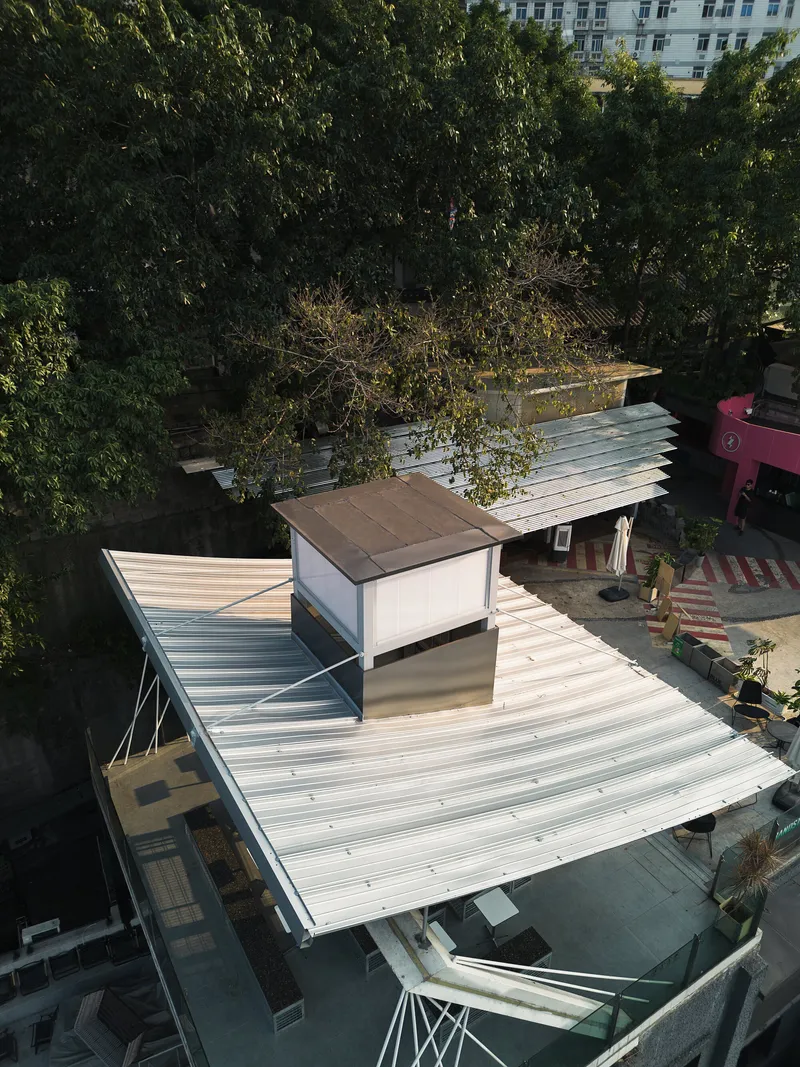
The aerial view reveals how precisely the curved corrugated roofs are calibrated to the site. They shelter a courtyard surrounded by mature trees, creating a composition that reads as deliberate even from above. The pavilions do not fight the rooftop's irregular geometry; they negotiate with it.
Plans and Drawings
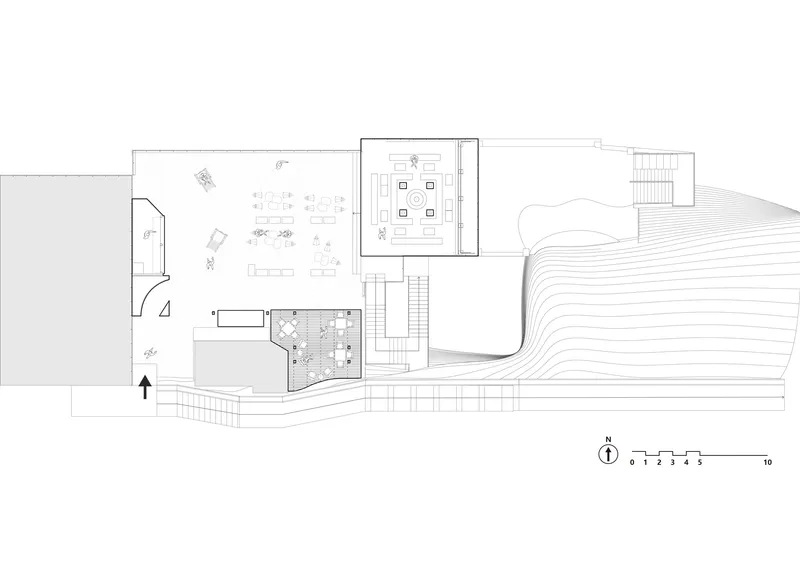
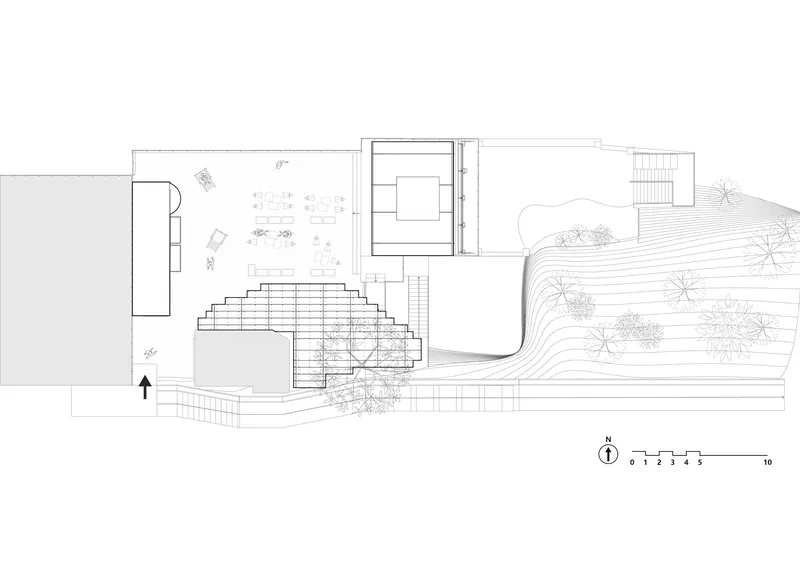
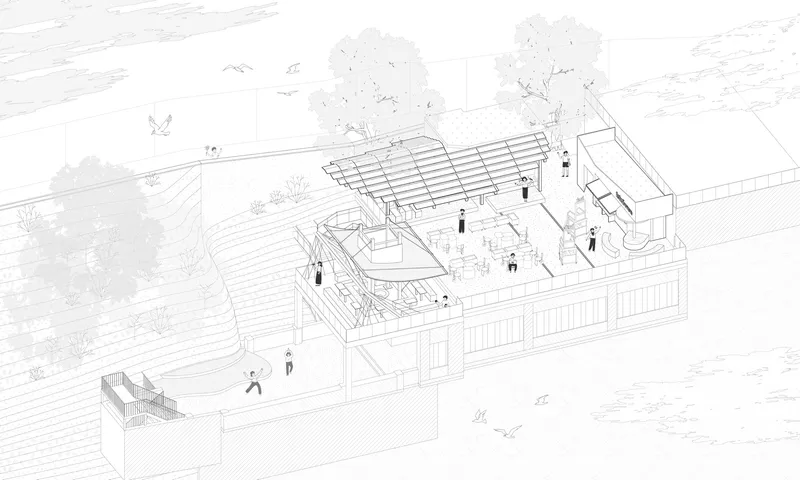
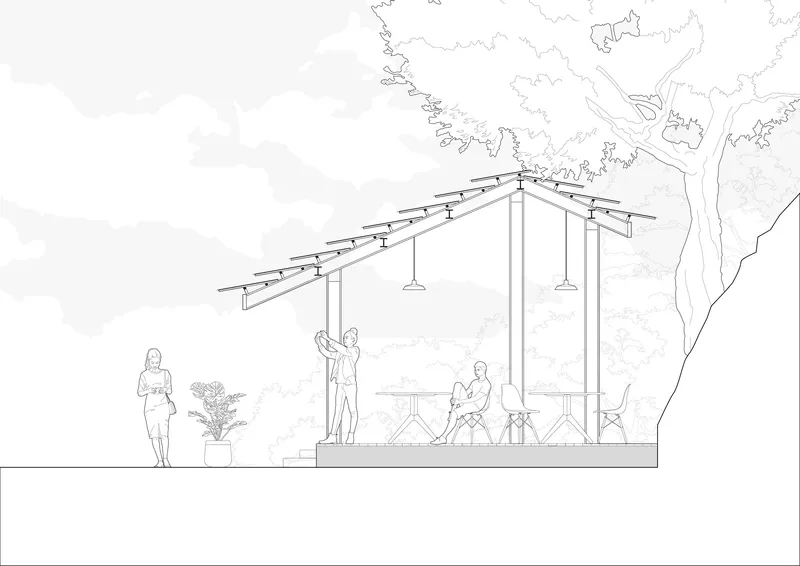
The site plans reveal the steep contoured topography that defines the project's context: stepped platforms descending through landscape with trees positioned as fixed coordinates around which the pavilions were placed. The axonometric drawing makes clear how the slatted canopy, landscaped areas, and circulation routes relate to one another across the compact 120 square meter footprint.
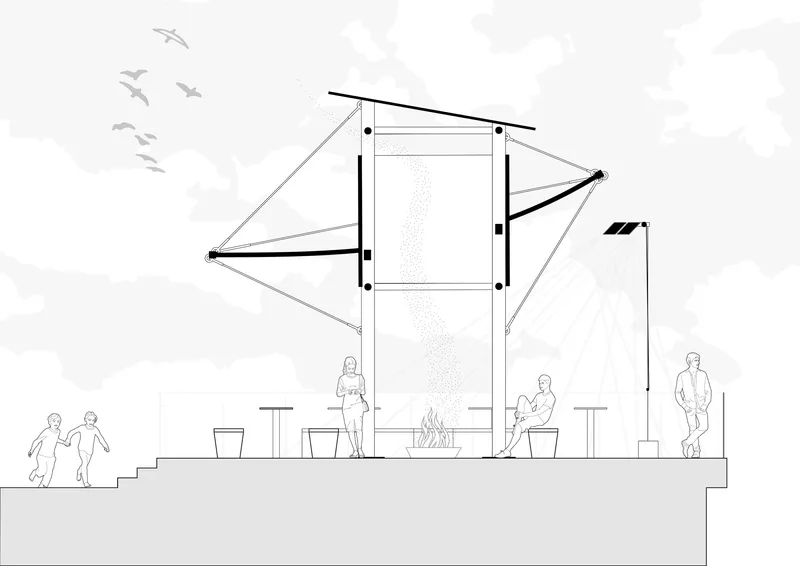
The section drawings are perhaps the most revealing. They show double-height spaces with tensile roof structures and figures gathered in loose social configurations. Pendant lights hang beneath tree canopies, and exposed rafters create rhythmic overhead planes. The sections confirm what the photographs suggest: these pavilions are designed to be experienced primarily from below, looking up through layered screens of structure, foliage, and sky.
Why This Project Matters
The Mountain Alley Rooftop Teahouse Pavilions matter because they demonstrate that architectural ambition does not require architectural scale. At 120 square meters, this is a project that could easily be dismissed as minor. But RY+P Architects have treated the rooftop as a complete urban proposition: a place where the speed of the contemporary city is deliberately slowed, where a Chinese character becomes a seating diagram, and where banyan roots are given more authority than the steel structure they inhabit.
In a city defined by its relentless vertical expansion, this project looks sideways and upward rather than higher. It reclaims an existing surface rather than adding new volume. It introduces a contemporary layer to a historic alley without erasing its character. And it insists that the ritual of tea, of sitting still and watching a river, is a program worthy of the same design intelligence we lavish on museums and concert halls. That is a position worth defending.
Mountain Alley Rooftop Teahouse Pavilions by RY+P Architects, lead architect Yang Ren. Chongqing, China. 120 m². Completed 2025. Photography by Hongming Liu.
About the Studio
Share Your Own Work on uni.xyz
If projects like this are the kind of work you want to make, uni.xyz is a place to publish your own, find collaborators, and enter design competitions.


Popular Articles
Popular articles from the community

Opera by the Sea Estonia: Three Shells Dissolving Architecture into Tallinn's Coastline
A winning opera house proposal replaces monumental form with interconnected shells that blur the boundary between building, park and Baltic Sea.

The Amber Palace Opera: A Geological Fiction Surfaces on Tallinn's Baltic Waterfront
Pierre Brillard reimagines a Baltic legend as a public landscape, opera house, and waterfront promenade rooted in Tallinn's coastal identity.
Extended Shell: Retrofitting Kolkata's Balconies as Living Urban Thresholds
A modular retrofit system recovers the social and environmental intelligence of Kolkata's historic verandas for contemporary Park Street residents.

Singing Woman: An Opera House That Performs Before the Curtain Rises
Ovidiu Cristian Pavel's conceptual opera house translates Estonia's choral identity into a sculpted waterfront landmark facing the Baltic Sea.

Similar Reads
You might also enjoy these articles

Pixel Gardens: One Repeated Module Stacked Into a Terraced Social Housing Tower for Famagusta
Salem Bader's shortlisted housing tower builds a vertical neighbourhood from one repeated module, offsetting units to carve terraces, light and air.

Bao Huynh Watercolor Atelier: A Serene Art Retreat in Hội An
Bao Huynh Watercolor Atelier in Hội An blends multifunctional art spaces, sustainable design, local materials, and family-friendly living in a serene environment.

Atelier Macri Concept Store Interior Design by CASE-REAL
Atelier Macri store features a "ko" counter, walnut wood details, cork displays, blending retail, gallery, and seamless customer experiences.

Manuel Vargas Izquierdo Stadium and High-Performance Sports Center: Architectural Excellence in Jalpa de Méndez
The Manuel Vargas Izquierdo Stadium blends sustainable design, inclusive sports facilities, and cultural-inspired architecture, revitalizing Jalpa de Méndez’s public spaces.

Explore Chinese Small Scale Architecture Competitions
Discover active competitions in this discipline

Challenge to design a portable theatre

Challenge to design a portable music platform

Challenge to design an open learning module for the elderly
Comments (0)
Please login or sign up to add comments
No comments yet. Be the first to comment!