
S-AR Builds a Courtyard House in Santiago That Frames Mountains Through Stone and Concrete
A 470-square-meter residence in colonial Santiago, Mexico, pairs gabion walls and concrete colonnades with views of the Sierra Madre.


La Villa de Santiago sits 37 kilometers south of Monterrey, a colonial town that draws weekend visitors to its mountain scenery and mild climate. For a private residence on a trapezoidal lot in this setting, S-AR, led by César Guerrero and Ana Cecilia Garza, chose to work with a restrained palette of raw concrete, gabion stone, and black metal. The result is a house that treats every element, from a spiral stair tower to a gravel courtyard, as an opportunity to negotiate between enclosure and openness.
What makes this project worth studying is not any single gesture but the disciplined way it orchestrates materials to calibrate privacy and prospect. The house operates as a series of thresholds: a stone wall that blocks the street while revealing distant peaks through a recessed door, a colonnade that mediates between interior rooms and garden, a cylindrical stair core that punctuates the horizontal plan with a vertical event. Each decision reinforces the idea that in a landscape this generous, architecture should curate rather than compete.
Stone Walls and Mountain Sight Lines
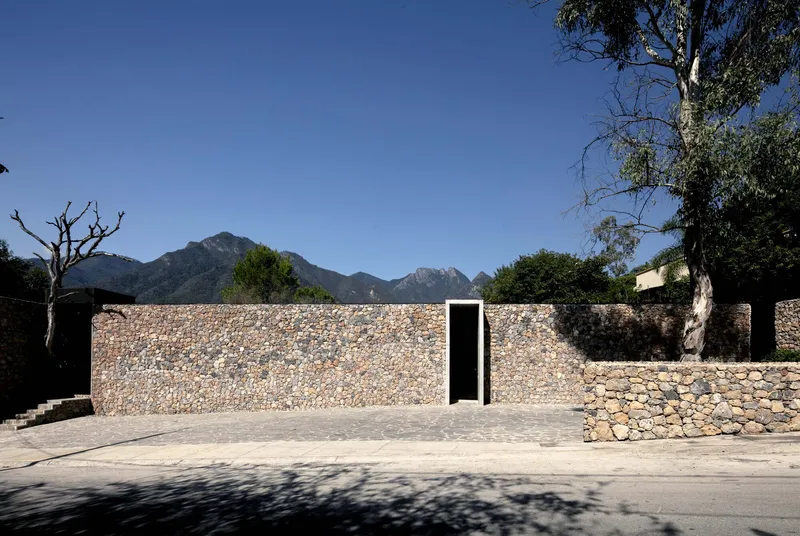
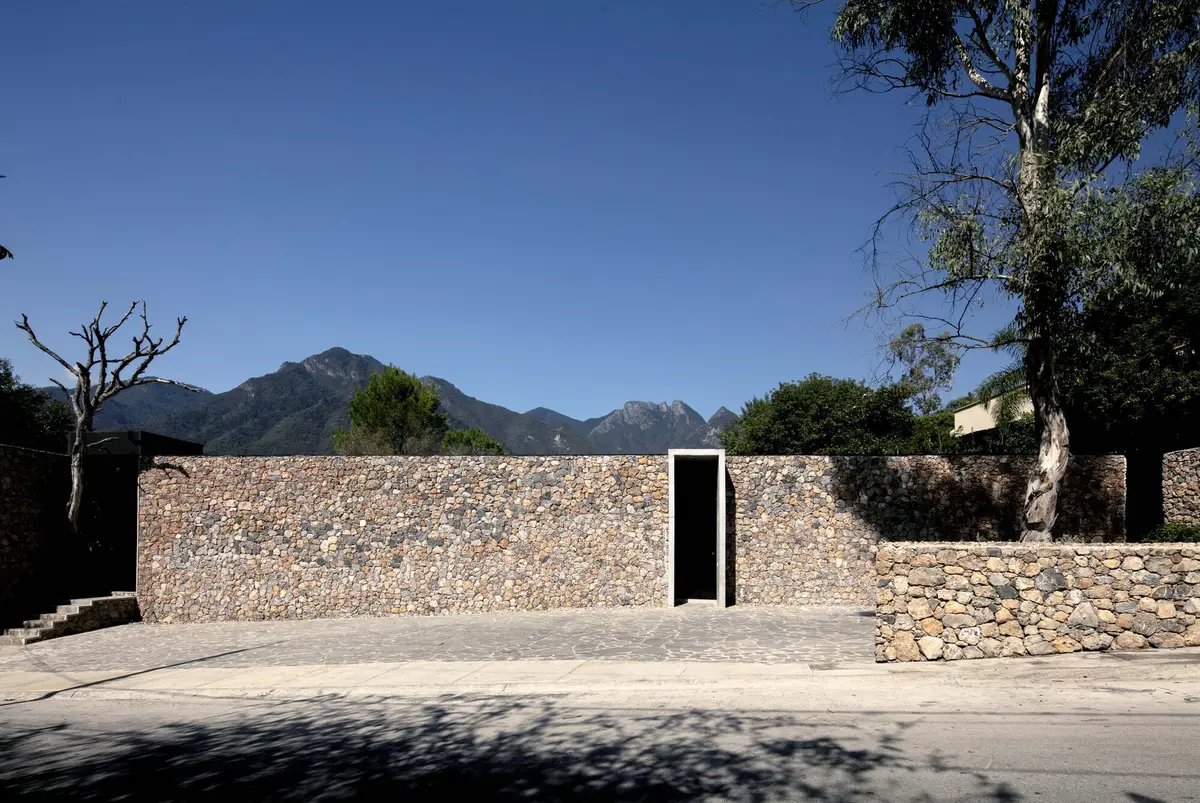
The gabion stone wall that defines the street edge is the house's most assertive move. Stacked local stone in wire cages gives the facade a geological weight, grounding the building to its site without mimicking vernacular masonry. A deeply recessed black doorway punches through this mass, and the payoff is immediate: through the opening, the Sierra Madre appears as a framed panorama. The wall simultaneously shields domestic life from the public road and connects it, through a careful cut, to the broader landscape.
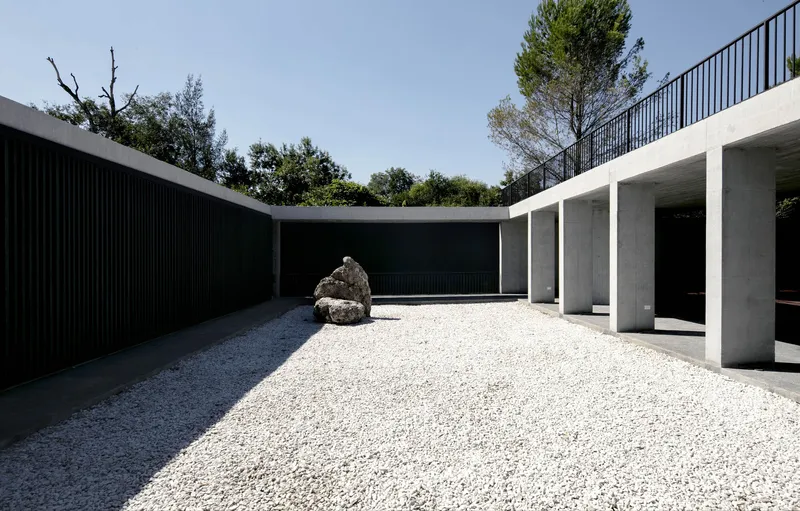
Inside the perimeter, the gravel courtyard acts as a decompression chamber. A single boulder sits on the crushed stone, an understated nod to Japanese garden traditions filtered through a distinctly northern Mexican sensibility. The black slatted wall on one side and the concrete colonnade on the other define the courtyard's spatial edges without sealing it off, allowing cross ventilation and light to move freely.
The Concrete Colonnade as a Living Threshold
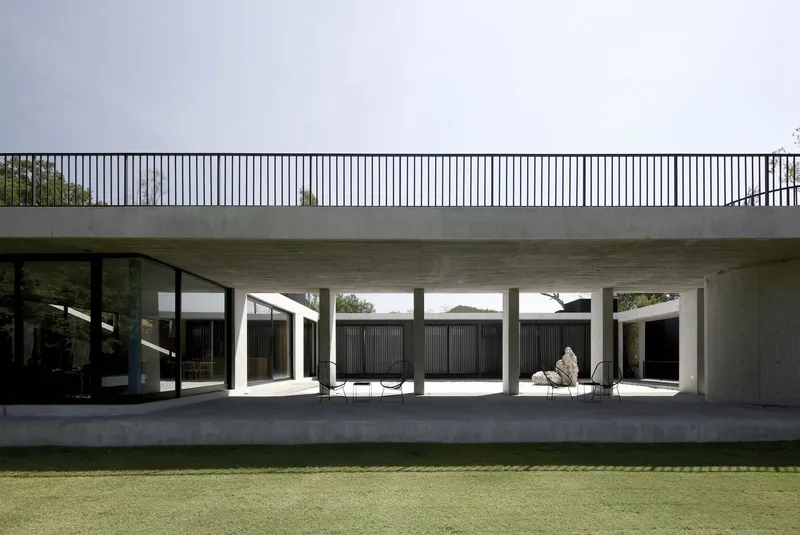
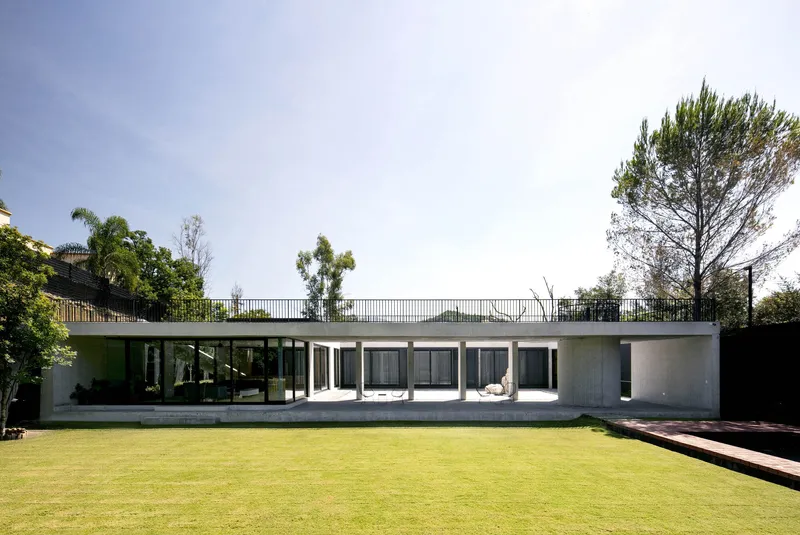
A row of concrete columns runs along the garden facade, supporting a roof terrace above and creating a sheltered corridor at ground level. The colonnade is generous enough to function as a room in its own right: a transitional zone where the manicured lawn meets the interior program. Vertical metal railings along the upper terrace echo the rhythm of the columns below, producing a layered reading of the elevation that changes with the angle of view.
S-AR's decision to leave the concrete exposed, with visible formwork marks, is a deliberate refusal of finish. Against the lush tree canopy and green lawn, the raw material reads as honest rather than austere. The columns are slender enough to maintain visual transparency but substantial enough to register as a proper architectural order, not just structural necessity.
A Cylindrical Stair Core in Dappled Light
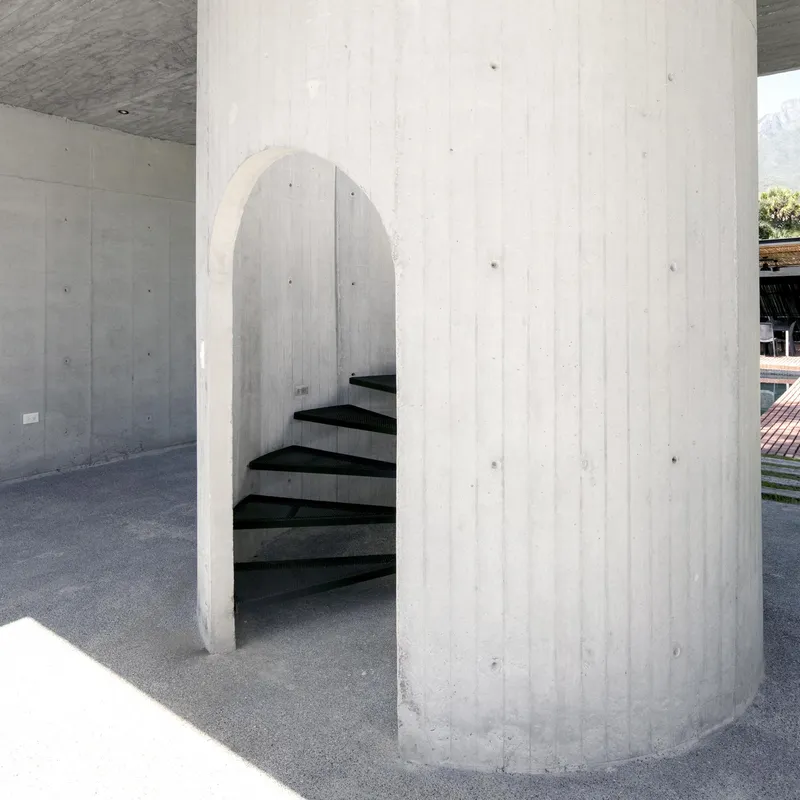
The most sculptural element of the house is a cylindrical concrete core that houses a black spiral staircase. An arched opening at its base lets light spill across the helical treads, and the play of dappled sunlight on the curved interior wall transforms the stair into something closer to a lantern than a circulation shaft. It is a deliberate punctuation mark within a plan that is otherwise resolutely horizontal.
Formally, the cylinder recalls the detached stair towers found in monasteries and fortified houses across Latin America, though here it is absorbed into the domestic program rather than appended to it. The contrast between its curved geometry and the orthogonal logic of the rest of the house gives it a totemic quality. It anchors the plan without dominating it.
Plans and Drawings
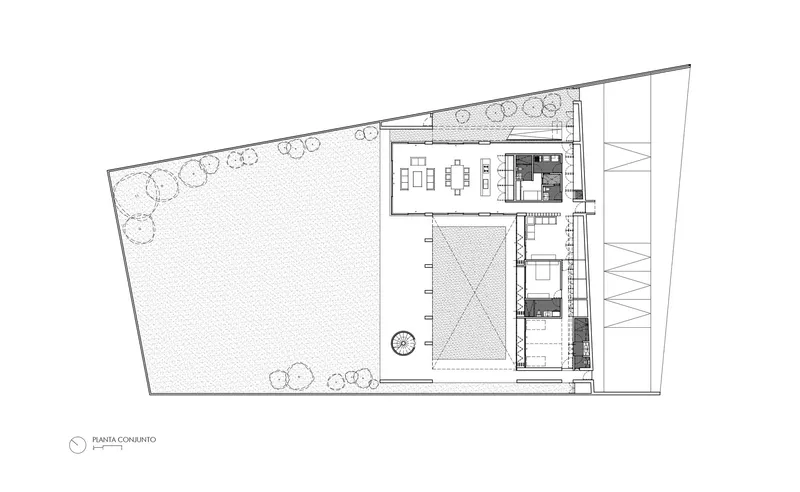
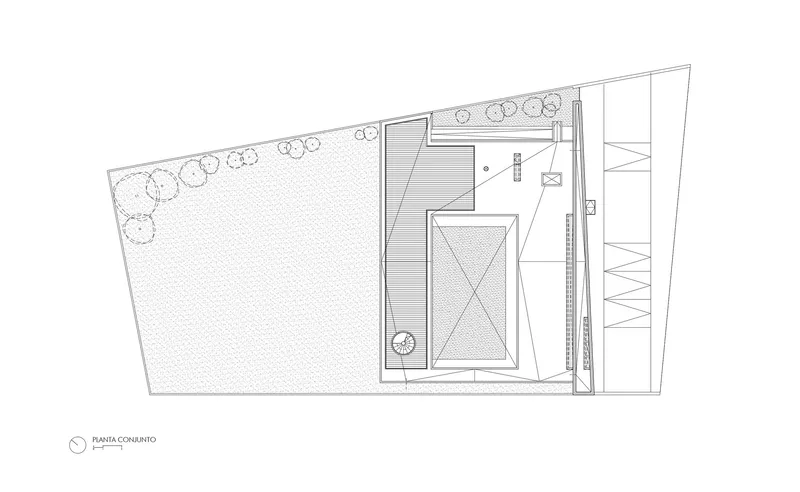
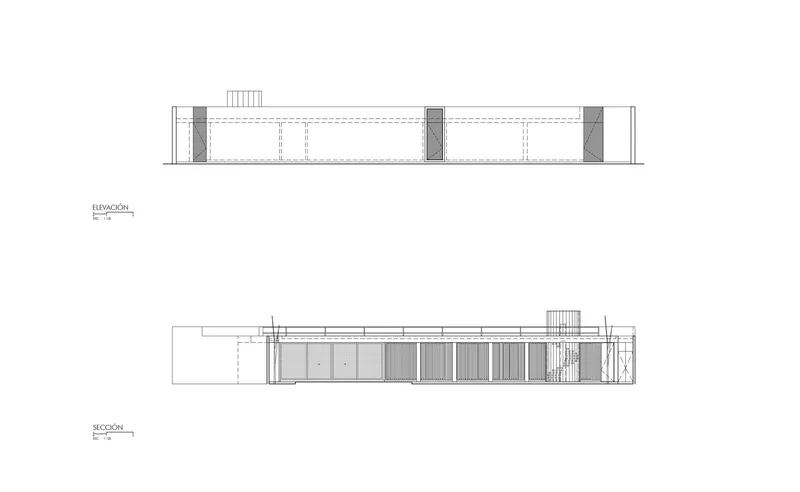
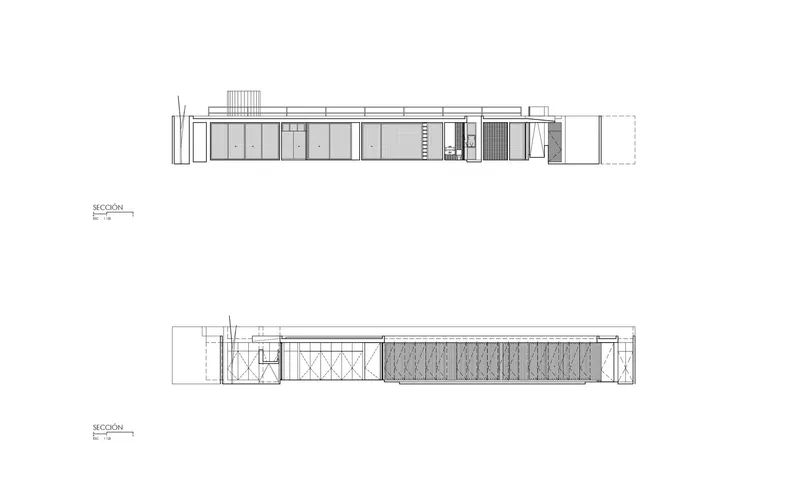
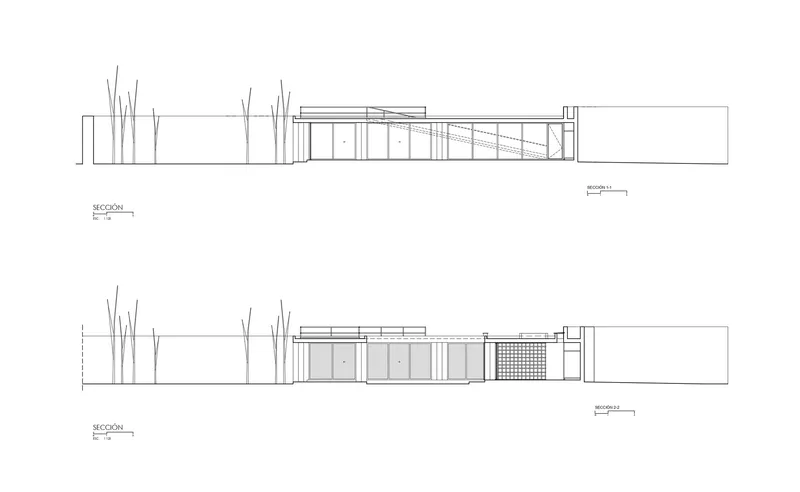
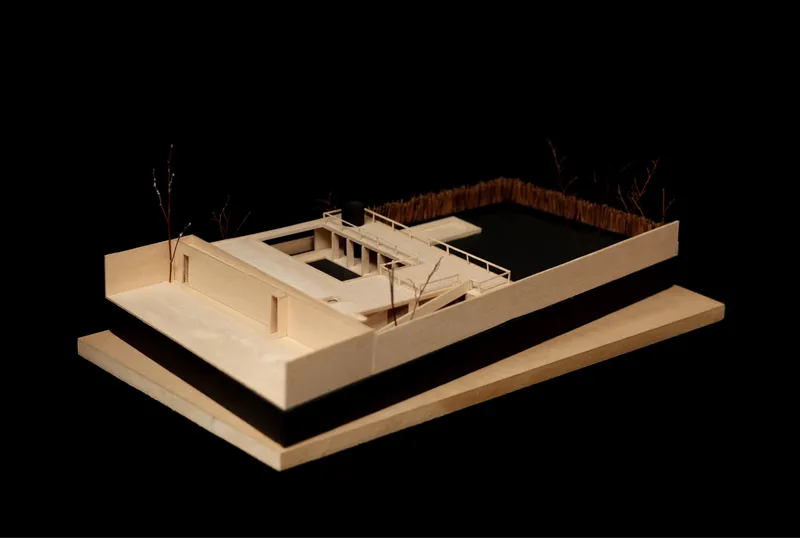
The floor plan reveals how S-AR exploited the trapezoidal lot geometry. Rather than fighting the angled boundaries, the architects aligned the main volume with the longest edge and let the courtyard absorb the irregular leftover space. A central pool divides the plan into two flanking wings, each serving different parts of the domestic program. The site plan confirms the building's relationship to a dense tree line along the western edge, which provides both shade and privacy.
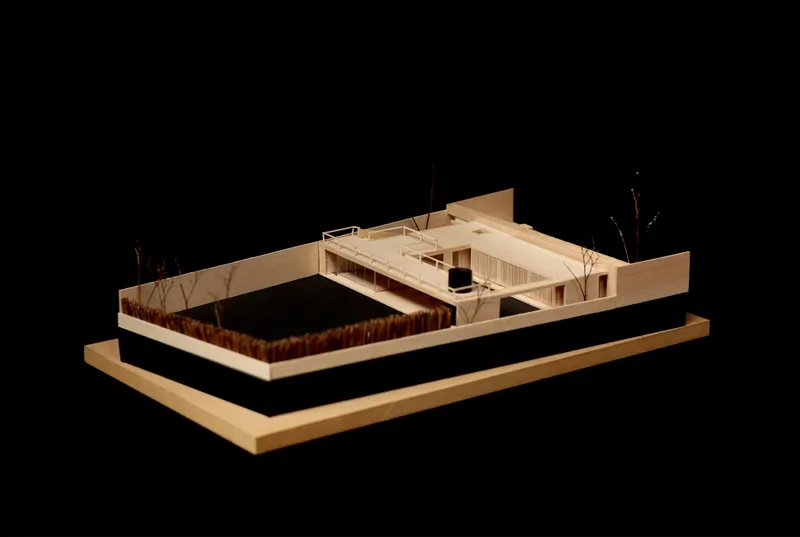
The sections are where the house's low-slung ambition becomes clearest. Glazed facades open interior rooms to the courtyard and garden, while textured wall treatments on the perimeter maintain opacity where needed. The elevation drawings show the repeating vertical slats that unify the facade composition and hint at the screening strategy that governs the entire project: never fully open, never fully closed. The physical models, photographed against black, convey the courtyard house typology with admirable clarity, showing how the angled roof forms create subtle variations in ceiling height across the interior.
Why This Project Matters
Weekend houses in scenic Mexican towns frequently default to one of two modes: the hermetic luxury box or the performatively rustic retreat. S-AR's House in Santiago manages to sidestep both. Its gabion walls and raw concrete belong to the terrain without cosplaying as rural architecture, and its careful framing of mountain views treats the landscape as a collaborator rather than a backdrop. The material discipline, limited to stone, concrete, black steel, and gravel, keeps the project coherent across every scale, from the urban gesture of the perimeter wall to the intimate detail of the spiral stair.
More broadly, the project demonstrates that the courtyard house, one of architecture's oldest typological ideas, still has room to evolve. By using the courtyard not as a decorative void but as a genuine organizer of plan, light, and thermal comfort, S-AR proves that a 470-square-meter residence can be both spatially generous and environmentally responsive. In a region where development pressure is rapidly reshaping small towns, work like this sets a benchmark for how to build with ambition and restraint in equal measure.
House in Santiago by S-AR (César Guerrero, Ana Cecilia Garza). Santiago, Mexico. 470 m². Completed 2021. Photography by Ana Cecilia Garza Villarreal.
About the Studio
Share Your Own Work on uni.xyz
If projects like this are the kind of work you want to make, uni.xyz is a place to publish your own, find collaborators, and enter design competitions.


Popular Articles
Popular articles from the community


Co-life: Sustainable Architecture for Age-Friendly Community Living
Co-life reimagines sustainable architecture for seniors through courtyards, rammed earth, shared gardens, and spaces designed for belonging.

The Musturak Paradise: Senior Living Architecture for a Connected Future in Temara, Morocco
The Musturak Paradise reimagines senior living architecture in Temara via private homes, social spaces, culture, community, and shared care.

Play: Fragments of Their World
Familiar architecture becomes modular playground design, creating safe spaces where displaced children can learn, connect, imagine and play.

ALGAL REALM: A Bio-Integrated Lunar Habitat Design for Life Beyond Earth
ALGAL REALM reimagines lunar habitat design with algae-powered life support, 3D-printed regolith, and vertical living for a lunar future.

Similar Reads
You might also enjoy these articles

Bao Huynh Watercolor Atelier: A Serene Art Retreat in Hội An
Bao Huynh Watercolor Atelier in Hội An blends multifunctional art spaces, sustainable design, local materials, and family-friendly living in a serene environment.

Atelier Macri Concept Store Interior Design by CASE-REAL
Atelier Macri store features a "ko" counter, walnut wood details, cork displays, blending retail, gallery, and seamless customer experiences.

Manuel Vargas Izquierdo Stadium and High-Performance Sports Center: Architectural Excellence in Jalpa de Méndez
The Manuel Vargas Izquierdo Stadium blends sustainable design, inclusive sports facilities, and cultural-inspired architecture, revitalizing Jalpa de Méndez’s public spaces.

KAKR Buluh Awar Hall: Revitalizing Community and Ecology Through Bamboo Architecture
Community built bamboo hall revitalizes Buluh Awar village, empowering youth, restoring ecology, celebrating vernacular craftsmanship through sustainable architecture and culture.


Comments (0)
Please login or sign up to add comments
No comments yet. Be the first to comment!