
Estudio Pedro Haruf Splits a 1960s Belo Horizonte House into Home and Urban Wellness Retreat
In the leafy São Pedro neighborhood, a family property nearly lost to a six-story tower becomes a mixed-use sanctuary for yoga, therapy, and daily life.


Sagarana House almost didn't happen. The 1960s property on a quiet, tree-lined street in Belo Horizonte's São Pedro neighborhood was headed toward demolition to make way for a six-story apartment building. Instead, Estudio Pedro Haruf and Cristiane Salles Arquitetura chose a more radical act of restraint: they kept the house standing, sliced it into two functionally independent zones, and added a prefabricated timber pavilion in the backyard that expanded leasable area by 100 square meters. The result is a 360-square-meter property that houses a private residence on one side and a commercial wellness space on the other, all without betraying the modest scale of its surroundings.
What makes the project genuinely interesting is not the split itself but the rigor with which it was executed. The architects carved two distinct facades and two separate entrances from a single street frontage, then deployed a sequence of material thresholds, from a deep blue corridor to a bamboo-and-pergola passage, that psychologically transport visitors from the city into something closer to countryside calm. Every decision about materiality, from Paraju wood to locally manufactured ceramic tiles to bamboo sourced from a bioconstruction research project, reinforces that transition. The house performs a kind of atmospheric alchemy that most urban adaptive reuse projects only gesture toward.
Two Facades, One Building
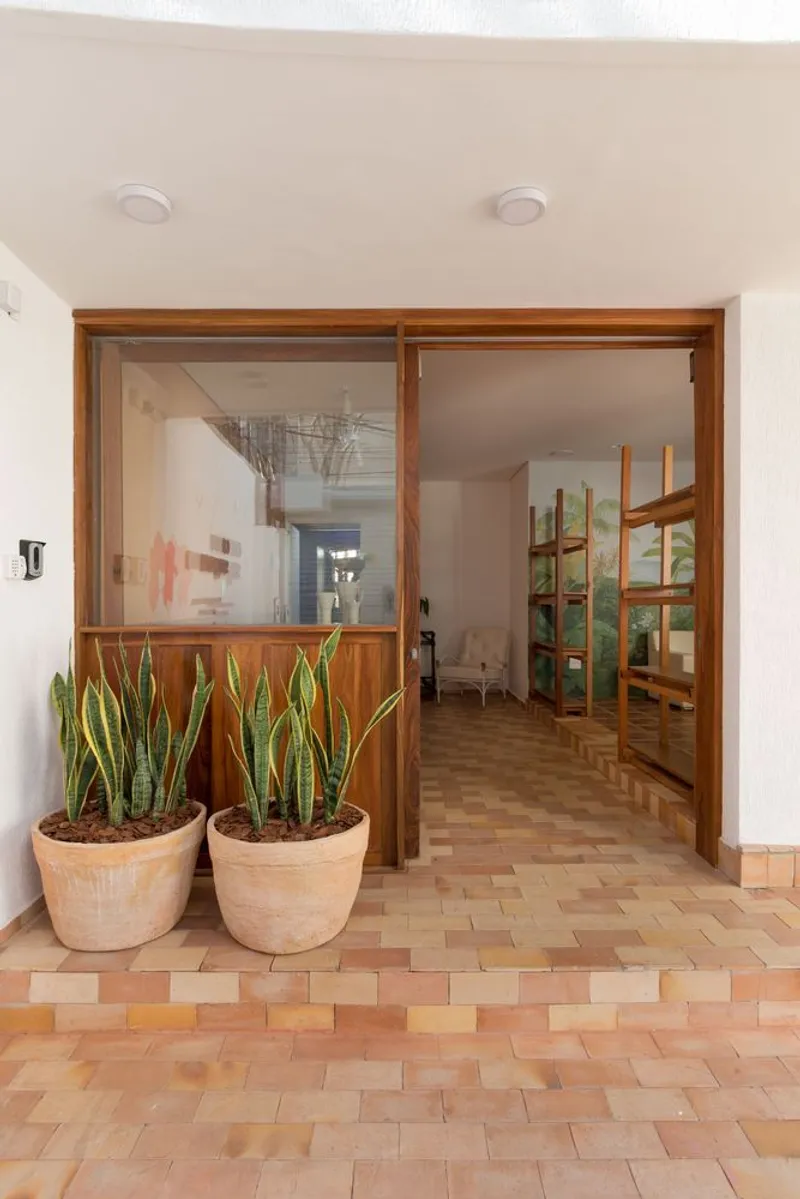
The original house had a single generous room facing the street. The architects divided it to produce two entrances, effectively giving the residential and commercial programs their own public faces. From the sidewalk, the two halves read as neighbors rather than as a bifurcated single property, which is exactly the point. The commercial entry, framed by timber-and-glass doors and flanked by potted snake plants in ceramic vessels, establishes an approachable, almost domestic warmth that signals wellness without resorting to spa clichés.
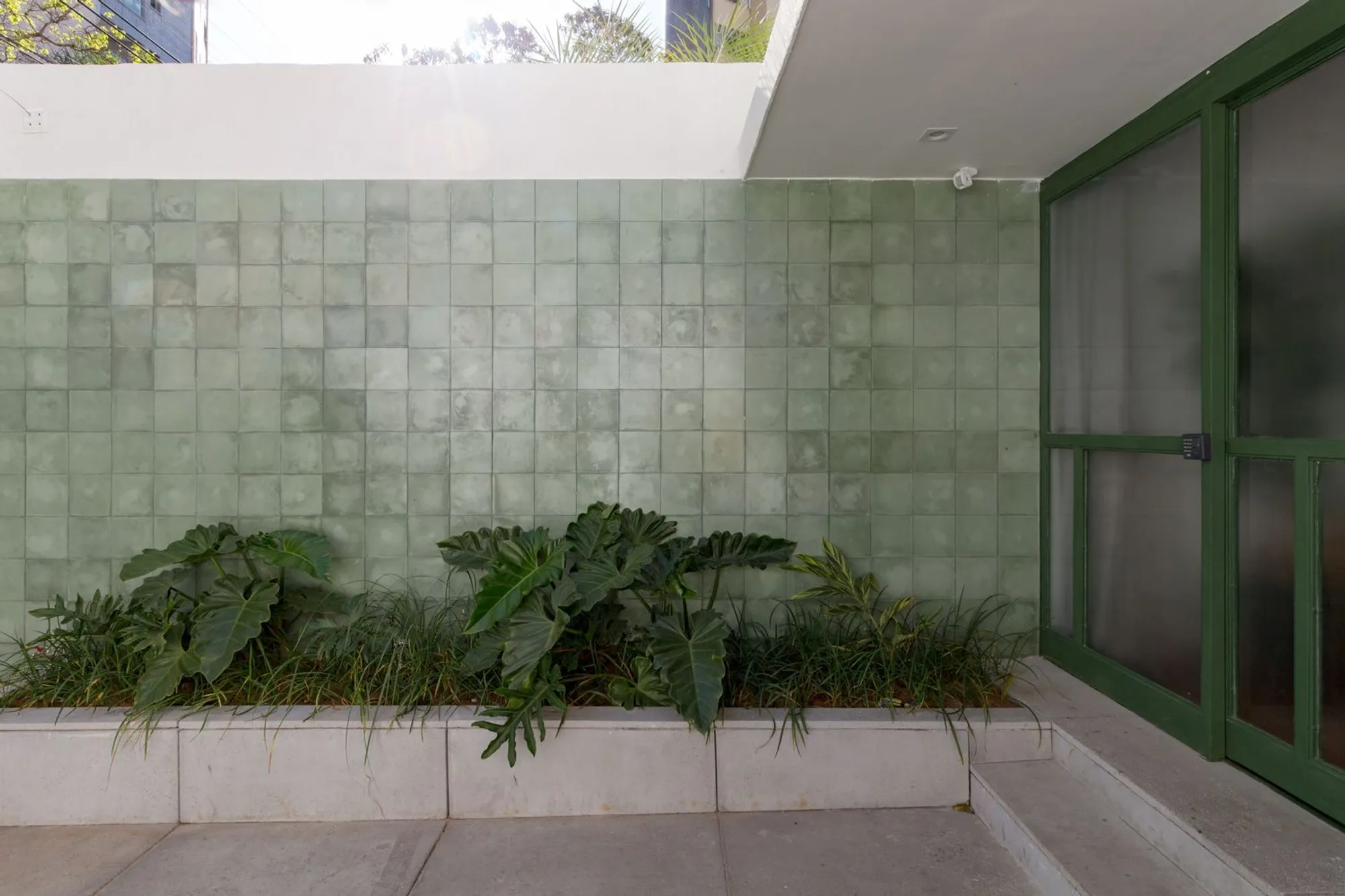
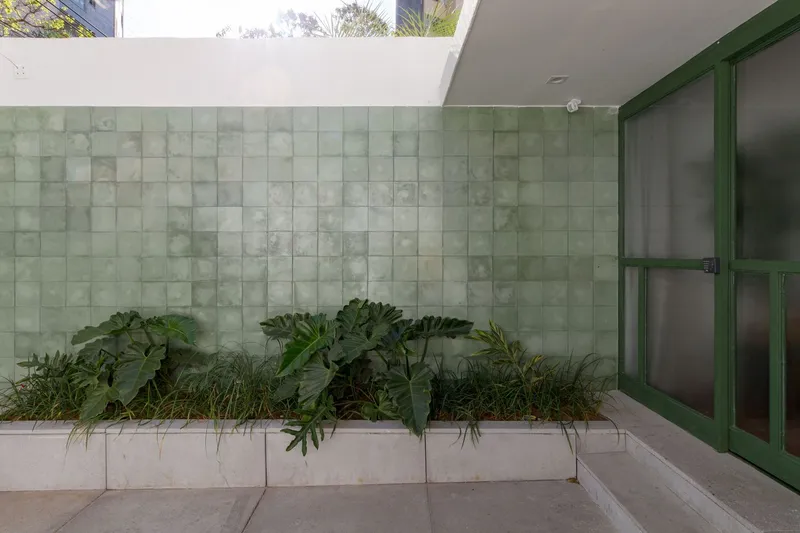
On the courtyard side, pale green tile walls and raised planters filled with tropical foliage create a pocket garden that serves double duty as a buffer between programs and as a visual extension of the retreat experience. The green-framed door is a small but telling detail: color is used sparingly throughout the project, so each instance carries weight.
Material Thresholds
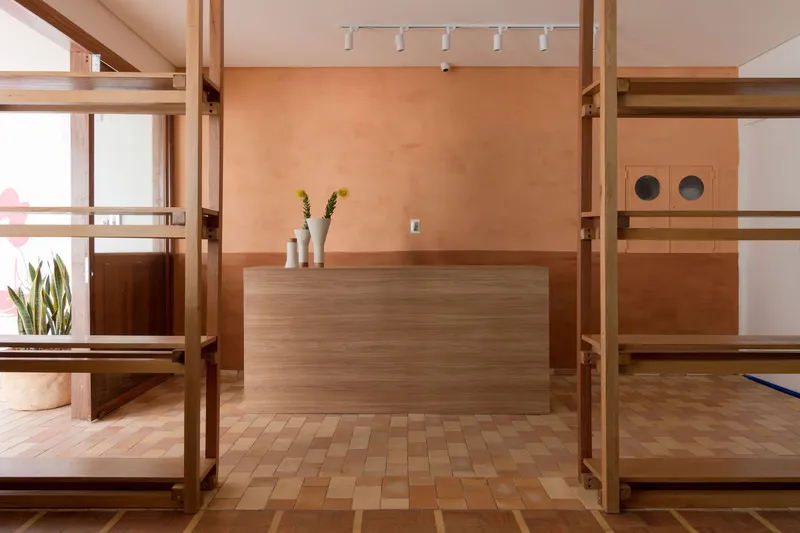
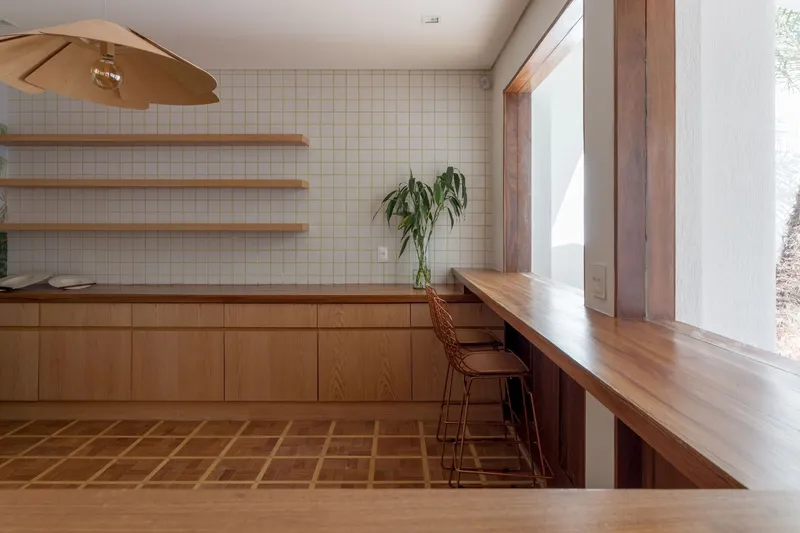
The commercial floor is finished in Altivo ceramic tiles manufactured near Belo Horizonte, a choice that keeps the supply chain short and grounds the space in regional craft. A timber shelving frame in the reception area sits against a peach-toned plaster wall, creating a warm first impression without fuss. The palette reads deliberate rather than decorative: natural tones, honest textures, no surface applied purely for effect.
In the kitchen zone, timber cabinetry meets a white tile backsplash and a single hanging pendant. The architects clearly understand that in a mixed-use property where half the program is dedicated to meditation and self-knowledge, visual noise is the enemy. Every material pulls its own weight functionally while contributing to the project's overarching calm.
Living with the Retreat Next Door
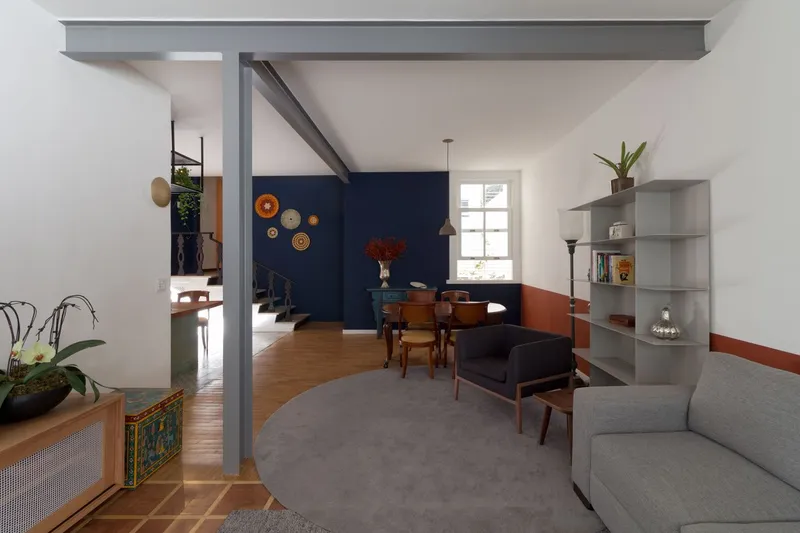
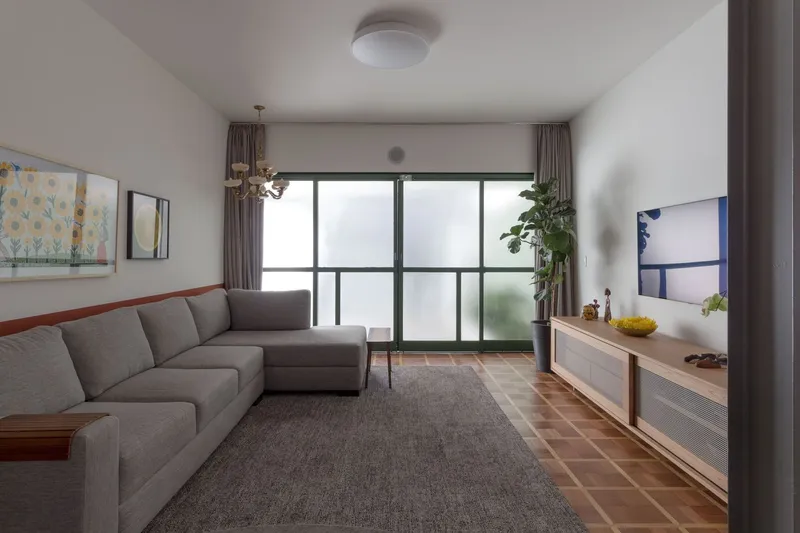
The residential half retains the intimate scale of the original house while introducing strategic upgrades for privacy and light. The open-plan living room pairs a grey carpet with timber flooring and an exposed steel column, a legible record of structural intervention that the architects chose not to conceal. Floor-to-ceiling frosted glass doors in the adjacent living space open onto a balcony, controlling visibility while flooding the interior with diffused daylight.
This is a house that belongs to a family with deep ties to the property, one they have known since 1987. The decision to keep living alongside a commercial program rather than cash out the lot reflects a particular relationship to place. The architecture honors that relationship by making the residential zones feel complete in themselves, not like leftovers carved from a more profitable scheme. Planter boxes at window lines serve simultaneously as privacy screens and as green extensions of the tropical landscaping outside.
Plans and Drawings
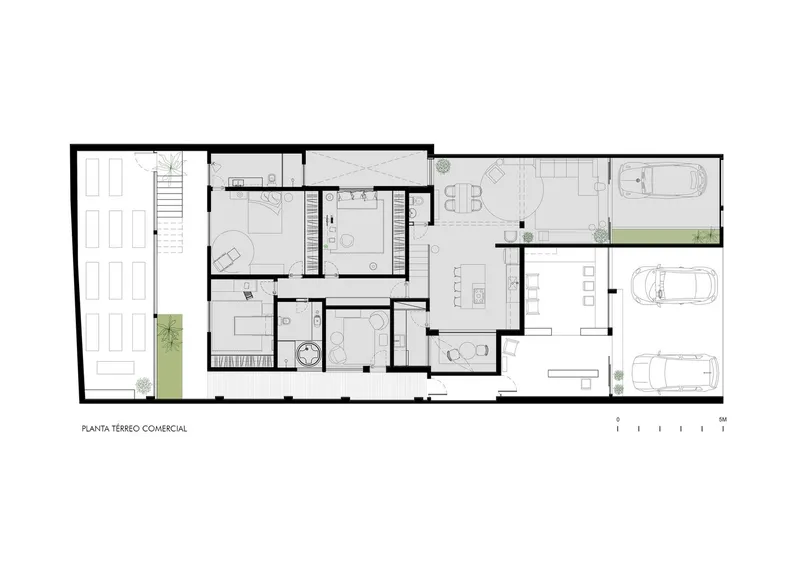
The ground floor plan reveals the logic of the split with clarity. Parking occupies the street edge, flanked by the two entrances. Circulation paths run parallel but never cross, maintaining strict separation between residential and commercial traffic. The planted areas shown on the plan are not afterthoughts: they structure movement and buffer sound between programs. The backyard pavilion appears as a distinct rectangular footprint, oriented to maximize openings toward the garden and away from the main house, a straightforward move that ensures the yoga and therapy space feels like an arrival rather than an appendage.
Why This Project Matters
Cities across Latin America are losing their mid-century residential fabric to densification, and the economics almost always favor demolition. Sagarana House offers a counter-model: retain the structure, diversify the program, and use a modest timber addition to make the numbers work. The prefabricated Paraju wood pavilion, assembled on site from components manufactured in Belo Horizonte, is the financial and spatial key that turns a nostalgic preservation gesture into a viable mixed-use operation. That it also happens to be a beautiful place to practice yoga is a bonus.
The deeper lesson is about atmospheric design. Estudio Pedro Haruf and Cristiane Salles understood that separating a home from a wellness retreat within a single 360-square-meter lot is not primarily a planning problem. It is a sensory one. The blue corridor, the bamboo ceilings, the straw closures, and the climbing greenery all work together to rewrite the visitor's sense of where they are. That kind of spatial storytelling, achieved with inexpensive natural materials and disciplined restraint, is worth more attention than it typically receives.
Sagarana House by Estudio Pedro Haruf and Cristiane Salles Arquitetura. Belo Horizonte, Brazil. 360 sqm. Completed 2021. Photography by Dentro Fotografia.
About the Studio
Share Your Own Work on uni.xyz
If projects like this are the kind of work you want to make, uni.xyz is a place to publish your own, find collaborators, and enter design competitions.



Popular Articles
Popular articles from the community


The Musturak Paradise: Senior Living Architecture for a Connected Future in Temara, Morocco
The Musturak Paradise reimagines senior living architecture in Temara via private homes, social spaces, culture, community, and shared care.

Co-life: Sustainable Architecture for Age-Friendly Community Living
Co-life reimagines sustainable architecture for seniors through courtyards, rammed earth, shared gardens, and spaces designed for belonging.

Riyadh For All: Intergenerational Urban Design for Active Aging in Rabat
Riyadh For All reimagines urban design in Rabat with intergenerational co-living, adaptive courtyards, and Moroccan cultural exchange today.

The Ocean Hive: Sustainable Architecture for a Self-Sufficient Civilization at Sea
The Ocean Hive imagines sustainable architecture at sea, where modular habitats, algae, wave power and ocean waste sustain a growing colony.


Similar Reads
You might also enjoy these articles


Hodi-Mandai Geram
Project Function: Preservation and revitalization of the Intangible heritage and socio-spatial identity of the Hodi by Housing, Cultural Memory Center, Sacred Grove, landscape, local tourism economy


Olio Towers: A Mid-Rise for Performers That Fuses Housing, Rehearsal, and Stage
Located blocks from Houston's Theater District, this modular tower stacks living units around a central performance atrium.

Oasis: Modular Green Housing Carved into Dhaka's Urban Fabric
A shortlisted Plugin Housing entry reclaims unauthorized settlements in Dhaka with stepped concrete volumes, green roofs, and ventilation-driven design.

Black Hole: A Floating Megastructure for the Post-Physical Era
Emiliano Mazzarotto envisions a spherical, self-scaling arena where e-sports, digital hotels, and holographic stadiums replace traditional public space.

Explore Sacralized Architecture Competitions
Discover active competitions in this discipline



Challenge to reimagine the Iron Throne


Photograph architecture without architects


Illustrate the lost glory of Angkor Wat - Render Challenge


Design challenge to reuse E-waste
Comments (0)
Please login or sign up to add comments
No comments yet. Be the first to comment!