
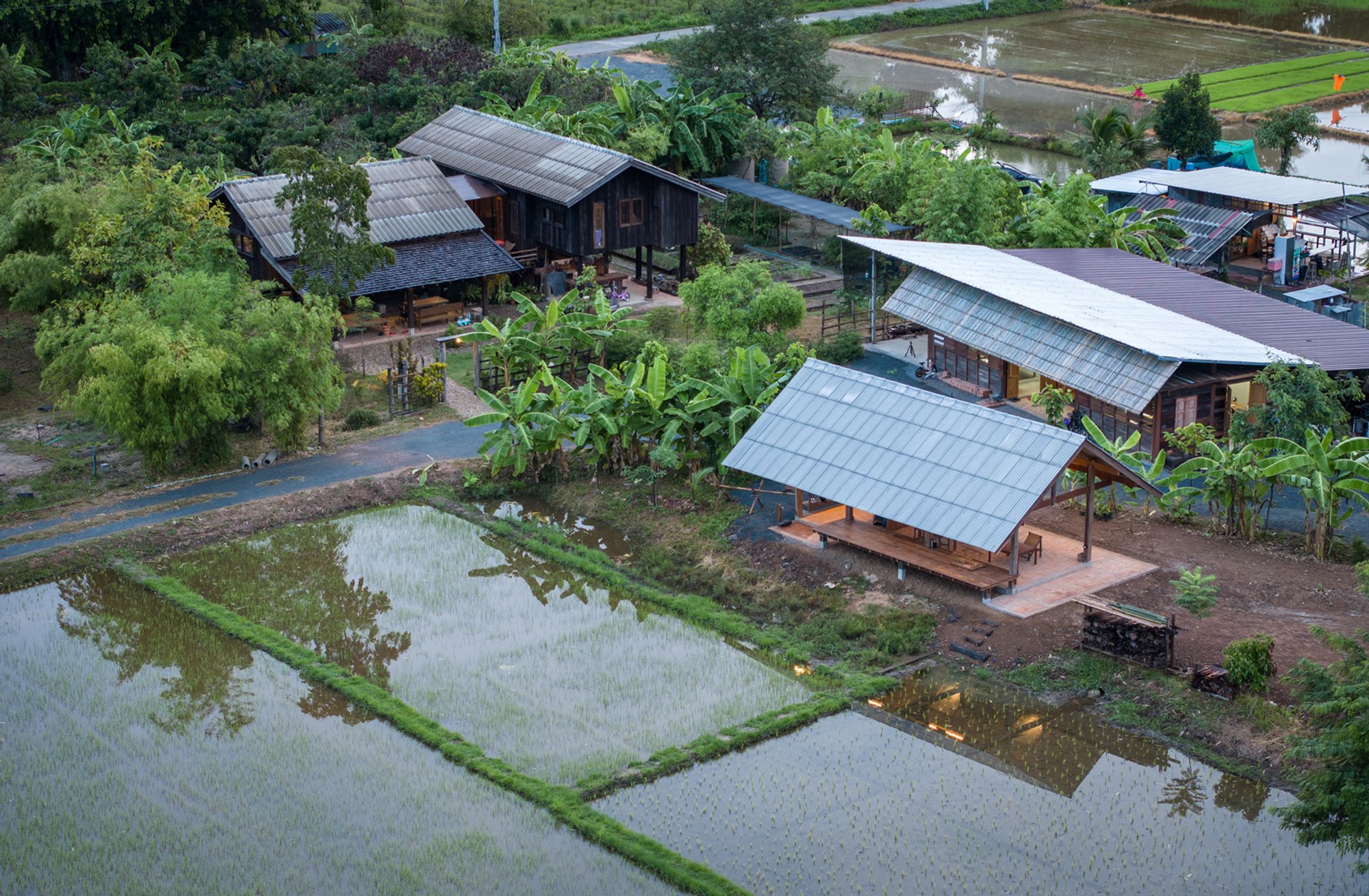
Yangnar Studio Plants a Timber Pavilion Among Rice Paddies in Rural Thailand
Sala Yangnar is an open-air gathering space built with reclaimed wood and traditional joinery, sitting quietly among flooded rice fields.

There is a particular quality to buildings that refuse to separate themselves from the ground they sit on. Sala Yangnar, designed by Yangnar Studio, is a timber pavilion set among flooded rice paddies somewhere in rural Thailand, and it behaves less like a building and more like an extension of the agricultural landscape. Its corrugated metal roof catches the dusk light and throws a reflection across the water below. Its columns rise from brick paving with the matter-of-fact verticality of tree trunks. Nothing about it tries to impress; everything about it tries to belong.
What makes the project genuinely interesting is its radical openness. The pavilion has no walls to speak of, only timber frames, slatted screens, and the occasional panel of reclaimed wood cladding. It is architecture reduced to the fundamental act of making shelter: a roof, some columns, a floor, and the intelligence to stop there. The craft of the joinery and the honesty of the materials do the rest.
Landscape as Co-Author
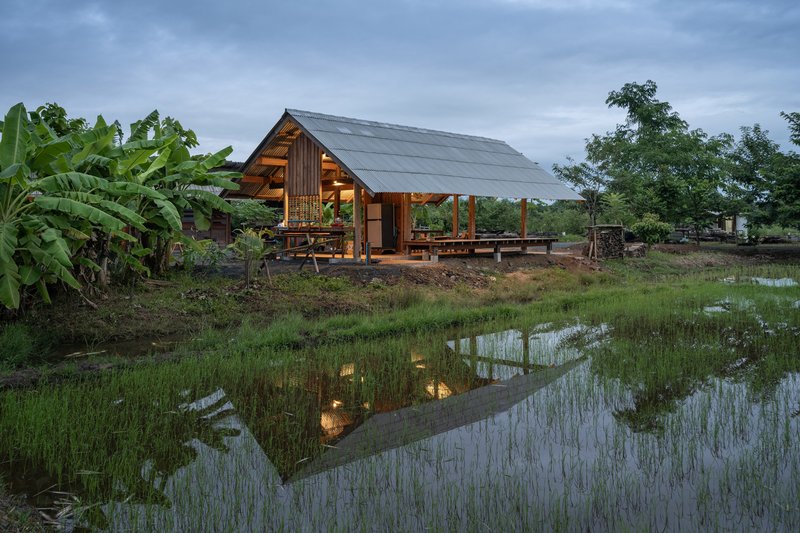
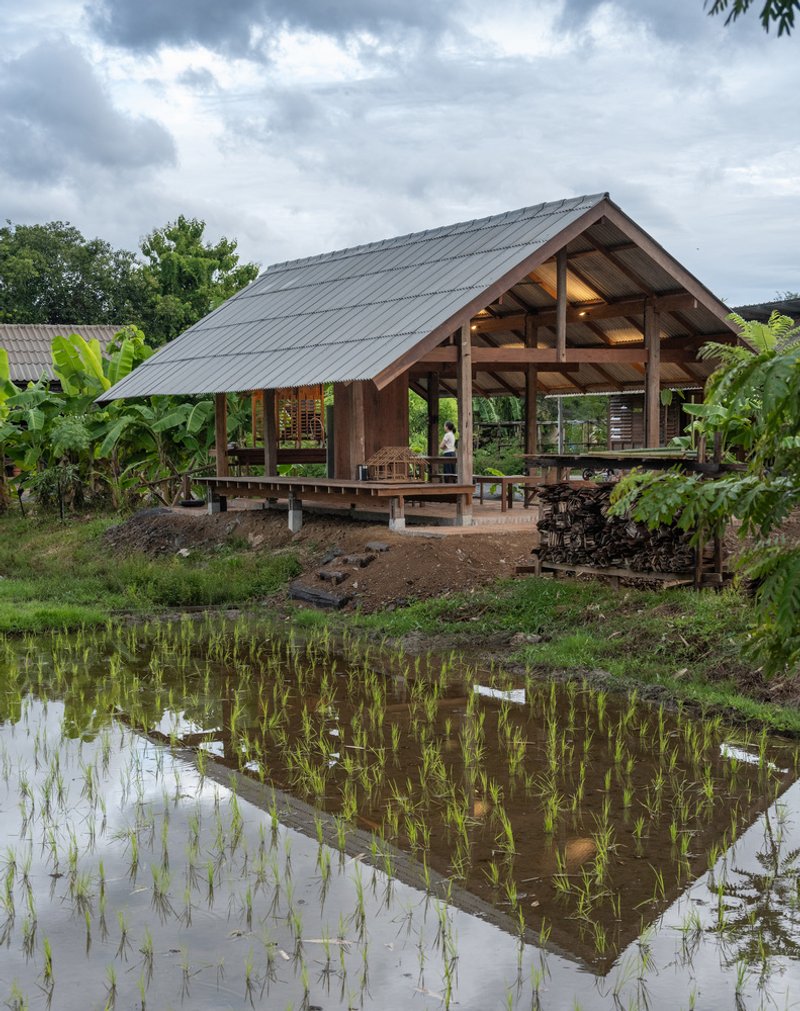
The flooded paddies that surround Sala Yangnar are not mere context. They are active participants in the architecture. At dusk, the standing water becomes a mirror, doubling the pavilion's silhouette and dissolving the boundary between built form and terrain. The building was clearly sited with this effect in mind. Its low profile and elongated proportions maximize the reflection, turning every evening into a quiet spectacle that costs nothing to produce.
From the air, the relationship is even clearer. The pavilion volumes scatter across the site like farm buildings that accumulated over generations, respecting the paddy grid rather than imposing a new geometry. Banana trees and tropical plantings soften the edges, and the corrugated roofs read as just another layer in a landscape already full of texture.
The Frame as Architecture
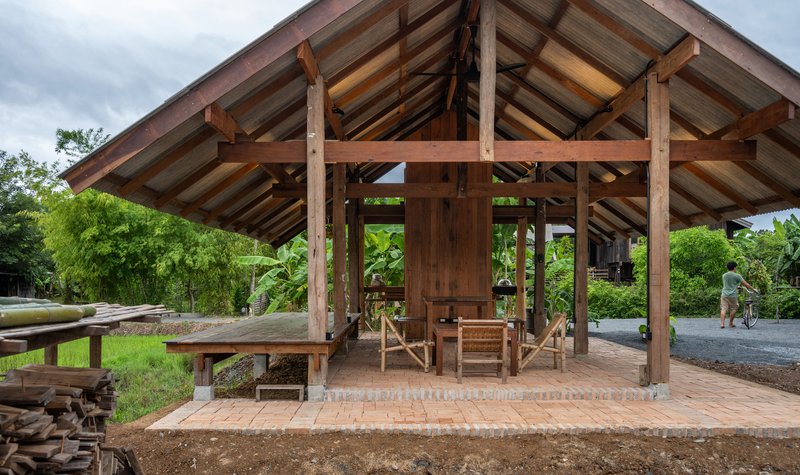
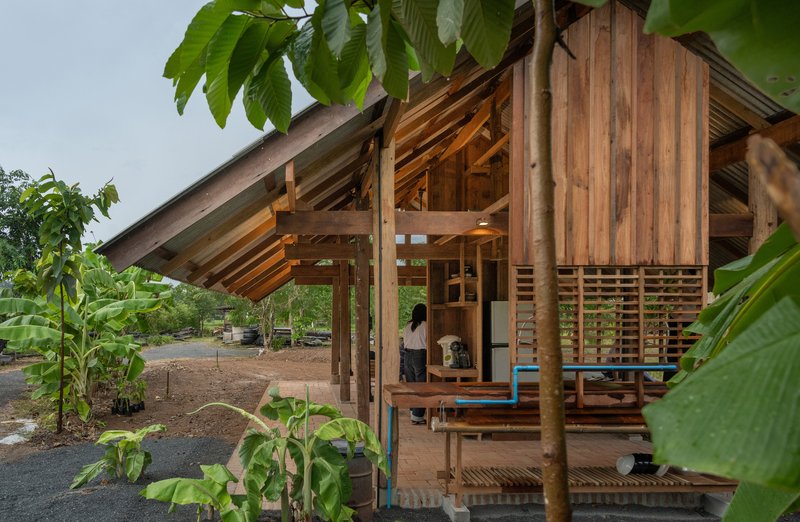
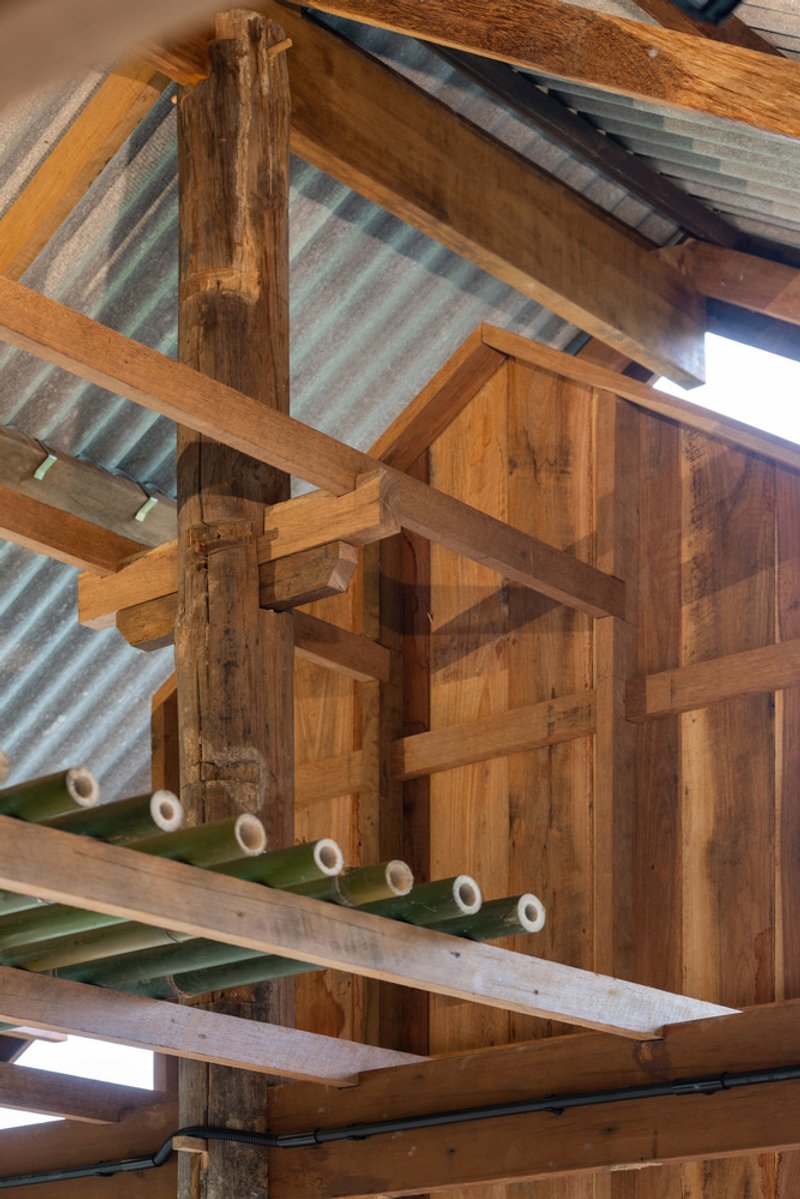
Strip away finishes, mechanical systems, and enclosure, and what remains is the frame. Yangnar Studio treats the post-and-beam timber structure not as something to be concealed but as the entire architectural proposition. Every rafter, every tie beam, every mortise-and-tenon connection is visible, legible, and considered. The joinery detail where column meets beam is especially telling: it borrows from traditional Thai carpentry without mimicking it, achieving a tightness and precision that speaks to genuine craft skill.
Reclaimed wood cladding appears in select locations, adding warmth and a sense of history to the new structure. The material palette is deliberately narrow: timber, corrugated metal, brick, and not much else. That constraint gives the pavilion its coherence. Nothing competes for attention.
Living Under the Roof
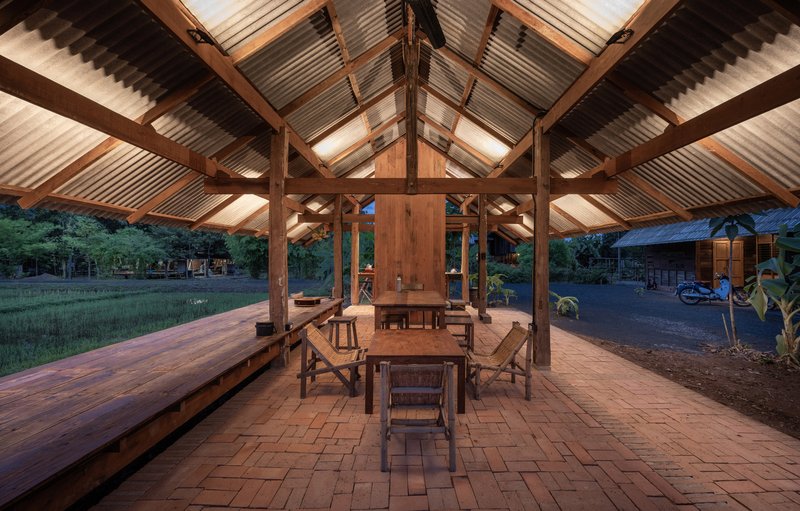
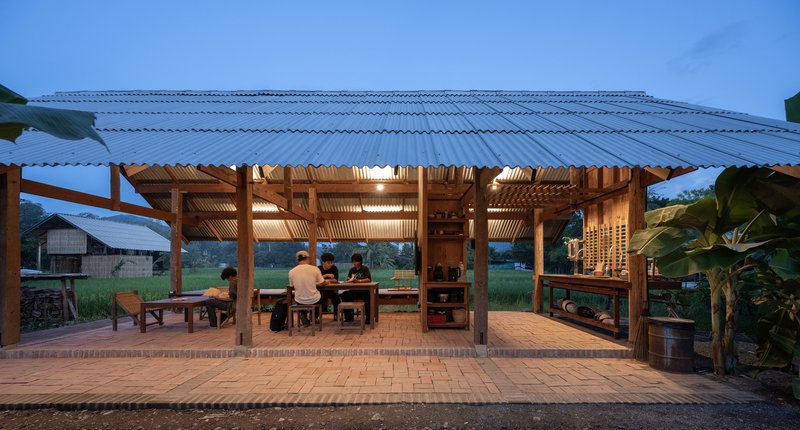
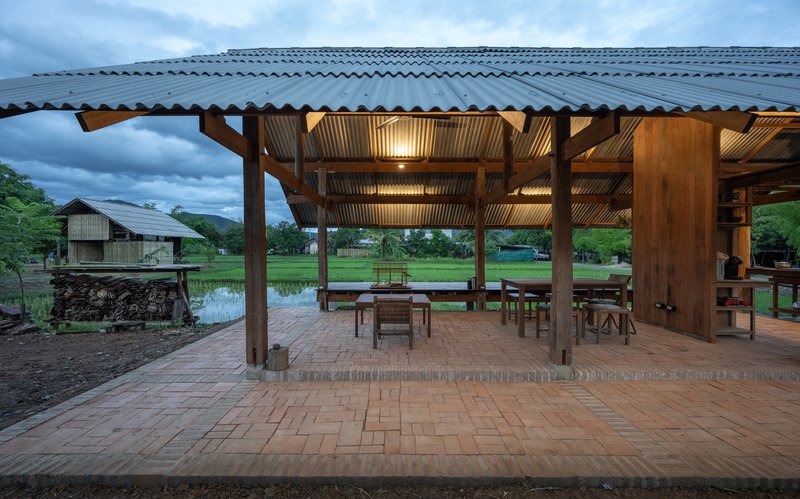
The interior, if one can call it that, is organized around a long timber dining table set on brick paving beneath the exposed rafters. It is a communal space in the truest sense: no partitions, no hierarchy, just a generous surface under a sheltering roof. A central storage volume anchors one of the bays, providing a sense of enclosure without closing anything off. At dusk, interior lighting transforms the structure into a lantern, its gabled form glowing against the darkening sky.
People gather here not because the space directs them to but because it invites them to. The proportions are generous without being cavernous. The ceiling height under the ridge gives the room air; the low eaves at the edges create intimacy. It is the kind of spatial intelligence that comes from understanding how bodies actually occupy a room, not from parametric gymnastics.
Thresholds and Terraces
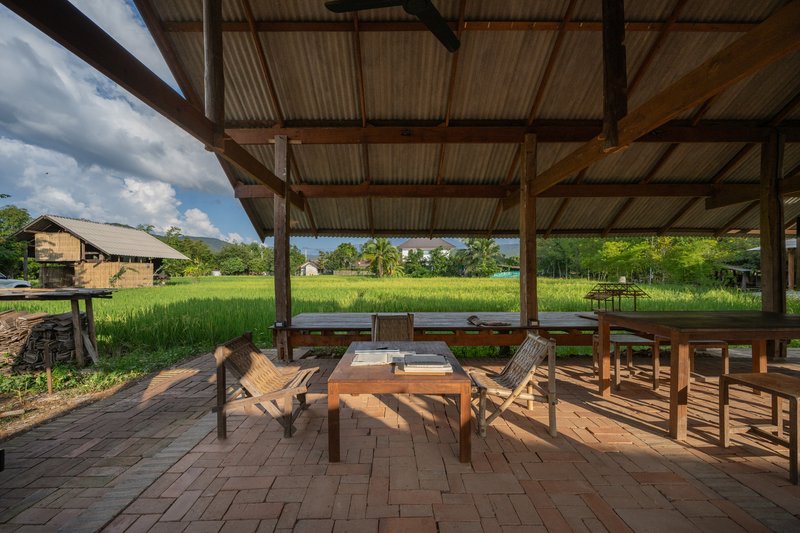
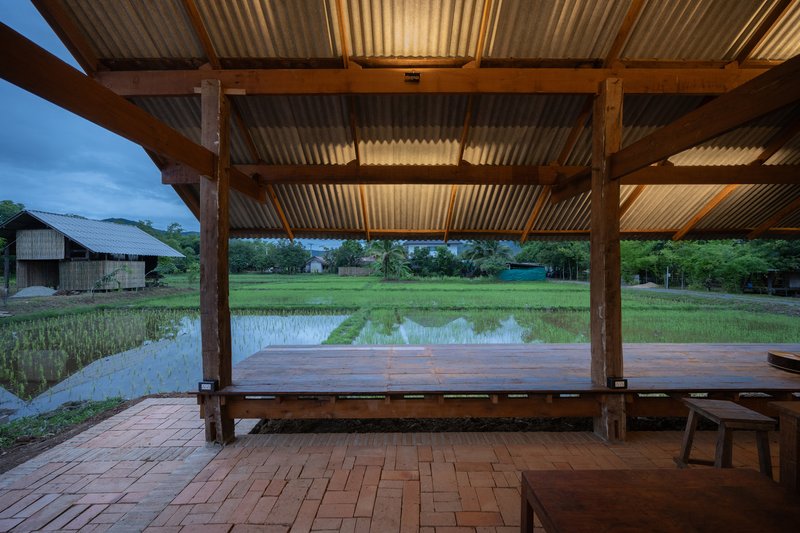
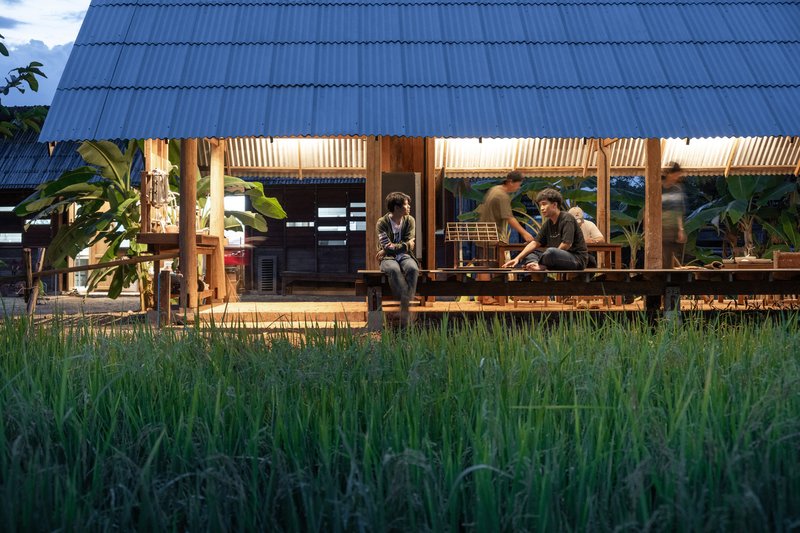
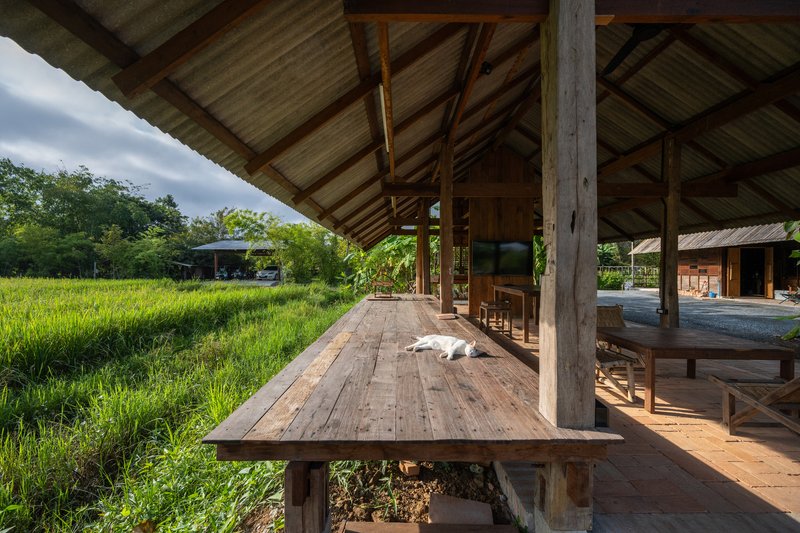
The covered terraces that extend from the main pavilion volume are arguably the most successful spaces in the project. Furnished with simple wooden tables and chairs, they offer unobstructed views across the rice paddies. The corrugated metal roof provides shade and rain protection while the open sides allow cross ventilation to do what air conditioning never could. At twilight, when the brick paving cools and the sky turns violet, these terraces become the kind of place you simply do not want to leave.
A raised timber platform extends toward the fields, where two figures can sit with their feet practically among the young rice plants. This gesture, pulling occupation out of the building and into the landscape, is the clearest expression of the project's philosophy. The pavilion does not frame nature at a safe distance. It wades into it.
Gable, Screen, and Edge
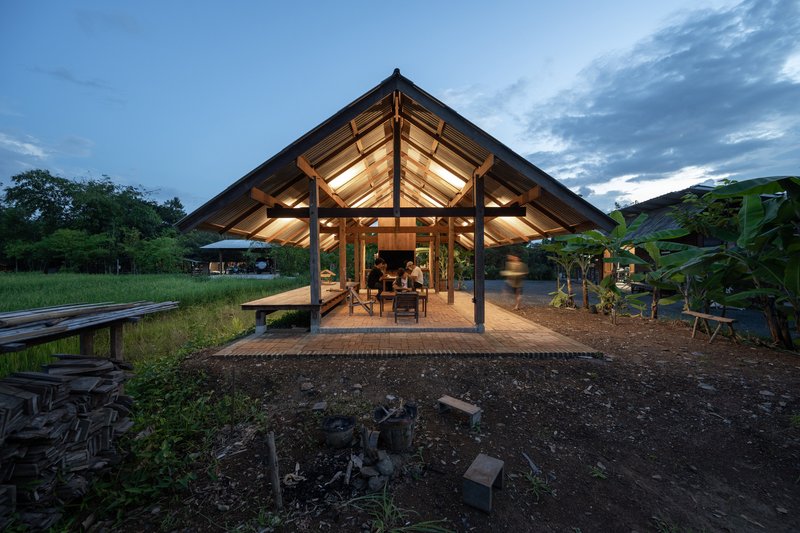
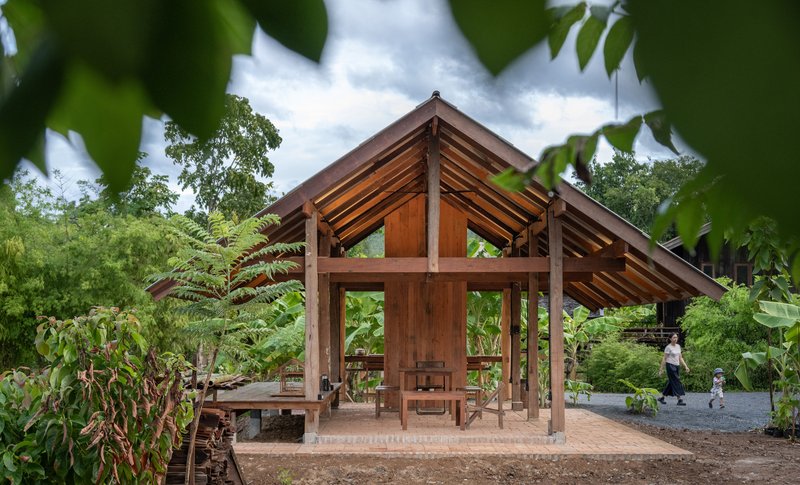
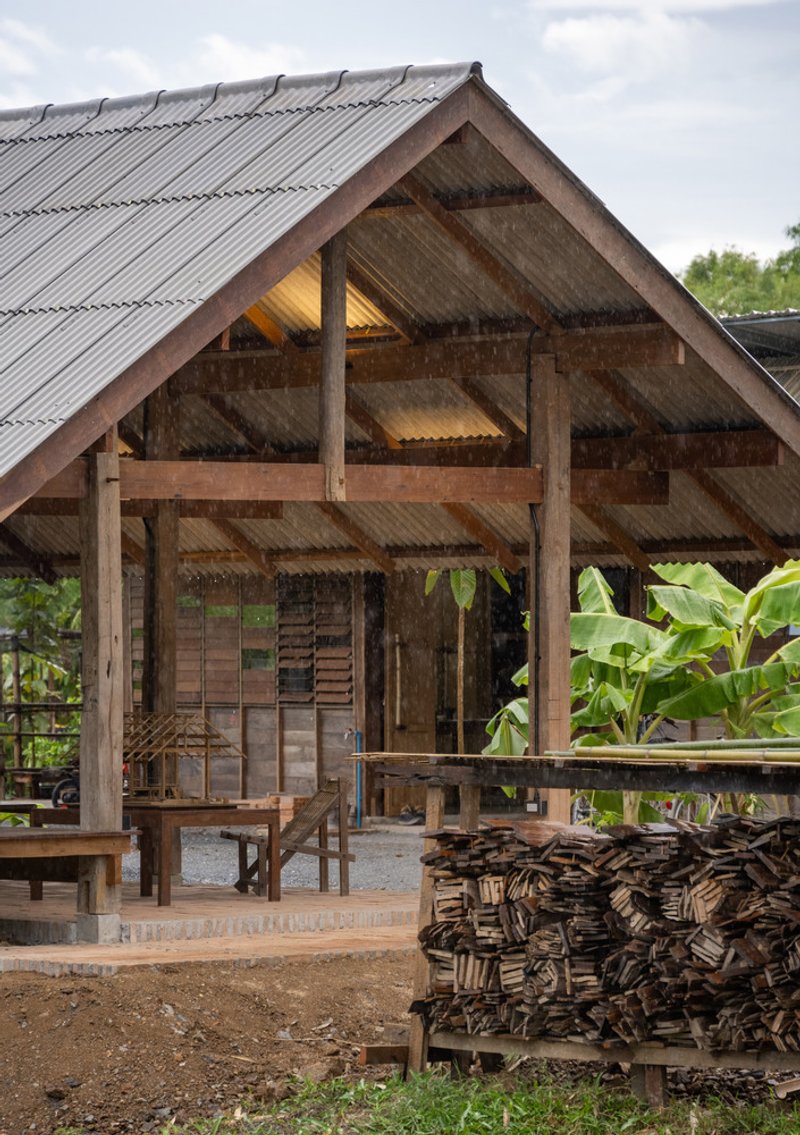
The gabled profile is the project's most recognizable formal move, and it works because it is rooted in typology rather than novelty. The pitched roof is the default form for rural Thai structures, and Yangnar Studio deploys it without irony. What elevates the gesture is how the gable ends are treated: exposed timber framing, stacked firewood, vertical board cladding, each one resolved differently to respond to its specific orientation and program.
Slatted screens and bamboo elements appear where privacy or wind protection is needed, filtering light into soft horizontal bands. Seen through banana trees and garden plantings, the structures achieve the quality of permanence without heaviness. They look as though they have been here for decades, which is exactly the right ambition for a building in this landscape.
Material Honesty at Close Range
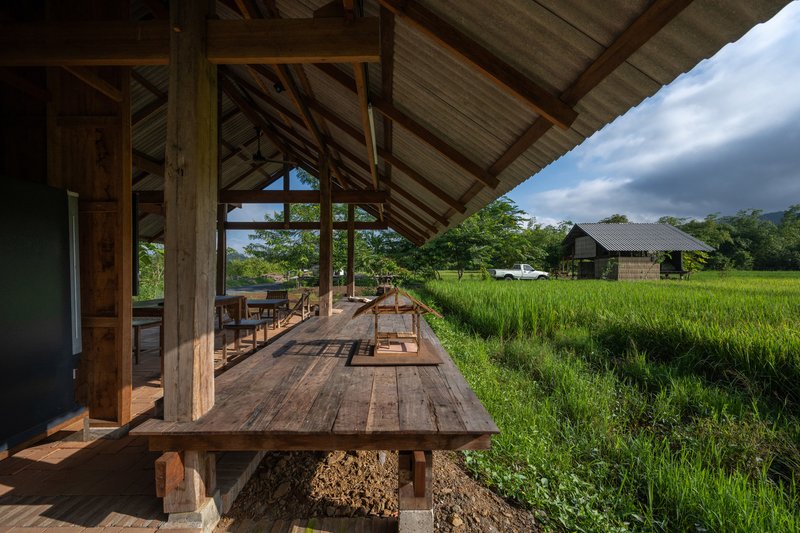
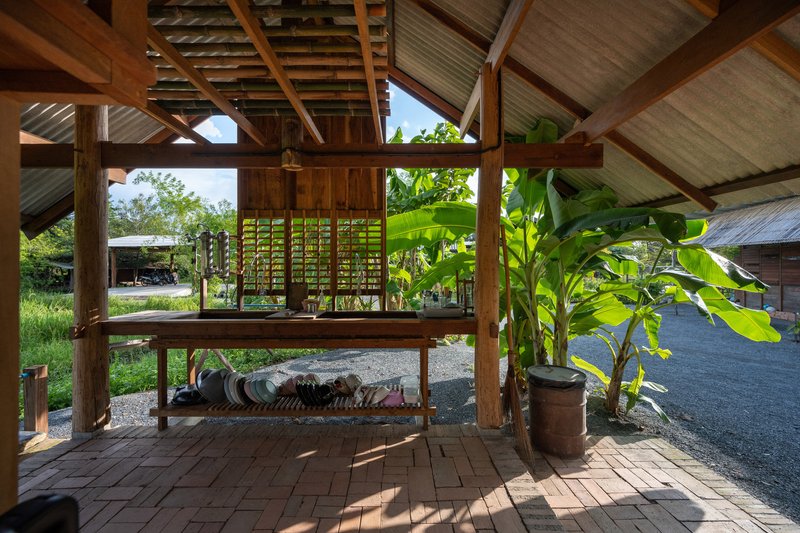
Viewed from inside, the timber frame becomes a lens. Each opening between columns acts as a picture frame, isolating a rectangle of green field and grey sky. The effect is cinematic but unpretentious, a byproduct of structural logic rather than a deliberate composition. Potted banana plants placed near the columns blur the distinction between cultivated garden and wild paddy, reinforcing the sense that the pavilion is a porous membrane rather than an enclosure.
Plans and Drawings
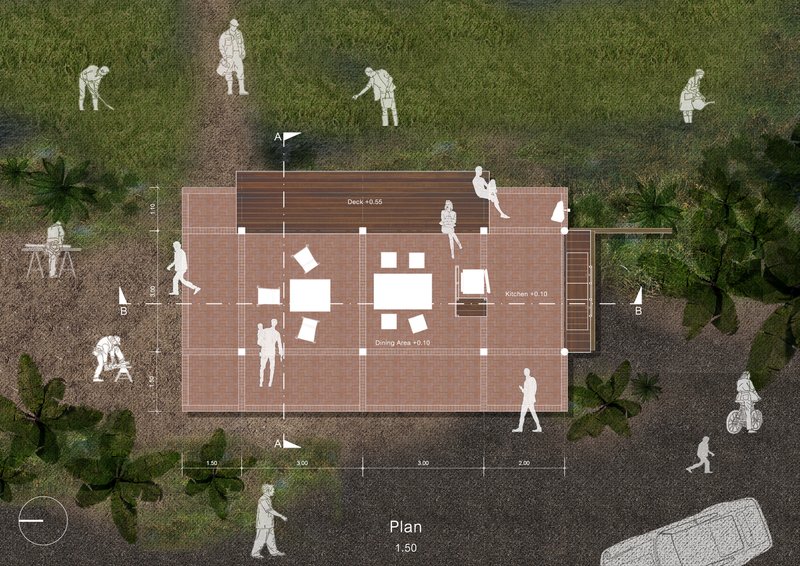
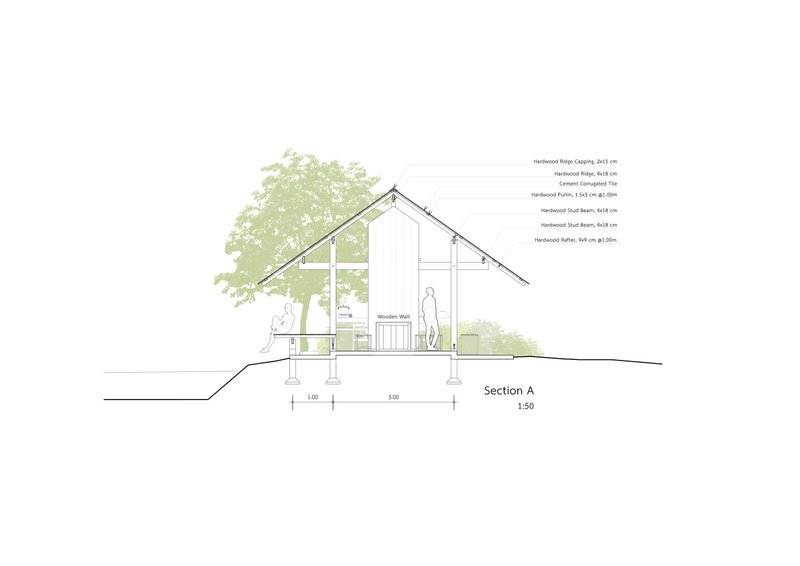
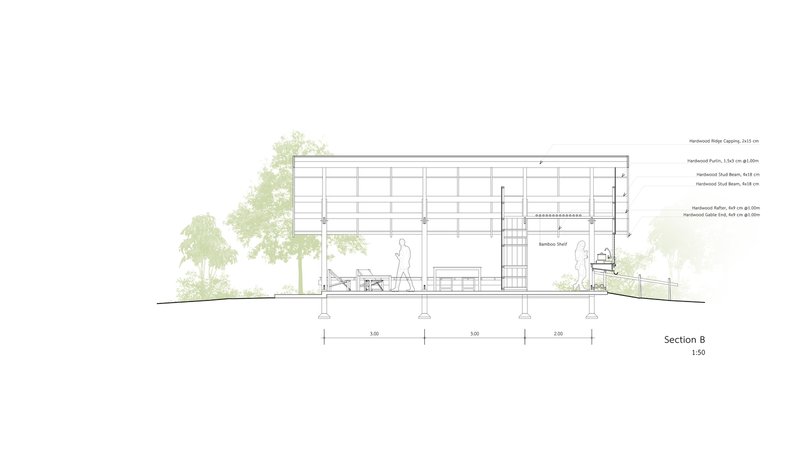
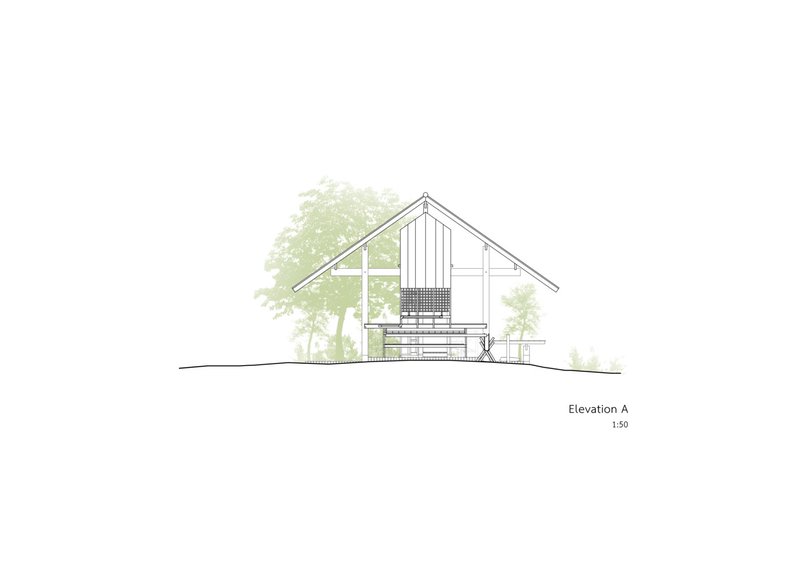
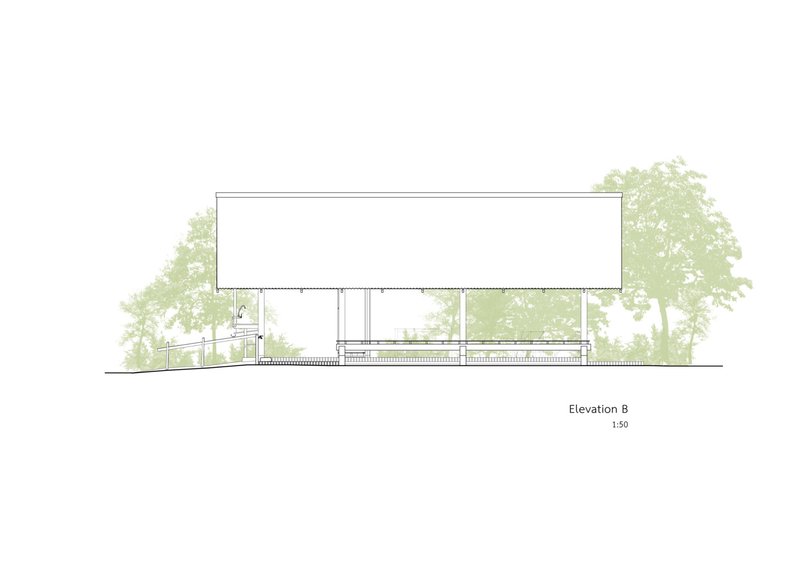
The plan drawing confirms what the photographs suggest: a simple rectangular deck oriented to maximize frontage onto the paddies, with furniture arranged for communal dining and relaxation. The section drawings reveal the proportional logic of the gabled roof, the generous head height at the ridge, and the relationship between the horizontal louvers, bamboo screens, and the surrounding tree canopy. An elevation drawing shows the brick base anchoring the structure to the ground, while vertical boards close off the gable end with a textural richness that reads well at distance.
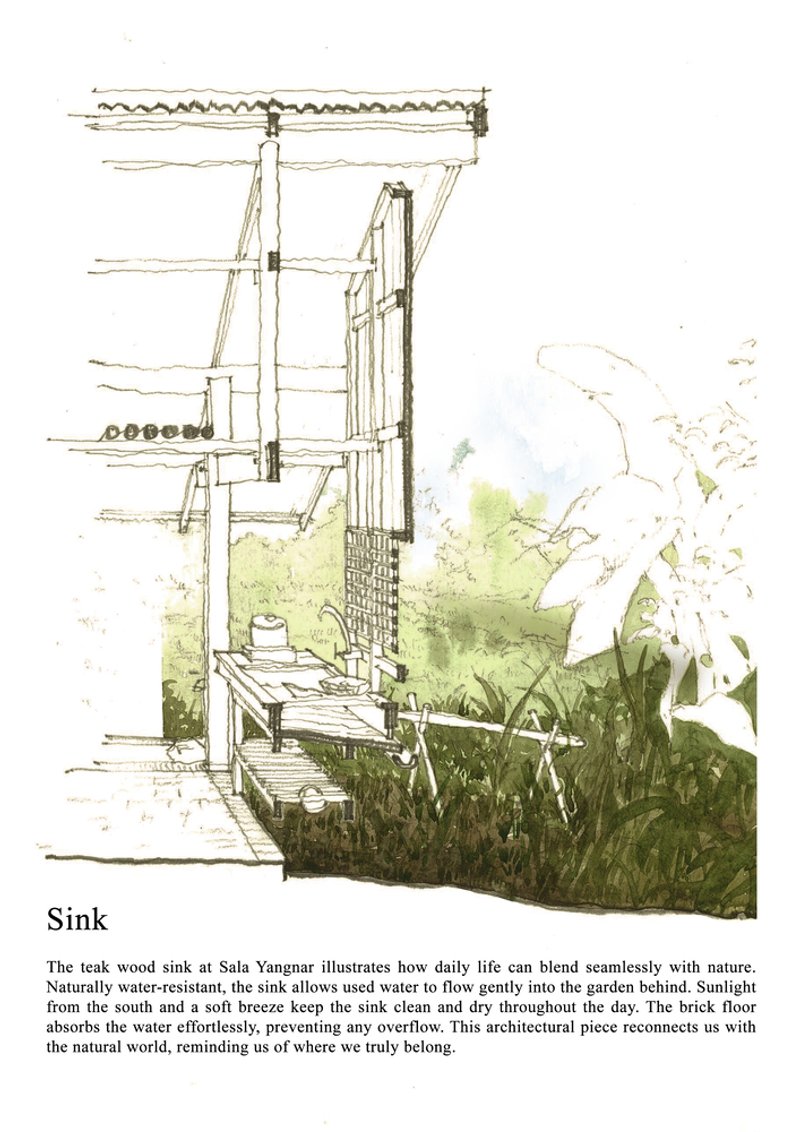
A watercolor sketch of an exterior sink beneath the eaves offers a rare glimpse into the design process. It is a reminder that architecture begins with the hand, not the computer, and that the qualities of warmth and specificity in the finished building were present from the very first drawing.
Why This Project Matters
Sala Yangnar matters because it proves that ambition in architecture does not require complexity. The pavilion does very few things, but it does them with conviction: it shelters, it gathers, it connects people to the land. In a discipline increasingly obsessed with formal novelty and technological spectacle, this kind of restraint is radical. It takes more confidence to stop at the right moment than to keep adding.
The project also demonstrates that vernacular intelligence is not a nostalgic exercise. Traditional Thai carpentry, local material sourcing, and passive environmental strategies are not relics to be preserved in a museum. They are active design tools, as relevant and as rigorous as any digital workflow. Yangnar Studio has built a small structure with a large argument: that the best architecture grows from its place, not in spite of it.
Sala Yangnar Pavilion by Yangnar Studio, Thailand. Photography by Rungkit Charoenwat.
About the Studio
Share Your Own Work on uni.xyz
If projects like this are the kind of work you want to make, uni.xyz is a place to publish your own, find collaborators, and enter design competitions.




Popular Articles
Popular articles from the community

Art 1 Office Strips Athens Back to Its Bones
Neiheiser Argyros transforms a 40-year-old Athens office building into a vivid, materially rich workplace anchored by red steel, exposed concrete, and roof
Not All Architecture Grounds a Timber Retreat in Victoria's Coastal Bushland
Ironbark House stretches low beneath eucalyptus canopy, threading a quiet domestic life between courtyard, deck, and landscape.
ure LLC Builds a Timber-Framed Suburban Office That Doubles as a Community Living Room in Hiroshima
KItoNOKO wraps sawtooth roofs and corrugated metal around an exposed timber frame to give a commercial district a new civic anchor.
Bood Design Bureau Splits a Gilan Residence in Two to Let the Forest In
Double Side House negotiates privacy and openness through interlocking concrete volumes and planted courtyards in northern Iran's humid Caspian lowlands.


Similar Reads
You might also enjoy these articles

Filtering Space: A Gradual Spatial Experience
From urban intensity to spatial calm.


The Ken Roberts Memorial Delineation Competition (Krob)
As the most senior architectural drawing competition currently in operation anywhere in the world, it draws hundreds of entries each year, awarding the very best submissions in a series of medium-based categories.


Waterfront Redevelopment and Urban Revitalization in Mumbai: Forging a New Dawn for Darukhana
A transformative waterfront redevelopment project reimagining Darukhana’s shipbreaking heritage into an inclusive urban future.

OUT-OF-MAP: A Call for Postcards on Feminist Narratives of Public Space
Rhizoma Design and Research Lab invites artists, designers, architects, researchers, and students to reflect on how feminist perspectives can reshape public space. Selected works will be exhibited in Barcelona, October 2026. Submissions open until 15 April 2026.


Explore Architecture Competitions
Discover active competitions in this discipline




The International Standard for Design Portfolios


The Global Benchmark for Architecture Dissertation Awards


The Global Benchmark for Graduation Excellence


Challenge to reimagine the Iron Throne
Comments (0)
Please login or sign up to add comments
No comments yet. Be the first to comment!