
Reyes Ríos + Larraín Arquitectos Staggers Three Pavilions Across Yucatán Dunes at San Bruno Beach House
A 700-square-meter coastal retreat in Telchac, Yucatán uses pigmented stucco, bamboo, and limestone to weather the sea without flinching.


A ten-meter-wide plot between the Gulf of Mexico and a brackish lagoon is not the kind of site that forgives vague intentions. Reyes Ríos + Larraín Arquitectos responded to that constraint with three staggered pavilions, each offset from the next so that every room catches a cross breeze and every threshold frames either ocean or lagoon. The result is a house that reads less like a single building and more like a small settlement, its solid-void rhythm drawn directly from the narrow geometry of the land.
What makes San Bruno Beach House worth studying is the discipline of its material palette. Bamboo, limestone, subtropical hardwood, and a pigmented cement-based stucco developed with CEMEX cover every surface, interior and exterior. There is no paint to peel, no cladding to replace. The stucco absorbs the salt air and the driving rain of the Yucatán coast as a feature, not a problem. It is a house designed for the specific physics of this place: wind, humidity, UV exposure, and sand.
Offset Volumes on the Dune
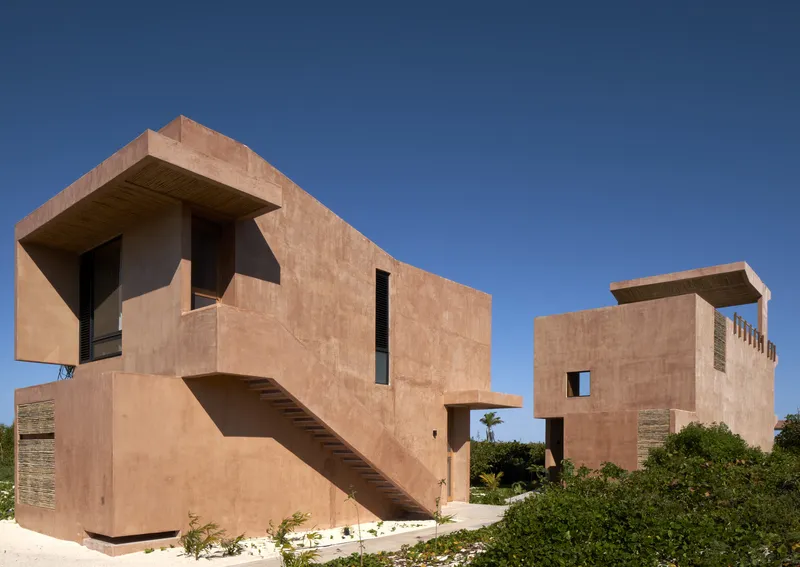
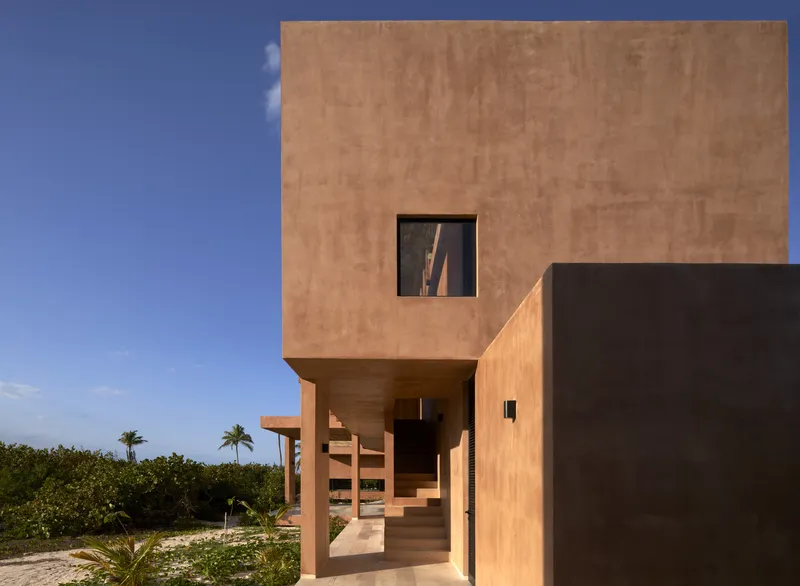
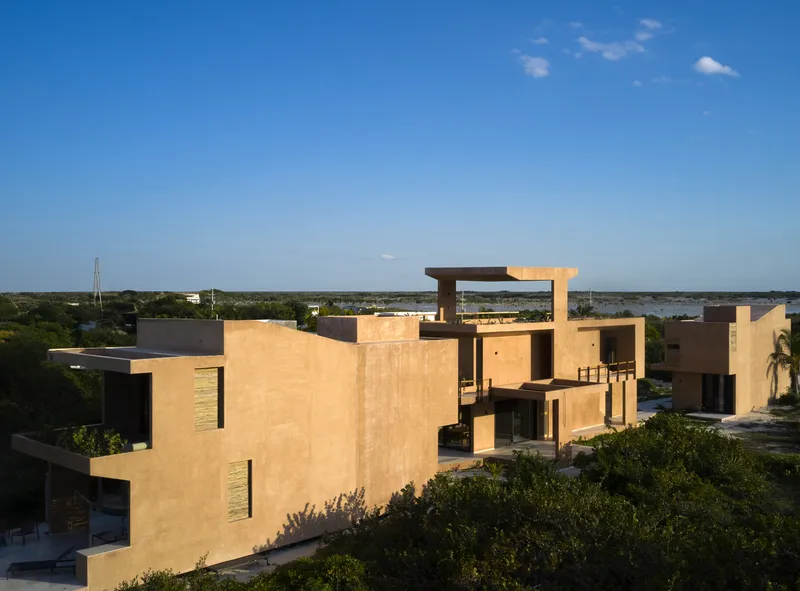
The three pavilions sit behind the second dune, lifted on concrete piles so the sand underneath remains largely undisturbed. Positioning them in a staggered line rather than a single bar accomplishes two things at once: it prevents any future construction on adjacent lots from blocking views, and it turns the gaps between volumes into linear courtyards where hammocks hang and coastal vegetation grows up to the walls.
The aerial perspective makes the logic plain. Each prismatic block is kept to the minimum width needed for its program, allowing sightlines to pass clean through the compound from lagoon to sea. The white gravel ground plane between volumes reflects light upward, brightening the soffits and reducing the bunker-like quality that thick-walled coastal architecture sometimes carries.
Rooftop Pergola and the Habitable Roof
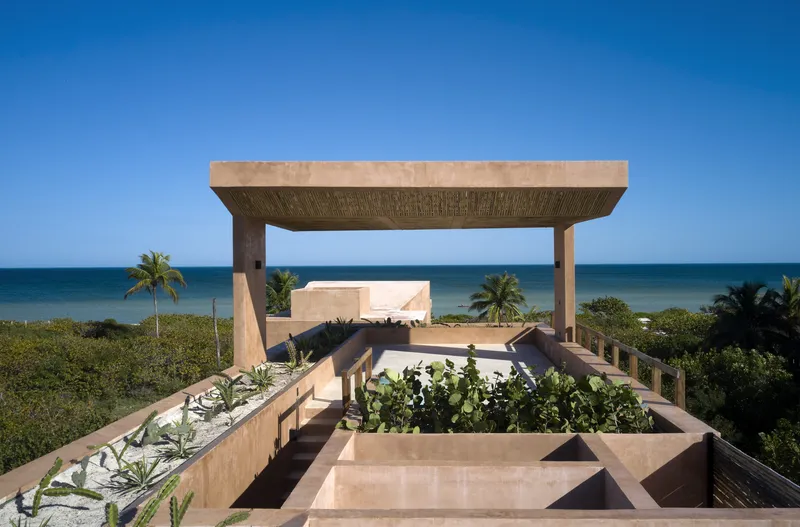
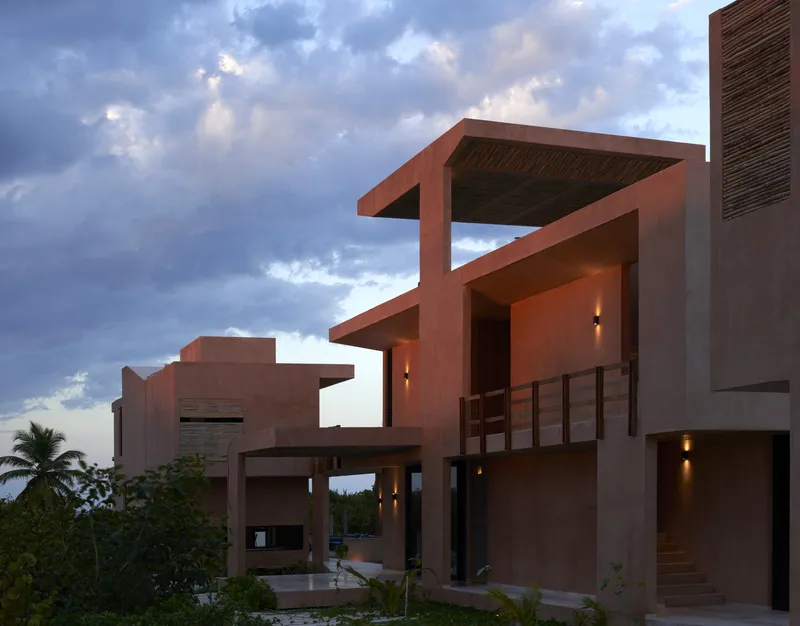
The intermediate pavilion earns its place as the social anchor of the compound by offering a rooftop platform sheltered under a bamboo pergola that touches down at only two structural points. Planted beds line the perimeter, softening the concrete parapet and creating a garden in the sky where the shifting light of the Gulf coast is the main event. It is a viewpoint first and a terrace second.
At dusk, the stepped terraces and slatted timber ceilings take on a theatrical quality. The pergola filters the last horizontal light of the day into bands, casting long parallel shadows across the deck. The design treats the roof not as leftover space but as the primary communal room of the house, one that happens to have no walls.
Circulation Between Walls
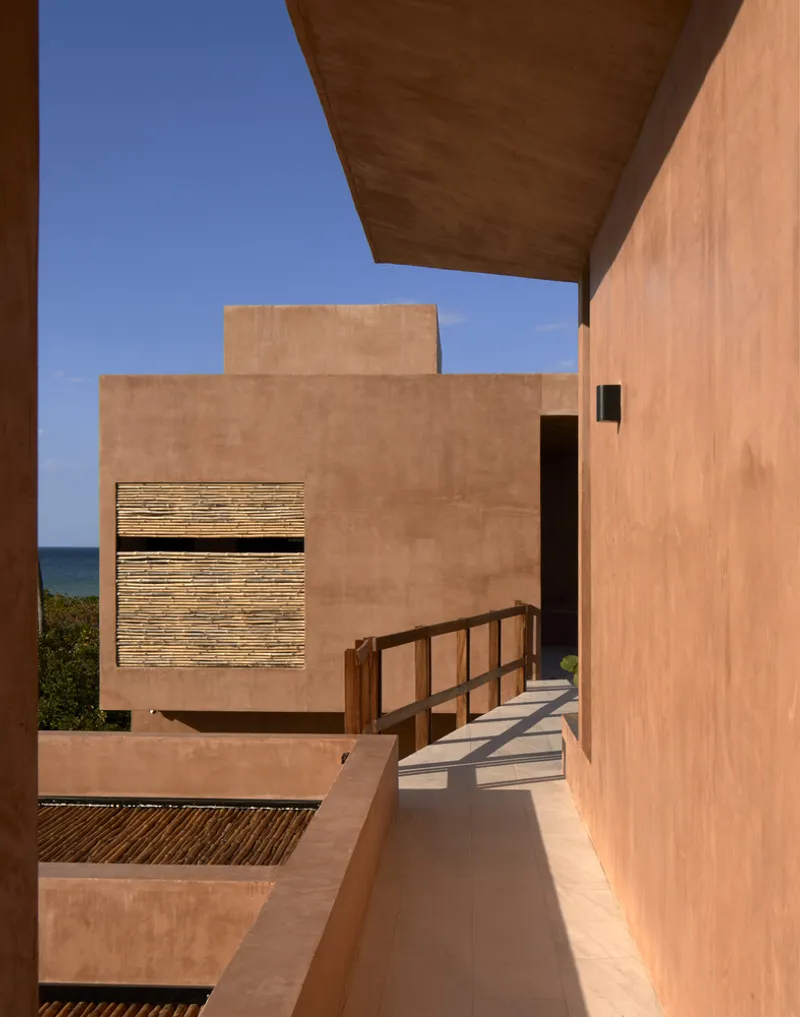
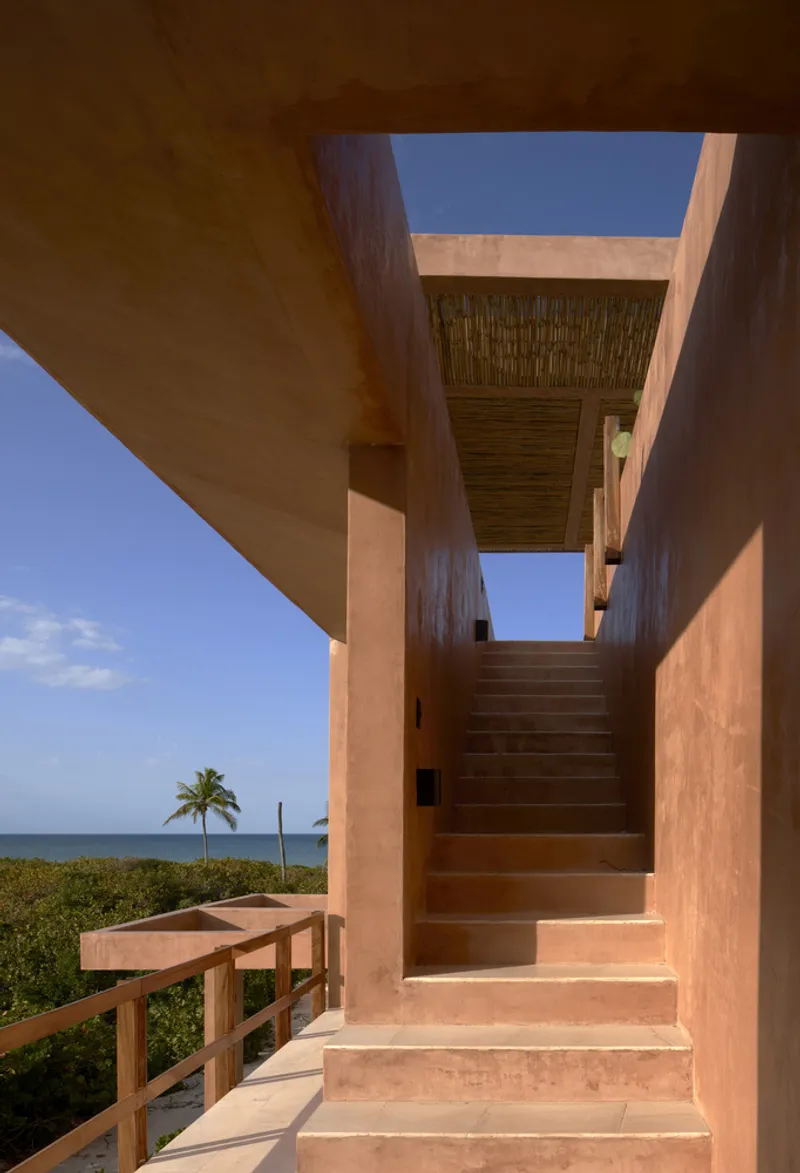
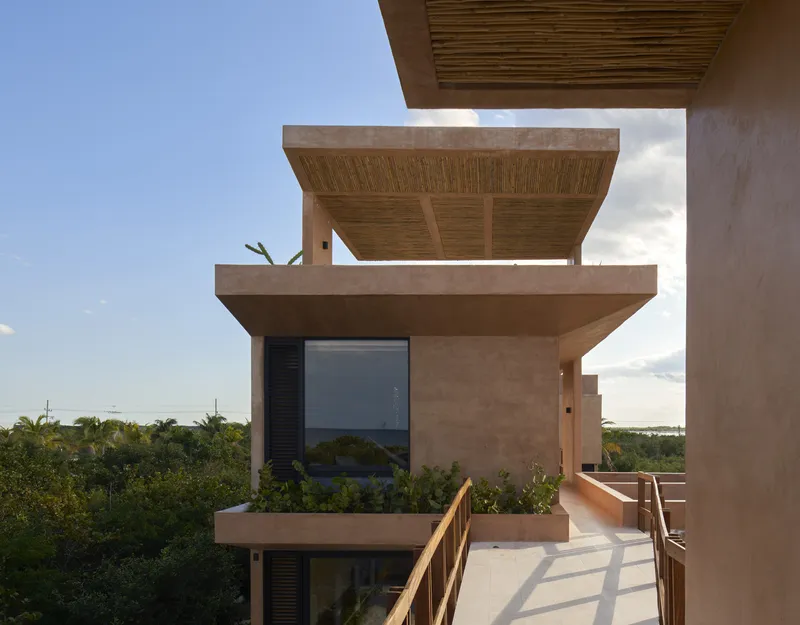
Moving through San Bruno Beach House means passing between thick stucco walls, climbing external staircases that frame palm canopies, and ducking under woven reed ceilings that recall the region's vernacular construction. The walkways connecting pavilions are open to the air on at least one side, making every transition from one volume to the next a brief encounter with the outdoors.
The staircase rising between heavy pigmented walls toward the ocean is one of the most compelling sequences in the project. The woven soffit overhead compresses the vertical space just enough that the release at the top, where the Gulf opens up beyond the palms, registers physically. It is a compressed, almost cinematic transition from shelter to exposure.
Interiors Calibrated to Light and Air
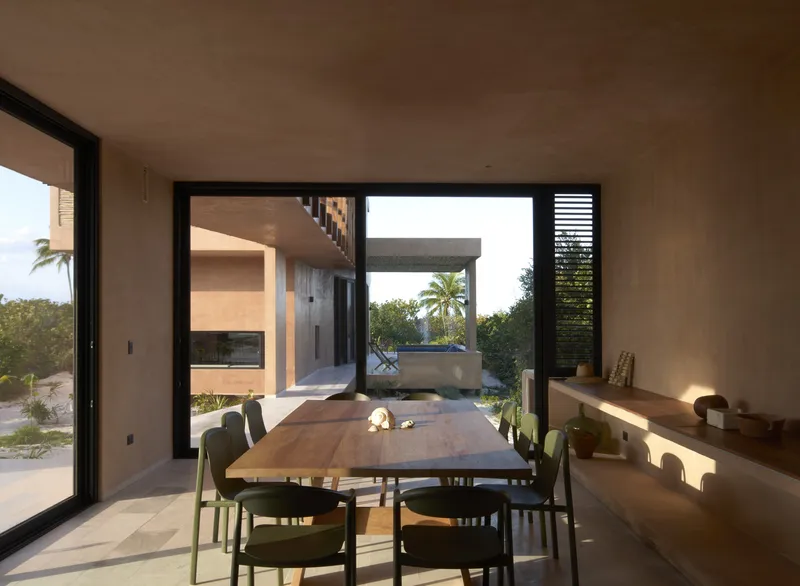
Inside, the openings are sized and placed to do specific jobs. The dining room looks through a full-height glazed wall into a courtyard framed by the pergola, pulling greenery into the foreground while keeping direct sun at bay. A live-edge hardwood table runs the length of the room, its organic grain a quiet counterpoint to the rectilinear geometry of the walls. Nothing in the material palette competes for attention; the stucco, timber, and stone simply coexist.
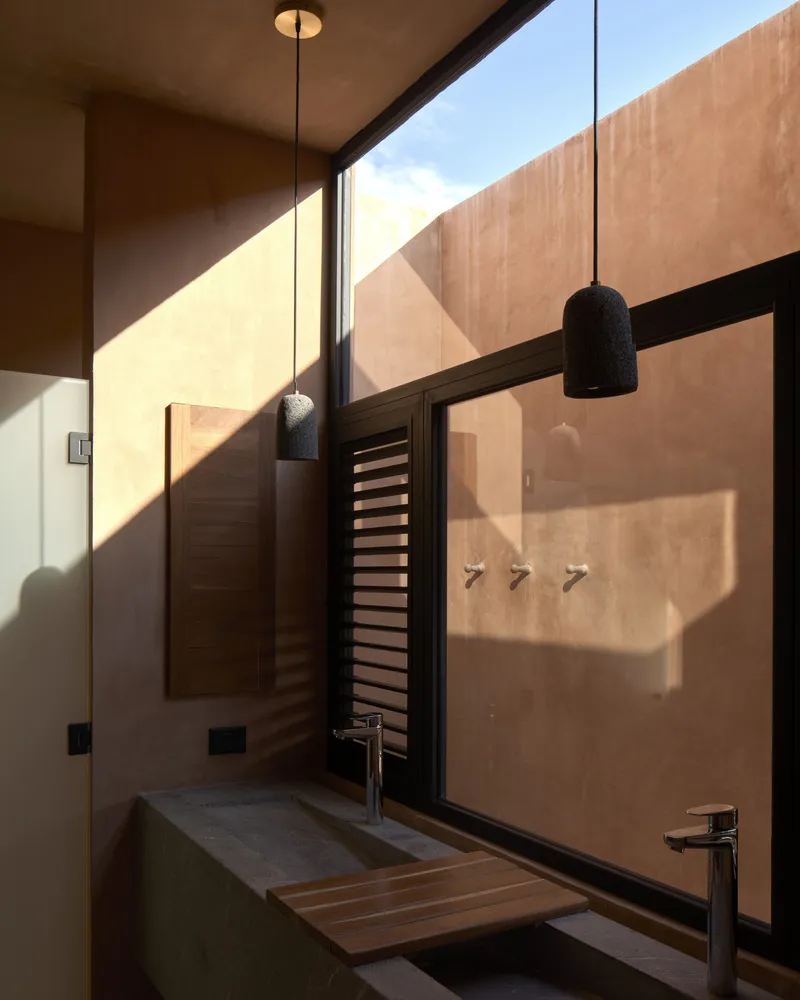
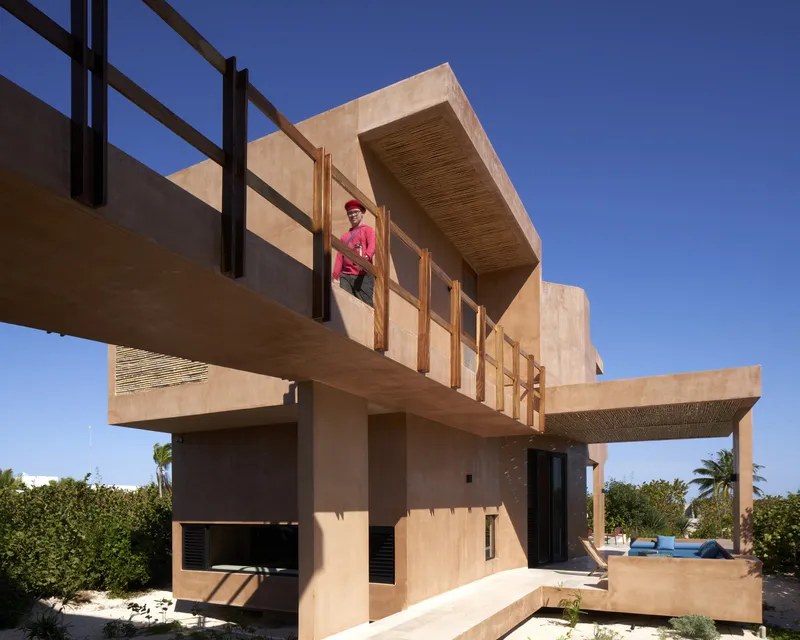
The bathroom deploys louvered windows to slice afternoon light into angular bands across a concrete trough sink. It is a small room that works hard: the louvers ventilate the wet space passively while the concrete absorbs and slowly releases heat, moderating temperature swings without mechanical intervention. On the cantilevered terrace, a woven ceiling soffit and timber railings create a shaded outdoor room that feels genuinely habitable rather than ceremonial.
Pigmented Stucco as Long-Term Strategy
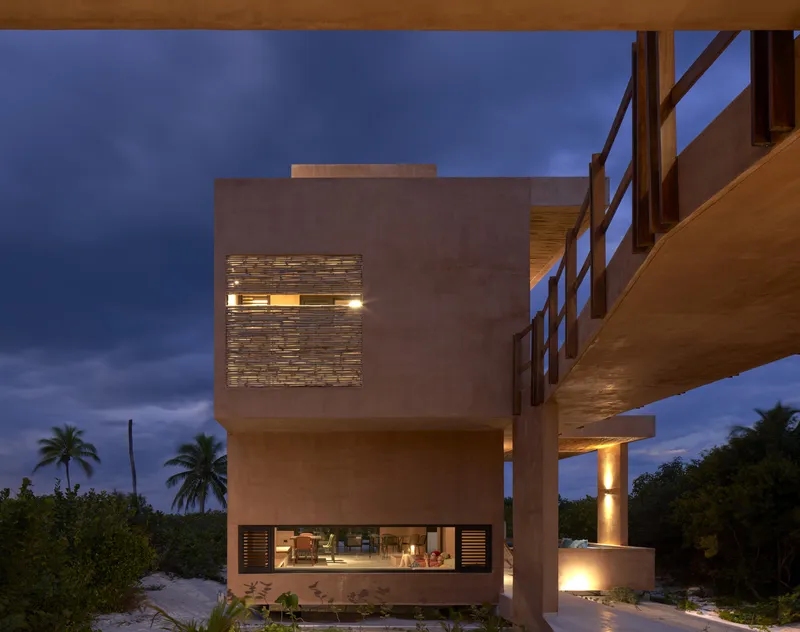
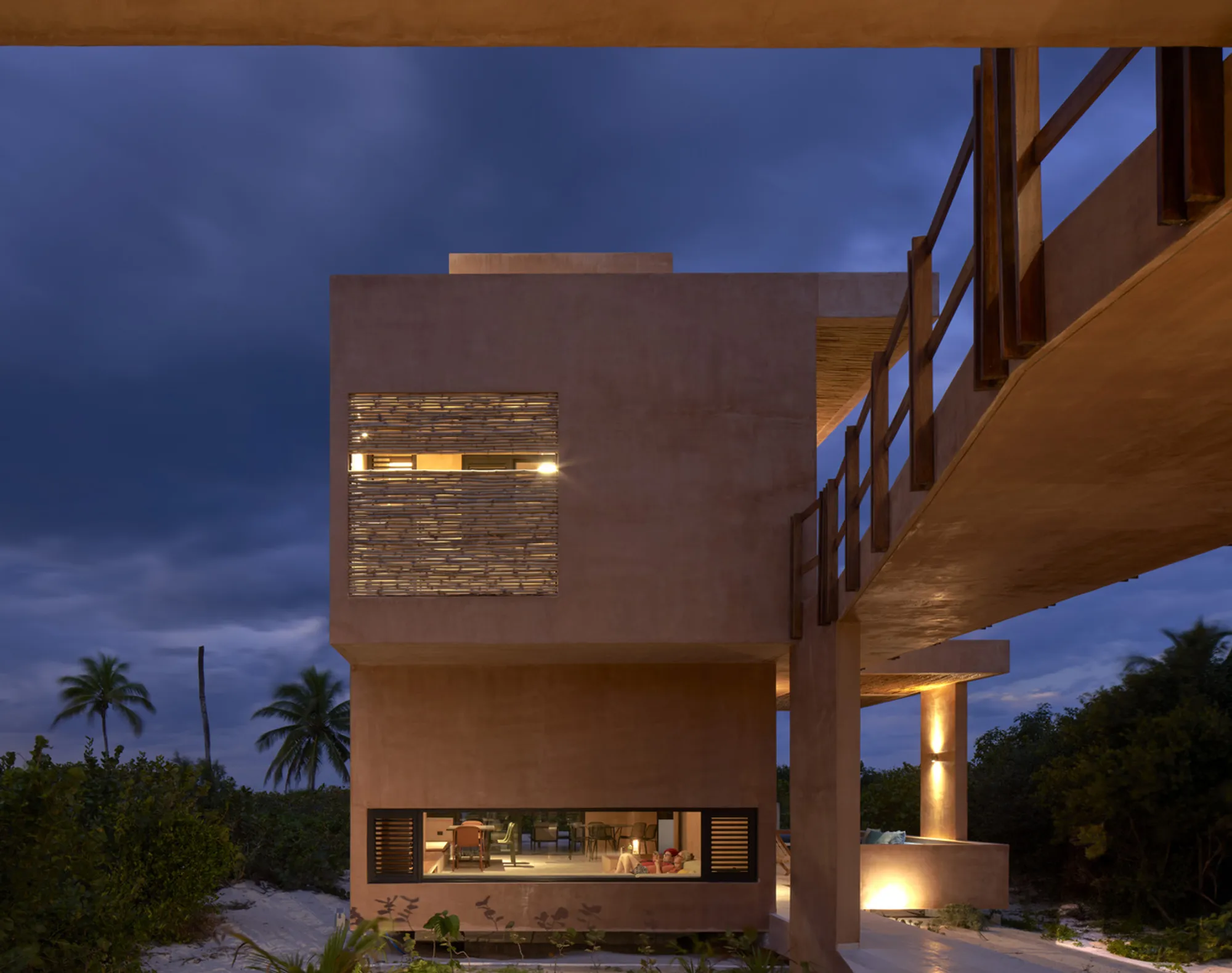
The collaboration with CEMEX to develop the mineral-pigmented mortar stucco is perhaps the most pragmatic decision in the project. Coastal houses in the Yucatán face relentless salt spray and humidity. Paint systems fail within years, demanding repeated maintenance that few owners sustain. By integrating the color directly into the cementitious finish, Reyes Ríos + Larraín eliminated an entire maintenance cycle. The warm earth tones visible at dusk are not a coating but the material itself.
At night, the illuminated square openings punched through the stucco volumes glow like lanterns against the dark silhouettes of coconut palms. The timber bridge linking upper levels reads as a single bright line connecting two solid masses. The effect is restrained and almost monastic, a quality that owes everything to the consistency of the surface: one material, one color, one texture wrapping every wall from foundation to parapet.
Plans and Drawings
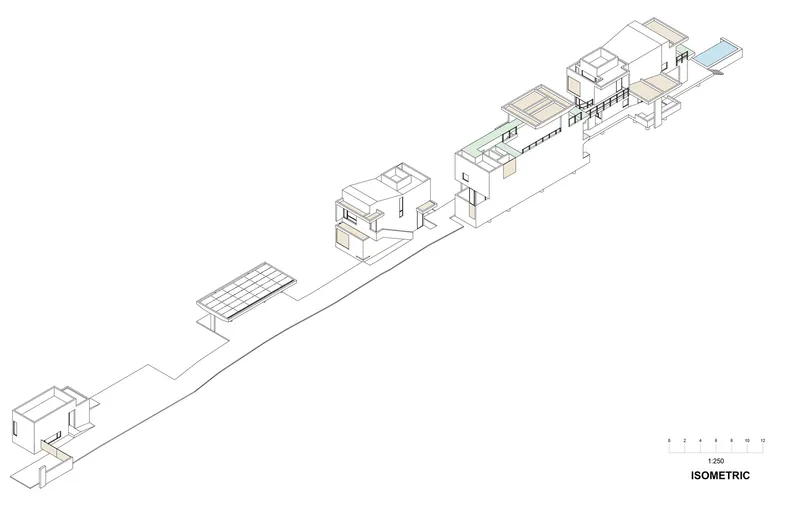
The isometric drawing reveals the organizational clarity that the photographs only hint at. The three pavilions are arranged in a linear sequence along the narrow plot, each one shifted laterally from its neighbor to open diagonal views and create sheltered courtyards between. Walkways and bridges stitch the volumes together at multiple levels, making the rooftops as accessible as the ground plane. The drawing confirms that the compound's apparent informality is actually tightly choreographed: every offset, every gap, and every stair is a deliberate calibration of breeze, light, and privacy.
Why This Project Matters
Coastal residential architecture in Mexico too often defaults to one of two modes: the hermetic concrete fortress or the open-air palapa fantasy. San Bruno Beach House occupies a more considered middle ground. Its thick stucco walls protect against storms, but its staggered plan ensures the compound breathes freely on calm days. Its materials are local and low-maintenance, but they are also genuinely beautiful in the way they age and catch light. The house treats durability and atmosphere as the same problem.
The project also offers a transferable lesson about narrow sites. Rather than forcing a single elongated volume onto a ten-meter-wide plot, Reyes Ríos + Larraín broke the program into discrete pavilions and used the spaces between them as rooms in their own right, places for hammocks, planting, and the simple pleasure of walking outdoors on the way to bed. That generosity with negative space, on a site where every square meter counts, is the most persuasive argument the house makes.
San Bruno Beach House by Reyes Ríos + Larraín Arquitectos. Telchac, Yucatán, Mexico. 700 square meters. Completed 2024. Photography by Edmund Sumner.
About the Studio
Share Your Own Work on uni.xyz
If projects like this are the kind of work you want to make, uni.xyz is a place to publish your own, find collaborators, and enter design competitions.




Popular Articles
Popular articles from the community


Co-Life: Senior Housing Design That Reconnects Older Adults With the City
Co-Life reimagines senior housing design through healing gardens, shared streets, workshops, and a sustainable community across generations.

The Ocean Hive: Sustainable Architecture for a Self-Sufficient Civilization at Sea
The Ocean Hive imagines sustainable architecture at sea, where modular habitats, algae, wave power and ocean waste sustain a growing colony.

Play: Fragments of Their World
Familiar architecture becomes modular playground design, creating safe spaces where displaced children can learn, connect, imagine and play.

Hill & Cross Opera: Sculptural Opera House Architecture Shaped by Tallinn’s Landscape and Identity
Hill & Cross Opera reimagines opera house architecture in Tallinn through its sculptural hill, civic plaza, glass wave and a luminous cross.


Similar Reads
You might also enjoy these articles


Hodi-Mandai Geram
Project Function: Preservation and revitalization of the Intangible heritage and socio-spatial identity of the Hodi by Housing, Cultural Memory Center, Sacred Grove, landscape, local tourism economy


Olio Towers: A Mid-Rise for Performers That Fuses Housing, Rehearsal, and Stage
Located blocks from Houston's Theater District, this modular tower stacks living units around a central performance atrium.

Oasis: Modular Green Housing Carved into Dhaka's Urban Fabric
A shortlisted Plugin Housing entry reclaims unauthorized settlements in Dhaka with stepped concrete volumes, green roofs, and ventilation-driven design.

Black Hole: A Floating Megastructure for the Post-Physical Era
Emiliano Mazzarotto envisions a spherical, self-scaling arena where e-sports, digital hotels, and holographic stadiums replace traditional public space.


Explore Architecture Competitions
Discover active competitions in this discipline



Challenge to reimagine the Iron Throne


Photograph architecture without architects


Illustrate the lost glory of Angkor Wat - Render Challenge


Design challenge to reuse E-waste
Comments (0)
Please login or sign up to add comments
No comments yet. Be the first to comment!