
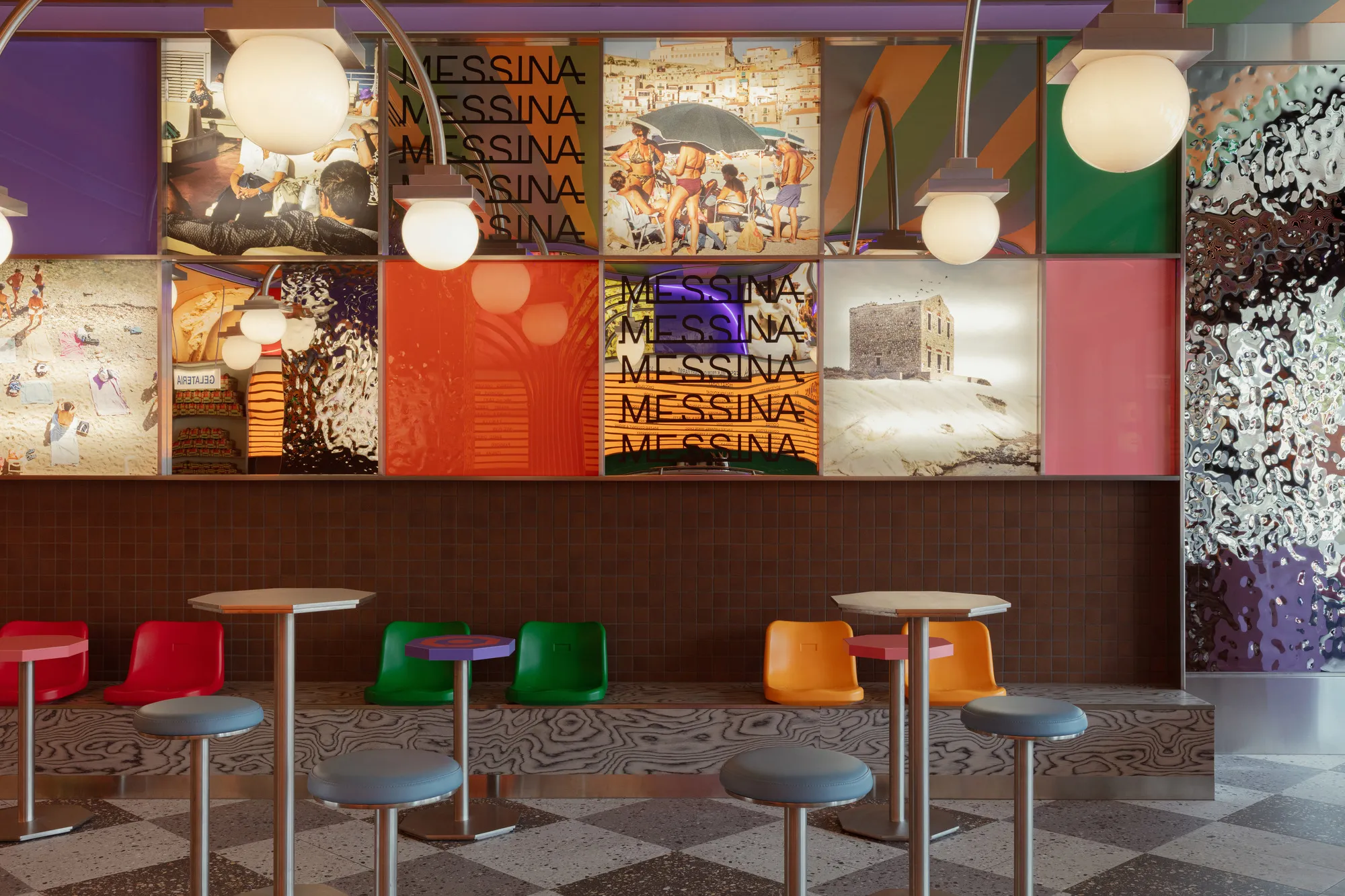
Sans-Arc Studio Turns a Glenelg Gelato Shop into a Maximalist Ode to Sicilian Summers
Gelato Messina's fifth collaboration with Sans-Arc Studio lands on Australia's coast, channeling southern Italian nostalgia in 138 square meters.


There is a particular genre of interior design that treats ice cream shops as temples of restraint: white walls, minimal signage, a single pastel accent. Sans-Arc Studio has never been interested in that approach. Gelato Messina Glenelg, the fifth collaboration between the Adelaide-based practice and the Australian gelato chain, doubles down on the studio's conviction that a scoop shop should be loud, warm, and unapologetically theatrical. Sitting on Glenelg's Jetty Road, steps from the beach, the 138 square meter fit-out pulls from a trip the designers took to southern Italy in 2019, translating the sensory overload of a Sicilian gelateria into a space that feels both foreign and deeply familiar.
What makes the project worth studying is not any single material choice or color decision but the commitment to treating a small commercial interior as a social instrument. Sans-Arc designs the shop not around the product alone but around the rituals that surround it: the queue, the deliberation over 40 flavors, the moment you step outside with a cone and the sun hits your face. Every surface in the room participates in building that atmosphere, which is harder to pull off than it sounds.
Orange Walls and Oculus Windows


The interior is dominated by a palette of burnt orange paneling that wraps the walls in a continuous, saturated field. Circular cutouts puncture these panels at irregular heights, functioning as porthole windows that let light bleed through and break the surface into something more playful than a flat color plane. Suspended globe pendants hang at varying levels, their warm glow reinforcing the golden tonality of the room. The effect is less "designed space" and more "the inside of someone's very specific memory of a holiday."
It is a bold move to commit an entire room to a single saturated hue, especially in a commercial context where landlords and brand managers tend to prefer safe neutrals. But the orange here is doing real work. It pulls the eye away from the ceiling grid and services, it warms the skin tones of everyone in the room (not a small thing for a space that lives on social media), and it creates a continuity between walls and ceiling that makes 138 square meters feel enveloping rather than cramped.
Mosaic Collage and the Counter Zone
At the counter, the design language shifts. A mosaic wall collage rises above brown tiled surfaces, assembling fragments of imagery into a composition that reads as both decorative and narrative. Colorful molded plastic stools cluster below, their candy-bright tones deliberately clashing with the earthy tile. The collision is the point: this is a space that refuses to resolve into a single aesthetic register, preferring instead to layer references the way a real Italian gelateria layers years of signage, stickers, and family photographs.
The counter itself anchors the social choreography of the room. With 35 permanent flavors and five weekly rotating specials spread across a single long cabinet, the design forces a linear procession, meaning every customer moves through the full length of the space before ordering. Sans-Arc understands that anticipation is part of the product. The queue is not a problem to solve; it is a ritual to stage.
Nostalgia as Architectural Strategy
Sans-Arc's founding interest in this ongoing Messina series has been the idea that gelato shops carry collective memory. Everyone has a version of the corner shop with the too-bright lights and the sticky counter. The Glenelg project leans into that emotional register without resorting to literal pastiche. The circular windows recall portholes or periscopes, suggesting a seaside vernacular without copying one. The mosaic wall suggests decades of accumulated imagery without actually being old. The space feels nostalgic for something that may never have existed in exactly this form, which is precisely how good nostalgia works.
The beachside context matters here. Glenelg is Adelaide's most popular coastal strip, a place where commercial and social life overlap in the specific way that only beach towns allow. Sans-Arc positions the shop as an extension of that blurred zone, with its open, street-facing layout dissolving the boundary between sidewalk and interior. You are meant to drift in the same way you drift along the foreshore.
Why This Project Matters
Five collaborations into its partnership with Gelato Messina, Sans-Arc Studio has built a body of work that argues convincingly for maximalism in small-format hospitality. At a moment when most food and beverage fit-outs still default to safe minimalism, the Glenelg project demonstrates that boldness is not just an aesthetic preference but a spatial strategy. Color, pattern, and texture do more than decorate: they shape how people move, linger, and remember a place.
The broader lesson is about the role of reference in contemporary interiors. Sans-Arc does not recreate a Sicilian gelateria; it constructs a feeling of one, using abstracted forms and saturated surfaces to trigger associations rather than reproduce them. That distinction is important. The best commercial interiors are not themed environments but spaces that activate something in the visitor's own memory. At 138 square meters, Gelato Messina Glenelg proves you do not need much room to do that well.
Gelato Messina Glenelg by Sans-Arc Studio, Glenelg, Australia. 138 m², completed 2025. Photography by Jonathan VDK.
About the Studio
Share Your Own Work on uni.xyz
If projects like this are the kind of work you want to make, uni.xyz is a place to publish your own, find collaborators, and enter design competitions.



Popular Articles
Popular articles from the community


Hill & Cross Opera: Sculptural Opera House Architecture Shaped by Tallinn’s Landscape and Identity
Hill & Cross Opera reimagines opera house architecture in Tallinn through its sculptural hill, civic plaza, glass wave and a luminous cross.

Conexión: Biophilic Design Reimagines High-Rise Living in Hong Kong
Conexión reimagines high-rise living in Hong Kong through biophilic design, green facades, shared spaces, daylight, water and nature within.
EW PARK: Sustainable Architecture Reimagines the Future of Urban Parking
EW PARK reimagines city parking as a modular wooden tower combining automation, solar energy, electric mobility, and adaptable urban design.

The Earth Pod: 3D Printed Homes for Resilient Refugee Communities
The Earth Pod reimagines refugee housing through 3D printed homes made from clay, combining resilience, self-sufficiency, and rapid shelter.


Similar Reads
You might also enjoy these articles

Bao Huynh Watercolor Atelier: A Serene Art Retreat in Hội An
Bao Huynh Watercolor Atelier in Hội An blends multifunctional art spaces, sustainable design, local materials, and family-friendly living in a serene environment.

Atelier Macri Concept Store Interior Design by CASE-REAL
Atelier Macri store features a "ko" counter, walnut wood details, cork displays, blending retail, gallery, and seamless customer experiences.

Manuel Vargas Izquierdo Stadium and High-Performance Sports Center: Architectural Excellence in Jalpa de Méndez
The Manuel Vargas Izquierdo Stadium blends sustainable design, inclusive sports facilities, and cultural-inspired architecture, revitalizing Jalpa de Méndez’s public spaces.
KAKR Buluh Awar Hall: Revitalizing Community and Ecology Through Bamboo Architecture
Community built bamboo hall revitalizes Buluh Awar village, empowering youth, restoring ecology, celebrating vernacular craftsmanship through sustainable architecture and culture.


Explore Commercial Buildings Competitions
Discover active competitions in this discipline


Challenge to design luxury tourism on rails


VR headsets Storefront design competition

Designing a staircase for a client
Comments (0)
Please login or sign up to add comments
No comments yet. Be the first to comment!