

José Morgado Carves a 12-Square-Meter Chapel from a Single Block of Concrete in Rural Portugal
In the mountain village of Touro, a monolithic brutalist shrine frames light, water, and stone for a community of believers.


When the residents of Touro, a village of fewer than a hundred souls perched at 803 meters above sea level in the Portuguese interior, decided they needed a chapel for Saint John the Baptist, they turned to José Morgado, an architect who lives and works among them. The result is a 12-square-meter concrete prism that sits on a ridge 300 meters from the parish church of São Miguel, stripped of ornament and built entirely from board-formed concrete. This is not an exercise in nostalgia. Morgado has taken the elemental program of a rural chapel and pressed it into a single monolithic gesture, one that reads as both shelter and monument.
What makes the São João Batista Chapel compelling is not its scale but its precision. The architect has used stereotomy, the ancient craft of cutting stone to exact geometries, to sculpt the concrete mass into a stylized house shape. The gable profile is so sharp it borders on abstraction, yet it unmistakably signals sanctuary. Inside, lozenges of sunlight slide across raw walls as the sun moves. There is no stained glass, no gilt, no cushioned pews. Just concrete, shadow, and the controlled admission of light and water.
A Threshold Carved from Mass


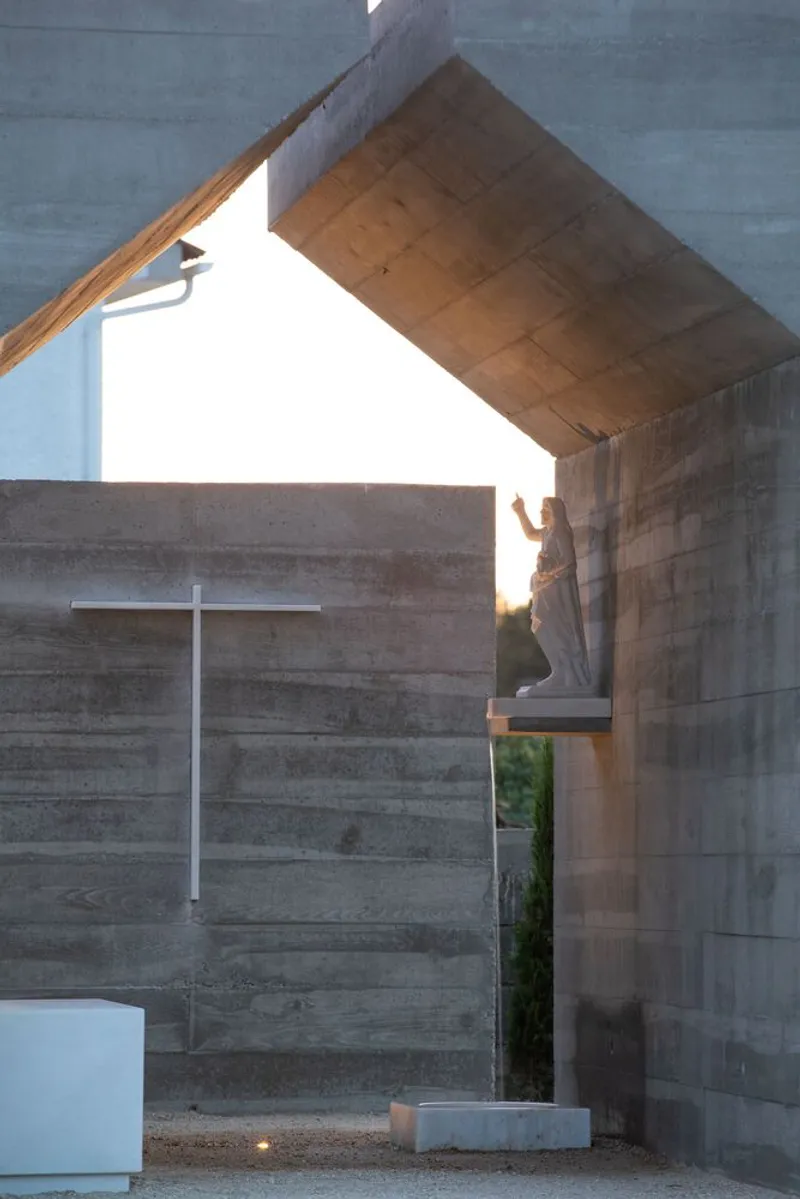
The entry is a pitched portal cut through the concrete block, a void shaped like a gable that frames the interior without compromise. The board marks from the formwork are left exposed, a texture that registers every plank and joint. At the threshold, the architecture does not invite so much as it defines. You step through the opening and the world outside collapses to a single framed view: a recessed cross on the rear wall and a sculptural element that anchors the ritual program.
The ceiling inside mirrors the exterior gable, a pitched surface of timber-formed concrete that turns the interior into a compression chamber for light. The geometry is ruthlessly simple, but the effect is spatial, not merely symbolic. The concrete reads as a single hewn mass, not an assembly of parts.
Water as Event
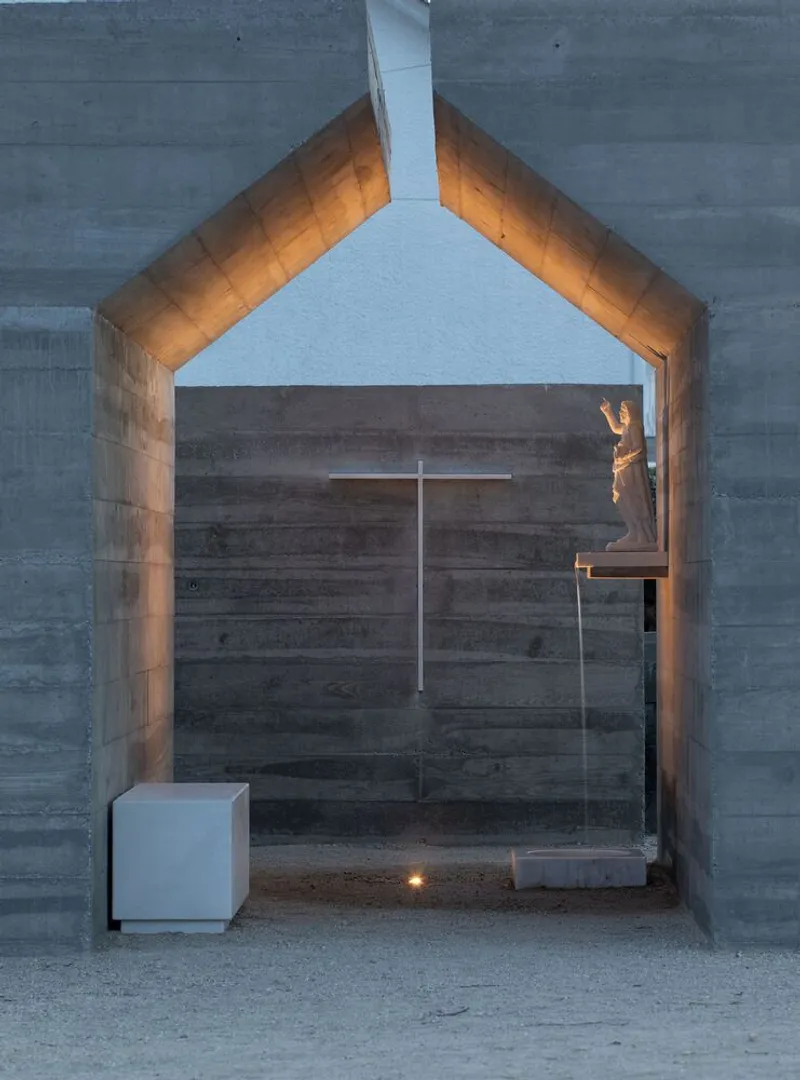
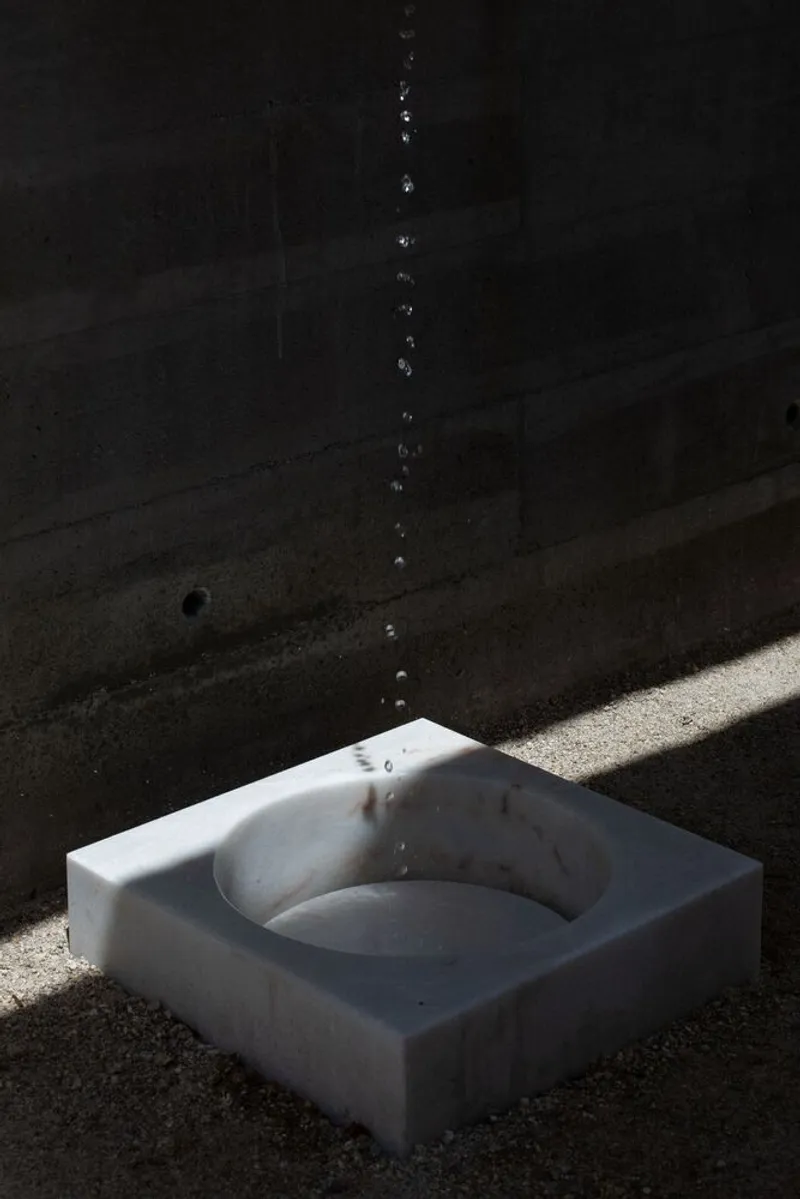
At the entry, a white marble basin sits beneath a square opening in the roof. Water drips into it, catching the sun as it falls. This is the baptismal reference rendered literal, a constant trickle that marks the threshold between outside and sacred interior. The basin is a cube, machined and placed with the same geometric rigor that governs the rest of the chapel.
Morgado has avoided the picturesque. The water does not burble or pool romantically. It falls, it fills, it overflows. The act is mechanical, almost industrial, yet it performs the symbolic work required of a chapel dedicated to John the Baptist without sentimentality.
Material Honesty in a Rural Context
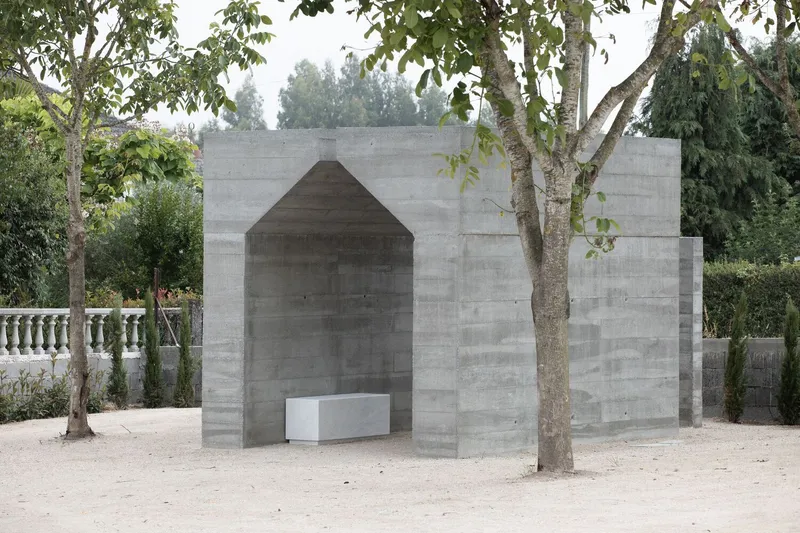
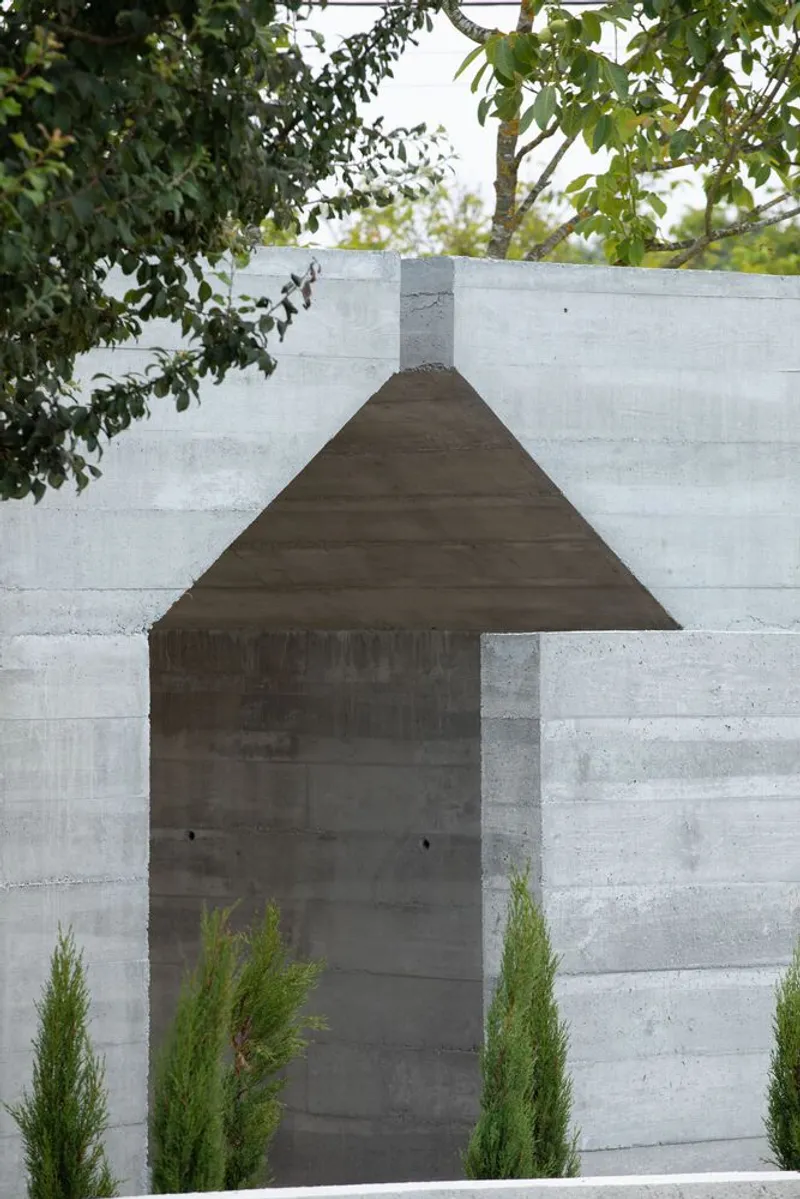
The chapel sits in a gravel courtyard ringed by deciduous trees and flanked by slender cypress plantings. The board-formed concrete reads as stone, not as a modern industrial product trying to mimic it. The formwork pattern is regular but not mechanical, a rhythm of horizontal bands that gives the mass texture without decoration.
This is brutalism in a village of stone houses and agricultural terraces, yet it does not feel imported. The gable silhouette connects it to the vernacular typology of the region, even as the monolithic execution pushes it into contemporary territory. The chapel does not blend in, but it does not fight its context either. It simply claims its ground.
Plans and Drawings
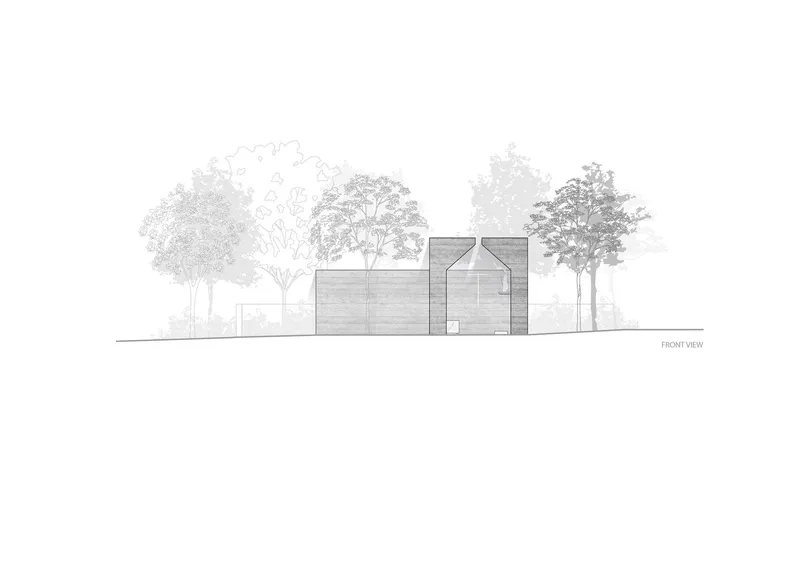
The front elevation drawing shows the chapel as a low horizontal volume with a pitched roof, set among mature trees. The drawing confirms what the photographs suggest: this is a building defined by subtraction, not addition. The architect has removed material to create the entry portal, the skylight, the interior void. What remains is a single block carved into function.
Why This Project Matters
The São João Batista Chapel proves that rigor and restraint can produce architecture of genuine spiritual weight. At 12 square meters, it is smaller than most residential bathrooms, yet it feels monumental because every decision is absolute. The gable form, the board-formed concrete, the white marble basin, the controlled admission of light and water: each element is necessary, and nothing is decorative.
Morgado has built a chapel for a community that still gathers to worship, and he has done so without pastiche or irony. The result is a building that respects both the program and the intelligence of its users. In an era when rural architecture too often defaults to either nostalgic mimicry or alien intervention, this chapel offers a third path: a contemporary language deployed with absolute clarity in service of a traditional need.
São João Batista Chapel by José Morgado, Touro, Vila Nova de Paiva, Portugal. 12 m². 2023. Photography by José Campos.
About the Studio
Share Your Own Work on uni.xyz
If projects like this are the kind of work you want to make, uni.xyz is a place to publish your own, find collaborators, and enter design competitions.


Popular Articles
Popular articles from the community


Cube Design Draws an Ecological Corridor Between Two Shenzhen Hills with the Nankai Building
Beside Shenzhen's container docks, the Nankai Building pairs stacked balconies with a climbing green screen to connect two hillsides across its height.


Manzana Morphosis: Stretching Barcelona's Grid into a Living Landscape for 2050
A radical reworking of the Eixample manzana turns density into a tool for generous public space, vertical ecology, and environmental performance.

graciastudio Turns a Viewless Tijuana Lot Inward Around a Courtyard of Concrete, Timber and Trees
In Tijuana, Jorge Gracia's GA2 House stacks a timber-clad private floor over exposed concrete and replaces a missing view with a planted interior patio.

Singing Woman: An Opera House That Performs Before the Curtain Rises
Ovidiu Cristian Pavel's conceptual opera house translates Estonia's choral identity into a sculpted waterfront landmark facing the Baltic Sea.

Similar Reads
You might also enjoy these articles


Hodi-Mandai Geram
Project Function: Preservation and revitalization of the Intangible heritage and socio-spatial identity of the Hodi by Housing, Cultural Memory Center, Sacred Grove, landscape, local tourism economy


Olio Towers: A Mid-Rise for Performers That Fuses Housing, Rehearsal, and Stage
Located blocks from Houston's Theater District, this modular tower stacks living units around a central performance atrium.

Oasis: Modular Green Housing Carved into Dhaka's Urban Fabric
A shortlisted Plugin Housing entry reclaims unauthorized settlements in Dhaka with stepped concrete volumes, green roofs, and ventilation-driven design.

Black Hole: A Floating Megastructure for the Post-Physical Era
Emiliano Mazzarotto envisions a spherical, self-scaling arena where e-sports, digital hotels, and holographic stadiums replace traditional public space.

Explore Chapel Competitions
Discover active competitions in this discipline

Design Challenge - Contemporary interpretation of a religious complex

Challenge to reimagine the Iron Throne

Photograph architecture without architects

Illustrate the lost glory of Angkor Wat - Render Challenge
Comments (0)
Please login or sign up to add comments
No comments yet. Be the first to comment!