
Satoru Ito Architects Stretches a 25-Meter Timber Villa Across a Karuizawa Forest Clearing
A long, low house in Japan's mountain retreat town uses dirt floors and covered decks to blur the line between indoors and out.


Karuizawa has been Tokyo's mountain escape valve for over a century, a place where generous lots and dense tree cover let architects think in horizontal lines instead of vertical ones. Satoru Ito Architects takes full advantage of that condition here, pulling the plan of this 223 m² vacation house into a single bar roughly 25 meters long in the east-west direction. Sited on one of the neighborhood's characteristic 1,000 m² plots, the building hugs the ground, letting the surrounding canopy tower above it rather than competing for height.
What makes the project genuinely interesting is how it treats the ground plane. Rather than sealing the interior off from the forest floor, the design draws an outer dirt floor into the house, using it as a spatial device to divide the plan into distinct zones for the owners, their parents, and guests. Combined with covered walkways, overhanging decks, and a shed volume appended to the main body, the result is a house that feels more like a small settlement than a single building.
A Slatted Face in the Trees
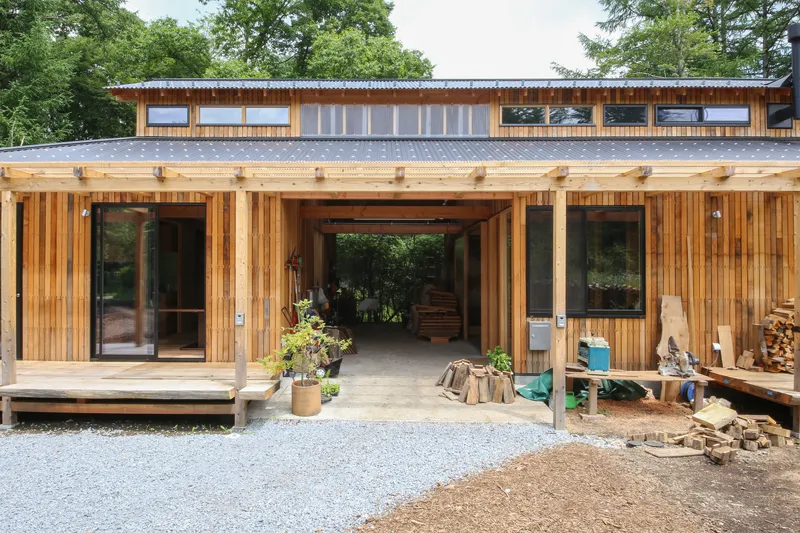
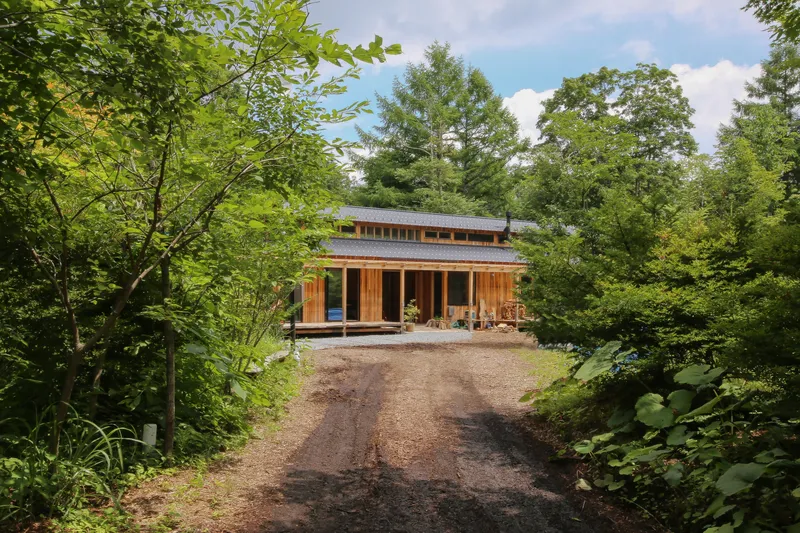
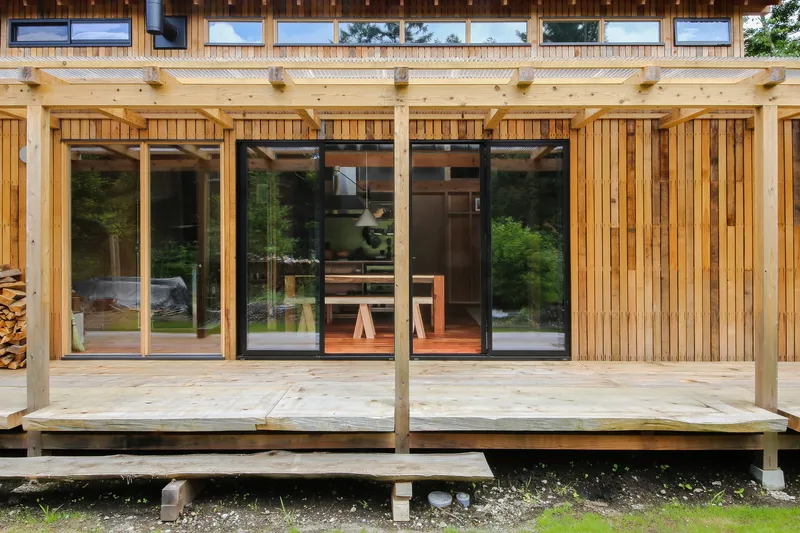
The facade is clad in vertical timber slats, a move that could feel generic in lesser hands but works here because of the proportional discipline. The building is relentlessly long and low, with a narrow clerestory band running above the main wall plane to lift light into the interior. From the gravel approach, the central open passageway reads as a threshold rather than a door, framing a view straight through the building to the garden beyond.
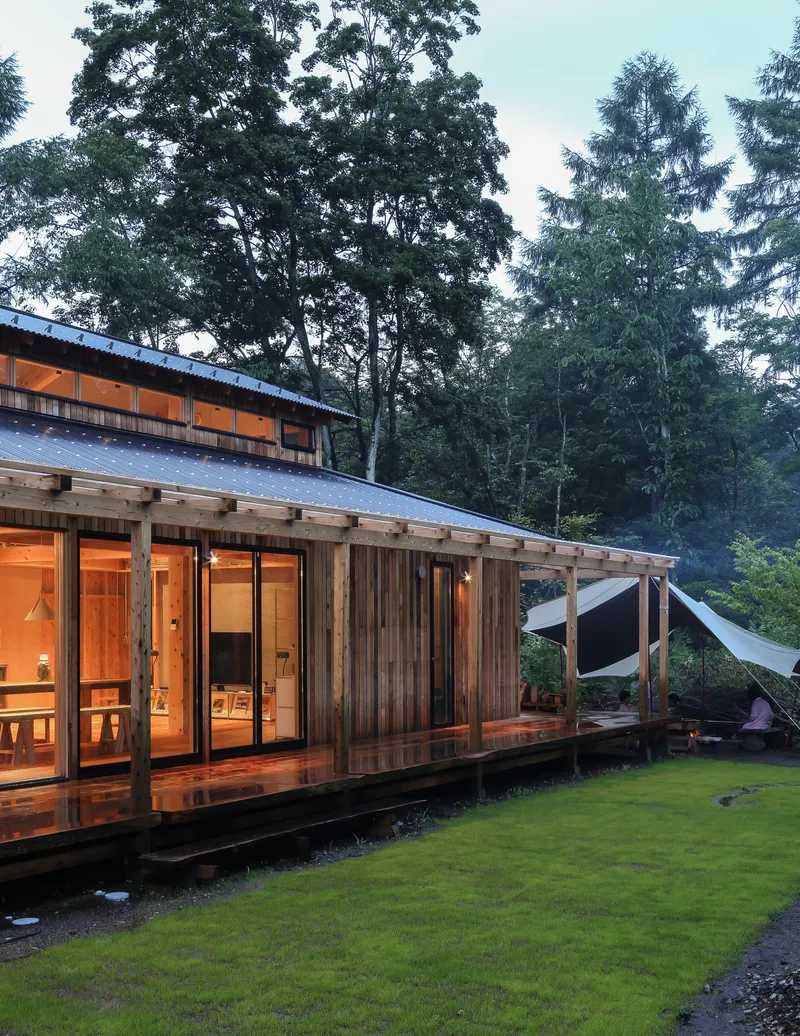
At dusk the building recedes into the tree line, its timber surfaces darkening while the glazed doors glow softly. The covered deck, visible in several exterior views, acts as a transitional zone, neither fully inside nor fully outside. It is generous enough to function as a real room, not just a token porch.
The Dirt Floor as Spatial Divider
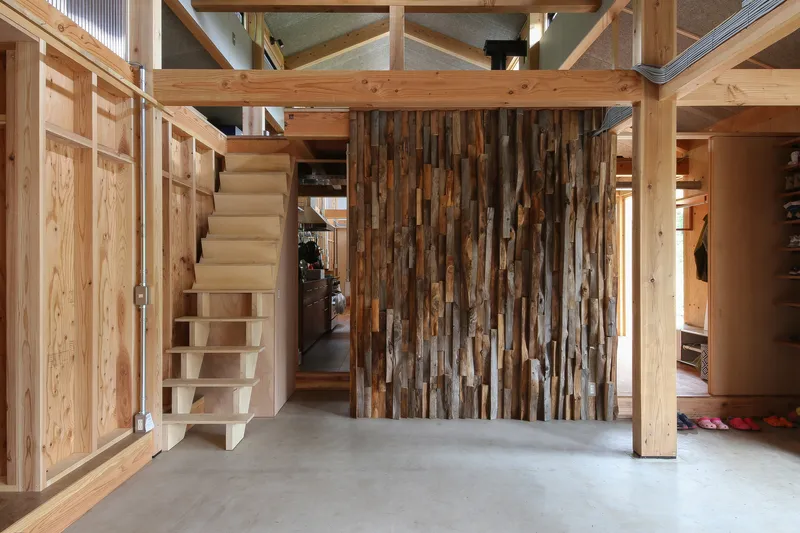
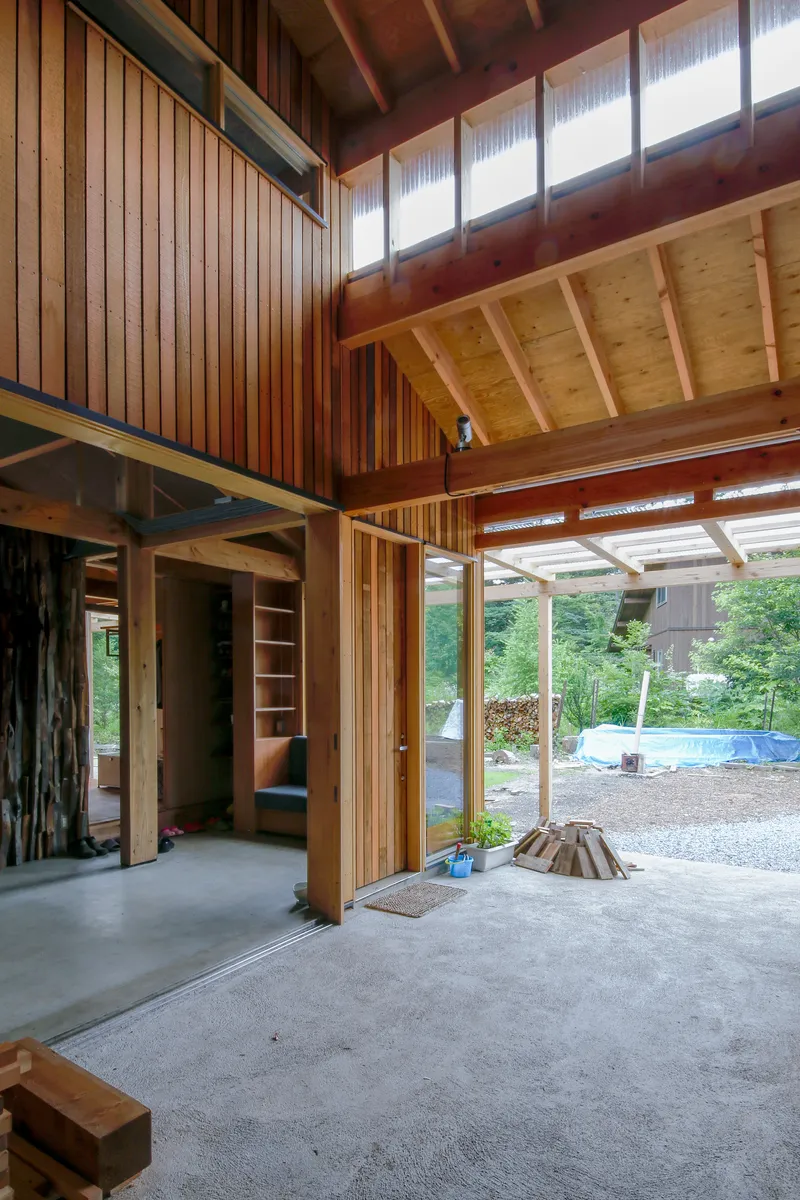
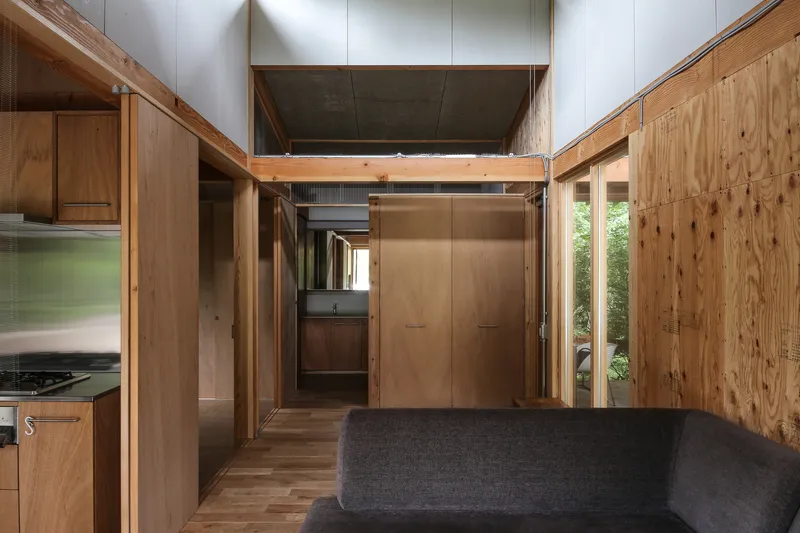
The most unconventional move in the plan is the incorporation of an earthen floor that penetrates the building's envelope, splitting the house into separate living zones. At the entry threshold, a polished concrete floor meets gravel and garden, making it unclear where the exterior stops. This ambiguity is deliberate. The passage invites the forest into the plan without the sentimentality of a "nature wall" or the cliché of a courtyard.
From the interior passages, plywood wall panels and exposed timber structure create a warm, tactile sequence. A floating plywood stair in the entry hall connects to a mezzanine workspace above, keeping the ground level open and continuous. The separation between the parents' quarters and guest areas happens almost invisibly, mediated by changes in floor material and ceiling height rather than by conventional corridors.
Exposed Frame, Filtered Light
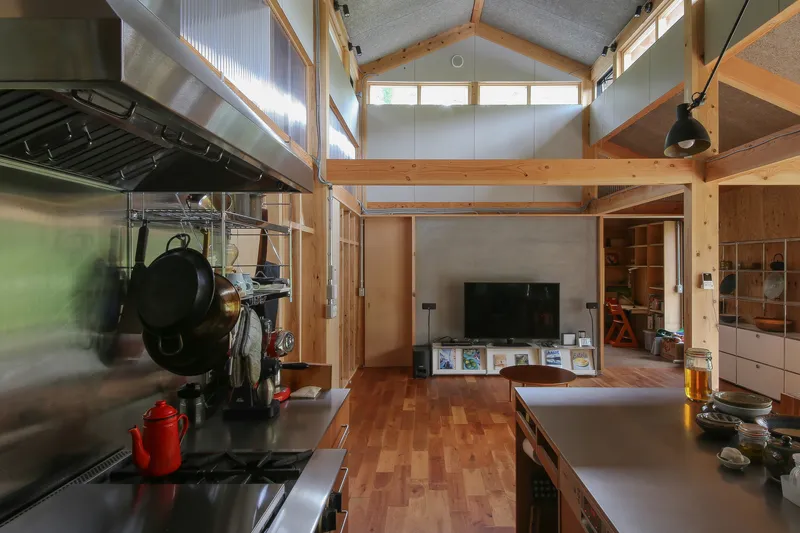
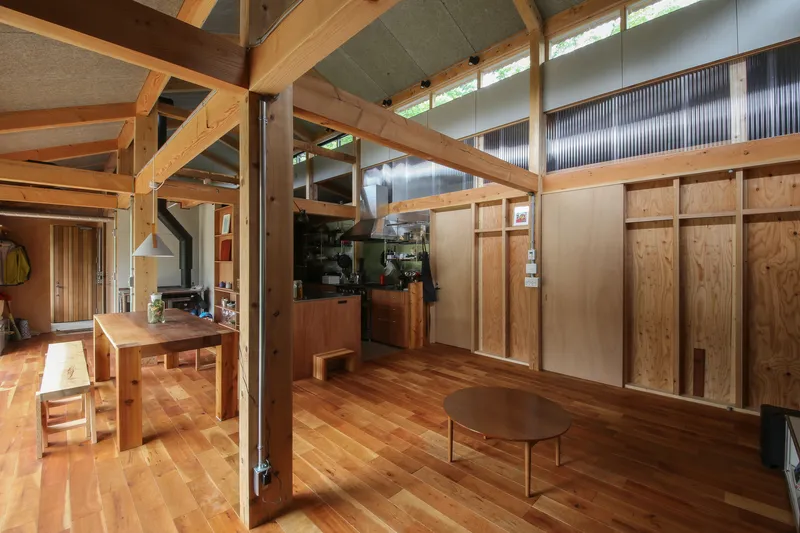
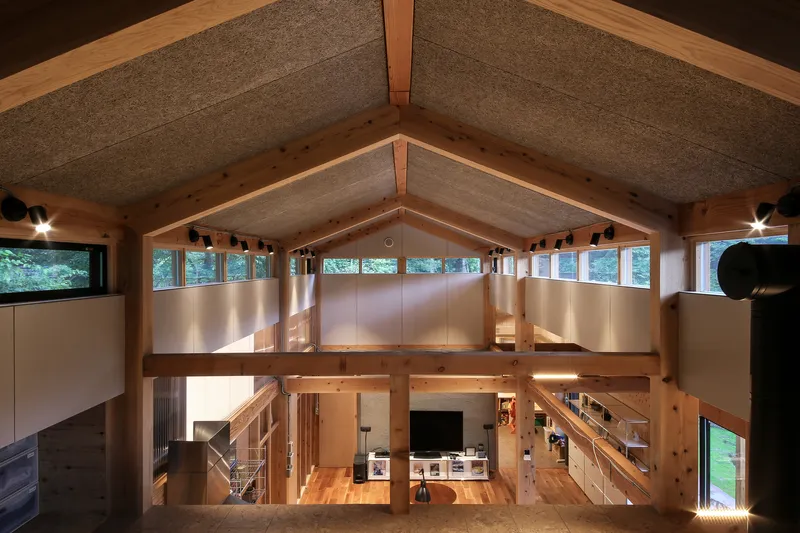
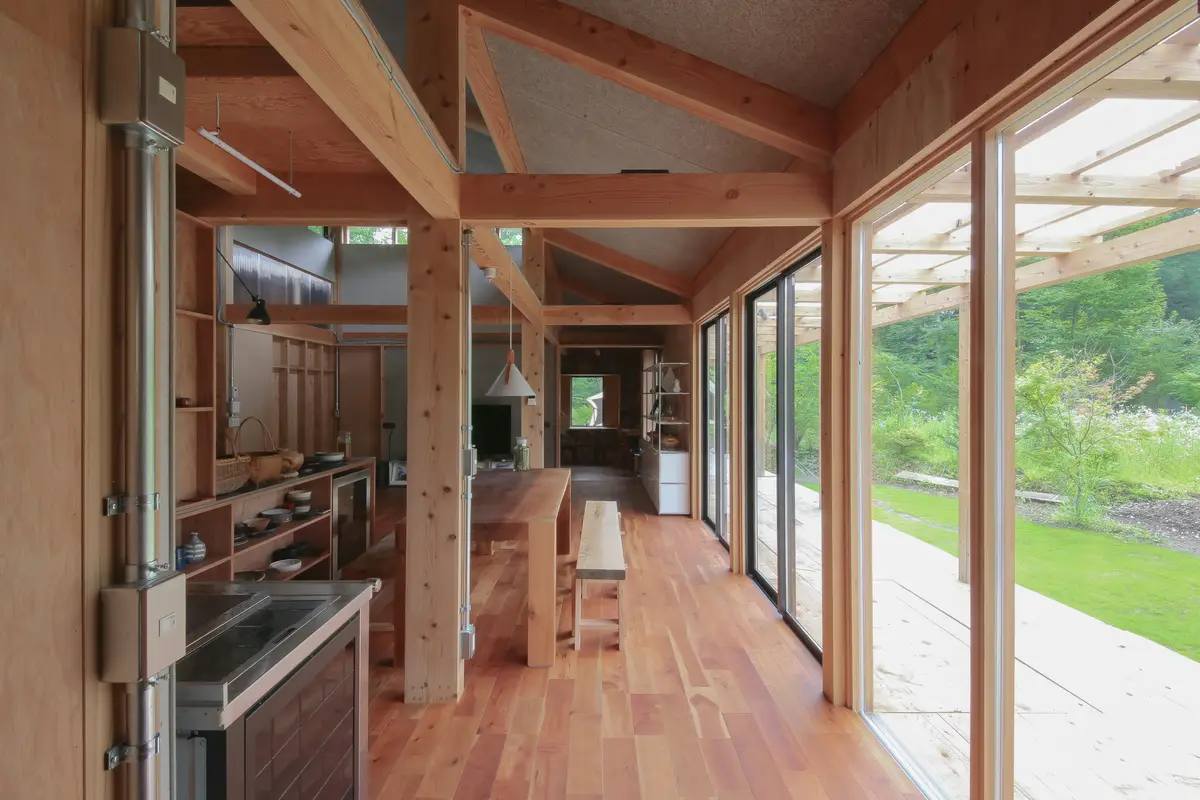
The post-and-beam timber frame is left entirely exposed, and it does serious work beyond structure. The regular rhythm of columns and beams organizes the open living spaces into legible bays, giving the kitchen, dining, and sitting areas their own identity without walls. Above, the gabled roof is lined with hempcrete panels visible from the mezzanine, a material choice that adds thermal mass and a rough, chalky texture to the otherwise warm palette of plywood and timber.
Clerestory windows along the ridge line filter daylight down through the frame, creating a layered wash of light that changes throughout the day. The effect is particularly striking in the kitchen and dining areas, where corrugated metal wall panels above plywood cabinetry catch and reflect the clerestory light, adding a subtle industrial counterpoint to the wood-dominant interior.
Living Spaces Open to the Garden
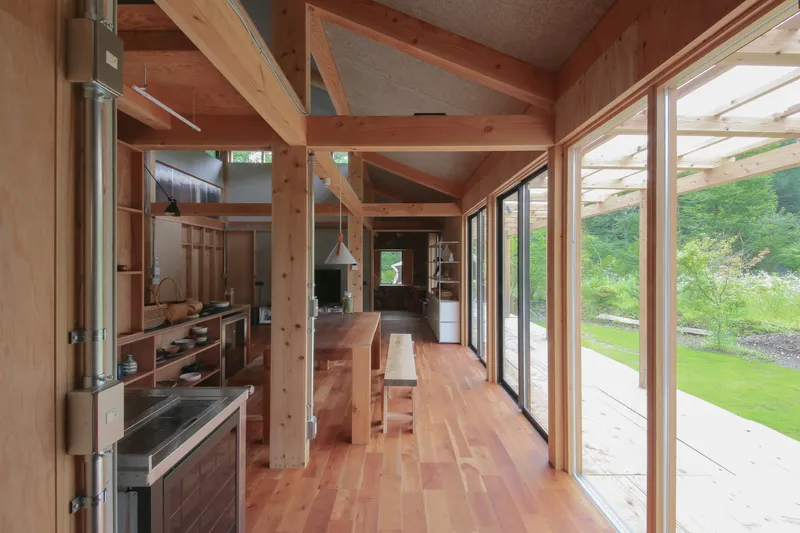
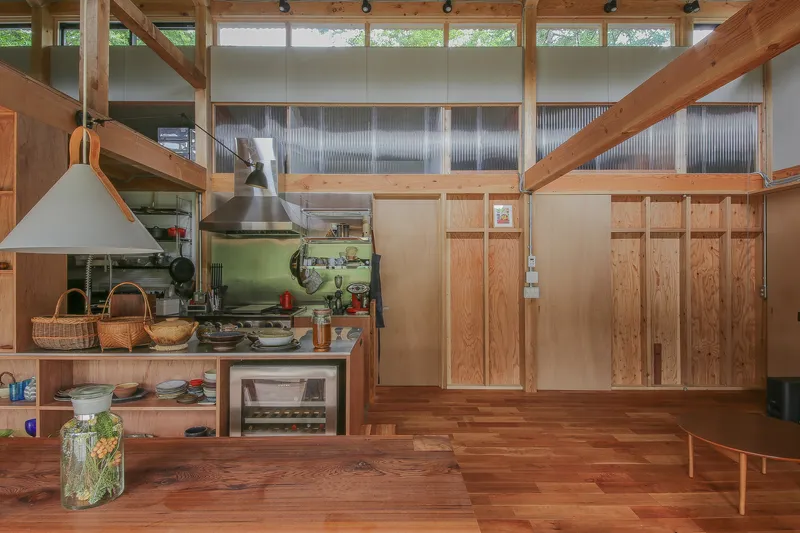
Full-height glass doors on the south side dissolve the wall between the living and dining space and the garden. When open, the interior effectively extends onto the timber deck, and the structural columns become the only elements defining the edge of the room. The 20% building-to-land ratio enforced in the area means there is a meaningful distance between the house and its neighbors, so this openness feels private rather than exposed.
The kitchen occupies the same open volume, with exposed beams overhead and a run of plywood cabinetry beneath corrugated metal panels. It is a working kitchen, not a showpiece, and the material honesty is consistent: everything you see is the thing itself, not a finish applied over something else.
The Covered Walkway and the Forest Edge
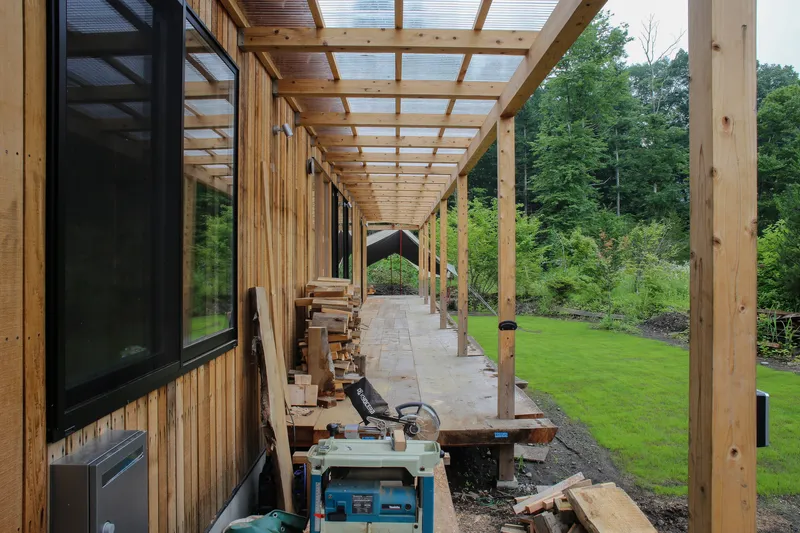
A covered timber walkway with translucent roof panels runs along one side of the house, looking out over a lawn that gives way to the forest edge. This is the connective tissue of the plan, linking the main house to the attached shed and providing a sheltered route between zones. The translucent panels diffuse daylight into a soft, even glow, making the walkway pleasant even in rain or heavy snowfall.
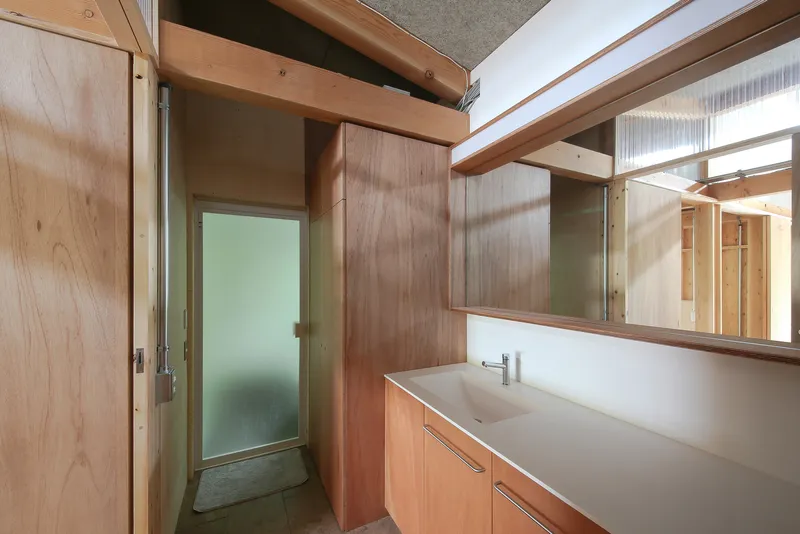
Even the bathroom, with its integrated vanity and frosted glass door, participates in the clerestory light strategy. Every room in the house receives natural light from above, reinforcing the sense that the roof is lifted slightly off the walls, hovering rather than bearing down.
Plans and Drawings
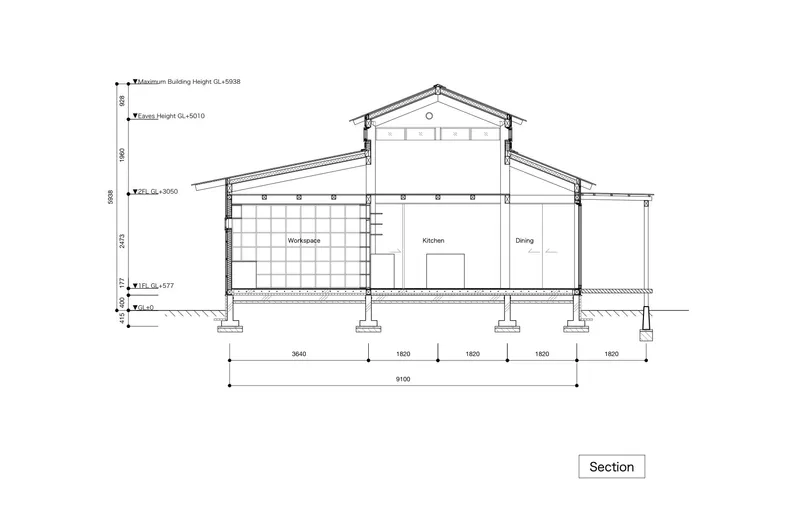
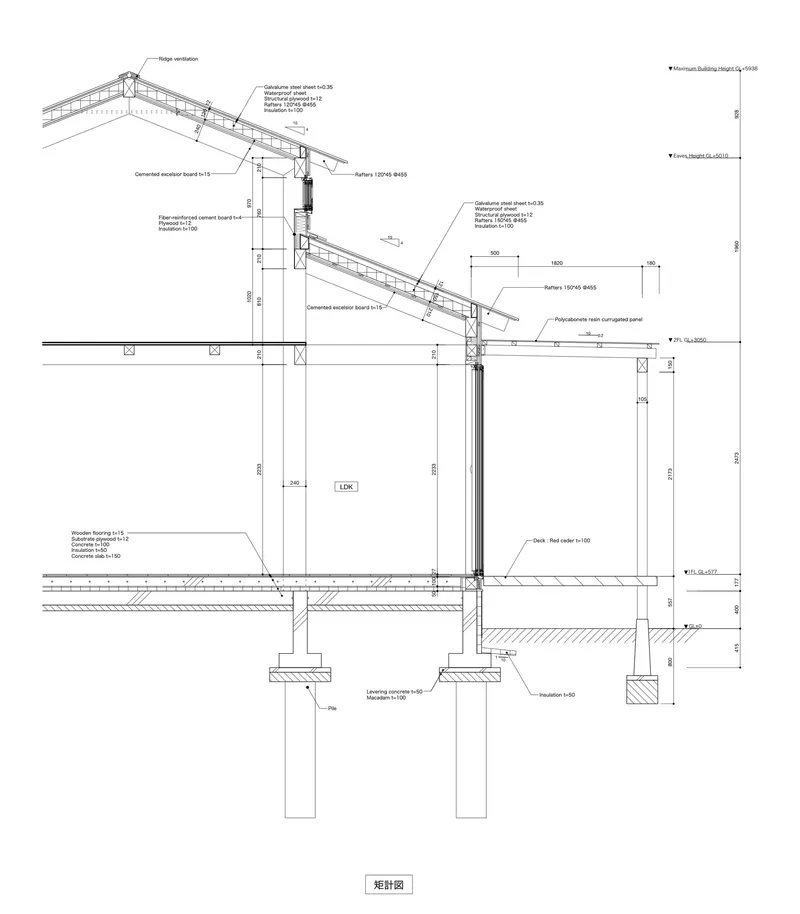
The section drawing reveals the logic of the clerestory: the gabled roof rises above a continuous band of glazing, with the mezzanine workspace tucked into the peak on one end while the kitchen and dining areas occupy the full double-height volume on the other. The detail section is instructive, showing pier foundations, timber column connections, corrugated exterior cladding, and rafter joints with a clarity that suggests the structure was designed to be read, not hidden.
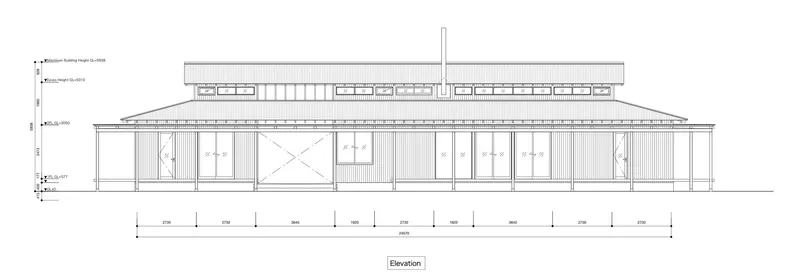
The elevation drawing confirms the relentless horizontality of the composition. Vertical cladding, horizontal glazing bands, and layered roof profiles stack into a facade that is visually quiet but tectonically precise. The building never tries to be dramatic; it earns its presence through proportion and material discipline.
Why This Project Matters
Vacation houses in resort towns too often fall into two traps: either they mimic urban living with sealed, climate-controlled boxes, or they romanticize rural life with performative rusticity. The House in Karuizawa avoids both. Its dirt floors, exposed frames, and covered walkways are practical responses to a specific site and program, not stylistic gestures. The plan accommodates multiple generations and guests without resorting to separate buildings or hotel-like corridors, using material changes and spatial thresholds to create privacy within a fundamentally open structure.
Satoru Ito's achievement here is one of restraint and intelligence. The 25-meter bar is not a formal conceit; it is the simplest way to organize the program along the site's east-west axis while maximizing the relationship between interior spaces and the surrounding forest. Every detail, from the hempcrete roof panels to the pier foundations, serves the same goal: a house that belongs to its clearing without pretending to be anything other than a carefully made building.
House in Karuizawa, designed by Satoru Ito Architects, Karuizawa, Japan. 223 m². Completed in 2020. Structural engineer: Noriaki Yamada Structural Design Office.
About the Studio
Share Your Own Work on uni.xyz
If projects like this are the kind of work you want to make, uni.xyz is a place to publish your own, find collaborators, and enter design competitions.


Popular Articles
Popular articles from the community


David Ortega Stacks a Two-Story Mexico City Penthouse Around a Steel Stair and a Pergola-Shaded Roof Terrace
In Colonia Roma, a 300 m² penthouse uses oak joinery, a planted steel stair and a slatted roof pergola to make a new-build apartment feel like a house.

longwave studio Reorganizes a 112 m² Tainan Apartment Around the Daily Routines of a Family and Two Cats
In Tainan, Taiwan, birch plywood, rust-red furniture and a freestanding plaster wall link arrival, storage, work and family life in one apartment.

David Macias Steps a Doorless Stone and Plaster House Down a Tropical Colombian Hillside
In the humid hills of Colombia, Threshold House replaces the front door with an open void and terraces its 850 m² down the slope instead of fighting it.

LT2A and OPEN Architectes Thread a Brick and Glass High School Through a Wooded Belgian Campus
In Braine-l'Alleud, a 3,000 m² wing for Collège Cardinal Mercier pairs pale brick with a glazed colonnade, deferring to a small chapel and a dense wood.

Similar Reads
You might also enjoy these articles


LAVA Architecten Gives Vocational Education a Sawtooth-Roofed Face on a Mechelen School Campus
In Mechelen, Belgium, a 2,053 m² STEM school on a 6×6 m grid turns workshops and classrooms into rooms that can be rearranged as teaching changes.

KEMA Studio Turns a Derelict Marvila Attic into a 60 m² Lighthouse Apartment Above Lisbon
In Lisbon's Marvila district, a rebuilt roof, four skylights and two plywood volumes turn an unlivable attic into a bright home facing the Tagus.

Pixel Gardens: One Repeated Module Stacked Into a Terraced Social Housing Tower for Famagusta
Salem Bader's shortlisted housing tower builds a vertical neighbourhood from one repeated module, offsetting units to carve terraces, light and air.

Bao Huynh Watercolor Atelier: A Serene Art Retreat in Hội An
Bao Huynh Watercolor Atelier in Hội An blends multifunctional art spaces, sustainable design, local materials, and family-friendly living in a serene environment.

Explore Residential Building Competitions
Discover active competitions in this discipline

Challenge to design mud housing for contemporary communities

Challenge to reimagine the Iron Throne

Photograph architecture without architects

Illustrate the lost glory of Angkor Wat - Render Challenge
Comments (0)
Please login or sign up to add comments
No comments yet. Be the first to comment!