
Sauerbruch Hutton Applies Kintsugi Logic to a 1970s Telecom Tower in Konstanz
A 62-meter office relic near Lake Constance becomes 98 apartments, with its scars turned into a polychrome civic landmark.


For over fifty years, the Telekom Tower in Konstanz's Petershausen district has been the city's most conspicuous misfit. Completed in 1971 by Oberpostbaudirektor Hans Merkenthaler, the 62-meter slab rose from the low-rise fabric southeast of the historic center like a bureaucratic exclamation mark, its aluminum sandwich panels and telecommunications mast radiating the blunt optimism of federal infrastructure. When the offices emptied out and the building went dark, the tower became an even harder thing to ignore: a monument to obsolescence, visible from the vineyards, the railway, and the lakefront promenade.
Sauerbruch Hutton, who won the competition for the tower's conversion in 2019, chose not to disguise the building's past. Their strategy borrows from the Japanese practice of kintsugi, in which broken ceramics are mended with gold so the repair becomes part of the object's story. Here, 93% of the original reinforced concrete frame stays in place, and every addition, the polychrome ceramic parapets, the timber-clad loggias, the folded aluminum panels, reads clearly as new material grafted onto old bone. The result saves an estimated 2,268 tons of CO₂ and, more importantly, gives Konstanz's second-tallest structure a reason to exist again: 98 apartments across 15 former office floors, with commercial space at ground level and a Telekom penthouse at the crown.
A Tower Rewritten in Color
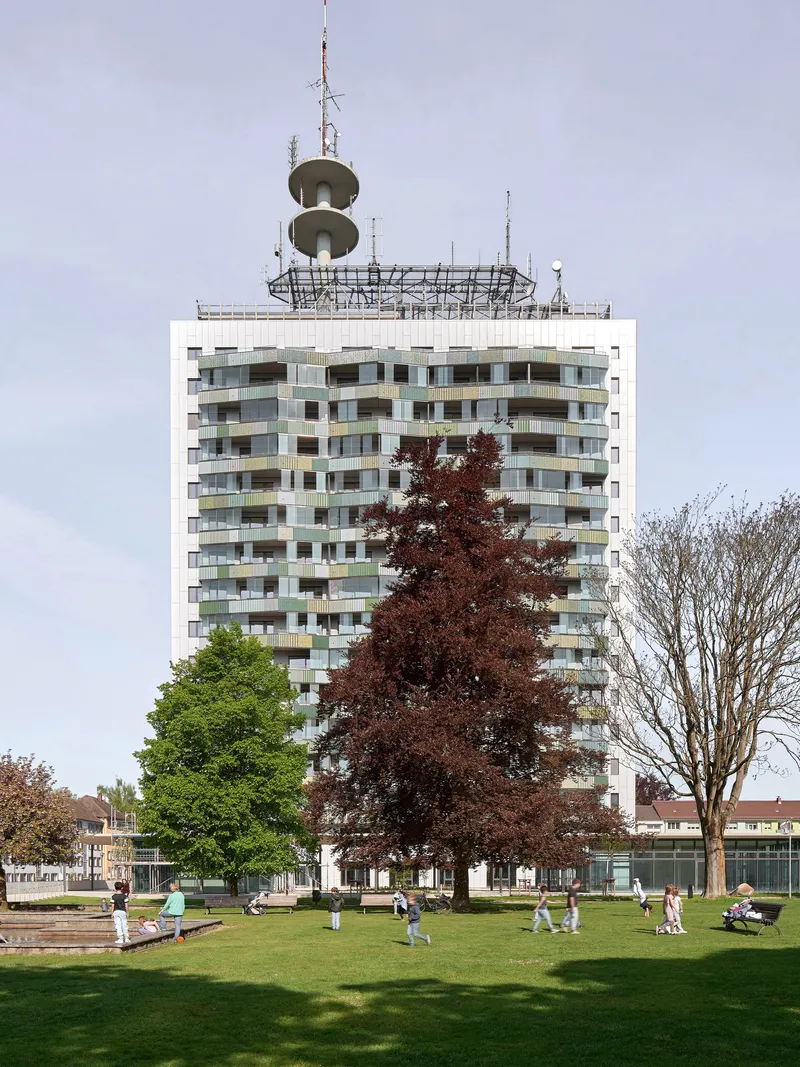
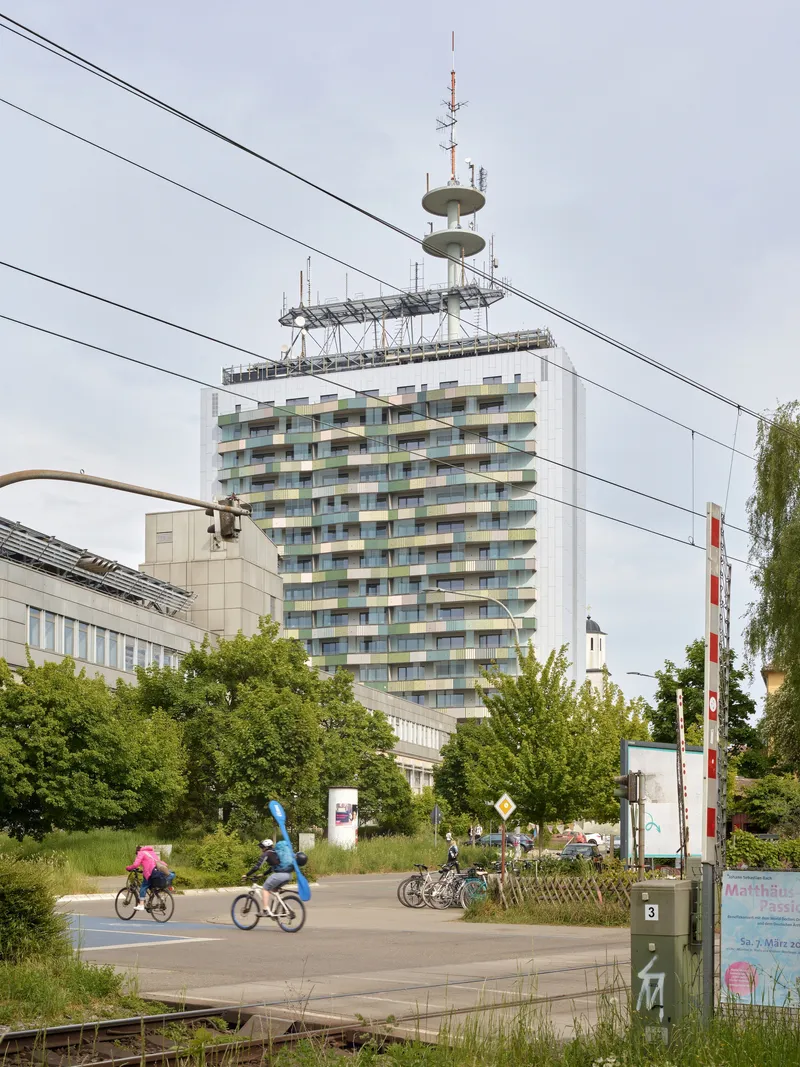
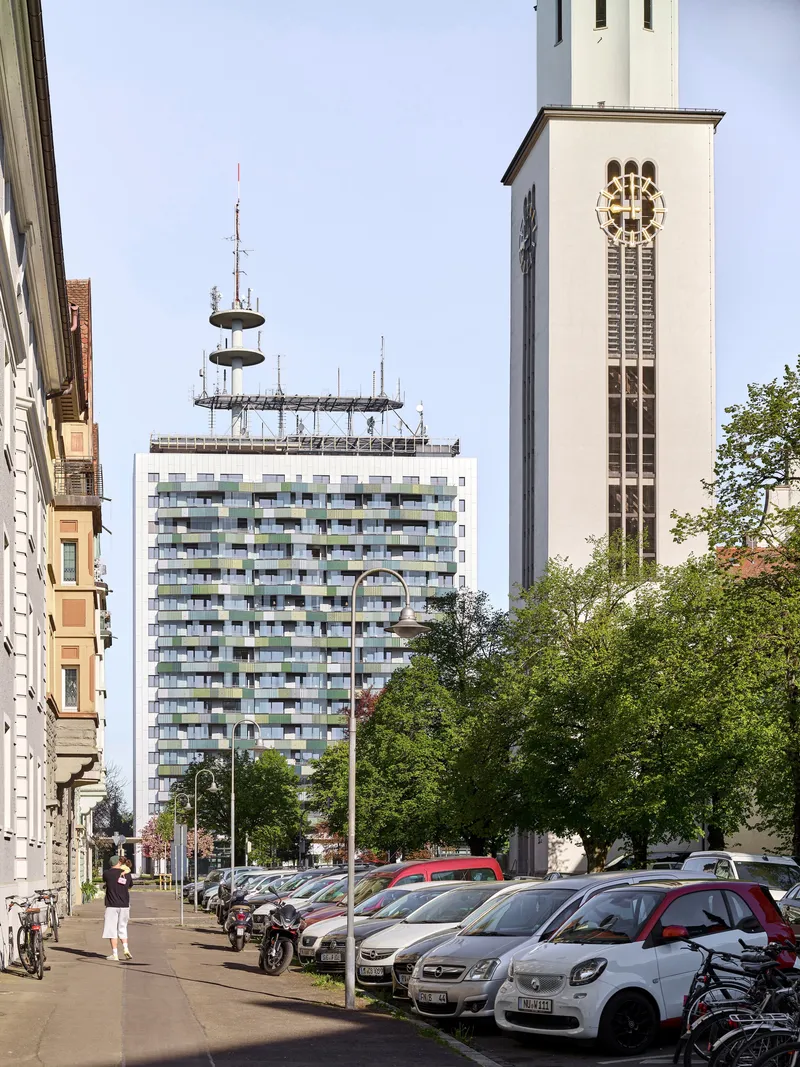
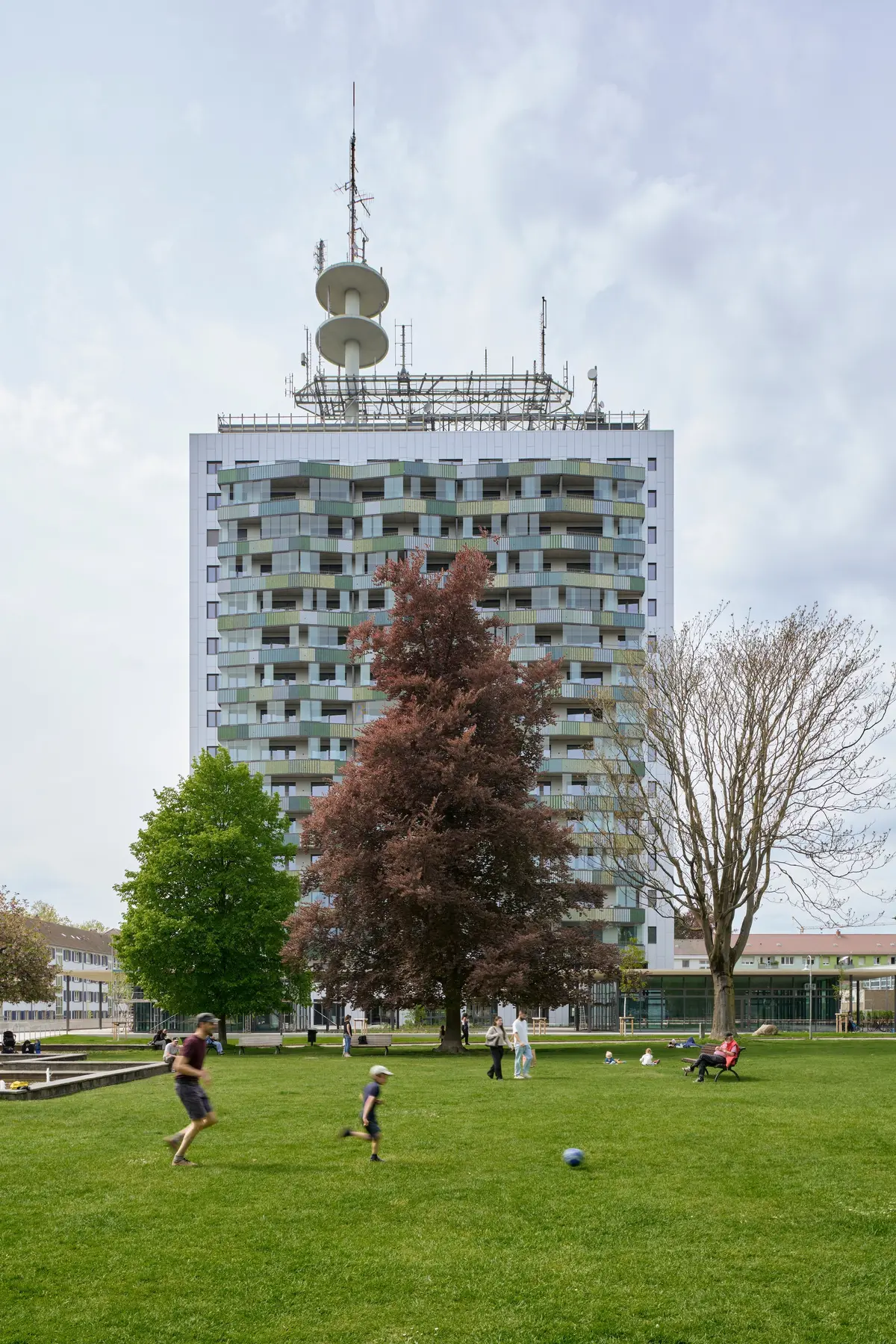
The most immediate change is chromatic. Where Merkenthaler's tower presented a monolithic grid of pale panels, Sauerbruch Hutton wrap it in a patchwork of greens, yellows, teals, and warm grays that ripple across the facade like a topographic map of the adjacent St. Gebhard Square park. The colors are not arbitrary decoration. The firm has spent decades developing polychrome facades as environmental instruments, and here the ceramic and aluminum cladding modulates the tower's visual mass depending on the season, the light, and the angle of approach.
Seen from the railway tracks, framed by overhead wires and passing commuter trains, the tower reads as a vertical garden above the infrastructure corridor. From the park, with children playing on the lawn, the balcony grid breaks down into a domestic scale that the original never possessed. The telecommunications antenna remains at the top, a frank acknowledgment of the building's first life, but it no longer dominates. The color field pulls the eye downward, back into the city.
Loggia as Climate Device
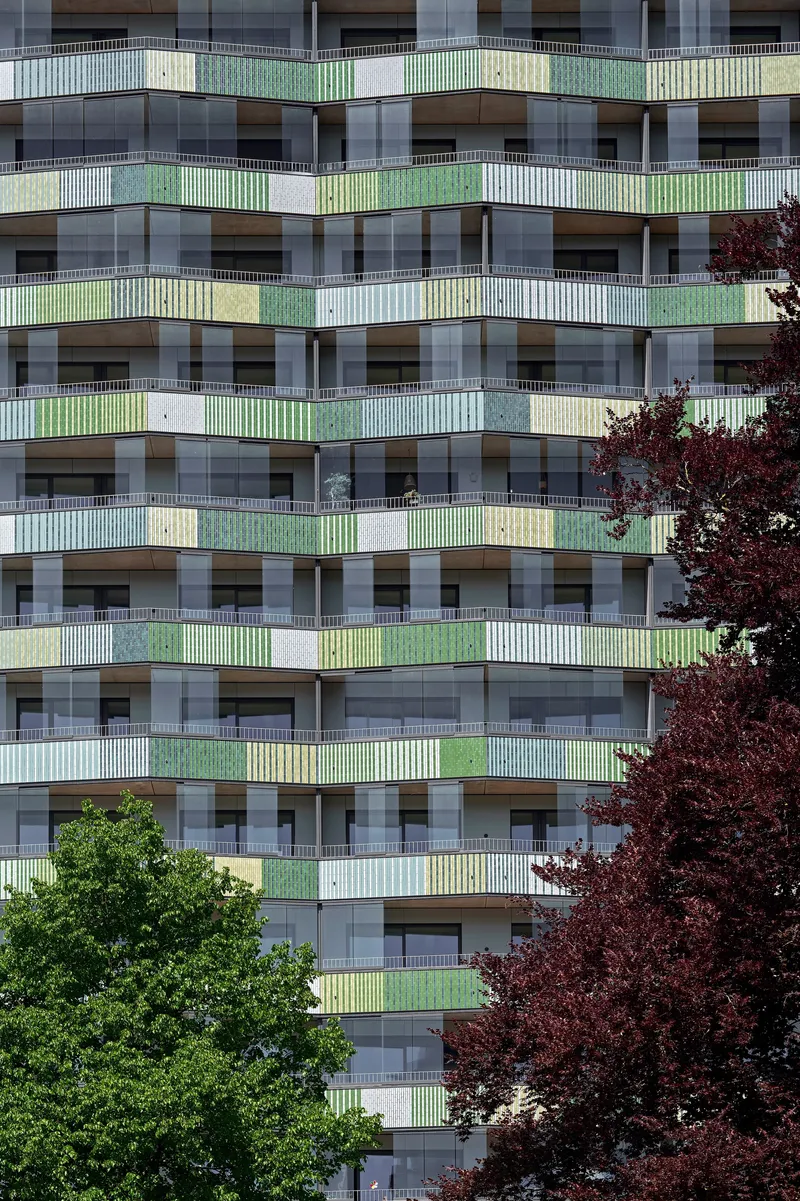
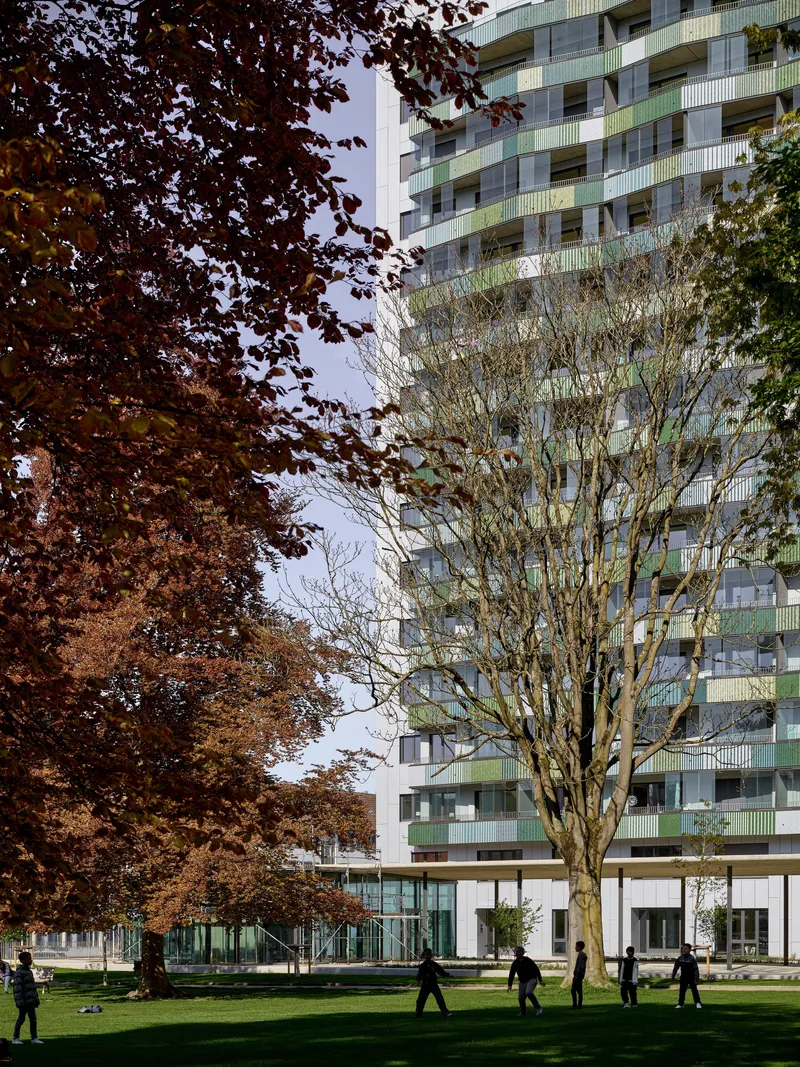
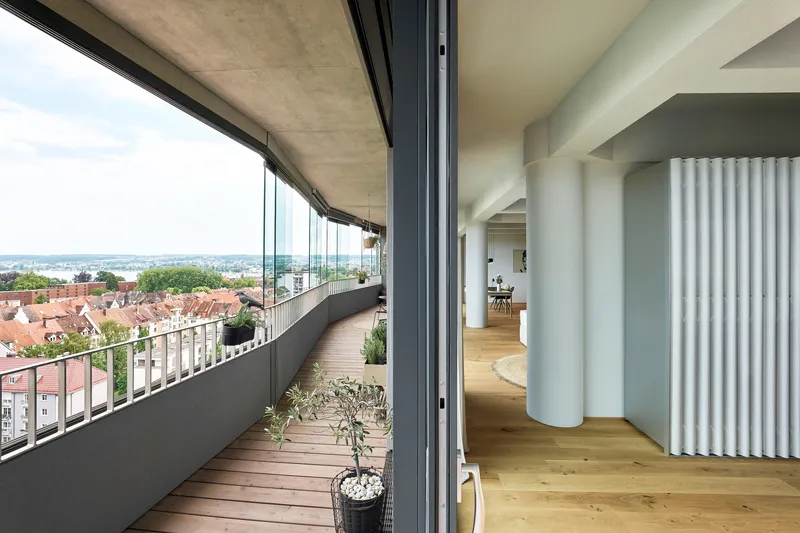
The loggias added to both longitudinal facades are the project's key spatial invention. Each apartment gains an outdoor room defined by timber cladding and a multicolored ceramic parapet, with movable glass sliding elements that let residents calibrate openness, solar gain, wind protection, and privacy in a single gesture. When closed, the loggias act as thermal buffers. When open, they extend the living area into the air. The installation pace, one month per floor for the parapets alone, underscores the craft involved in retrofitting a structure that was never designed for domestic life.
From the interior, the effect is generous. A wooden deck, a potted olive tree, sliding glass giving onto fluted concrete columns: the loggias mediate between the rawness of the retained structure and the warmth of habitation. They also give each apartment a distinct face on the facade, trading the tower's former anonymity for something closer to a vertical neighborhood.
Ground Level: Stitching the Tower to the Park
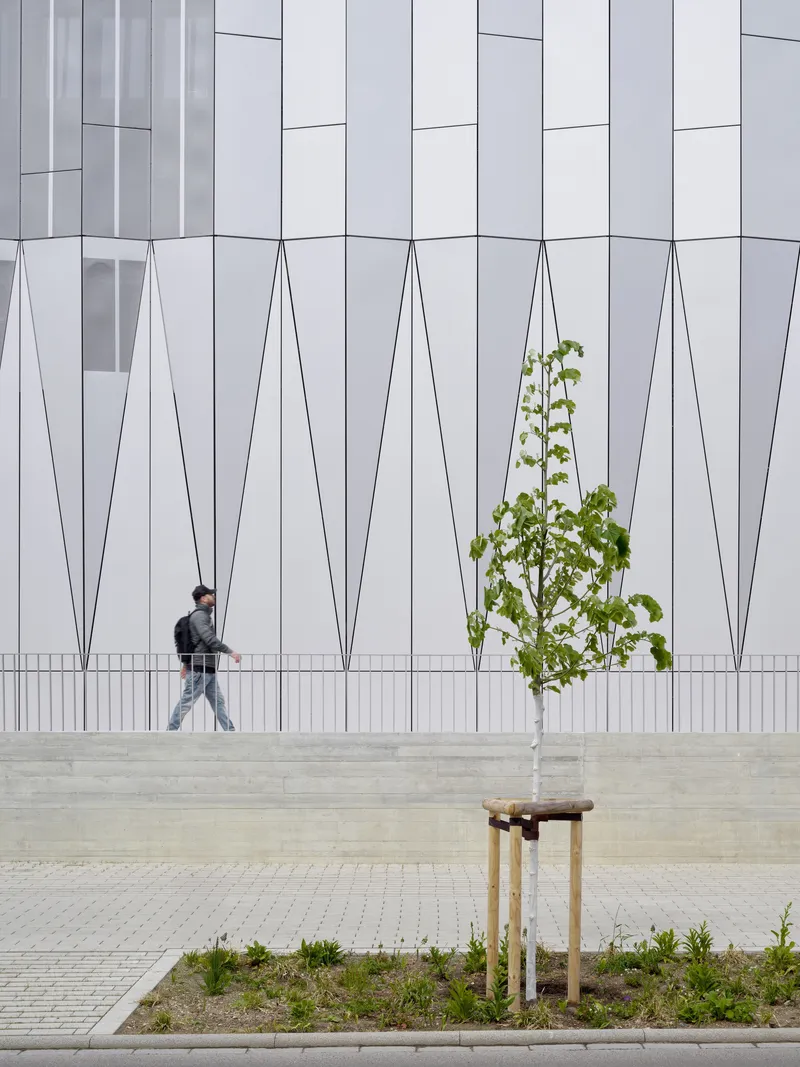
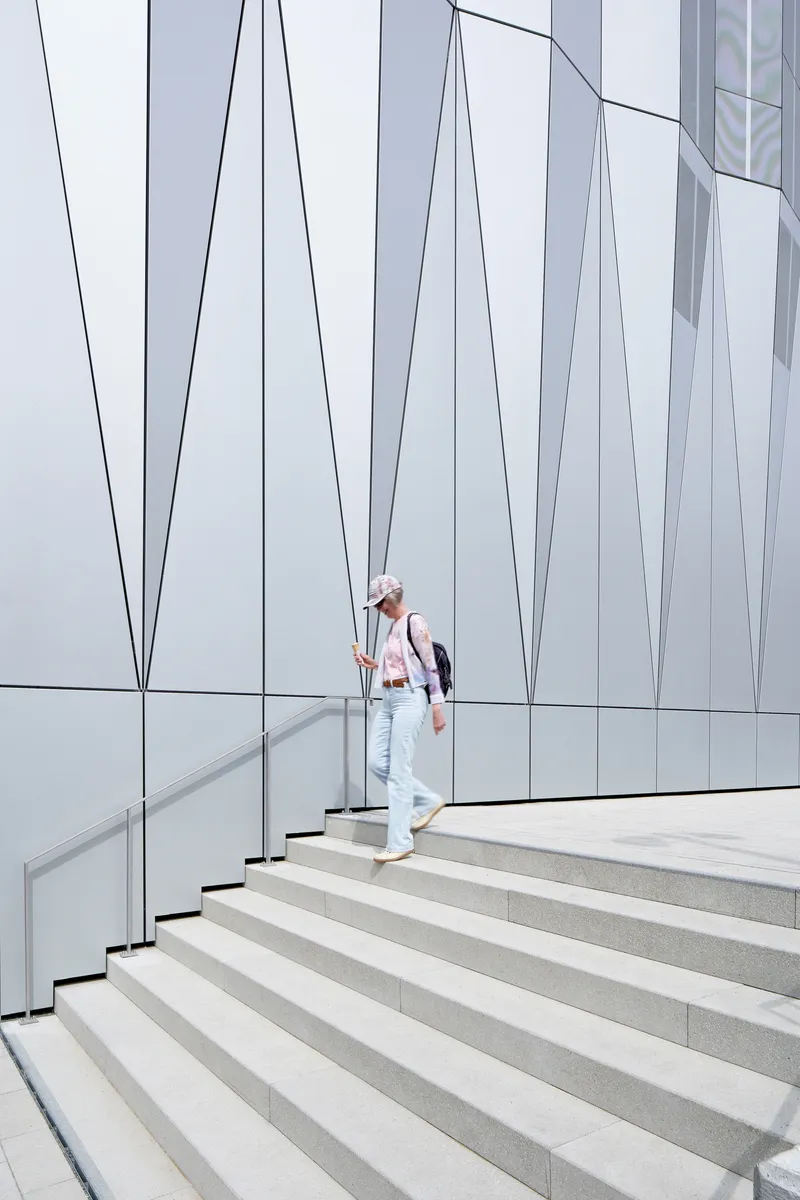
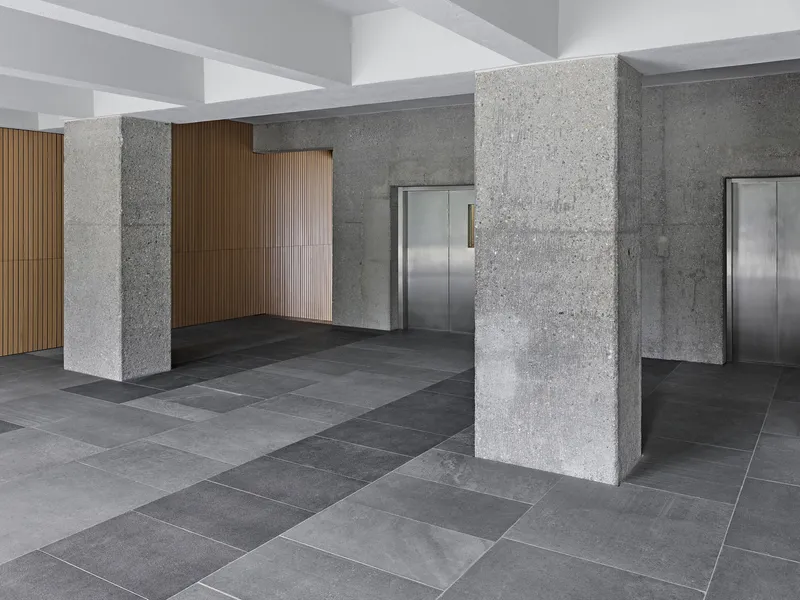
If the loggias heal the tower's relationship with the sky, the ground-floor interventions heal its relationship with the street. The base extends toward St. Gebhard Square through transparent pavilion structures sheltered under a filigree board-formed concrete roof, a finish deliberately chosen to recall the construction techniques of the original era. The roof of the converted technical building connects to grade via broad steps, becoming a communal terrace with a meadow garden for residents. Two freestanding linear buildings mediate between the tower's mass and the surrounding low-rise context.
The entrance lobby retains the textured concrete columns and introduces polished gray tile flooring and stainless steel elevator doors, a restrained palette that lets the existing structure speak. White exterior panels with geometric relief and angular black joint lines give the base a graphic identity distinct from the colorful loggias above, reinforcing the reading of old and new as separate but complementary systems. Even the staircase handrails feel considered: metal, minimal, set against the panel grid.
Cityscape and Context
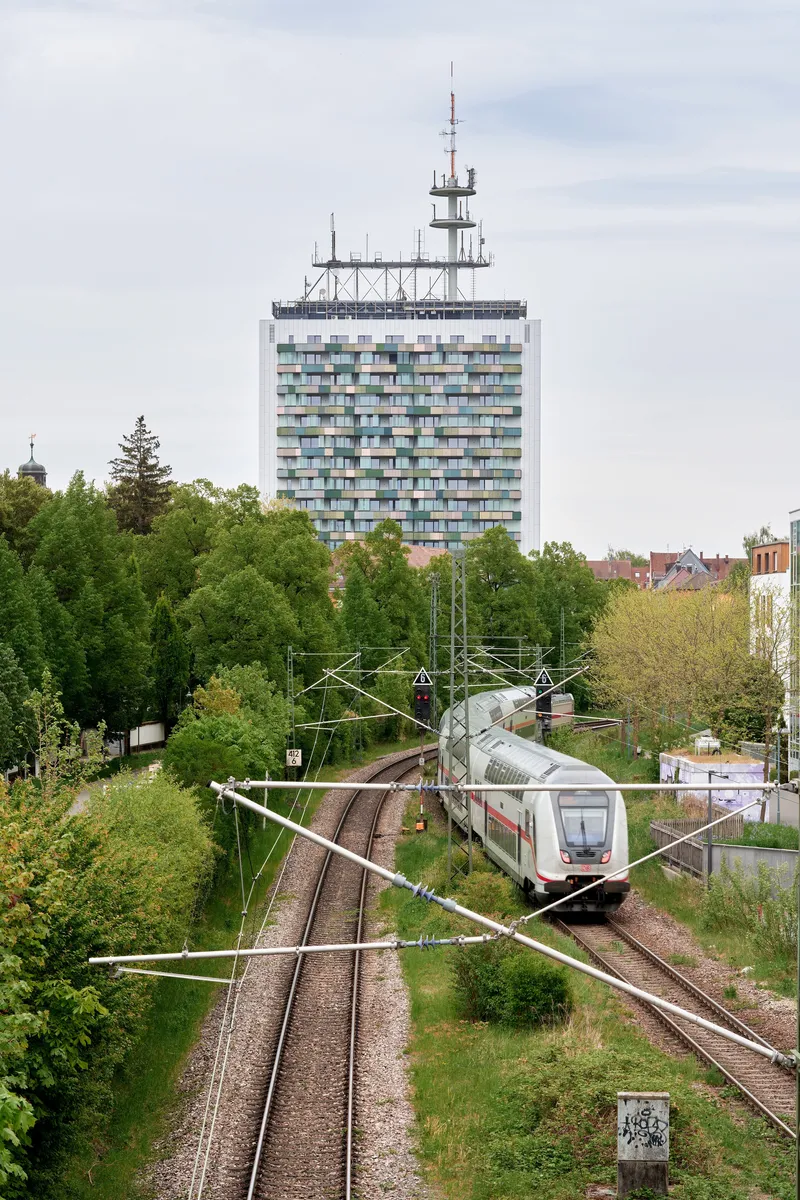
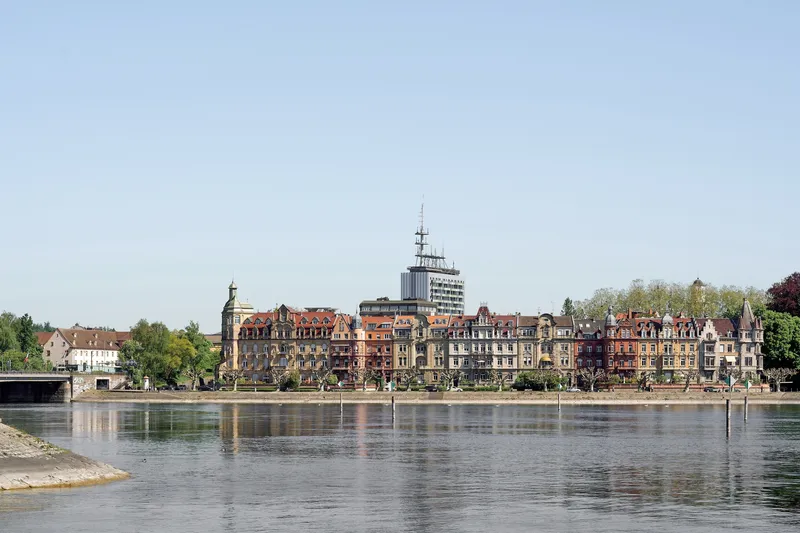
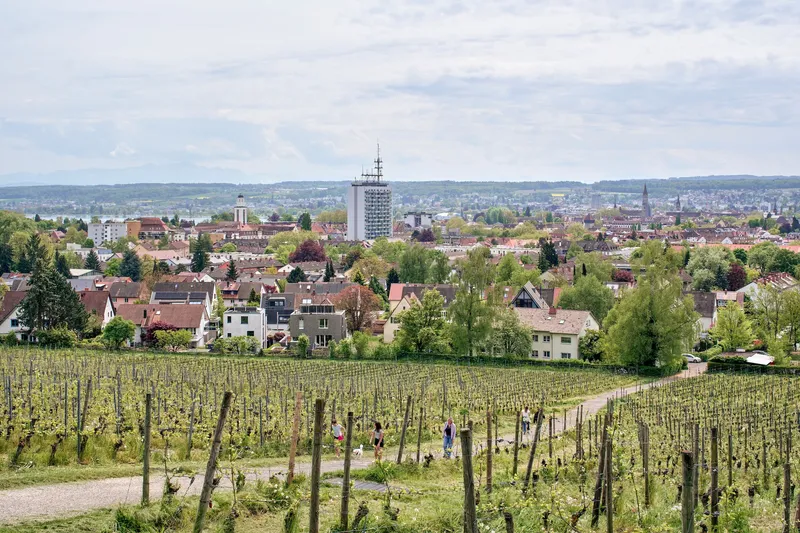
A building this tall in a city this small cannot avoid being read as a landmark, so the question becomes what kind of landmark it wants to be. The original tower answered that question with indifference: it was a signal mast with offices attached. The converted tower answers with engagement. From across the Rhine, it rises behind the riverfront residential blocks as a slender glass-and-color bar. From the vineyards at the city's edge, it punctuates the suburban roofscape with a vertical stroke that now reads less like an imposition and more like a hinge between Konstanz's medieval core and its postwar periphery.
The presence of the church bell tower in several sightlines is telling. Konstanz has always been shaped by vertical markers, spires and towers that organize the view from Lake Constance. Sauerbruch Hutton's renovation does not pretend the Telekom Tower belongs to that lineage, but it no longer stands apart from it either. The polychrome facade and the planted base draw the tower into a conversation with its neighbors rather than shouting over them.
The Park Edge
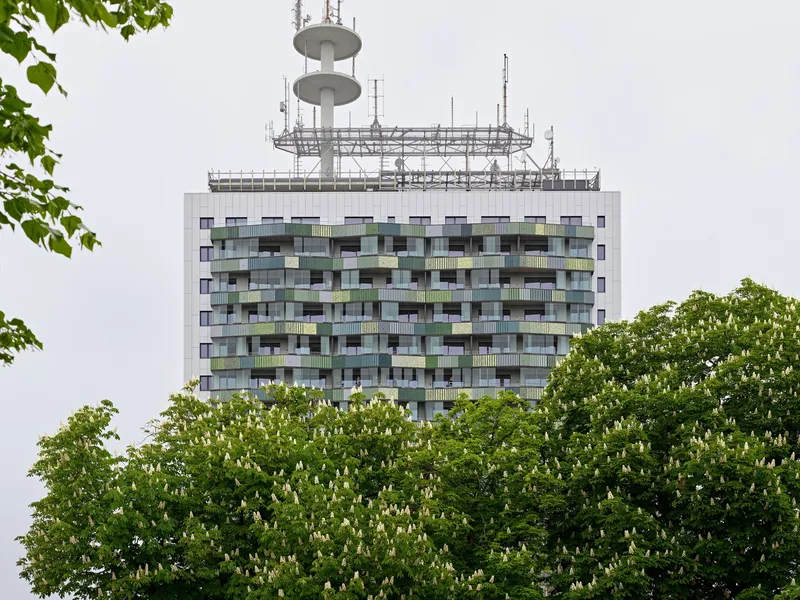
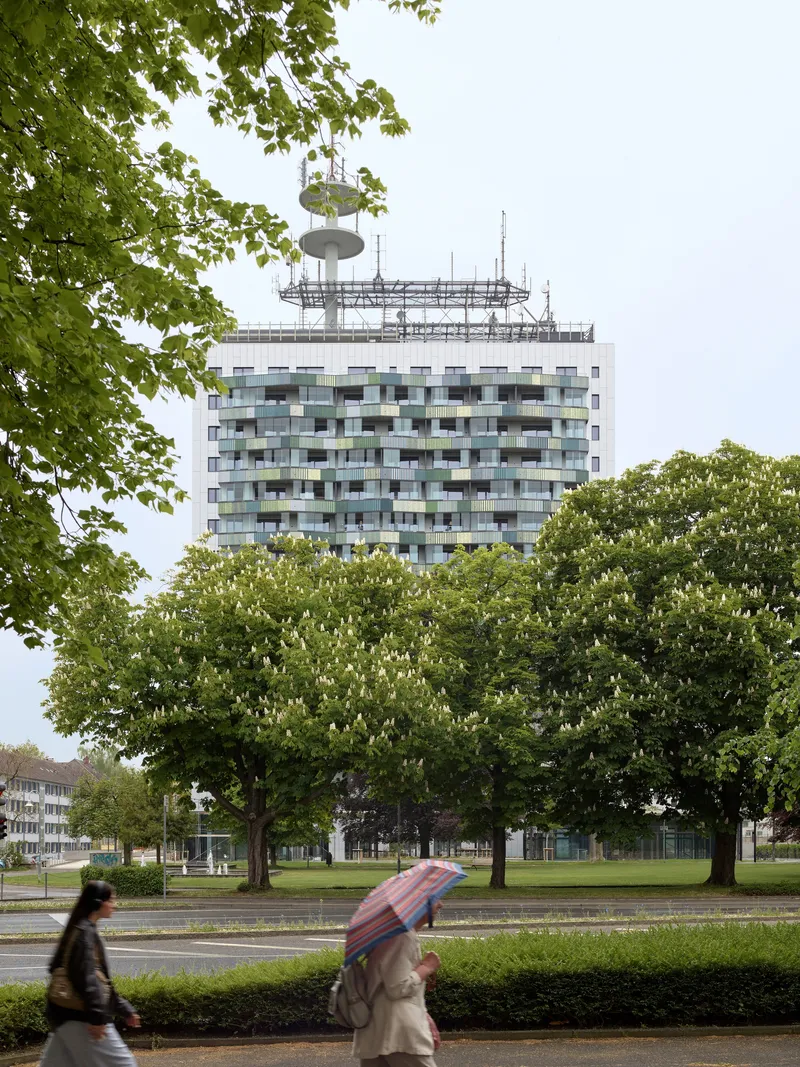
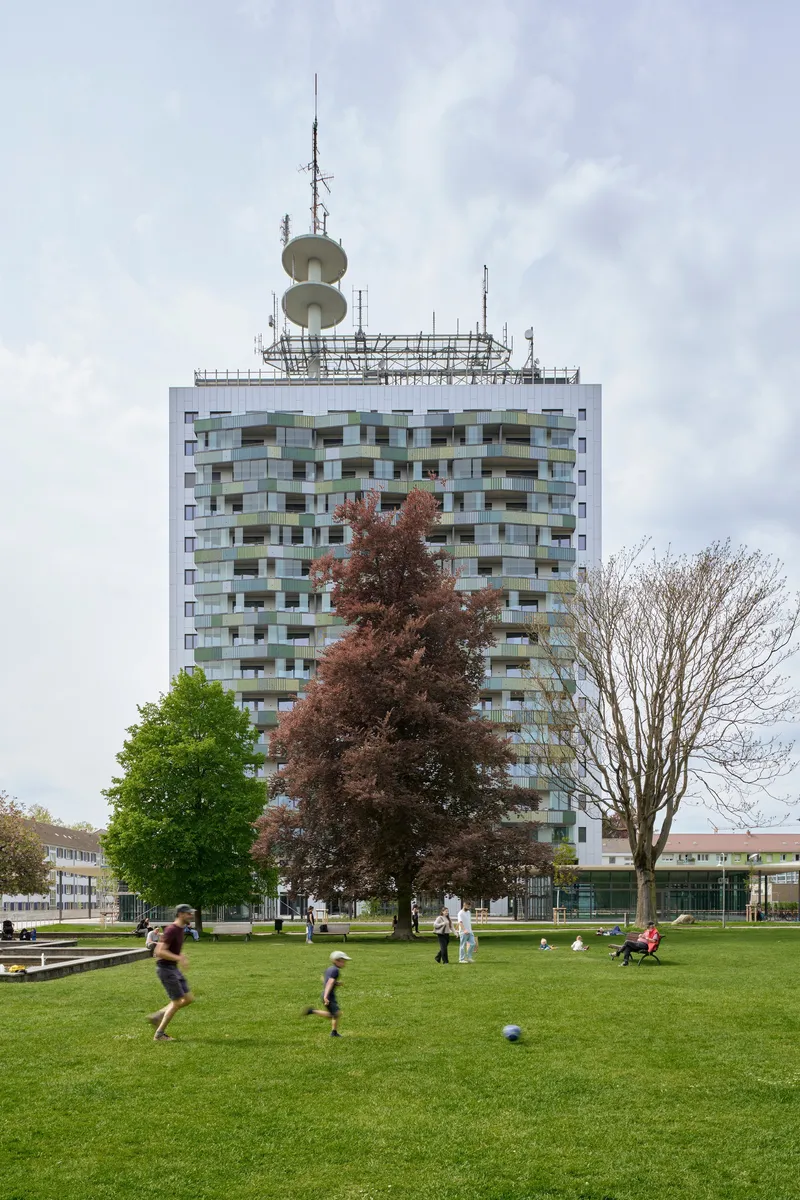
From St. Gebhard Square, the tower finally makes sense as part of a landscape composition. Spring foliage frames the lower floors, autumn trees partially obscure the balconies, and in each season the facade colors shift in register with the vegetation. The palette was designed with this seasonal dialogue in mind. On overcast days the greens recede and the grays come forward; in bright sun the yellows and teals assert themselves. Residents with umbrellas, children on the lawn, cyclists on the street: the base of the tower has become an active civic edge where none existed before.
Plans and Drawings
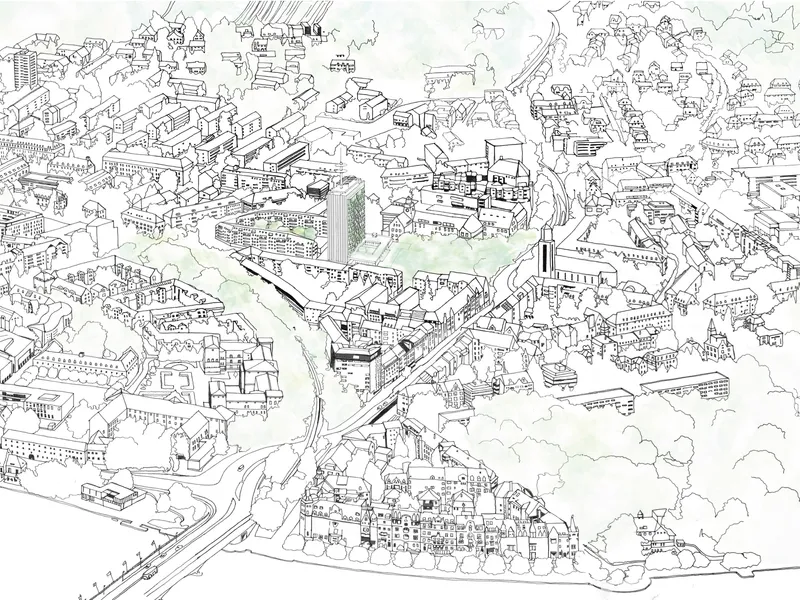
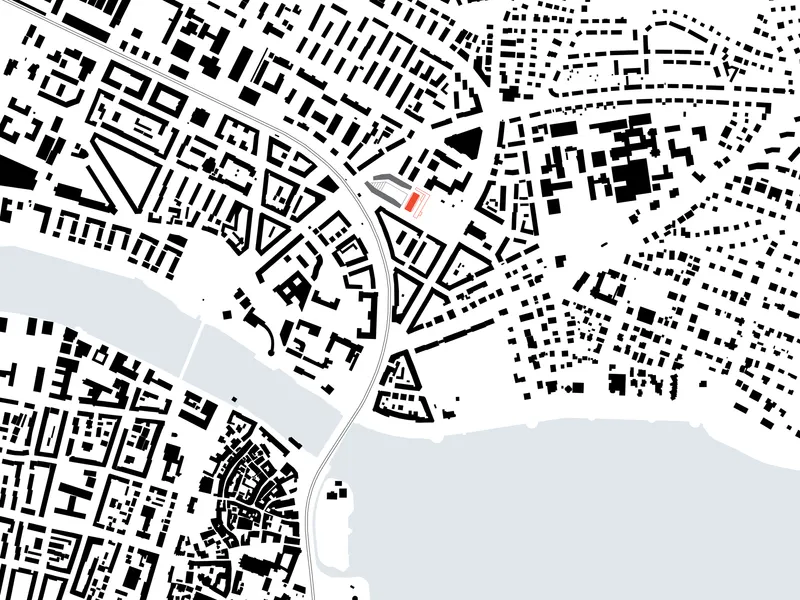
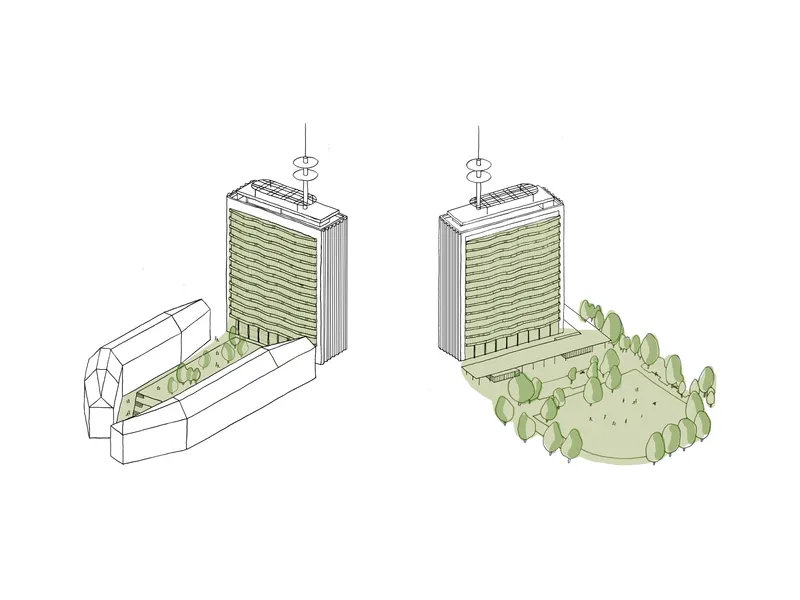
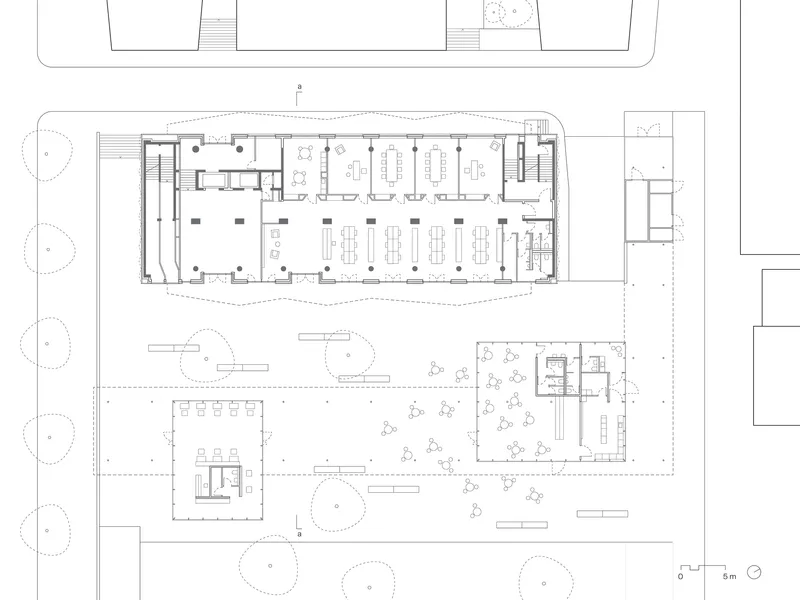
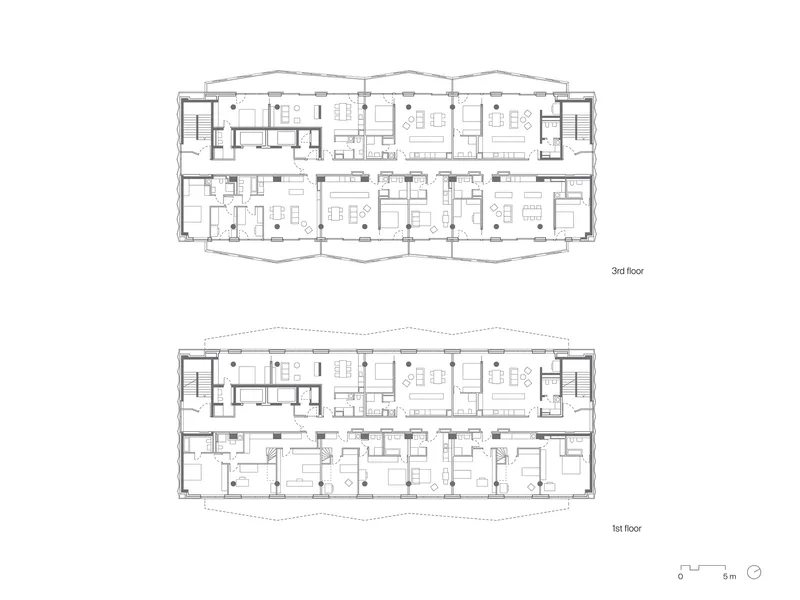
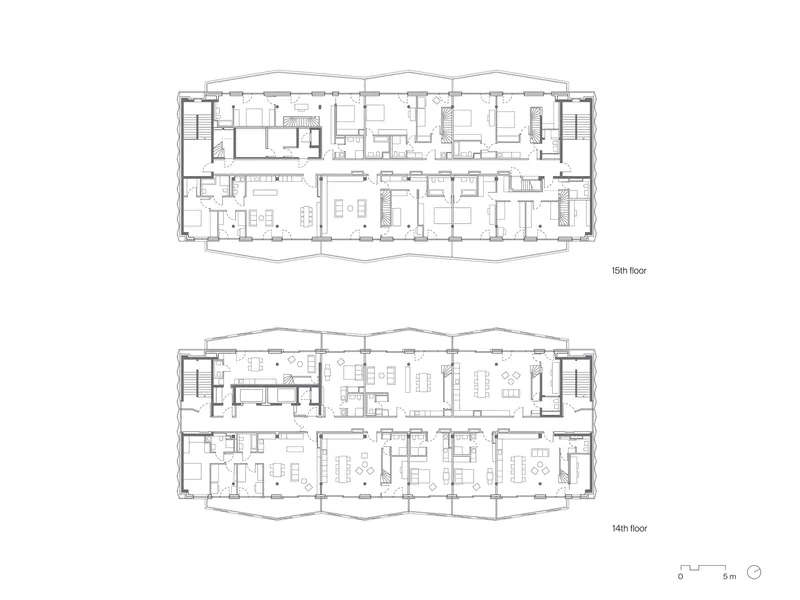
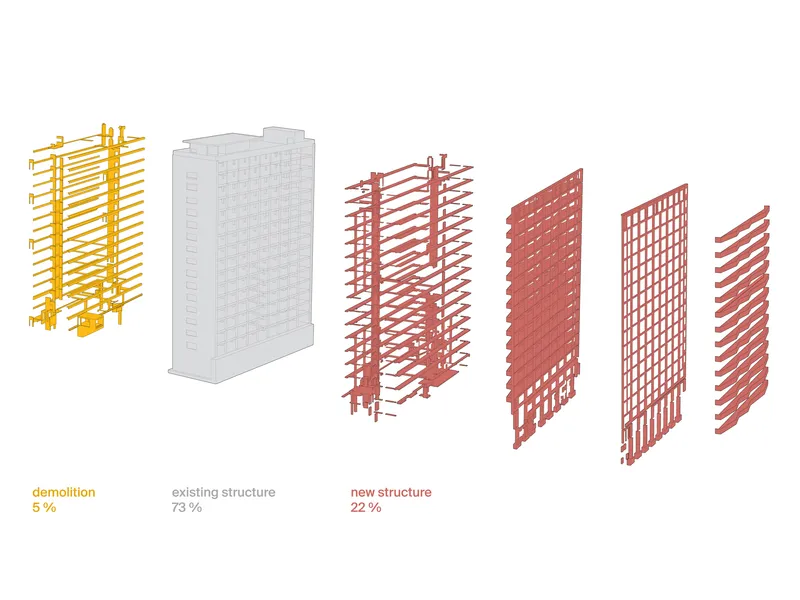
The axonometric site drawing reveals the tower's position along a river corridor, flanked by the two new linear buildings that step down in scale toward the park. The site plan makes clear how tightly the tower sits within the urban fabric; the pavilion extension and landscaped roof work hard to create breathing room at grade. Floor plans show how the existing column grid dictates apartment layouts: central loft-like living spaces run the full depth of the plan, with bedrooms, bathrooms, and service rooms compacted along the core. Sliding doors between rooms along the facade allow residents to open or subdivide the plan at will, maintaining sightlines across the full apartment length.
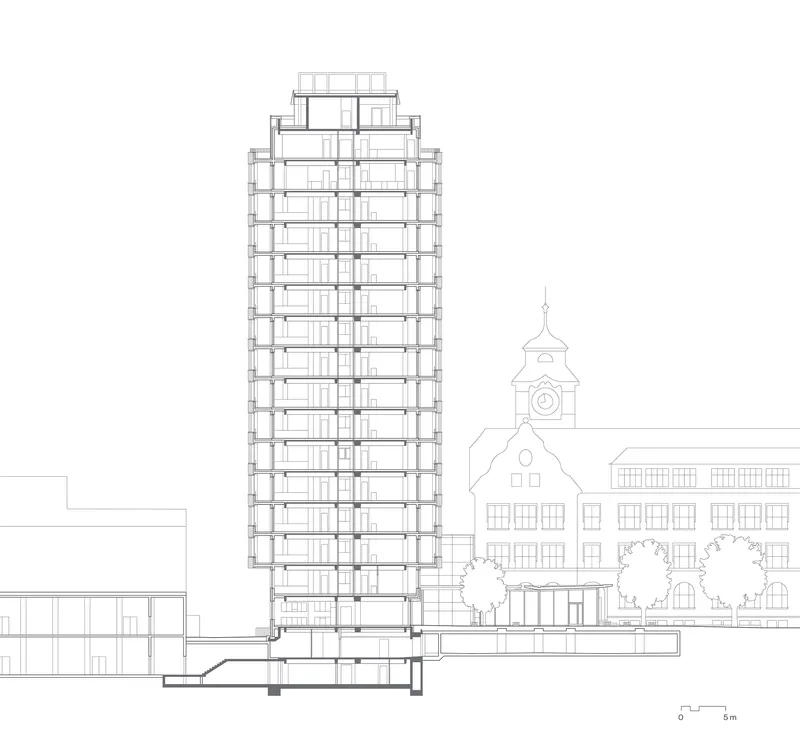
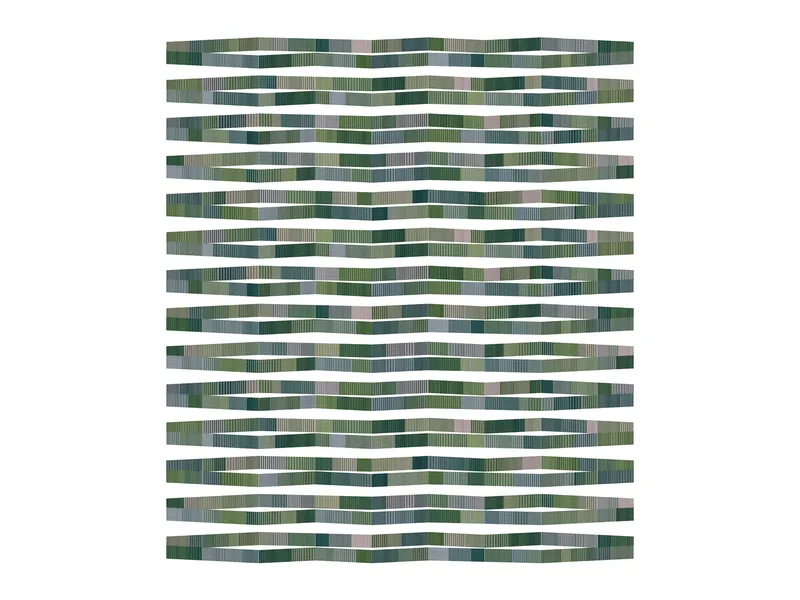
The section drawing places the tower next to a historic clocktower, making the scale contrast unavoidable but also showing how the new base structures and tree planting soften the transition. The facade color study confirms that the horizontal banding is not random: wave-like gradients of green, gray, and teal produce a chromatic rhythm calibrated to the tower's proportions. The exploded axonometric is perhaps the most instructive drawing, breaking the project into structural retention (shown in yellow), new facade systems, and loggia additions, with percentage labels quantifying the reuse. Ninety-three percent of the existing frame stays. That number is the project's ethical backbone.
Why This Project Matters
Adaptive reuse is easy to champion and difficult to execute well, especially when the host building is not a photogenic industrial hall but an unloved postwar office slab. Sauerbruch Hutton's Telekom Tower demonstrates that the hardest reuse projects, the ones involving structures nobody asked to be saved, can yield the most instructive results. By retaining 93% of the concrete frame and making every intervention legible, the firm avoids the twin traps of nostalgic restoration and wholesale demolition. The kintsugi metaphor is not merely poetic; it describes a construction logic in which old and new materials maintain separate identities while forming a coherent whole.
The broader lesson is urban. Konstanz, like many European cities, inherited postwar infrastructure that was designed for institutional efficiency, not civic life. The tower's conversion into 98 apartments with loggias, a public park edge, and a communal rooftop garden turns a mono-functional object into a multi-scalar participant in the city. It also proves that embodied carbon savings and architectural ambition are not in tension. Two thousand two hundred sixty-eight tons of CO₂ stayed in the ground because Sauerbruch Hutton found a way to love a building that nobody else did.
Telekom Tower, Konstanz by Sauerbruch Hutton. Konstanz, Germany. 20,260 m². 2026. Photography by © Helmuth Scham.
About the Studio
Share Your Own Work on uni.xyz
If projects like this are the kind of work you want to make, uni.xyz is a place to publish your own, find collaborators, and enter design competitions.


Popular Articles
Popular articles from the community


Opera on the Sea: Driftwood Logic Shapes a Timber Opera House on Estonia's Coast
Trevor Orgill's opera house translates the entangled drift of floating timber into a civic building where wood, water, and music converge.


Cube Design Draws an Ecological Corridor Between Two Shenzhen Hills with the Nankai Building
Beside Shenzhen's container docks, the Nankai Building pairs stacked balconies with a climbing green screen to connect two hillsides across its height.

graciastudio Turns a Viewless Tijuana Lot Inward Around a Courtyard of Concrete, Timber and Trees
In Tijuana, Jorge Gracia's GA2 House stacks a timber-clad private floor over exposed concrete and replaces a missing view with a planted interior patio.

Singing Woman: An Opera House That Performs Before the Curtain Rises
Ovidiu Cristian Pavel's conceptual opera house translates Estonia's choral identity into a sculpted waterfront landmark facing the Baltic Sea.

Similar Reads
You might also enjoy these articles

LAVA Architecten Gives Vocational Education a Sawtooth-Roofed Face on a Mechelen School Campus
In Mechelen, Belgium, a 2,053 m² STEM school on a 6×6 m grid turns workshops and classrooms into rooms that can be rearranged as teaching changes.

KEMA Studio Turns a Derelict Marvila Attic into a 60 m² Lighthouse Apartment Above Lisbon
In Lisbon's Marvila district, a rebuilt roof, four skylights and two plywood volumes turn an unlivable attic into a bright home facing the Tagus.

Pixel Gardens: One Repeated Module Stacked Into a Terraced Social Housing Tower for Famagusta
Salem Bader's shortlisted housing tower builds a vertical neighbourhood from one repeated module, offsetting units to carve terraces, light and air.

Bao Huynh Watercolor Atelier: A Serene Art Retreat in Hội An
Bao Huynh Watercolor Atelier in Hội An blends multifunctional art spaces, sustainable design, local materials, and family-friendly living in a serene environment.

Explore Water Tower Competitions
Discover active competitions in this discipline

Challenge to reimagine the Iron Throne

Photograph architecture without architects

Illustrate the lost glory of Angkor Wat - Render Challenge

Design challenge to reuse E-waste
Comments (0)
Please login or sign up to add comments
No comments yet. Be the first to comment!