

Scenic Architecture Office Sculpts a Science Fiction Museum from Concrete Waves on a Shanghai Lake
Eight curved concrete shells form a 29,700-square-meter cultural landmark on the shores of Jinhai Lake in Fengxian New City.


There is something almost paradoxical about a building that tries to be a wave. Waves are transient, formless, defined by movement rather than matter. Architecture is the opposite: heavy, fixed, stubbornly permanent. Yet Scenic Architecture Office has built a 29,700-square-meter cultural center on the eastern shore of Jinhai Lake in Shanghai's Fengxian District that makes the paradox feel not only plausible but inevitable. Wave Cube, completed in 2025, takes the idea of wave morphology and pushes it through a three-layered curved-shell composite structure in reinforced concrete, producing eight interlocking shells that rise, crest, and settle back into a man-made landscape of planted slopes and waterways.
What makes this project genuinely interesting, rather than merely spectacular, is the way it resolves two competing ambitions. On the one hand, the building operates as a public park: its undulating green roof is a walkable meadow, perforated by circular skylights and threaded with metal-railed paths, open to anyone who wanders up from the lakeside. On the other, it houses an immersive science fiction museum inspired partly by the cultural moment of Liu Cixin's The Three-Body Problem, with a "Dark Zone" for narrative immersion and a "Light Zone" that opens panoramically to the water. The result is a building that is simultaneously a landscape, a museum, and a piece of infrastructure connecting a new suburban district to its lake.
A Roof That Belongs to Everyone
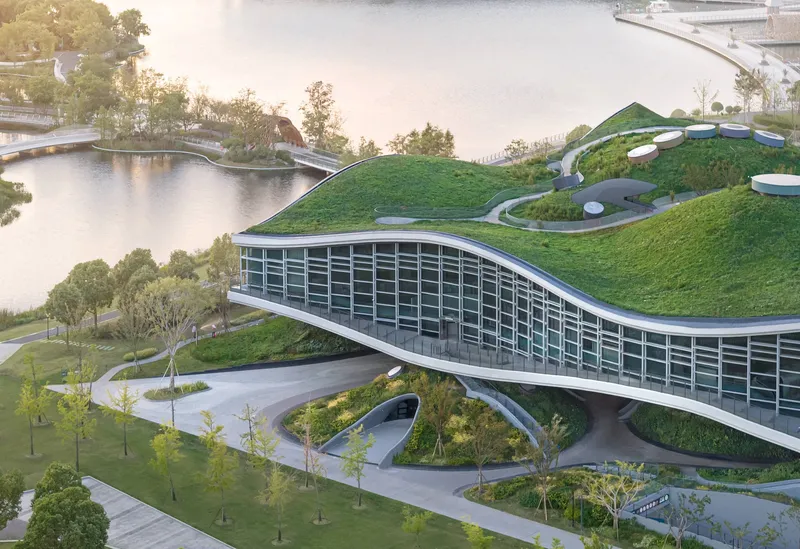
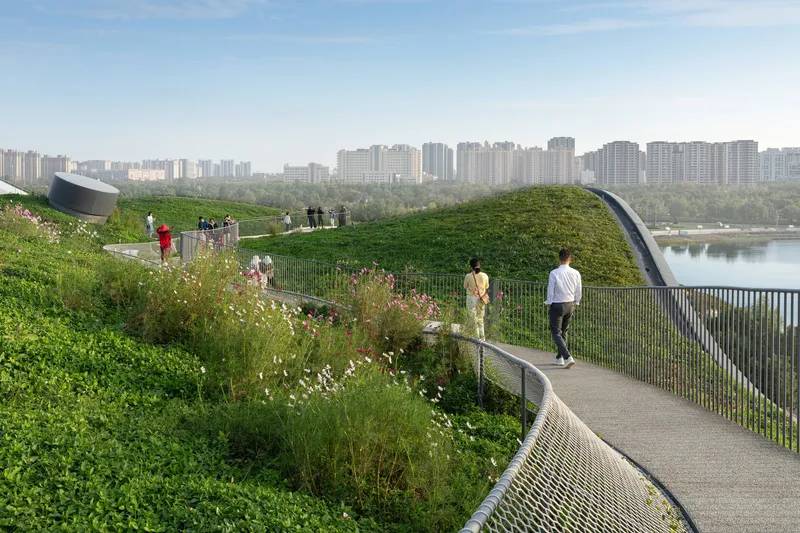
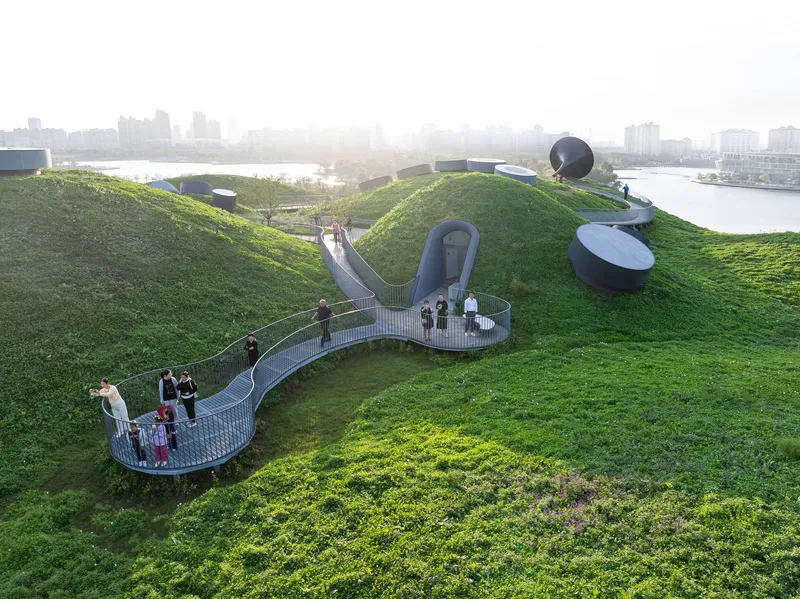
The defining gesture of Wave Cube is its roofscape. Described by the architects as "Grass Landscape on the Waves," it is a continuous, publicly accessible terrain of planted meadows that crests at 19.8 meters and rolls down to ground level in a series of green embankments. Circular openings punch through the surface to draw light into the galleries below, doubling as skylights and as gathering spots where visitors naturally pause. Steel mesh walkways and viewing platforms stitch across the meadow, offering elevated sightlines to the lake and the distant Shanghai skyline.
It is worth pausing on what this choice means programmatically. By giving the roof over to pedestrians, the building extends the public realm of Fengxian New City vertically. The roof is not a garden for tenants or a VIP terrace; it is open ground, accessible from gentle slopes at the building's edges. In a district that is still largely under development, this kind of immediate public amenity does real urban work.
Concrete Shells and the Space Age Inheritance
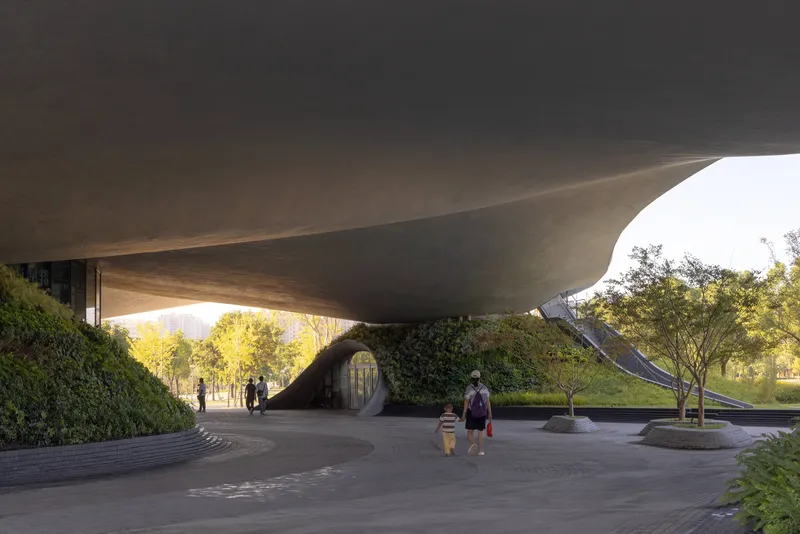
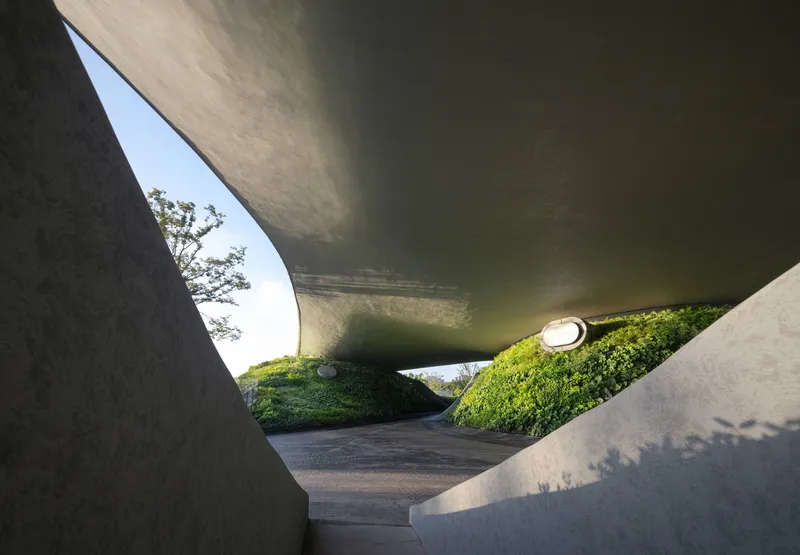
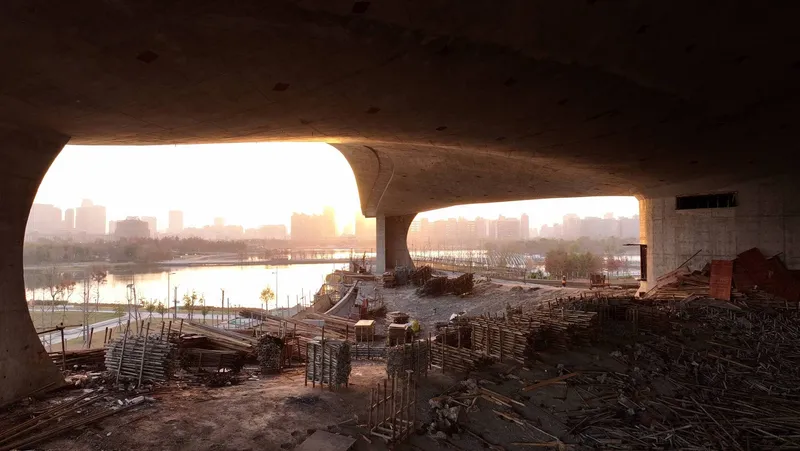
Underneath the meadow, the structural reality is muscular. Eight wave-shaped concrete shells form the primary volumes, their curved undersides exposed as smooth, sweeping soffits that recall the thin-shell experiments of the 1960s and 1970s. The formal language is unapologetically Space Age, a vocabulary that fell out of fashion for decades but feels newly relevant in the context of a science fiction museum. There is a directness here: the structure is the architecture, and the ornament is the structure's geometry.
Scenic Architecture Office worked with structural consultant AND Office and the Tongji Architectural Design Group to realize the three-layered curved-shell composite system. Medium and dark grey concrete protectants coat the surfaces, lending a tonal consistency that reads as monolithic even where different structural logics are at play. The interstitial zones between shells become outdoor passages and covered forecourts, blurring the distinction between inside and outside at ground level.
Ground Level: Permeable Thresholds
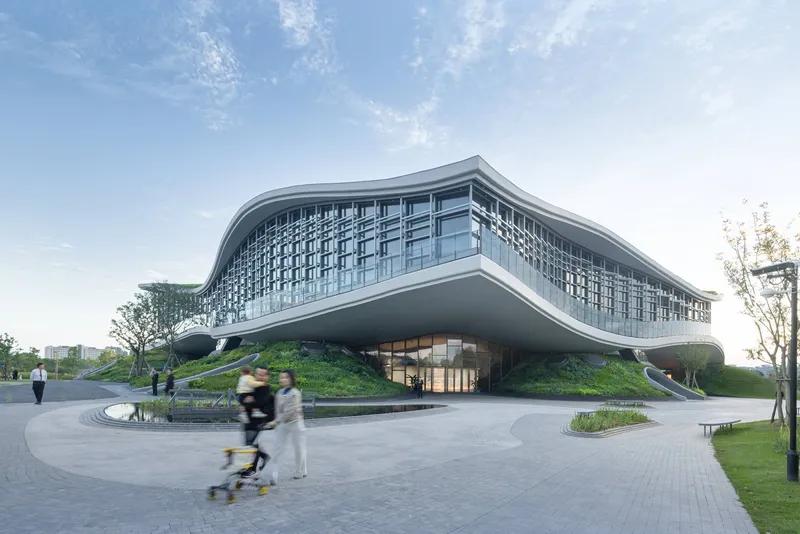
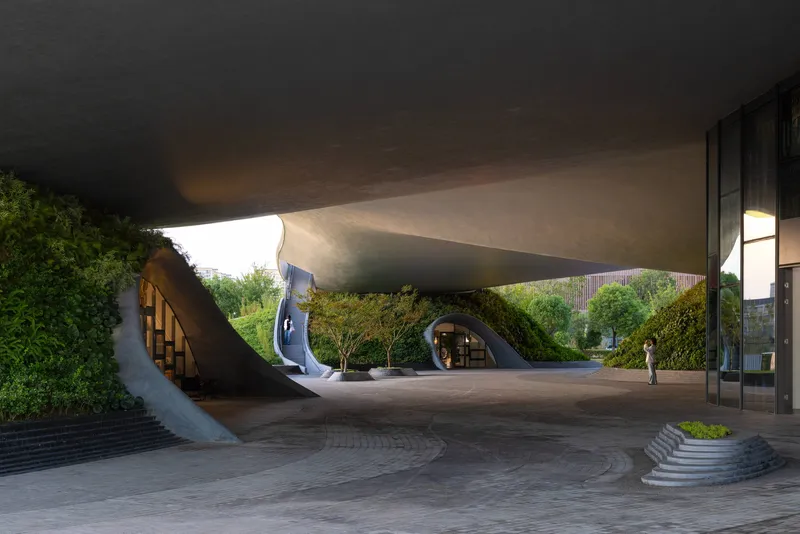
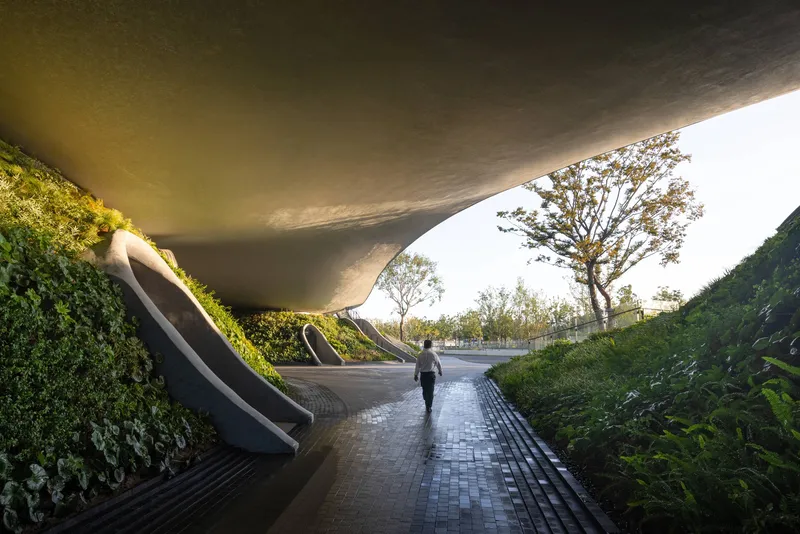
The ground floor houses entrance areas, exhibition spaces, and cafés distributed across the eight shells, but the real story is what happens between them. The gaps between shells are not residual; they are designed as continuous public corridors, open-air passages that invite movement through the building rather than merely into it. A curved water feature at the entrance plaza reinforces the wave theme without belaboring it, and the glass curtain wall, framed in dark grey T-shaped steel, keeps the perimeter transparent.
Walking beneath the cantilevered edges, visitors experience the building's mass overhead while looking out to planted embankments and paved paths that merge seamlessly with the surrounding park. The effect is closer to passing under a bridge or a natural overhang than entering a conventional museum lobby. It is a gesture of deliberate hospitality in a building type that often defaults to gatekeeping.
The Dark Zone and Light Zone
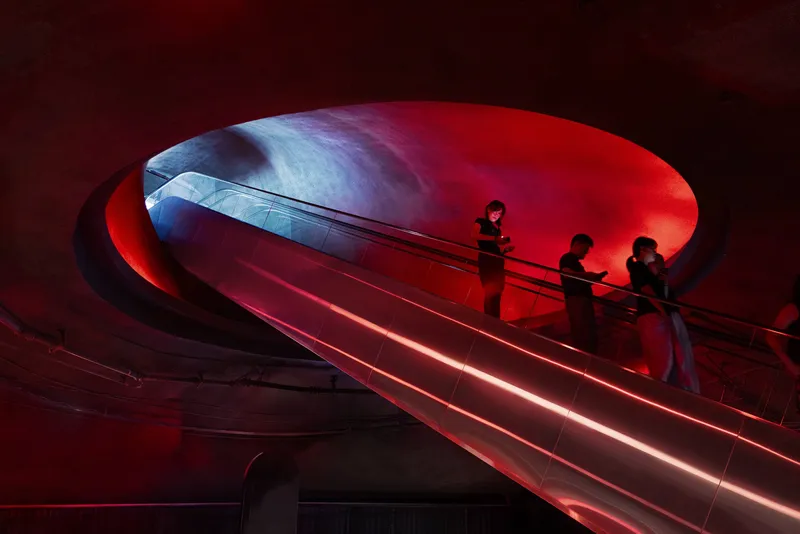
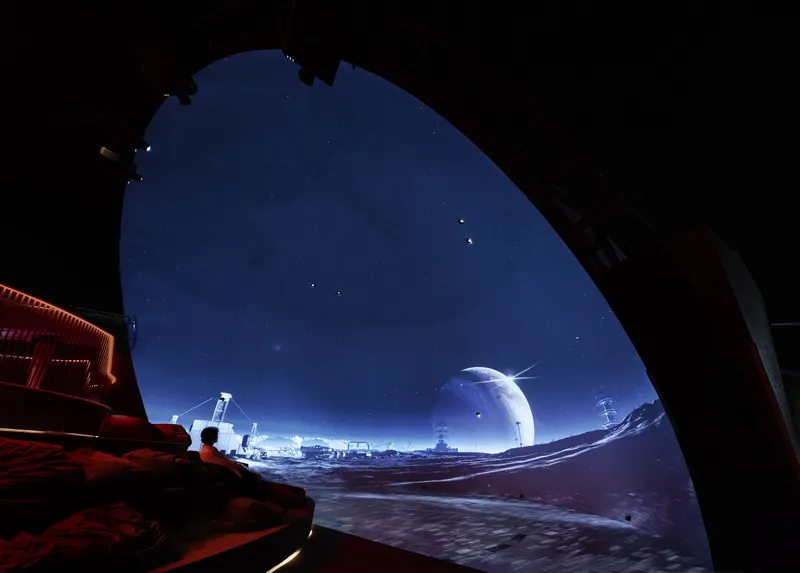
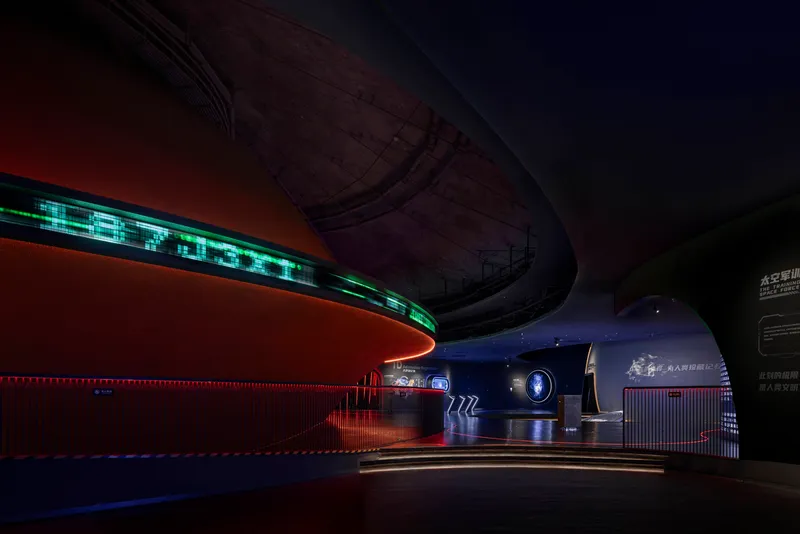
The second floor, spanning 6,400 square meters, is divided into two experiential territories. The northeastern "Dark Zone" is dedicated to immersive science fiction narratives, with helical escalators rising through elliptical voids bathed in color-graded lighting and exhibition galleries where curved soffits, LED data displays, and red horizontal light bands create an atmosphere of controlled intensity. A circular planetarium with tiered seating beneath a crystalline geometric ceiling anchors the most theatrical sequence.
The western "Light Zone" inverts the mood entirely, opening to the lake through laminated hollow ultra-white glass, quadruple-glazed with two chambers. Where the Dark Zone plunges visitors into narrative darkness, the Light Zone frames the real landscape as its own kind of spectacle. The juxtaposition is smart: it prevents the building from becoming a single-note experience and acknowledges that a science fiction museum gains resonance when it stays tethered to the observable world.
Interior Atmospheres
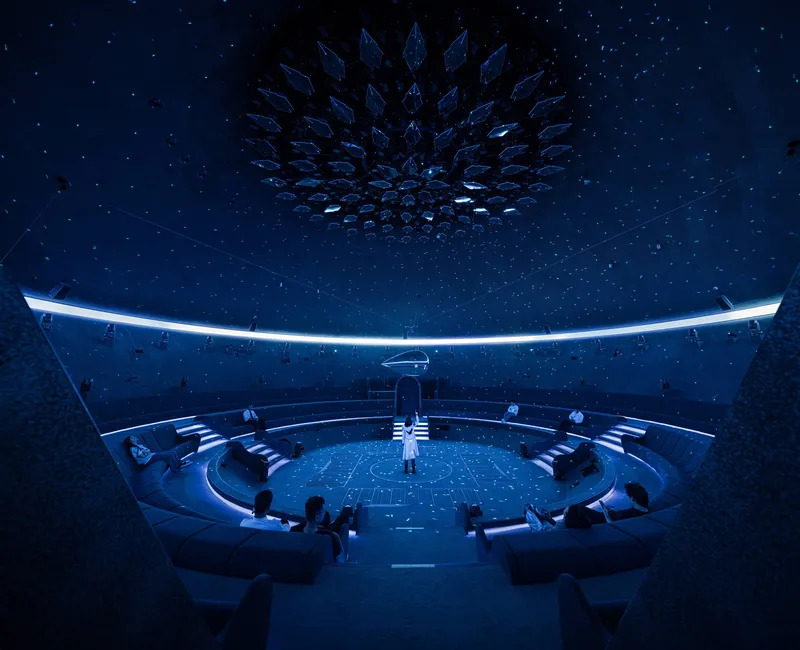
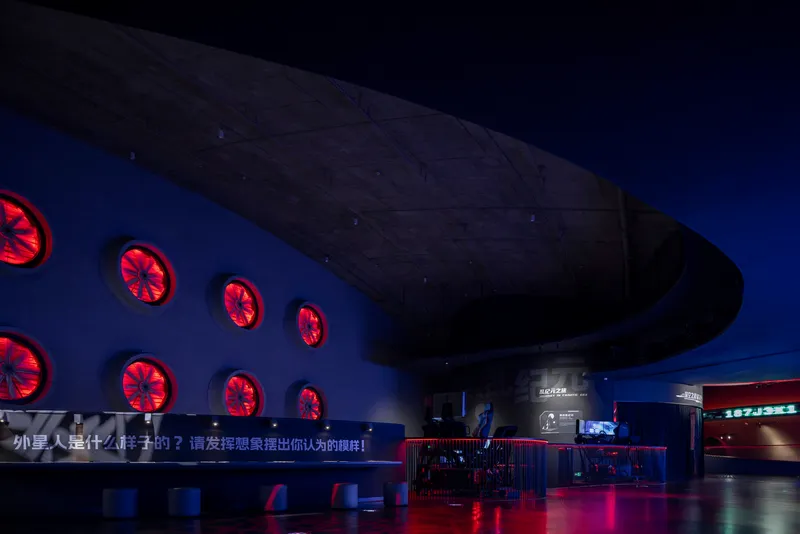
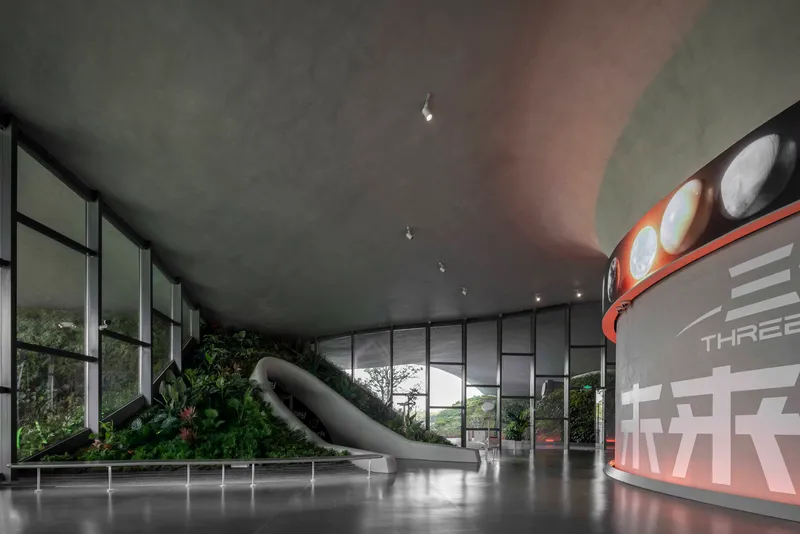
The interior spaces oscillate between the celebratory and the uncanny. The planetarium, with its starry projection dome and faceted ceiling, is a set piece that earns its drama. Exhibition halls with red-illuminated circular ventilation grilles and ribbed black ceilings suggest a vocabulary borrowed as much from film production design as from architecture. A tubular slide descends through one space alongside floor-to-ceiling glazing and planted indoor hillocks, collapsing the boundary between playground and gallery.
There is a risk with interiors this thematic: they can date quickly or feel like theme park sets. Wave Cube mitigates this by grounding its most theatrical moves in the building's structural logic. The curved soffits are not decorative appliqué; they are the underside of the concrete shells. The skylights are not stage lighting; they are the same circular openings visible from the roof. This structural honesty gives the interior spectacle a backbone.
Lake, Landscape, and Urban Strategy
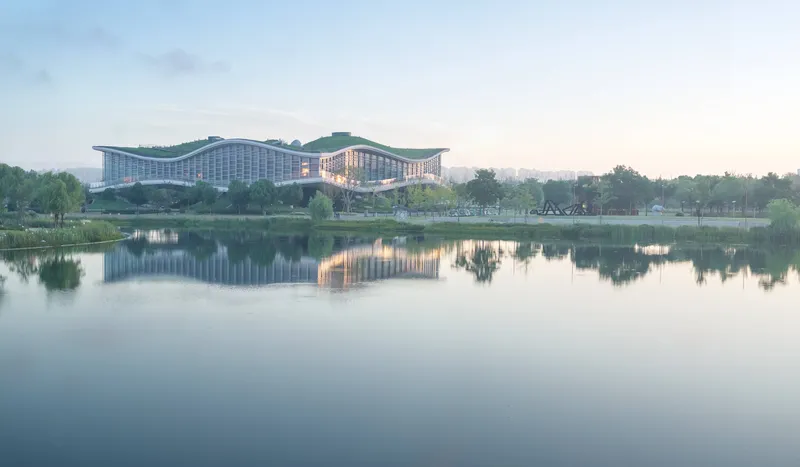
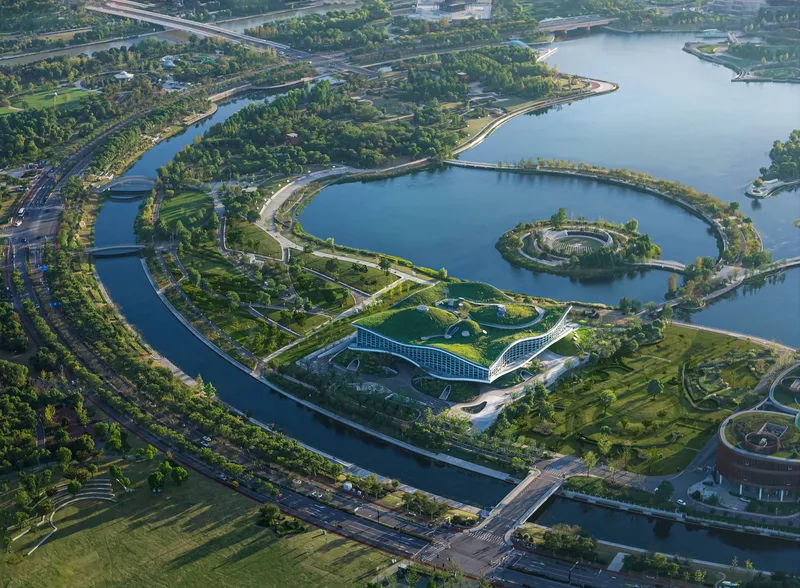
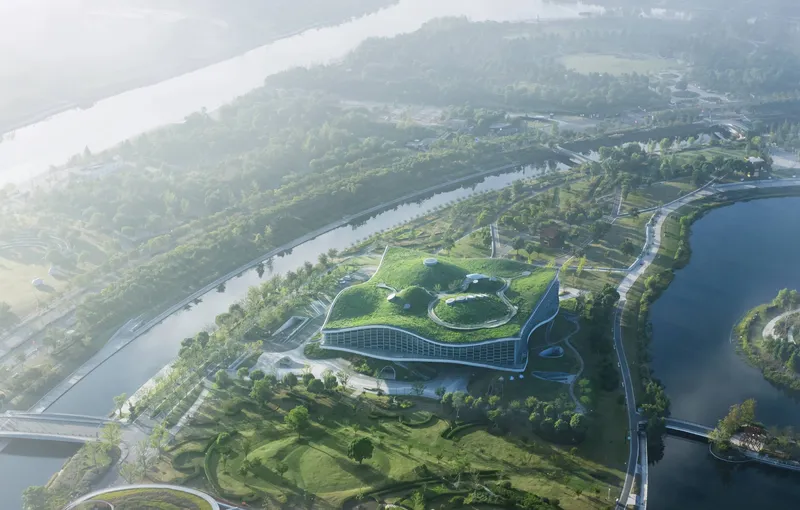
Fengxian is one of five new districts along the coast south of Shanghai's city center, bordering Hangzhou Bay. Jinhai Lake, the district's primary landscape feature, is a circular body of water around which the new urban fabric is being organized. Wave Cube sits on a peninsula along the eastern shore, fronting water on two sides. The landscape design, by Growdesign Co. Ltd., extends the building's wave logic into the surrounding terrain with curving waterways, circular planted islands, and graded slopes that absorb the building's footprint into a larger park system.
From across the lake at dawn, the building reads as a series of green hills rather than a conventional structure. The reflections double the effect, and the planted roofscape merges with the horizon line. For a new district still establishing its identity, this kind of landmark, one that enhances its setting rather than competing with it, is a more useful contribution than a tower or a signature blob.
Curtain Wall and Materiality
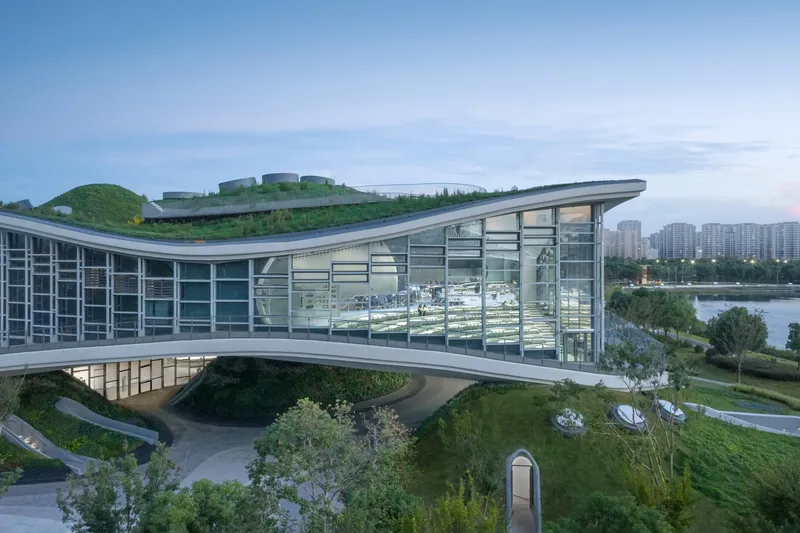
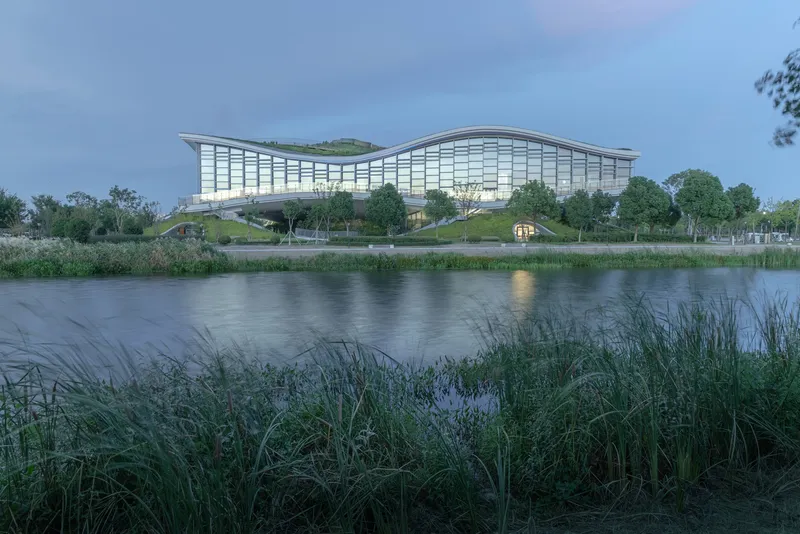
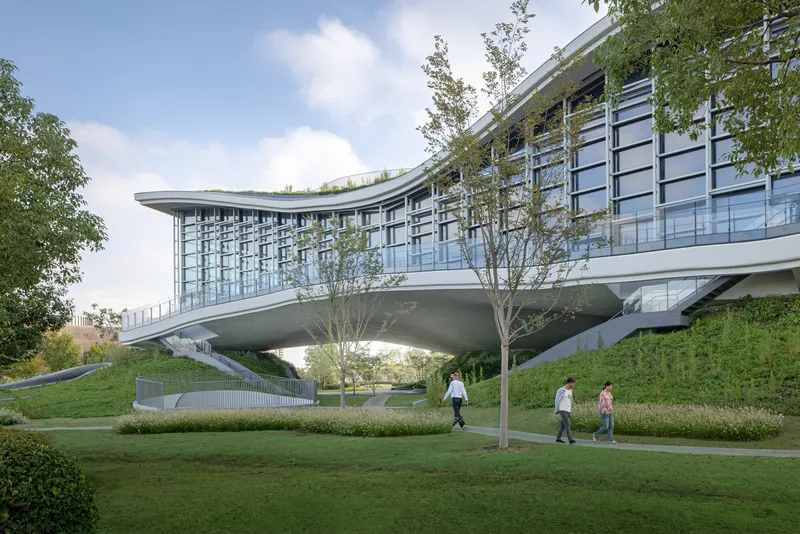
The glass envelope deserves specific attention. On the ground floor, laminated hollow ultra-white glass in triple-glazed assemblies is held in dark grey T-shaped steel frames, producing a wall that is thermally serious and visually restrained. On the second floor, the specification steps up to quadruple-glazed panels in light grey truss frames. The shift in frame color between levels is subtle but registers on approach, differentiating the public ground from the museum proper without resorting to obvious material contrasts.
Stainless steel and laminated ultra-white glass railings line the roof paths and cantilevered bridges, maintaining a material palette that stays within a narrow tonal range: grey concrete, grey steel, clear glass, green planting. The discipline is welcome. A building of this geometric ambition could easily have been overwhelmed by a noisy material palette. Instead, the restraint lets the form do the talking.
Plans and Drawings
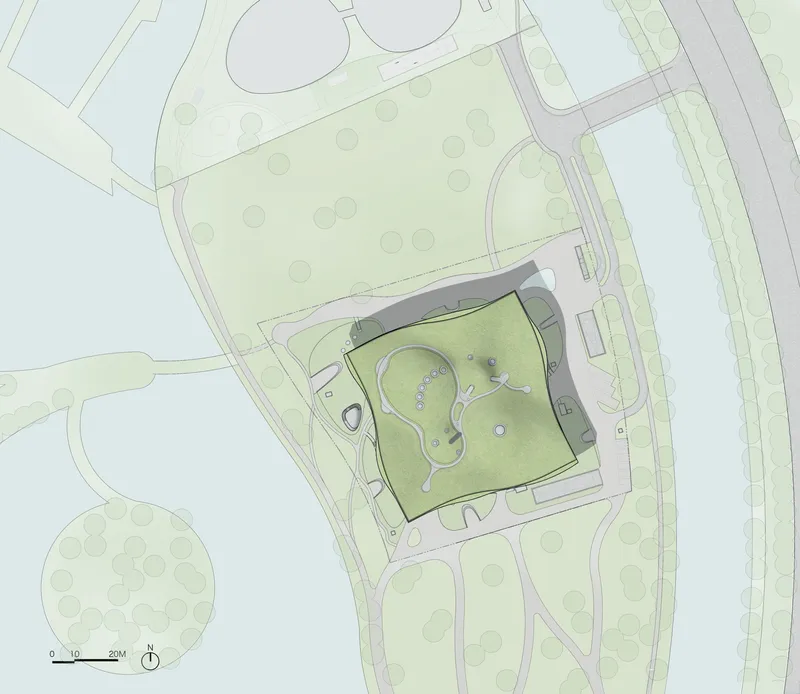
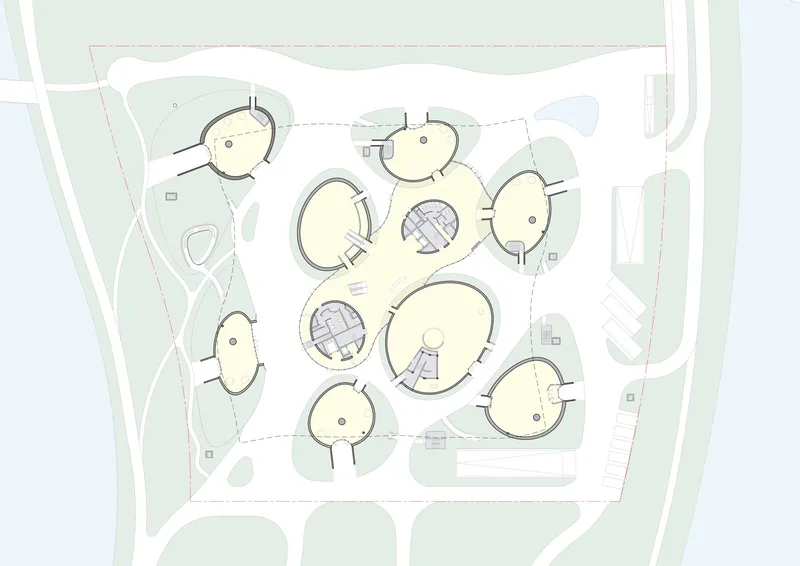
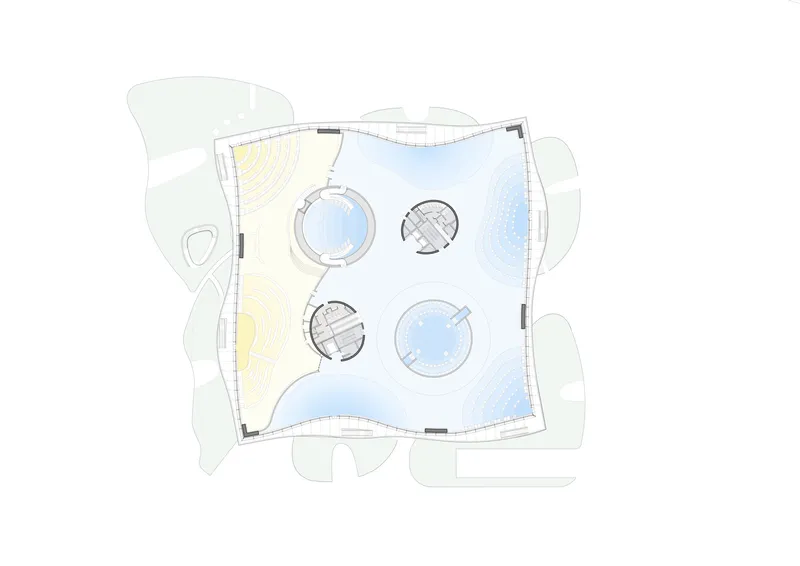
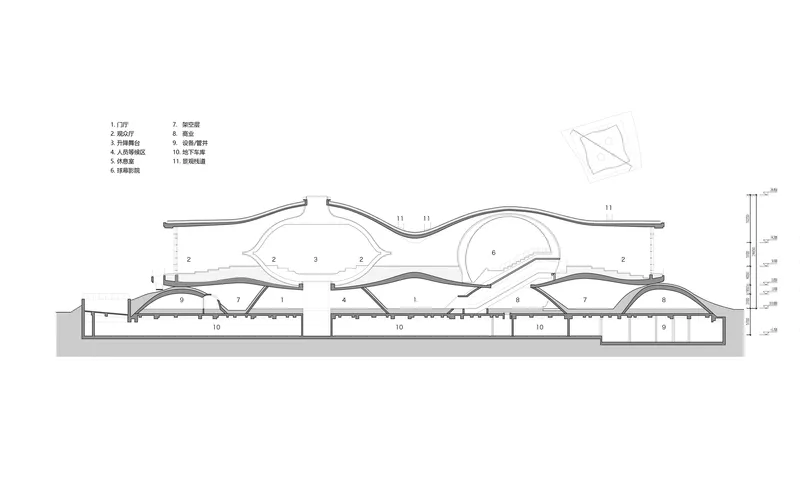
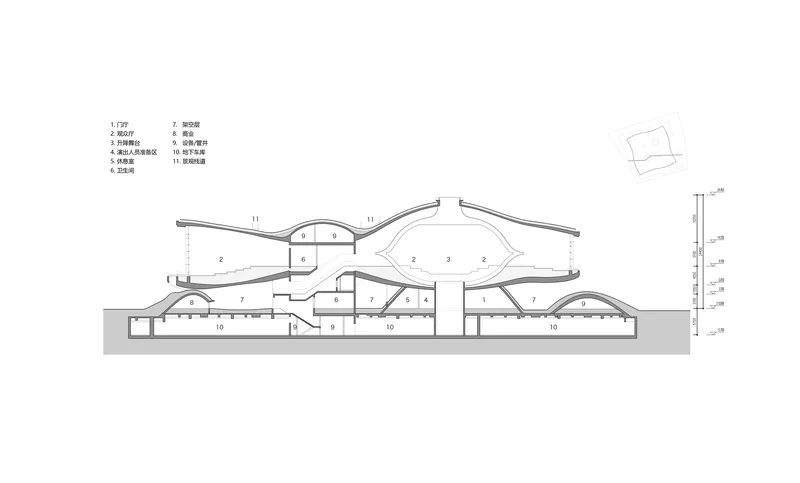
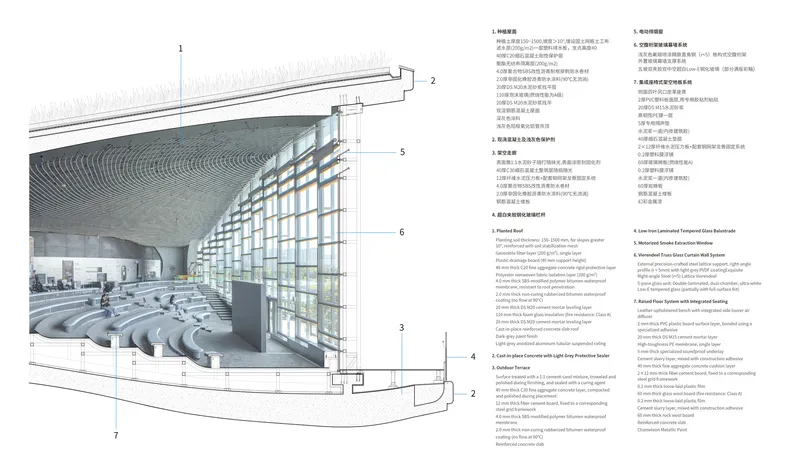
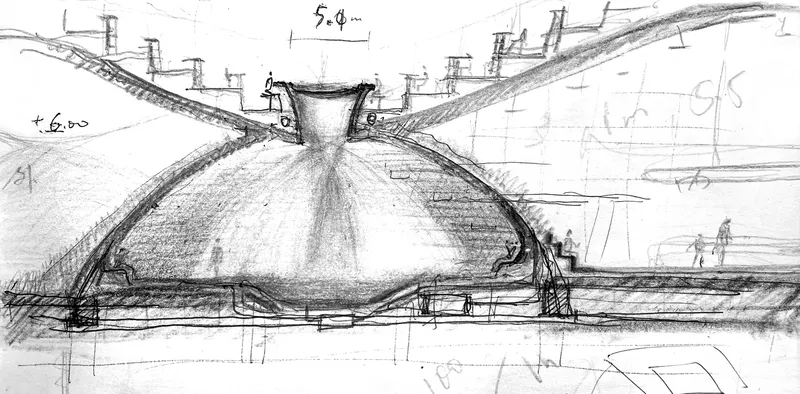
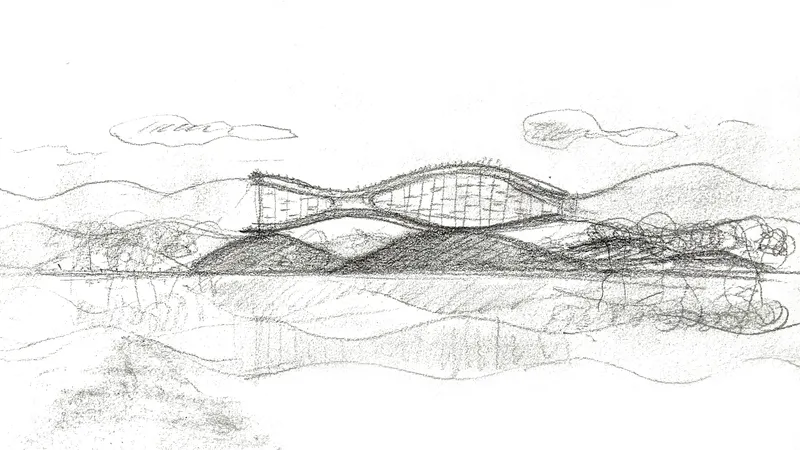
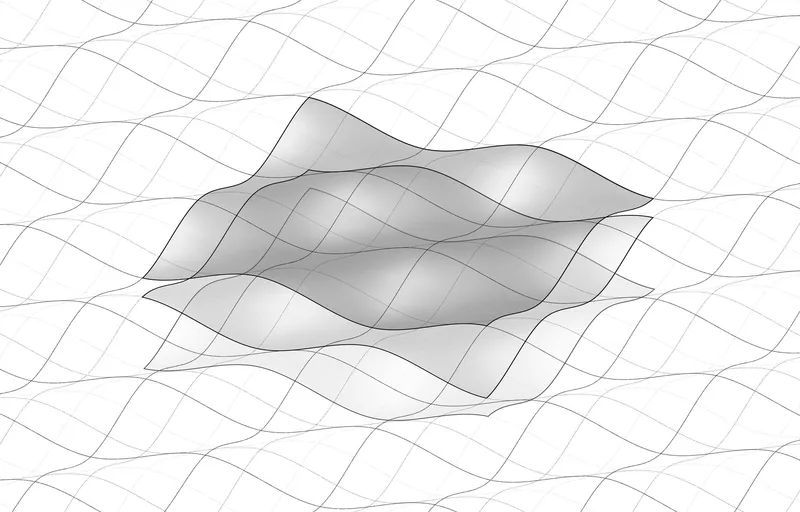
The site plan reveals just how embedded the building is within its landscape infrastructure, with paths, waterways, and planted zones radiating outward from the footprint. The roof plan makes the circular skylight distribution legible as a deliberate pattern rather than random punctuation. In section, the relationship between the vaulted interior volumes and the underground service levels becomes clear: the building is deeper than it appears from the outside, with significant program tucked below grade. The axonometric diagram, rendering the wavelike roof as a topographic field of contour lines, is perhaps the most instructive drawing, showing how the architects conceived the roof not as a surface but as a terrain.
Why This Project Matters
Wave Cube lands at a moment when China's new suburban districts are searching for cultural anchors that justify their existence. Too often, the answer has been a signature museum that functions as an isolated object, spectacular from the air but disconnected at street level. What Scenic Architecture Office has done here is more considered. By making the roof a public landscape, the ground level a permeable threshold, and the interiors a genuine narrative environment, the building operates at multiple scales simultaneously. It is a park, a museum, and a piece of city-making, and it does not sacrifice any one role for the others.
The project also pushes the structural possibilities of curved reinforced concrete in a way that feels purposeful rather than performative. The wave motif is not a gimmick; it is the organizational logic for the plan, the section, the landscape, and the visitor experience. When metaphor and structure align this tightly, the result is architecture that communicates its ideas without requiring a wall text. On the shores of Jinhai Lake, the waves make sense.
Wave Cube by Scenic Architecture Office, in collaboration with Tongji Architectural Design Group. Located on the eastern shore of Jinhai Lake, Fengxian New City, Shanghai, China. 29,700 m². Completed 2025. Structural consultant: AND Office. Landscape design: Growdesign Co. Ltd. General contractor: Shanghai Construction Group Co., Ltd. Photography by Shengliang Su, Guowei Liu, and Fengyuzhu.
About the Studio
Share Your Own Work on uni.xyz
If projects like this are the kind of work you want to make, uni.xyz is a place to publish your own, find collaborators, and enter design competitions.


Popular Articles
Popular articles from the community


Faces of the Soviet Avant-Garde: Turning Moscow's Street Names into an Open-Air Museum
A network of sculptural installations across a Moscow residential district transforms forgotten architect names into spatial encounters with cultural memor

The Amber Palace Opera: A Geological Fiction Surfaces on Tallinn's Baltic Waterfront
Pierre Brillard reimagines a Baltic legend as a public landscape, opera house, and waterfront promenade rooted in Tallinn's coastal identity.

Singing Woman: Contemporary Architecture Inspired by Estonia’s Voice and the Sea
Singing Woman turns Estonia’s song culture into flowing opera house architecture, blending public life, landscape, sea, and national memory.
Temporary Home for Dogs: A Reversed Zoo Rethinks Animal Shelter Architecture
In Bucharest, a sinuous corridor and freed landscape flip the logic of containment, designing a shelter that works to make itself unnecessary.

Similar Reads
You might also enjoy these articles

Bao Huynh Watercolor Atelier: A Serene Art Retreat in Hội An
Bao Huynh Watercolor Atelier in Hội An blends multifunctional art spaces, sustainable design, local materials, and family-friendly living in a serene environment.

Atelier Macri Concept Store Interior Design by CASE-REAL
Atelier Macri store features a "ko" counter, walnut wood details, cork displays, blending retail, gallery, and seamless customer experiences.

Manuel Vargas Izquierdo Stadium and High-Performance Sports Center: Architectural Excellence in Jalpa de Méndez
The Manuel Vargas Izquierdo Stadium blends sustainable design, inclusive sports facilities, and cultural-inspired architecture, revitalizing Jalpa de Méndez’s public spaces.

KAKR Buluh Awar Hall: Revitalizing Community and Ecology Through Bamboo Architecture
Community built bamboo hall revitalizes Buluh Awar village, empowering youth, restoring ecology, celebrating vernacular craftsmanship through sustainable architecture and culture.


Comments (0)
Please login or sign up to add comments
No comments yet. Be the first to comment!