

Schenk Hattori Builds a Timber Beacon at the Edge of a Belgian Nature Reserve
A 230-square-meter entrance pavilion near Ieper translates the threshold between built landscape and wild terrain into raw timber frames.


There is a particular kind of architecture that refuses to announce itself. It does not compete with what surrounds it, nor does it retreat into camouflage. The Entrance Pavilion Palingbeek, completed in 2020 by Schenk Hattori at the edge of a nature reserve near Ieper, Belgium, occupies exactly that register. At 230 square meters, it is small enough to be absorbed by the mature trees around it, yet its repeating timber portal frames carry an unmistakable structural rhythm that draws visitors forward into the landscape beyond.
What makes this project worth studying is not ambition of scale but precision of intention. Schenk Hattori describes the design as doing the minimum necessary to transform a space into a place. That sounds modest, almost programmatic. But the built result reveals a sophisticated reading of site, history, and material. Ieper's terrain is saturated with the memory of the First World War, and any intervention here must negotiate between nature's reclamation of the land and the residual gravity of what happened on it. The pavilion does this through a clear structural language: exposed timber frames, diagonal bracing, raw plywood, and metal roofing composed into a walkway that functions simultaneously as shelter, orientation device, and threshold.
Portal Frames as Landscape Punctuation
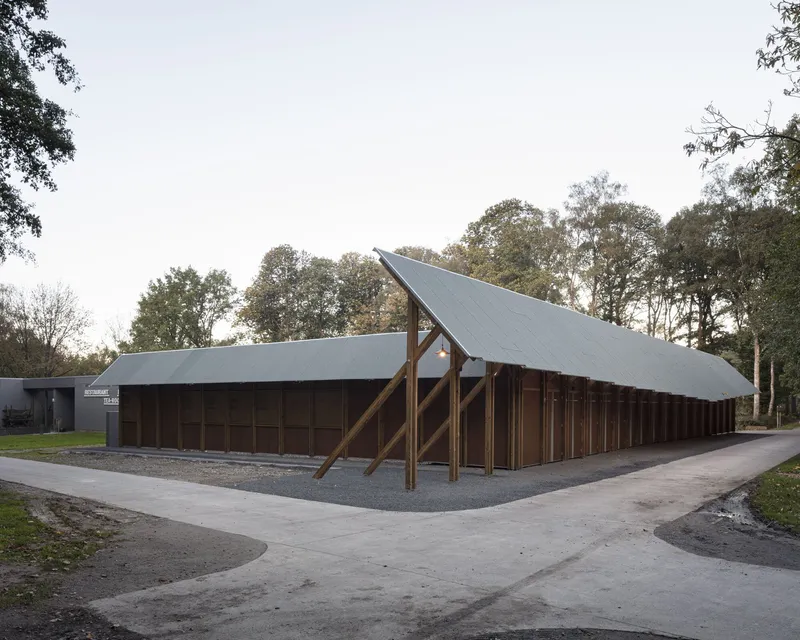
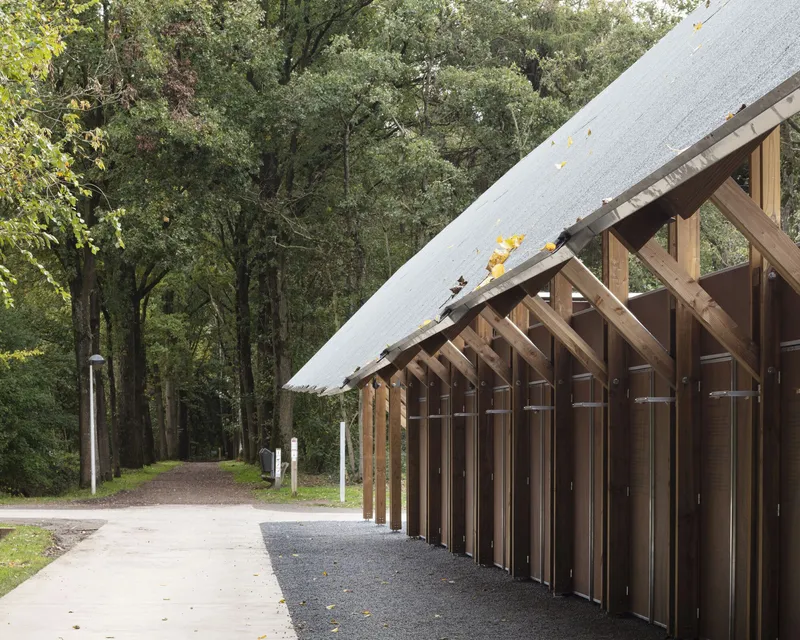
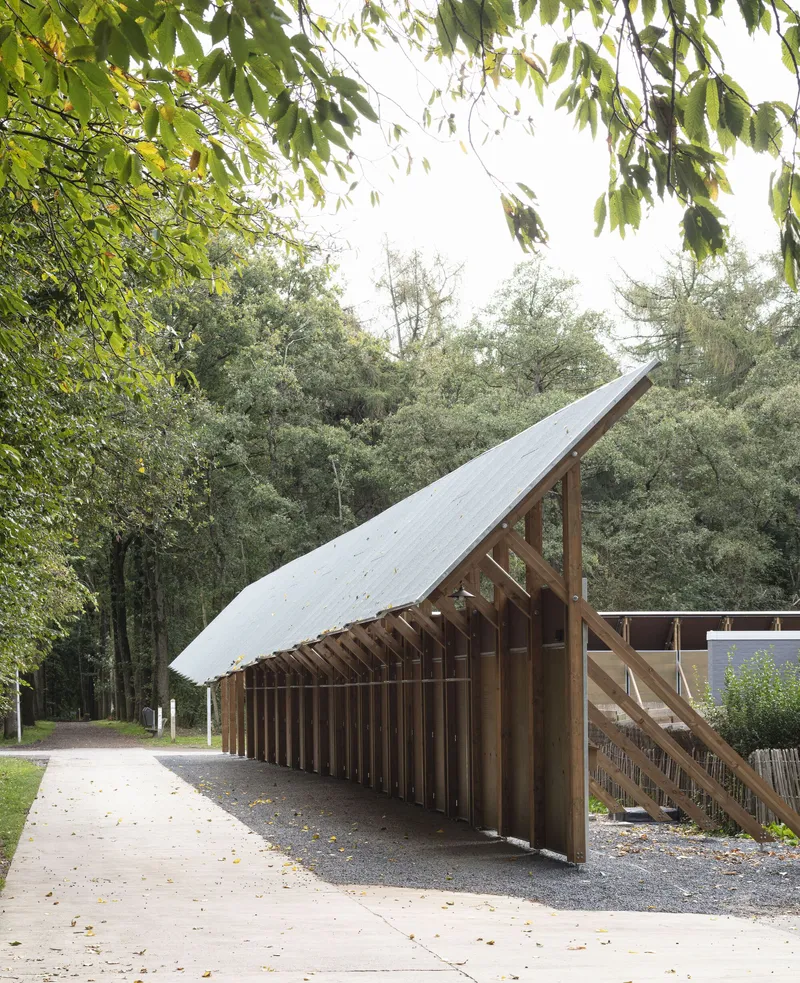
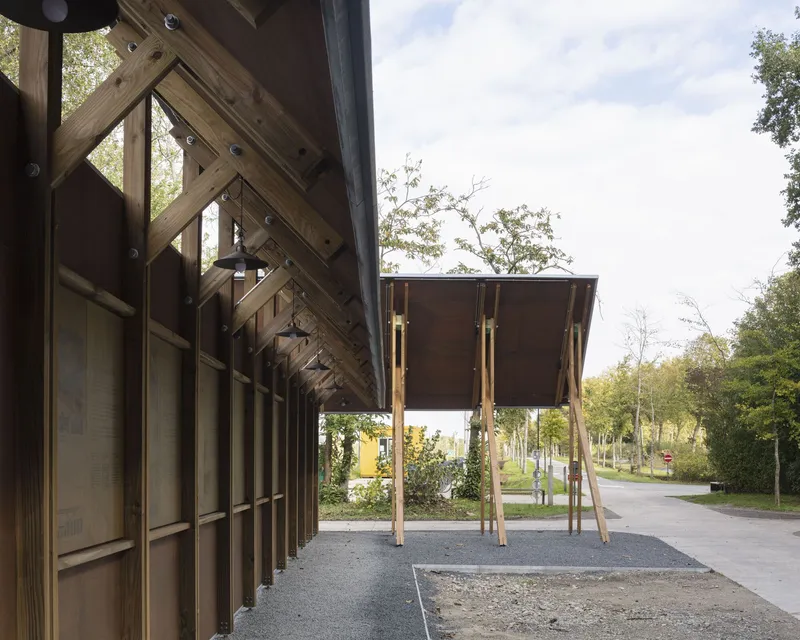
The pavilion's most legible architectural gesture is its repetition of timber portal frames along a linear axis. These frames establish a cadence, a measured beat that organizes the visitor's movement from the paved entrance path toward the reserve. Each frame is identical in geometry but reads differently as light conditions, tree canopy, and ground surface shift along the walkway. On an overcast autumn day, the frames dissolve into the grey sky; in dappled sunlight, they cast sharp diagonal shadows across the gravel.
The pitched metal roof they support is deliberately understated, a single sloping plane that channels rainwater and defines the upper boundary of the covered passage without asserting a monumental silhouette. The whole composition reads less like a building and more like a piece of infrastructure, a covered bridge or a pergola that has been given just enough enclosure to become habitable.
Diagonal Bracing and Structural Honesty
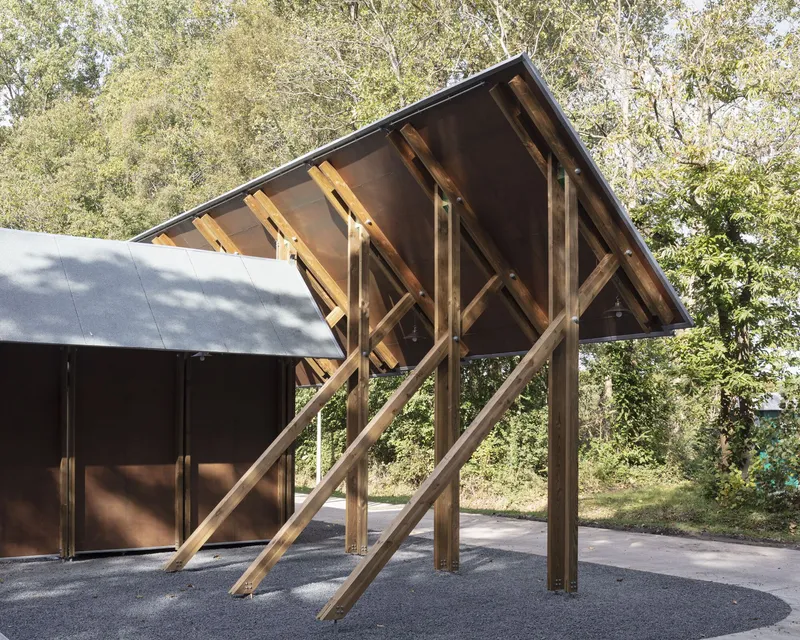
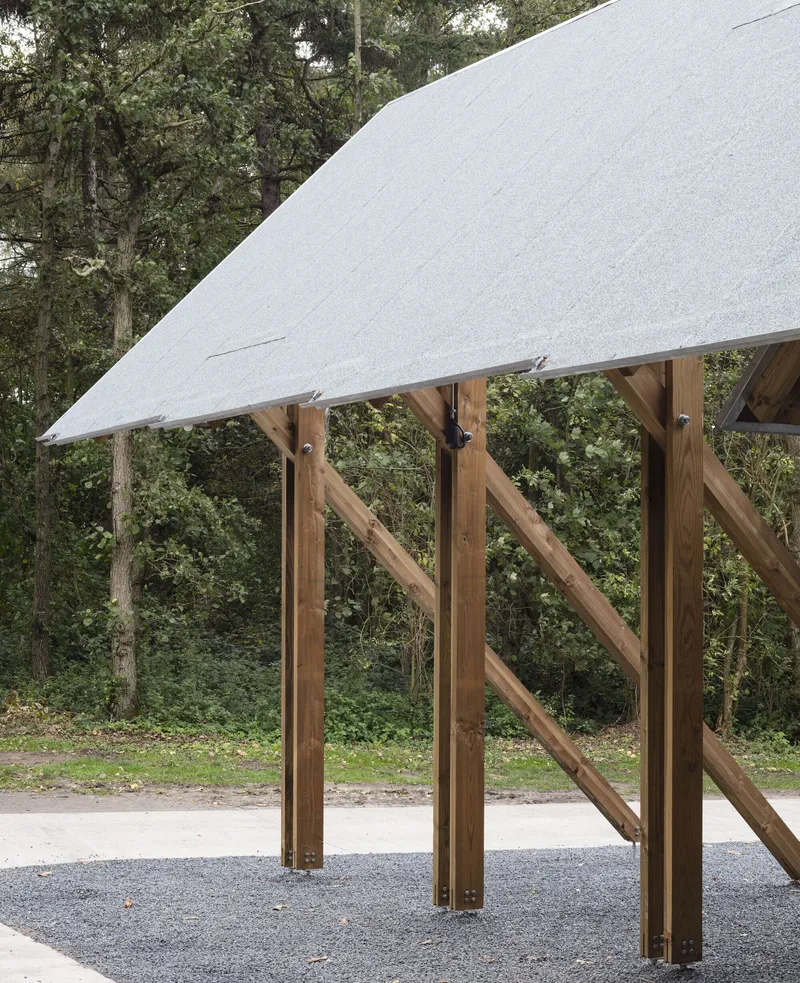
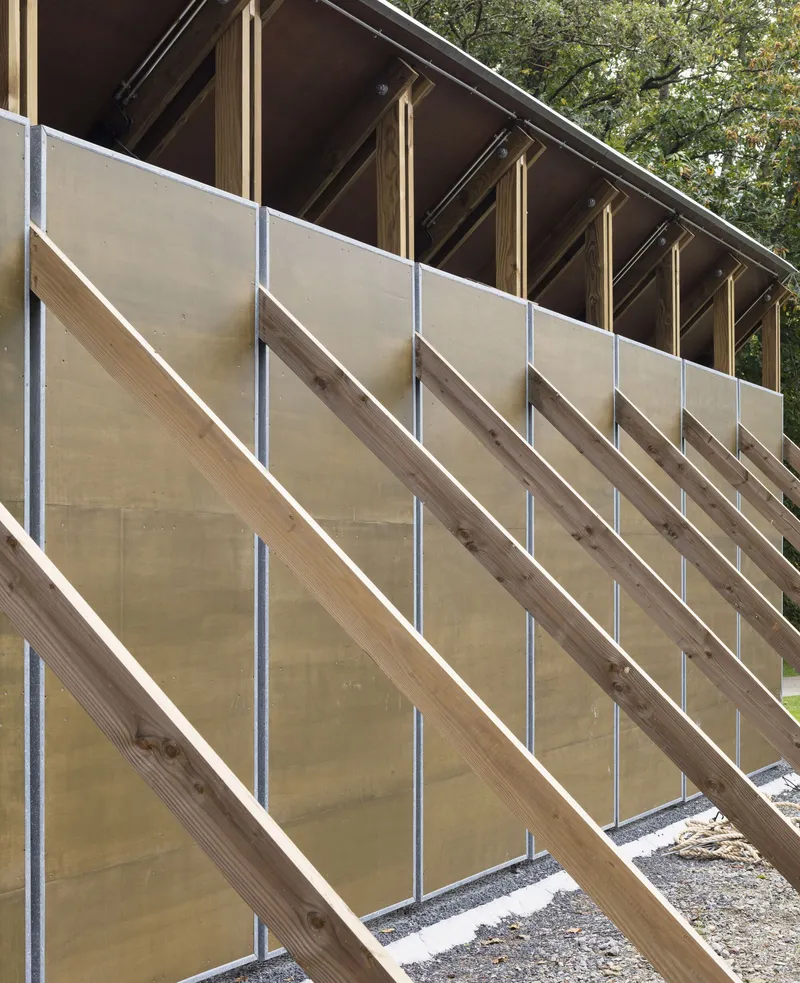
Schenk Hattori makes no attempt to conceal how the building stands up. Diagonal timber braces are left fully exposed, connecting columns to the roof plane with bolted joints that you can inspect from a few inches away. Metal tension rods supplement the timber where additional lateral stiffness is needed, creating a hybrid structural logic that treats each element as a visible participant in the overall stability of the frame.
This is not ornamental transparency. The diagonal braces are doing real work, and their angle and dimension reflect actual force paths. The result is a building that teaches you how it was made while you walk through it. That didactic quality feels appropriate for a pavilion whose purpose is orientation: it introduces visitors to the reserve by first introducing them to the logic of its own construction.
The Covered Walkway as Spatial Transition
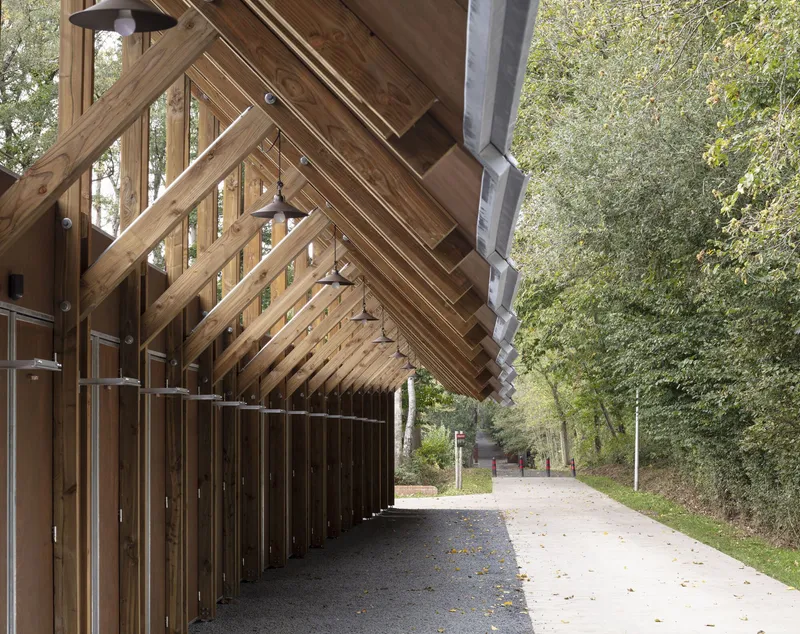
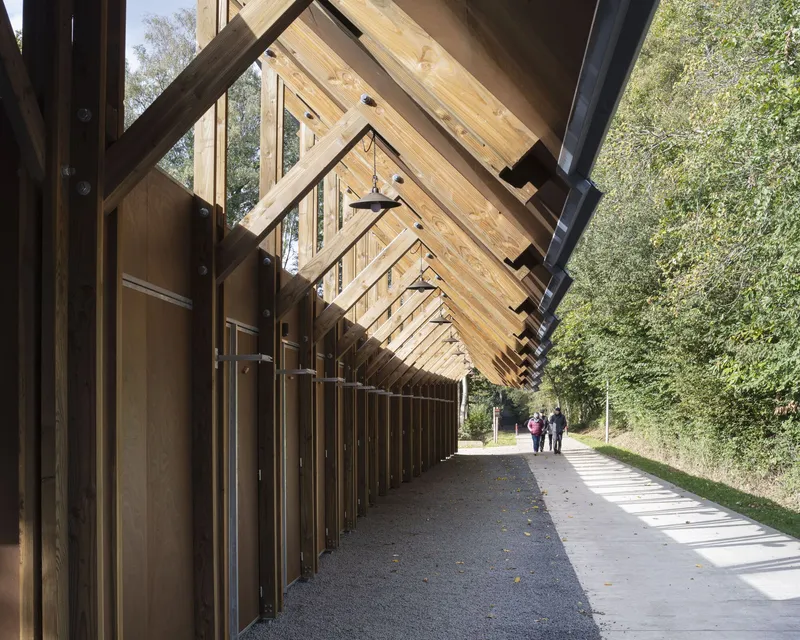
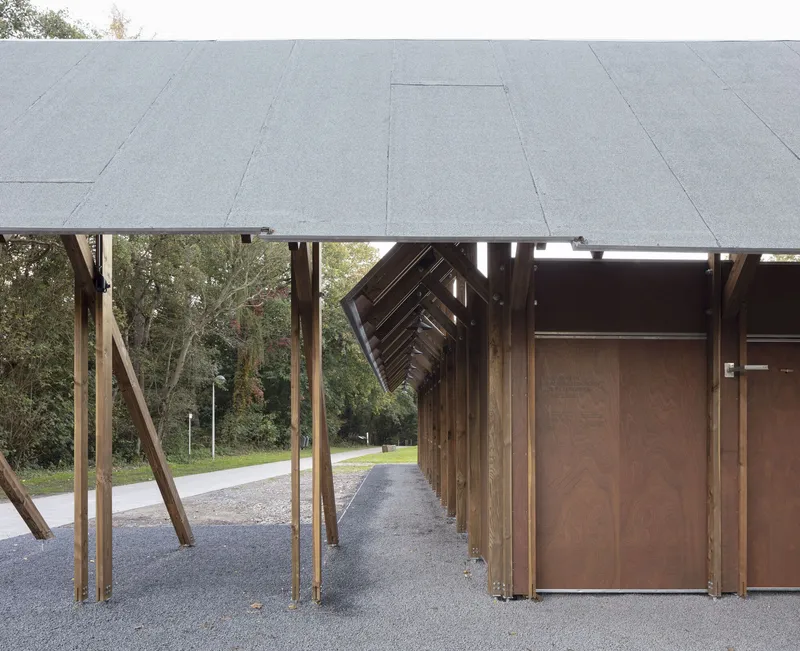
The walkway is the project's core spatial idea. Rather than designing a discrete object, Schenk Hattori stretches the pavilion into a linear experience. Bronze-toned metal cladding and dark paneled doors line one side, while the opposite edge opens toward the tree canopy. The covered passage compresses the visitor's field of vision, framing specific views of the surrounding woodland and then releasing them at the open gable ends.
Vertical wood slats and sawtooth rafter profiles add textural complexity to the interior surfaces without breaking the directional clarity of the space. You move through the pavilion, not into it. The gravel path underfoot reinforces the sense of passage, a material continuity with the trails that extend into the nature reserve beyond.
Material Palette and Weathering
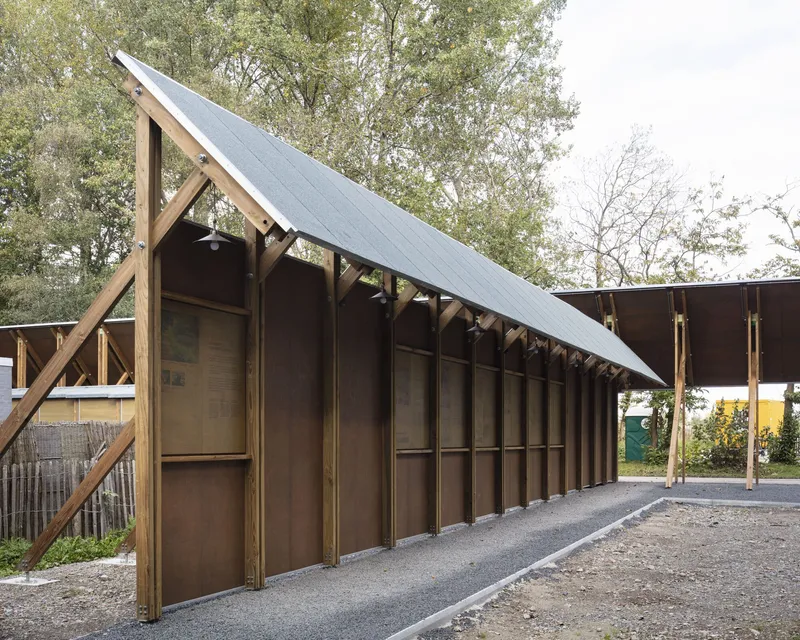
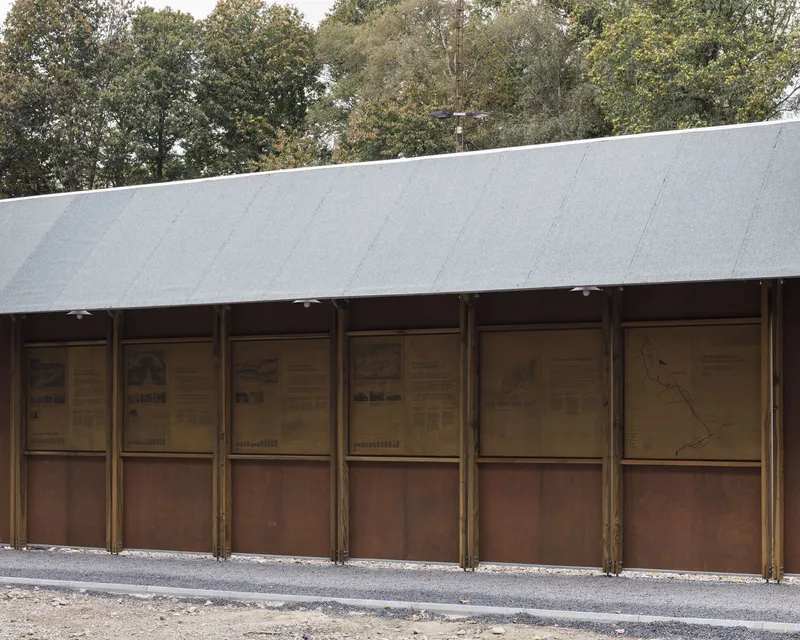
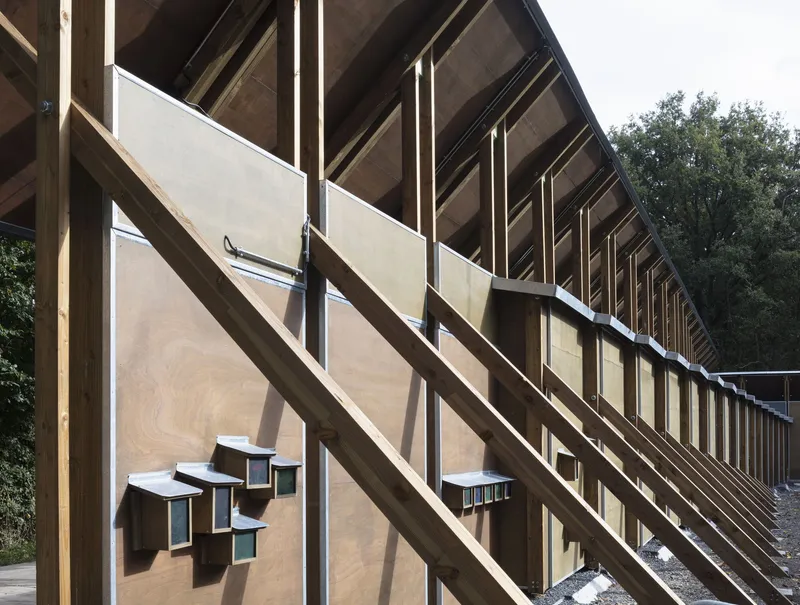
The material selection is deliberately limited: sawn timber, plywood, corten-clad panels, and standing-seam metal roofing. Each material is allowed to age and weather without protective coatings, meaning the pavilion will darken and patinate in step with the seasonal cycles of the reserve. The corten lower panels have already begun their oxidation, their warm rust tones echoing the autumn leaf litter that collects at the base of the columns.
Small protruding shelves on the plywood facade panels suggest an informational or display function, reinforcing the pavilion's role as both spatial threshold and interpretive station. These details are minimal, almost provisional, consistent with the architects' iterative design philosophy. The building feels calibrated to accept future additions or modifications without losing its compositional coherence.
The Elevated Volume and Canopy
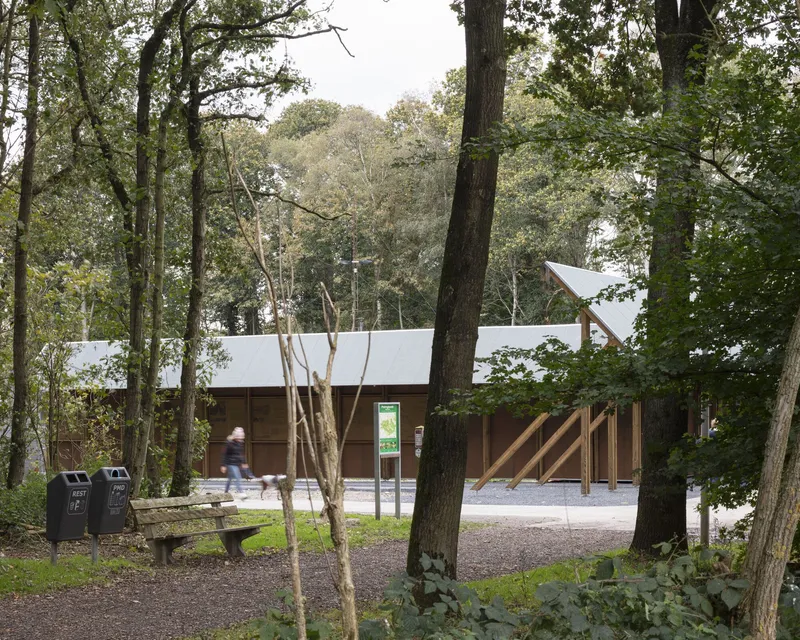
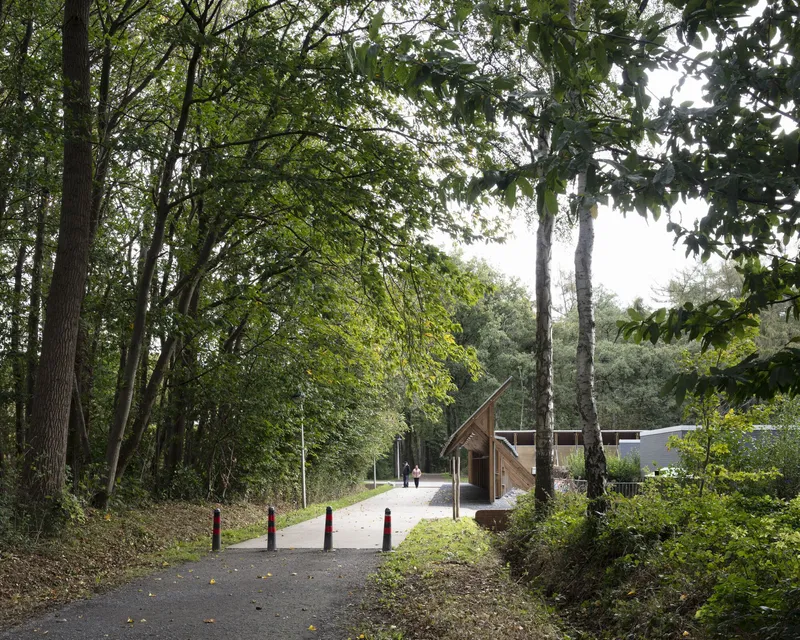
At one end of the complex, a dark wood volume lifts off the ground on slanted timber columns, creating a canopy that marks a secondary entrance or gathering point. The raised volume introduces a change in scale and density that counterpoints the openness of the walkway. Where the walkway is all rhythm and transparency, this element is compact and opaque, a solid anchor in the composition.
Seen from a distance through the trees, the pavilion registers as a series of angled silhouettes rather than a unified mass. Schenk Hattori has deliberately broken the program into clustered volumes that can be glimpsed, lost, and rediscovered as you approach through the woodland. This choreography of partial views transforms a walk through the parking area into an experience of architectural anticipation.
Details and Enclosure
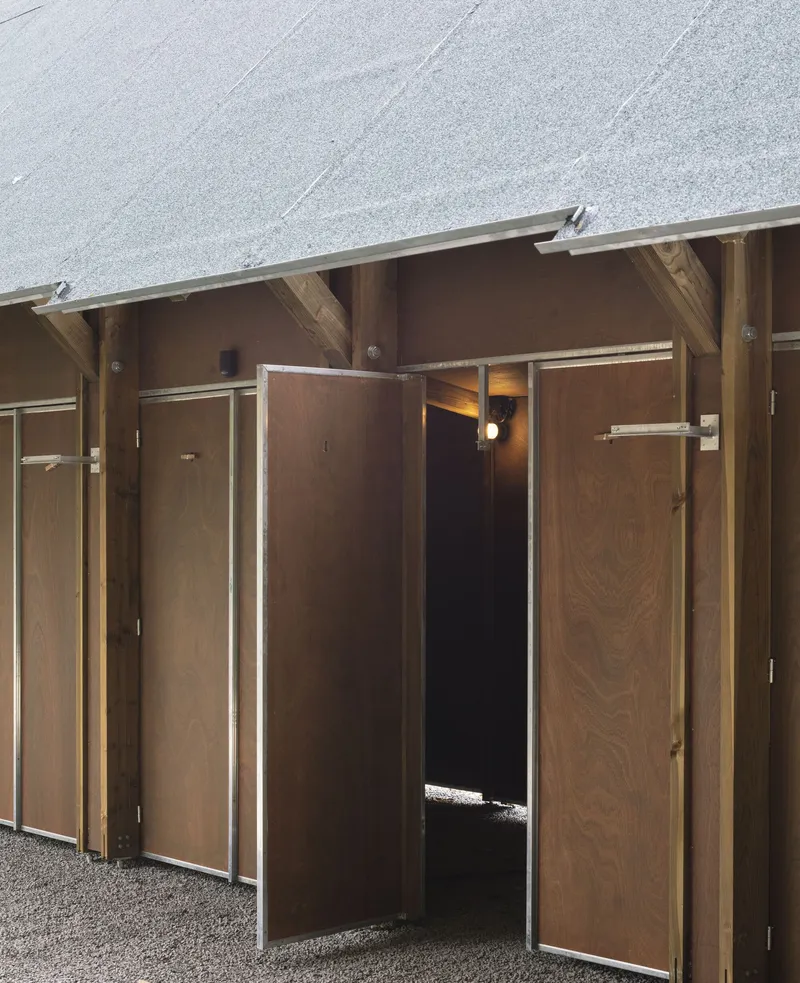
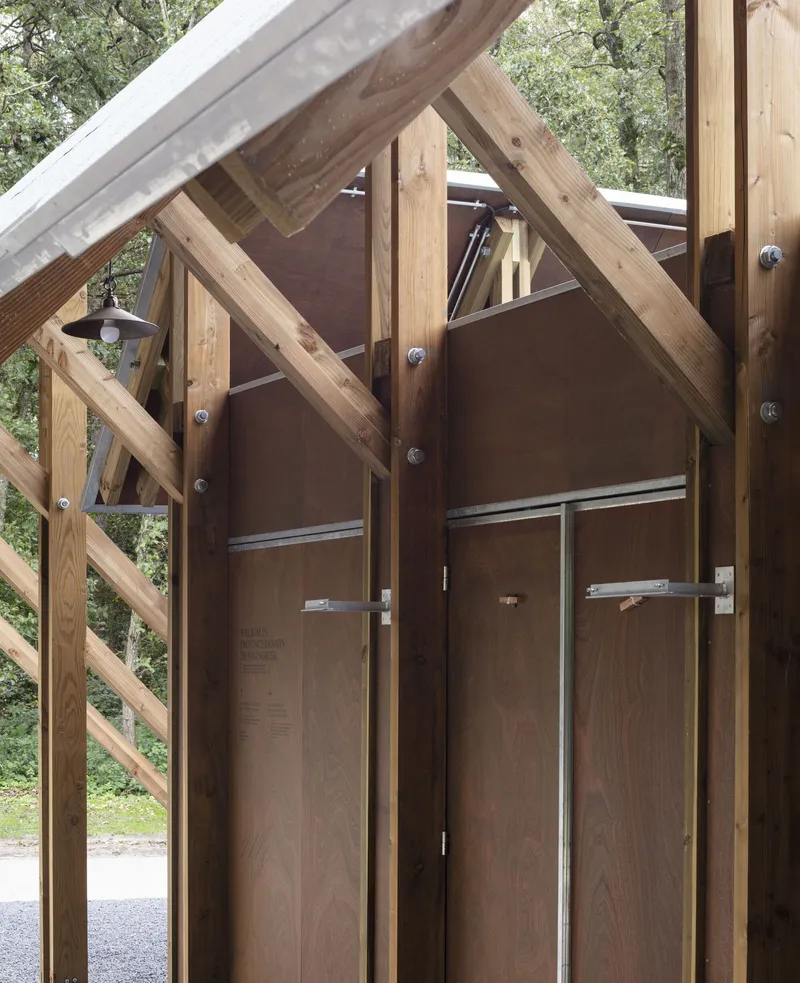
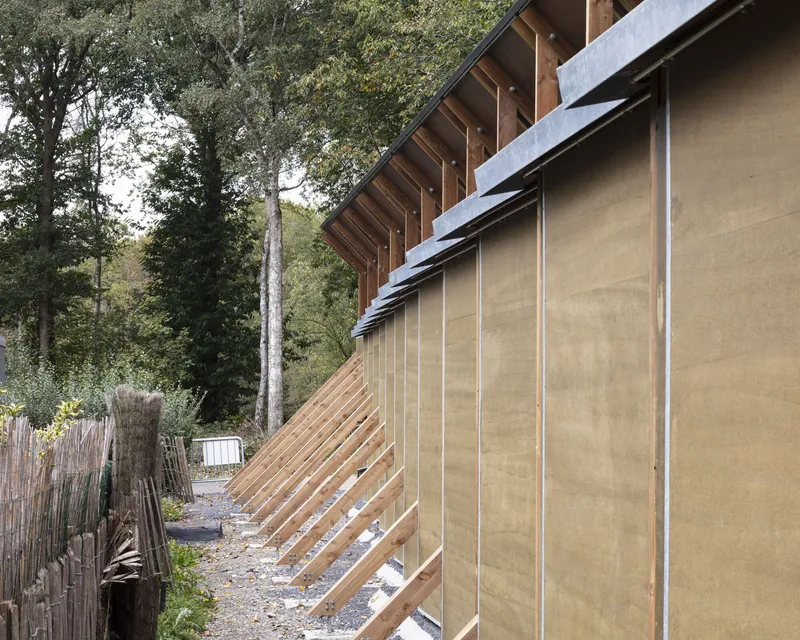
The entrance portals are framed with bolted timber columns and gabled profiles that recall the vernacular gable ends of Flemish agricultural buildings. The reference is not literal but proportional: the pitch of the roof, the width of the opening, and the ratio of solid to void align with a regional memory of sheltered thresholds. Plywood panels with metal edging fill the gable, creating a flush surface that can accommodate doors or informational panels.
Canvas panels and metal brackets supplement the timber frame at the roof overhangs, providing temporary or adjustable enclosure that reinforces the pavilion's iterative character. Nothing here feels permanent in the monumental sense. Instead, the detailing communicates a willingness to evolve, to be modified by use and weather and programmatic change over time.
Plans and Drawings
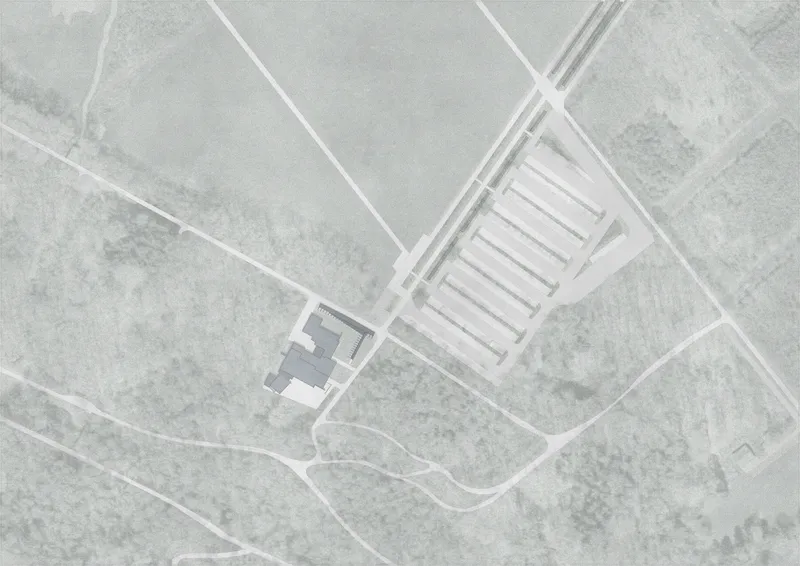
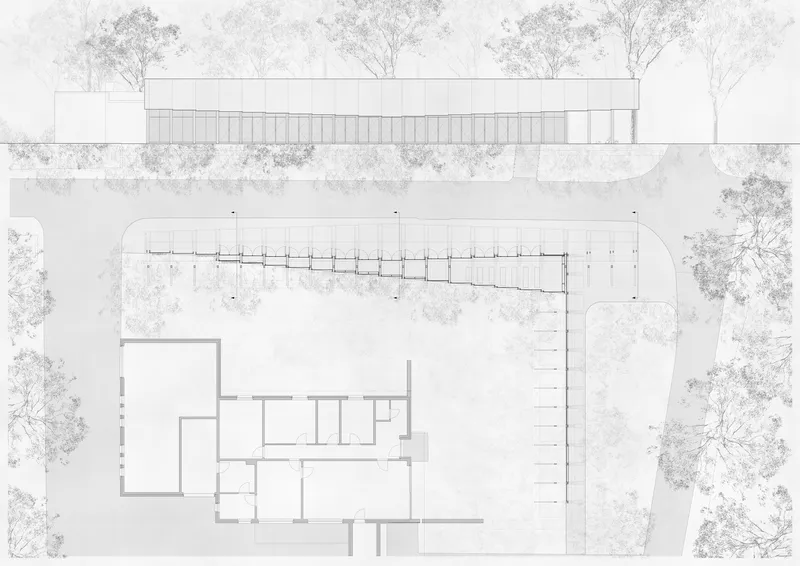
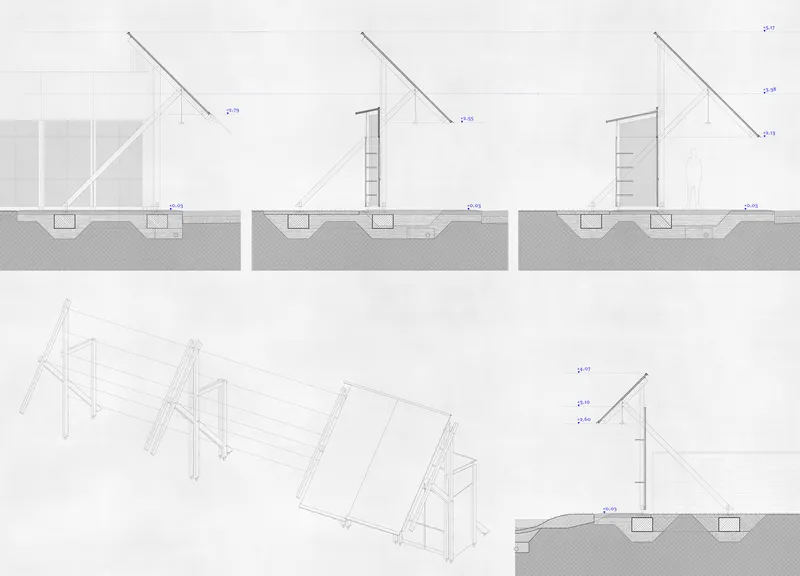
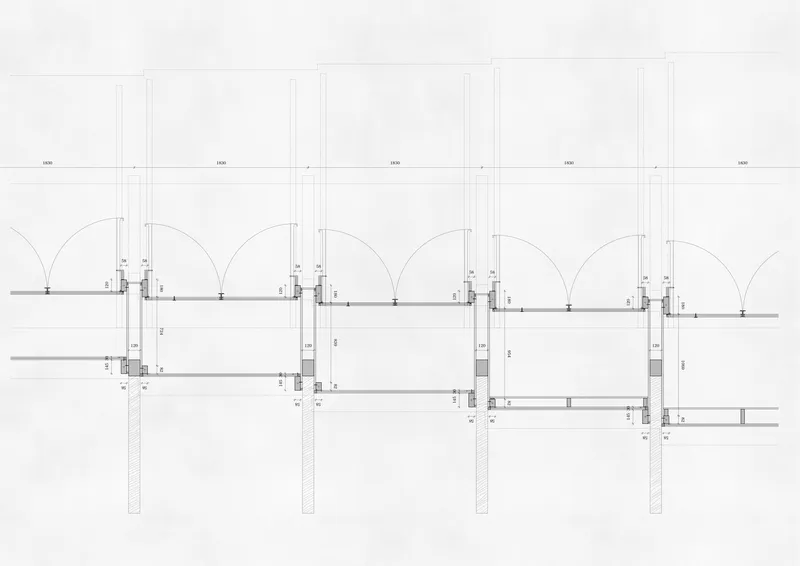
The site plan reveals the pavilion's strategy of clustering: several volumes are grouped loosely along the reserve's edge, connected by the linear walkway structure but maintaining distinct orientations and footprints. The floor plan and elevation drawings show how the elongated roof form negotiates a gentle slope across the site, with the ridge line tilting to accommodate drainage and to create varying interior heights along the passage.
Section drawings make the diagonal structural logic legible in two dimensions, illustrating how the columns lean inward to meet the roof plane and how the bracing triangulates the frame against lateral loads. A facade detail drawing exposes the glazing connections and arched openings that are not immediately obvious in photographs, suggesting moments of controlled transparency within the otherwise opaque enclosure panels.
Why This Project Matters
The Entrance Pavilion Palingbeek won the AIJ Young Architect Award for Selected Architectural Designs in 2023, and the recognition is deserved. Not because the building is spectacular, but because it demonstrates a disciplined refusal to do more than necessary. In a profession that often rewards formal complexity, Schenk Hattori's pavilion argues that architecture can operate most powerfully when it restrains itself to the role of mediator: between inside and outside, between the constructed and the wild, between arrival and departure.
For students and young practitioners, the project offers a clear lesson in how material economy, structural transparency, and spatial sequencing can produce an architecture of genuine presence without relying on scale or spectacle. The pavilion does not interpret Ieper's difficult history through symbolism or memorial gesture. Instead, it marks a threshold and steps aside, letting the landscape do the rest. That kind of architectural restraint, knowing when to stop, is harder to achieve than it looks.
Entrance Pavilion Palingbeek by Schenk Hattori, located in Ieper, Belgium. 230 m². Completed in 2020. Photography by Michiel De Cleene.
About the Studio
Share Your Own Work on uni.xyz
If projects like this are the kind of work you want to make, uni.xyz is a place to publish your own, find collaborators, and enter design competitions.


Popular Articles
Popular articles from the community


Tsunami Convergenics: Turning Catastrophic Ocean Forces into Underwater Housing Infrastructure
A speculative underwater settlement off the coast of Onagawa, Japan, treats tsunamis and typhoons as energy sources rather than threats.

The Amber Palace Opera: A Geological Fiction Surfaces on Tallinn's Baltic Waterfront
Pierre Brillard reimagines a Baltic legend as a public landscape, opera house, and waterfront promenade rooted in Tallinn's coastal identity.

Temporary Home for Dogs: A Reversed Zoo Rethinks Animal Shelter Architecture
In Bucharest, a sinuous corridor and freed landscape flip the logic of containment, designing a shelter that works to make itself unnecessary.

Opera by the Sea Estonia: Three Shells Dissolving Architecture into Tallinn's Coastline
A winning opera house proposal replaces monumental form with interconnected shells that blur the boundary between building, park and Baltic Sea.

Similar Reads
You might also enjoy these articles

Bao Huynh Watercolor Atelier: A Serene Art Retreat in Hội An
Bao Huynh Watercolor Atelier in Hội An blends multifunctional art spaces, sustainable design, local materials, and family-friendly living in a serene environment.

Atelier Macri Concept Store Interior Design by CASE-REAL
Atelier Macri store features a "ko" counter, walnut wood details, cork displays, blending retail, gallery, and seamless customer experiences.

Manuel Vargas Izquierdo Stadium and High-Performance Sports Center: Architectural Excellence in Jalpa de Méndez
The Manuel Vargas Izquierdo Stadium blends sustainable design, inclusive sports facilities, and cultural-inspired architecture, revitalizing Jalpa de Méndez’s public spaces.

KAKR Buluh Awar Hall: Revitalizing Community and Ecology Through Bamboo Architecture
Community built bamboo hall revitalizes Buluh Awar village, empowering youth, restoring ecology, celebrating vernacular craftsmanship through sustainable architecture and culture.

Explore Pavilion Competitions
Discover active competitions in this discipline

Challenge to design a portable theatre

Challenge to design a portable music platform

Challenge to design an open learning module for the elderly
Comments (0)
Please login or sign up to add comments
No comments yet. Be the first to comment!