
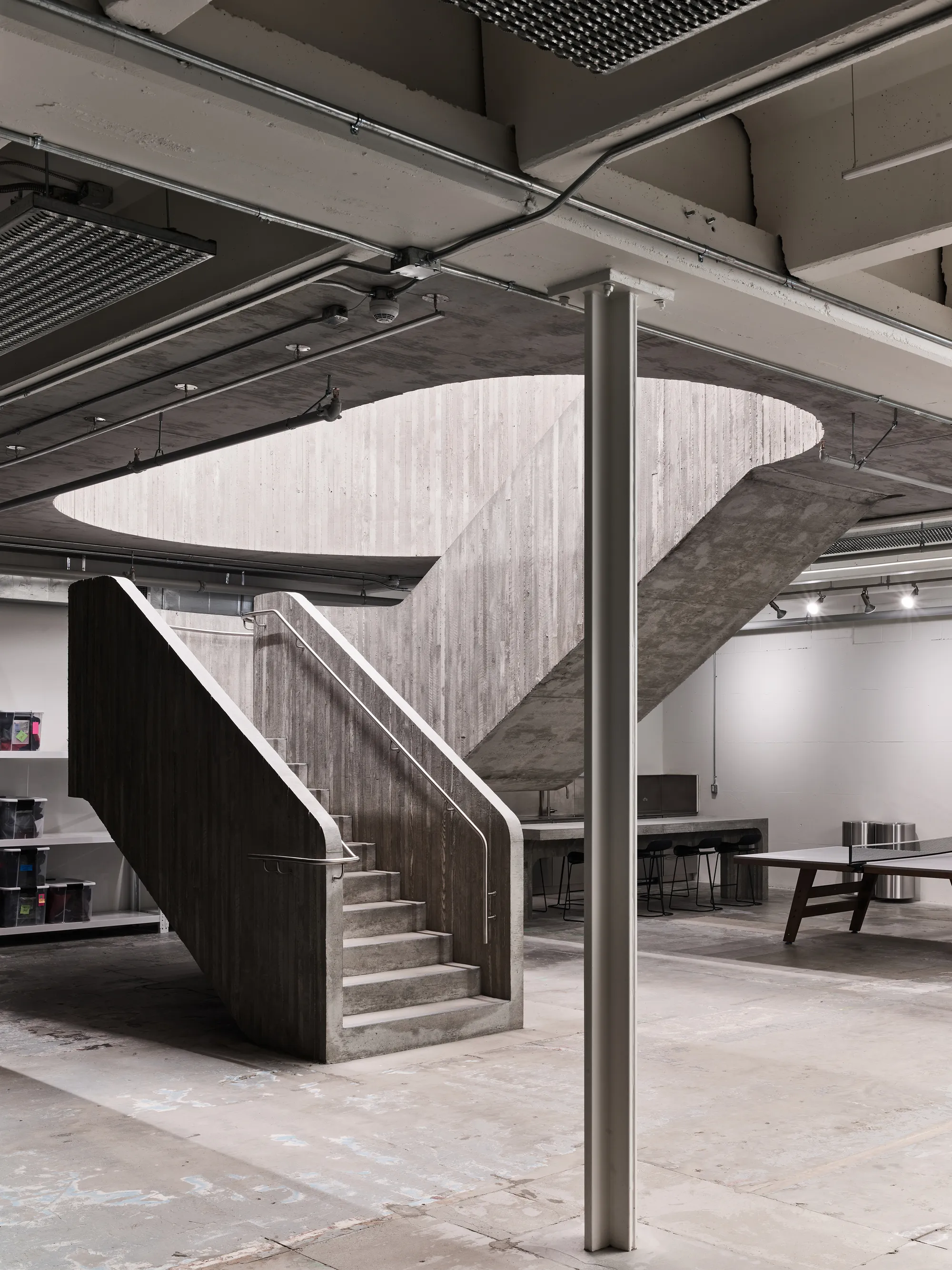
Scott & Scott Architects Carve a Concrete Staircase Through a 1973 Vancouver Warehouse for Purple Brand
A denim label's new operations studio in Mount Pleasant pairs board-formed concrete with raw timber trusses and pigmented plywood.


Purple Brand built its reputation on reworking vintage denim, treating wear and patina as design features rather than defects. When the label needed a 1,300 square meter operations studio in Vancouver's Mount Pleasant industrial district, Scott & Scott Architects took the same attitude toward a warehouse built in 1973: strip it back, celebrate what's already there, and add only materials willing to age honestly. The result, designed by Susan and David Scott with Andrea Zittlau, is a workspace where the original metal ceiling trusses and timber-plank roof do the heavy atmospheric lifting, and nearly every new insertion is cast from concrete or built from pigmented plywood.
The most striking move is structural surgery. A pill-shaped opening was cut through the existing concrete floor slab, and a cast-in-situ staircase of two parallel flights joined by a curved landing was threaded through it. The staircase's board-formed concrete walls retain every grain of the wooden formwork, turning a vertical circulation core into the building's sculptural anchor. Around it, the program fans out across two levels: reception, workstations, and presentation areas above; kitchen, dining, archive, and additional meeting rooms below. It is a workspace that treats material honesty as a form of brand identity.
The Staircase as Centerpiece
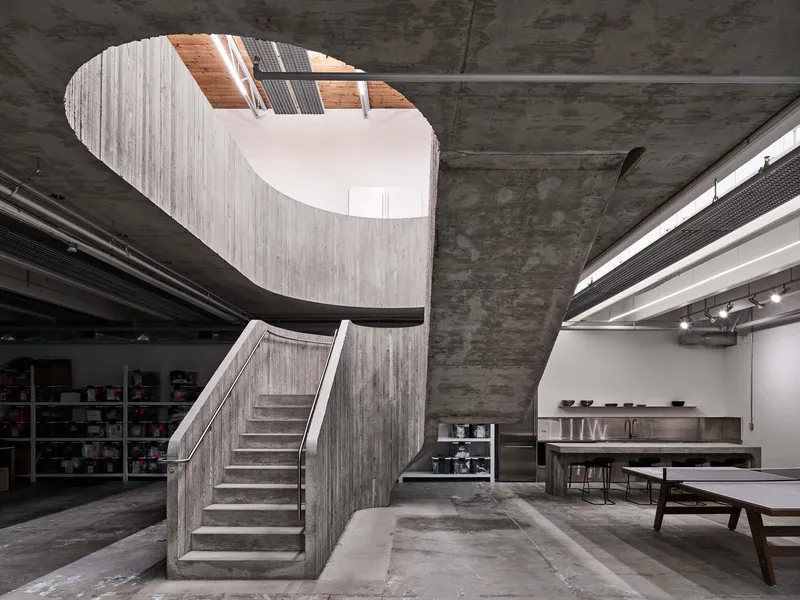
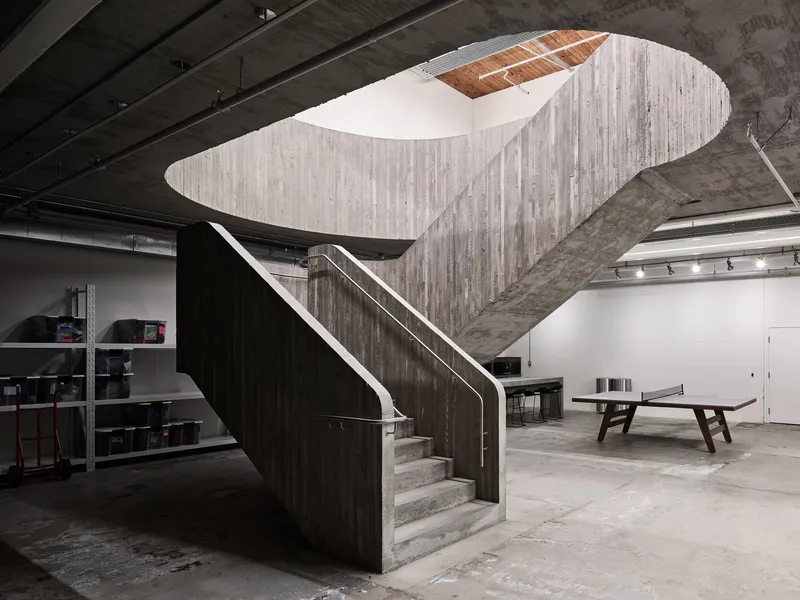
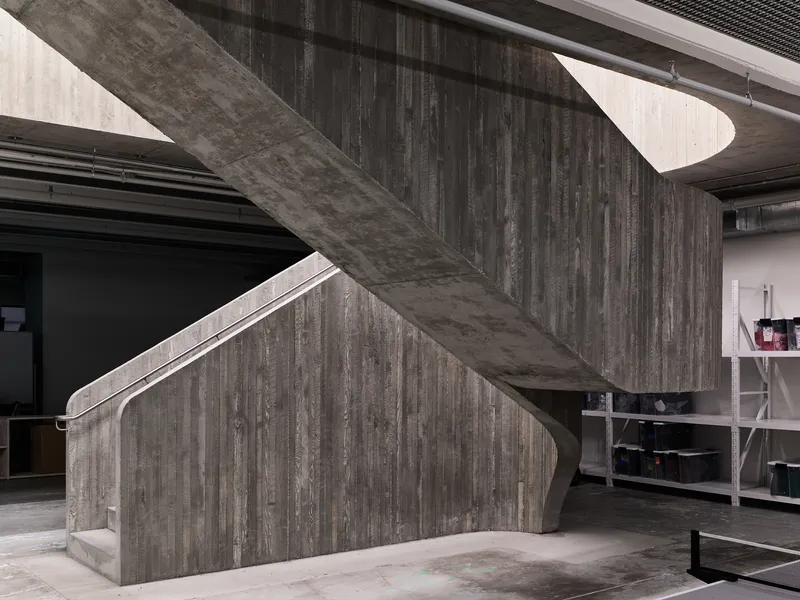
Cutting an oval aperture through a concrete slab is not a subtle gesture, and Scott & Scott Architects don't try to minimize it. The staircase rises in two angular flights beneath the curving lip of the opening, framed by a cylindrical steel column and lit from above. Board-formed concrete walls carry the vertical striations of their plank formwork all the way up, a texture so deliberate it reads as ornament. The stainless steel handrail is almost comically restrained by comparison: a thin tube that lets the concrete do the talking.
What elevates the move beyond spectacle is that this staircase is the only vertical link between the two programmatic halves of the studio. Every trip to lunch, every visit to the sample archive, every meeting downstairs passes through this concrete volume. It isn't a grand gesture reserved for visitors. It is the building's most used piece of infrastructure, and it is treated accordingly: heavy, durable, and deliberately beautiful in its roughness.
Upper Level: Trusses, Plywood, and Presentation Walls
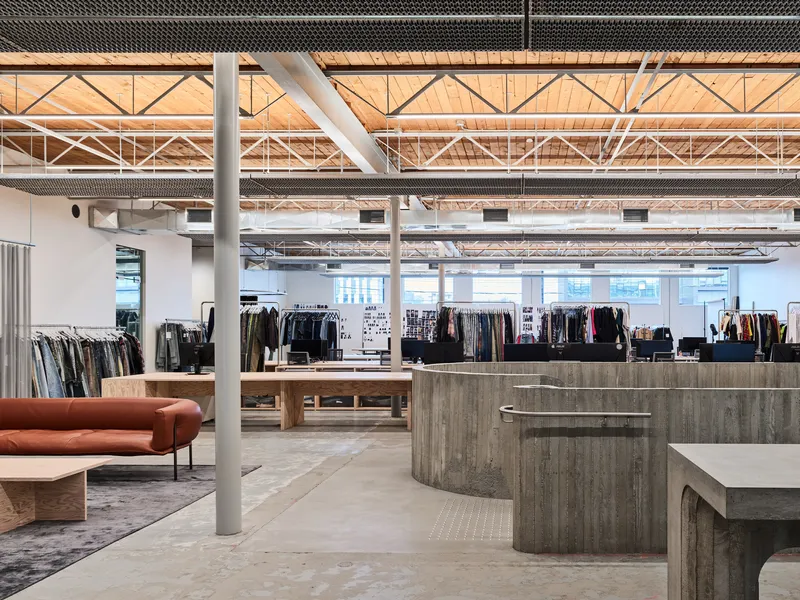
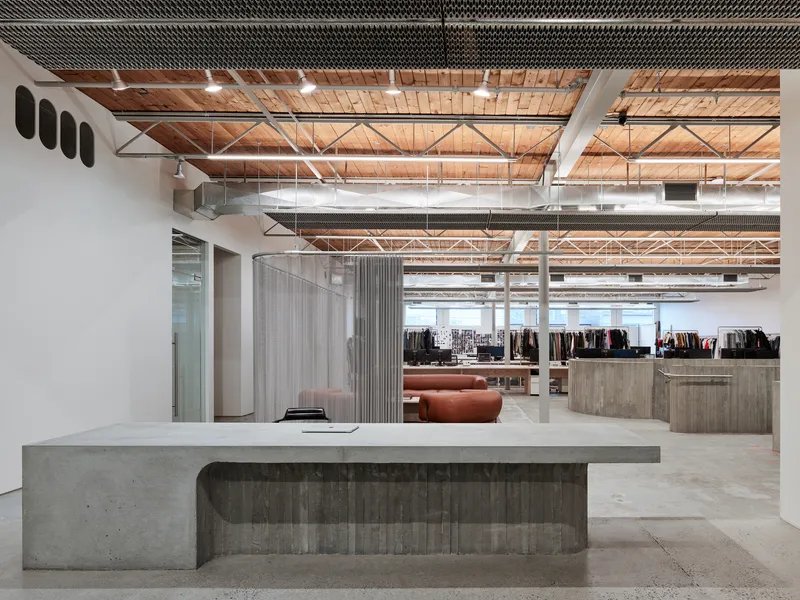
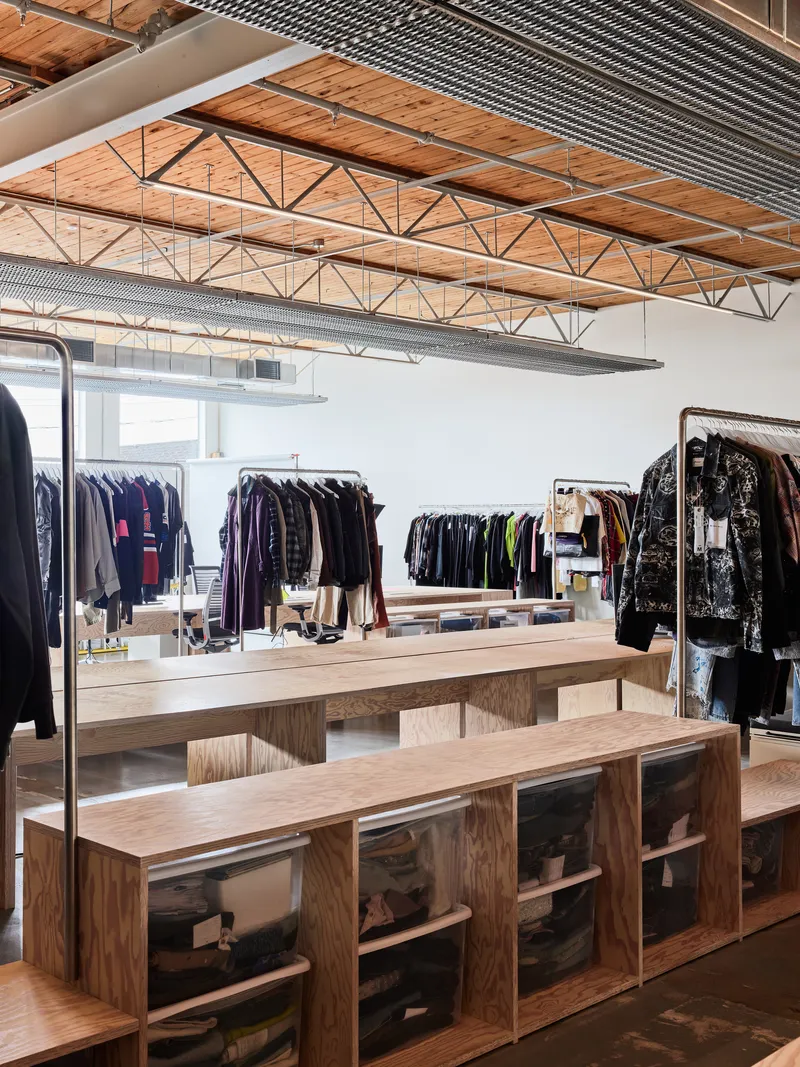
The upper level is where the warehouse's original bones are most visible. Metal ceiling trusses and timber planking form a continuous overhead plane, painted white in spots but largely left alone. Indirect lighting bounces upward off the truss members to illuminate the timber, giving the ceiling a warm glow without introducing any suspended fixtures that would compete with the structure. Below, long rows of pigmented plywood workstations run parallel to the building's length, punctuated by storage units for samples and garments.
At the back of the floor, white layout boards serve as presentation surfaces for collections in progress. The effect is workshop-like: clothing racks sit alongside desks, garments hang within arm's reach, and there is no clean separation between design labor and its output. For a brand that distresses denim as a primary design act, this refusal to polish the working environment feels philosophically consistent.
Board-Formed Concrete and Material Character
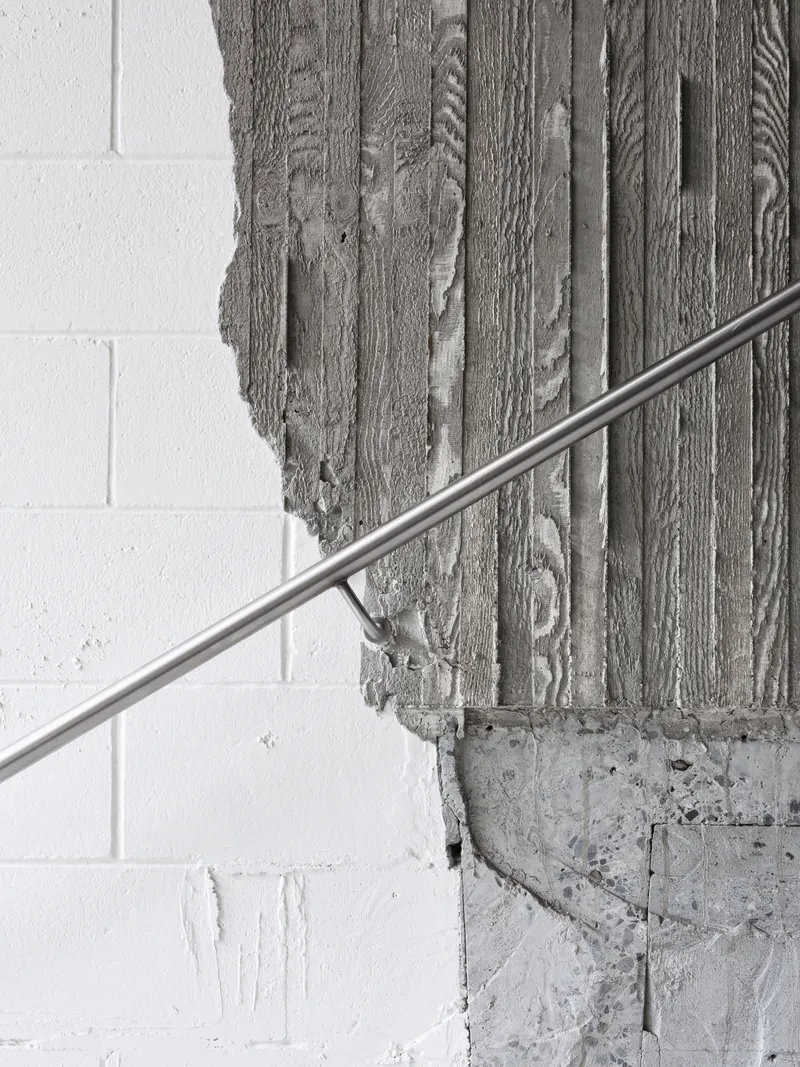
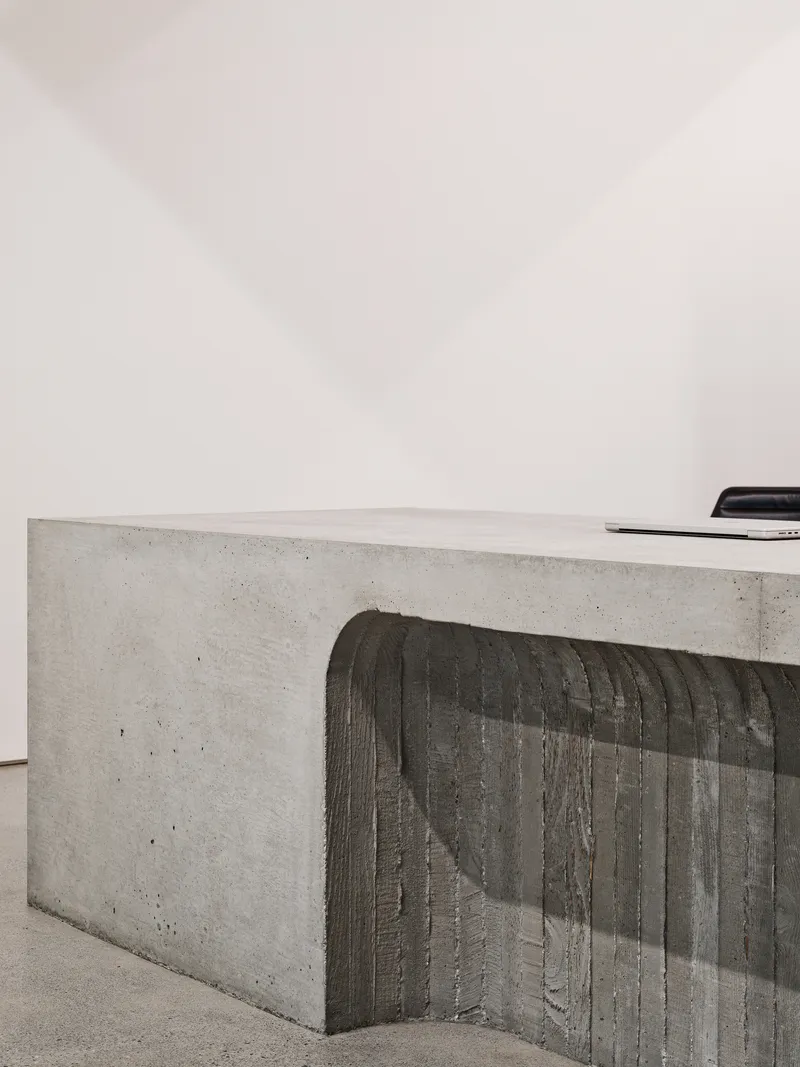
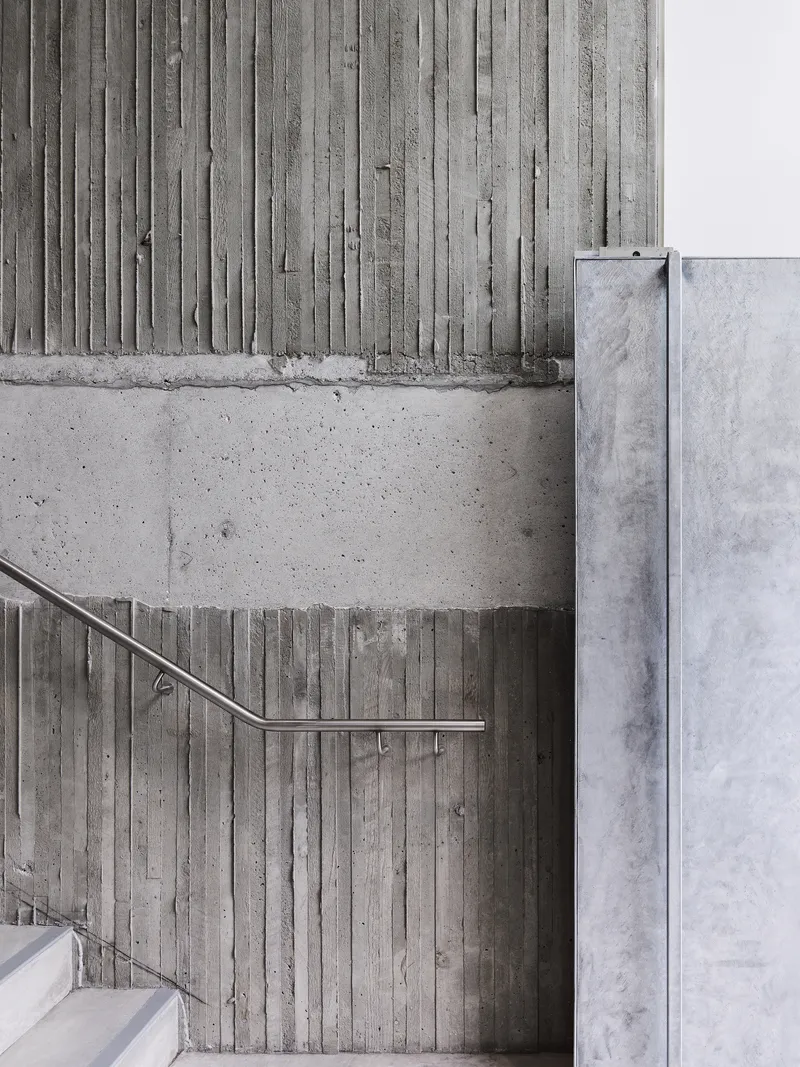
The board-formed concrete is the project's most persistent detail, appearing in the staircase walls, the reception counter, and the communal tables on both levels. In each case, the wooden formwork grain is left legible on the surface, creating a material that is simultaneously concrete and a record of timber. The vertical plank texture reads differently at each scale: monumental on the staircase walls, almost tactile on the counter edges where visitors lean in.
Scott & Scott have long favored this technique, and here it functions as more than aesthetic preference. Purple Brand's denim collections draw on vintage and utilitarian sources, reworking worn materials into new garments. Concrete that remembers its formwork operates on the same logic: the finished surface carries the trace of its making. It is a material metaphor that doesn't need a wall text to explain itself.
The Lower Level: Kitchen, Archive, and Communal Life
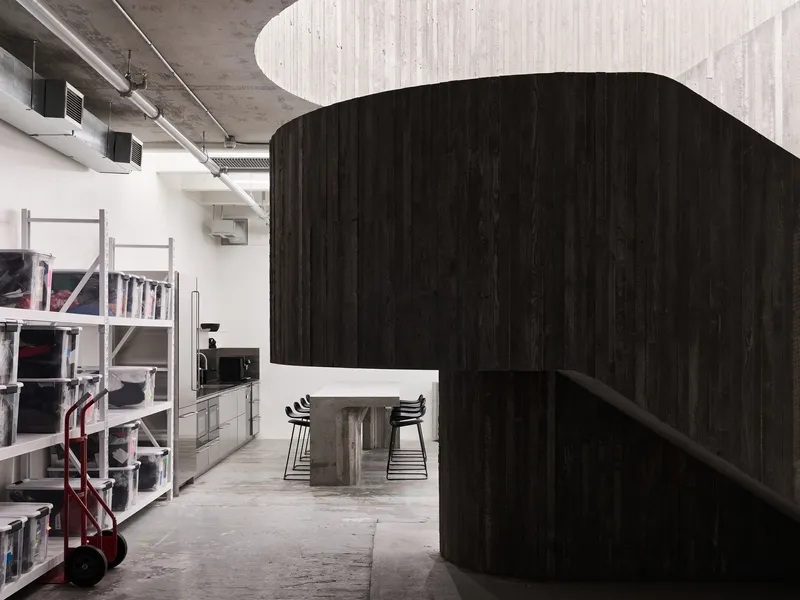
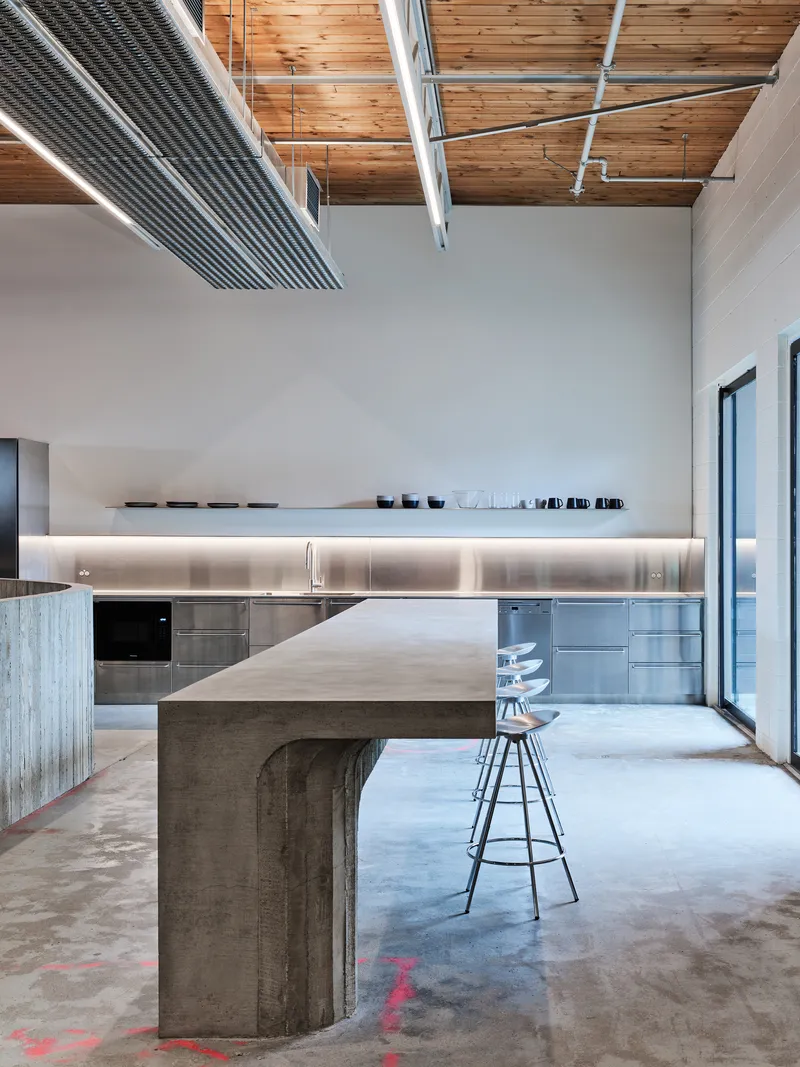
Downstairs, the atmosphere shifts. A dark timber-clad volume encloses the kitchen and dining area, creating an intimate room within the larger industrial shell. A concrete island table anchors the kitchen, and backlit upper cabinets glow beneath the exposed timber ceiling and conduit runs above. The space doubles as a social hub: a ping-pong table sits nearby, and the brand archive occupies adjacent rooms where the history of Purple Brand's output is stored and accessible.
The decision to place the communal and archival functions below, connected to the work floor only by the central staircase, introduces a deliberate friction. Descending into the lower level is a minor event, a transition from the open productive floor into spaces that serve memory, rest, and informal exchange. The architecture insists that these activities matter, but it also insists they happen apart from the workstations.
Details: Chainmail, Galvanized Grating, and Restroom Finishes
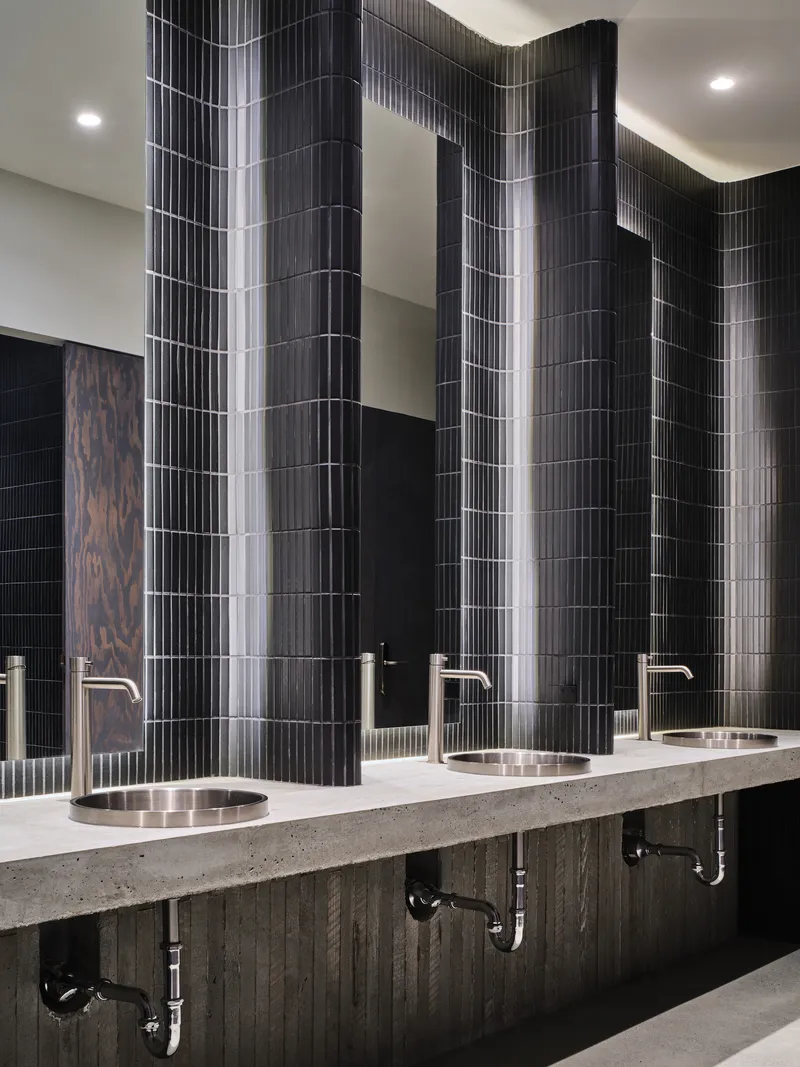
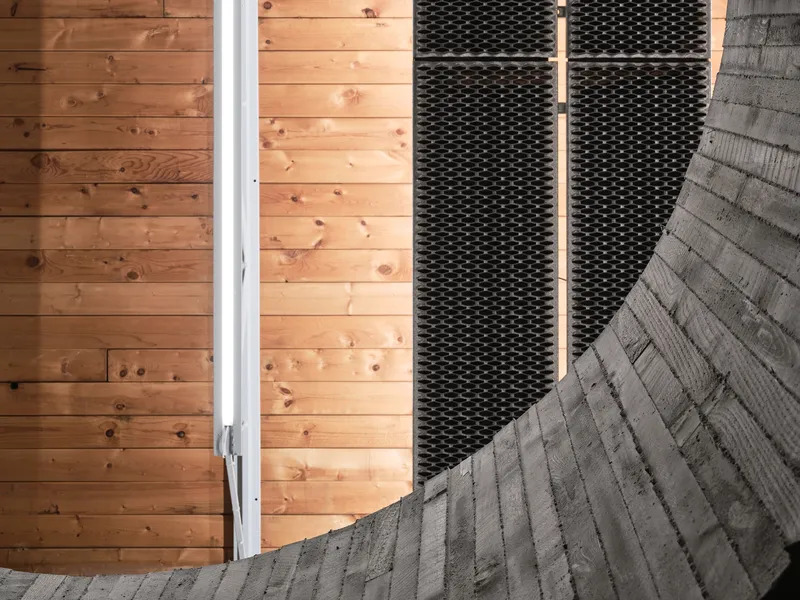
The detailing sustains the project's material argument at smaller scales. A chainmail curtain marks the entry, establishing a threshold that is industrial and slightly theatrical. Galvanized plank grating runs above the service zones, organizing mechanical runs and housing acoustic panels in a system that doubles as ceiling texture. In the restrooms, terrazzo counters and round metal sinks sit against vertically ribbed black tile, a moment of deliberate refinement that acknowledges the difference between a warehouse and a luxury brand's headquarters.
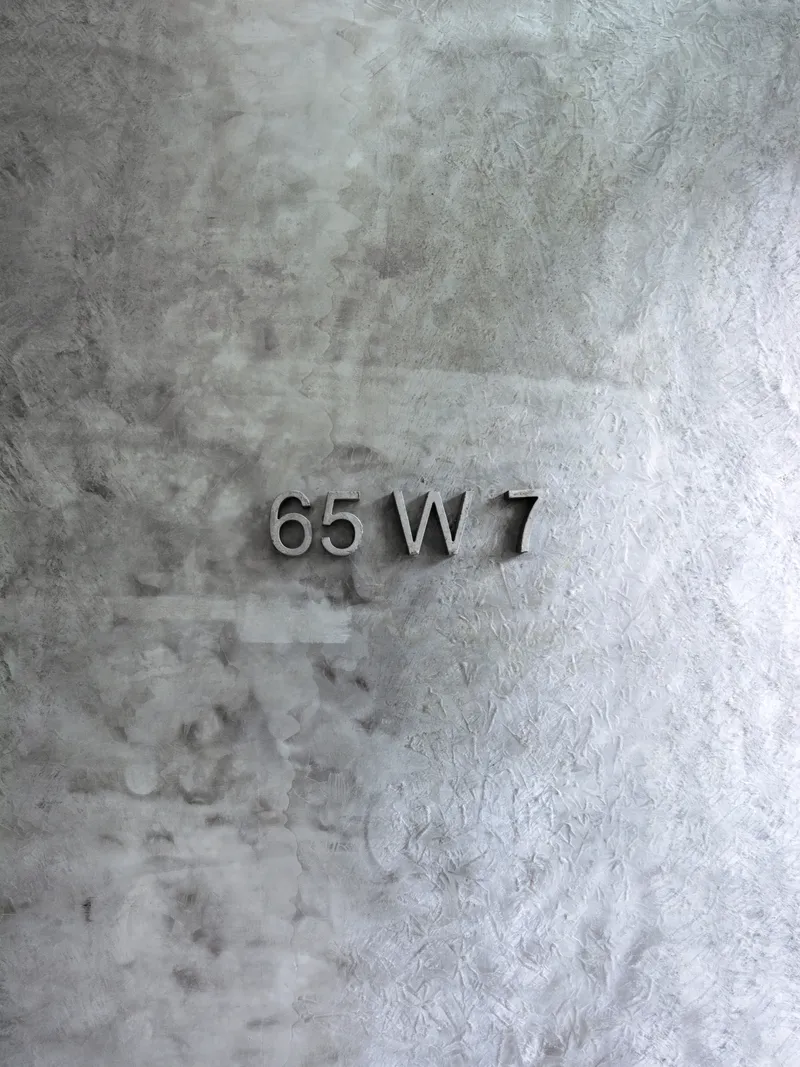
Metallic address numbers on a weathered concrete wall, perforated metal panels meeting timber cladding, the polished edge of plywood meeting a concrete floor: these junctions are handled with care but never prettified. Everything reads as what it is. The palette is narrow, almost austere, and the consistency pays off across 1,300 square meters where a single false note would break the spell.
Seating and Display
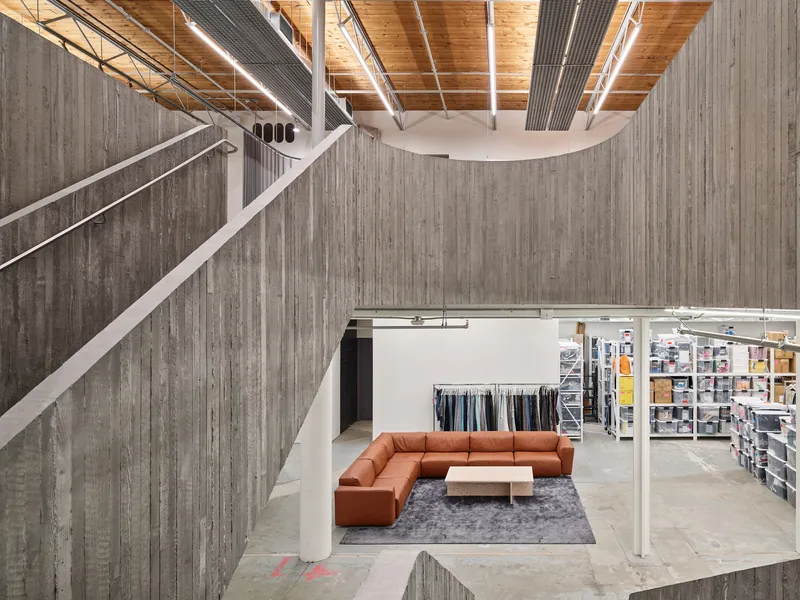
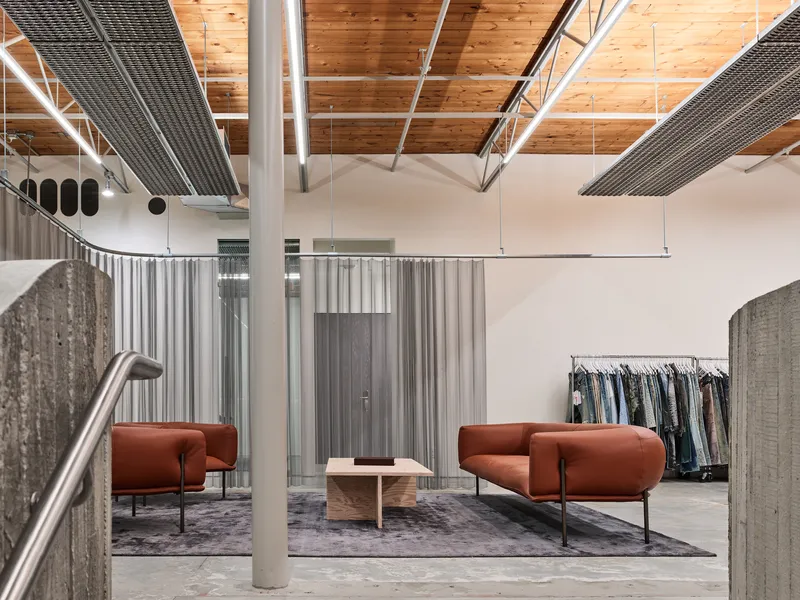
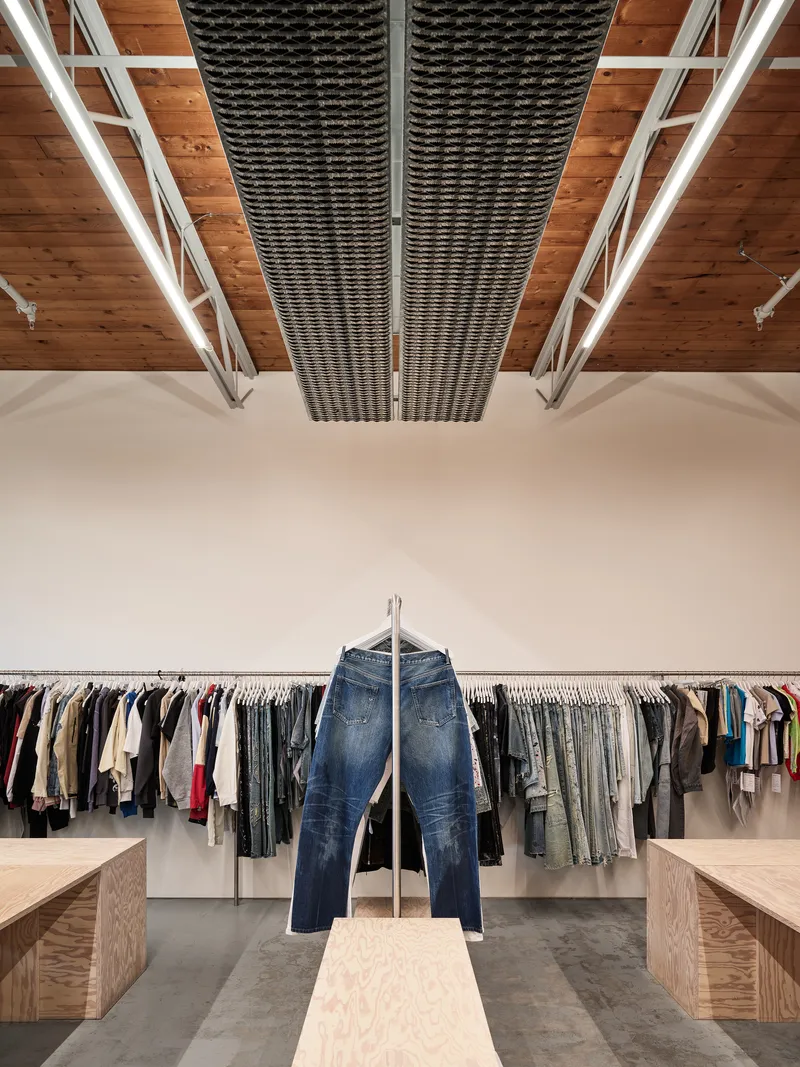
Furniture selections reinforce the industrial-warm register. An orange sectional sofa occupies a seating area near the board-formed concrete partition, its upholstery the most vivid color in the building. Terracotta lounge chairs sit on a rug beneath the mesh panels and timber ceiling, forming an informal meeting zone that could easily double as a showroom vignette. Clothing racks run beneath the trusses, garments visible from the workstations and the seating areas alike.
The integration of display and work is not accidental. Purple Brand operates from design through production to distribution, and this studio needed to house all of those functions without segregating them. The garments on racks are not decorative props; they are inventory, samples, and references. Placing them in the open keeps the product literally in view, a spatial commitment to the idea that a fashion brand's workspace should look and feel like an extension of its output.
Plans and Drawings
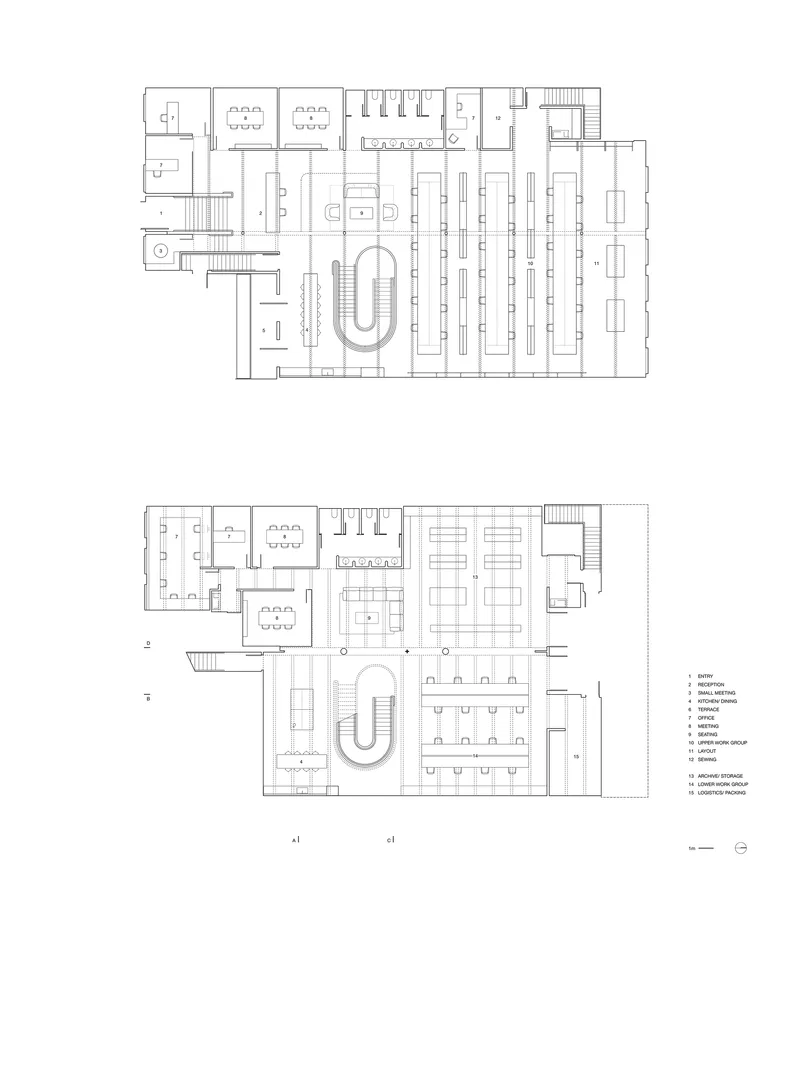
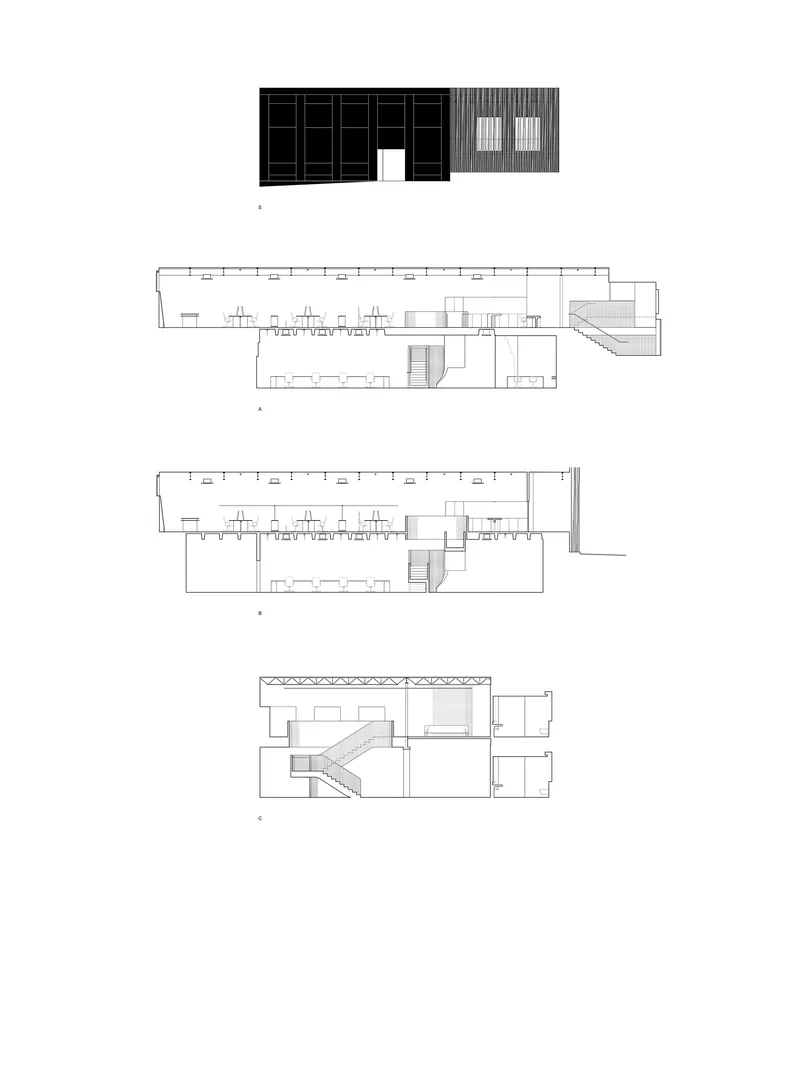
The floor plans confirm what the photographs suggest: the staircase sits dead center, and the two levels mirror each other in overall footprint while diverging in program. The upper level arranges workstations in long parallel rows flanked by perimeter offices and meeting rooms. The lower level clusters its program around the kitchen and archive, with additional workstations and meeting rooms pushed to the edges. The elevation drawing reveals the long, low profile of the warehouse, its unassuming street presence belying the spatial complexity inside.
Why This Project Matters
Fashion brand workspaces too often default to one of two modes: showroom-grade polish that treats employees as extras in a brand film, or tech-startup casualness that treats architecture as irrelevant. The Purple Brand Operations Studio stakes out different territory. By investing its strongest architectural gesture in a staircase rather than a lobby, and by refusing to conceal the warehouse's structural past, Scott & Scott Architects built a space that takes the work seriously without performing seriousness.
The material logic is the real argument. A denim brand that distresses and reworks its garments gets a workplace made from concrete that remembers its formwork, plywood that will patinate, and steel that was galvanized rather than polished. These choices will age. In five years the surfaces will carry the scuffs and marks of daily use, and the building will be better for it. That is a rare quality in commercial interiors, where most finishes are selected to resist time rather than absorb it.
Purple Brand Operations Studio, designed by Scott & Scott Architects (Susan and David Scott, Andrea Zittlau). Located in Vancouver, Canada. 1,300 m². Completed in 2025. Photography by Andrew Latreille.
About the Studio
Scott Architects
Share Your Own Work on uni.xyz
If projects like this are the kind of work you want to make, uni.xyz is a place to publish your own, find collaborators, and enter design competitions.




Popular Articles
Popular articles from the community


Co-life: Sustainable Architecture for Age-Friendly Community Living
Co-life reimagines sustainable architecture for seniors through courtyards, rammed earth, shared gardens, and spaces designed for belonging.

Co-Life: Senior Housing Design That Reconnects Older Adults With the City
Co-Life reimagines senior housing design through healing gardens, shared streets, workshops, and a sustainable community across generations.

The Musturak Paradise: Senior Living Architecture for a Connected Future in Temara, Morocco
The Musturak Paradise reimagines senior living architecture in Temara via private homes, social spaces, culture, community, and shared care.

Hill & Cross Opera: Sculptural Opera House Architecture Shaped by Tallinn’s Landscape and Identity
Hill & Cross Opera reimagines opera house architecture in Tallinn through its sculptural hill, civic plaza, glass wave and a luminous cross.

Similar Reads
You might also enjoy these articles

Bao Huynh Watercolor Atelier: A Serene Art Retreat in Hội An
Bao Huynh Watercolor Atelier in Hội An blends multifunctional art spaces, sustainable design, local materials, and family-friendly living in a serene environment.

Atelier Macri Concept Store Interior Design by CASE-REAL
Atelier Macri store features a "ko" counter, walnut wood details, cork displays, blending retail, gallery, and seamless customer experiences.

Manuel Vargas Izquierdo Stadium and High-Performance Sports Center: Architectural Excellence in Jalpa de Méndez
The Manuel Vargas Izquierdo Stadium blends sustainable design, inclusive sports facilities, and cultural-inspired architecture, revitalizing Jalpa de Méndez’s public spaces.
KAKR Buluh Awar Hall: Revitalizing Community and Ecology Through Bamboo Architecture
Community built bamboo hall revitalizes Buluh Awar village, empowering youth, restoring ecology, celebrating vernacular craftsmanship through sustainable architecture and culture.

Explore Commercial Buildings Competitions
Discover active competitions in this discipline


Challenge to design luxury tourism on rails


VR headsets Storefront design competition


Designing a staircase for a client
Comments (0)
Please login or sign up to add comments
No comments yet. Be the first to comment!