
S.DA Transforms a Riyadh Warehouse into a Spatial Narrative of the Coffee Journey
Origin Café and Roasters in Diriyah's JAX District maps the seed-to-cup process across three material zones inside an industrial shell.

Adaptive reuse in the Gulf tends to favor spectacle over restraint. A warehouse gets a flashy new skin, some statement lighting, and a brand partnership, and suddenly it's a "creative hub." Origin Café and Roasters, designed by S.DA under lead architect Duaa Abukhalaf, does something more deliberate. Situated within the industrial fabric of Diriyah's JAX District, where a cluster of warehouses has been repurposed for cultural and creative programming, the 329 square meter project takes the existing shell seriously, preserving its vaulted ceiling and exposed trusses while inserting a tightly controlled sequence of spaces that mirror the stages of coffee production itself.
The concept is rooted in the brand name: Origin. Rather than treating the café as a singular room with a counter and some chairs, S.DA organized the warehouse into three linear zones, each corresponding to a stage in the coffee-making process. You enter through the roastery, where raw beans are stored and processed in full view. You move through the central preparation and serving area, lit from above by a prominent skylight. And you arrive at a split-level workspace and office zone at the far end. It is a spatial narrative, not a decorative one, and the material palette of charred wood, cast-in-place terrazzo, and metal cladding reinforces the progression from raw to refined.
The Roastery as Threshold
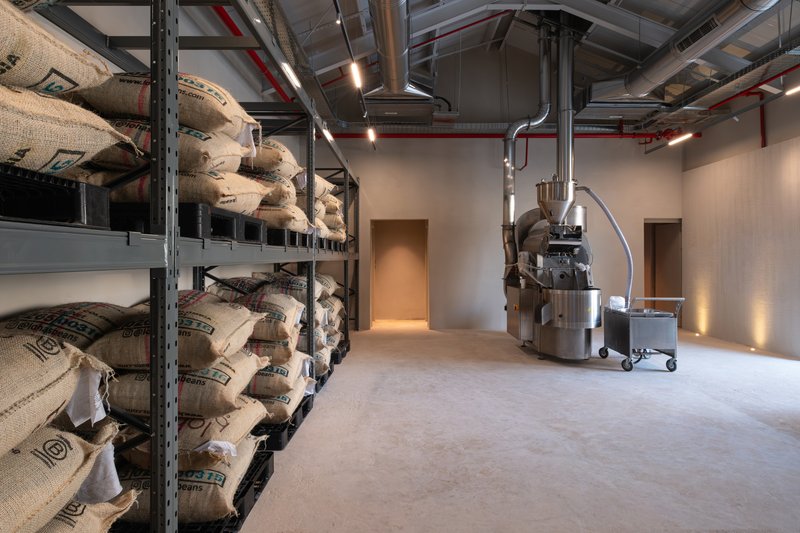
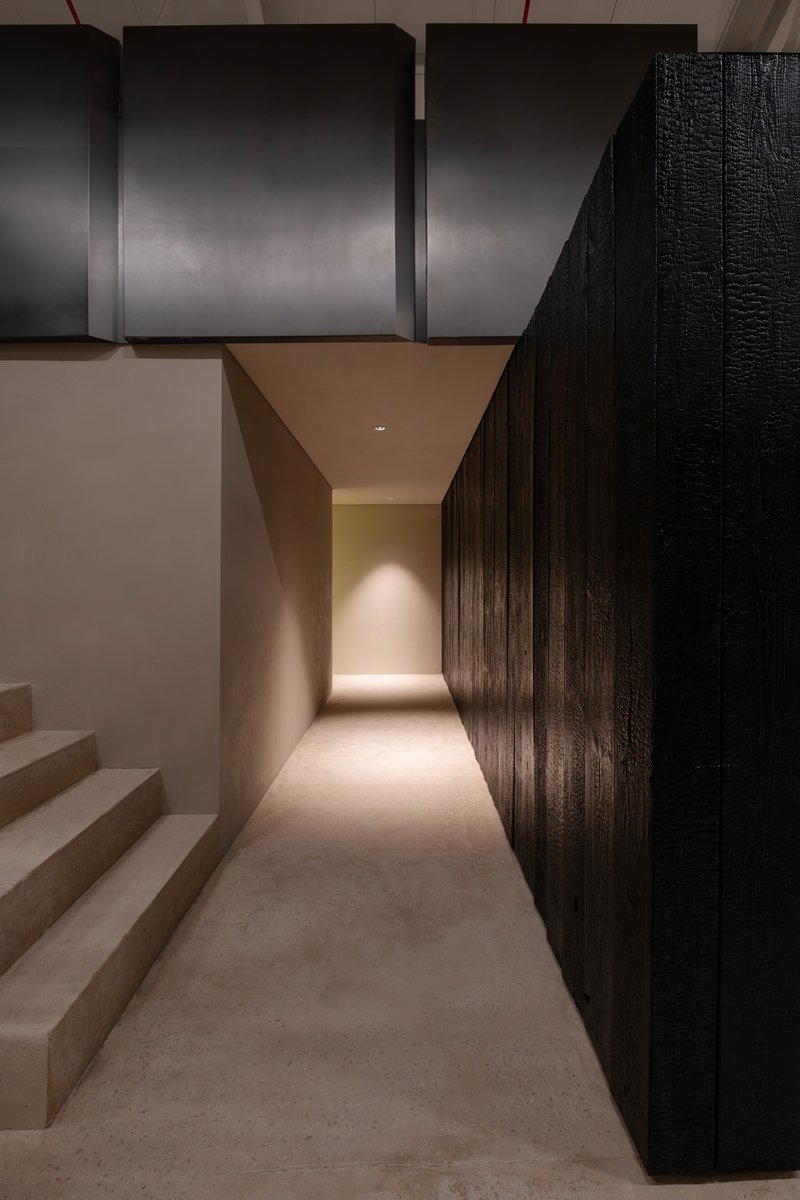
Most specialty coffee shops push the roaster to the back or behind glass, turning it into a visual novelty. S.DA makes it the entry condition. Burlap sacks sit stacked on industrial metal shelving under exposed mechanical ductwork, and the atmosphere reads as plainly functional. There is no attempt to dress this up. The charred timber wall panels that define the corridor alongside the roastery establish a material darkness that gradually gives way to lighter, more processed surfaces as you move deeper into the plan.
This decision to begin with the least polished zone is what gives the rest of the project its legibility. You understand the café differently because you walked past the raw material first.
Charred Wood and Terrazzo in Dialogue
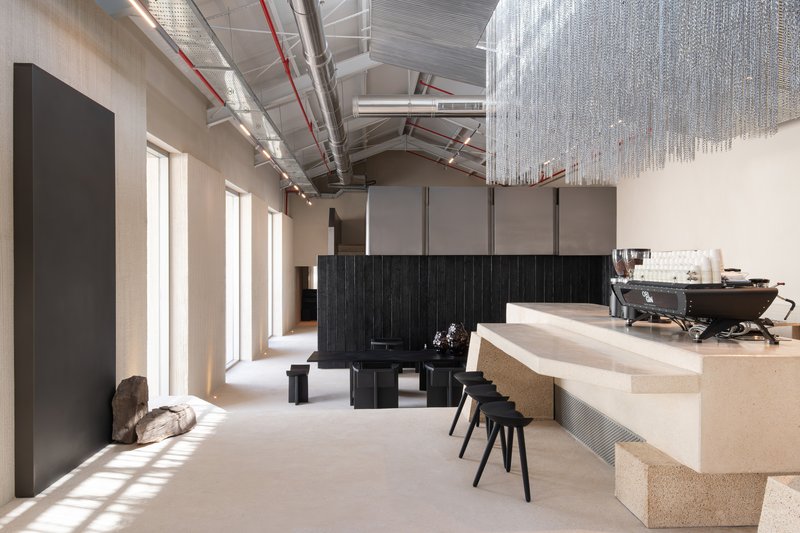
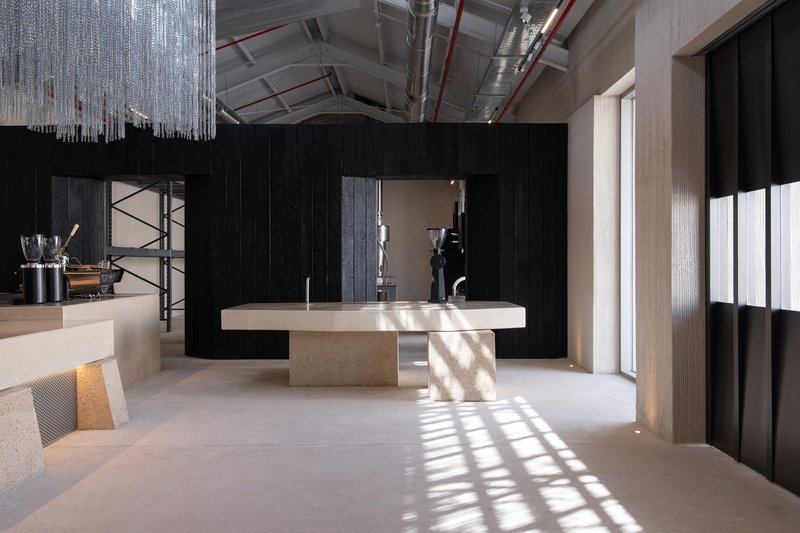
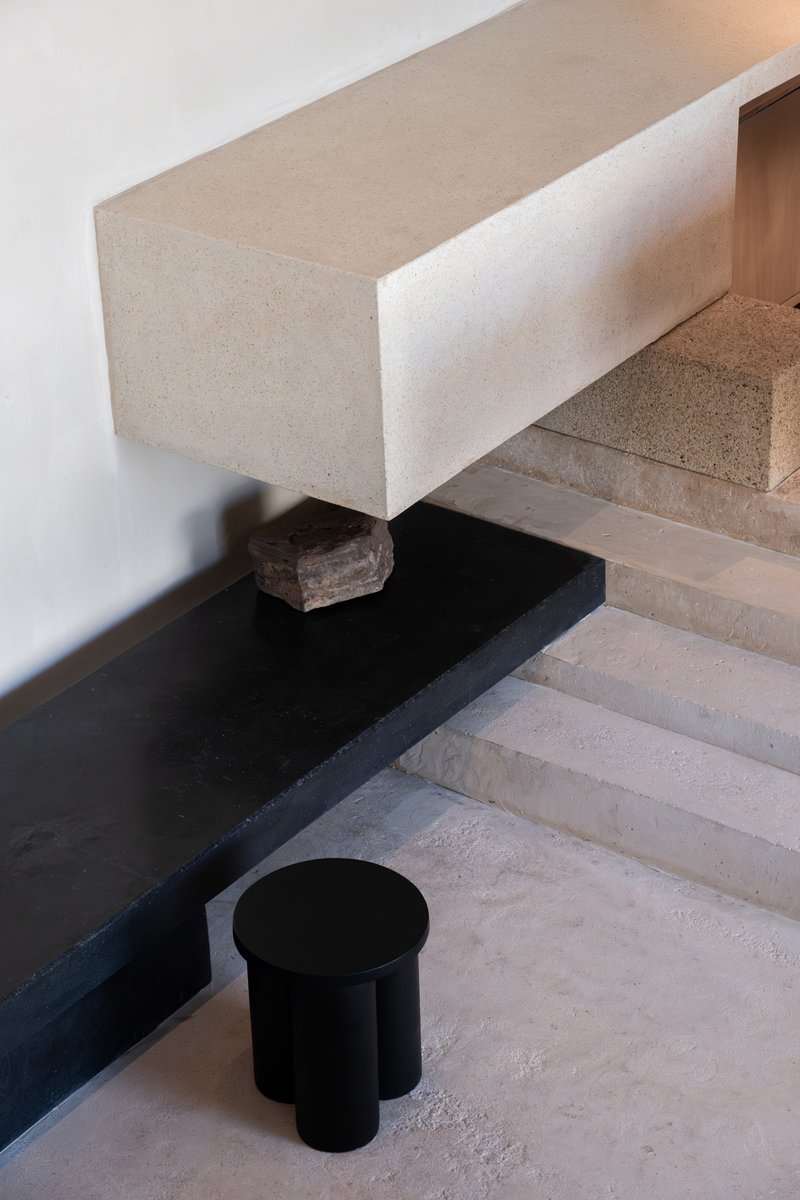
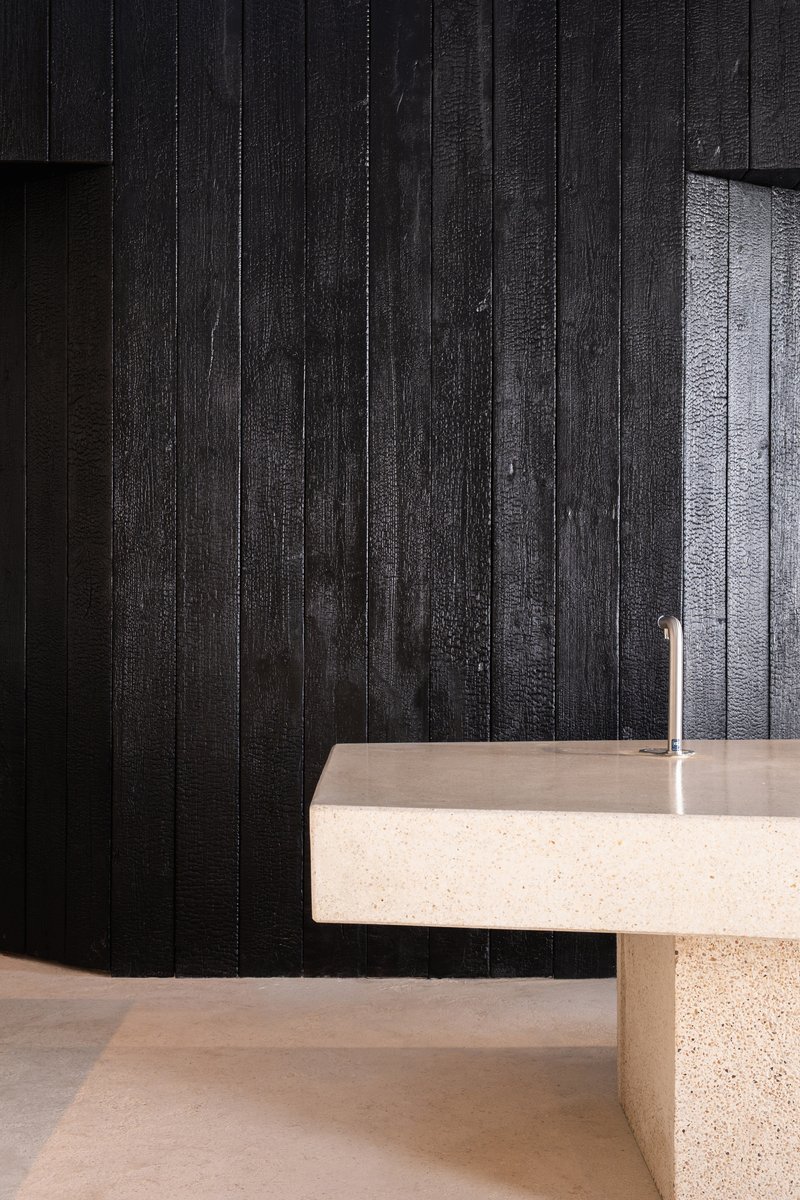
The project's most distinctive material move is the pairing of charred wood partitions with cast-in-place cement counters finished in exposed aggregate terrazzo. The counters express a dual materiality: rough and smooth surfaces coexist on the same element, and a continuous bench extends the terrazzo language from the service counter directly into the seating area. The effect is that furniture and architecture become indistinguishable. A cantilevered terrazzo bench, supported by a timber block resting on a black steel ledge, captures this integration in miniature.
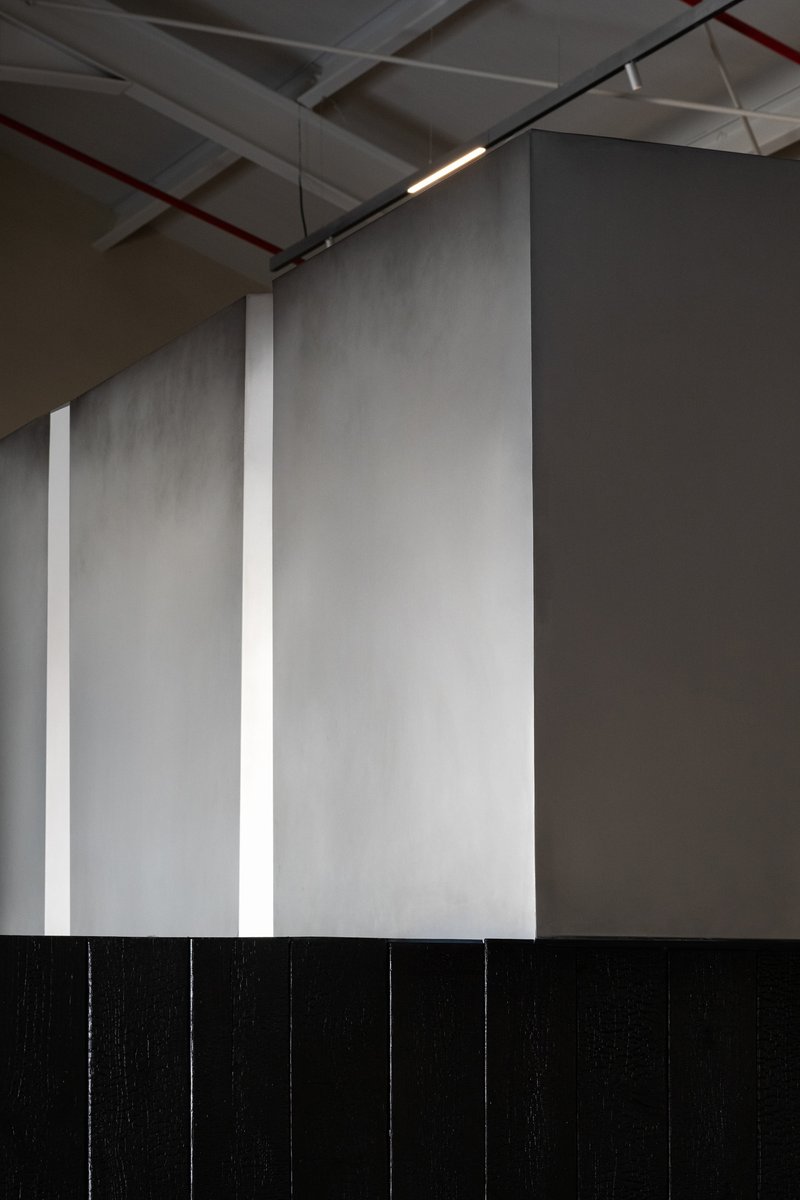
Charred wood, typically associated with the Japanese shou sugi ban technique, reads differently here in a Saudi context. Against the desert light that streaks through strategically placed openings, the blackened timber absorbs rather than reflects, creating pockets of shadow that make the terrazzo surfaces appear to glow. The contrast is tonal rather than colorful, and it works.
The Central Counter and Its Overhead Installation
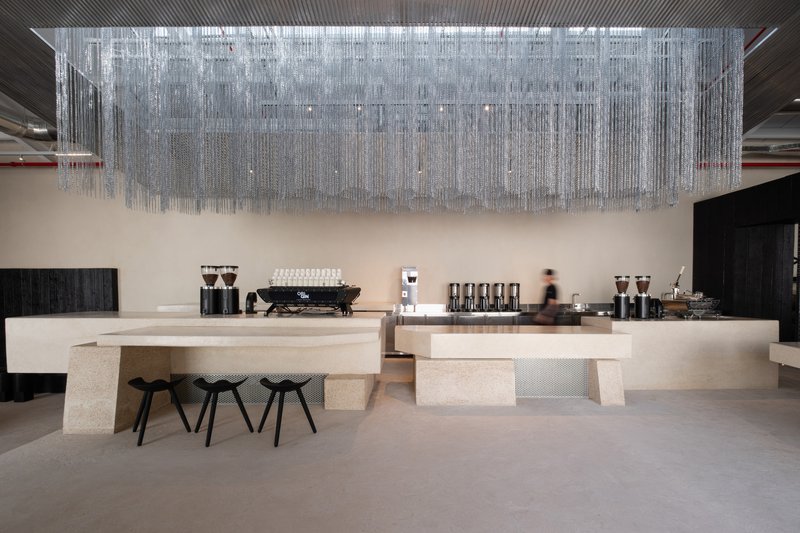
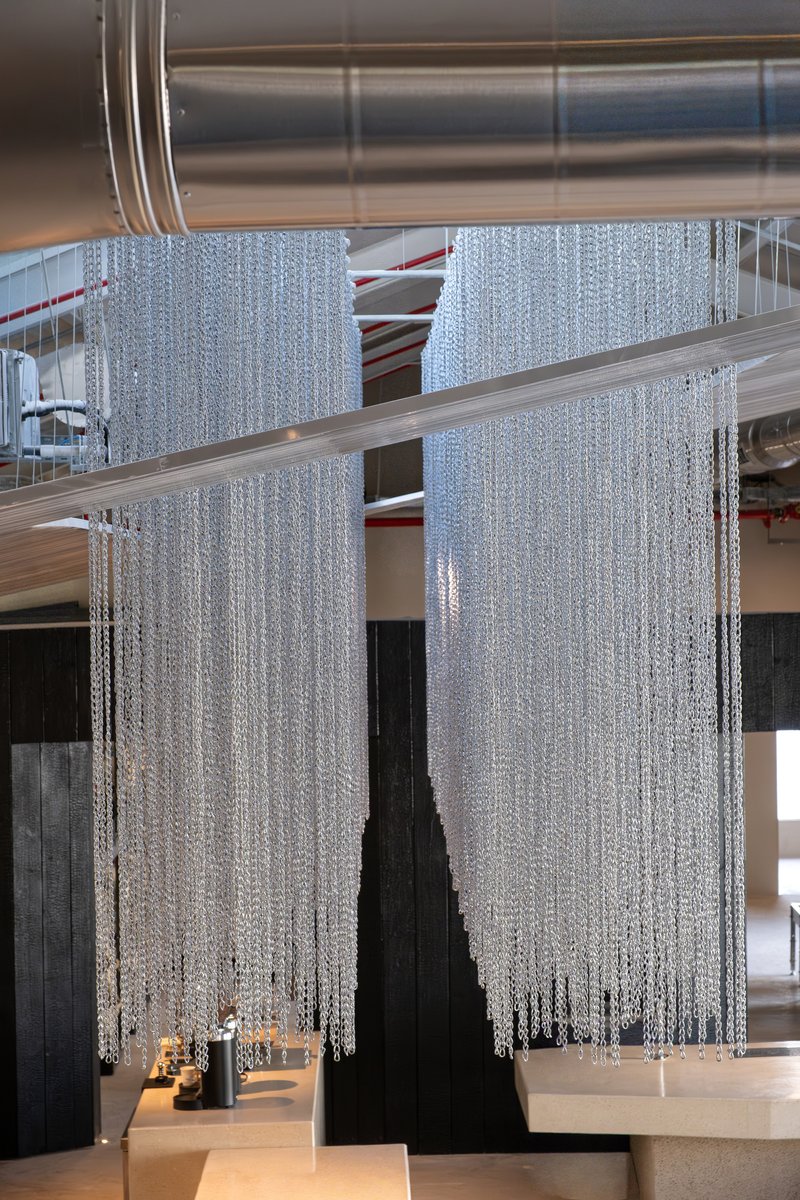
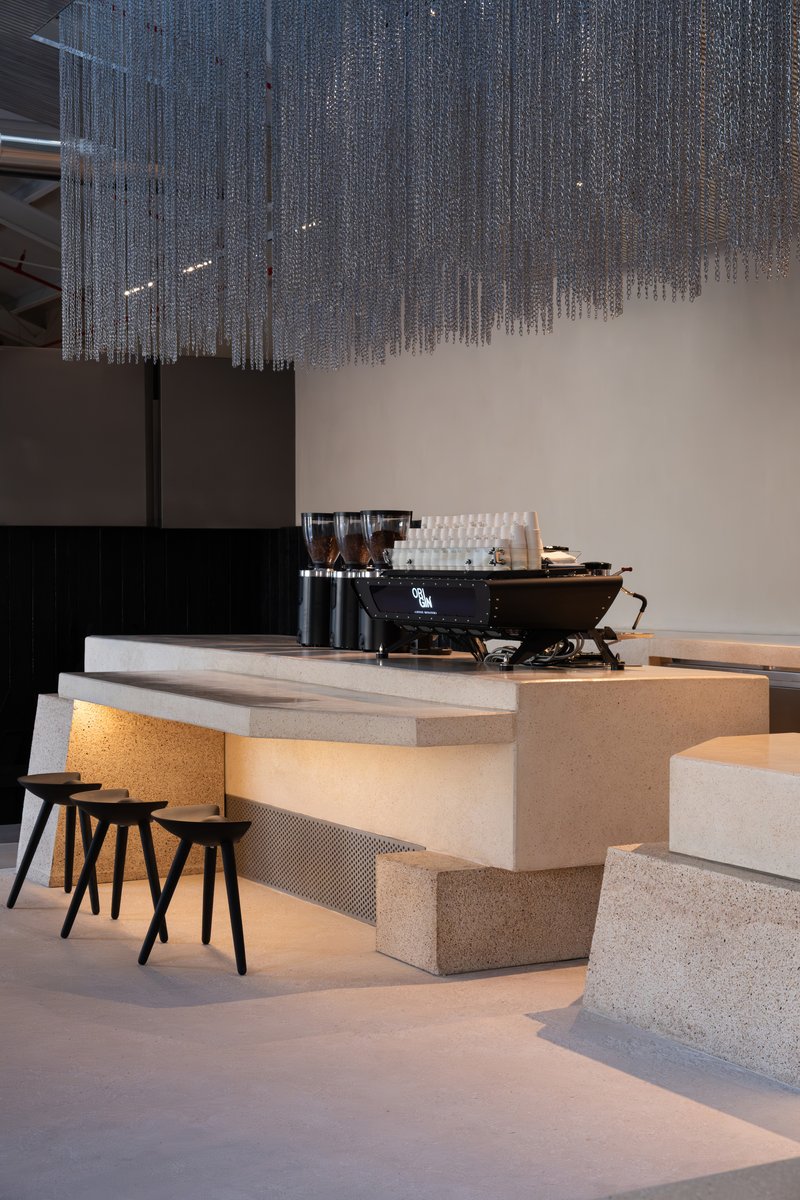
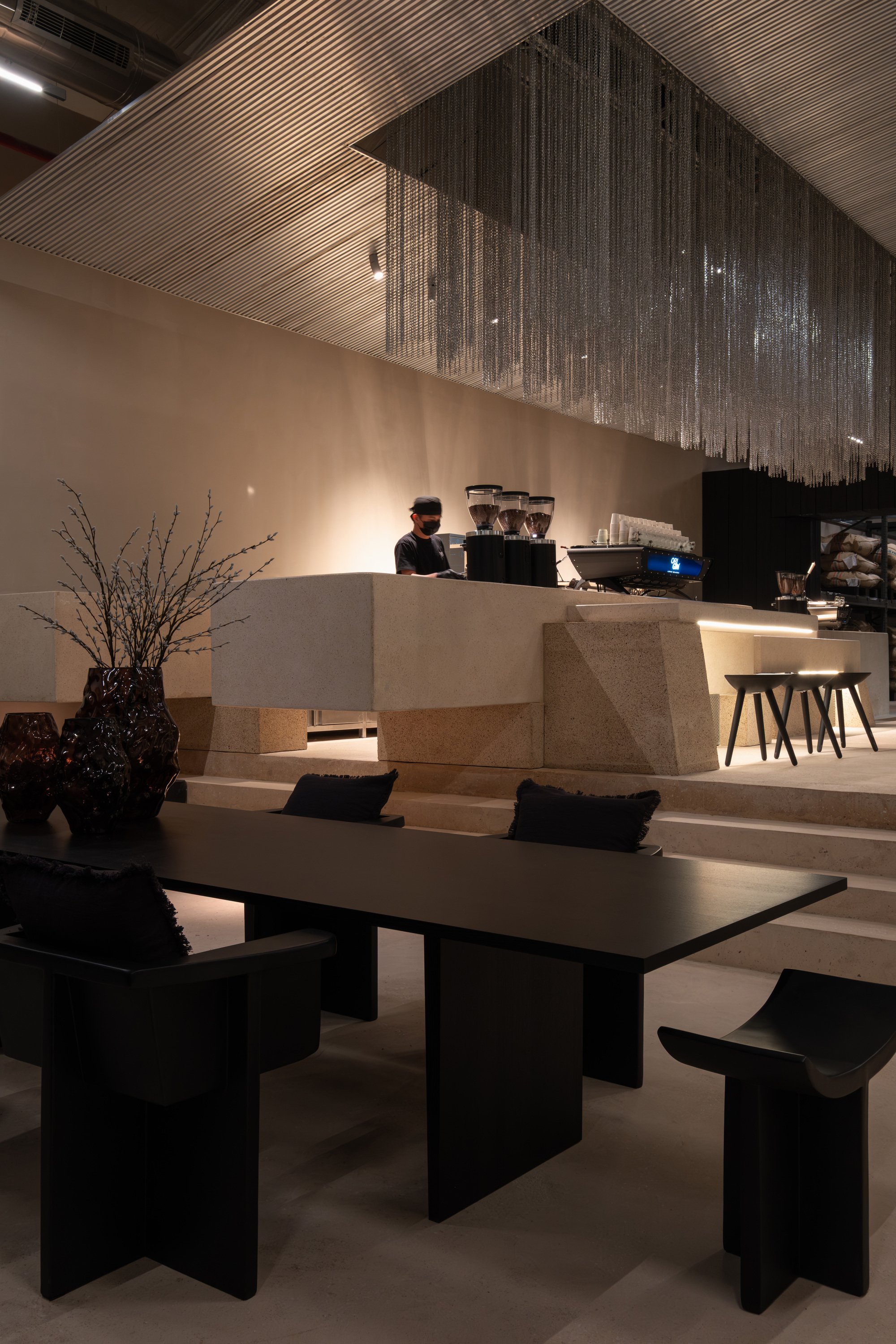
The heart of the café is the long terrazzo service counter, topped with espresso equipment and backed by a cascading installation of suspended metal chains that drops from the exposed trusses above. This is the one moment where S.DA permits something close to spectacle, and it earns the gesture. The chains catch and scatter the daylight introduced by the skylight above, producing shifting patterns throughout the day. It functions as both a light diffuser and a spatial marker, signaling the transition from the raw zone to the preparation zone.
The chains also serve a practical role in defining the vertical territory of the counter area without enclosing it. The warehouse ceiling is tall, and the installation brings the scale down to something intimate at the point of service, a translucent beaded curtain that separates without dividing.
Daylight as a Design Material
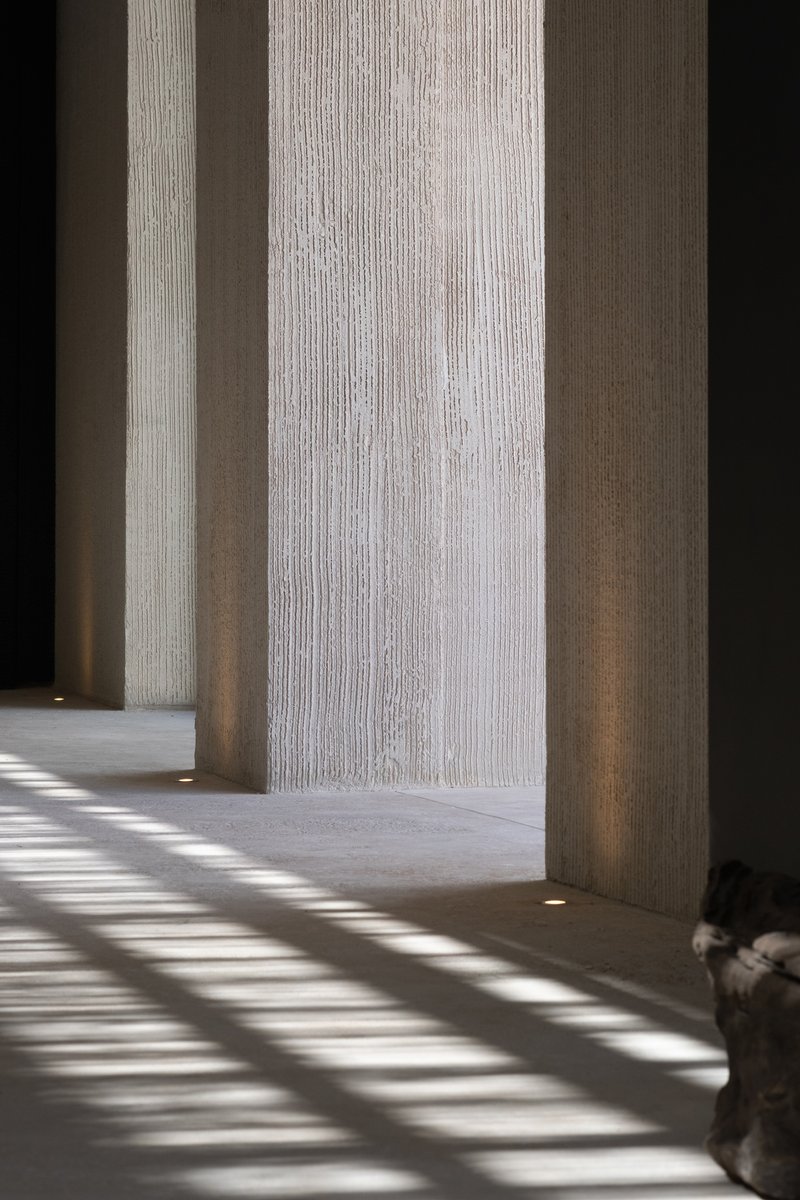
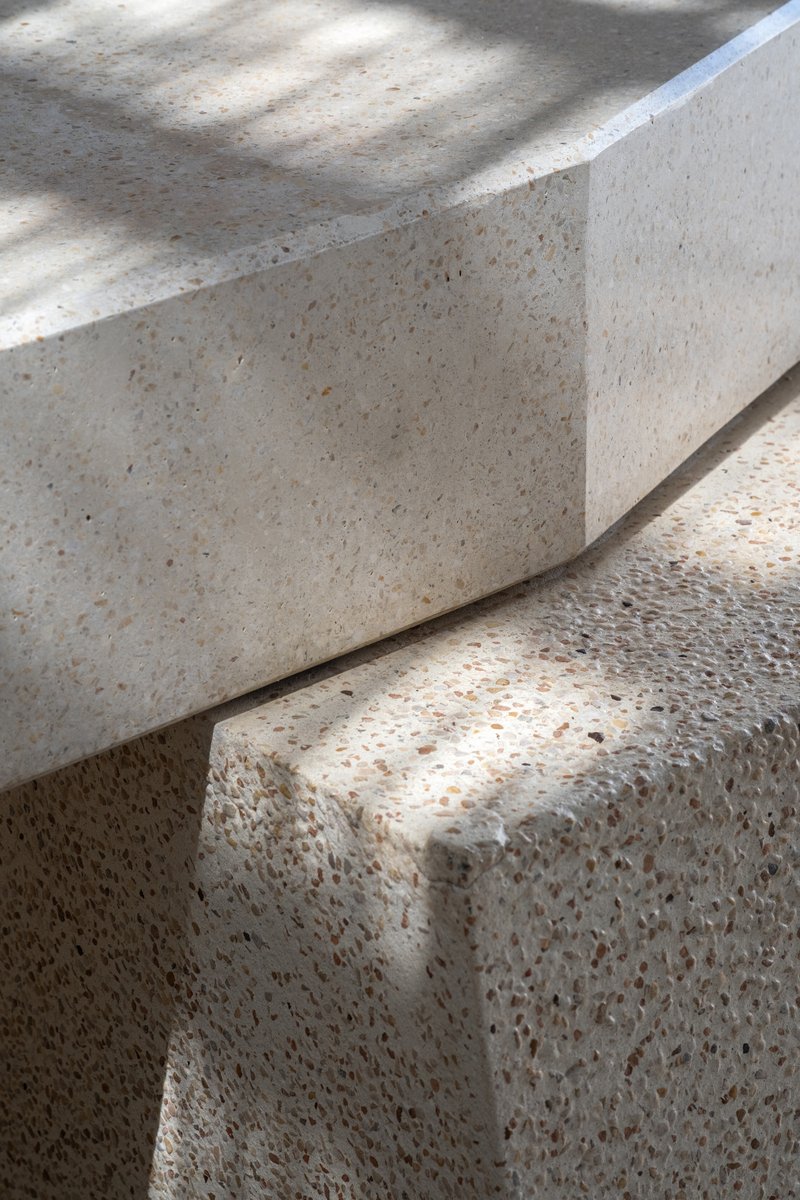
The façade has been reconfigured with recessed openings that control the desert light rather than simply admitting it. Ribbed concrete columns with vertical striations cast precise striped shadows across the polished concrete floor, turning sunlight into pattern. The stepped terrazzo platforms in the seating area receive dappled natural light from above, and the exposed aggregate finish reads differently depending on the time of day: warm and golden in the morning, flat and mineral in the afternoon.
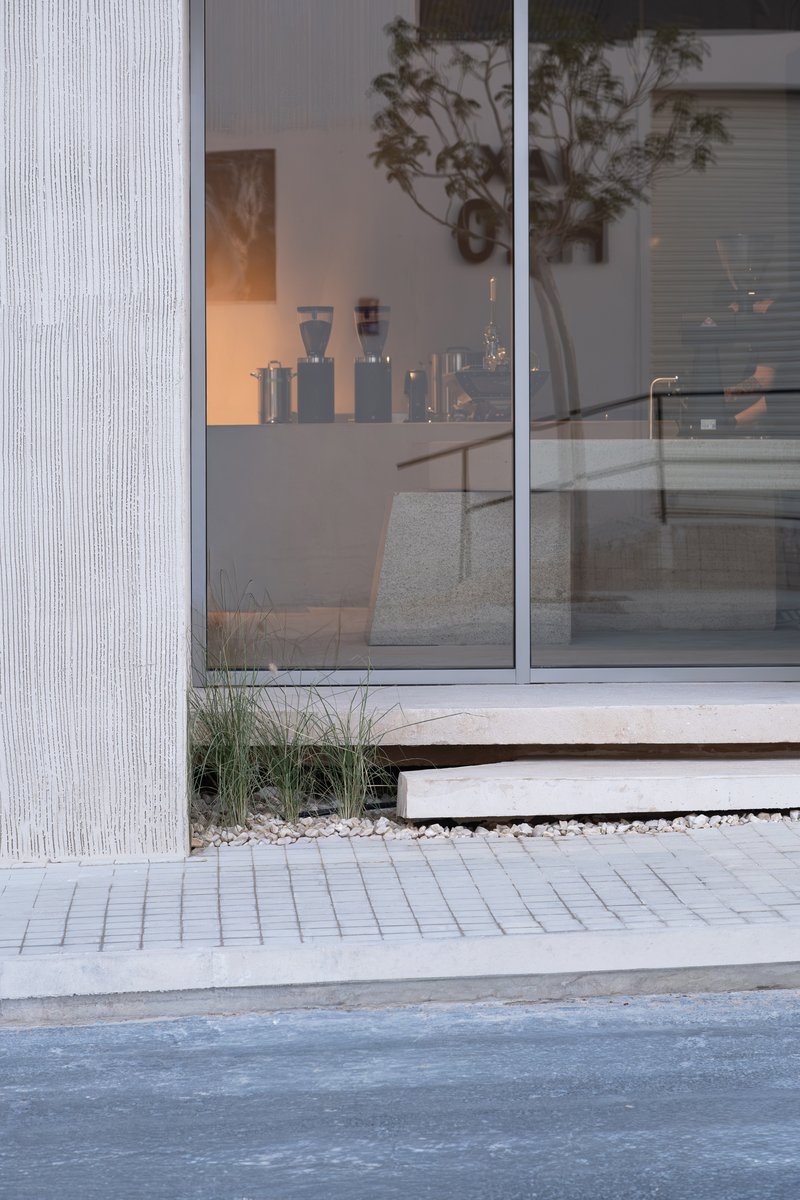
At the exterior threshold, a glazed storefront meets a textured concrete pilaster and gravel planting bed, mediating between the dry landscape outside and the controlled atmosphere within. The building does not ignore its climate. It engages it selectively.
The Workspace Zone and Split-Level Section
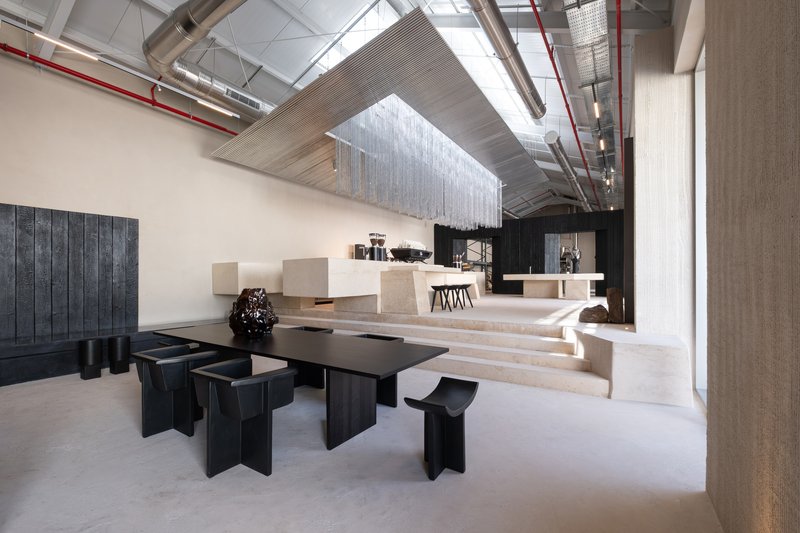
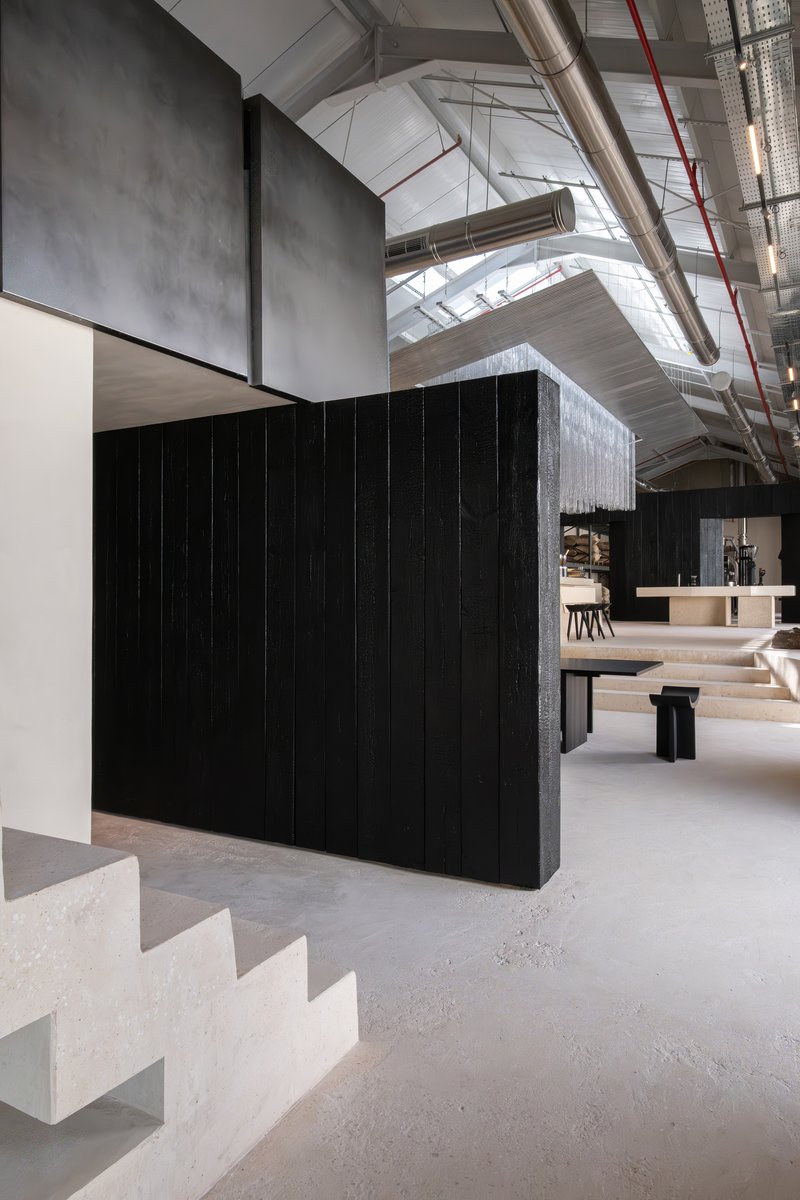
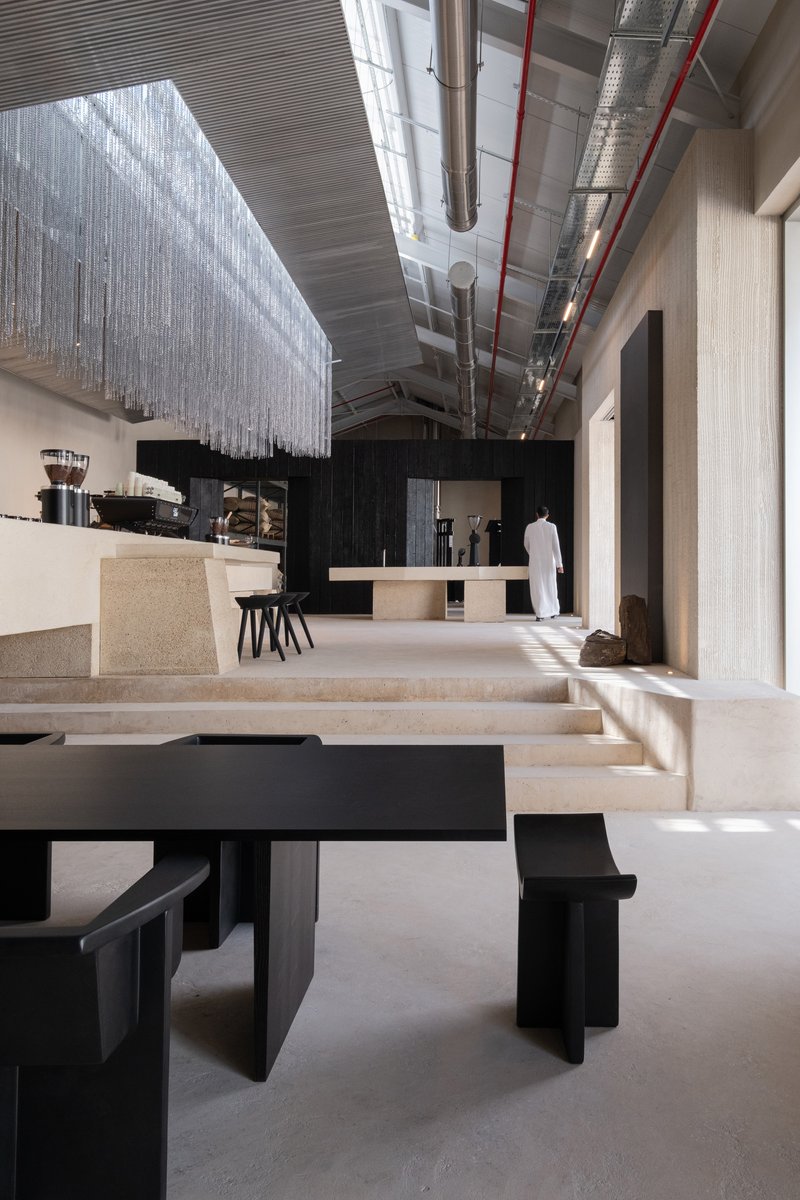
The third and final zone pushes the program beyond the café typology. A pale stone staircase ascends beside charred timber cladding toward a split-level workspace enclosed by metal cladding, creating a zone that is visually connected to the café below but acoustically and functionally distinct. Tiered terrazzo seating with black tables provides an intermediate condition: you can work here, but you can also just sit with a coffee and watch the activity below.
This multi-functionality is critical to how JAX District operates. The warehouses are not just retail or hospitality spaces; they need to accommodate creative work. S.DA's decision to embed an office within the café footprint acknowledges this reality without forcing a separate entrance or a hard boundary.
Exterior and Facade
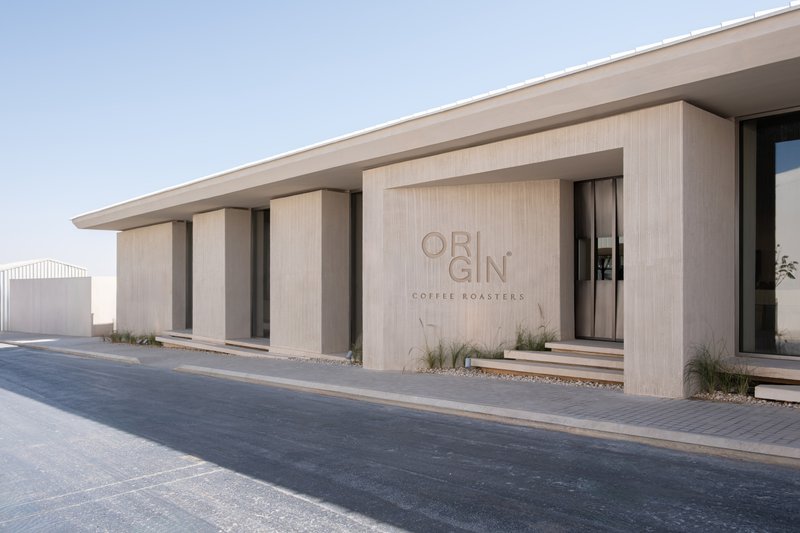
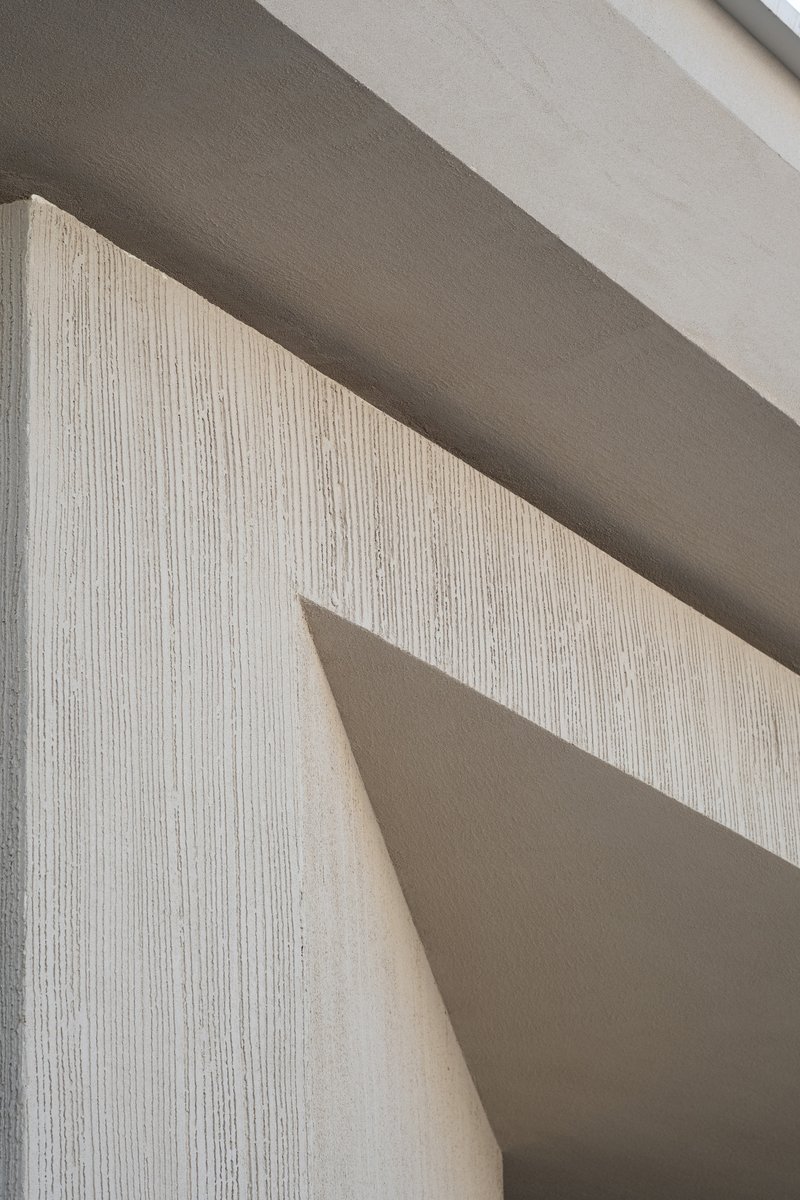
From the outside, Origin reads as quietly industrial. The ribbed concrete façade with flush-mounted signage does not announce itself loudly. The vertically striated surfaces and recessed openings suggest a building that has been modified rather than built from scratch, which is exactly the point. The aluminum-clad roof sits above as a simple cap on the existing structure, and the overall impression is of careful intervention rather than wholesale replacement.
Furnishings and Detailing
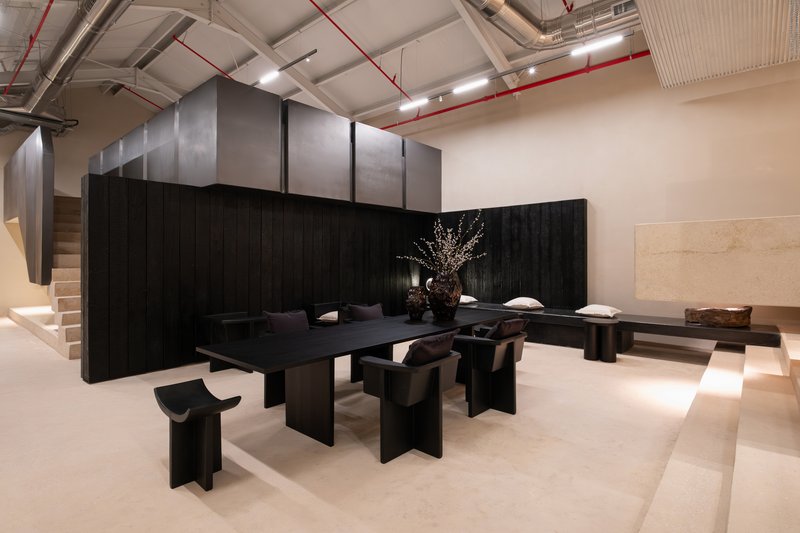
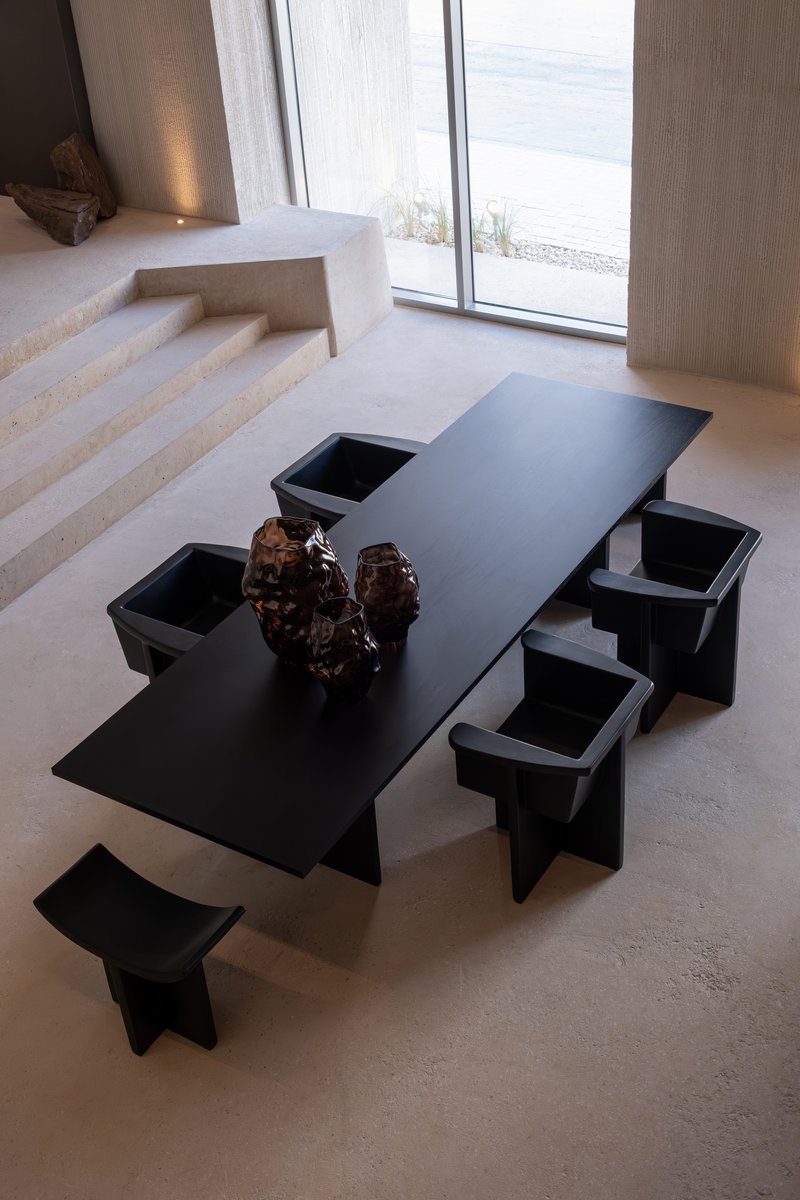
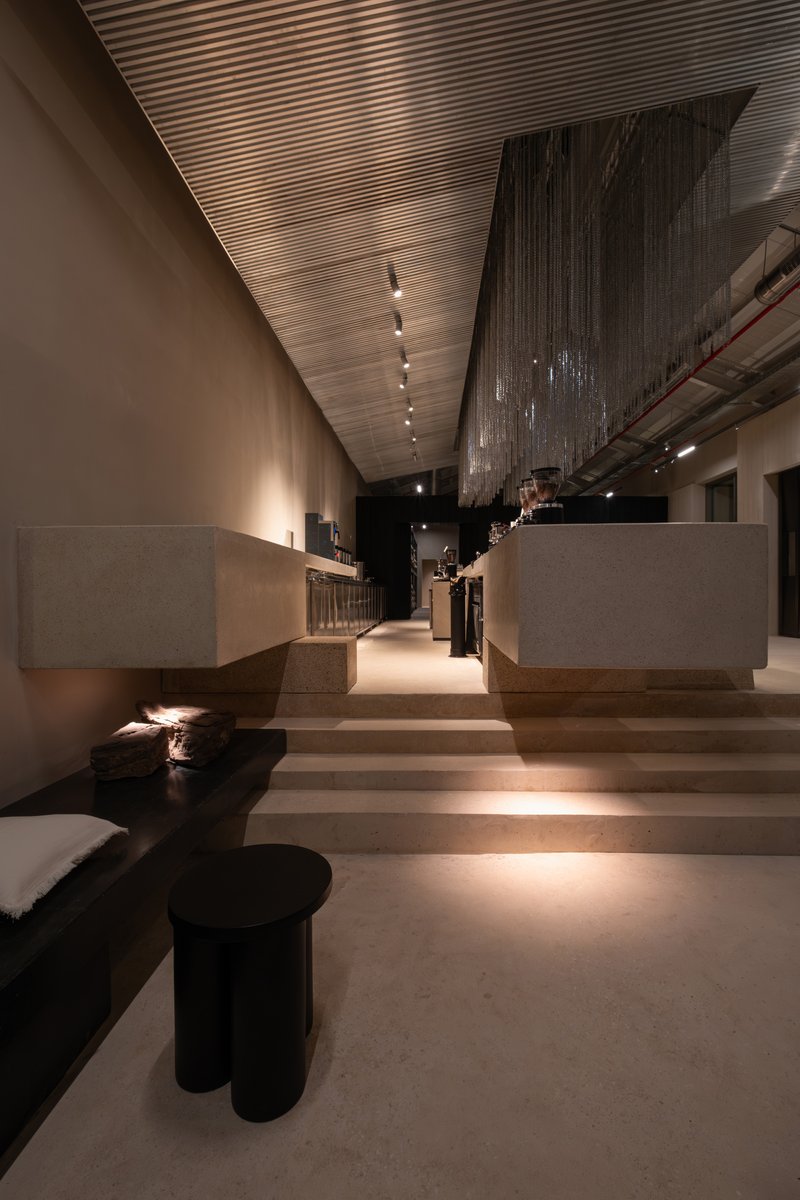
The furniture is almost entirely black: geometric dining tables, integrated bench seating, and timber stools that reinforce the tonal palette established by the charred walls. A branch arrangement against the blackened wall is one of the few organic gestures in the project, and it reads as deliberate restraint rather than decoration. Stepped seating platforms under slatted ceilings create intimate zones within the larger volume, and the ambient evening lighting shifts the atmosphere from the productive brightness of daytime to something more social.
Plans and Drawings
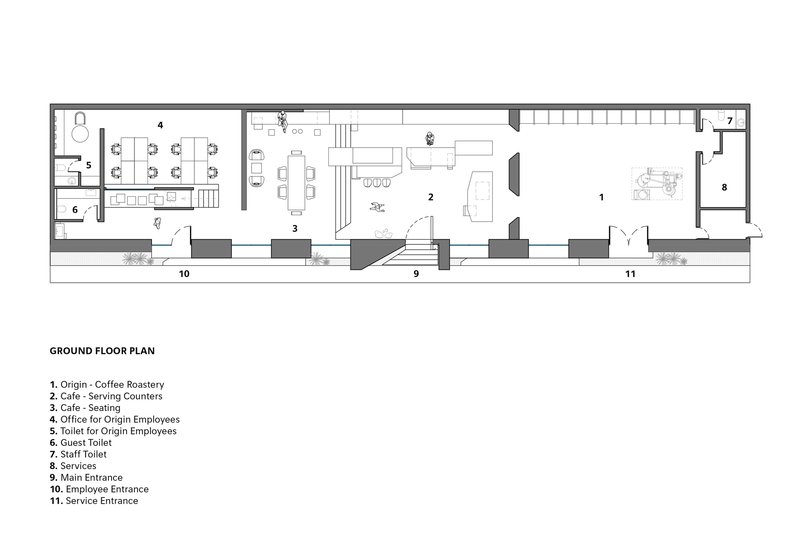
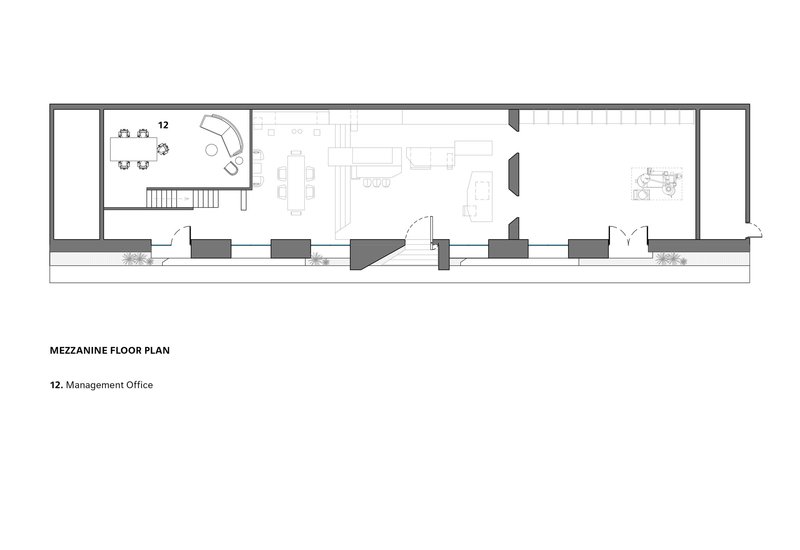
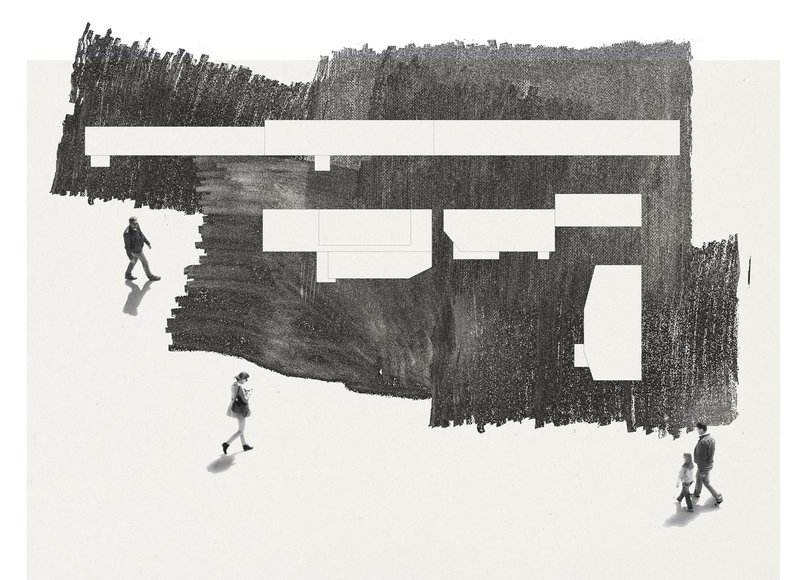
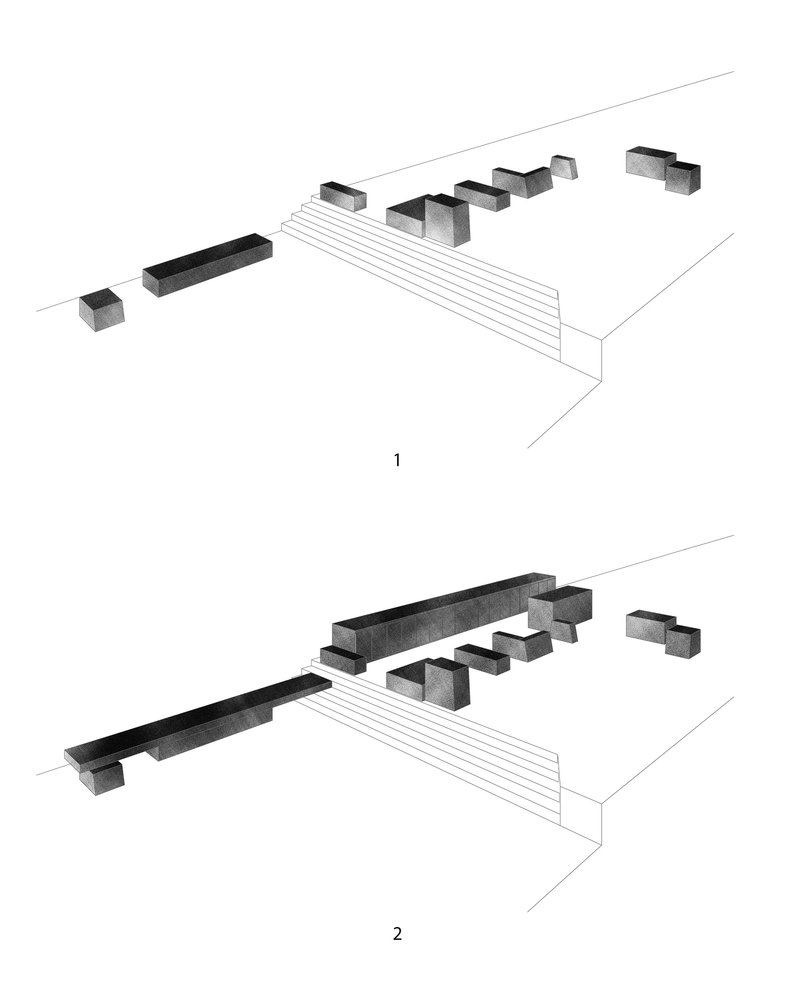
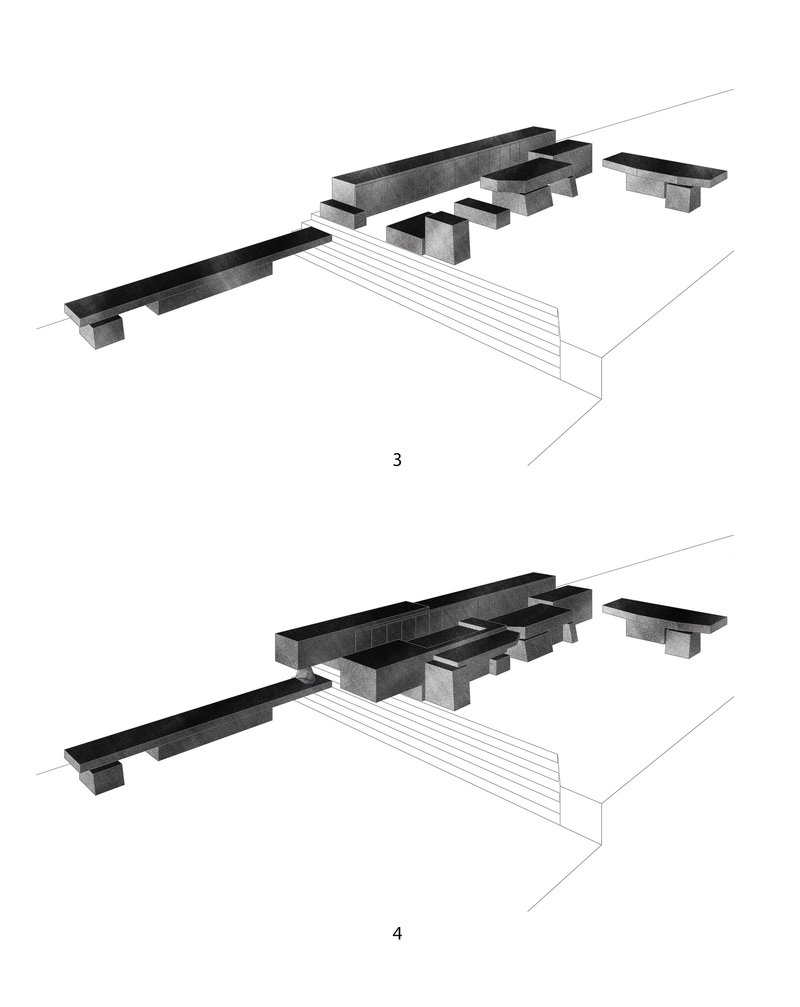
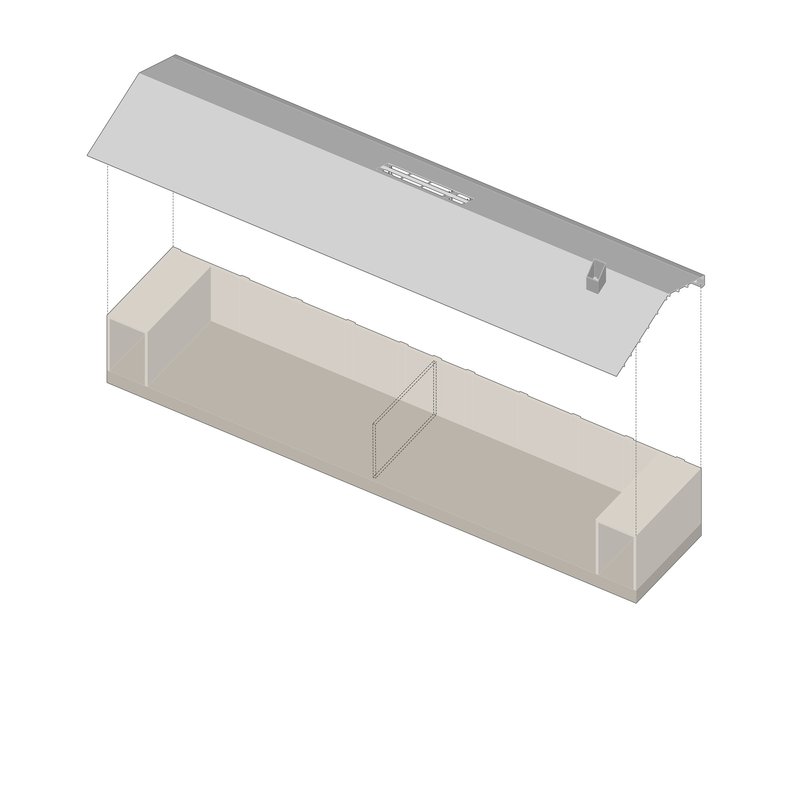
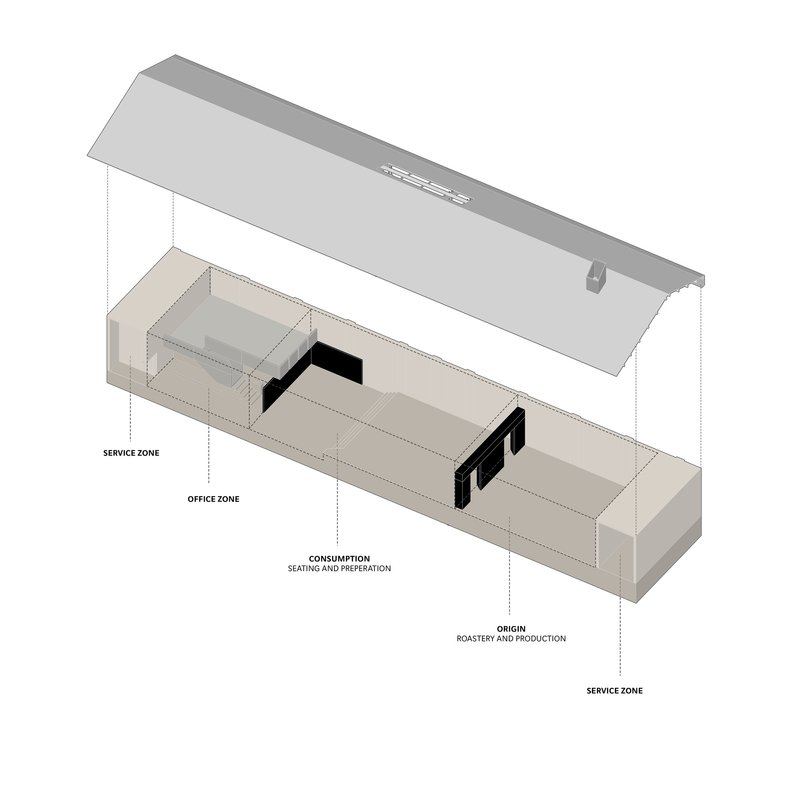
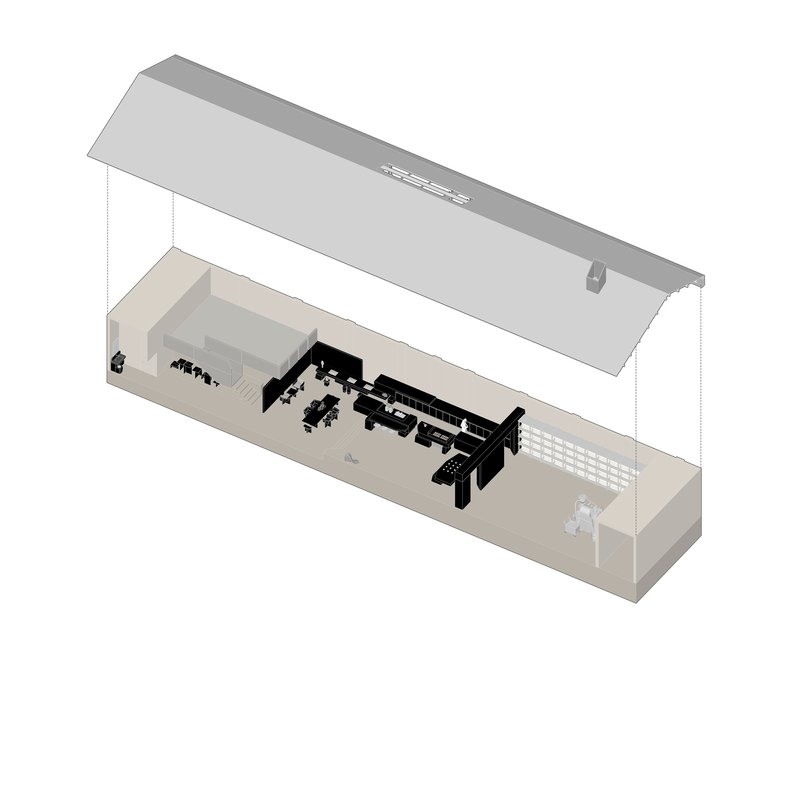
The ground floor plan reveals the linear logic clearly: a long rectangular volume with the roastery at one end, the serving counters in the middle, and a stair leading to a conference area at the opposite end. The exploded axonometric drawings are particularly instructive. One shows the construction sequence with rectangular volumes and elongated base slabs, while another maps the spatial zoning into service, office, consumption, and production areas. A cutaway axonometric reveals how the furnishings and equipment are organized within the single elongated shell. The roof plan confirms the simplicity of the container: two rectangular volumes with the skylight positioned precisely above the central counter zone.
Why This Project Matters
Origin Café and Roasters is a small project with an unusually coherent thesis. The idea of mapping a production process onto a spatial sequence is not new, but S.DA executes it with a material discipline that most café interiors never attempt. Charred wood, terrazzo, and metal are not decorative choices here; they correspond to the transformation of the product itself, from raw to processed to consumed. That conceptual rigor elevates what could have been a routine adaptive reuse into something genuinely considered.
More broadly, the project demonstrates how warehouse conversions in rapidly developing Saudi cultural districts can succeed without erasing the industrial character that made these buildings compelling in the first place. S.DA kept the bones visible, the ductwork exposed, the ceiling high, and worked within those constraints rather than against them. In a region where newness is often the default aspiration, that kind of restraint is both rare and welcome.
Origin Café and Roasters Jax by S.DA, lead architect Duaa Abukhalaf. Located in JAX District, Diriyah, Riyadh, Saudi Arabia. 329 m², completed 2026. Photography by Aylul Studio.
About the Studio
S.DA
Share Your Own Work on uni.xyz
If projects like this are the kind of work you want to make, uni.xyz is a place to publish your own, find collaborators, and enter design competitions.




Popular Articles
Popular articles from the community

Cro&Co Architecture Builds a 150-Meter Tower on Top of a Seven-Lane Highway in La Défense
Trinity Tower reimagines the office high-rise as a bioclimatic organism threaded with terraces, trees, and public ground in Paris's business district.
GGR Architectes Anchors a New Neighborhood in Frouzins with a Brick and Timber School Complex
A cruciform plan of terracotta brick and exposed wood frames four courtyards for 140 students outside Toulouse, France.
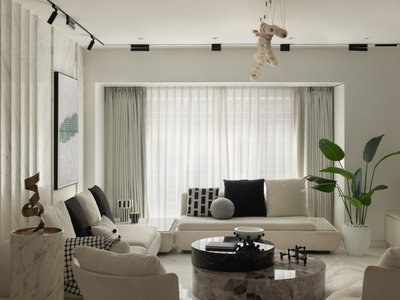
Inside a Timeless Mumbai Residence by Aether Studio
Aether Studio's 2,250 sq ft apartment in Malad, Mumbai uses marble, brass, boucle, and disciplined restraint to build a quiet retreat from the city.
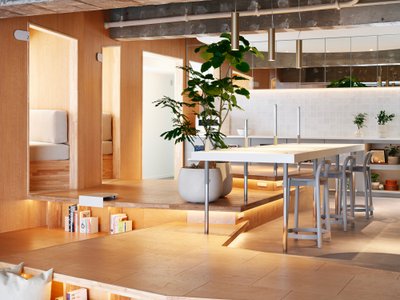
R/URBAN DESIGN OFFICE Carves a Communal Living Room from a Tokyo Corporate Dormitory
In Shinagawa's Oi district, a 35-year-old reinforced concrete tower becomes a 49-unit rental residence with shared spaces that redefine cohabitation.


Similar Reads
You might also enjoy these articles

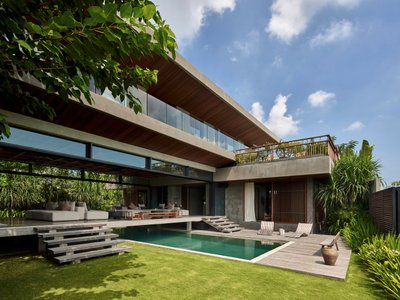
Freebird Residence by Alexis Dornier: A Tropical Modernist Sanctuary in Bali
Floating living pavilion above pool anchors H-shaped tropical villa, blending Japanese minimalism, sustainable strategies, lush landscape, and sculptural interiors.
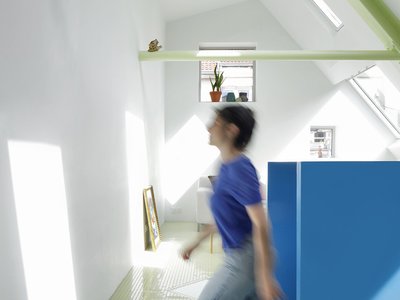
127af Flips a Tiny Bagnolet Rowhouse Upside Down with a Handcrafted Roof Extension
A 55-square-meter terraced house on the edge of Paris gains a luminous upper living floor through lightweight timber and steel.
1.61 Design Workshop Wraps a 600-Square-Meter Café in Vietnam in Sculptural Burgundy Drama
Reden Café & Bistro pairs a helical staircase, mosaic floors, and deep red interiors to rethink Vietnamese hospitality space.

The Unbound Brain: A School Shaped by Cognitive Architecture
Cylindrical learning pods radiate like neurons from a central cortex, turning the floor plan into a spatial model of human thought.






Comments (0)
Please login or sign up to add comments
No comments yet. Be the first to comment!