
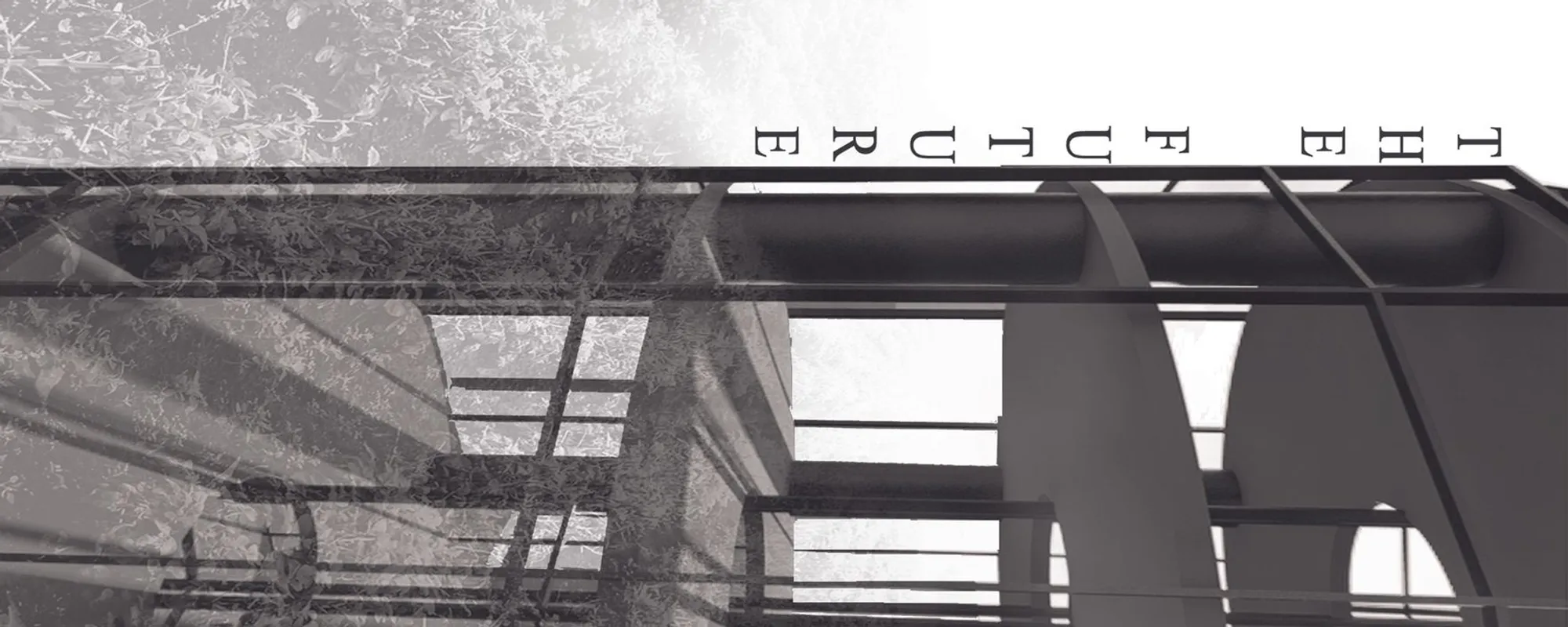
The Future: A Seed Bank Woven into Hong Kong's Vertical Urban Fabric
Three towers, underground vaults, and a public plaza embed ecological regeneration into one of the world's densest financial districts.


What if the most radical act of ecological preservation wasn't hiding seeds inside a frozen mountain vault, but planting a living seed bank in the middle of one of the world's densest financial districts? The Future takes that provocation seriously, proposing a vertically stratified complex in central Hong Kong that fuses underground seed storage with vertical agriculture towers and a pedestrian green plaza. The seed here is both literal and metaphorical: a unit of biological continuity and a symbol of urban regeneration, cycled through a four-step process of storage, analysis, regeneration, and re-storage that residents can observe and participate in.
Designed by Fulya Özmen, Enes Keleşmehmet, Zeynep Çoban, Dilara Bedir, and Ömerfaruk Satçelik, the project is a People's Choice Award entry in the Seed Bank competition on uni.xyz. The site sits at the intersection of Queen Victoria Street, Des Voeux Road, Jubilee Street, and Queen's Road, tight urban corridors with minimal green space and limited walkability squeezed between Hong Kong's skyscraper-filled financial core and the forested mountain terrain that locals regard as the island's sanctuary.
Circular Landscapes Inserted into a Rigid Grid
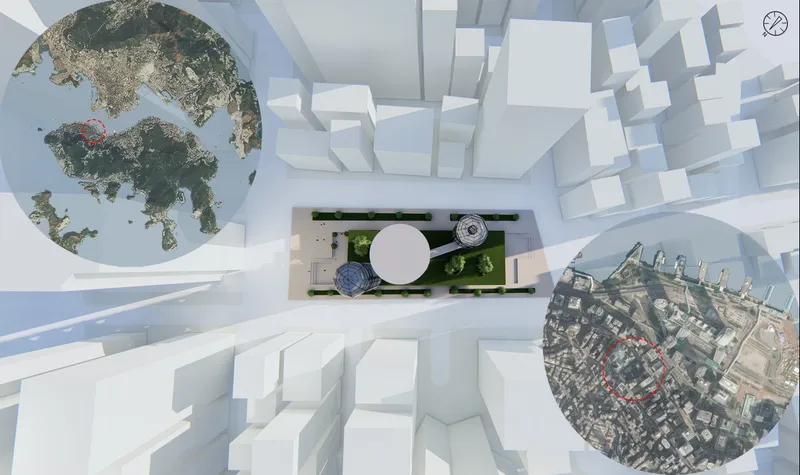
The top-down conceptual model reveals the designers' strategy at its most diagrammatic: circular green inserts punched into an otherwise relentless white urban grid. These are not decorative planting beds. They represent the seed bank's ground-level public plaza and its surrounding landscape infrastructure, conceived as ecological events within the existing street fabric. The circular geometries contrast sharply with the orthogonal blocks around them, signaling that this intervention is deliberately foreign to the typical Hong Kong streetscape. It opens a wall, as the designers describe it, between the dense vertical city and the forested slopes behind.
Reading the Site: From Congested Corridors to Pedestrian Greenways
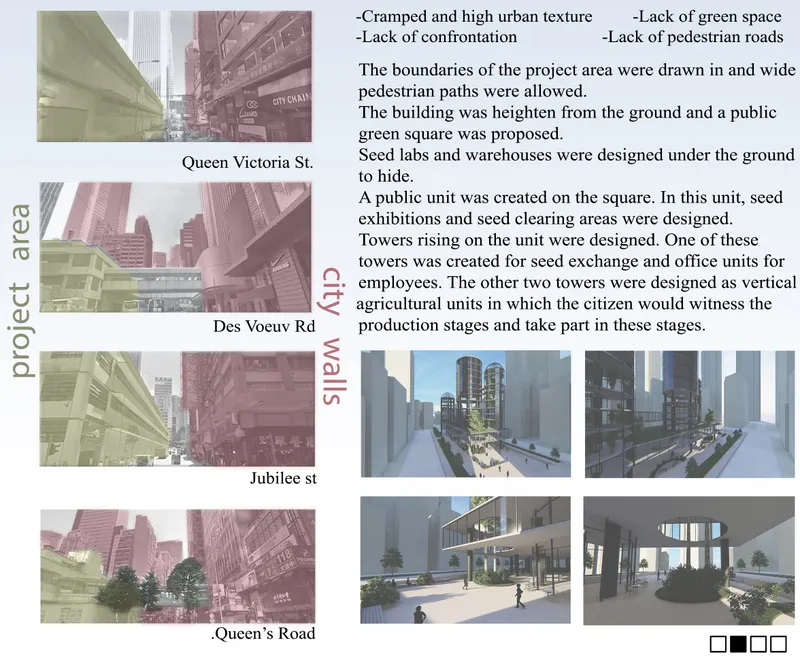
The presentation board maps the argument for intervention through site analysis photographs and perspective renderings. Existing conditions along Queen Victoria Street and the surrounding corridors show narrow sidewalks, heavy vehicular traffic, and almost no vegetation at street level. The renderings propose a different reality: pedestrian-friendly streets flanked by the seed bank's tower cluster, with ground-level greenery replacing asphalt. The forest and mountain, which hold sacred meaning for Hong Kong's residents, are no longer separated from the urban core by a wall of glass and concrete. Instead, the seed bank becomes a programmatic bridge, pulling ecological activity into the daily routines of the financial district.
Vertical Stratification: Vaults Below, Farms Above
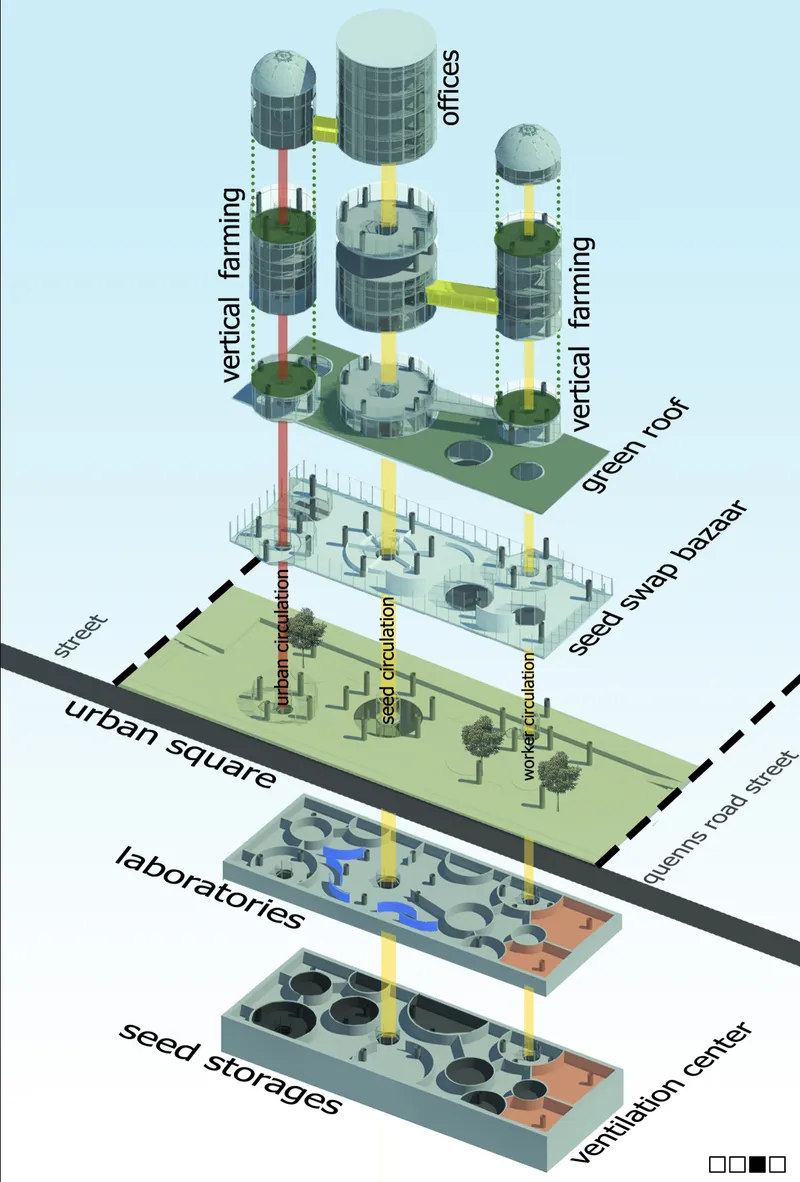
The exploded axonometric diagram makes the program's vertical logic legible. Underground, the design buries its most critical functions: seed storage vaults, laboratories, and ventilation centers, all climate-controlled and secured against environmental threats. At ground level, the program shifts to public engagement: an urban square, a seed swap bazaar, exhibition spaces, and educational facilities. Rising above are three towers, one dedicated to offices and seed exchange, two given over to vertical agriculture. This layering is not arbitrary. It sequences the seed's lifecycle spatially, from protected dormancy underground through public awareness at grade to active regeneration in the towers above.
The stacking strategy also reflects the designers' sustainability systems. A double-skin facade wraps the towers to insulate against Hong Kong's extreme heat and humidity. Rainwater harvesting captures and purifies precipitation for irrigation of the vertical farms. The underground position of the vaults provides natural thermal stability while offering protection against the natural disasters and conflict scenarios the team identifies as threats to global plant diversity.
Three Glazed Towers Over an Urban Commons
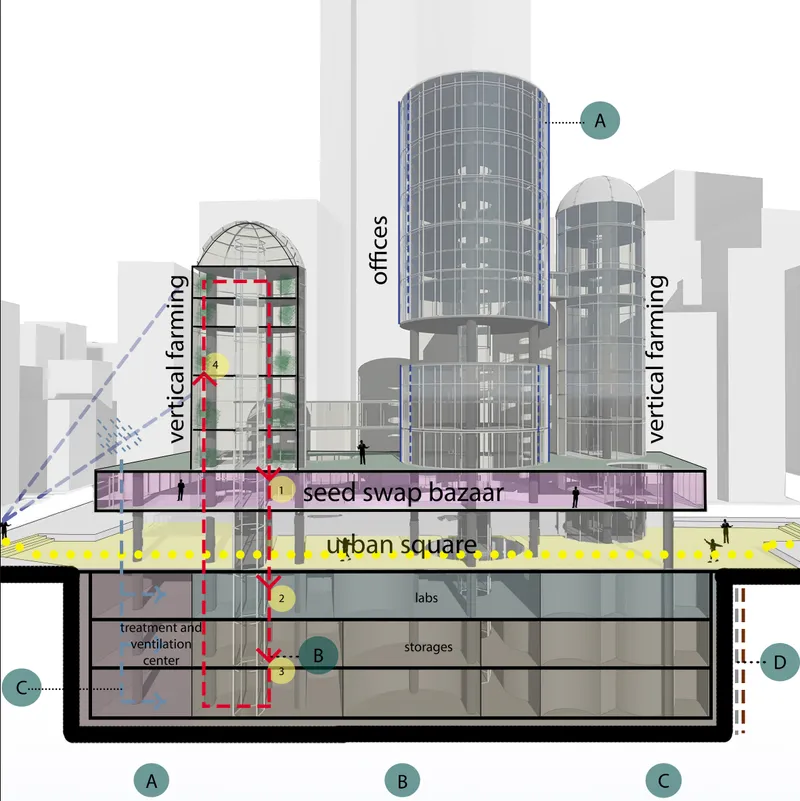
The section drawing cuts through the full depth of the proposal and clarifies the spatial experience the designers envision. Three glazed tower volumes rise from a shared urban square, their transparency making the vertical agriculture and seed exchange activities visible from the street. Below the plaza, the section reveals the layered underground world of laboratories and storage, connected by circulation cores that allow the public to descend into the seed vaults. The section emphasizes that the architecture is not a sealed container but a permeable system, one where citizens can watch, learn, and actively participate in hyperlocal food production and seed regeneration.
The relationship between the subterranean and aerial programs creates a productive tension. The vaults are still, dark, protective. The towers are exposed, productive, social. The ground-level plaza mediates between these two conditions, functioning as a civic threshold where ecological infrastructure meets everyday urban life.
Why This Project Matters
Seed banks are typically understood as bunkers: remote, secure, inaccessible. The Svalbard Global Seed Vault sits inside a mountain on a Norwegian archipelago, by design removed from the populations it serves. The Future inverts that model entirely. By locating its seed bank in the commercial heart of Hong Kong, the design team argues that preservation and participation are not opposed goals. Citizens who can observe seed cycling, swap seeds at a bazaar, and harvest food from a vertical farm in their financial district develop a different relationship with ecological resilience than citizens who know seeds are stored safely somewhere far away.
The strength of the proposal lies in its insistence that architecture can be both container and catalyst. The underground vaults fulfill the technical mandate of a seed bank. The towers and plaza fulfill a civic one: making the invisible labor of ecological preservation legible, social, and participatory. In a city defined by vertical density and shrinking public space, embedding a regenerative program into the urban fabric is not just idealistic. It is precisely the kind of spatial provocation that urbanism in climate crisis demands.
View the Full Project
About the Designers
Designers: Fulya Özmen, Enes Keleşmehmet, Zeynep Çoban, Dilara Bedir, Ömerfaruk Satçelik
Enter a Design Competition on uni.xyz
uni.xyz runs architecture and design competitions year-round that reward proposals with spatial conviction and real site intelligence.
Project credits: The Future by Fulya Özmen, Enes Keleşmehmet, Zeynep Çoban, Dilara Bedir, Ömerfaruk Satçelik Seed Bank (uni.xyz).




Popular Articles
Popular articles from the community


Co-life: Sustainable Architecture for Age-Friendly Community Living
Co-life reimagines sustainable architecture for seniors through courtyards, rammed earth, shared gardens, and spaces designed for belonging.

The Earth Pod: 3D Printed Homes for Resilient Refugee Communities
The Earth Pod reimagines refugee housing through 3D printed homes made from clay, combining resilience, self-sufficiency, and rapid shelter.

Lunar Spiral: Space Architecture Shaped by the Mathematics of the Universe
Lunar Spiral reimagines space architecture through Fibonacci geometry, lunar regolith, levitating habitats, and self-sustaining Moon living.

The Ocean Hive: Sustainable Architecture for a Self-Sufficient Civilization at Sea
The Ocean Hive imagines sustainable architecture at sea, where modular habitats, algae, wave power and ocean waste sustain a growing colony.

Similar Reads
You might also enjoy these articles

Bao Huynh Watercolor Atelier: A Serene Art Retreat in Hội An
Bao Huynh Watercolor Atelier in Hội An blends multifunctional art spaces, sustainable design, local materials, and family-friendly living in a serene environment.

Atelier Macri Concept Store Interior Design by CASE-REAL
Atelier Macri store features a "ko" counter, walnut wood details, cork displays, blending retail, gallery, and seamless customer experiences.

Manuel Vargas Izquierdo Stadium and High-Performance Sports Center: Architectural Excellence in Jalpa de Méndez
The Manuel Vargas Izquierdo Stadium blends sustainable design, inclusive sports facilities, and cultural-inspired architecture, revitalizing Jalpa de Méndez’s public spaces.

KAKR Buluh Awar Hall: Revitalizing Community and Ecology Through Bamboo Architecture
Community built bamboo hall revitalizes Buluh Awar village, empowering youth, restoring ecology, celebrating vernacular craftsmanship through sustainable architecture and culture.

Comments (0)
Please login or sign up to add comments
No comments yet. Be the first to comment!