
SeuM
Mental therapy and rehabilitation center

When choosing one of the competitions to participate, everyone in our team paid attention to this competition for the creation of a mental health and rehabilitation center. The modern world gives us a lot of wonderful things that make our life and our work easier, but it still gives people a lot of stress that many people cannot cope with for one reason or another, so this topic of the competition attracted the attention of our group, and we decided try to find a solution to this problem.
The choice of concept was not easy. We studied the site for a long time and looked for an approach to it, as we wanted to place a large number of functions inside and at the same time create a good level of zoning and dilution of human flows. This turned out to be quite difficult in this section, since it is narrow and long, and with all this, we wanted to orient the main entrance to the intersection of Sumyeong-ro 6-gil and Magokjungang 2-ro streets, since these are the main highways for traffic.
The main idea was to create a structure, being in which each person could not need any additional external services, solving all their needs, being inside, and at the same time feeling protected from the outside world, and getting inside, as if floating down the winding paths, in which you can’t get confused, but at the same time, we didn’t want a person in the complex to feel locked inside, while being in the center of one of the largest cities in Korea, he felt that nature was nearby, and not left far outside the city. The creation of such an internal space has become our main concept, which we adhered to during the design.
To address such a controversial challenge, we began by examining existing structures of this nature to understand how patients, workers, and visitors exist in such a complex structure. The next step for us was to create sketches and drawings on paper, develop basic concepts and create simple 3D models to understand the volume and true scale. In order to come to the final concept, our team had to undertake three brainstorming sessions, since the task turned out to be not easy, in each of the concepts chosen before, there was a critical flaw due to which the concept was rejected.
Also, after studying information about mental disorders, we saw how many tasks can be solved during rehabilitation and how many psychotherapeutic practices currently exist. When developing the unit responsible for therapy and rehabilitation, we tried to add as many conditions as possible for such practices. The main base was, of course, individual work with people, because it helps to find a personal approach to each person in his recovery. The next important practice was group practice, because being in society a person finds support from other people, realizes that he is not alone in his problem. We also learned that many mental disorders are associated with injuries and health problems, so we tried to create an environment as accessible as possible for people with disabilities, in which they would not feel limited in movement, and also laid good places for sports and activities so that visitors could keep their body in good shape, do gymnastics and water procedures. The opportunity to engage in creativity has also become an important function, because a person, even with mental disorders, should always have the freedom to express their emotions and realization, so we created creative spaces where people could do their creative hobbies on their own in a group, or learn something new. Information is also very important for a modern person, it can be dangerous to abruptly pull a person out of the familiar information environment, so visitors have the opportunity to use modern technology in a controlled manner, receive information, and watch movies. In addition, many mental disorders are also accompanied by eating disorders, besides, a healthy diet helps a person maintain balance in his body and undergo rehabilitation faster, so placing a dining room where visitors could eat healthy food was a must.
The main materials for the construction were chosen at the very start, because one of the main tasks was to create a feeling of closeness to nature, so the use of a large number of wooden and imitating wooden surfaces was chosen at the very beginning, as well as a large number of green spaces, including on the roofs, as well as the creation of a small artificial reservoir along the entire length of the complex. Also, glass became one of the predominant materials, as this material allowed us to create a feeling of openness and airiness, but at the same time creating a certain perceived barrier to external forces, so that the person inside felt protected.
The number of tasks that we set for ourselves turned out to be truly large, but this corresponds to how complex the human psyche is and how many things in it can be traumatized. And when creating this project, we wanted that every such injury could be healed thanks to our ideas. Putting all these functions together proved to be a difficult task, but it was doable, and we achieved our goal.
However, what next, because psychotherapeutic practices do not stand still, and the complex will remain unchanged and someday will cease to be relevant? Someday humanity will change so much that the whole of psychiatry can be turned upside down, but we wanted our center to be effective even in this case. To do this, we have designed most of the therapy-related spaces to be versatile rather than strictly planned for specific activities. So people themselves will be able to change the space to make it more suitable for new future psychiatric practices that we cannot yet foresee. We hope that our ideas will allow the direction of psychiatric rehabilitation to develop further, and soon many people will have access to mental health services.

Popular Articles
Popular articles from the community


The Musturak Paradise: Senior Living Architecture for a Connected Future in Temara, Morocco
The Musturak Paradise reimagines senior living architecture in Temara via private homes, social spaces, culture, community, and shared care.

Lunar Spiral: Space Architecture Shaped by the Mathematics of the Universe
Lunar Spiral reimagines space architecture through Fibonacci geometry, lunar regolith, levitating habitats, and self-sustaining Moon living.

The Ocean Hive: Sustainable Architecture for a Self-Sufficient Civilization at Sea
The Ocean Hive imagines sustainable architecture at sea, where modular habitats, algae, wave power and ocean waste sustain a growing colony.

Riyadh For All: Intergenerational Urban Design for Active Aging in Rabat
Riyadh For All reimagines urban design in Rabat with intergenerational co-living, adaptive courtyards, and Moroccan cultural exchange today.

Similar Reads
You might also enjoy these articles

Open letter to community of UNI
A set of important news for our existing participants and community of UNI worldwide.

Little Red Riding Hood: Architectural Design as a Journey Through Fear, Light, and Storytelling
Little Red Riding Hood reimagines the fairy tale through architectural design shaped by fear, light, scale, memory, uncertainty, and choice.

Floating Urban Village: Sustainable Architecture for a Climate-Resilient Community on Water
A modular floating village uses sustainable architecture, local materials and self-sufficient systems to create resilient life on water.
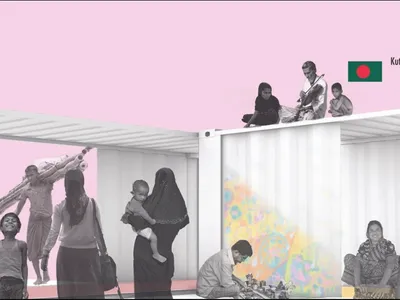
IN ONE, MANY, IN MANY, ONE: Modular Architecture for Play, Learning and Community
Modular architecture turns a travelling container into a flexible hub for play, learning, community life and belonging across refugee camps.



Comments (0)
Please login or sign up to add comments
No comments yet. Be the first to comment!