

35-51 ARCHITECTURE Office Brings the Dome Down to Earth in an Iranian Desert Mausoleum
In Ardakan, a 448-square-meter tomb doubles as a cemetery gateway, rethinking a thousand years of Iranian funerary architecture.


Iranian tomb architecture carries roughly a thousand years of formal evolution, from introverted stone towers to open pavilion memorials that invite the city inside. The Shafagh Tomb, completed in 2023 in Ardakan on the edge of Iran's central desert, by 35-51 ARCHITECTURE Office, steps into that lineage with a deliberate provocation: what happens when you pull the dome, the most symbolically charged element of an Iranian mausoleum, off its celestial pedestal and set it at arm's reach?
The answer is a 448-square-meter structure that refuses to behave like a private monument. Instead of standing apart from its surroundings, the Shafagh Tomb operates as the entrance to Ardakan's cemetery, merging the commemorative program of a mausoleum with the civic function of a public threshold. Two ribbed domes, a canopy of pierced arches, covered passageways inspired by traditional sabats, and a material palette of soil-colored brick alongside turquoise glazed tile produce a building that feels simultaneously ancient and unfamiliar. That tension is the point.
A Dome You Can Touch
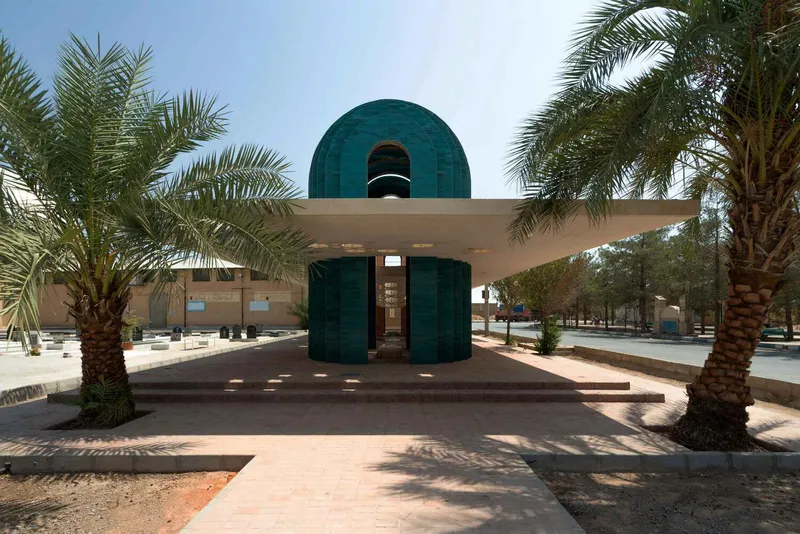
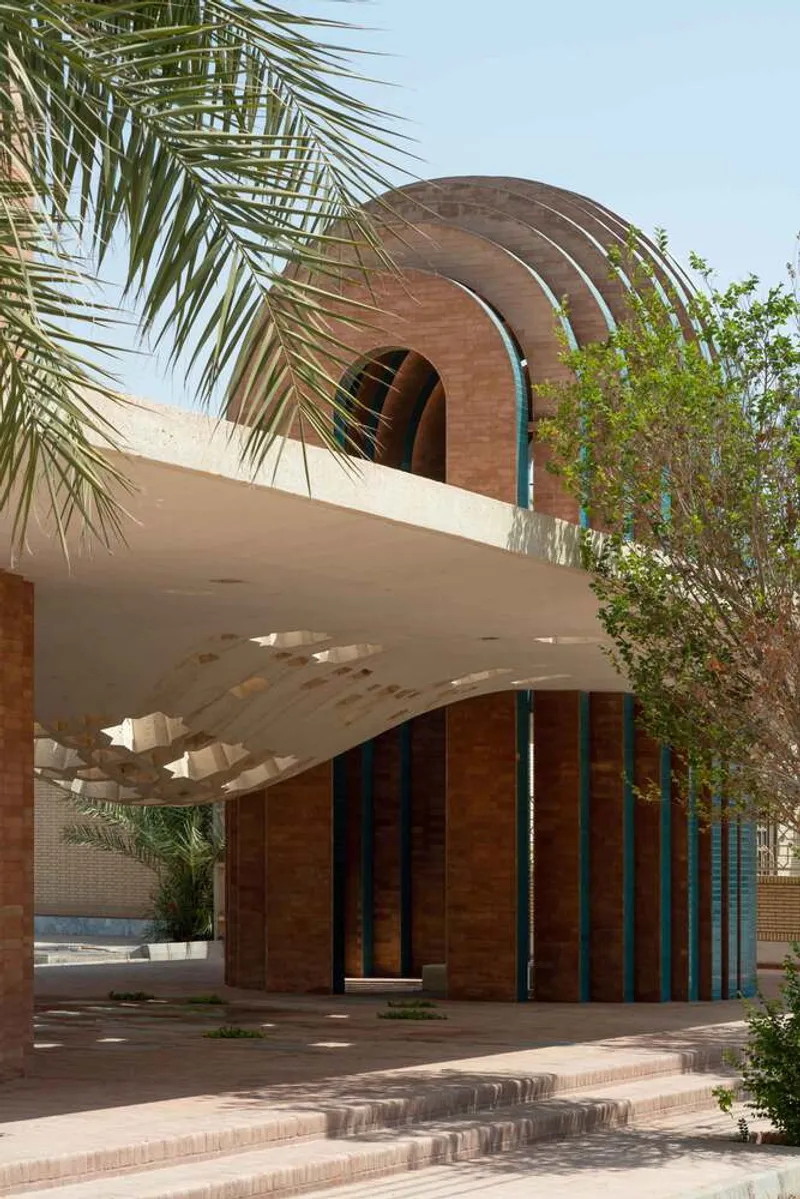
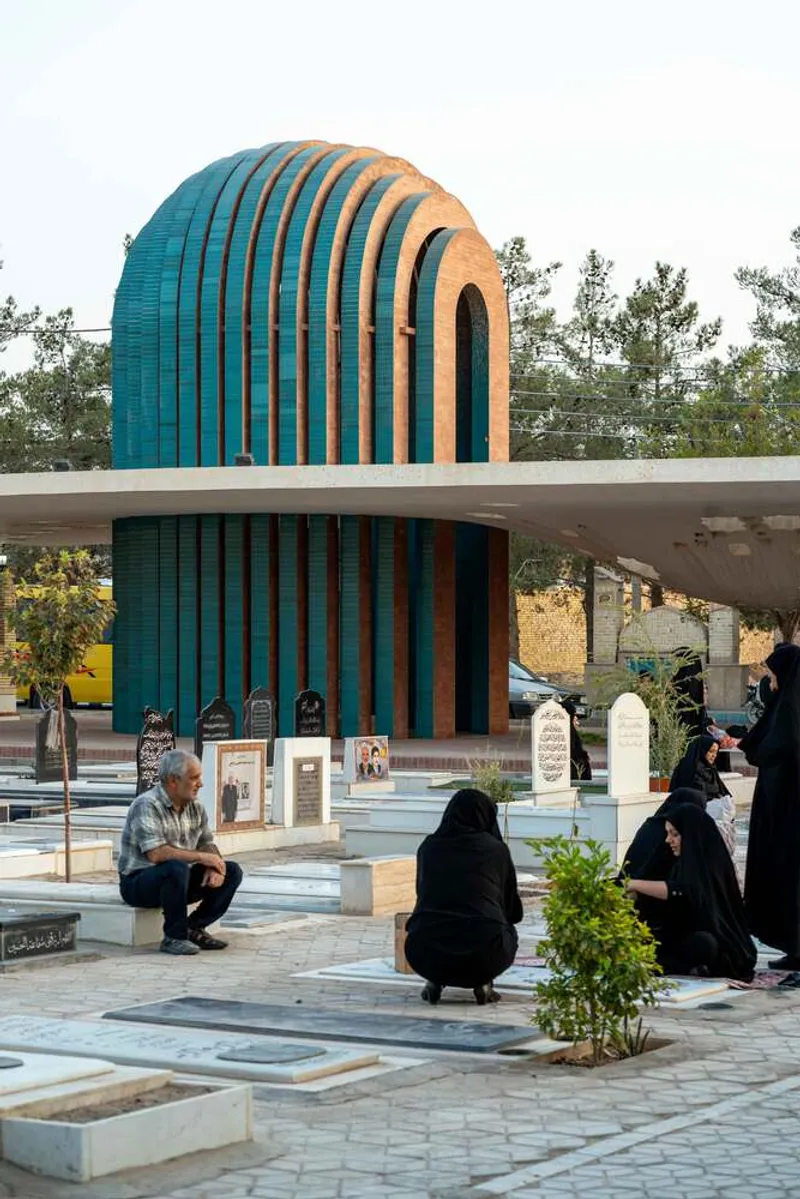
The conventional Iranian dome hovers. It sits atop a drum, at a distance from the body, suggesting transcendence. Lead architects Hamid Abbasloo, Abbas Yaghooti, and Neda Adiban Rad invert that relationship. The two ribbed domes here rise directly from the horizontal roof plane, their terracotta and teal bands visible at close quarters as you approach from the parking area or the cemetery courtyard. You are not looking up at spiritual authority; you are walking through it.
35-51 ARCHITECTURE Office describes the strategy as "defamiliarization," altering an established typology just enough to realign it with contemporary values. Lowering the dome strips away the implicit hierarchy between the honored dead and the living visitor, replacing it with something closer to shared ground. The ribbed barrel vaults, with their alternating teal and terracotta bands, reinforce this: they read as structural ornament you can parse from just a few meters away, not patterns that dissolve into a distant ceiling.
Calligraphy as Canvas
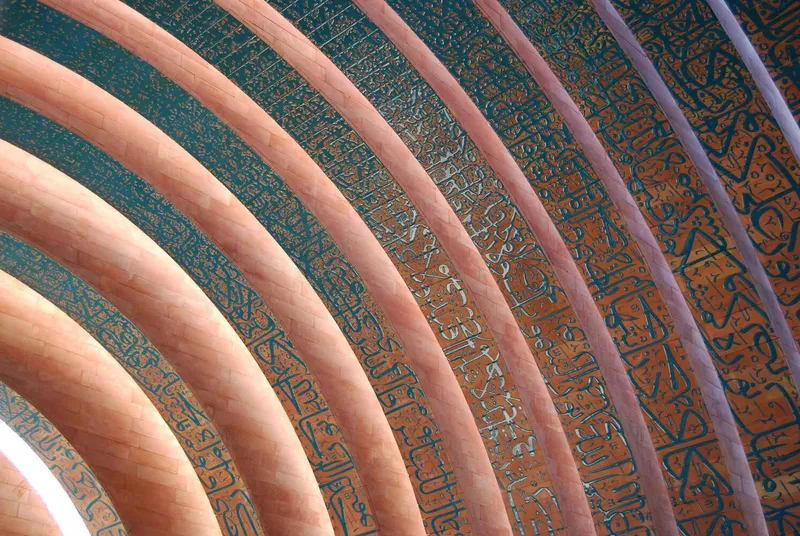
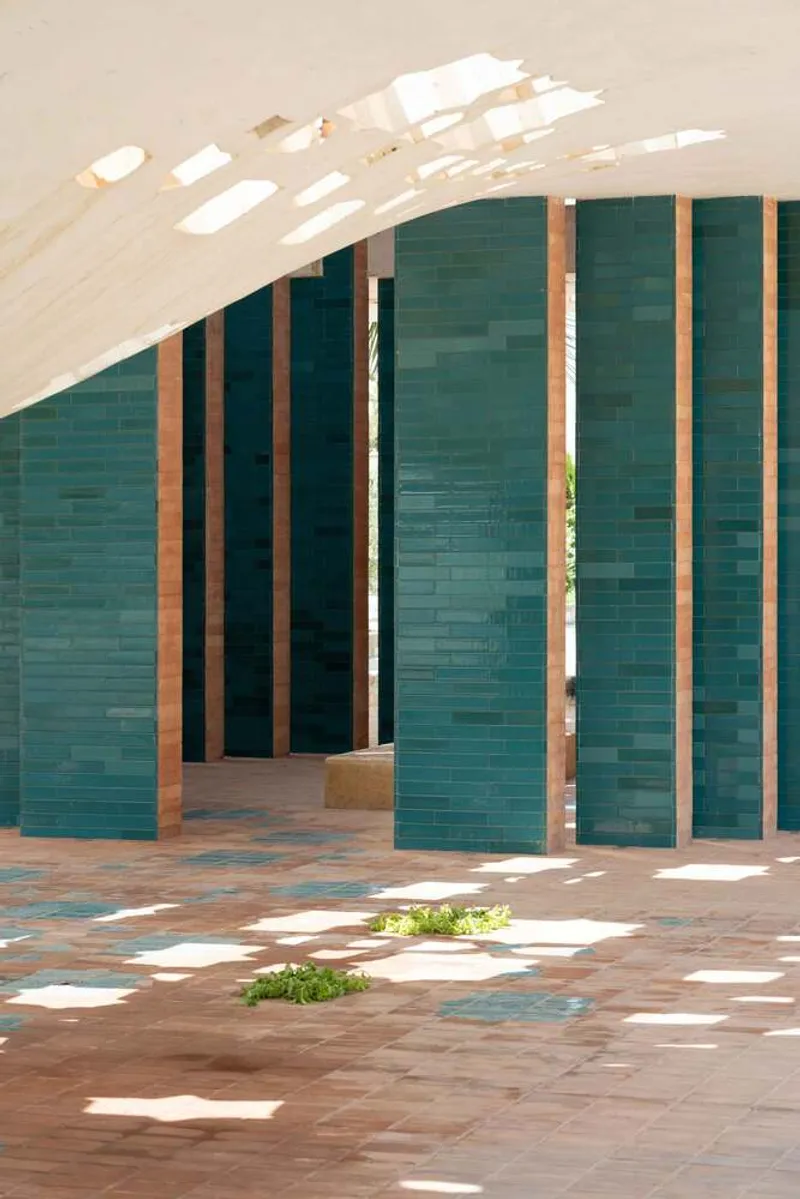
In historical Iranian mausoleums, Quranic inscriptions and calligraphic bands are embedded within the dome's lower surfaces, functioning as integral architectural decoration inseparable from the structure. The Shafagh Tomb does something riskier. Calligraphy by artist Mohammad Reza Amouzad appears on turquoise ceramic tiles set between curved timber ribs, treated less as scripture-in-stone and more as a standalone visual element. Close-up, you can trace each character against the glazed surface; the timber framing gives the text a gallery-like presentation.
The glazed tiles, produced by artists Shirin Soroudi and Mehdi Rahimi, carry a saturated turquoise that reads differently depending on the light: almost green in the shade of the canopy, electric blue under direct desert sun. Lifting the inscription out of its traditional architectural position and treating it as art object rather than ornamental layer is a quiet but consequential move. It argues that Islamic decorative traditions have a life beyond their historical containers.
The Canopy and the Sabat
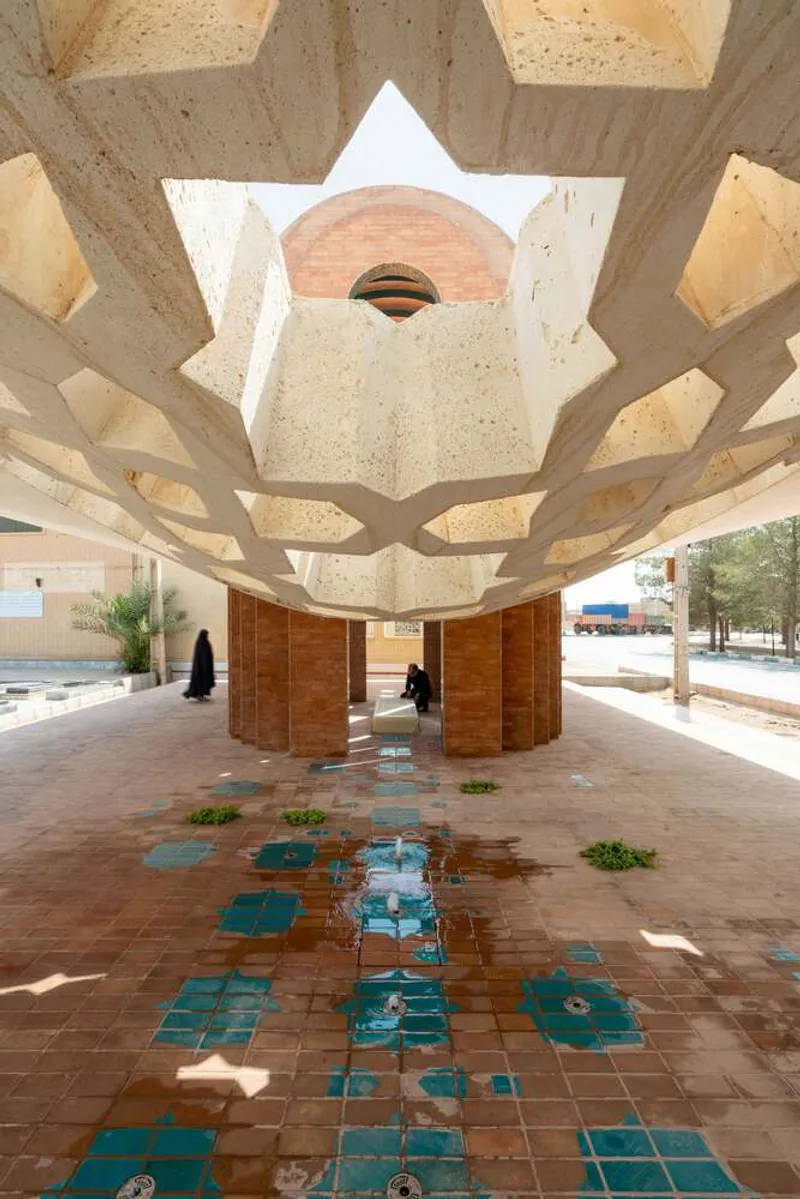
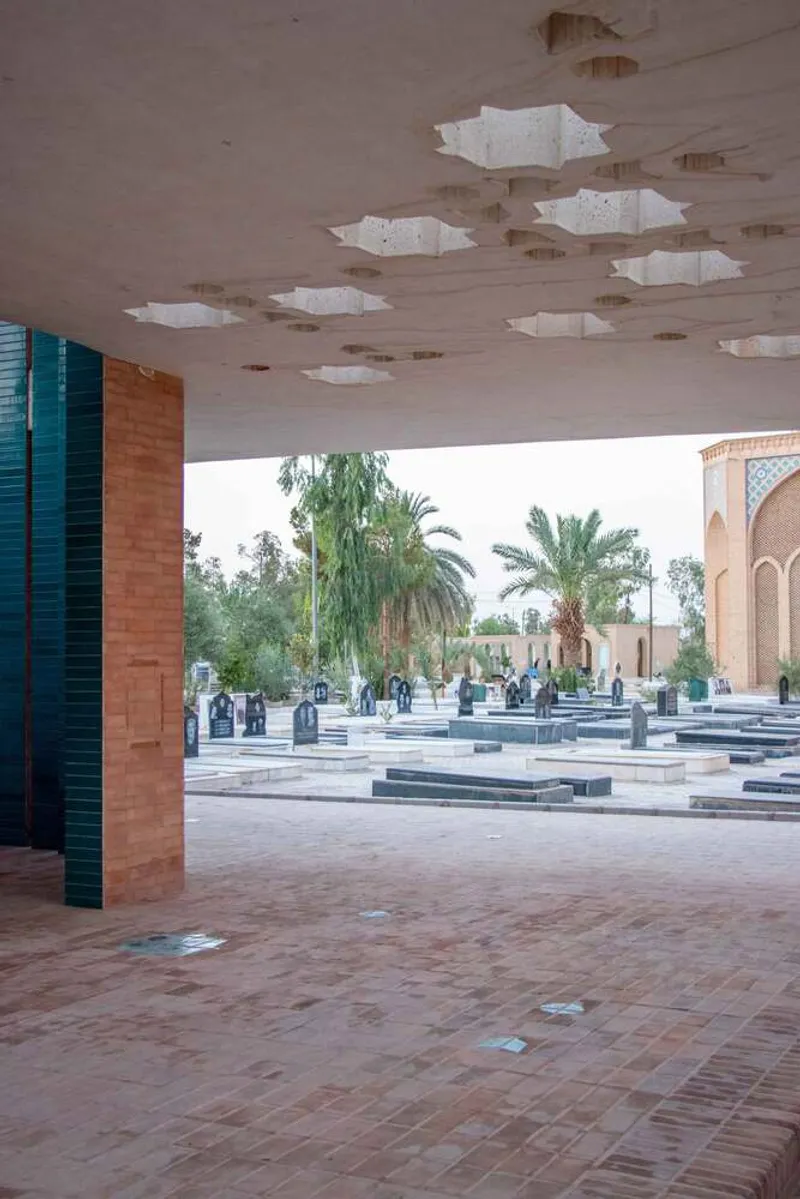
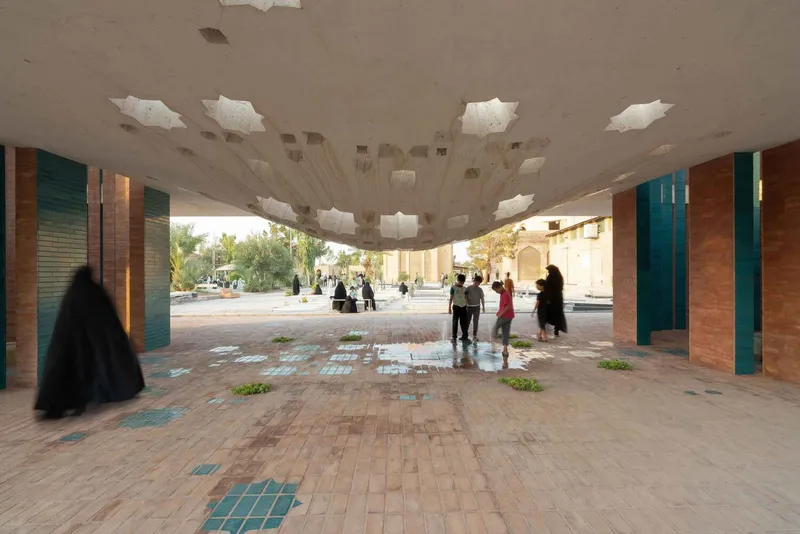
Ardakan sits on the edge of Iran's central desert, where shade is not an amenity but a necessity. The architects draw on the sabat, the covered passageway that appears in historic Iranian cities, to create a connective canopy linking the two domed volumes. Steel and concrete form the primary structure, with exposed timber ceilings and star-shaped roof perforations that allow controlled daylight to enter without the full force of the sun.
The result is a covered portico that transforms an otherwise punishing climate into something hospitable. Visitors walking between the parking area and the cemetery pass through dappled shadow, and the space doubles as a gathering zone for religious ceremonies. The perforated ceiling casts geometric shadows across the brick paving below, producing an ornamental effect through environmental logic rather than applied decoration. It is a reminder that in desert architecture, comfort and beauty are often the same problem.
Public Threshold, Private Memory
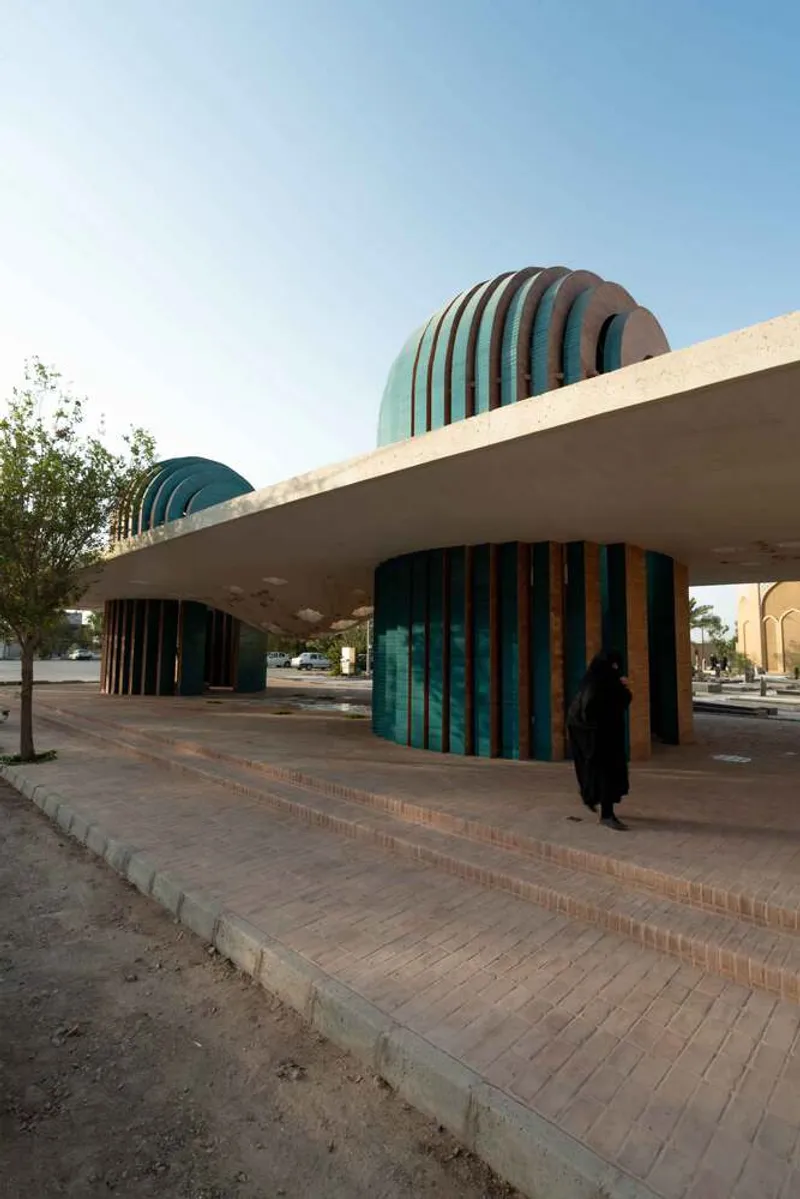
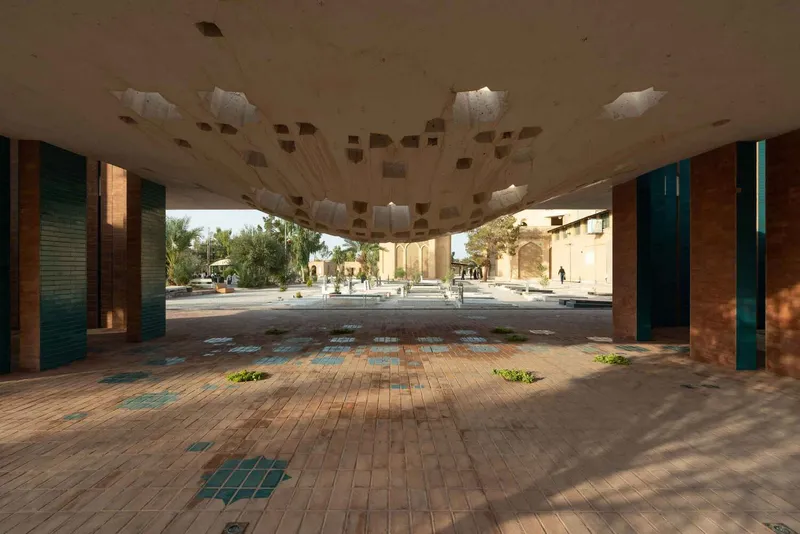
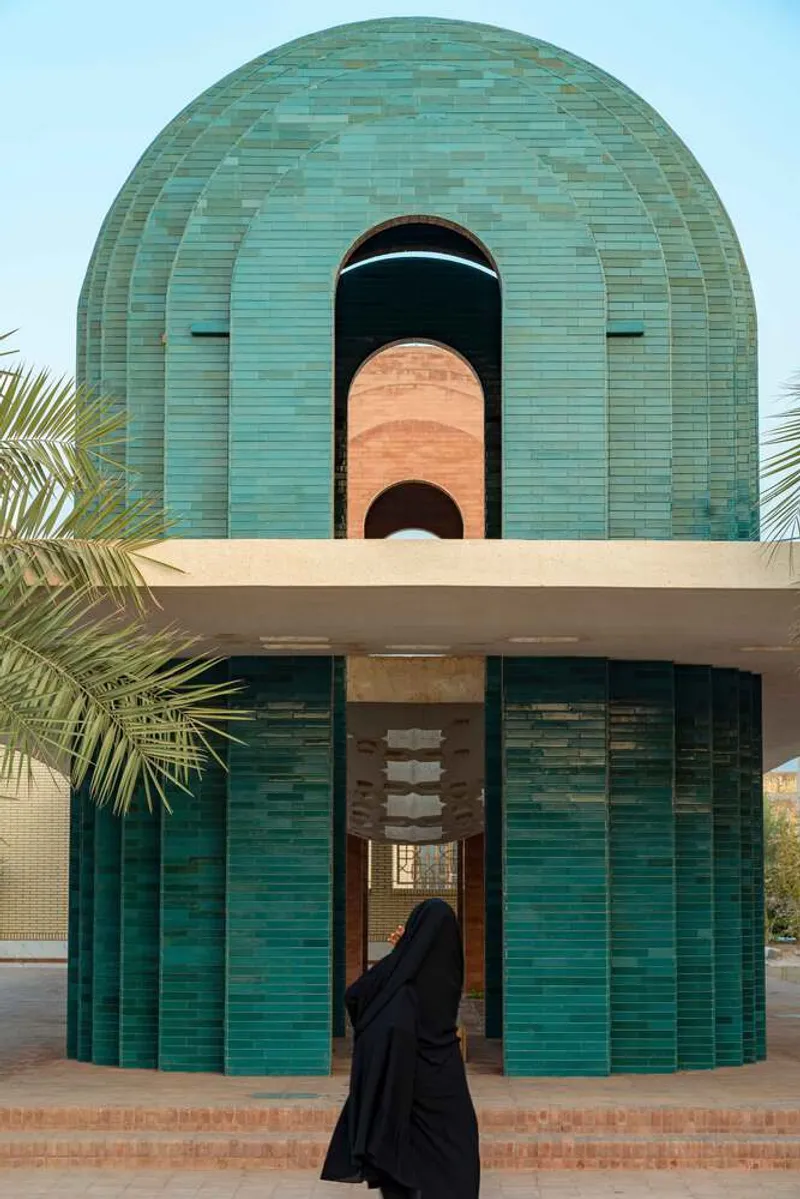
The most conceptually charged decision here is functional, not formal. A private tomb typically closes inward: walls, a door, a sealed chamber for one family's grief. The Shafagh Tomb opens outward, serving as the main entrance to the cemetery complex. The shaded colonnade channels circulation through the building rather than around it, so that every visitor to the cemetery passes through this family's memorial.
That blurring of private monument and public infrastructure has deep roots in Iranian architecture, where mosques, caravanserais, and shrines have always served overlapping civic and devotional roles. But in a contemporary context, the gesture feels unusually generous. The tomb embraces its surroundings rather than defending against them, and the sequence of arches piercing through the canopy frames views of the sunlit plaza beyond, making the boundary between inside and outside deliberately ambiguous.
Material Dialogue: Soil and Sky
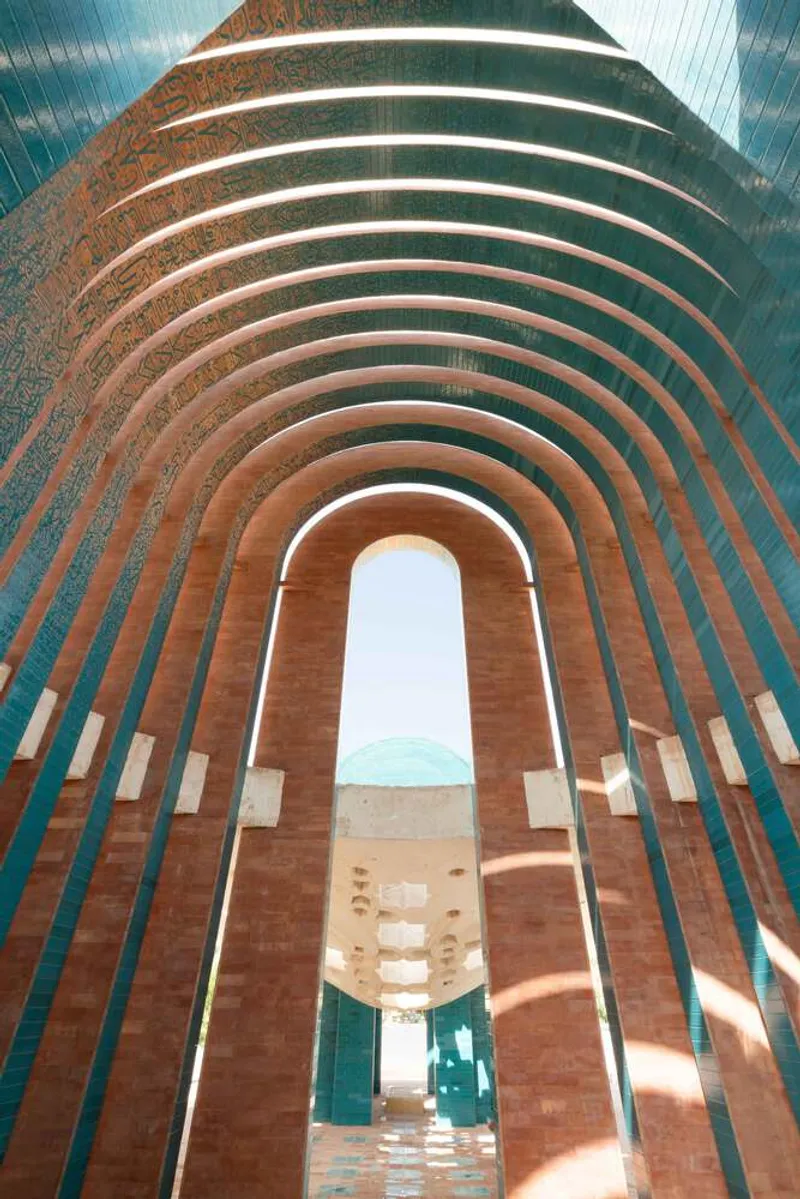
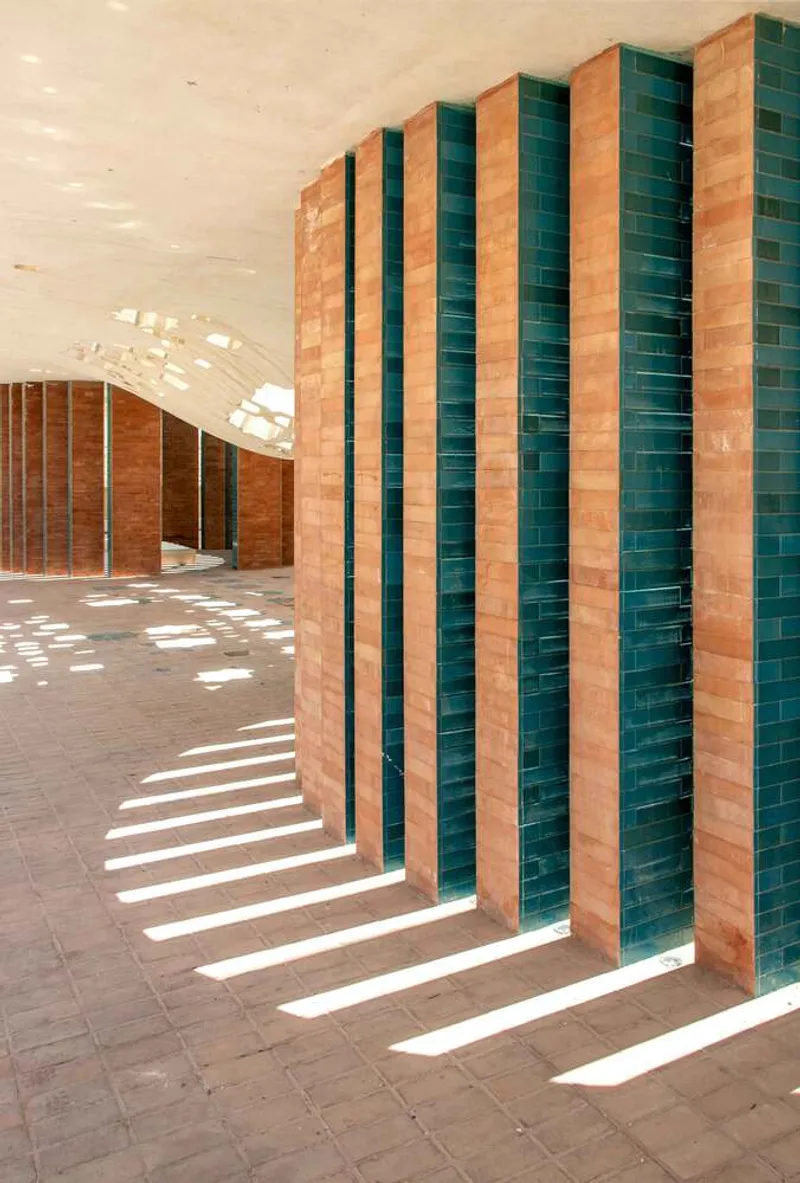
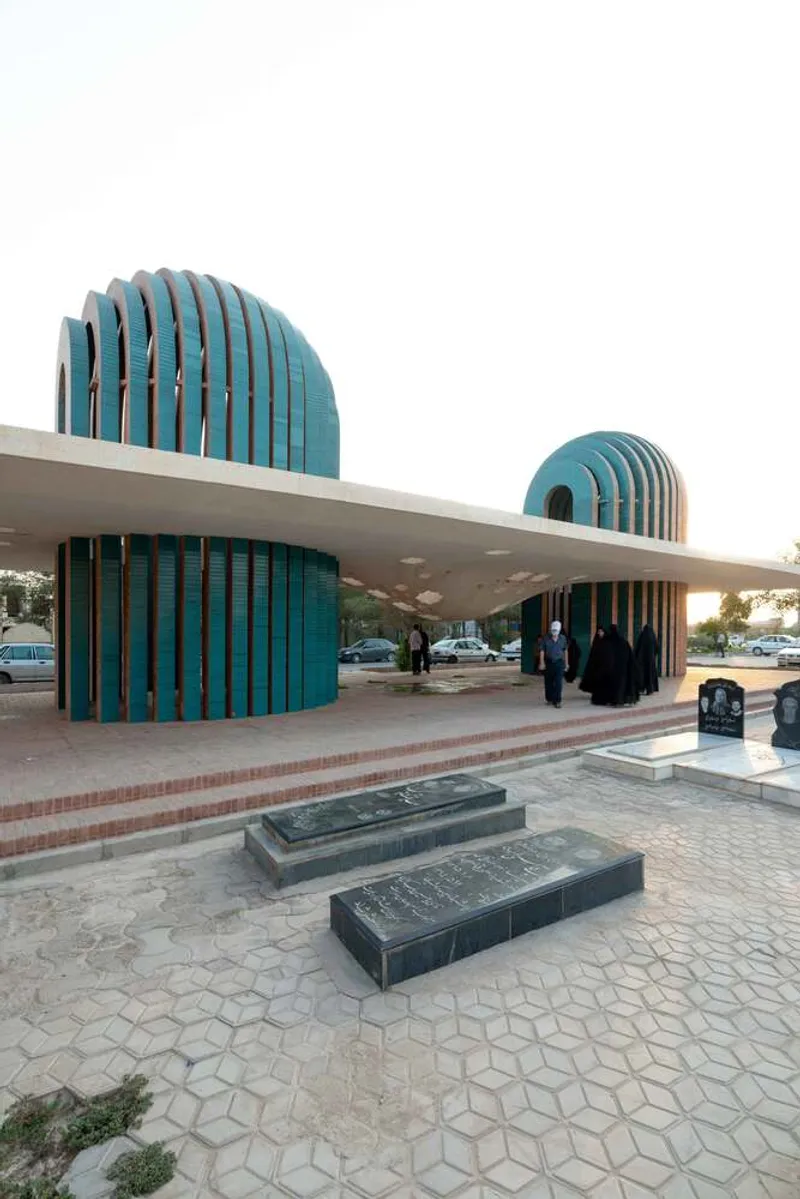
The palette is binary and legible. Soil-colored bricks ground the building in its desert context, reading as an extension of the earth itself. Turquoise glazed bricks lift the eye and connect the project to the long Iranian tradition of blue-tiled sacred architecture, from Isfahan's mosques to the shrine complexes of Mashhad. The two materials trade places throughout: terracotta bands alternate with teal on the ribbed vaults, turquoise columns stand against brick paving, and the overall effect is of a building that oscillates between earthbound and aspirational.
At dusk, as visible in the exterior views, the turquoise tiles catch the last ambient light while the concrete canopy recedes into shadow. The domes read almost as lanterns above the horizontal roof plane. It is a smart material strategy: the building changes its visual emphasis with the time of day, rewarding repeated visits and shifting the hierarchy of its elements with every hour.
Why This Project Matters
The Shafagh Tomb matters because it takes on one of architecture's hardest problems, how to build within a living tradition without either freezing it in nostalgia or abandoning it for novelty, and arrives at a convincing answer. The defamiliarization strategy works precisely because it is not wholesale invention. Every move, the lowered dome, the liberated calligraphy, the sabat-derived canopy, has a clear ancestor in Iranian architectural history. What changes is the relationship between these elements and the people who encounter them.
In a global context where "contemporary Islamic architecture" too often defaults either to parametric spectacle or to literal historical pastiche, the Shafagh Tomb charts a third path. It is specific to Ardakan's climate and cemetery culture, legible within a thousand-year tradition, and genuinely new. That combination is rarer than it should be, and it makes this small building one of the more thoughtful recent contributions to the ongoing conversation about how tradition evolves.
Shafagh Tomb by 35-51 ARCHITECTURE Office (Lead Architects: Hamid Abbasloo, Abbas Yaghooti, Neda Adiban Rad). Ardakan, Iran. 448 m². Completed 2023. Photography by Arash Akhtaran.
About the Studio
Share Your Own Work on uni.xyz
If projects like this are the kind of work you want to make, uni.xyz is a place to publish your own, find collaborators, and enter design competitions.


Popular Articles
Popular articles from the community


Faces of the Soviet Avant-Garde: Turning Moscow's Street Names into an Open-Air Museum
A network of sculptural installations across a Moscow residential district transforms forgotten architect names into spatial encounters with cultural memor

The Amber Palace Opera: A Geological Fiction Surfaces on Tallinn's Baltic Waterfront
Pierre Brillard reimagines a Baltic legend as a public landscape, opera house, and waterfront promenade rooted in Tallinn's coastal identity.

Opera by the Sea Estonia: Three Shells Dissolving Architecture into Tallinn's Coastline
A winning opera house proposal replaces monumental form with interconnected shells that blur the boundary between building, park and Baltic Sea.

Temporary Home for Dogs: A Reversed Zoo Rethinks Animal Shelter Architecture
In Bucharest, a sinuous corridor and freed landscape flip the logic of containment, designing a shelter that works to make itself unnecessary.

Similar Reads
You might also enjoy these articles


Hodi-Mandai Geram
Project Function: Preservation and revitalization of the Intangible heritage and socio-spatial identity of the Hodi by Housing, Cultural Memory Center, Sacred Grove, landscape, local tourism economy


Olio Towers: A Mid-Rise for Performers That Fuses Housing, Rehearsal, and Stage
Located blocks from Houston's Theater District, this modular tower stacks living units around a central performance atrium.

Oasis: Modular Green Housing Carved into Dhaka's Urban Fabric
A shortlisted Plugin Housing entry reclaims unauthorized settlements in Dhaka with stepped concrete volumes, green roofs, and ventilation-driven design.

Black Hole: A Floating Megastructure for the Post-Physical Era
Emiliano Mazzarotto envisions a spherical, self-scaling arena where e-sports, digital hotels, and holographic stadiums replace traditional public space.

Explore Mausoleum Competitions
Discover active competitions in this discipline

Challenge to reimagine the Iron Throne

Photograph architecture without architects

Illustrate the lost glory of Angkor Wat - Render Challenge

Bring back Drive In's
Comments (0)
Please login or sign up to add comments
No comments yet. Be the first to comment!