

SHAU Indonesia Builds a Spiraling Public Square for a Javanese Beach Town of 420,000
Paamprokan Square gives Pangandaran a landmark gathering space where a concrete tower, open pavilion, and plaza meet the coast.


Public space in Indonesian coastal towns tends to default to the beach itself, a strip of sand that doubles as promenade, market, and parking lot. In Pangandaran, a south-coast West Java town of 420,000 people, SHAU Indonesia saw an opportunity to give the community something more deliberate: an 18,000-square-meter civic ground that pulls life off the shoreline and into a landscaped interior. Paamprokan Square, completed in 2021 as part of Governor Ridwan Kamil's priority public space programs for the province, takes its name from the Sundanese word for "to gather." The name is not decorative. It is a program brief compressed into a single verb.
What makes the project worth examining is its funding model as much as its architecture. The site was government-owned land that happened to sit between a coastal road and a developer's property. In a public-private arrangement, the developer donated construction of the square in exchange for direct access through the government parcel. That transactional clarity freed the architects to design without the usual municipal budget constraints, and the result, a spiraling concrete observation tower, a generous steel-canopy pavilion, and a broad stone plaza, reads with a confidence that small-town civic projects rarely achieve.
A Civic Anchor Between Road and Shore


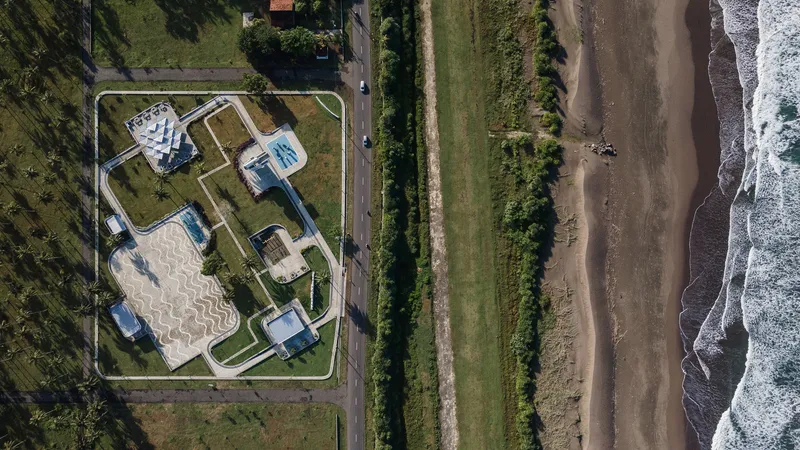
From the air the logic is immediate. The square occupies a green clearing bounded by a curving perimeter road on one side and dense coconut palm groves on the other, with the Indian Ocean surf visible just beyond. Rather than competing with the coastline, the complex holds its own center of gravity: pavilions, pathways, and the tower are arranged to pull pedestrians inland, creating a destination that does not depend on the beach for its identity.
The serpentine paving visible in the aerial views stitches multiple programmatic zones, playground, exercise area, open plaza, into a single readable figure. This is a project that thinks in plan before it thinks in elevation, and the discipline shows. Circulation is generous, shade is strategic, and the sightlines back toward the coast keep visitors oriented even as they move deeper into the compound.
The Tower as Vertical Landmark

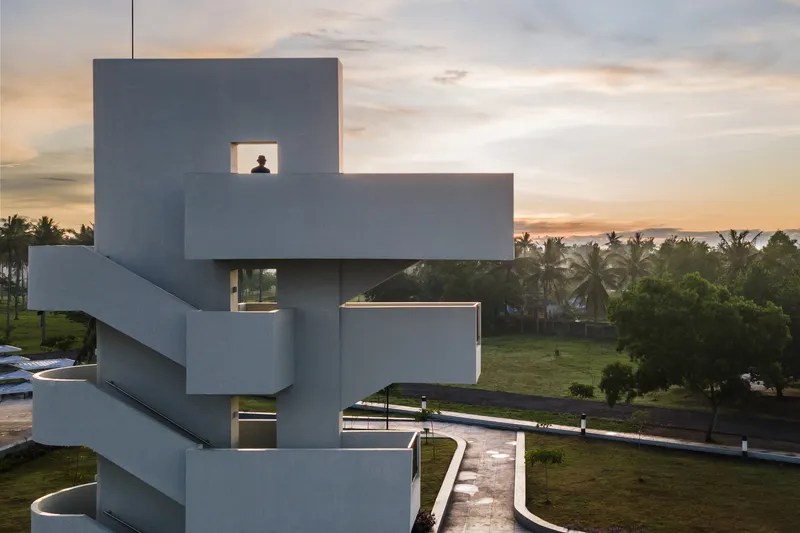
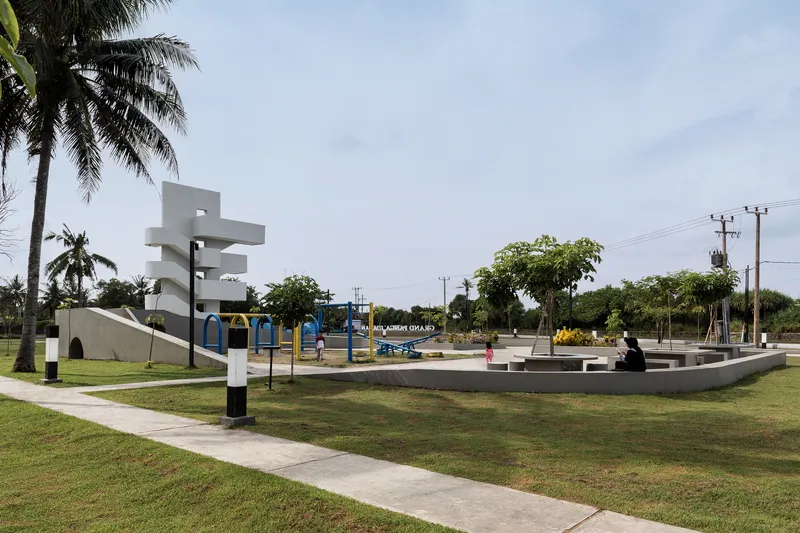
The spiraling white concrete tower is the gravitational center of the entire composition. Its stacked volumes, each slightly rotated and cantilevered from the one below, give it a kinetic silhouette that reads clearly against the flat palm canopy. It is not a watchtower in any military sense, but it does exactly what a watchtower should: it marks a spot on the ground and rewards the climb with a panoramic orientation to the landscape.
Cutout windows and an exterior staircase break the mass into approachable pieces. At dusk, when the concrete catches low light and the cantilevers throw long shadows, the tower transforms from a civic marker into something closer to sculpture. SHAU has clearly studied how a vertical element operates in a flat coastal terrain, and they have calibrated the tower's height to clear the palm crowns without overwhelming them.
Inside the Tower: Framed Views and Open Air

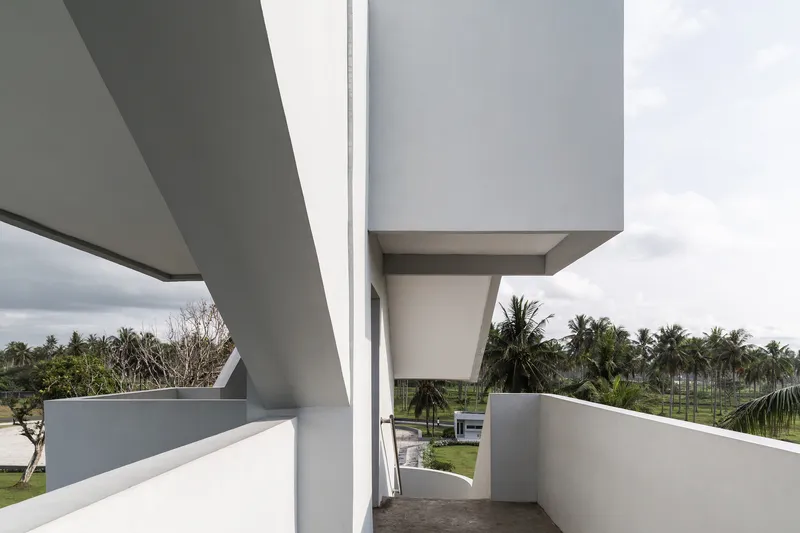
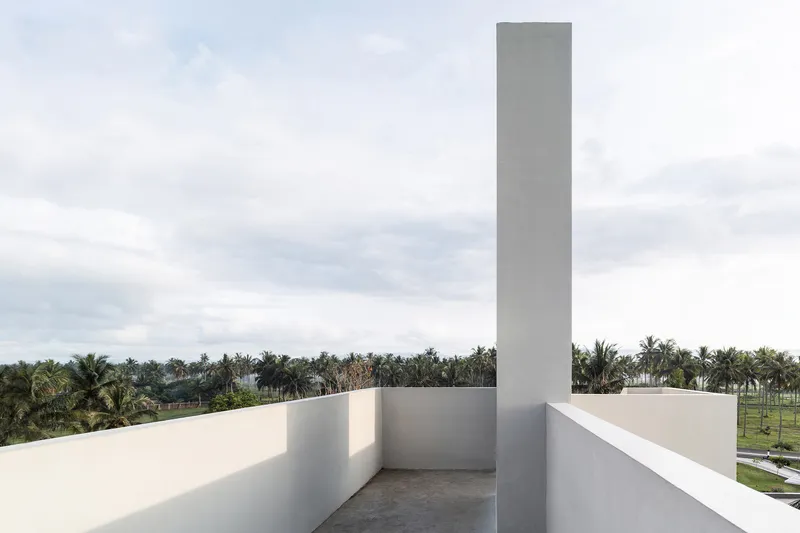
The interior experience of the tower is a sequence of tightly framed views. Stairwell openings cut through white walls to reveal the ocean, the roadway, and the palm grove at different elevations. Each landing functions as an outdoor room: cantilevered slabs create shaded passages, and the breeze moves through unenclosed corridors without obstruction. There is no glass here, no conditioned air, just concrete and sky.
At the rooftop level, a square chimney element rises above the parapet and the surrounding palm canopy drops away. The decision to leave the upper terraces open rather than capping them with a viewing platform enclosure is the right one for this climate. It keeps the tower porous, prevents heat buildup, and ensures that the structure never feels sealed off from the town it serves.
The Canopy Pavilion and the Plaza


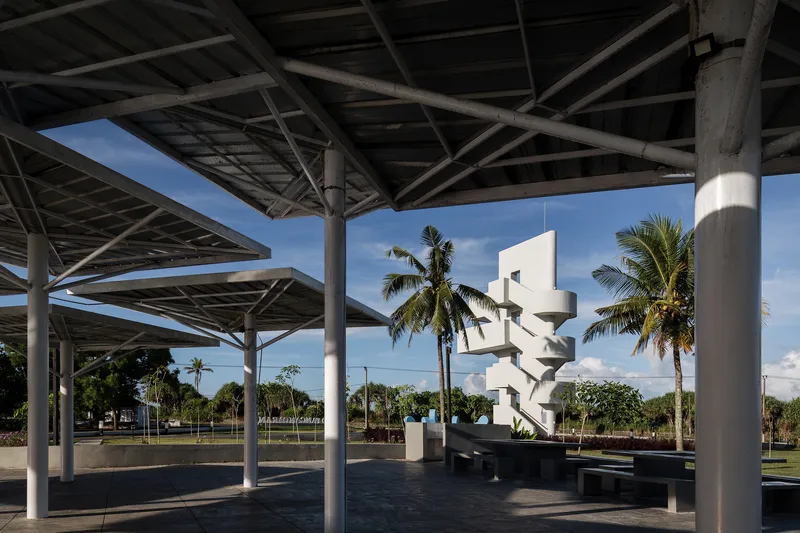
If the tower is the exclamation point, the open pavilion is the paragraph. A folded white steel roof rests on a grid of slender circular columns, creating a shaded zone large enough for markets, gatherings, or simply sitting out a midday rain. The canopy's geometry is angular without being aggressive, its folds directing rainwater while casting shifting patterns of light on the ground plane beneath.
The broad stone plaza that extends from the pavilion uses large-format tiles laid in a clean grid, a surface that reads as generous and maintained rather than monumental. Under the gridded steel canopy, views filter through columns toward the tower and the palms beyond, collapsing the distance between covered and open space. The material palette, stone and concrete throughout, is deliberately restrained, letting the spatial moves carry the architectural argument.
Ground-Level Life: Play, Exercise, and Shade
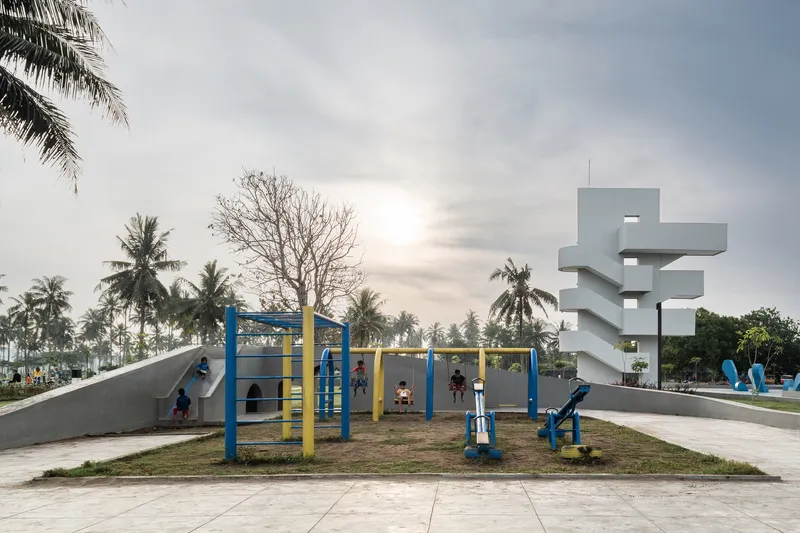


A public square is only as good as the people who use it, and the images of Paamprokan at dusk show exactly the kind of layered occupation that architects hope for. Children swarm the blue and yellow playground equipment at the base of the tower. An exercise zone with outdoor equipment sits beneath a bare tree, attracting adults to a different part of the site. Visitors walk along curved concrete walls that organize the edges without enclosing them.
The decision to distribute program around the site rather than concentrating everything under the canopy means that the square activates across its full 18,000 square meters. Palm trees provide dappled shade where architecture does not, and the spatial gaps between built elements are as important as the structures themselves. Nothing feels leftover.
Context and Landscape


One image tells you everything about how this project sits in its world: a farmer in a conical hat works a grassy field in the foreground while the white stacked tower rises behind palm trunks. Paamprokan Square does not pretend to be metropolitan infrastructure dropped into a rural setting. It acknowledges the agrarian landscape and the beach economy that define Pangandaran, and it inserts itself as a third register, a civic ground that belongs to neither the farm nor the resort.
At sunset, the aerial view of the flat canopy structure among palms is quietly striking. The building's horizontal datum line echoes the flat ocean horizon, while the tower provides the one vertical counterpoint. SHAU understood that in this landscape, restraint at ground level earns the right to one emphatic gesture upward.
Plans and Drawings

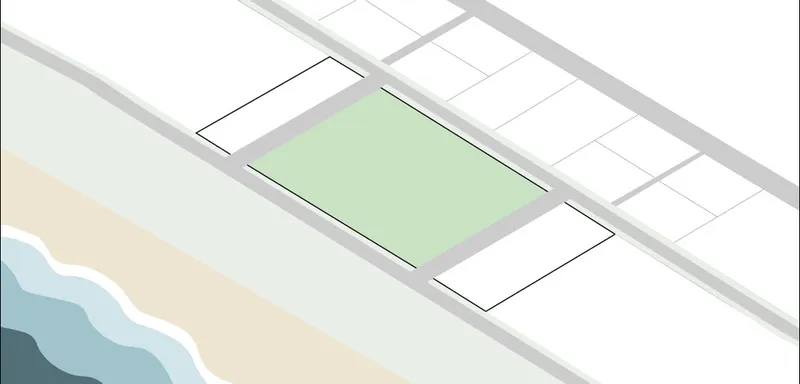
The site plan reveals the full extent of the landscape strategy: multiple pavilions connected by pathways are enclosed within a perimeter ringed by trees, creating a legible boundary between the public square and the surrounding roads and palm plantations. The axonometric drawing shows a rectangular pool courtyard set within a gridded framework adjacent to the beach, suggesting a secondary amenity zone that complements the tower and pavilion. Both drawings confirm that the project was conceived as a landscape-first intervention, with architecture distributed as punctuation rather than as continuous enclosure.
Why This Project Matters
Paamprokan Square matters because it demonstrates what happens when a public space funding model actually works. The public-private arrangement that made this project possible is not a novel concept, but its execution in a secondary Indonesian town is notable. The developer got site access, the government got a finished civic space without capital expenditure, and the community got a place to gather that is not a parking lot or a neglected park. The architecture, a confident composition of tower, canopy, and plaza in stone and concrete, elevates the transaction into something worth visiting and worth studying.
For a practice like SHAU, which has built its reputation on community-oriented projects in Indonesia, Paamprokan represents a scale jump. Eighteen thousand square meters of public ground, anchored by a vertical landmark visible from the coast road and the surrounding fields, is a serious piece of civic infrastructure. It is also proof that towns like Pangandaran, often overlooked in favor of Bali or Jakarta in architectural discourse, can produce work that contributes meaningfully to the conversation about tropical public space.
Paamprokan Square by SHAU Indonesia. Pangandaran, Indonesia. 18,000 m². Completed 2021. Photography by Andreaswidi.
About the Studio
Share Your Own Work on uni.xyz
If projects like this are the kind of work you want to make, uni.xyz is a place to publish your own, find collaborators, and enter design competitions.


Popular Articles
Popular articles from the community


Faces of the Soviet Avant-Garde: Turning Moscow's Street Names into an Open-Air Museum
A network of sculptural installations across a Moscow residential district transforms forgotten architect names into spatial encounters with cultural memor

Tsunami Convergenics: Turning Catastrophic Ocean Forces into Underwater Housing Infrastructure
A speculative underwater settlement off the coast of Onagawa, Japan, treats tsunamis and typhoons as energy sources rather than threats.

Opera on the Sea: Driftwood Logic Shapes a Timber Opera House on Estonia's Coast
Trevor Orgill's opera house translates the entangled drift of floating timber into a civic building where wood, water, and music converge.

Extended Shell: Retrofitting Kolkata's Balconies as Living Urban Thresholds
A modular retrofit system recovers the social and environmental intelligence of Kolkata's historic verandas for contemporary Park Street residents.

Similar Reads
You might also enjoy these articles

Bao Huynh Watercolor Atelier: A Serene Art Retreat in Hội An
Bao Huynh Watercolor Atelier in Hội An blends multifunctional art spaces, sustainable design, local materials, and family-friendly living in a serene environment.

Atelier Macri Concept Store Interior Design by CASE-REAL
Atelier Macri store features a "ko" counter, walnut wood details, cork displays, blending retail, gallery, and seamless customer experiences.

Manuel Vargas Izquierdo Stadium and High-Performance Sports Center: Architectural Excellence in Jalpa de Méndez
The Manuel Vargas Izquierdo Stadium blends sustainable design, inclusive sports facilities, and cultural-inspired architecture, revitalizing Jalpa de Méndez’s public spaces.
KAKR Buluh Awar Hall: Revitalizing Community and Ecology Through Bamboo Architecture
Community built bamboo hall revitalizes Buluh Awar village, empowering youth, restoring ecology, celebrating vernacular craftsmanship through sustainable architecture and culture.

Explore Public Square Competitions
Discover active competitions in this discipline

Challenge to design a portable theatre

Challenge to design a portable music platform

Challenge to design an open learning module for the elderly
Comments (0)
Please login or sign up to add comments
No comments yet. Be the first to comment!