
Yijing Architectural Design Carves a Green Valley Campus into Shenzhen's Dense Urban Fabric
A 24-class junior school in Longhua District stacks gardens, sports fields, and classrooms on an irregular hillside site between towers.


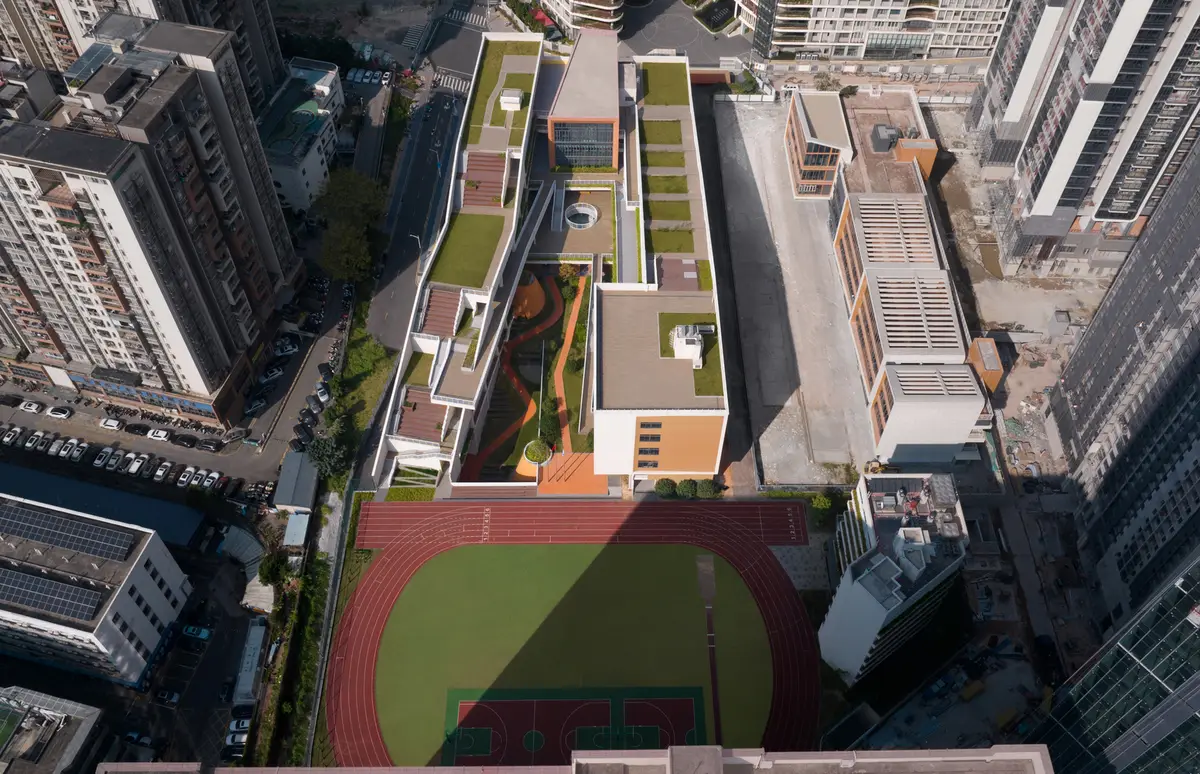
Shenzhen's Longhua District is the kind of place where residential towers crowd every available lot and school sites arrive as leftover geometries. For the Qingquan Foreign Language Junior School, Yijing Architectural Design received a 14,590 square meter trapezoid with a 7.1 meter grade change, then was asked to fit 24 classrooms, a library, an auditorium, sports facilities, and meaningful outdoor space into roughly 29,266 square meters of built area. The result is less a building and more a topographic operation: two six-story classroom wings define the perimeter while a cascade of planted terraces fills the space between them, producing what the architects call a "campus valley."
What makes the project genuinely interesting is its refusal to treat density as a concession. Rather than stacking program into a single slab and calling it efficient, Yijing split the mass, lifted it on pilotis, and used the resulting section to generate rooftop gardens, aerial walkways, and covered ground-level plazas that give students far more usable outdoor area than a conventional footprint would allow. The school sits among towers that dwarf it, yet its terraced profile reads as landscape rather than institution.
A Valley Between Wings
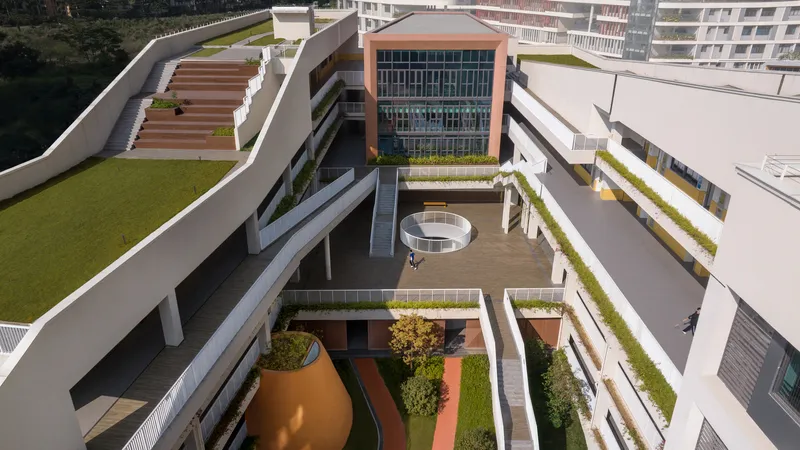
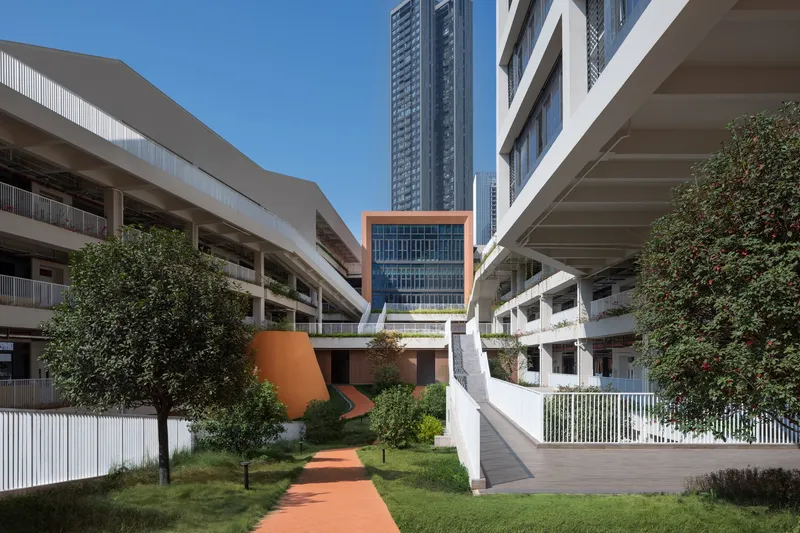
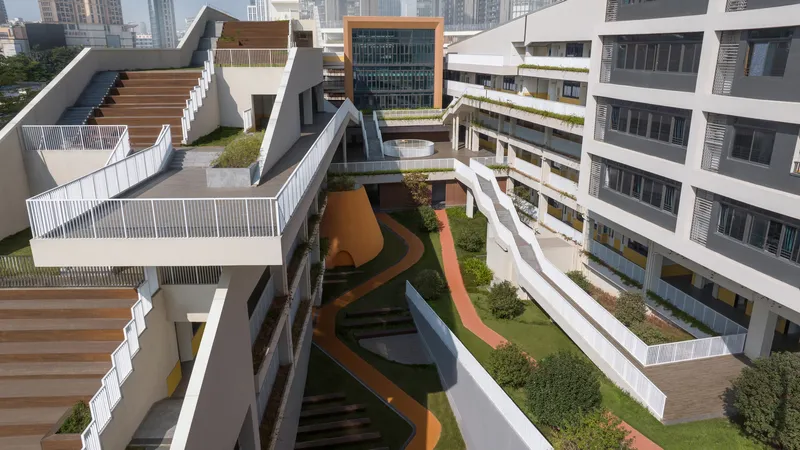
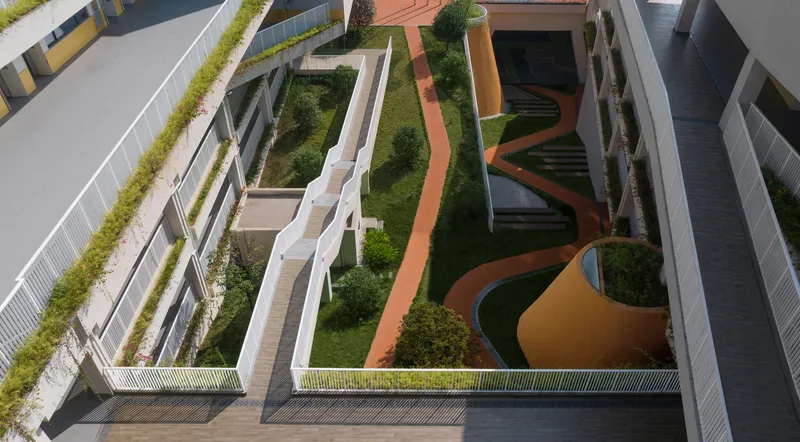
The two classroom wings angle toward each other to follow the irregular lot boundary, creating a widening central courtyard that steps down with the natural grade. Curved pathways thread between planted beds, and the section produces a series of half-levels and terraces that give the courtyard the feeling of a small ravine. It is a legible organizational move: classrooms face inward toward green, circulation wraps the perimeter, and the valley becomes the social heart of the campus.
From above, the courtyard reads as a continuous green surface punctuated by circular skylights and pavilion structures. At ground level, the experience shifts to something more intimate: grass slopes, shaded arcades, and moments of enclosure that break down the scale of what is, by numbers, a substantial institutional building.
Lifting the Ground Plane
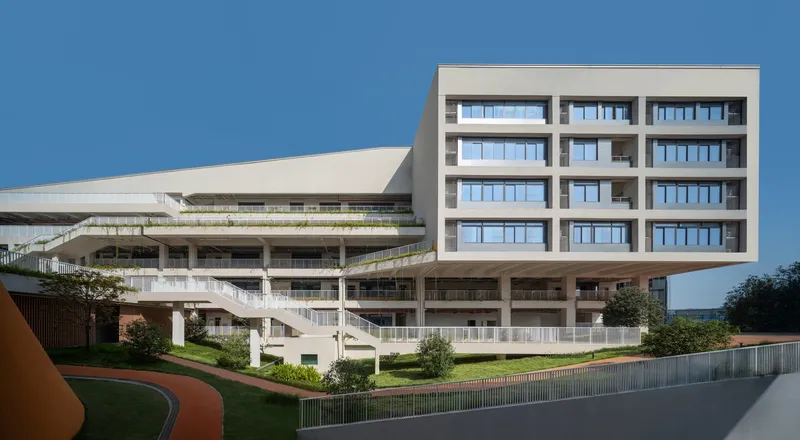
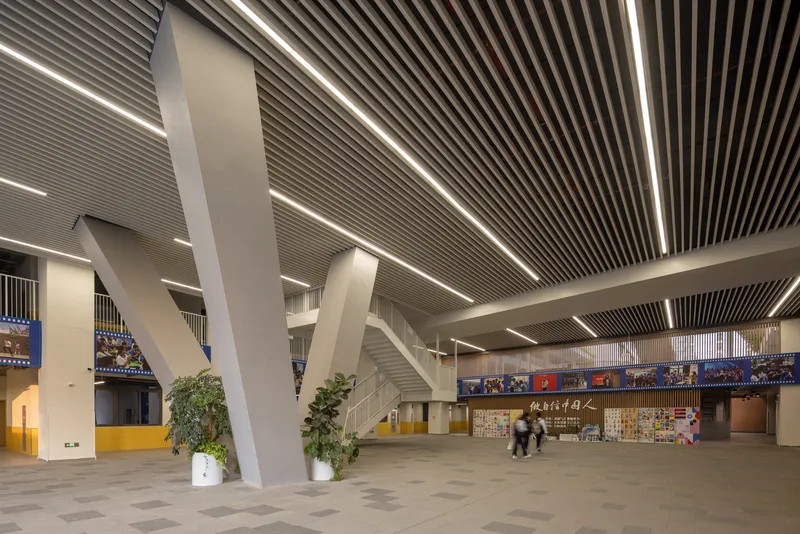
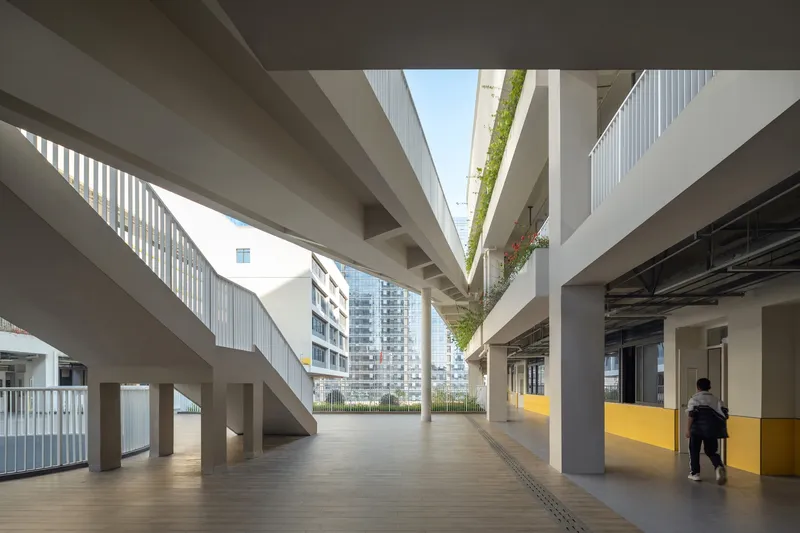
The ground floors of both classroom wings are elevated on concrete columns, a move that accomplishes several things simultaneously. It opens sightlines across the site so that arriving students can see through to the courtyard beyond. It creates covered outdoor space beneath the building volume, useful in Shenzhen's subtropical climate where rain and heat make shade a necessity rather than a luxury. And it visually reduces the apparent mass of six-story wings that would otherwise feel oppressive at the property edge.
The entrance sequence takes advantage of this openness. Angled white columns support a slatted ceiling with integrated lighting, creating a threshold that is generous without being monumental. Covered walkways with diagonal cross-bracing and vertical planted walls extend this language, turning circulation into something closer to a garden promenade than a school corridor.
Rooftop Landscapes and the Stacked Sports Field
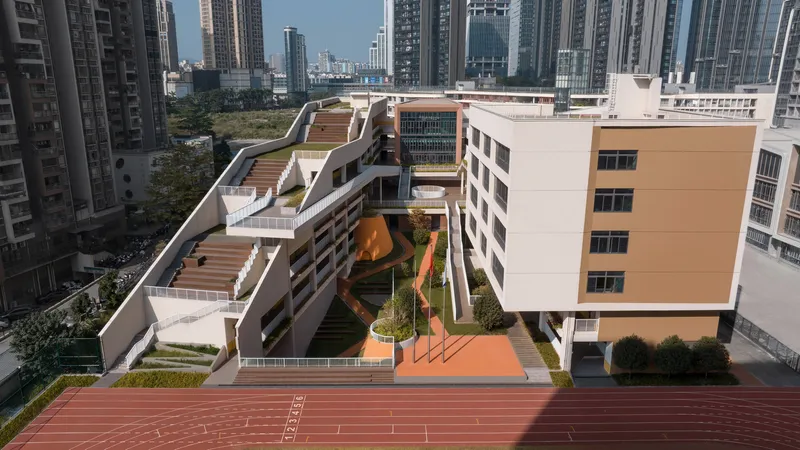
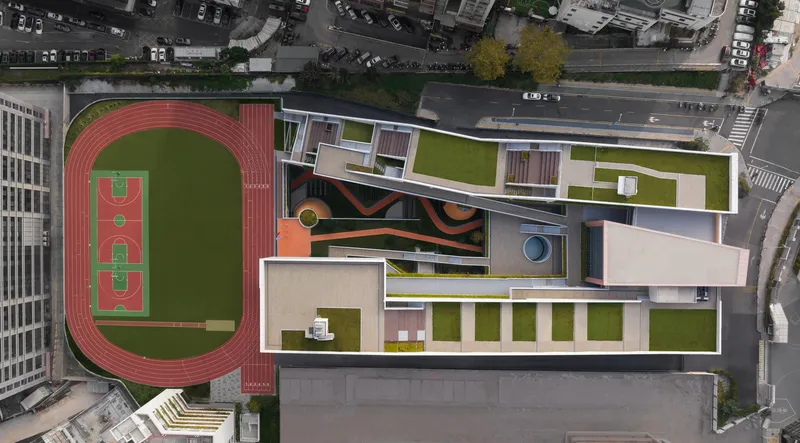
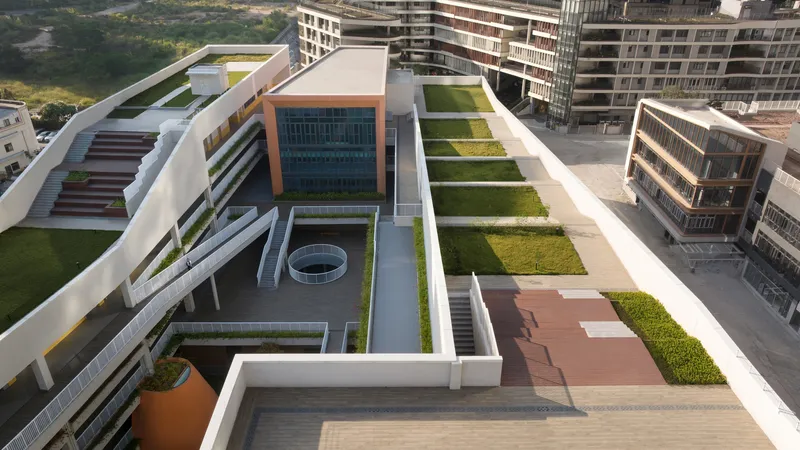
The most consequential design decision may be the treatment of the roof. Setbacks in the classroom wings create a series of terraced green roofs that step upward from the courtyard valley to the building perimeter, extending the usable landscape well beyond the ground plane. Lawn panels, planted beds, and observation decks give students direct access to outdoor space on multiple levels, and the green surfaces work as passive cooling, reducing heat absorption in a city where summer temperatures regularly exceed 35 degrees Celsius.
The running track, which on a conventional campus would consume the majority of ground-level open space, is elevated to the roof level and positioned along the street edge. This frees the courtyard for softer, slower activities while placing the athletic program where it benefits from airflow and views. A covered sports hall beneath the track ensures year-round use regardless of weather. It is a vertical stacking strategy applied to recreation rather than classrooms, and it works.
Orange Interventions and Child-Scaled Moments
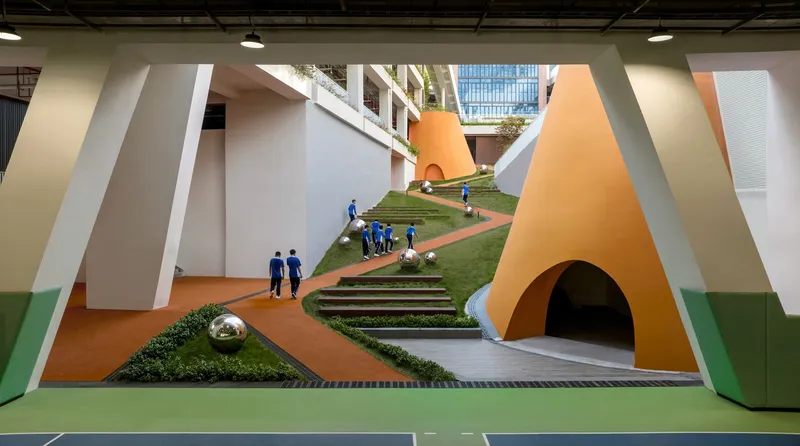
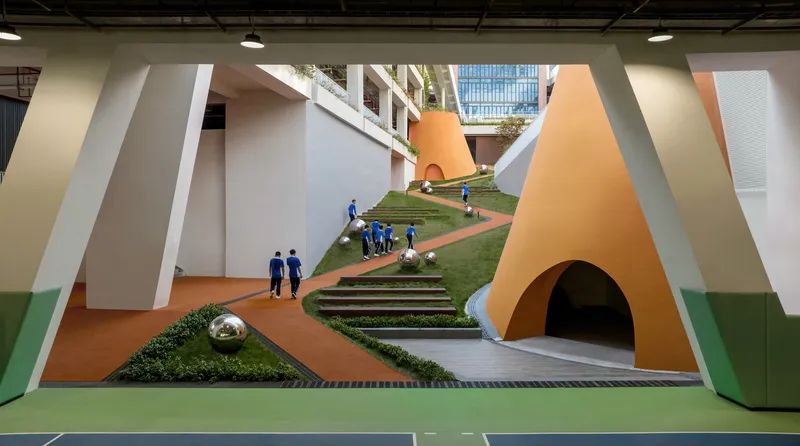
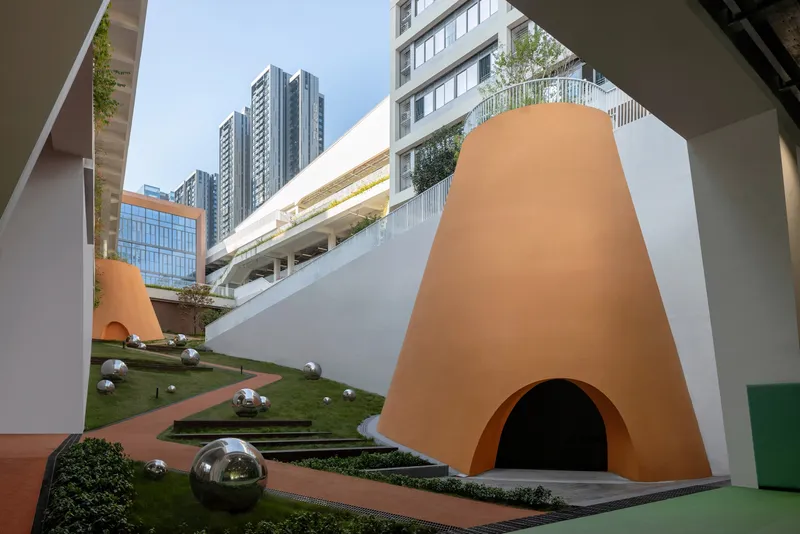
Against the white concrete and glass of the classroom wings, a series of orange sculptural elements inject color and play. Curved tunnel entrances, conical volumes, and arched forms appear at key points in the courtyard and along the terraced slopes. These are not decorative afterthoughts. They mark auditorium entrances, frame views, and create micro-spaces where small groups of students can gather. The orange reads as invitation, signaling the moments where the architecture shifts from instruction to exploration.
A grassed slope in the interior courtyard becomes an informal amphitheater, its scale tuned to children rather than adults. Metal sphere sculptures sit among the conical volumes on the upper terrace, turning a rooftop into a landscape of objects that reward curiosity. The design concept reportedly draws on the image of a scholar teaching beneath a tree; the built reality translates that into architecture where learning and landscape are genuinely inseparable.
Vertical Connections and the Aerial Library
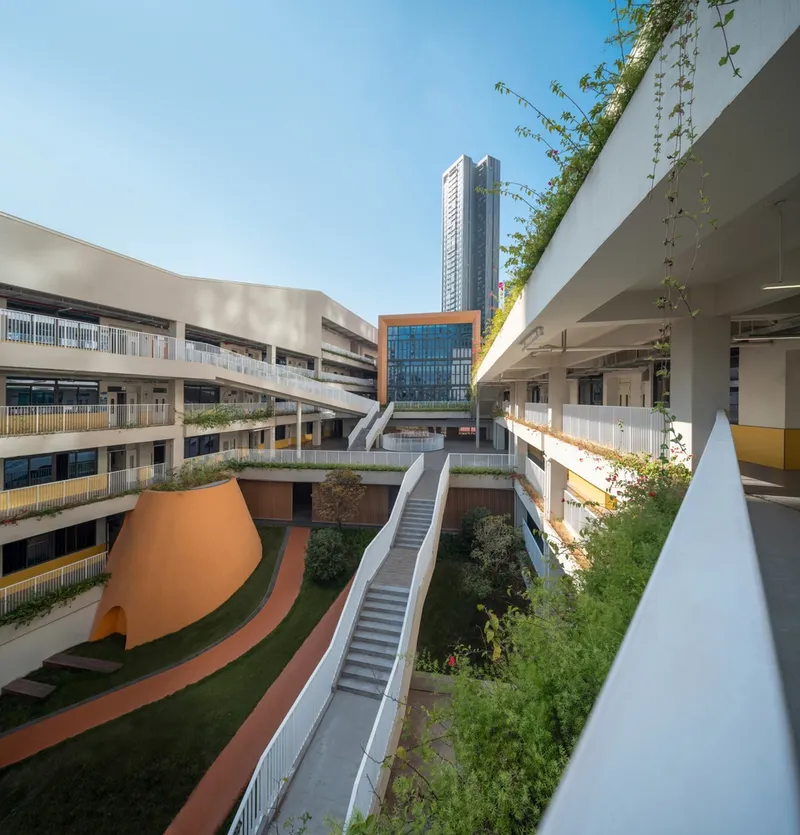
Pedestrian bridges and aerial walkways stitch the two wings together at multiple levels, the most significant being the aerial library that spans between the teaching buildings. Structurally, these connections stiffen the overall building frame while programmatically they eliminate the dead-end corridors that plague conventional campus plans. Students move through the section as much as across the plan, ascending through planted terraces and crossing over the courtyard valley.
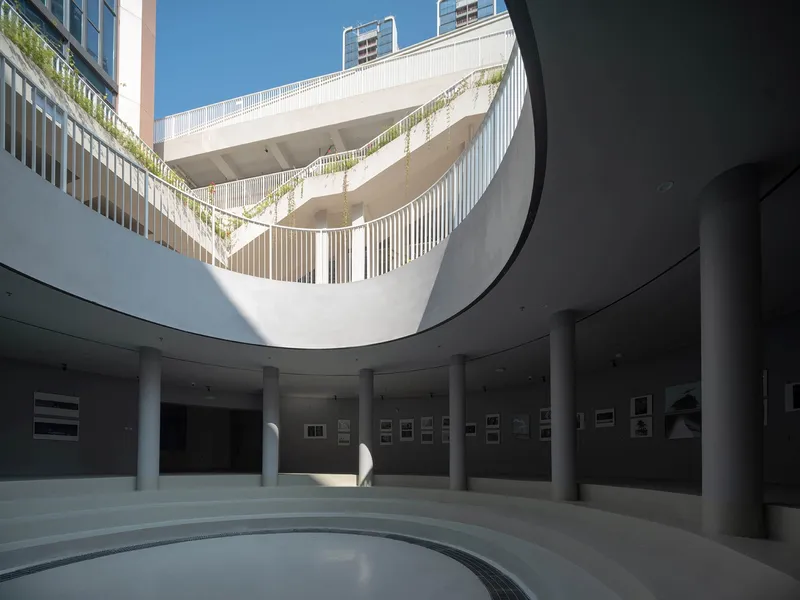
A circular atrium punches vertically through the building mass, lined with white louvers that filter light down to the lower levels. From below, the view upward through this void reveals planted terraces receding into sky. It is the most photogenic moment in the project, but it also performs real work: pulling daylight deep into the plan and establishing a visual datum that orients students within the complex section.
Dusk and the Urban Context
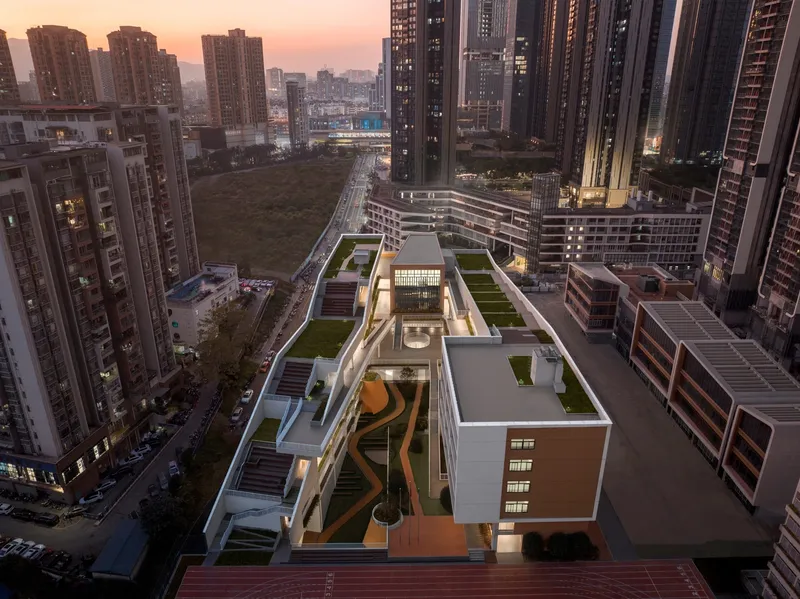
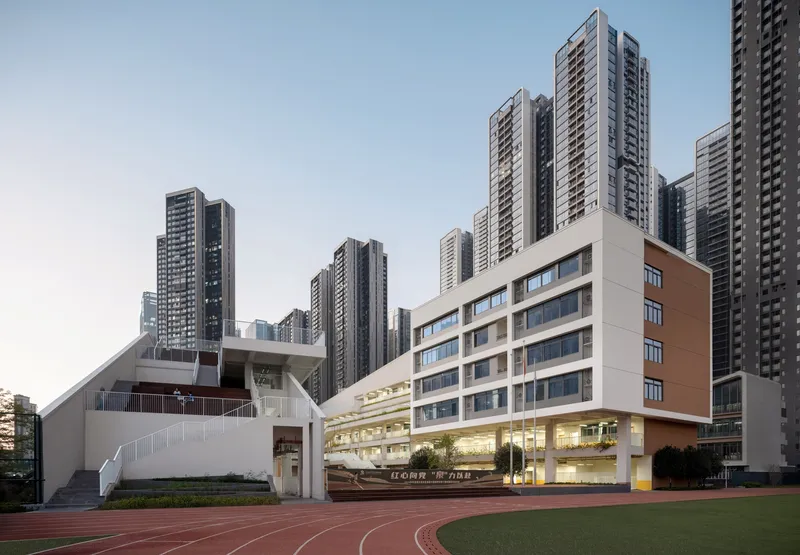
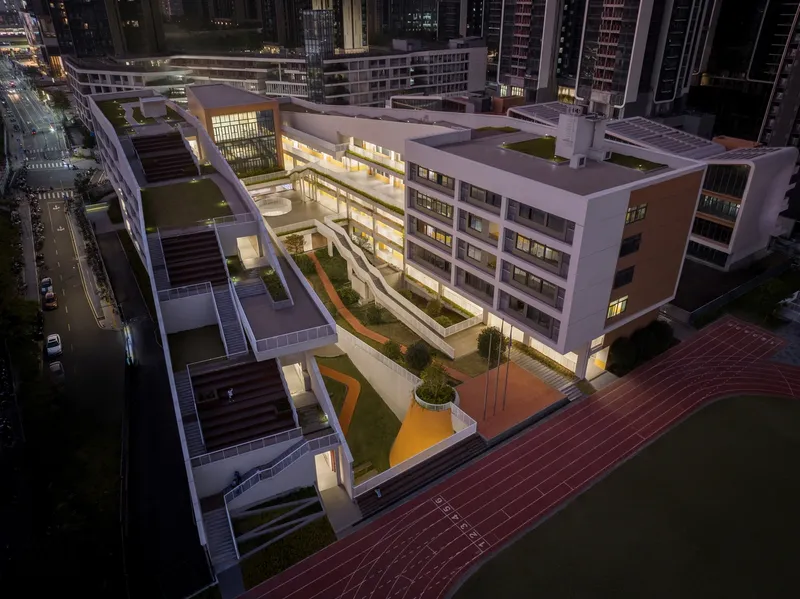
At dusk, the school glows between its residential neighbors, and the contrast in typology becomes stark. The surrounding towers are repetitive extrusions, identical floor plates stacked thirty or forty stories high. The school, by comparison, is a landscape in section: shifting volumes, green surfaces, and warm interior light visible through the glass facades. The running track's perimeter lighting draws a bright line along the street edge, announcing a civic presence that most schools in high-density Asian cities simply do not achieve.
The illuminated courtyard gardens, visible from the residential towers above, become a kind of neighborhood amenity even for those who never enter the campus. Shenzhen is a city where green space is measured in fractions of a square meter per capita. A school that presents 29,000 square meters of program as a terraced garden rather than a sealed block is making a statement about what density owes to the public realm.
The Courtyard as Social Infrastructure
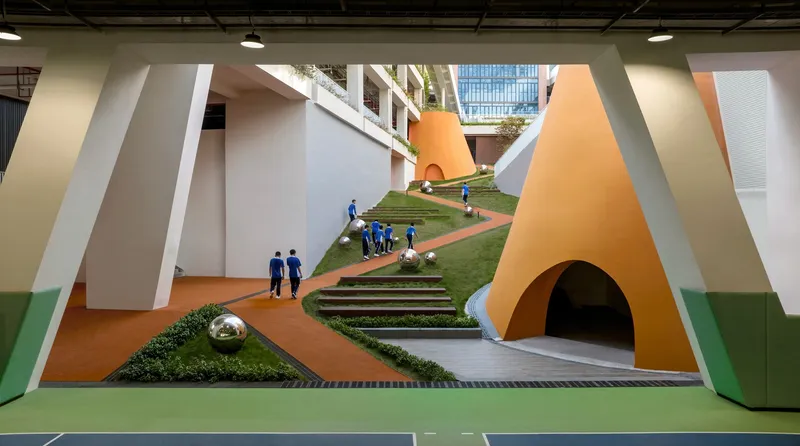
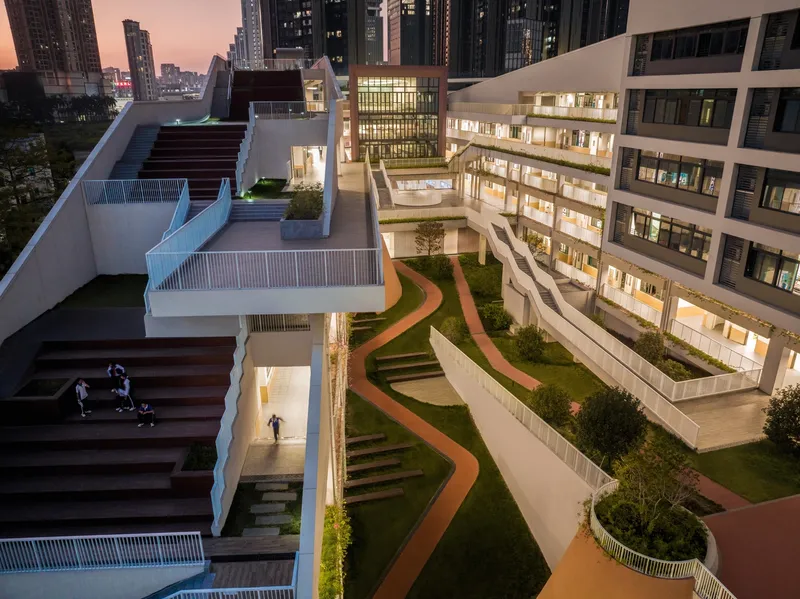
The terraced courtyard does the heaviest lifting in this design. It absorbs recess crowds, provides outdoor teaching space, handles stormwater through planted terraces that feed into a rainwater harvesting system, and gives the building its identity. Curved pathways prevent the space from reading as a single plaza; instead, it unfolds as a sequence of smaller rooms defined by grade changes, planting, and the orange sculptural walls. Students walking the stepped paths encounter different scales and degrees of enclosure as they move through the section.
This is where the project's high-density argument is most convincing. The courtyard area alone likely exceeds what a conventional single-story campus could provide on this site, because the landscape extends vertically across multiple roof levels. Density, in this reading, does not reduce outdoor space. It multiplies it.
Plans and Drawings
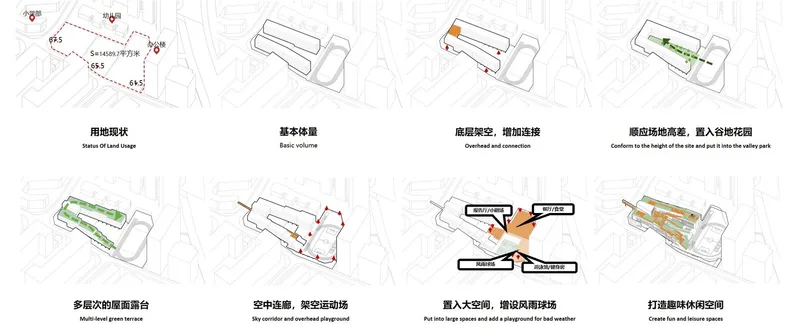
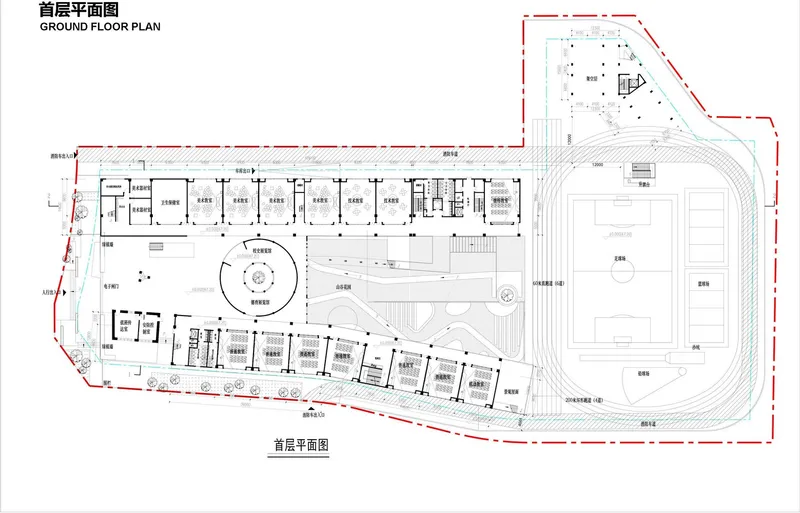
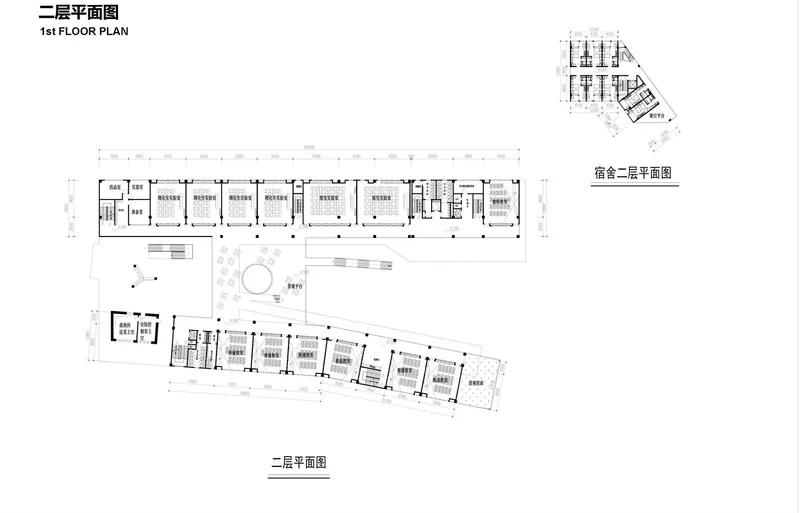
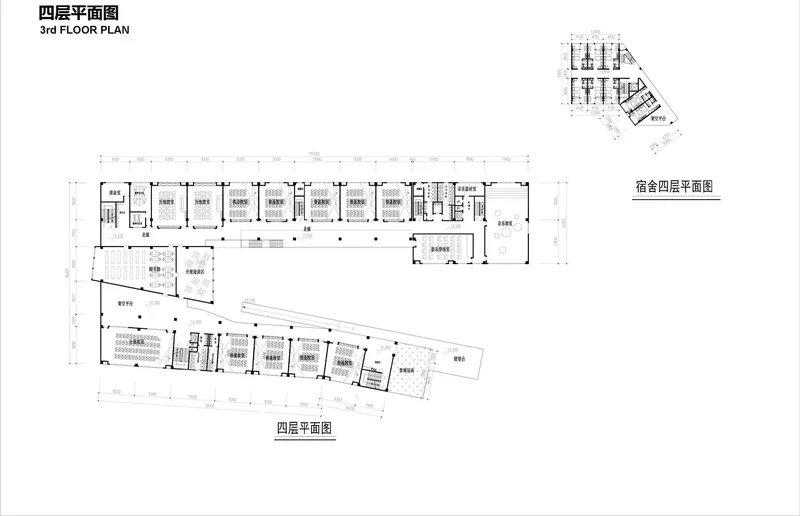
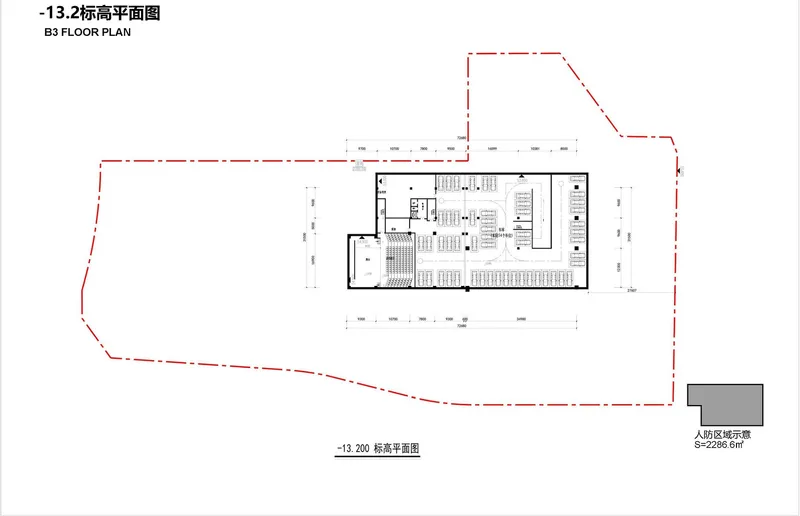
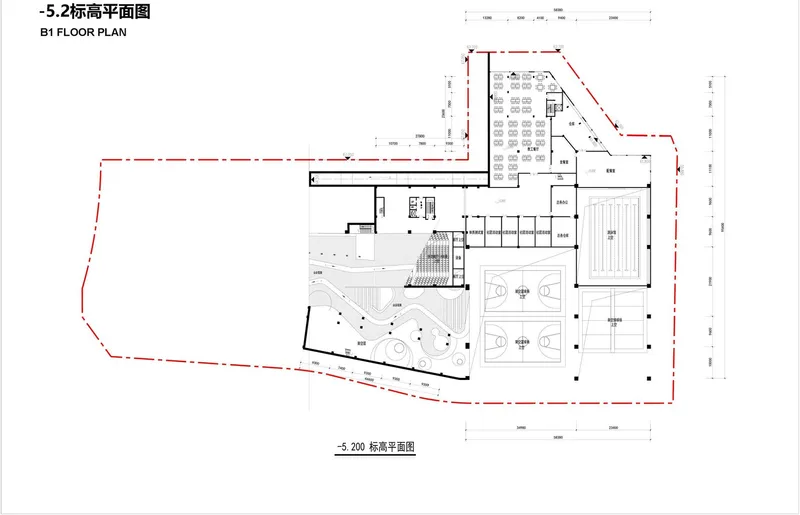
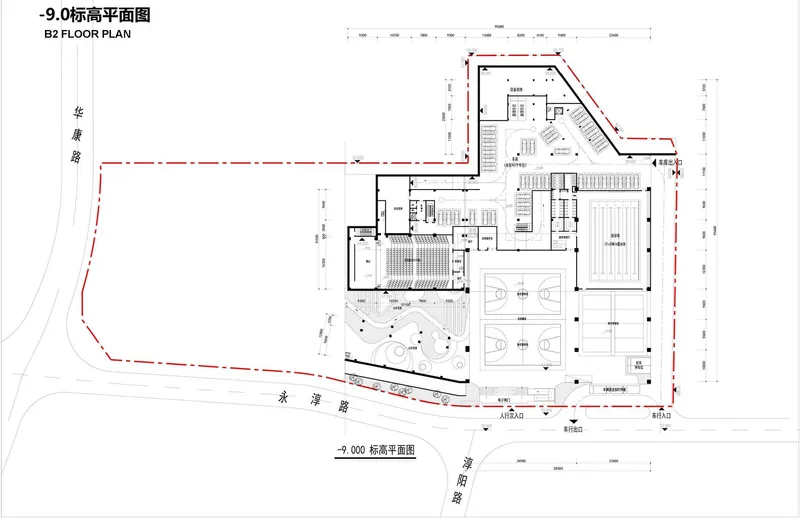
The axonometric diagrams reveal the massing logic clearly: the two wings splay outward to follow the trapezoidal boundary, and the central valley is not residual space but the primary organizing gesture. Floor plans show how the irregular perimeter generates angled classroom wings that branch from a central circulation spine, with the auditorium and sports facilities occupying the wider end of the trapezoid. The ground floor plan confirms that the outdoor sports field and courtyard form one continuous ground plane, with classroom blocks framing rather than dividing the landscape.
Upper-level plans demonstrate the aerial library's bridging role and show how basketball courts and stepped seating are tucked into the section at levels that would otherwise be unusable rooftop area. The diagonal stepped seating zone appears in multiple floor plans, suggesting it serves as both sports spectator space and informal gathering area across several levels.
Why This Project Matters
The default response to land scarcity in Chinese cities has been vertical extrusion: take the program, stack it, shrink the footprint. Yijing's approach at Qingquan is more sophisticated. By splitting the mass into two wings and treating every horizontal surface as potential landscape, the architects created a campus with more outdoor area per student than many suburban schools enjoy, all within a constrained urban lot. The section does the work that the plan cannot, and the result is a building that reads as topography rather than institution.
The project also offers a replicable model for school design in rapidly densifying cities across Asia and beyond. Its strategies, including elevated ground floors, stacked sports facilities, aerial connections, and terraced green roofs, are not formal gestures. They are spatial tactics that directly address the conflict between density and livability. If the premise of contemporary urbanism is that more people will live in tighter quarters, then schools like Qingquan demonstrate that children's environments do not have to suffer the consequences.
Shenzhen Longhua District Qingquan Foreign Language Junior School by Yijing Architectural Design. Located in Longhua District, Shenzhen, China. Total area: 29,266 square meters.
About the Studio
Share Your Own Work on uni.xyz
If projects like this are the kind of work you want to make, uni.xyz is a place to publish your own, find collaborators, and enter design competitions.


Popular Articles
Popular articles from the community


longwave studio Reorganizes a 112 m² Tainan Apartment Around the Daily Routines of a Family and Two Cats
In Tainan, Taiwan, birch plywood, rust-red furniture and a freestanding plaster wall link arrival, storage, work and family life in one apartment.

Architekt Andreas Gruber Scatters 23 Dark Timber Chalets Across a South Tyrolean Forest Edge
In Molini di Tures, Amonti Chalets breaks a resort into a hamlet of gabled timber houses, with parking, storage and services pushed into the slope.

David Ortega Stacks a Two-Story Mexico City Penthouse Around a Steel Stair and a Pergola-Shaded Roof Terrace
In Colonia Roma, a 300 m² penthouse uses oak joinery, a planted steel stair and a slatted roof pergola to make a new-build apartment feel like a house.

U.GA Architects Wraps an Oval Rooftop Pool in Curved Board-Formed Concrete on Busan's Jeollidan-gil
In Busan's Jeonpo-dong, a 454 m² mixed-use block stacks a neighborhood facility, guest rooms and an oval rooftop pool inside spiraling concrete walls.

Similar Reads
You might also enjoy these articles

Bamboo Housing Challenge 2026: Design Affordable, Sustainable Homes Using Bamboo
An international design competition by Bamboo U and IBUKU inviting architects and designers to reimagine affordable housing using bamboo — with the winning design built full-scale in Bali.

Computational Design & Education: Beegraphy Design Awards Introduces 7th Category (Featuring Jiyun's Innovative Approach)
Dive into Beegraphy’s 7th Design Awards category, where computational design meets education to create immersive, interactive learning tools, inspired by Jiyun’s work.

From Parametric Lighting to Urban Furniture: Join the 2nd Workshop in Beegraphy’s Computational Design Series
Dive into Cutting-Edge Design Techniques and Practical Applications with Industry Experts

Last Call: Unleash Your Architectural Genius in SHAK's Kindergarten Design Competition
Urgent call for architects to join SHAK's kindergarten design competition before the looming deadline

Explore School Building Competitions
Discover active competitions in this discipline

Challenge to reimagine the Iron Throne

Photograph architecture without architects

Illustrate the lost glory of Angkor Wat - Render Challenge

Design challenge to reuse E-waste
Comments (0)
Please login or sign up to add comments
No comments yet. Be the first to comment!