
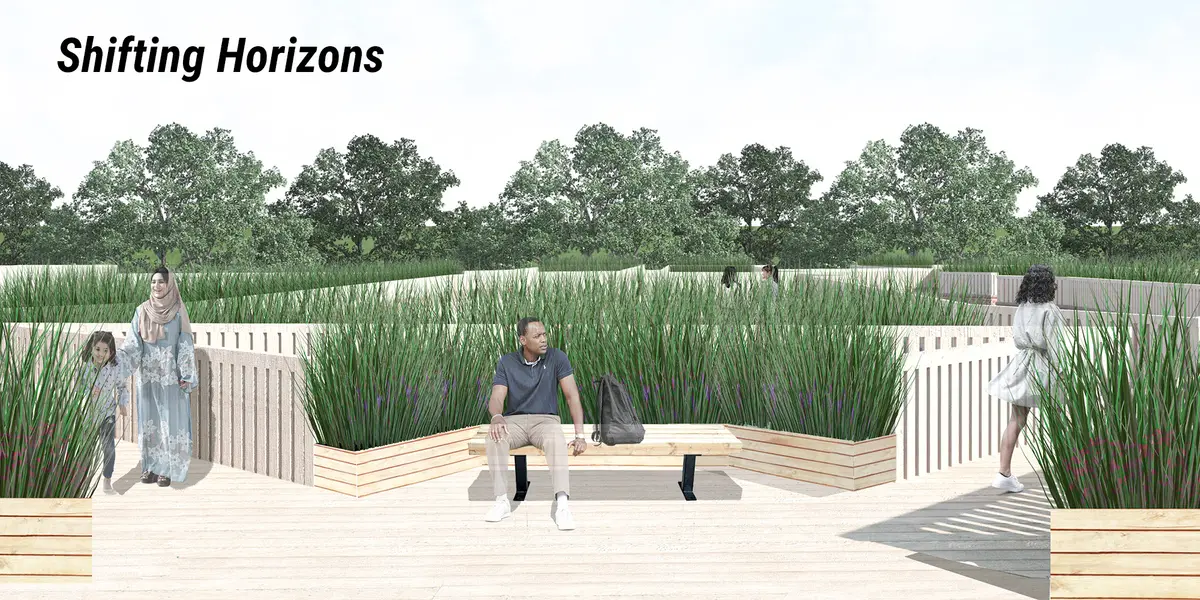
Shifting Horizons
Evan Williams and Aaron Lewis
In the process of designing the space we aimed our initial research to understand two key entities. One being what people need TO BE people, that is to say what gives people the ability to feel comfortable and to grow as both individuals and as a community. The other was how the urban form functions. We needed this to be answered as urban development is inherently made up of many stakeholders, groups, and organizations and to understand the urban form and condition is to understand how all of these entities interact for the betterment of one another. We felt that not understand the refugee community as people and to ignore how their community’s fit into the grater urban context would severely hinder the project’s success.
We investigated these ideas with data analysis and spatial experiments with 3D modeling and perspectives. From these studies we derived that an urban approach to the site would provide the social benefits that help people establish themselves but also use Utrecht resources to their fullest ability. Through our research we also developed an appreciation for the Netherlands rich history and we sought to expose the refugees to the history through the architecture and the landscape.
We focused on three key elements of Dutch history. First being the Dutch mastery and playful approach to brick structure and architecture. With this discovery we wanted to prioritize the use of brick. Duikklok Tilburg by Bedaux de Brouwer Architecten is a building that carries similar elements to what we were looking to replicate in a unique way with the long channel glass pieces that extortionate the verticality despite bricks horizontality. Large windows that usher in light from the world around are prominent in our concept as well. The surrounding context was also considered. We wanted to have our architecture fit within the context of both the industrial and residential buildings. The brick helped connect our new project to the existing residential buildings nearby. The new architecture features uniform plans of the façade this allows our structures to also be similar to the industrial areas around the site. We also wanted to keep the idea of playful use and interpretation of brick that is so present in school of thought. We leaned into the literal interpretation and created a playground that resembles the hull of a boat made from brick.
In an effort to give the sustainable best practice of a green roof a didactic and artful design we looked to the famous Dutch landscape paintings. The field and vegetation are inspired by the pastoral images. Tree canopies serve as groves of trees cluster on the plains of the roof line. The layout of the plants and circulation are inspired by the windmills that historically supported local communities. This is a symbolic link that the windmill was a part of historic communities of the region, and it is going to be a part of this community going forward. The paths link other buildings together, this helps circulation throughout the project but also this allows for building social connections as each path has seasonal interest. By doing this we encourage users to take different routes to through the years allowing different groups of people to come into contact with one another.
Lastly, at the ground level we considered the environmental that has given rise and defined the the Netherlands since its conception, water. The Dutch have become masters of water and best management associated with it. The large bioretention ponds between buildings it to both manage water from the atmosphere but also used for irrigation and as grey water use inside the buildings. They were placed so as to ensure that residents were all proximate to the water to reaffirm the connection to the Netherlands, and now the refugee community, to water.
The interior spaces look to connect with the more intimate needs of a person. We connected to people through scale of space which was exploded through extensive models and a perspectives. Type of space was also imperative. Through the site we designed 4 types of spaces: Urban, Community, Invited group, Personal. Urban is located in the southwest corner this is where people from the refugee community and the greater Utrecht. A small fair could occur here, or vendors could step up and invite people in. Community places are those where those in the refugee community could congregate, the playground space the nooks just off the arial paths and the open walks between buildings. Invited group is the realm when individual scan decide who enters the space. This would be the family/kitchen area of the units. Lastly the personal area, these are where people could be alone. From our research solitude was difficult if not imposable in these environments so we through it essential for us to design this space in.
Looking to how we plan to develop this project in the future, we understood the need for resource to be nearby. To accomplish this phase II has a community development and recreation center. This is space were services like a library, religious establishments, and community rooms would be. This flexible space could act as small store fronts, schools for Dutch language. The idea is this is an expansion of the community space where people in the community can work together to grow and improve the community. This is ultimately the goal of our shifting horizon, to not only change geographic location of the refugee population but shifting there community narrative from survival to elevation and growth.

Popular Articles
Popular articles from the community


ETEH Reworks the Shared Spaces of São Domingos School in Brazil Around Timber, Color and Hanging Plants
At São Domingos School in Brazil, 436 m² of hall, refectory and library are recast with timber joinery, a yellow and blue code and trailing greenery.


Singing Woman: An Opera House That Performs Before the Curtain Rises
Ovidiu Cristian Pavel's conceptual opera house translates Estonia's choral identity into a sculpted waterfront landmark facing the Baltic Sea.

The Amber Palace Opera: A Geological Fiction Surfaces on Tallinn's Baltic Waterfront
Pierre Brillard reimagines a Baltic legend as a public landscape, opera house, and waterfront promenade rooted in Tallinn's coastal identity.

LT2A and OPEN Architectes Thread a Brick and Glass High School Through a Wooded Belgian Campus
In Braine-l'Alleud, a 3,000 m² wing for Collège Cardinal Mercier pairs pale brick with a glazed colonnade, deferring to a small chapel and a dense wood.

Similar Reads
You might also enjoy these articles
The Rhythm of Seasons
A Farmers' Market Connecting Nature and the City

More Than a Building-Designing a Living System
More Than a Building-Designing a Living System
Base Beyond
DESERT COMPOUND ARID: TOURISM OF ABSENCE AND ABUNDANCE


Comments (0)
Please login or sign up to add comments
No comments yet. Be the first to comment!