
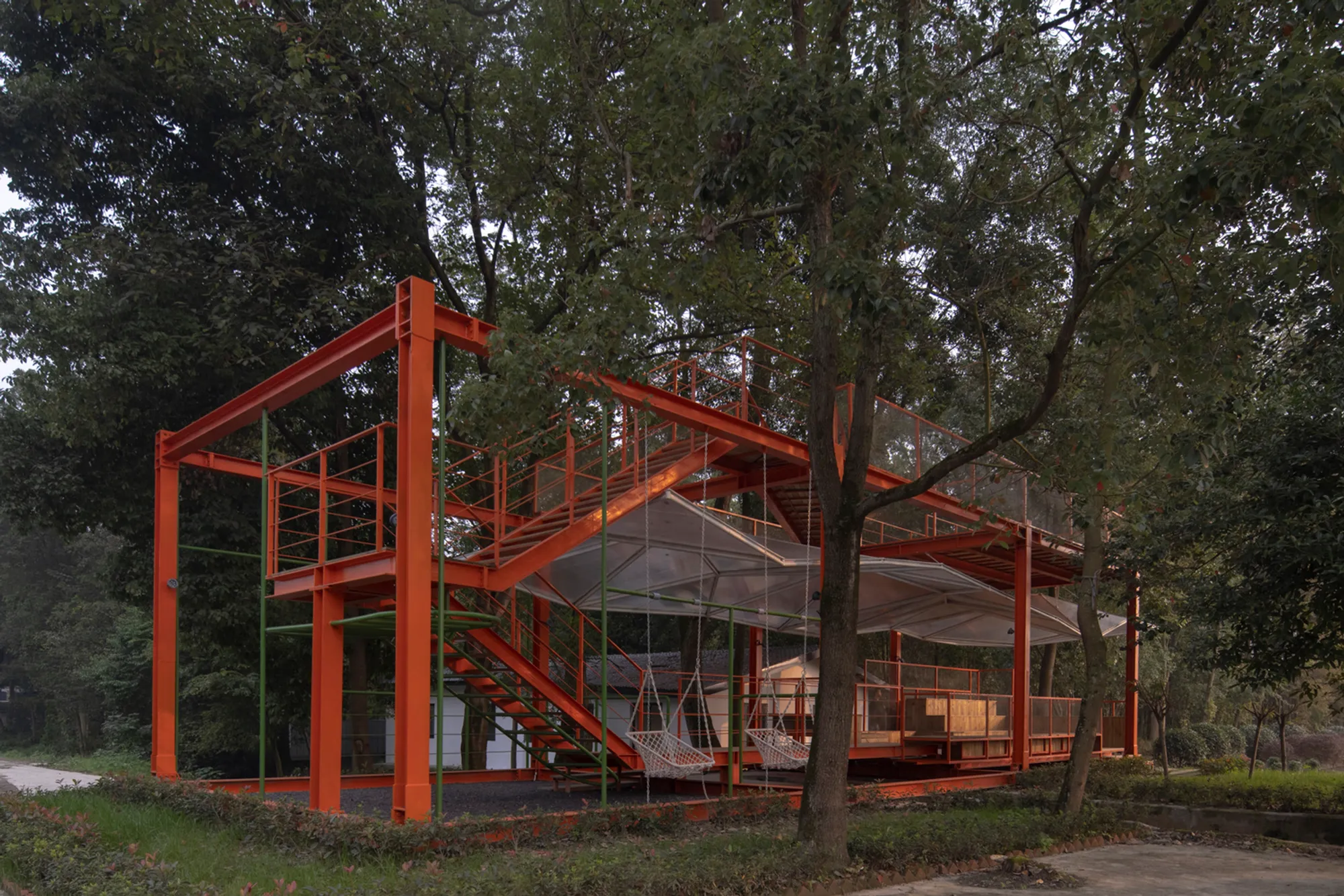
Shuinian Station: An Orange Pavilion in Sichuan
Atelier ArchFAN built an orange steel pavilion around the trees and water channel of a 40-year-old mill in rural Sichuan, China.


Le Shan is a city in Sichuan province, in south-western China, known for the Giant Buddha carved into a riverside cliff. Outside the city, the countryside is flat, green, and agricultural: rice paddies, water channels, and dense groves of trees around old farmhouses. Shuinian Station, designed by Atelier ArchFAN, is a small public pavilion built beside a water mill that has been operating for over 40 years. The intervention is an orange steel frame that rises through the existing trees, creating a series of open platforms, a stair, and a viewing deck, all without removing a single tree.
The project is the first phase of a larger rural development plan covering 15 square kilometres. It is intended as a catalyst: a visible, colourful structure that draws visitors to the site and demonstrates that rural architecture can be precise, inventive, and rooted in its context. The budget was small. The construction is modular and reversible. The material is painted steel and translucent polycarbonate. The colour is orange, which the architects call "Moulin Rouge," a reference to the mill.
The Site: Water Channel, Trees, and Mill
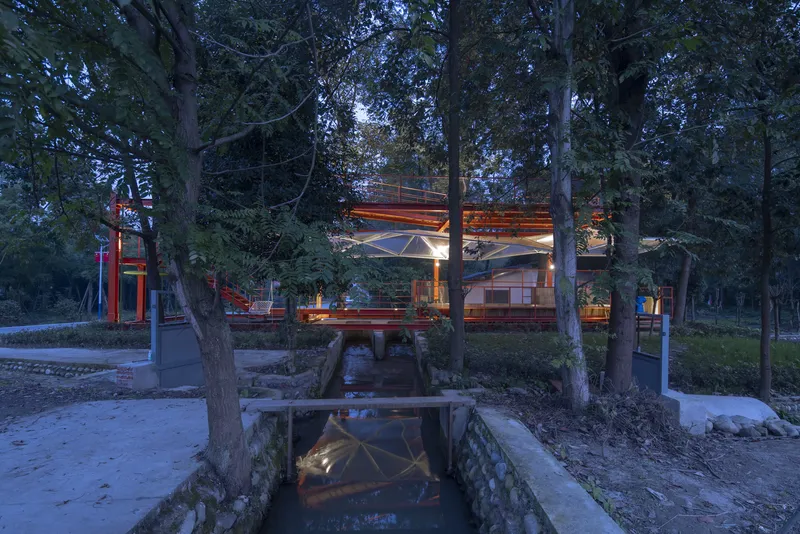
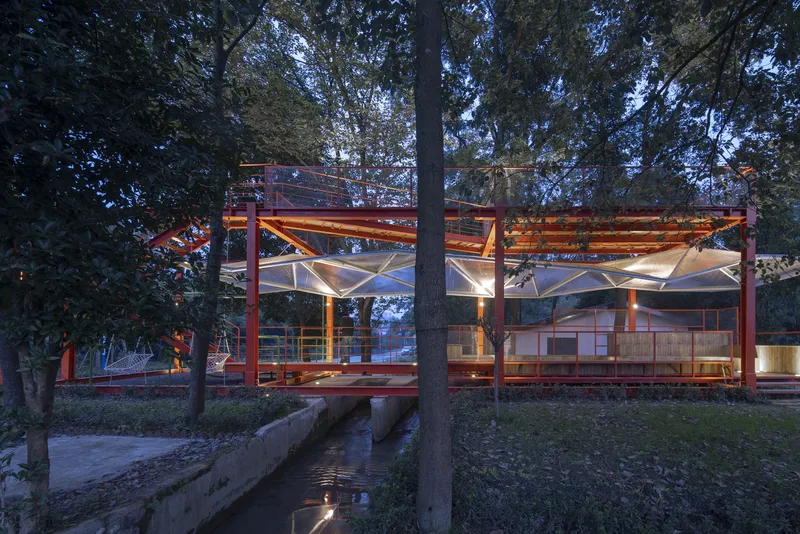
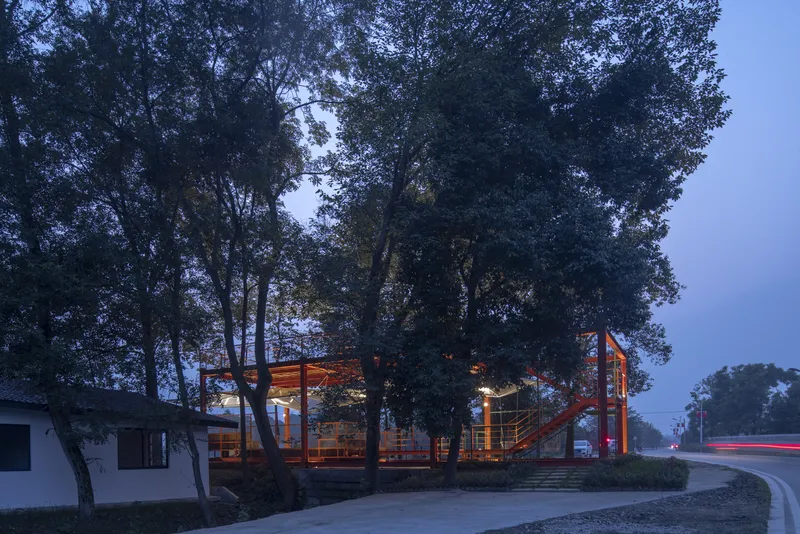
The site is defined by three elements: a stone-lined water channel that powered the original mill, a grove of tall trees (some over 40 years old), and the white-rendered mill building itself. The water channel runs straight from the road to the mill, with a small bridge crossing it. The trees form a dense canopy above. The architects decided to keep all three elements and build around them. The pavilion sits between the trees, over the channel, and against the mill wall. Nothing existing was removed.
The Orange Frame
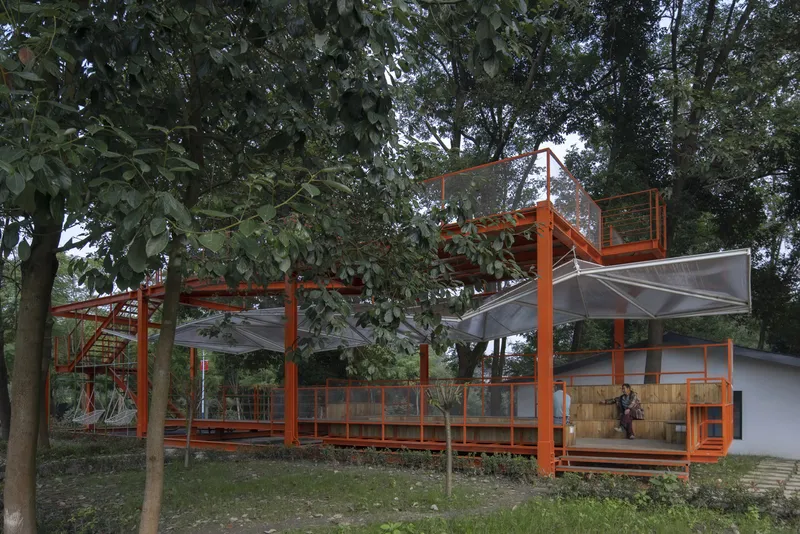
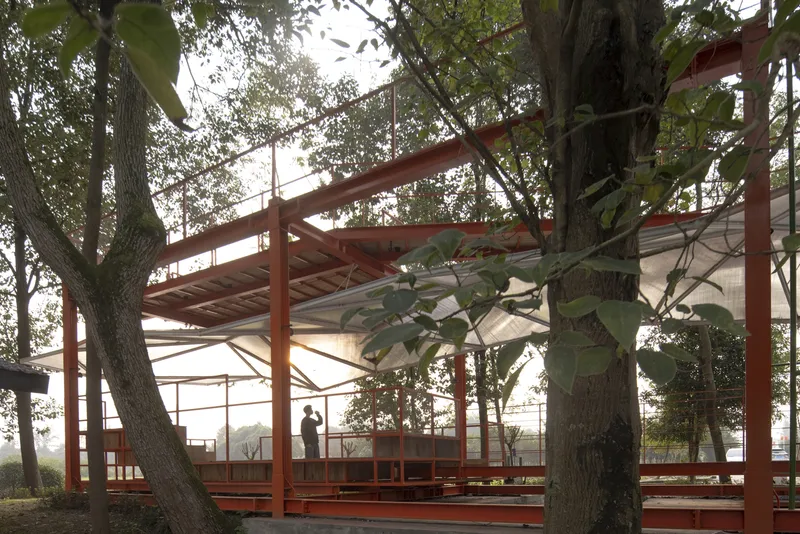
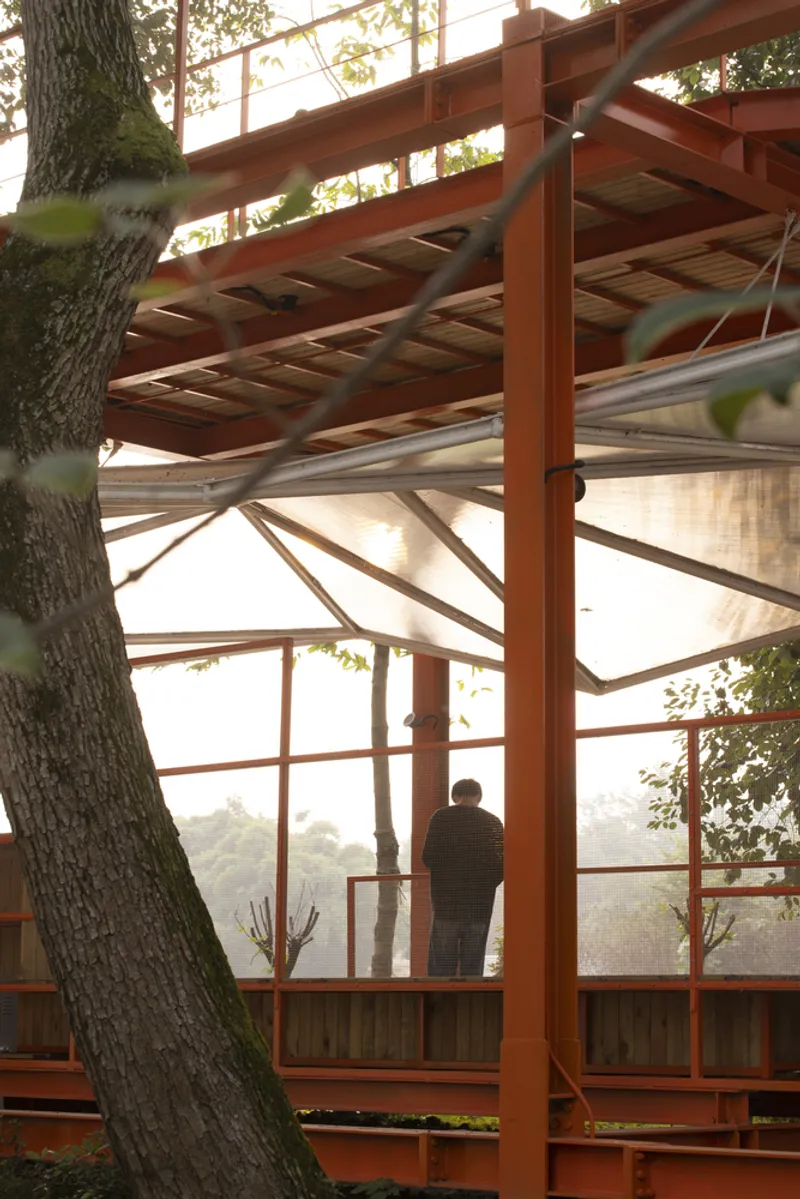
The pavilion is a multi-level open steel frame painted orange. The lower level is a timber deck at ground level with benches and seating. The upper level is a viewing platform reached by a steel stair, positioned at the height of the tree canopy. A translucent polycarbonate canopy in triangular panels shelters the lower deck from rain without blocking the filtered light from the trees above.
The orange colour is deliberate and functional. It makes the structure visible from the road, signalling that something has changed in this rural landscape. It contrasts with the green of the trees and the white of the mill building. And it gives the project an identity that a neutral grey or black steel frame would not provide. At dusk, the lit interior turns the pavilion into a lantern in the grove.
The Canopy and the Trees
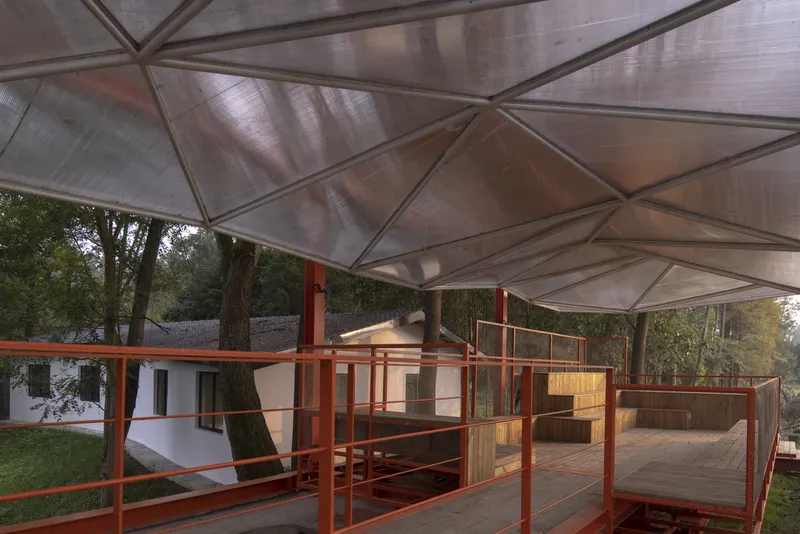
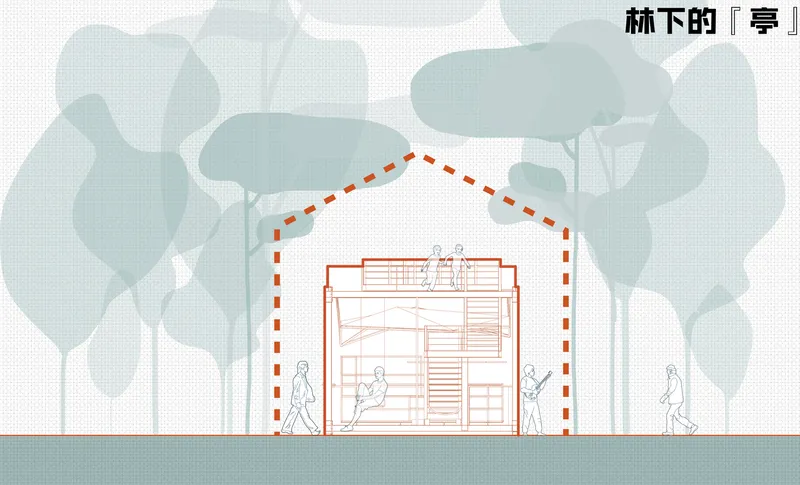
The translucent canopy is made of triangular polycarbonate panels supported by the steel frame. The geometry of the panels creates a faceted surface that follows the irregular positions of the tree trunks, wrapping around them without touching. The concept diagram shows the strategy: the pavilion sits entirely within the silhouette of the existing tree canopy, fitting under the branches like a piece of furniture under a roof. The dashed line in the diagram traces the form of a traditional house; the pavilion occupies the same volume but without walls, without a ridge, and without removing anything.
The Stair and Viewing Deck
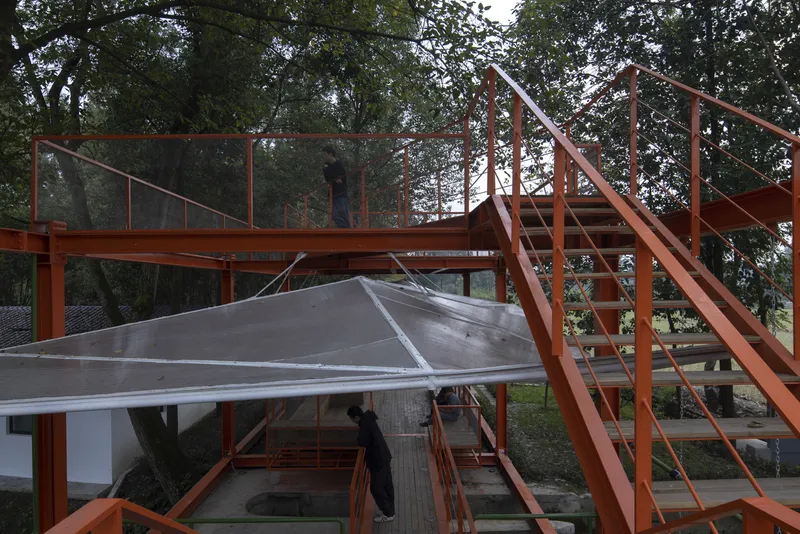
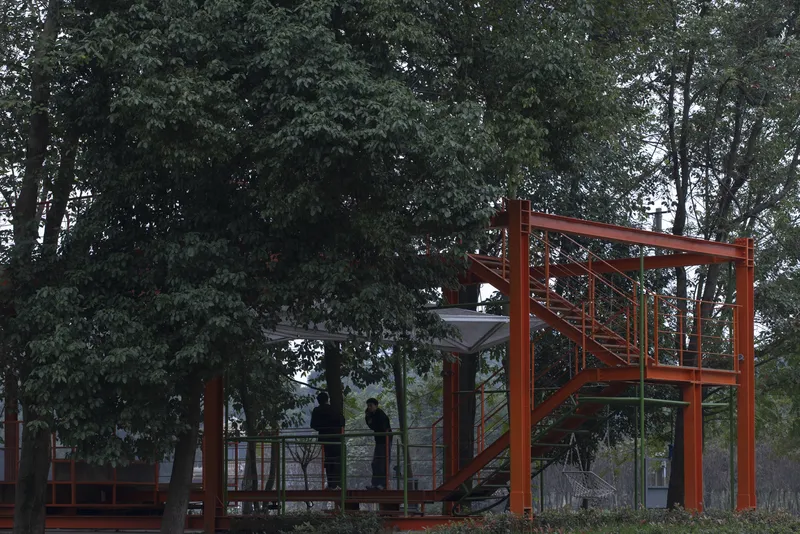
The steel stair leads from the lower deck to an upper viewing platform at the level of the tree canopy. From here, visitors look out across the farmland and the surrounding countryside. The platform is open on all sides, with orange steel railings and mesh panels. It is a place to stand above the trees and see the landscape that, from the ground, is hidden by the grove. The stair itself is a simple steel run with open treads and an orange handrail.
The Water Channel and the Bridge
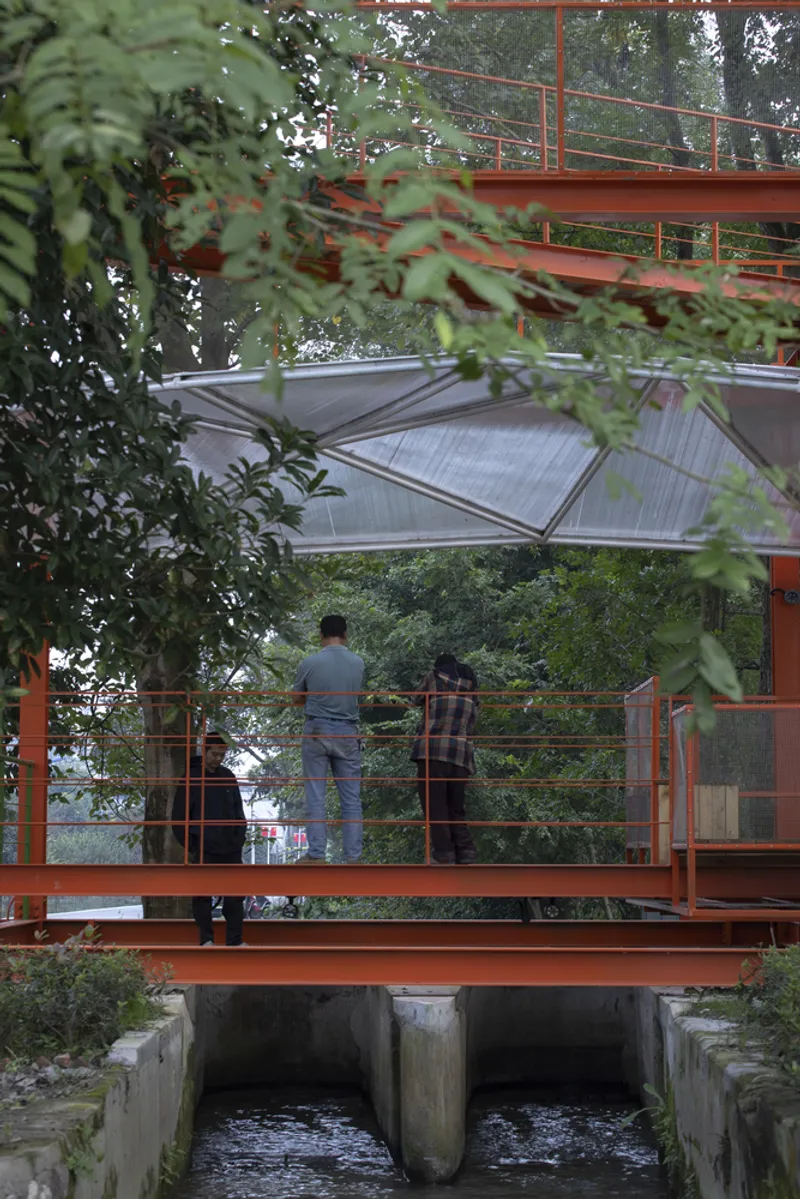
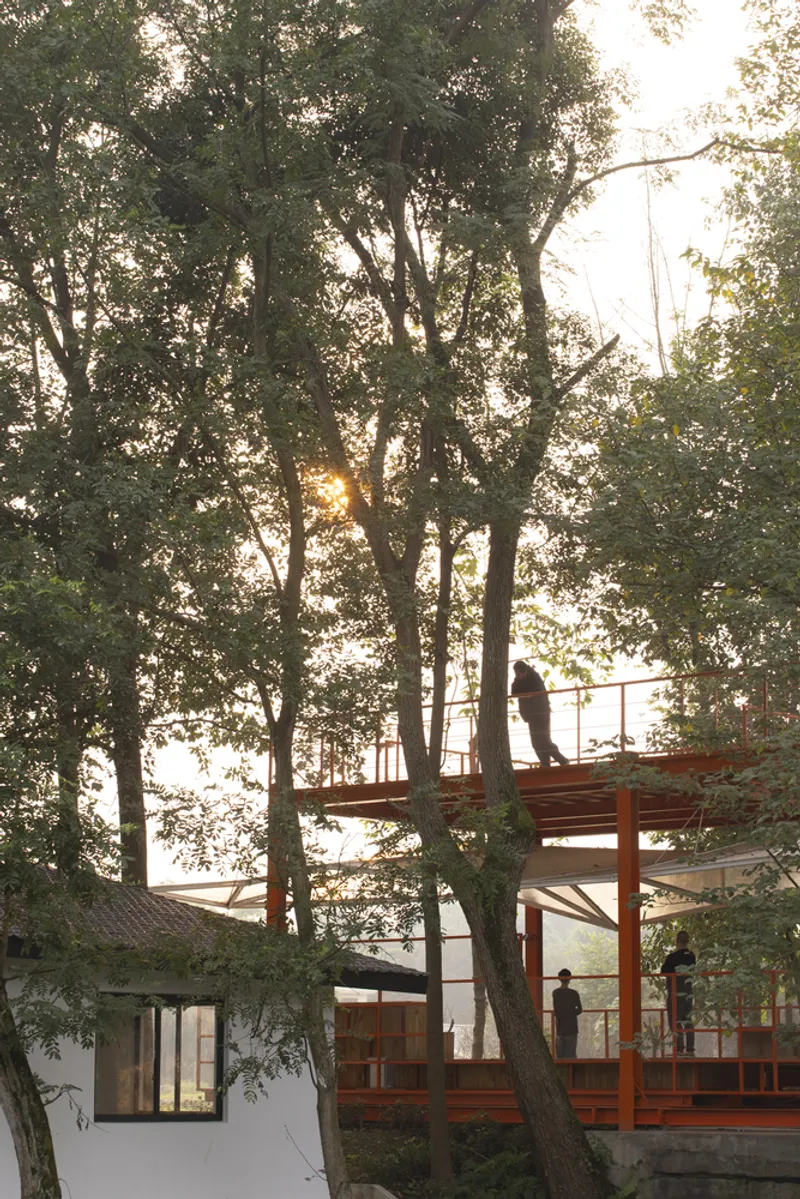
The water channel is the oldest element on the site. It feeds the mill and creates a vortex beneath the millstone. The architects preserved the channel and the original flow, adding a simple bridge that spans it and provides a vantage point over the water. The pavilion structure extends over the channel, framing views down into the water from above. At dusk, the orange frame reflects in the surface of the channel.
Why This Project Matters
Rural revitalisation in China has produced hundreds of projects in the last decade, many of them expensive, heavy, and disconnected from their sites. Shuinian Station is the opposite: cheap, light, reversible, and built around everything that was already there. The modular steel construction means it can be disassembled and moved if the site's needs change. The orange colour and the open platforms make it a public gathering point in a landscape that had none.
If you are designing a small public structure in a rural or landscape setting, this project is worth studying for how it uses a simple steel frame and a strong colour to create a spatial experience that is larger than its footprint.
About the Studio
Share Your Own Work on uni.xyz
If you are working on rural architecture, landscape pavilions, or adaptive reuse of agricultural buildings, uni.xyz is a place to publish your work and connect with a global design community.
Project credits: Shuinian Station by Atelier ArchFAN. Le Shan, Sichuan, China. Photographs: Arch-Exist.



Popular Articles
Popular articles from the community


Lunar Spiral: Space Architecture Shaped by the Mathematics of the Universe
Lunar Spiral reimagines space architecture through Fibonacci geometry, lunar regolith, levitating habitats, and self-sustaining Moon living.

Co-Life: Senior Housing Design That Reconnects Older Adults With the City
Co-Life reimagines senior housing design through healing gardens, shared streets, workshops, and a sustainable community across generations.

Play: Fragments of Their World
Familiar architecture becomes modular playground design, creating safe spaces where displaced children can learn, connect, imagine and play.

The Ocean Hive: Sustainable Architecture for a Self-Sufficient Civilization at Sea
The Ocean Hive imagines sustainable architecture at sea, where modular habitats, algae, wave power and ocean waste sustain a growing colony.


Similar Reads
You might also enjoy these articles


Hodi-Mandai Geram
Project Function: Preservation and revitalization of the Intangible heritage and socio-spatial identity of the Hodi by Housing, Cultural Memory Center, Sacred Grove, landscape, local tourism economy


Olio Towers: A Mid-Rise for Performers That Fuses Housing, Rehearsal, and Stage
Located blocks from Houston's Theater District, this modular tower stacks living units around a central performance atrium.

Oasis: Modular Green Housing Carved into Dhaka's Urban Fabric
A shortlisted Plugin Housing entry reclaims unauthorized settlements in Dhaka with stepped concrete volumes, green roofs, and ventilation-driven design.

Black Hole: A Floating Megastructure for the Post-Physical Era
Emiliano Mazzarotto envisions a spherical, self-scaling arena where e-sports, digital hotels, and holographic stadiums replace traditional public space.




Comments (0)
Please login or sign up to add comments
No comments yet. Be the first to comment!