

Sitio Arquitectura Carves a Courtyard and Staircase into a Tucumán Row House
A compact renovation in San Miguel de Tucumán turns a conventional small house into a light-filled home organized around a timber-decked patio.


Renovating a small house in a dense neighborhood is rarely glamorous work, but it is the kind of work that actually matters in Latin American cities. In San Miguel de Tucumán, Sitio Arquitectura, led by Augusto Montes de Oca and Carlos Zelarayan, took a conventional two-story dwelling on a corner lot and restructured it around two surgical insertions: a new internal courtyard and a floating timber staircase. The 173-square-meter result is the Matias House Intervention, completed in 2021, and it demonstrates how much spatial quality can be unlocked in a tight footprint when the core moves are precise.
What makes the project worth examining is the economy of its strategy. Rather than adding volume, the architects subtracted it. They opened a void in the plan to create a courtyard, then threaded a steel-and-timber staircase through the section to connect both levels while doubling as a spatial divider. The rest follows from those two decisions: daylight reaches deep into the plan, rooms gain cross-ventilation, and a sequence of views through vertical slat screens and glazed doors replaces the sealed-off compartmentalism of the original layout.
The Street Face: Quiet and Calibrated
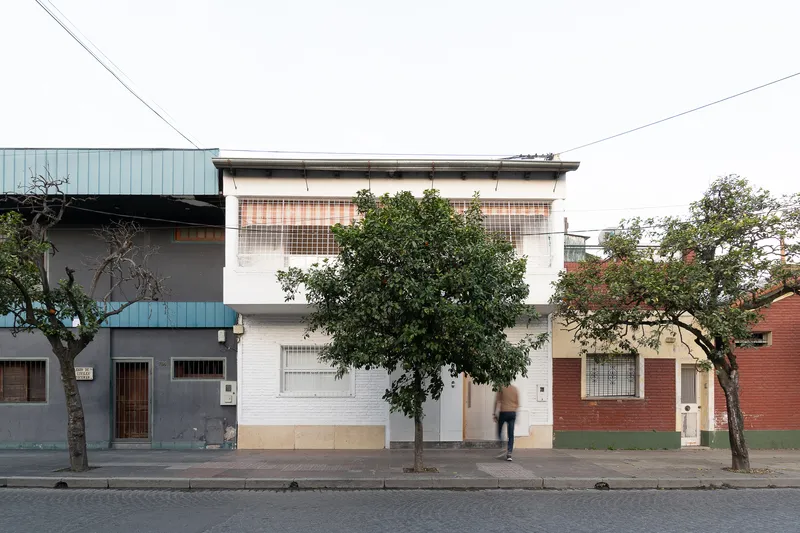
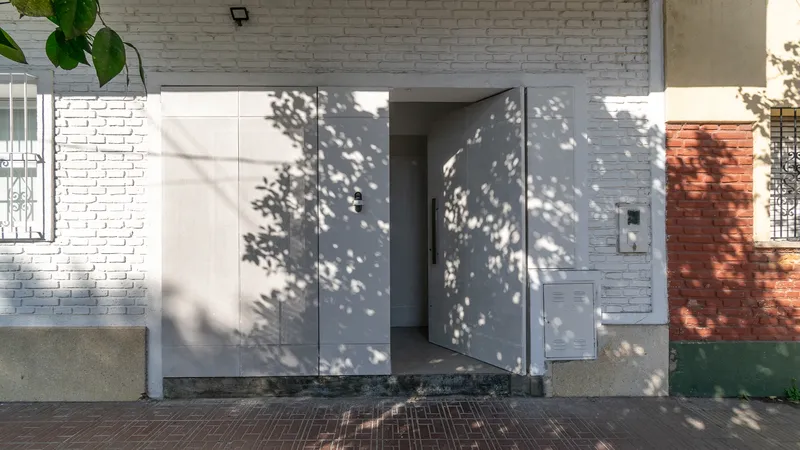

From the street, the Matias House does not announce itself. The facade is white-painted brick, consistent with its neighbors, punctuated by metal security grilles and a set of pivoting steel doors. The intervention is legible only in the refinement of the entry panel and the crisp planearity of the new elements against the older masonry. Dappled shadows from street trees soften the surface, giving the facade a character that shifts through the day without relying on formal gymnastics.
The pivoting door at the street is a detail worth noting. Rather than a conventional swing, the grey panel rotates to create a generous opening that blurs the threshold between sidewalk and interior. It signals hospitality without sacrificing security, a meaningful gesture in a neighborhood where metal grilles are standard equipment.
The Courtyard as Engine
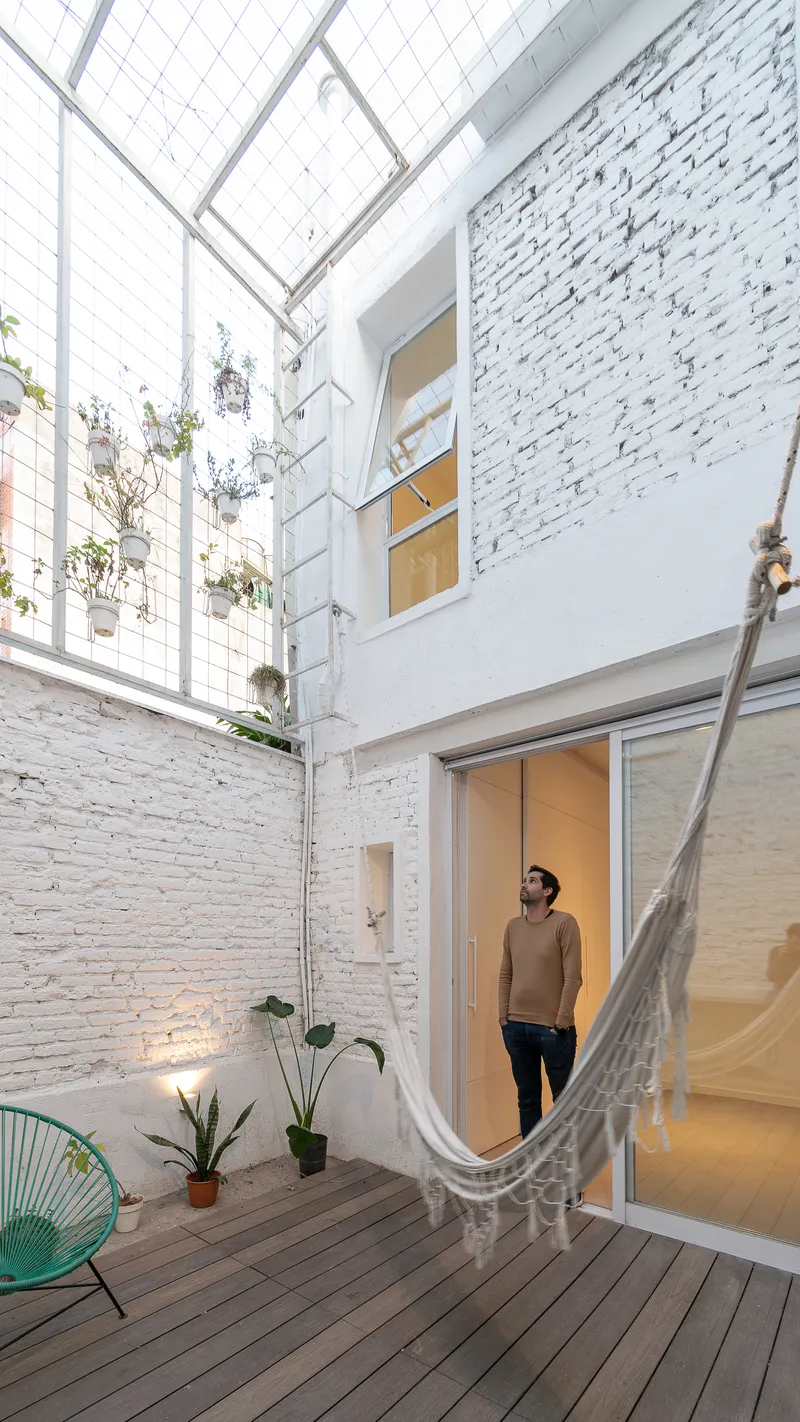


The courtyard is the project's central argument. Cut into the middle of the plan, it is paved in timber decking and bounded by white-painted brick walls, with a wire mesh canopy overhead that supports hanging planters and filters the intense Tucumán sun. A hammock stretches across one wall. The space is modest in dimension but generous in what it provides: light, air, and a sense of outdoor life that the original house almost certainly lacked.
The mesh skylight is a smart move. It admits enough light to feel open but controls solar gain, creating a microclimate that is sheltered rather than exposed. Planting cascades from above and in pots at ground level, softening the hard surfaces. This is not a courtyard for show; it is a working piece of environmental infrastructure that also happens to be the most pleasant room in the house.
Living Spaces: Layered Transparency
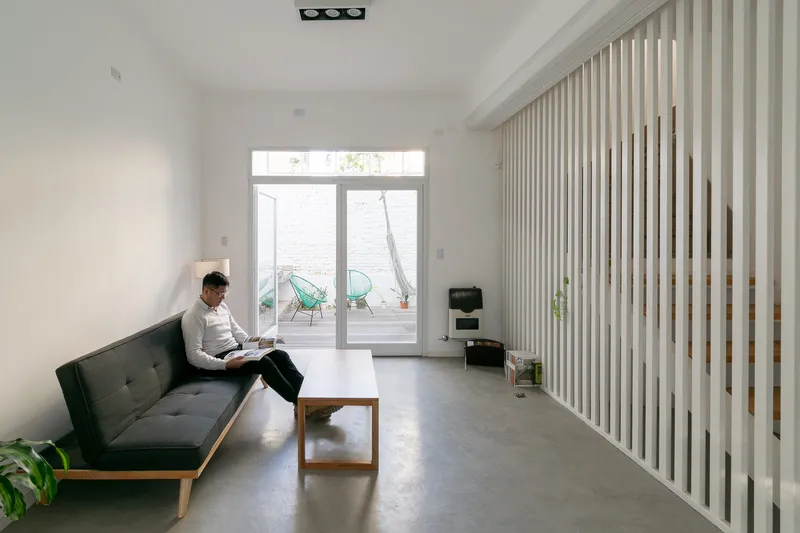
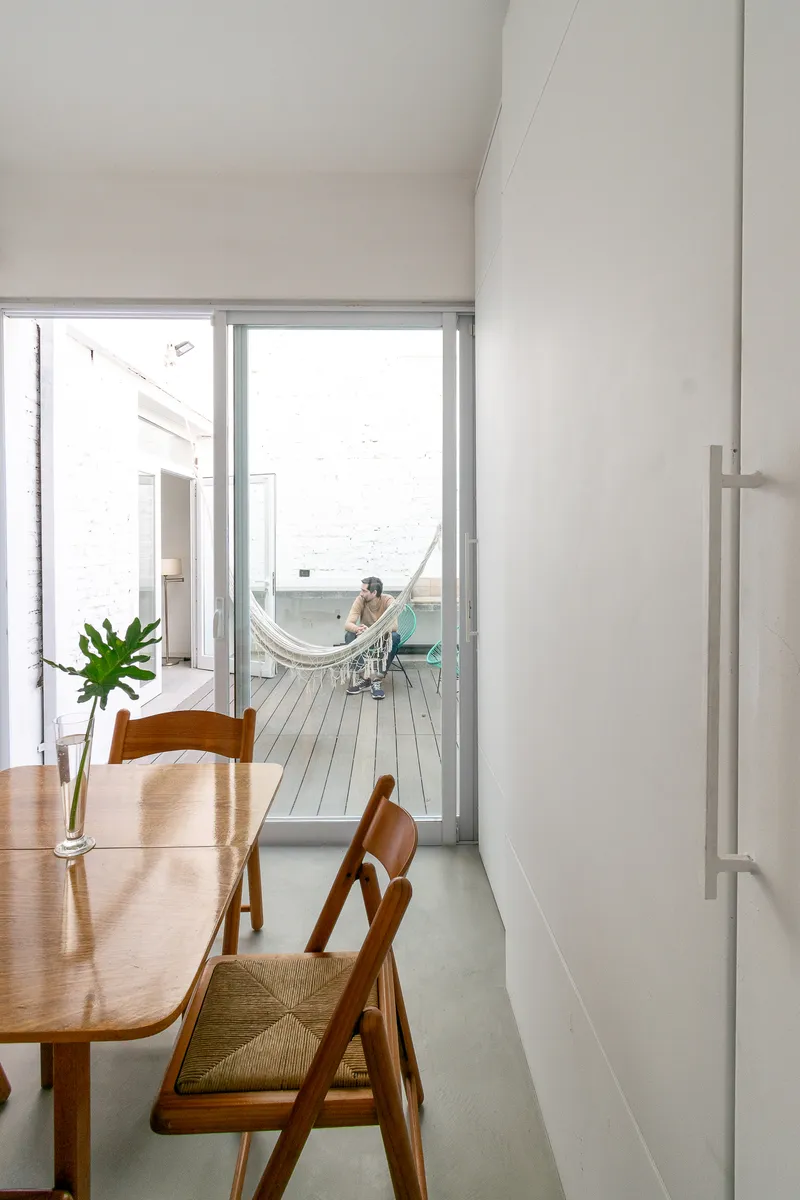
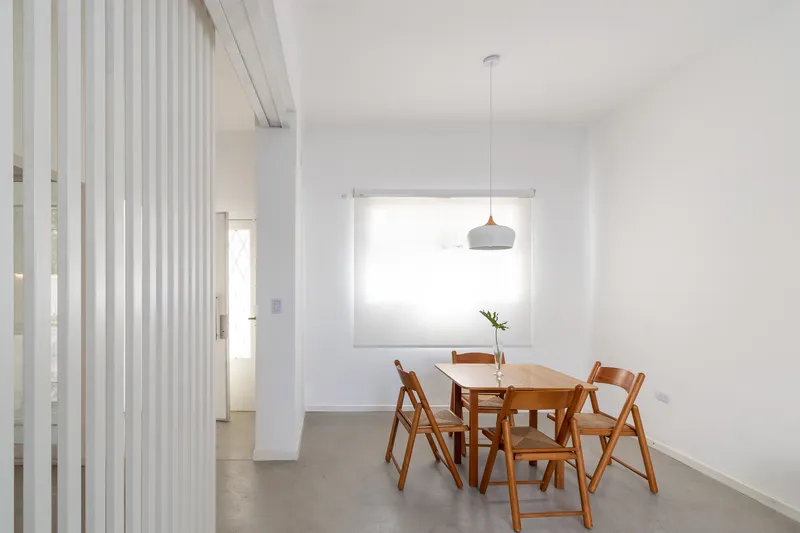
The ground-floor living and dining areas are organized as a sequence of layered planes: vertical timber slat screens, glazed sliding doors, and the courtyard beyond. The effect is cinematic. Sitting at the dining table, you look through the slats to filtered daylight; from the living room, full-height glass doors frame the hammock and turquoise chairs on the deck. Each position in the plan offers a different depth of view, and the screens modulate privacy without closing anything off.
The timber slats deserve particular attention. They function simultaneously as spatial dividers, light filters, and visual rhythm-makers. Their vertical grain echoes the steel stair stringers visible beyond, creating a material consistency across the ground floor that ties disparate elements together. The palette is restrained: concrete floors, white walls, timber, steel. Nothing competes for attention.
The Staircase as Architecture


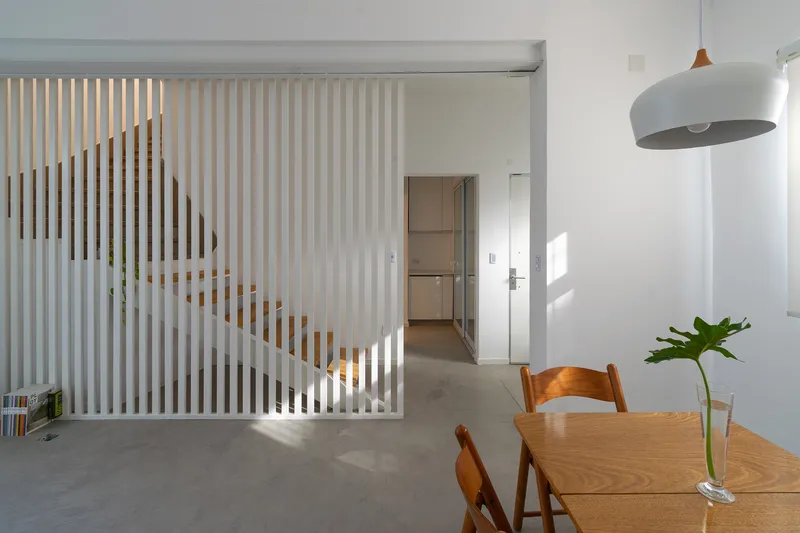
The new staircase is the project's most deliberate architectural gesture. Cantilevered timber treads hang from steel stringers, ascending between white fluted wall panels that give the enclosure a vertical texture. It is a piece of furniture at building scale: precise, lightweight, and legible from multiple vantage points through the slatted partitions that flank it.
Positioning the stair at the center of the plan was a strategic choice. It draws circulation away from the perimeter walls, freeing them for rooms and openings. The stair also acts as a hinge between the public ground floor and the private upper level, creating a moment of transition that is spatial rather than merely functional. Afternoon sunlight rakes through the slats and across the treads, turning the climb into a sensory event.
Upper Floor and Material Details


Upstairs, a polished concrete corridor runs beneath an exposed metal beam, connecting bedrooms arranged around the central stairwell. The material language remains consistent: concrete, white-painted surfaces, steel structure left visible. There is no applied decoration. The architecture relies on proportion, light, and the honest expression of its own construction.
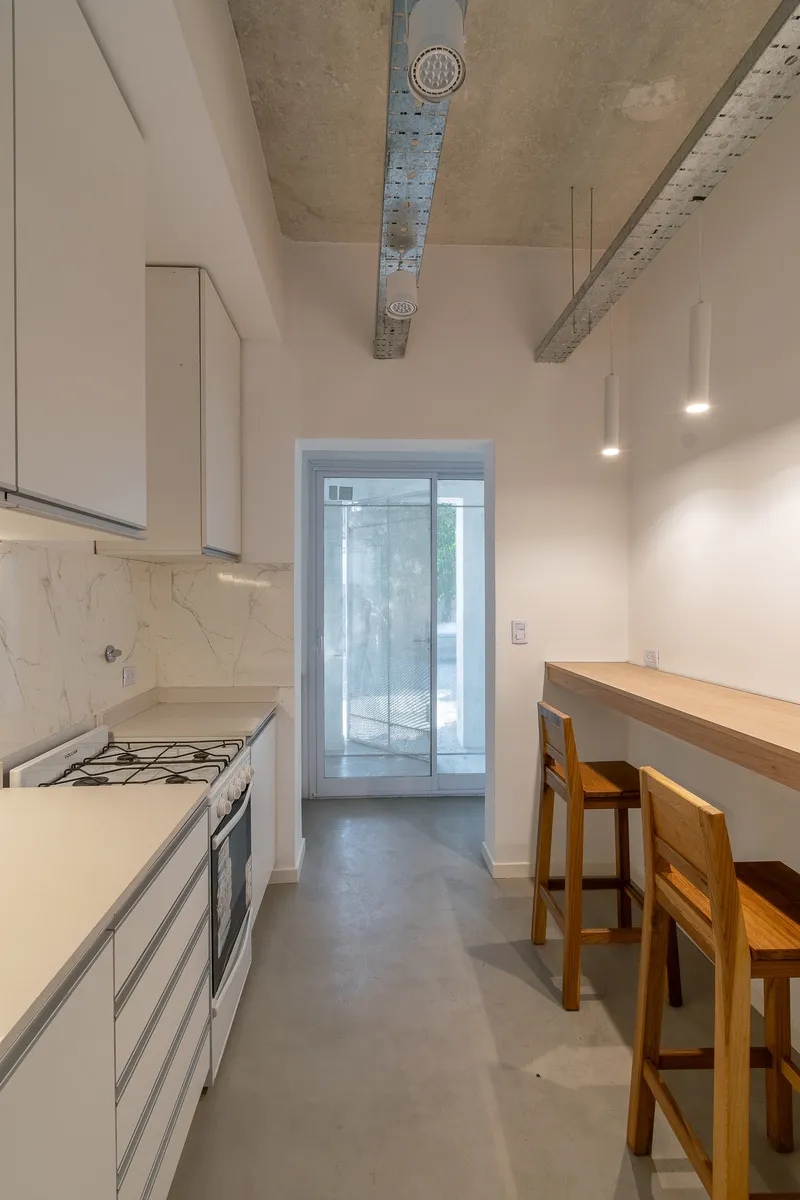
Back on the ground floor, a paneled storage wall conceals a door that opens to a yellow-lit passageway, and the galley kitchen is capped by an exposed concrete ceiling duct that runs its full length toward a glazed door at the far end. These are not beautiful details in the conventional sense. They are precise ones: each element has a reason, and the detailing communicates that reason clearly.
Threshold Moments
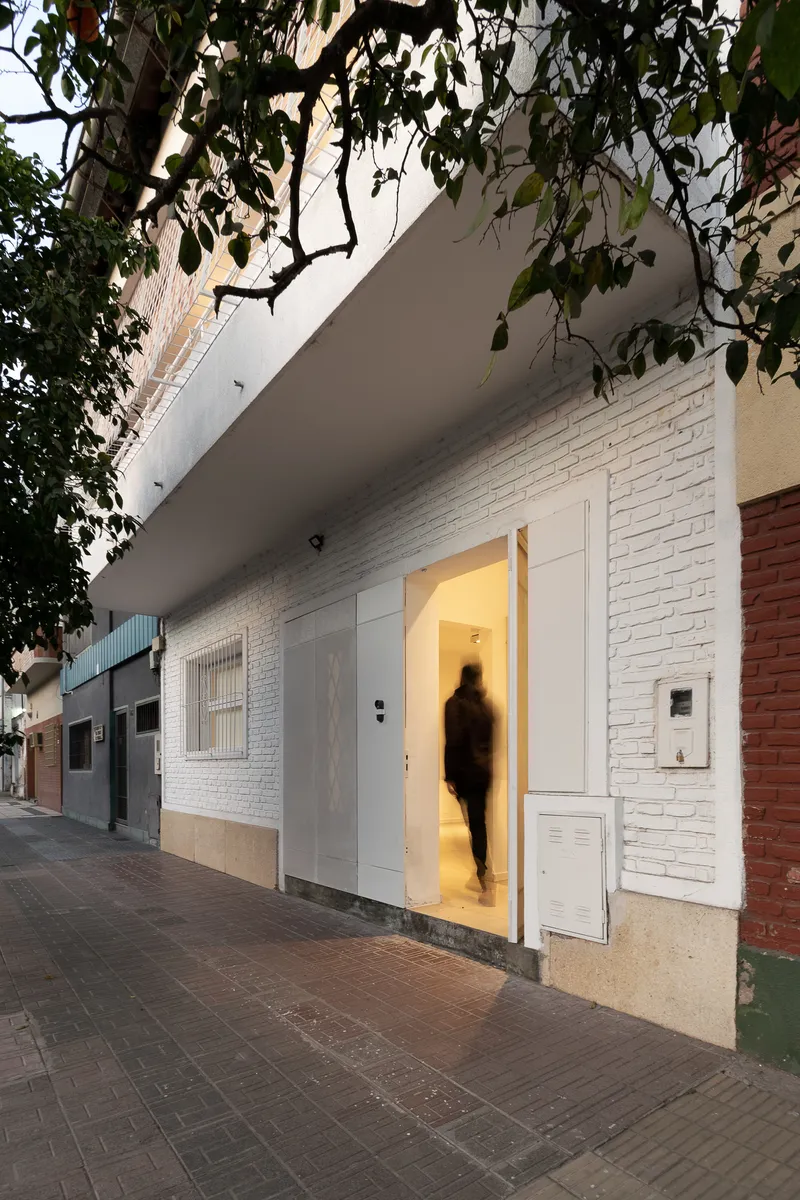
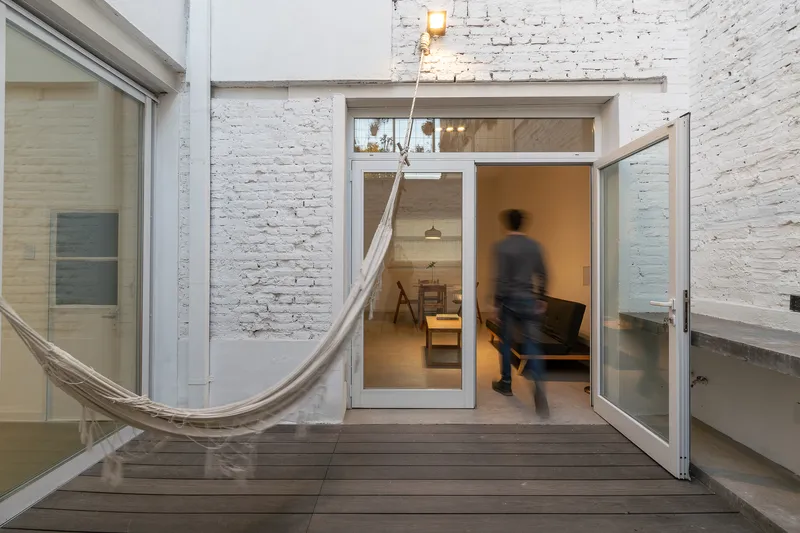
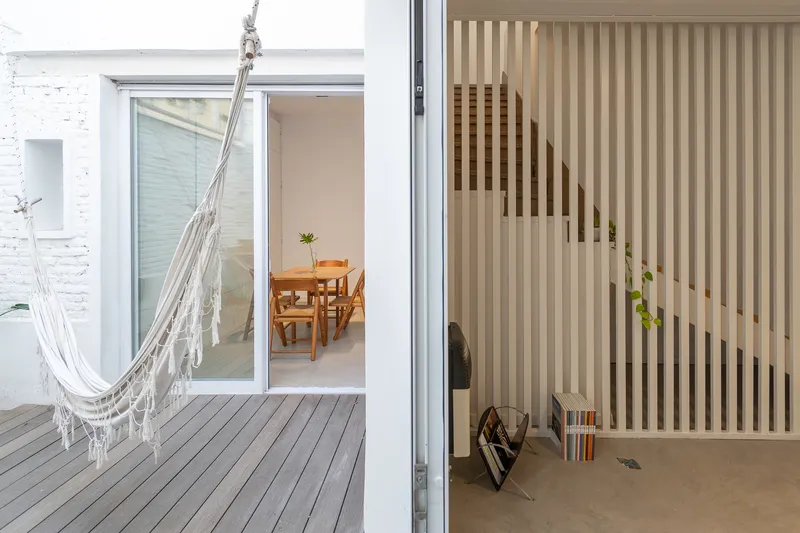
Some of the project's strongest moments occur at its thresholds. The front door at dusk, backlit by the warm interior, frames a blurred figure in motion. The glazed courtyard doors stand open, inviting passage between inside and out. The hammock, visible from nearly every ground-floor room, becomes a marker of leisure embedded in the architecture itself.
Photographer Josefina Viaña captures these in-between moments with a sense of lived time. Figures blur through the frames, shadows shift, doors hang open. The house is not presented as a finished object but as an environment in use, which is exactly how renovation projects should be judged.
Plans and Drawings
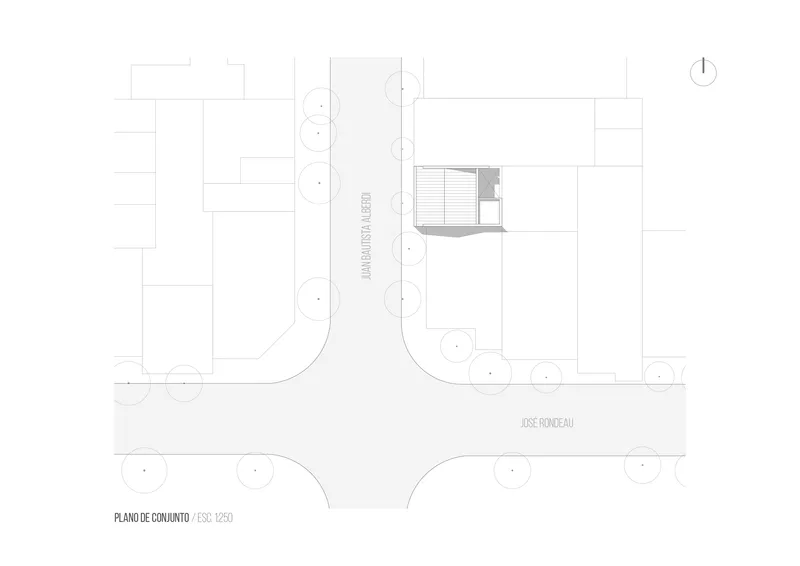
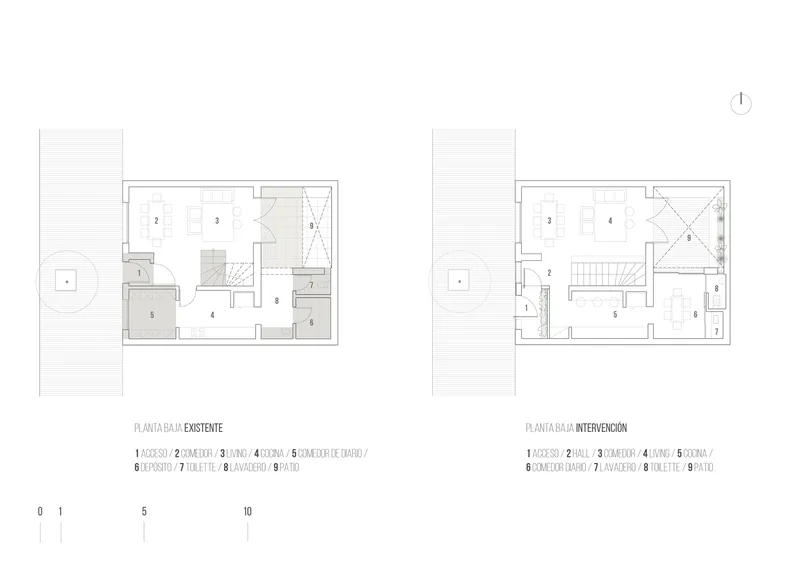
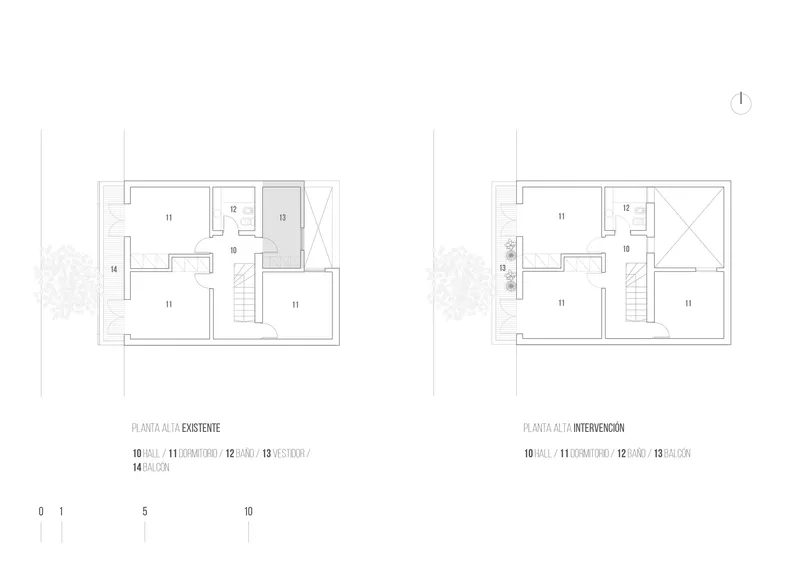
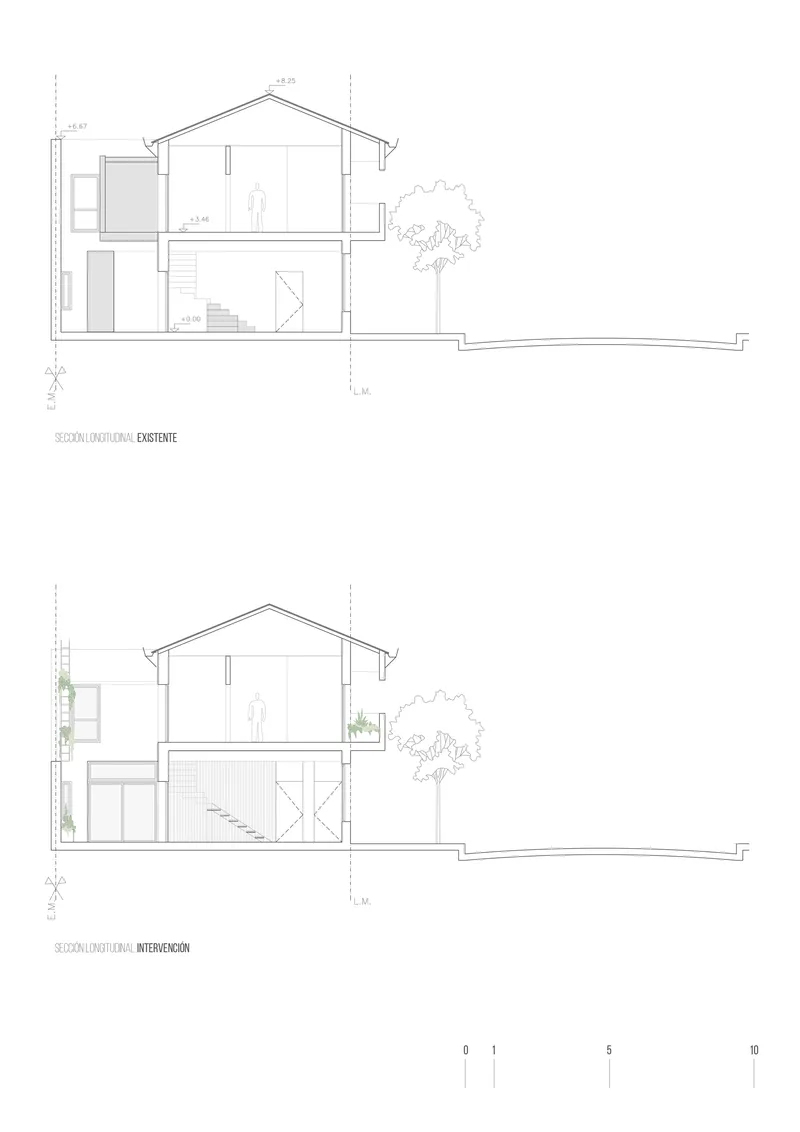
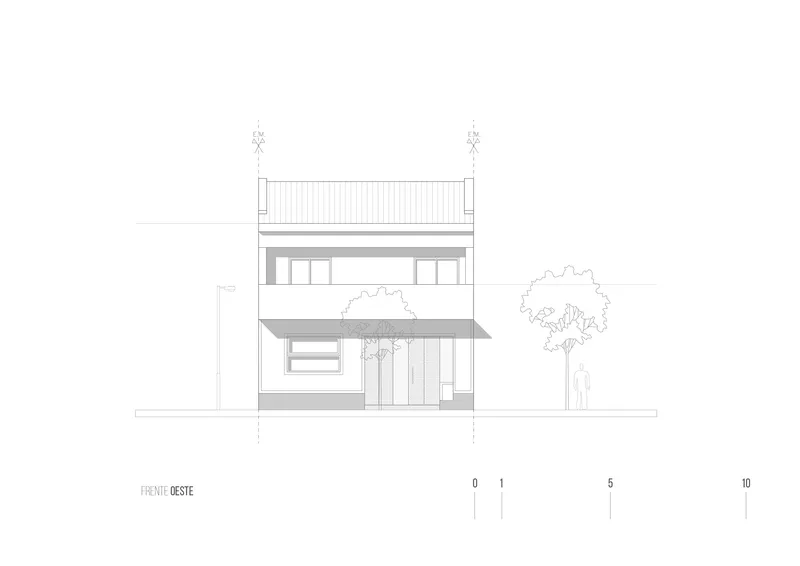


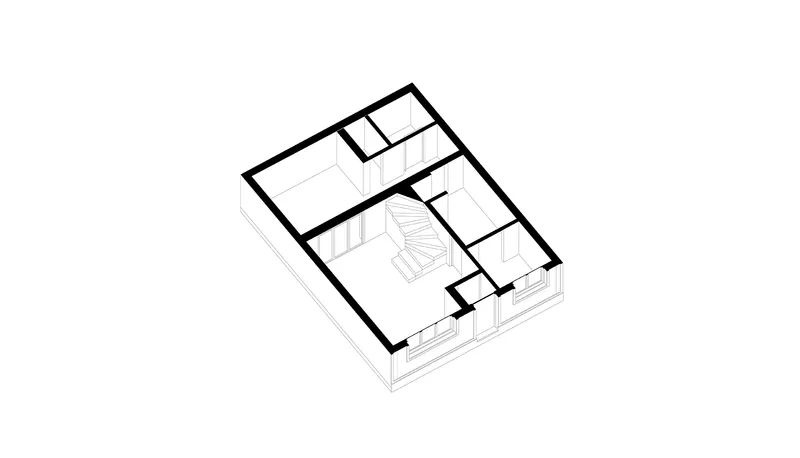


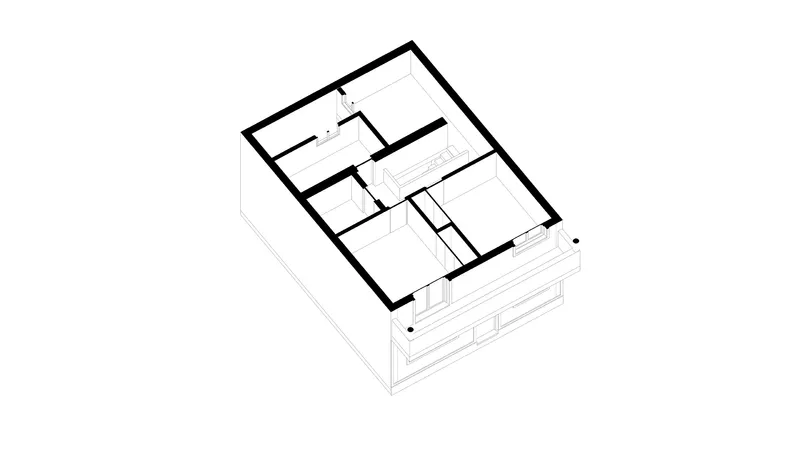

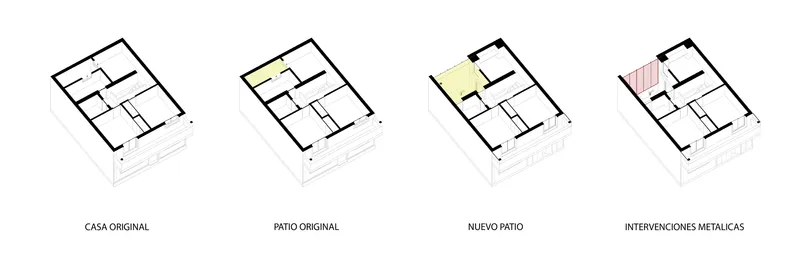
The drawing set reveals the clarity of the intervention's logic. Comparing existing and proposed floor plans shows how the new staircase was inserted at the center of the plan, reorganizing circulation on both levels. The before-and-after sections illustrate the courtyard's role in opening the section to daylight while maintaining the gabled roof profile. The axonometric diagram sequence is particularly revealing: four stages of spatial transformation are laid out, with new metallic elements and circulation paths highlighted in pink, making the strategy legible at a glance. The courtyard transformation diagrams show the evolution from a sealed interior condition to the open, planted patio that now anchors the plan.
Construction detail drawings of the facade window assembly and door jamb indicate the level of precision Sitio Arquitectura brought to the junction between new steel-and-aluminum elements and existing masonry. The front elevation drawing reveals a canopy overhang that does not read dramatically from the street but is structurally and environmentally purposeful.
Why This Project Matters
The Matias House Intervention is not a transformation that overwhelms its host. It is a renovation that reads the existing structure carefully and makes a small number of high-impact moves: one courtyard, one staircase, one system of screens and openings. The result is a house that feels open and connected without having grown in size. In a continent where millions of homes could benefit from exactly this kind of thoughtful reconfiguration, the project offers a template that is specific to its site but transferable in its principles.
What Sitio Arquitectura demonstrates here is that renovation is not a lesser form of practice. The constraints of working within an existing shell, on a tight urban lot, with a modest budget, produce a discipline that ground-up projects often lack. Every decision in this house had to earn its place. The architects made that constraint visible, and the result is a home where nothing feels surplus and everything contributes to a domestic environment that is calm, generous, and deeply functional.
Matias House Intervention by Sitio Arquitectura (Arq. Augusto Montes de Oca, Arq. Carlos Zelarayan). San Miguel de Tucumán, Argentina. 173 m². Completed 2021. Photography by Josefina Viaña.
About the Studio
Share Your Own Work on uni.xyz
If projects like this are the kind of work you want to make, uni.xyz is a place to publish your own, find collaborators, and enter design competitions.


Popular Articles
Popular articles from the community


U.GA Architects Wraps an Oval Rooftop Pool in Curved Board-Formed Concrete on Busan's Jeollidan-gil
In Busan's Jeonpo-dong, a 454 m² mixed-use block stacks a neighborhood facility, guest rooms and an oval rooftop pool inside spiraling concrete walls.

Architekt Andreas Gruber Scatters 23 Dark Timber Chalets Across a South Tyrolean Forest Edge
In Molini di Tures, Amonti Chalets breaks a resort into a hamlet of gabled timber houses, with parking, storage and services pushed into the slope.

David Macias Steps a Doorless Stone and Plaster House Down a Tropical Colombian Hillside
In the humid hills of Colombia, Threshold House replaces the front door with an open void and terraces its 850 m² down the slope instead of fighting it.

Juan García Correa, John González and Claudia Rueda Sink a Circular Amphitheater into a Manizales Engineering Building
On the La Nubia campus in Manizales, Colombia, the S1 Building folds labs and offices into a hillside of ramped lawns that double as a campus route.

Similar Reads
You might also enjoy these articles


LAVA Architecten Gives Vocational Education a Sawtooth-Roofed Face on a Mechelen School Campus
In Mechelen, Belgium, a 2,053 m² STEM school on a 6×6 m grid turns workshops and classrooms into rooms that can be rearranged as teaching changes.

KEMA Studio Turns a Derelict Marvila Attic into a 60 m² Lighthouse Apartment Above Lisbon
In Lisbon's Marvila district, a rebuilt roof, four skylights and two plywood volumes turn an unlivable attic into a bright home facing the Tagus.

Pixel Gardens: One Repeated Module Stacked Into a Terraced Social Housing Tower for Famagusta
Salem Bader's shortlisted housing tower builds a vertical neighbourhood from one repeated module, offsetting units to carve terraces, light and air.

Bao Huynh Watercolor Atelier: A Serene Art Retreat in Hội An
Bao Huynh Watercolor Atelier in Hội An blends multifunctional art spaces, sustainable design, local materials, and family-friendly living in a serene environment.

Explore Residential Building Competitions
Discover active competitions in this discipline

Challenge to design mud housing for contemporary communities

Challenge to reimagine the Iron Throne

Photograph architecture without architects

Illustrate the lost glory of Angkor Wat - Render Challenge
Comments (0)
Please login or sign up to add comments
No comments yet. Be the first to comment!