
31/44 Architects Build a Cabinet of Curiosities for Themselves in Crystal Palace
A southeast London infill house on a trapezoidal plot channels postwar optimism, Scandinavian brick, and Californian openness into 164 square metres.


Architects designing their own homes can go either way: self-indulgent showcase or quiet laboratory. Six Columns House, completed in 2024 by 31/44 Architects in Crystal Palace, southeast London, lands firmly in the latter camp. Built on a former side garden belonging to a neighboring semi-detached house, the 164 square metre residence twists across a sloping trapezoidal plot while protecting a mature sycamore tree at its heart. The result is a home that reads as a series of architectural memories assembled into a single coherent building: part English farmhouse, part Californian Case Study House, part Nordic brick essay.
What makes the project genuinely interesting is its refusal to choose one identity. The six brick pilasters on the front elevation nod to Berthold Lubetkin's nearby Six Pillars house, while a slab of dark green marble at the entrance quotes Mies van der Rohe's Barcelona Pavilion with zero apology. Inside, the spatial strategy borrows from wunderkammer tradition, turning the entrance hall into a cabinet of curiosities lined with thick pine walls that double as cupboards and shelves. The house was built for a family that wants shared spaces over private retreats, and every decision, from screw pile foundations to passive stack ventilation, reflects a willingness to test ideas at full scale.
A Street Facade That Earns Its Details
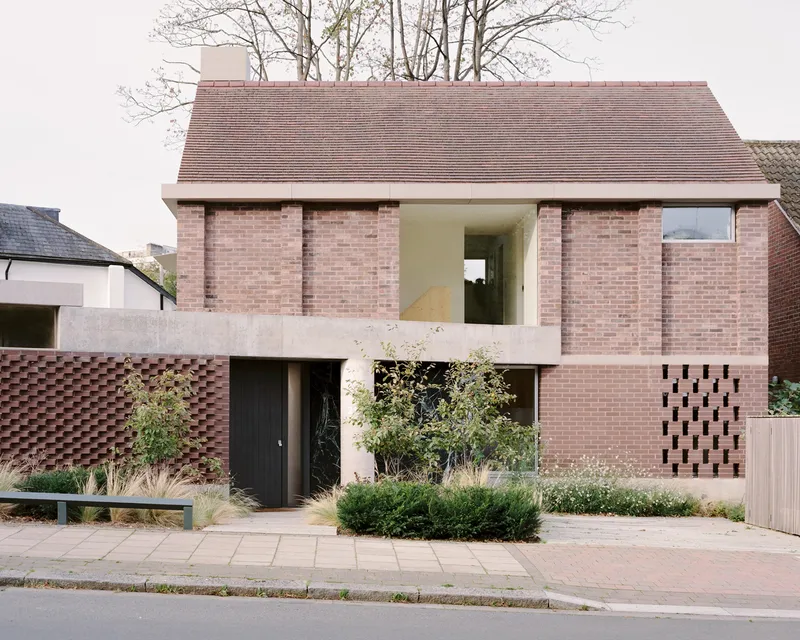
The street elevation is where Six Columns House does its civic work. The lower portion uses super-smooth Wienerberger Staffordshire Brown bricks, while the first floor shifts to a rougher, more varied Furness Brick & Tile Co. stock. The change in texture reads as a subtle base and body, an old trick borrowed from palazzo typology and translated into suburban London without irony. Chequered brickwork panels add a layer of surface play that rewards close looking.
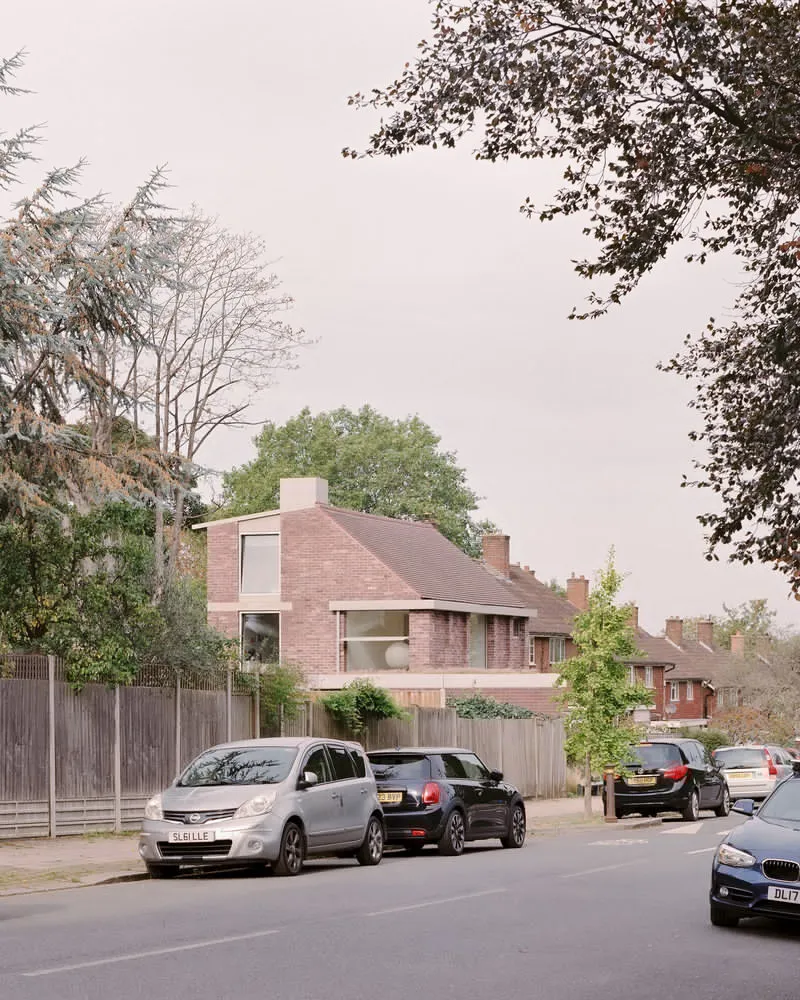
From a distance, the house sits comfortably among its 1950s neighbors, sharing their roof pitch and heavy eaves. It steps up in height and forward by the same increments as the houses along the road, a disciplined contextual move that allowed the project to clear planning hurdles where previous applications had failed. The pitched roof and the dark timber eaves clad in 6mm cement board give visual weight without the carbon cost of solid masonry.
The Threshold: Marble, Concrete, and Staggered Brick
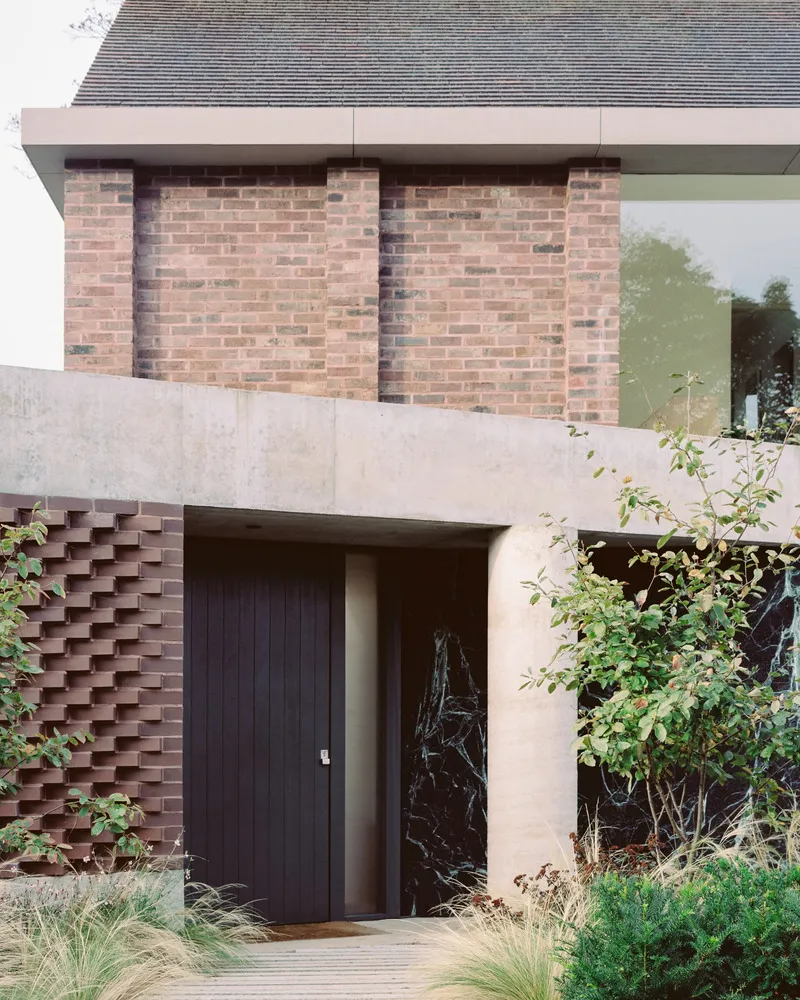
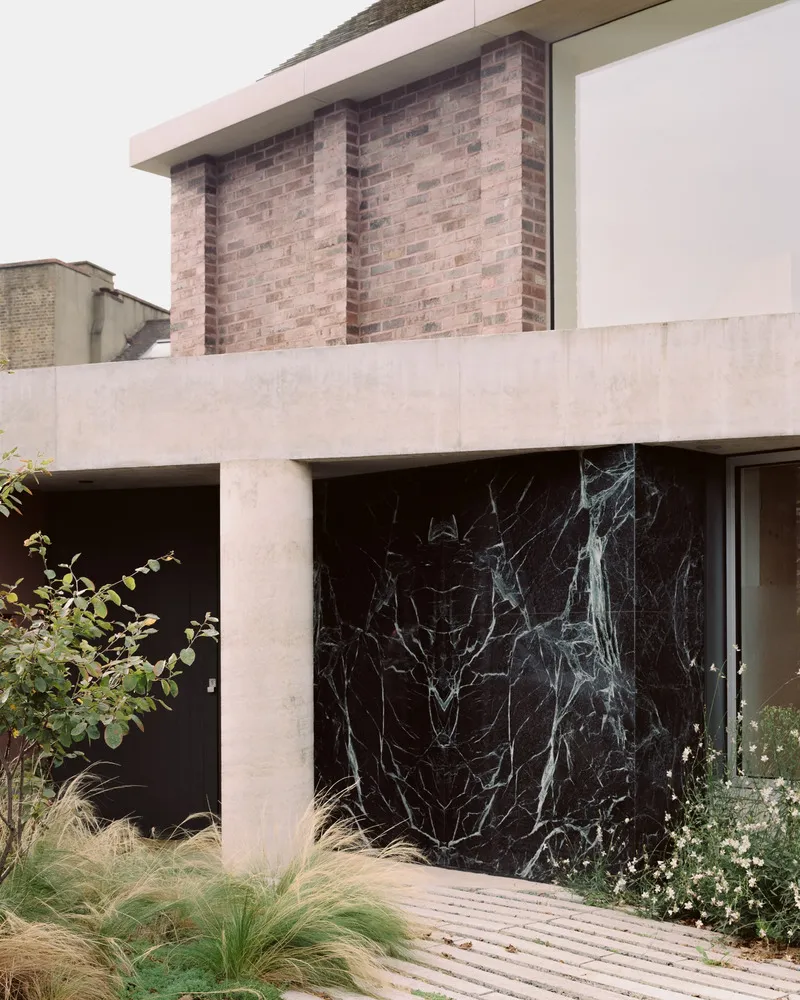
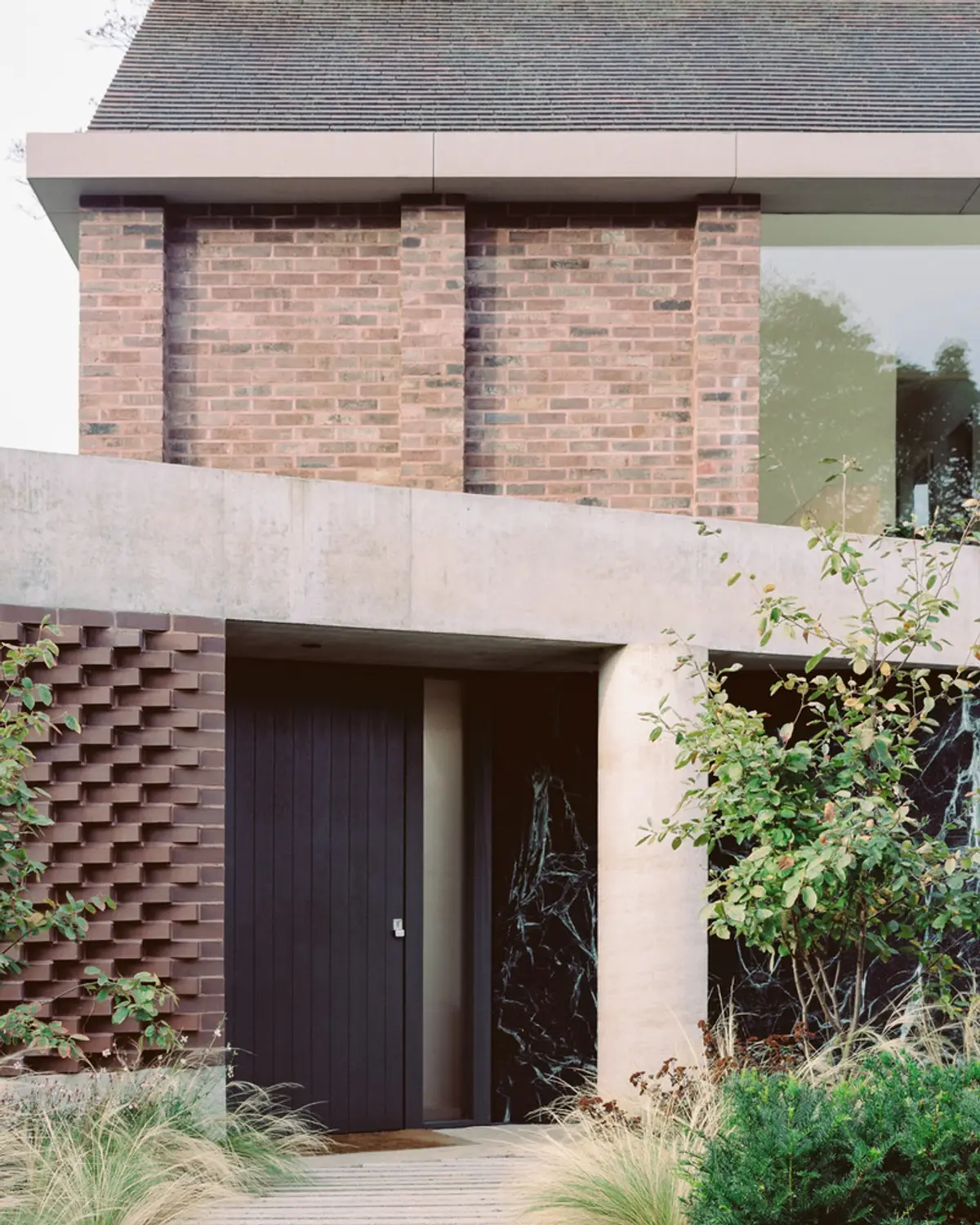
The entrance sequence is the most deliberately composed moment of the house. A black timber door sits within a concrete portal, flanked by a staggered brick screen wall that filters the view of the interior from the street. Beside it, a panel of black-veined marble, framed by concrete and backed by planted beds, announces that this is not a typical infill project. The marble is a direct reference to the Barcelona Pavilion, and it works because 31/44 deploy it sparingly: one panel, one gesture, then you move on.
The staggered brickwork screen does double duty, providing privacy to the entry while letting light and air through. It is the kind of detail that demonstrates how much design thinking can be embedded in a single wall when the architect is also the client and has no one to convince but themselves.
Entry Hall as Wunderkammer
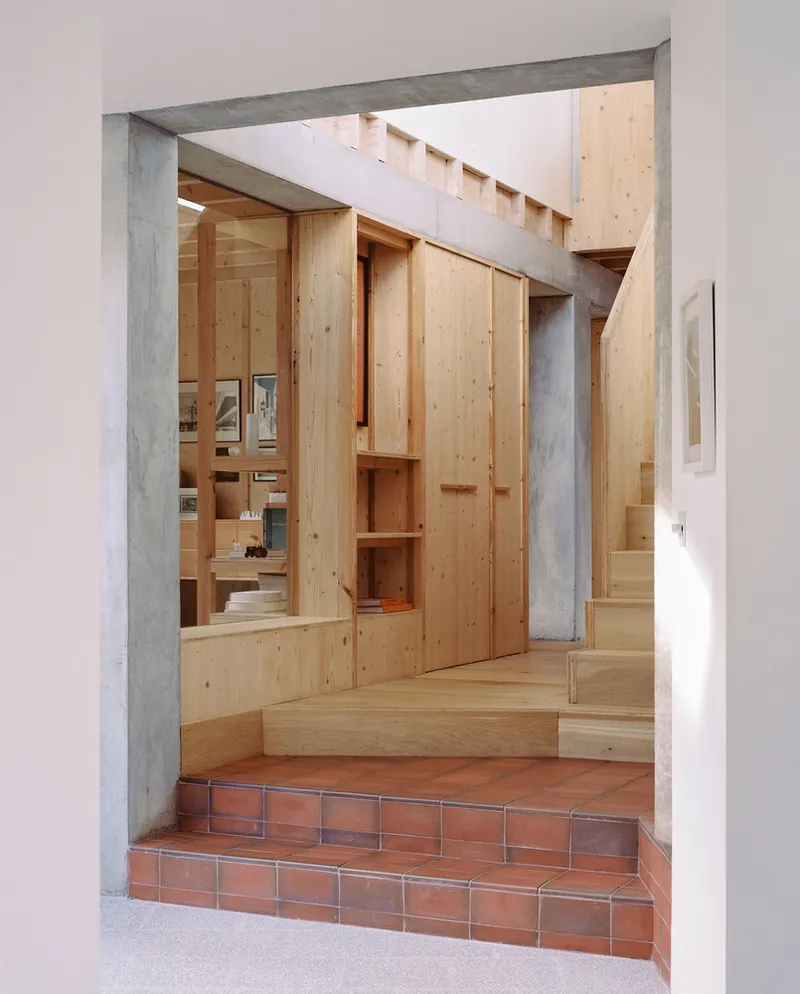
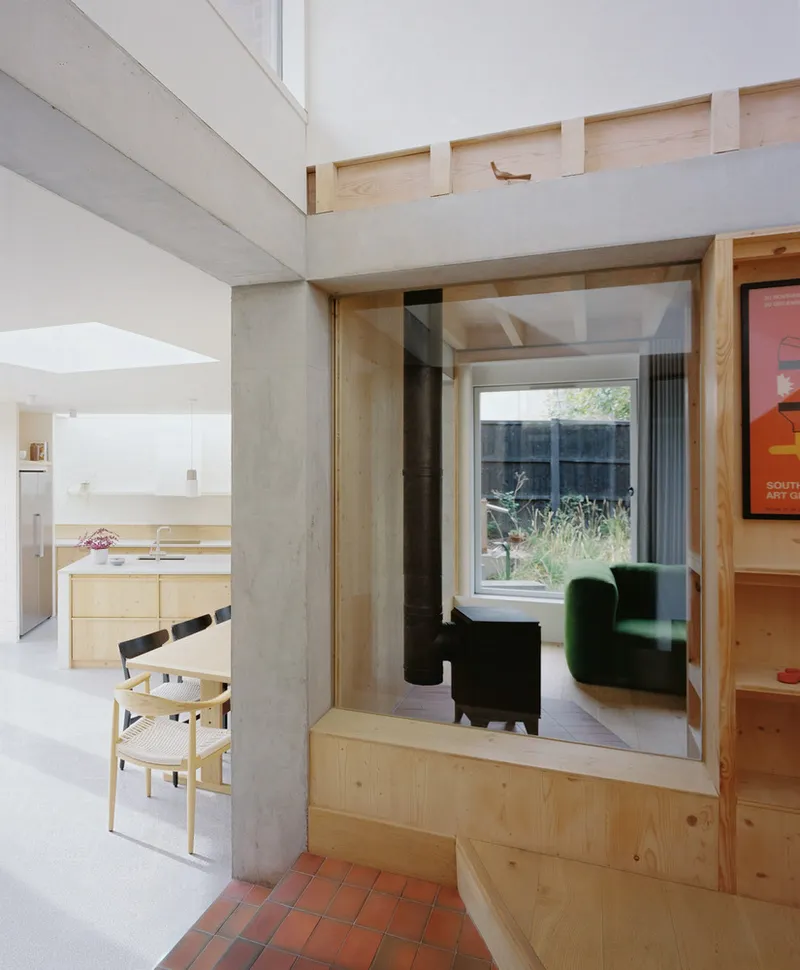
Step inside and the terracotta tile floor begins a gentle climb through the entry hall. The level changes are deliberate: the house uses stepped floors to navigate the site's slope, turning a constraint into a spatial sequence. Thick pine walls line the hall on both sides, concealing built-in storage, cupboards, and shelving behind flush panels. The concept of the wunderkammer, a cabinet of curiosities, is taken literally here. The hall is not a corridor to pass through but a room in its own right, a place for objects, coats, books, and the slow ritual of arrival.
Through a pine-framed glazed aperture, the entry connects visually to the living room beyond. The framing is tight and deliberate, controlling what you see before you reach it. All joinery is oiled, never painted, and fixed in a way that allows easy adjustment over time. 31/44 cite Enzo Mari's Autoprogettazione as inspiration for the simply finished woodwork, and it shows: nothing here pretends to be precious.
Shared Living Over Private Retreat
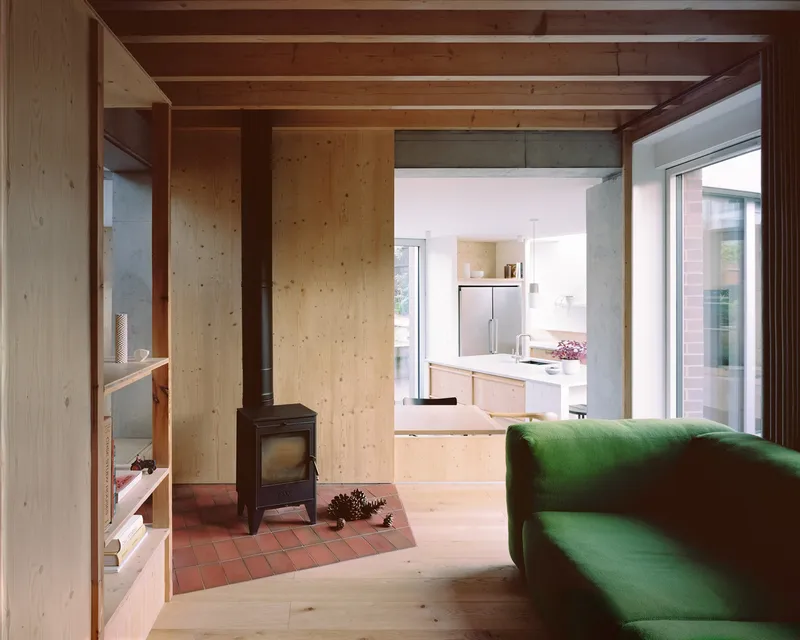
The ground floor organizes kitchen, living space, a bedroom, and a family room around a strategy of contained rooms complemented by more open areas. Very few corridors exist in the plan. The living space is anchored by a wood stove set on a terracotta tile hearth, with a view straight through to the kitchen and out to one of the two rear gardens. The effect is one of layered depth: you are always looking through one room into the next, which makes 150 square metres of living space feel considerably larger.
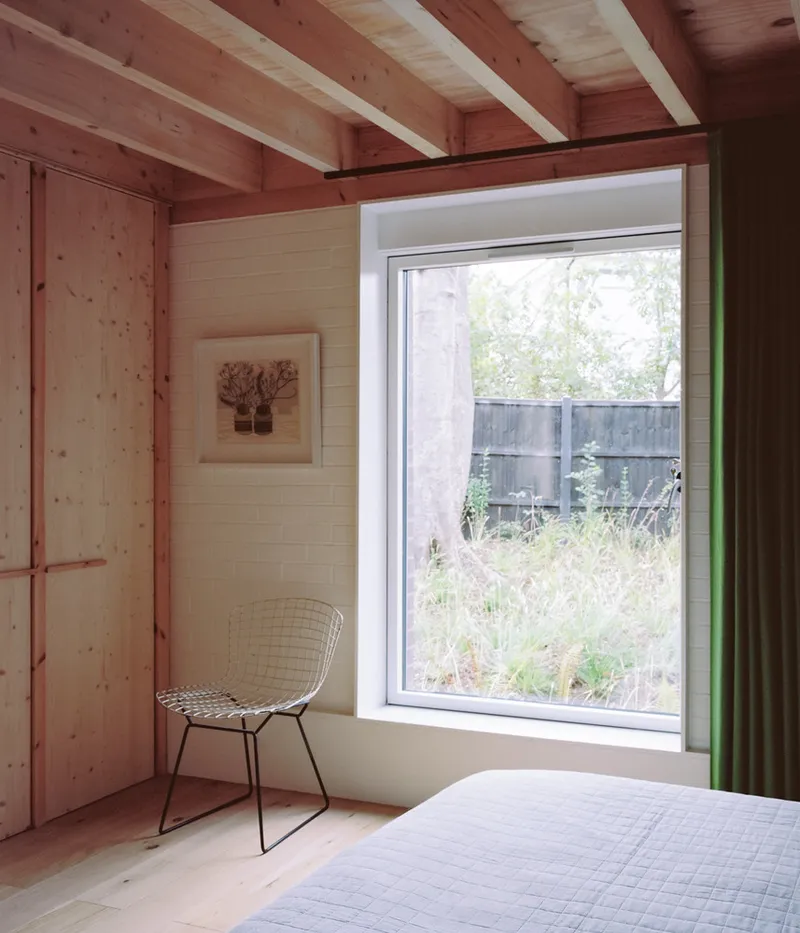
Upstairs, a bedroom with exposed timber beams and pale plywood walls demonstrates the shift in structure: from the ground floor's exposed brickwork and concrete frame to the upper floors' timber framing. Timber spans were carefully designed to avoid steelwork entirely, keeping both embodied carbon and visual language consistent. The interiors remain intentionally unfinished in the Le Corbusier sense, raw surfaces that will age and patinate alongside the family.
Two Gardens and a Glazed Seam
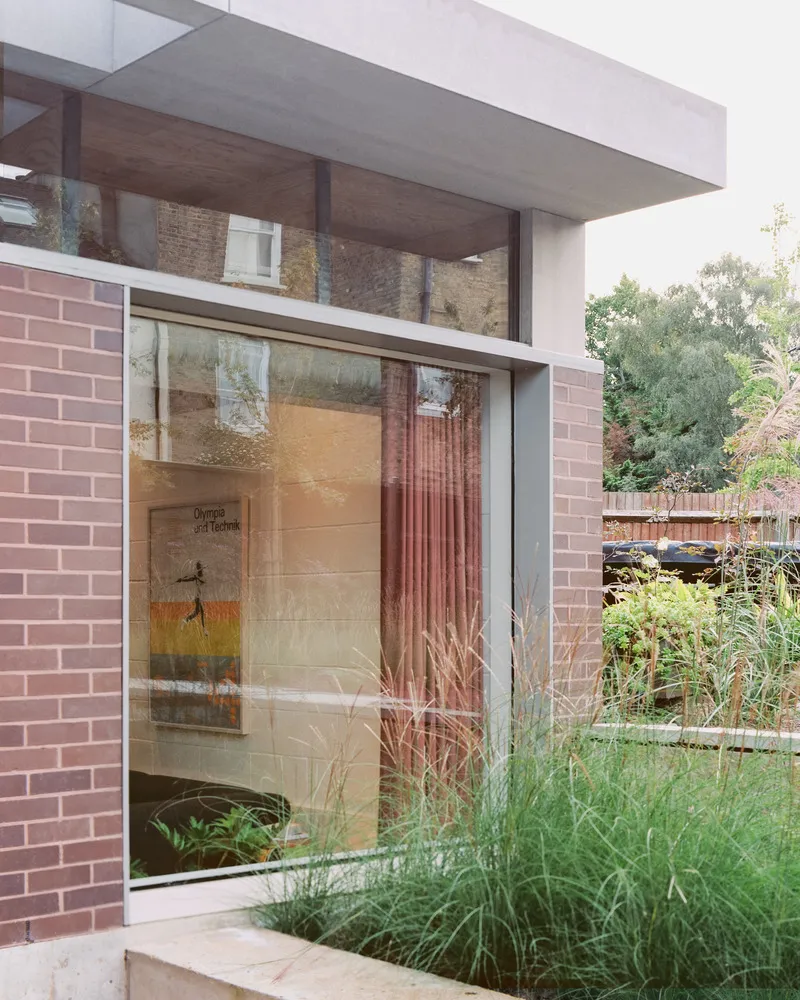
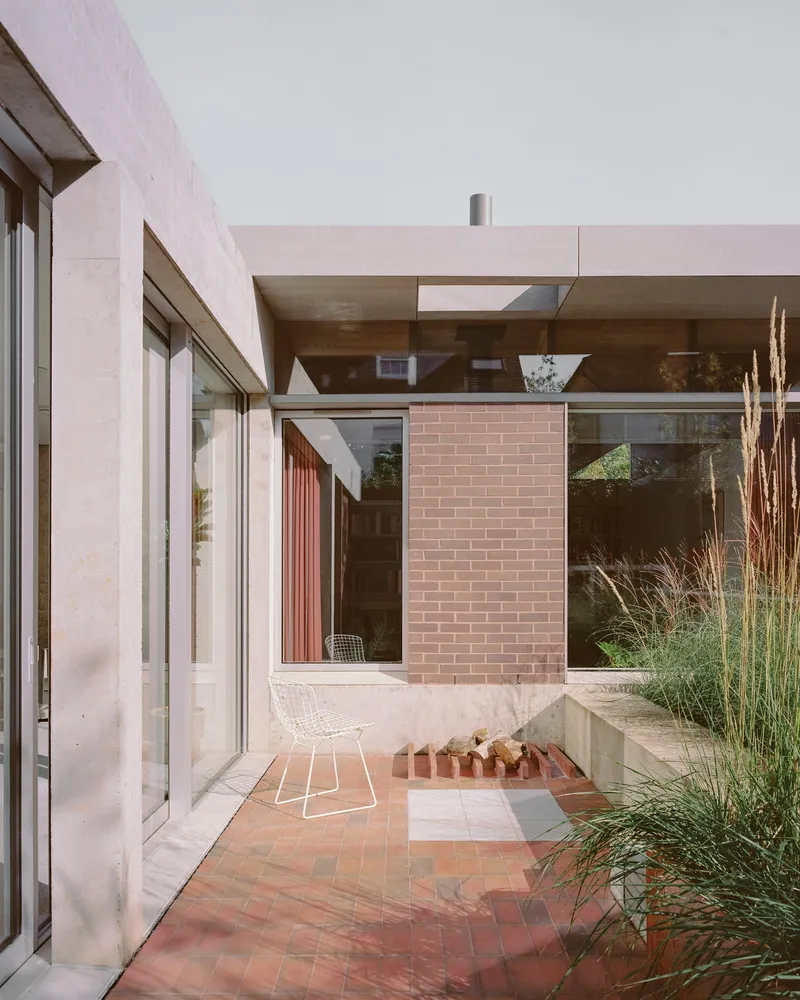
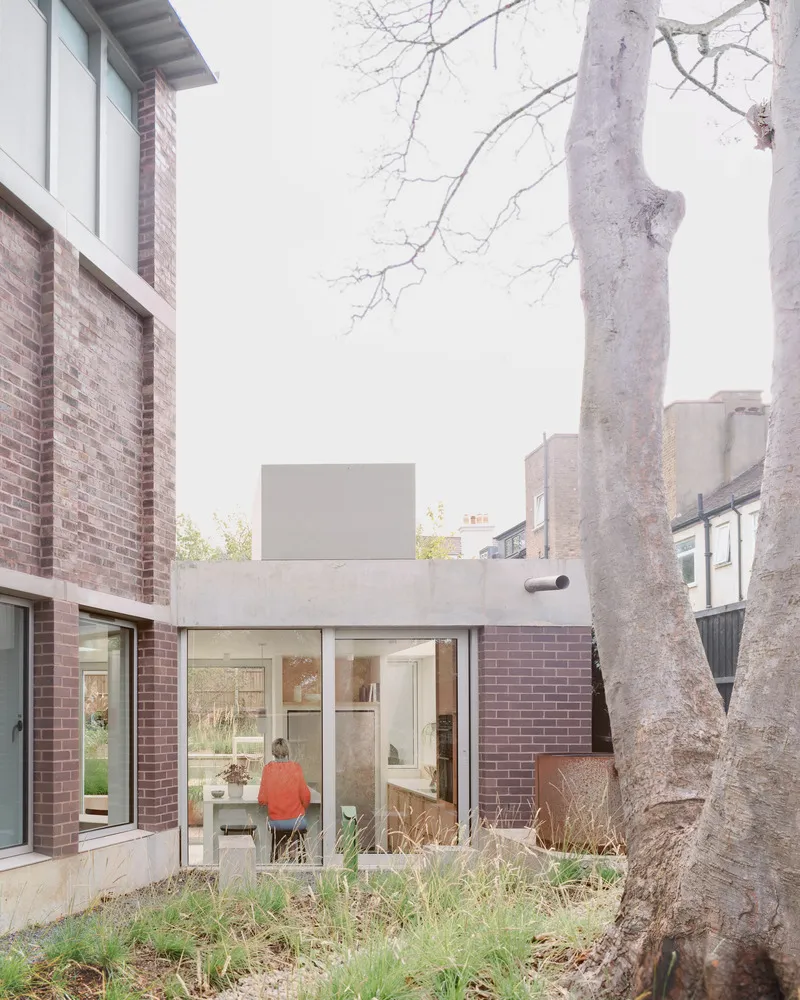
The house splits its rear into two gardens. A west-facing rainwater garden, planted for low maintenance, captures evening light for the kitchen, living room, and ground-floor bedroom. A south-facing terrace with drought-resistant planting is accessible from the kitchen. Between them, the kitchen and living space act as a glazed seam, pulling light from both orientations and creating cross-views that dissolve the boundary between inside and out.
The glazed corner condition, framed by pink brick walls looking onto planted grasses in afternoon light, is the image that best captures the house's ambition: to be both solid and transparent, urban and garden-facing. Rainwater is channelled into water butts with runoff managed entirely on-site, while the foundation system of steel screw piles was chosen specifically to protect the roots of the protected sycamore, with structural resistance measured in real time during installation to allow tighter design margins.
Low Carbon by Design, Not by Sacrifice
Six Columns House is fully electric, heated by an air-source heat pump with underfloor heating throughout. Triple-glazed aluminum windows, passive stack ventilation driven by a rooflight in the double-height first-floor space, and self-finished materials that avoid high-embodied-carbon plastering all contribute to a measured performance of 1.78 tonnes CO2 per year, less than a third of the six-tonne average for a UK home. The embodied carbon figure of 436 kgCO2eq/m² exceeded the studio's initial LETI Guide targets, but the operational savings over the building's lifetime will more than compensate.
What is refreshing about the sustainability strategy is its lack of martyrdom. The house does not look like a low-carbon building. It looks like a brick house with good details and generous gardens. The carbon reductions come from structural logic, material selection, and passive design rather than from bolt-on technology or visible sacrifice. That distinction matters if low-carbon housing is going to become normative rather than niche.
Why This Project Matters
Architect-designed self-builds are often dismissed as privileged experiments with limited relevance. Six Columns House pushes back on that assumption. The steel screw pile foundation system, the timber-over-masonry structural transition, the passive ventilation strategy, and the avoidance of steelwork and wet plaster are all techniques that can be applied to volume housing. 31/44 have used their own project as a proving ground for ideas that deserve wider application, and they have documented the performance data to back it up.
More broadly, the project is a serious argument for architectural literacy at the domestic scale. Every brick joint, every threshold, every framed view communicates something specific about how the family wants to live and what buildings they admire. The house treats Crystal Palace not as a blank canvas but as a neighborhood with existing rhythms worth joining. In a London market saturated with developer-led infill, that kind of attention is not a luxury. It is the baseline we should expect.
Six Columns House by 31/44 Architects. Crystal Palace, London, United Kingdom. 164 m². Completed 2024. Photography by Nick Dearden.
About the Studio
Share Your Own Work on uni.xyz
If projects like this are the kind of work you want to make, uni.xyz is a place to publish your own, find collaborators, and enter design competitions.


Popular Articles
Popular articles from the community


ALGAL REALM: A Bio-Integrated Lunar Habitat Design for Life Beyond Earth
ALGAL REALM reimagines lunar habitat design with algae-powered life support, 3D-printed regolith, and vertical living for a lunar future.

Conexión: Biophilic Design Reimagines High-Rise Living in Hong Kong
Conexión reimagines high-rise living in Hong Kong through biophilic design, green facades, shared spaces, daylight, water and nature within.

Hill & Cross Opera: Sculptural Opera House Architecture Shaped by Tallinn’s Landscape and Identity
Hill & Cross Opera reimagines opera house architecture in Tallinn through its sculptural hill, civic plaza, glass wave and a luminous cross.

The Musturak Paradise: Senior Living Architecture for a Connected Future in Temara, Morocco
The Musturak Paradise reimagines senior living architecture in Temara via private homes, social spaces, culture, community, and shared care.

Similar Reads
You might also enjoy these articles


Bamboo Housing Challenge 2026: Design Affordable, Sustainable Homes Using Bamboo
An international design competition by Bamboo U and IBUKU inviting architects and designers to reimagine affordable housing using bamboo — with the winning design built full-scale in Bali.

Computational Design & Education: Beegraphy Design Awards Introduces 7th Category (Featuring Jiyun's Innovative Approach)
Dive into Beegraphy’s 7th Design Awards category, where computational design meets education to create immersive, interactive learning tools, inspired by Jiyun’s work.

From Parametric Lighting to Urban Furniture: Join the 2nd Workshop in Beegraphy’s Computational Design Series
Dive into Cutting-Edge Design Techniques and Practical Applications with Industry Experts

Last Call: Unleash Your Architectural Genius in SHAK's Kindergarten Design Competition
Urgent call for architects to join SHAK's kindergarten design competition before the looming deadline

Explore Architecture Competitions
Discover active competitions in this discipline

Challenge to reimagine the Iron Throne

Photograph architecture without architects

Illustrate the lost glory of Angkor Wat - Render Challenge

Design challenge to reuse E-waste
Comments (0)
Please login or sign up to add comments
No comments yet. Be the first to comment!