
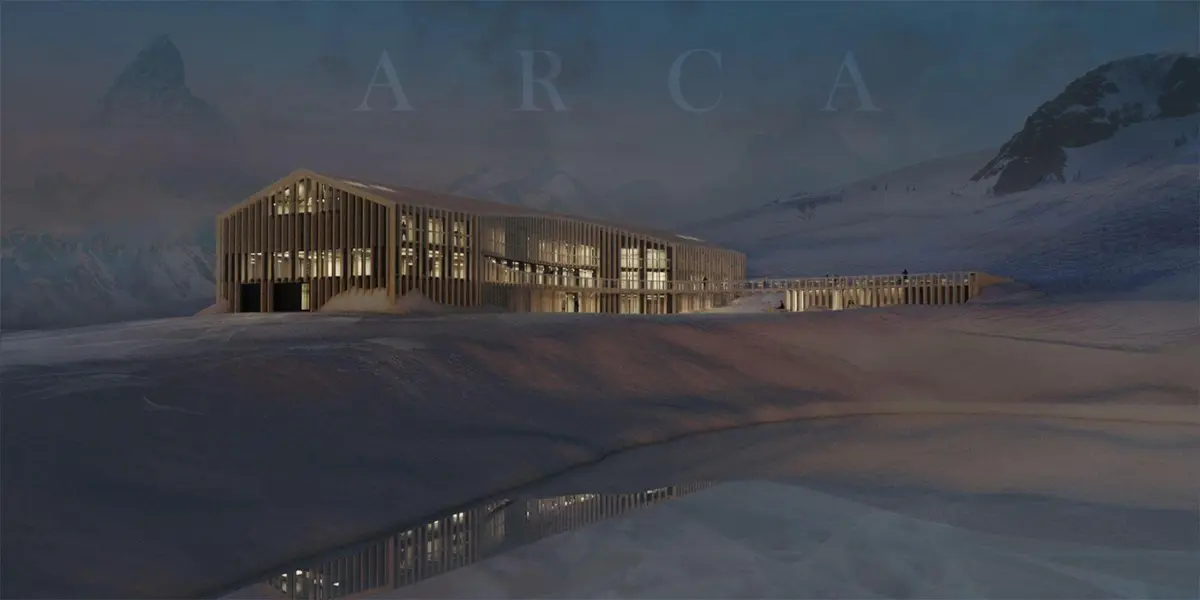
Skiing in the snow: Low-emission, climate conscious Ski Resort designs in Switzerland
Result for 'Snow Dwell One' - Architecture Design challenge, out now.


Hunter-Gatherers roamed around the globe trying to find temporary/permanent habitats and food. Scaling through varied landscapes encouraged them to develop different equipment for proper hunting and surveillance of the area. One of those pieces of equipment was Skis, to hunt and move in the northern regions. Evidence of skiing can be traced to 5000-year-old Chinese paintings that suggest the use of skis and fragments of ski-like structures found in northern Russia.
Many who lived in the snowy mountains, developed some skiing as a means of transport. It was and is still being used for transportation in rural Russia and Scandinavia. The boom of Skiing as a sport happened after veterans of the World-war started promoting it. Since then, skiing both as a sport and recreation was a natural development from its utilitarian applications. Over the years' equipment improved and skiing for different regions was developed.
The 90s witnessed this boom especially when the snowmaking machine was developed, which allowed tourists and enthusiasts to enjoy skiing even when the weather was uncooperative.
The roots of Alpine and Nordic tourism, in general, can be traced to the development of transport in the 19th-20th century. Lodges in the Alpines have sprung from agriculture, as barns housed skiers and tourists in the 80s. After it, the first generation of Winter resorts including Grindelwald, Chamonix and St. Moritz invested in skiing facilities after it bloomed in the 1950s.
An increase in disposable incomes and automobile ownership brought families and vacationer's to the Alpines demanding a better standard of living and mass tourism began. Along with the availability of on-slope skiing activities, the off-slope amenities began to grow. Facilities and services attached to lodging, beverages and entertainment became important elements associated with ski vacation packages.
The architecture of these typologies has evolved from rural origins to cultural influences of different eras and aesthetics. Now the resort acts as multi-functioning typologies catering to the needs of skiing, transport as well as winter-vacations.
Ski-tourism is a global industry with approximately 68 countries with ski-resorts offering integrated services. It is a multi-billion dollar international market attracting between 300 and 350 million annual skier visits. Although due to its strong dependency on specific climatic conditions, the ski industry is regarded as the tourism market most directly and immediately affected by climate change.
Due to global warming scientists have predicted that 70% of snow over the Alps will be lost by the end of the 21st century. While the effects on ski tourism and ski resort are due to global phenomena, more than 20% of the emission of greenhouse gases are from the transport facilities and accommodations in the region. The resorts and tourism facilities face a decline due to their unsustainable strategies. The future for the ski industry seems to be highly unfavorable.
Can we provide solutions for the ski industry that helps to mitigate the effects of climate change?
With this ever-rising demand for ski vacations, ski resort and climate change, there is intense pressure on the ski industry. The industry since its inception is the central economic factor for remote regions in the mountains; its decline will cause direct harm to their livelihoods.
Several technologies, construction processes, and materials have been developed/evolving since the crisis of environmental decline all over the world. This has pushed many typologies to adapt to more sustainable means to harbour recreational activities.
While delivering a great experience of a vacation and skiing activities, can we sensitize people about climate change through ski resort design?
Brief: The design challenge here was to create a low-emission ski resort that is environmentally aware in the form of its design strategies, and also provides excellent skiing and vacation experience.
The jury for the competition consisted of esteemed designers, professionals, and academicians from around the world. The Lead Jurors for the competitions were as follows:
Takashige Yamashita, Principal Architect, Takashige Yamashita Office, Japan
Ana Julia Carvajal / Alejandra De La Cerda, Cofounder - CEO, POLEN ARQUITECTURA DE PAISAJE, Mexico
Louis Thompson, Chief Executive Officer, Nomadic Resorts, Mauritius

Some of the Best competition projects are as follows:
Winning Project: ARCA mountain resort
By: Paulina Wojnarowicz, Jan Warchol, Przemek Ruta & Anatol Popławski
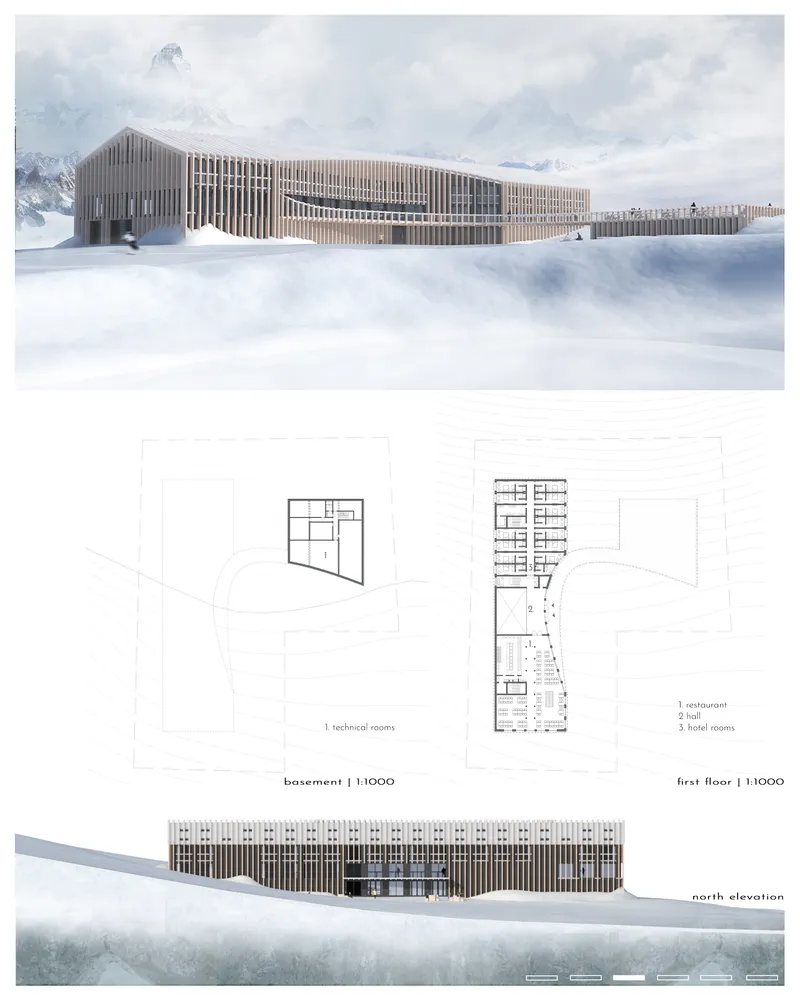
Fig: 1 Floor and Elevation Plan
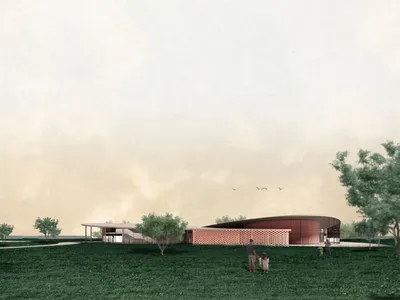
Description: While designing a simple body, we wanted to fit well into the natural landscape. To make the building not too simple, we added a dynamic cut which represents shape of the lake and "second layer of facade", which changes the perception of the building depending on the point of observation.
-----------------------
Editor’s Choice: Cross the Season
By: Jihyeon Lee, Kim Taeyun & Seyun Hwang
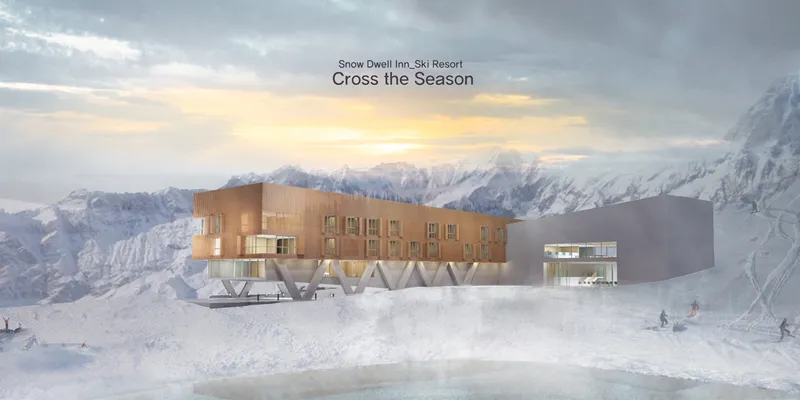
Fig: 2 Cover image
Description: "Cross the Season" is a new form based on Vorsäß. The biggest feature of Vorsäß can be seen as the fact that simple masses are composed without boundaries depending on the mountain range and topography. Based on these characteristics, we reinterpreted the form and proceeded with this project.
-----------------------
Editor’s Choice: Snow Dwell Inn
By: Patricio Lavalle
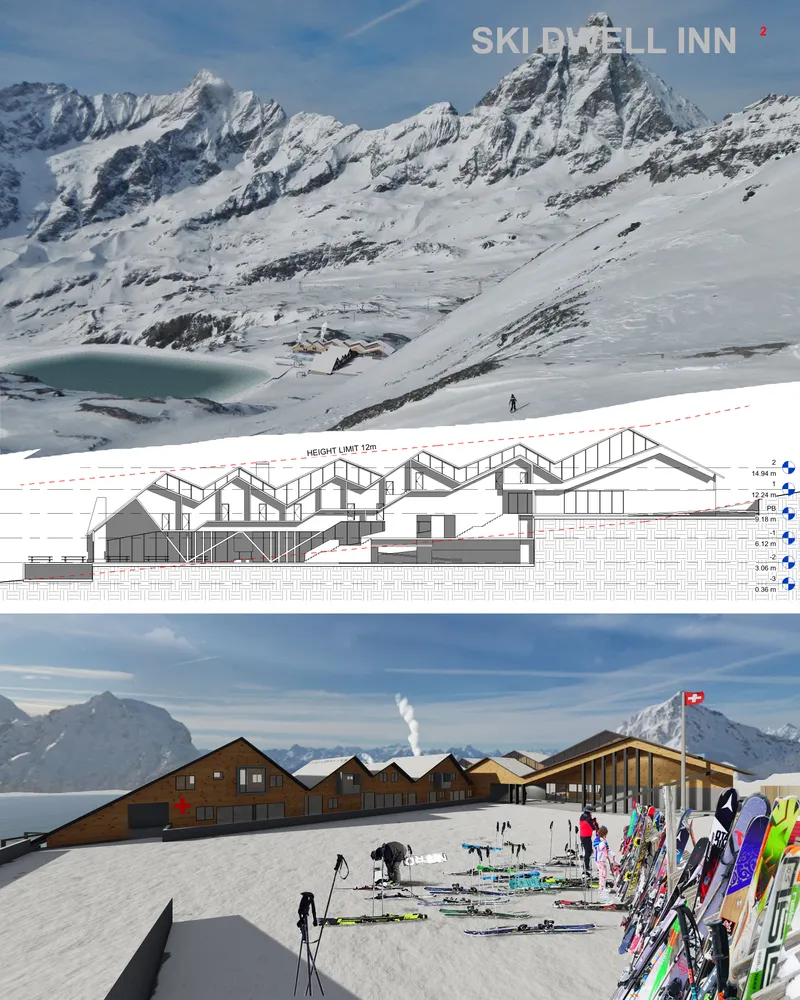
Fig: 3 Site image and Section Plan
Description: Near a water reservoir this project mimics the spectacular profiles of the surrounding mountains. At a high altitude of almost 4,000mts, this refugee is not only a place to spend part of the day, but it is also a ski in ski out resort to spend a couple of days for retreat or vacation, alone, couple, or with family.

Follow us on social media: Facebook | Instagram | LinkedIn | Twitter | Youtube
References (3)


Popular Articles
Popular articles from the community

SCENTLAND: An Animal Shelter Designed Through the Nose of a Dog
Winner of Strays 2020, this proposal uses scent mapping to generate circulation, form, and program for a sensory-driven shelter.

Extended Shell: Retrofitting Kolkata's Balconies as Living Urban Thresholds
A modular retrofit system recovers the social and environmental intelligence of Kolkata's historic verandas for contemporary Park Street residents.

Faces of the Soviet Avant-Garde: Turning Moscow's Street Names into an Open-Air Museum
A network of sculptural installations across a Moscow residential district transforms forgotten architect names into spatial encounters with cultural memor

Opera by the Sea Estonia: Three Shells Dissolving Architecture into Tallinn's Coastline
A winning opera house proposal replaces monumental form with interconnected shells that blur the boundary between building, park and Baltic Sea.

Similar Reads
You might also enjoy these articles

Temporary Home for Dogs: A Reversed Zoo Rethinks Animal Shelter Architecture
In Bucharest, a sinuous corridor and freed landscape flip the logic of containment, designing a shelter that works to make itself unnecessary.

Kelpscape: An Underwater Habitat That Becomes Part of the Kelp Forest
A submersible research vessel designed to be colonized by the very marine ecosystem it studies, blurring the line between architecture and organism.
Extended Shell: Retrofitting Kolkata's Balconies as Living Urban Thresholds
A modular retrofit system recovers the social and environmental intelligence of Kolkata's historic verandas for contemporary Park Street residents.
Immersion: An Opera House Born from Ripples, Sound Waves, and Coastal Terrain
Paulina Walachowska's conceptual opera house translates wave propagation and acoustic geometry into a walkable public landscape.

Explore Architecture Competitions
Discover active competitions in this discipline

Challenge to reimagine the Iron Throne

Photograph architecture without architects

Illustrate the lost glory of Angkor Wat - Render Challenge

Design challenge to reuse E-waste
Comments (0)
Please login or sign up to add comments
No comments yet. Be the first to comment!