
Skill Center for women in Nigeria
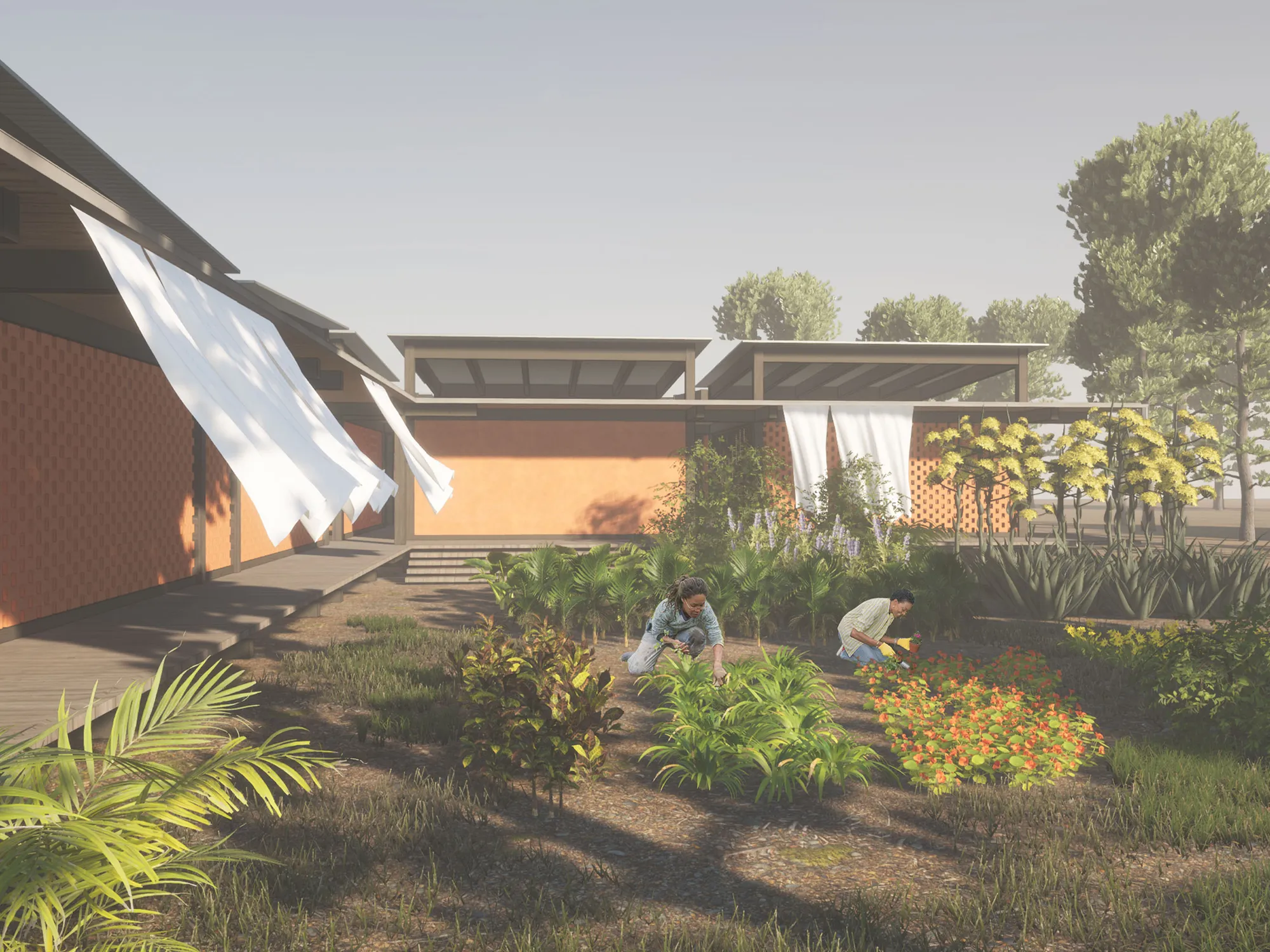
The main idea of the project is to create a space that is adaptable to current needs of its users. Another important aspect is to refer to the traditional Nigerian buildings that can be achieved by using natural, local materials such as wood and laterite bricks. The whole project is based on a construction grid that is modified in the way to enable dividing and combining spaces together. The functional program is divided into three main parts: educational, recreational and administration.

The main source of income in Nigeria is oil exploitation. In terms of mining, it is ranked 9th in the world, yet it is not a wealthy country. Problems such as poverty, terrorism and corruption contribute to increased unemployment in Nigeria and have a negative impact on youth development, resulting in increased difficulty in accessing basic education, especially among women. The proposed facility is intended to address this issue and primarily provide a safe place to learn for women who have historically been denied access to basic education for various reasons. The building is intended to meet the needs of the users, creating a comfortable place also to spend leisure time together, relax, practice crafts and strengthen the community.
Buildings in the vicinity of the proposed development are of varying heights, and the development is loosely spaced. It is dominated by residential function. The development surrounding the lot has a uniform color scheme, rich in warm shades of yellow, beige, and orange. The terrain of both the plot and its immediate surroundings is flat.
The main idea of the project is to create a safe and welcoming place for its users, which will primarily solve the problem of access to basic education among women in Nigeria. Another important aspect is to fit the building into its context so that it does not dominate it, but becomes an interesting element in the neighborhood. The entire premise is based on a doubled structural grid, into which the rooms forming the individual blocks are inscribed. It is an element that strongly organizes the space and at the same time gives the possibility to combine and separate specific zones and rooms.
The form of the building is reminiscent of a traditional Nigerian settlement. It consists of three functional blocks open to the entrance area, which is a representative space - a place for meetings, discussions and exchange of views. Each block consists of rooms of similar dimensions. The dynamism of the solid is added by the canopy, which gives the impression of waving. There is one roof slope of three degrees for each room. The communication part is roofed separately with flat sheets of corrugated steel. Together, these elements form a roof structure that is perceived as a single unit. In this way, it binds all the functional blocks together.
The designed Center is first and foremost an adaptable place to meet the needs of its female users at any given time. It uses different types of vertical partitions with different degrees of transparency: solid and perforated laterite brick walls and wooden panels, allowing for the separation of rooms or combining them, depending on the current needs of users. Traditional local materials were used in the design: wood and laterite brick, characteristic of traditional Nigerian buildings. Perforated brick walls allow for passive cooling and shading while maintaining a sense of privacy.
The body of the building is simple, consisting of three main functional blocks. The form of the building is reminiscent of a traditional Nigerian settlement - this is evident in the above-mentioned blocks located around the square, which is a common space and a representative entrance zone. The design was based on a structural grid, modified to allow for easy communication within the facility, but also flexibility. This is the main organizing element of the entire project. A doubled grid of columns and rafters allows for separate corridors between all rooms. The wood frames are filled in with laterite brick, which is seen on the facades of the building. They consist of solid and perforated walls. The building is characterized by warm colors that fit well into the existing landscape. The dynamism of the whole mass is added by the structure of the roof, which gives the impression of waving. It consists of trapezoidal sheet metal roof slopes, all with the same angle of inclination.
The facility is handicap accessible. There is a ramp at the main entrance of the facility to allow wheelchair access. There are separate toilets for people with disabilities, with a specially adapted toilet, sink and grab bars. The 1. 60m wide crossings allow for wheelchair passage.
The most important assumption in the design concept is the possibility of adapting the facility to the current needs of users while ensuring their privacy, comfort and safety. Taking into account the above assumptions, the facility should be characterized by a clear functional division, as well as the possibility of combining zones and creating multifunctional spaces. The building is single-story. Its volume was based on a doubled structural grid and divided into three functional blocks: educational, recreational and administrative. Each of them consists of rooms that fit into the aforementioned structural grid and accommodate different functions. The functional blocks open onto a roofed space, not separated by vertical partitions, which is a representative entrance zone to the building. The roofing of the facility is composed of two parts. Traffic routes are roofed with flat sheets of trapezoidal metal sheet. Individual rooms were roofed independently with roof slopes also made of trapezoidal sheet. The roof structure, although disjointed and composed of many elements, is one whole. In this way it binds the whole mass, and its wavy form is an interesting element which adds dynamism to the object.
The meaning of the concept lies in the combination of two structures: architectural and urban. Individual rooms separated by an orthogonal network of corridors correspond to the dense development of slum districts in African cities. Here, however, the chaos of these districts has been replaced by an ordered structure that brings out a certain value from their ugliness.



Popular Articles
Popular articles from the community


Hill & Cross Opera: Sculptural Opera House Architecture Shaped by Tallinn’s Landscape and Identity
Hill & Cross Opera reimagines opera house architecture in Tallinn through its sculptural hill, civic plaza, glass wave and a luminous cross.

AL-JANNAH: Sustainable Architecture and Permaculture for Afghan Widows
AL-JANNAH uses sustainable architecture and permaculture to create resilient oasis of housing, learning, work and renewal for Afghan widows.

The Earth Pod: 3D Printed Homes for Resilient Refugee Communities
The Earth Pod reimagines refugee housing through 3D printed homes made from clay, combining resilience, self-sufficiency, and rapid shelter.

EW PARK: Sustainable Architecture Reimagines the Future of Urban Parking
EW PARK reimagines city parking as a modular wooden tower combining automation, solar energy, electric mobility, and adaptable urban design.
Similar Reads
You might also enjoy these articles

The Rhythm of Seasons
A Farmers' Market Connecting Nature and the City

LIVING LEDGES
A living place

More Than a Building-Designing a Living System
More Than a Building-Designing a Living System
Base Beyond
DESERT COMPOUND ARID: TOURISM OF ABSENCE AND ABUNDANCE




Comments (0)
Please login or sign up to add comments
No comments yet. Be the first to comment!