
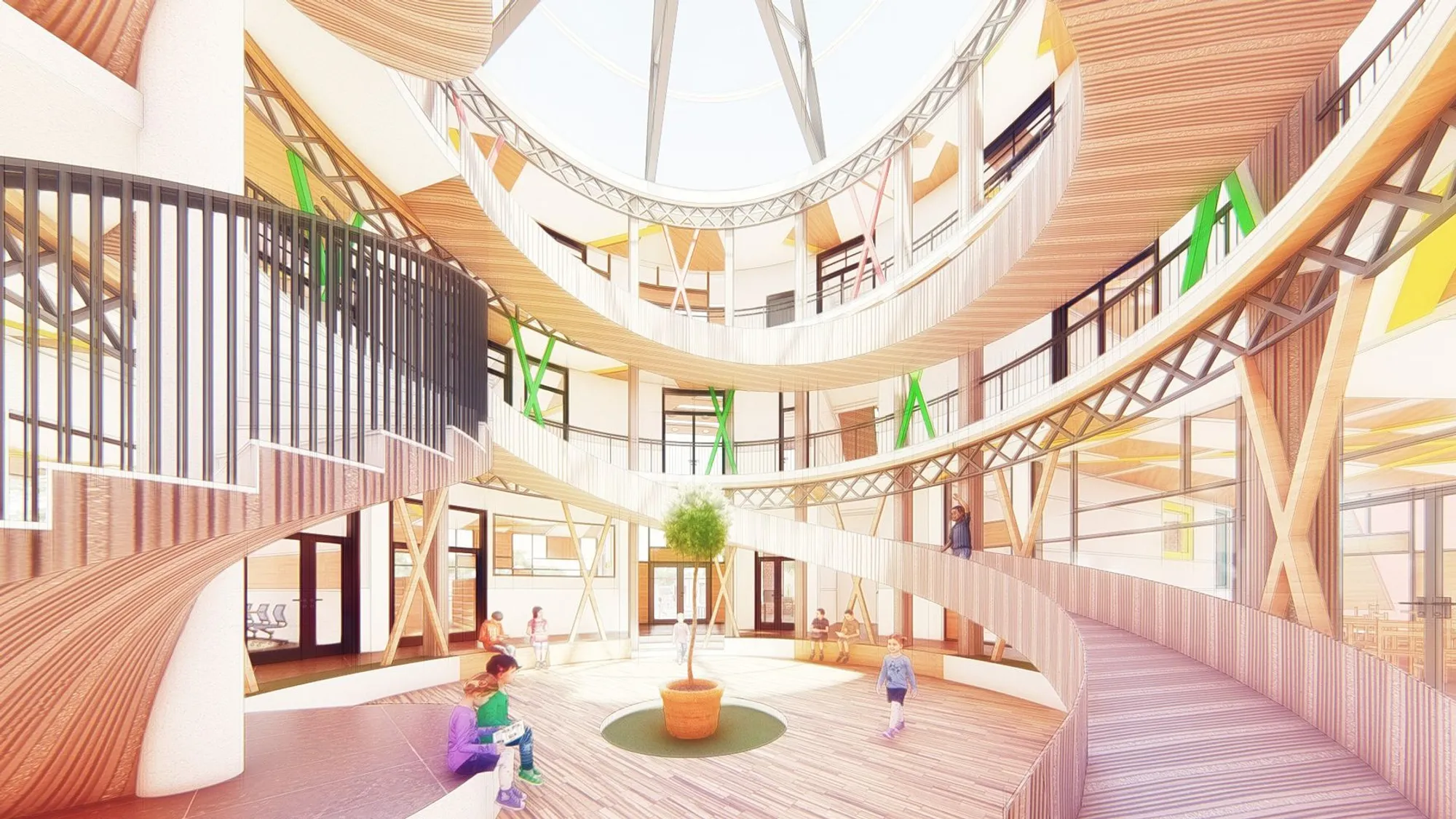
Skill-School: A Circular Learning Ecosystem Built Around a Central Atrium
An elementary school designed as a nested ring of pedagogical zones, anchored by a cylindrical atrium that doubles as social and intellectual core.


What if the floor plan of a school could teach as powerfully as its curriculum? Skill-School starts from a radical premise: a circular building organized around a central cylindrical atrium, where every corridor, terrace, and courtyard reinforces the idea that children are producers of knowledge, not passive receivers. The nested ring configuration places pre-school blocks, elementary classrooms, reading zones, and a fully vegetated rooftop teaching garden into concentric layers, each calibrated to a specific developmental stage. The geometry itself carries meaning: continuity, community, connection.
Designed by Takam Kenmogne Sidoine and MEKEMTA Jodel Bismarc, the project draws on Finland's progressive educational model while responding to locally gathered data from students, parents, and community members. Those surveys surfaced clear priorities: spaces that promote autonomy, environments that spark creativity, and construction techniques aligned with global climate imperatives. The result is a multi-story educational building constructed in reinforced concrete and terracotta brick, threaded with natural ventilation strategies and planted terraces that dissolve the boundary between indoor instruction and outdoor exploration.
A Site Plan That Reads as a Diagram of Community
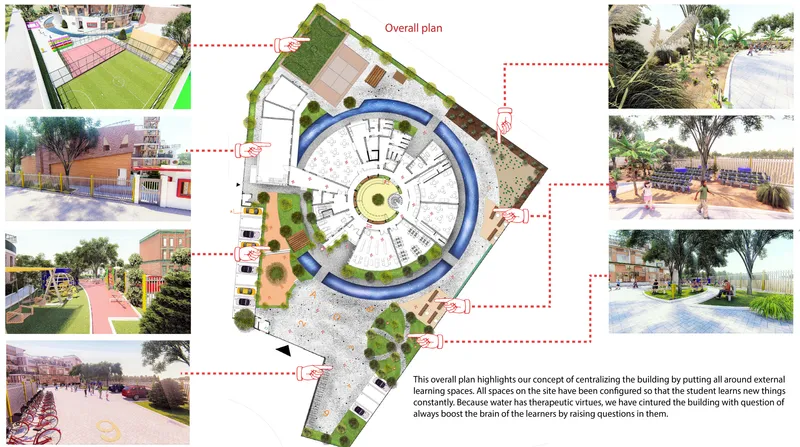
The site plan reveals the project's organizational logic at a glance. A circular central building anchors the composition, with radiating wings extending outward into landscaped zones for outdoor learning, shaded courtyards, and play areas. Pathways are carefully routed to ensure seamless, safe circulation between internal classrooms and external grounds. Rather than treating the school as a fenced compound, the layout frames it as a landscape of exploration, where vegetated terraces and open courts establish a rhythm of gathering and dispersal.
The circularity is not merely formal. It supports the separation of pedagogical zones: pre-school classrooms occupy dedicated blocks distinct from the elementary cycle, so children at different developmental stages encounter spatial conditions appropriate to their needs. Main entrances and exits are configured to control flow without creating bottlenecks, a practical decision that also reinforces the scheme's commitment to child safety.
Nested Learning Layers Around a Cylindrical Core
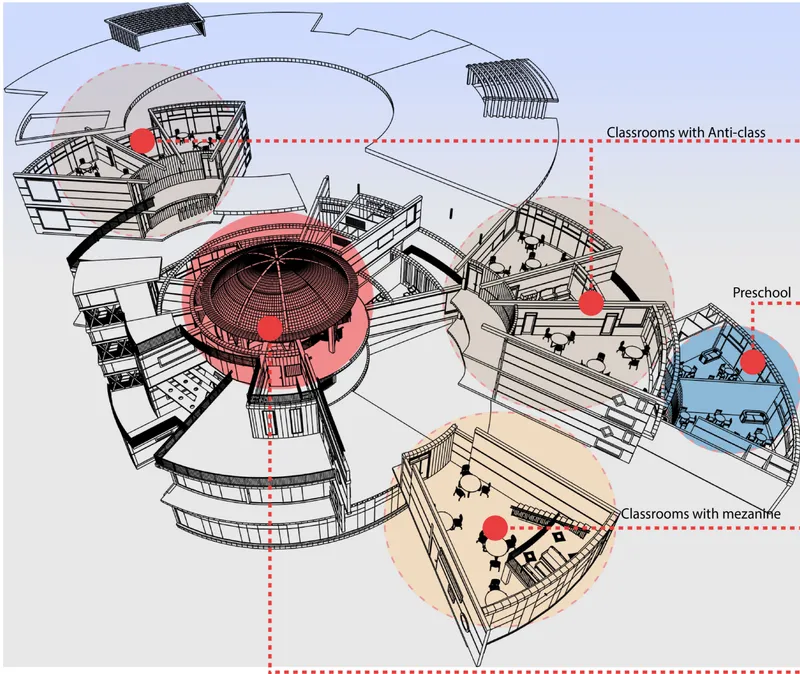
The axonometric drawing makes the building's three-dimensional strategy legible. Classrooms are arranged in clusters around the perimeter, wrapping the central cylindrical atrium that serves as both the intellectual and social heart of the school. The ground floor houses reception, administrative areas, pre-school rooms designed for sensory exploration, and access to communal spaces. The first floor steps up to elementary classrooms, reading zones, breakout spaces, and gardens overlooking the atrium below. The second floor holds quiet study rooms, multipurpose activity areas, and additional learning terraces.
Crowning the structure is a fully vegetated rooftop that functions as a teaching garden, where students engage directly with vegetation and small-scale ecosystems. The vertical stacking of program from sensory play at ground level to contemplative study and ecological education at the top traces a conceptual gradient: as children ascend, the spaces become progressively more autonomous and reflective. It is a building that grows up alongside its students.
Ground-Level Life Between Curved Walls
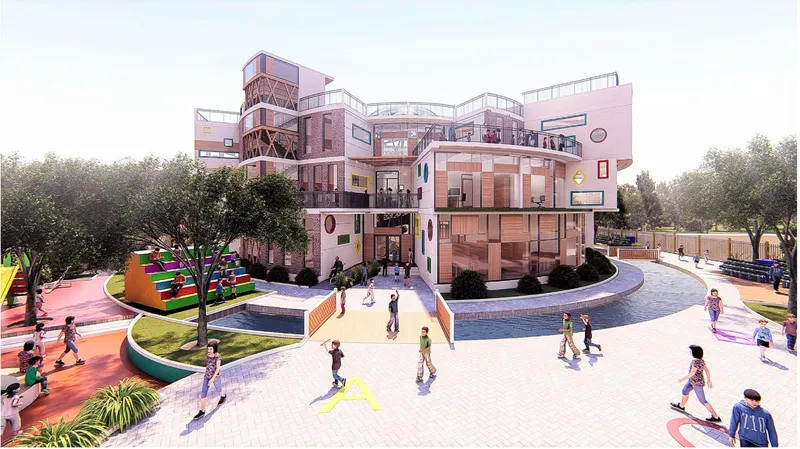
The courtyard perspective brings the scheme to human scale. A curved three-story facade wraps around an open ground plane where children play on colorful pavement alongside playground equipment. The building's curvature eliminates the rigid corridor-and-classroom monotony of conventional school typologies, creating instead a continuous surface that draws students along its arc toward different activities. The court itself acts as an extension of the interior program, a space where structured learning and free play coexist without strict demarcation.
Timber Louvers and the Sectional Logic of Light
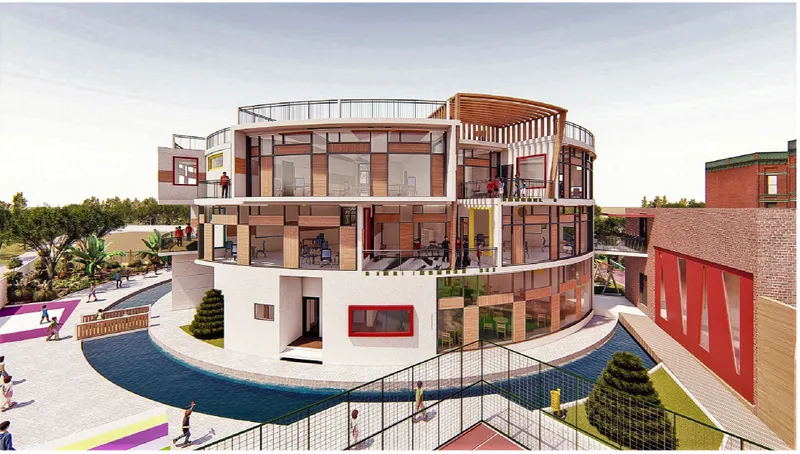
The section perspective cuts through the cylindrical building to expose its interior floors and structural rhythm. Vertical timber louvers frame the facade, filtering daylight into classrooms while providing passive shading. The section clarifies how the central atrium works as a light well, pulling natural illumination deep into the plan and enabling cross-ventilation through the building's core. Reinforced concrete provides structural durability suited to varying climatic conditions, while terracotta brick infill walls add thermal mass and a warm material register that softens the scale for young occupants.
This interplay of heavy and light, open and screened, is what gives the building its environmental performance without relying on mechanical systems as a first resort. The louver system doubles as an identity marker: from the outside, the vertical rhythm transforms the facade into a lantern-like form, signaling the building's civic role as a place of learning visible across the surrounding landscape.
Why This Project Matters
Skill-School is compelling because it refuses to treat educational architecture as a neutral container. Every decision, from the circular plan to the developmental gradient of the section, carries pedagogical intent. The designers did not start with form and retrofit a program; they started with community voices, survey data, and a clear philosophical stance that children learn best when their environment encourages autonomy, creativity, and direct engagement with nature. The architecture follows from those convictions.
In a global context where school design too often defaults to rectangular classrooms stacked beside corridors, projects like this demonstrate an alternative ambition. The combination of locally sourced terracotta, passive ventilation, planted terraces, and a rigorous spatial hierarchy shows that sustainability and social meaning are not competing goals. They are the same project. For Takam Kenmogne Sidoine and MEKEMTA Jodel Bismarc, Skill-School is both a built proposition and a provocation: what would our schools look like if we designed them for the learners we want, not the system we inherited?
View the Full Project
About the Designers
Designers: Takam Kenmogne Sidoine, MEKEMTA Jodel Bismarc
Enter a Design Competition on uni.xyz
uni.xyz runs architecture and design competitions year-round that reward proposals with spatial conviction and real site intelligence.
Project credits: SKILL-SCHOOL by Takam Kenmogne Sidoine, MEKEMTA Jodel Bismarc.




Popular Articles
Popular articles from the community


The Ocean Hive: Sustainable Architecture for a Self-Sufficient Civilization at Sea
The Ocean Hive imagines sustainable architecture at sea, where modular habitats, algae, wave power and ocean waste sustain a growing colony.

The Earth Pod: 3D Printed Homes for Resilient Refugee Communities
The Earth Pod reimagines refugee housing through 3D printed homes made from clay, combining resilience, self-sufficiency, and rapid shelter.

Hill & Cross Opera: Sculptural Opera House Architecture Shaped by Tallinn’s Landscape and Identity
Hill & Cross Opera reimagines opera house architecture in Tallinn through its sculptural hill, civic plaza, glass wave and a luminous cross.

Co-Life: Senior Housing Design That Reconnects Older Adults With the City
Co-Life reimagines senior housing design through healing gardens, shared streets, workshops, and a sustainable community across generations.


Similar Reads
You might also enjoy these articles

Lunar Spiral: Space Architecture Shaped by the Mathematics of the Universe
Lunar Spiral reimagines space architecture through Fibonacci geometry, lunar regolith, levitating habitats, and self-sustaining Moon living.
The Main Dream: Modular Architecture for Play, Learning, and Community
A modular playground turns recycled plastic into adaptable spaces where refugee children can play, build, learn, and reconnect.

Play: Fragments of Their World
Familiar architecture becomes modular playground design, creating safe spaces where displaced children can learn, connect, imagine and play.

Wadi Rum Observatory: Desert Architecture Designed for the Night Sky
Wadi Rum Observatory turns desert architecture into a quiet instrument for astronomy, hiding research spaces under Jordan's starlit terrain.





Comments (0)
Please login or sign up to add comments
No comments yet. Be the first to comment!