
Snøhetta and USM Turn a Milan Garden into a Breathing Pavilion That Counters Digital Saturation
A multisensory inflatable installation at Fondazione Luigi Rovati uses modular furniture as architectural skeleton during Milan Design Week 2026.


At a moment when the design world seems locked in an arms race of screens, projections, and AI-generated spectacle, Snøhetta and USM Modular Furniture have bet on the opposite impulse. Renaissance of the Real, their joint installation for Milan Design Week 2026, occupies the garden of Fondazione Luigi Rovati on Corso Venezia and asks visitors to slow down, sit on the floor, and notice the shadow of a tree drifting across a membrane wall. No projectors. No headsets. Just inflated textile, chrome steel, diffused light, and scent.
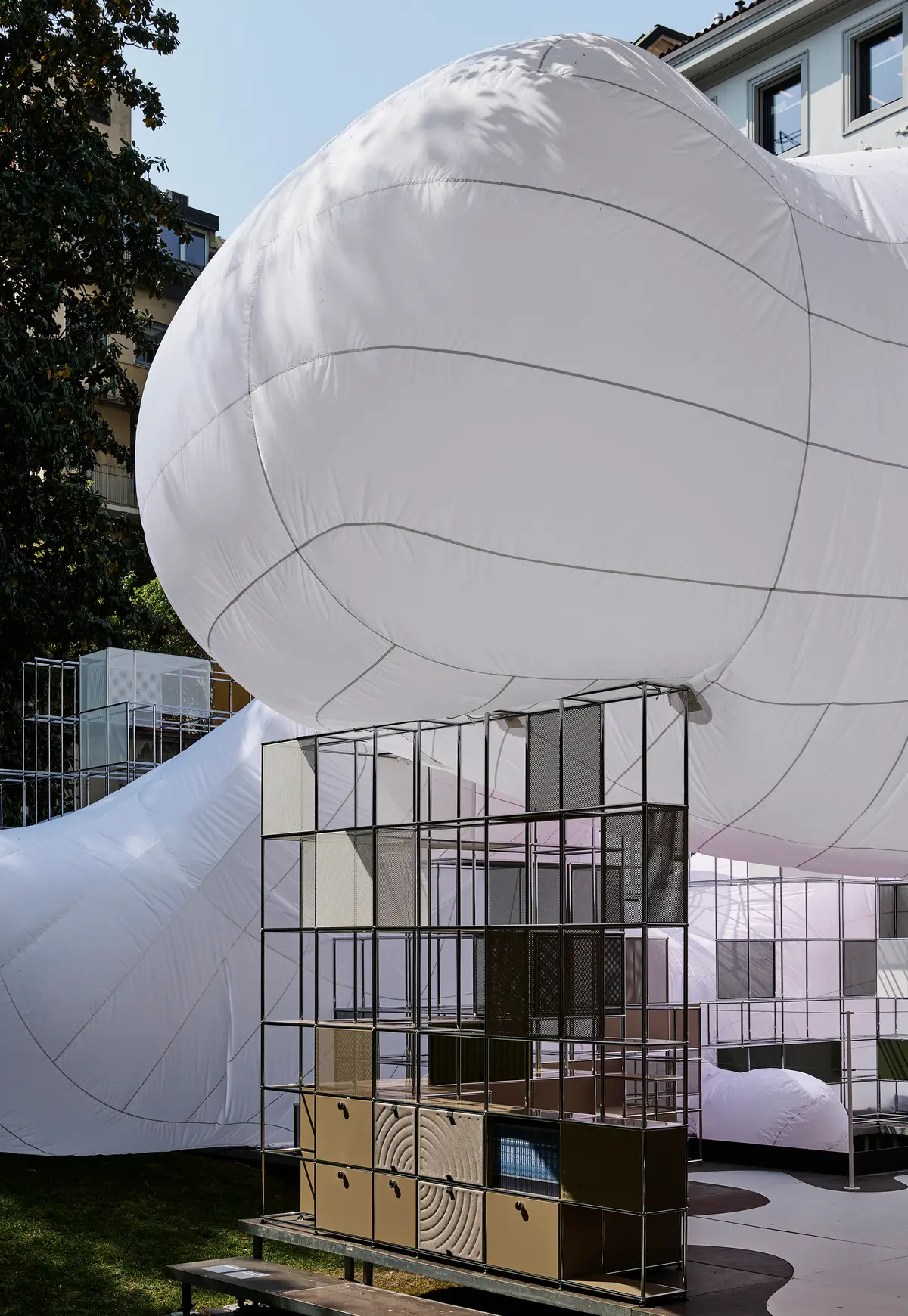
What makes the project genuinely interesting is the structural conceit at its core: USM's Haller storage system, a product synonymous with office filing cabinets and Zurich boardrooms, is recast as an architectural skeleton. Tubes, ball connectors, and panels that normally hold binders now hold up a breathing textile skin. The modular grid extends across the garden lawn as a low open framework before rising into a scaffold that anchors bulbous, semi-transparent lobes of fabric. It is a convincing argument that furniture and architecture are separated by ambition, not by material.
A Furniture System Becomes a Building
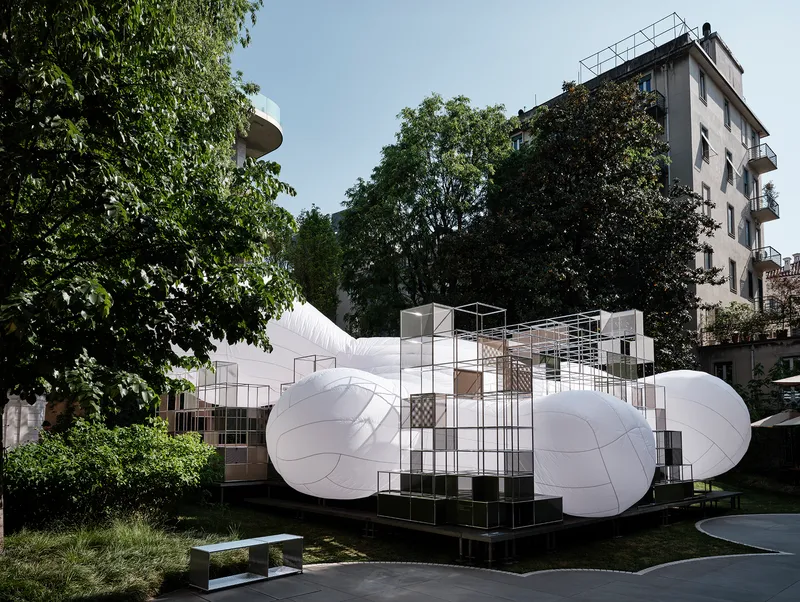
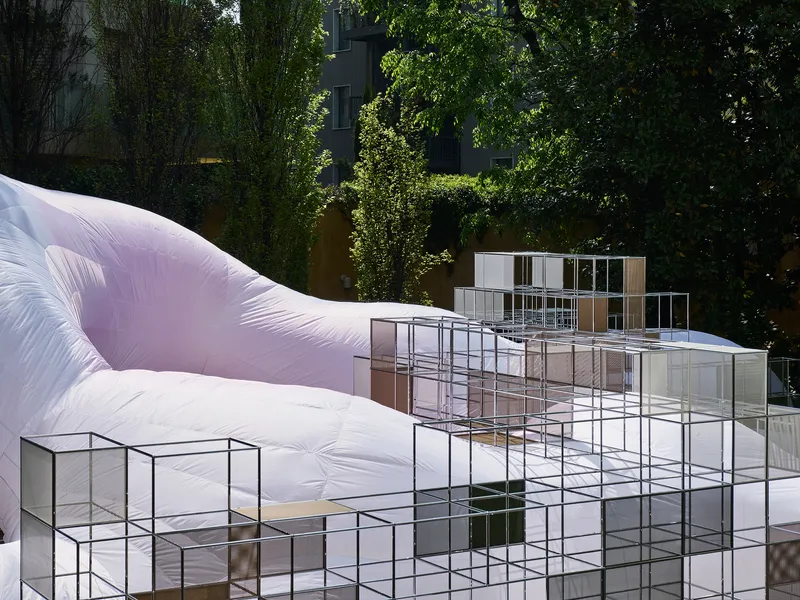
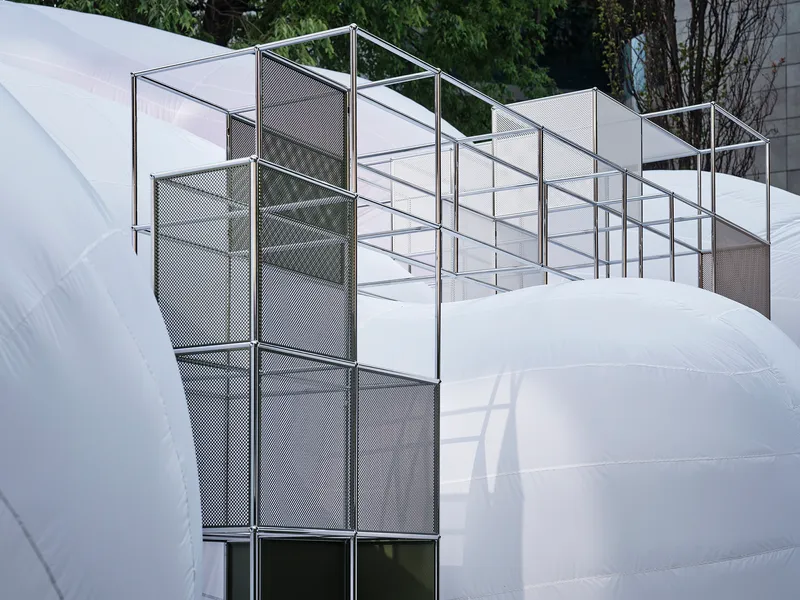
The USM Haller system has always been premised on infinite reconfiguration: the same tubes and ball joints assemble into a desk, a credenza, or a room divider. Here, Snøhetta pushes that premise to a logical extreme. The chrome grid rises to double height, functioning as both display and load-bearing armature. Stacked cubic modules with clear and bronze-tinted glass panels read simultaneously as shelving and as facade. The result is not furniture pretending to be architecture; it is a genuine hybrid, closer to a steel-frame pavilion than to anything you would order from a catalog.
Translucent, perforated, and mirrored panels slot into the grid, creating a permeable boundary that filters the garden beyond rather than blocking it. Light passes through tinted glass and bounces off chrome, producing a layered visual field that shifts as you move around the structure. The grid does real work: it anchors the inflatable membrane, organizes circulation, and defines thresholds between garden and interior.
The Breathing Membrane
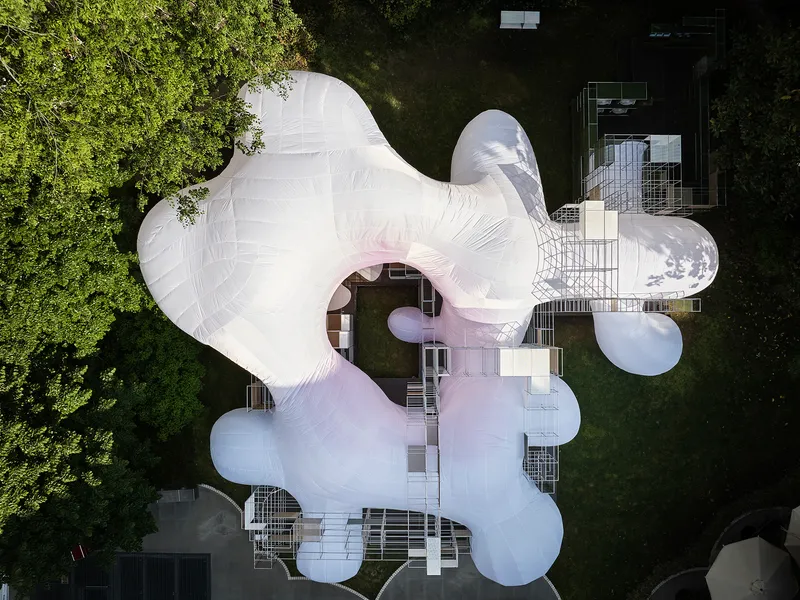
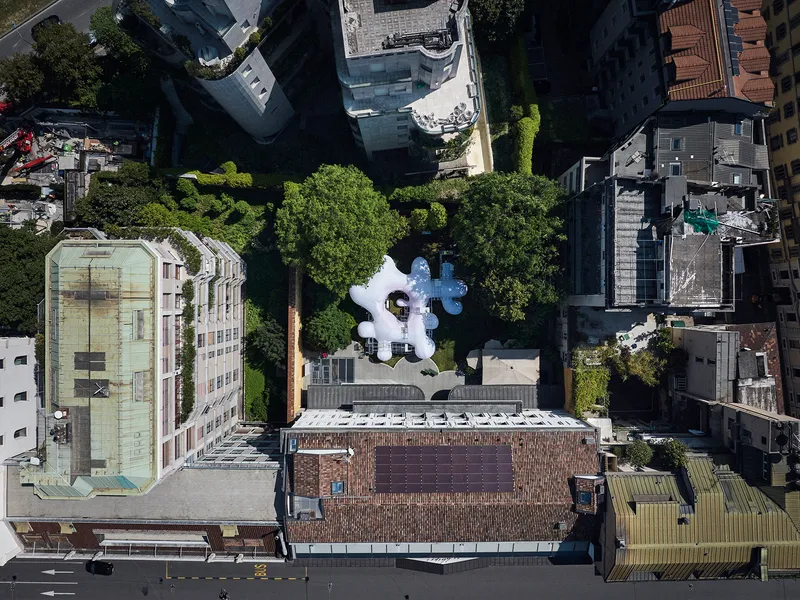
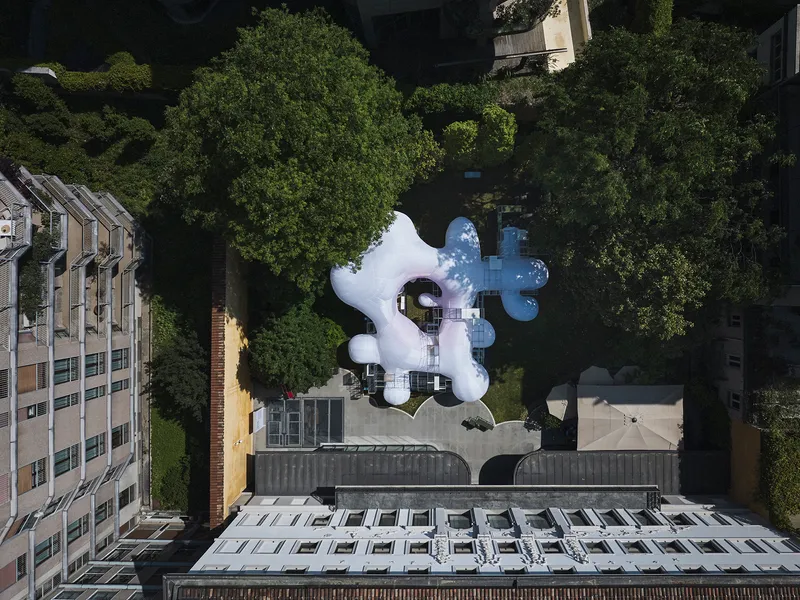
From above, Renaissance of the Real looks like three enormous white lobes that have settled among the trees of the Fondazione's garden, bulging gently above the roofline of neighboring buildings. The textile membrane is inflated by a system of fans, and it swells and compresses with a subtle rhythm that Snøhetta describes as breathing. The word is apt. The pavilion has the quality of a living organism, its surfaces taut one moment and relaxed the next, constantly adjusting to air pressure and wind.
The choice of a white, semi-transparent textile is critical. It diffuses Milan's spring daylight into a soft, even glow inside the chambers, while the shadows of surrounding trees register on the curved walls as slow-moving patterns. The effect is closer to being inside a paper lantern than inside a conventional tent structure. There is no harshness, no direct sun, just a warm luminosity that changes throughout the day.
Gridded Logic Meets Amorphous Volume
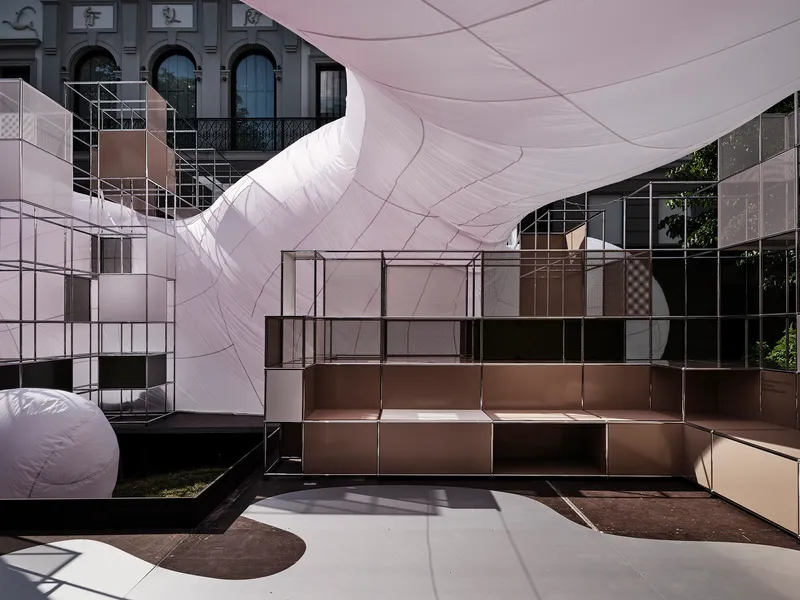
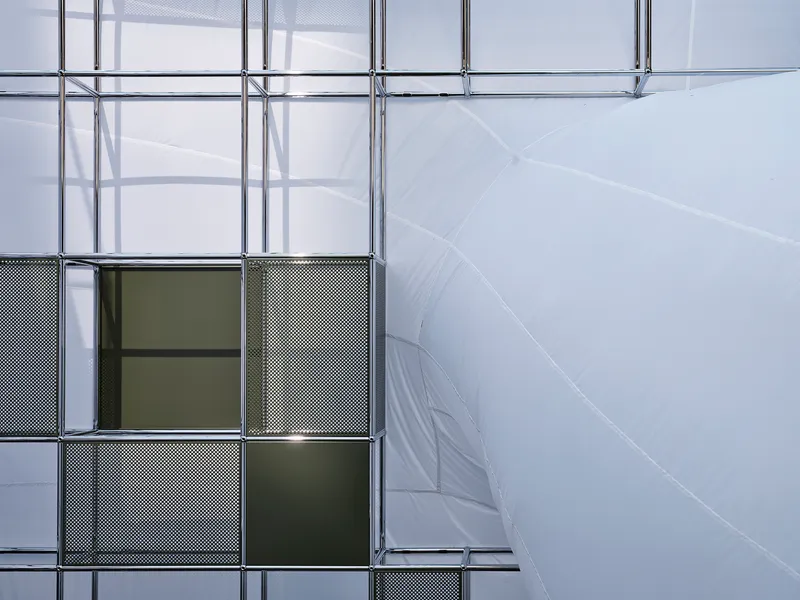
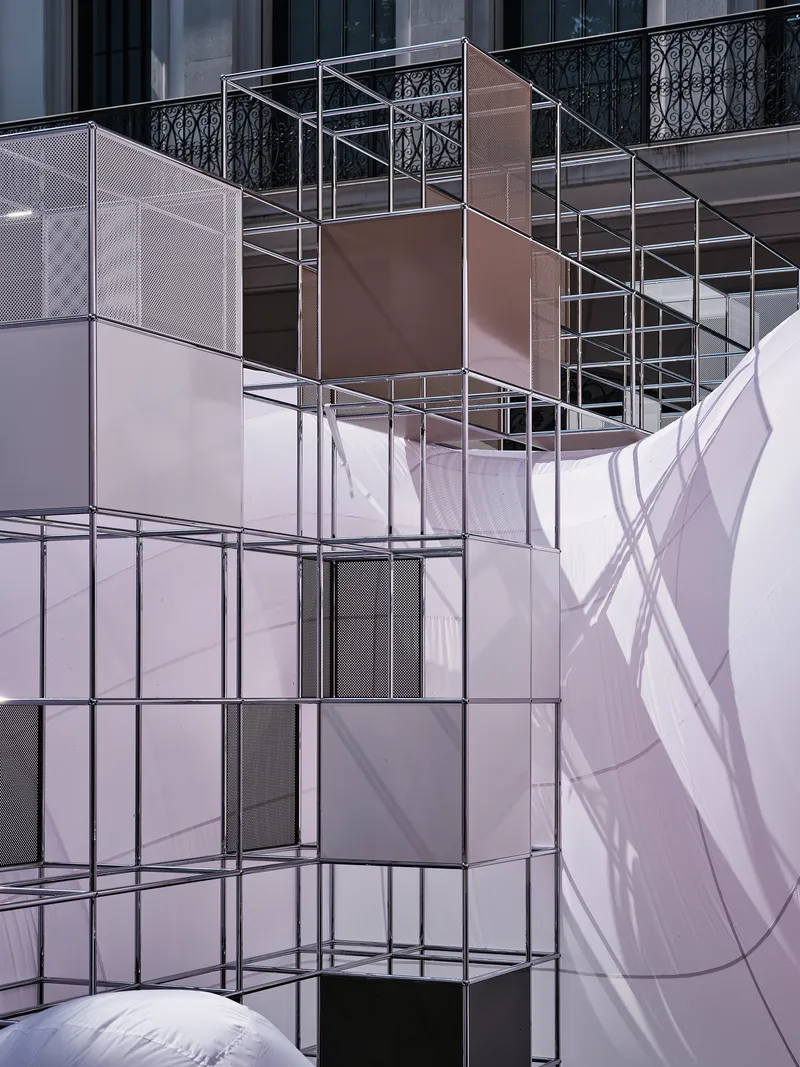
The productive tension in the installation lives at the seam between the rigorous orthogonal grid and the soft, unpredictable curves of the inflatable. Bronze and glass shelving units sit beneath the curved canopy, casting hard-edged shadows onto yielding fabric surfaces. Perforated metal panels and tinted glass catch fragments of the billowing membrane behind them. Neither system dominates. The grid gives the space its legibility and its human scale; the membrane gives it its atmosphere and its sense of enclosure.
Snøhetta has long been interested in thresholds: the moment you cross from outside to inside, from public to intimate. Here that threshold is drawn out into a sequence. Visitors move across the lawn, through the open grid, toward an entry that compresses slightly before opening into the full interior volume. The compression is gentle, almost subliminal, but it does the work of preparing you for a different sensory register.
A Sensory Interior
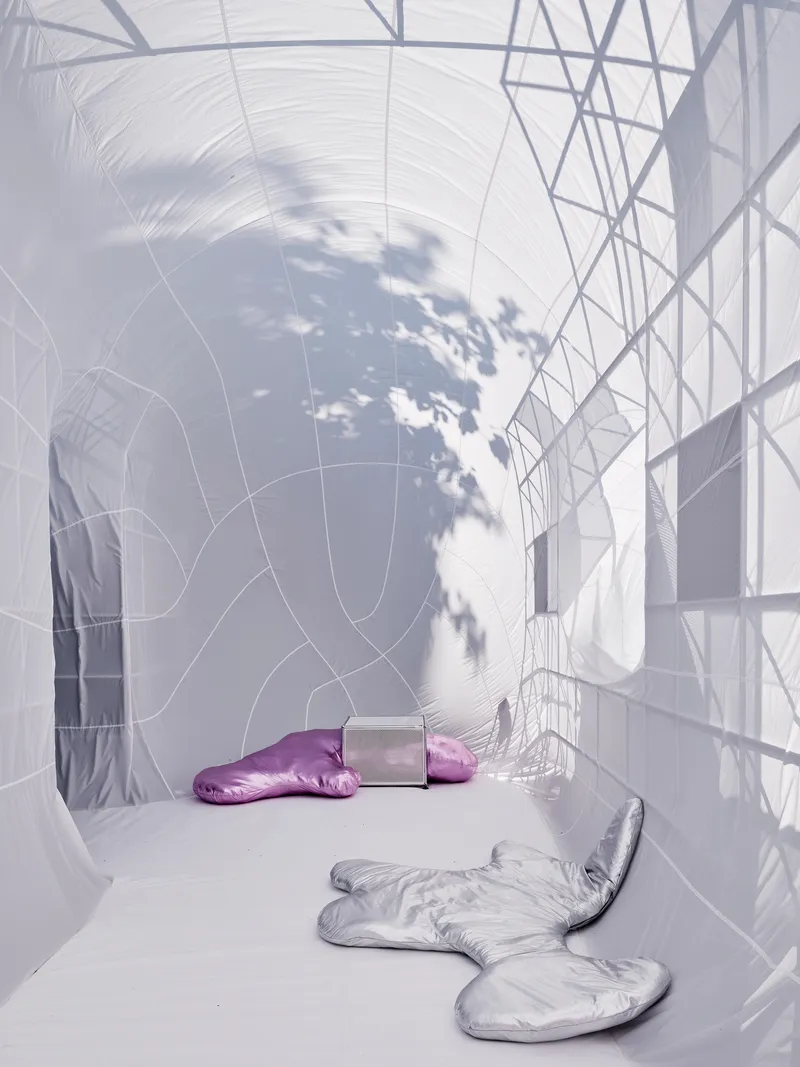
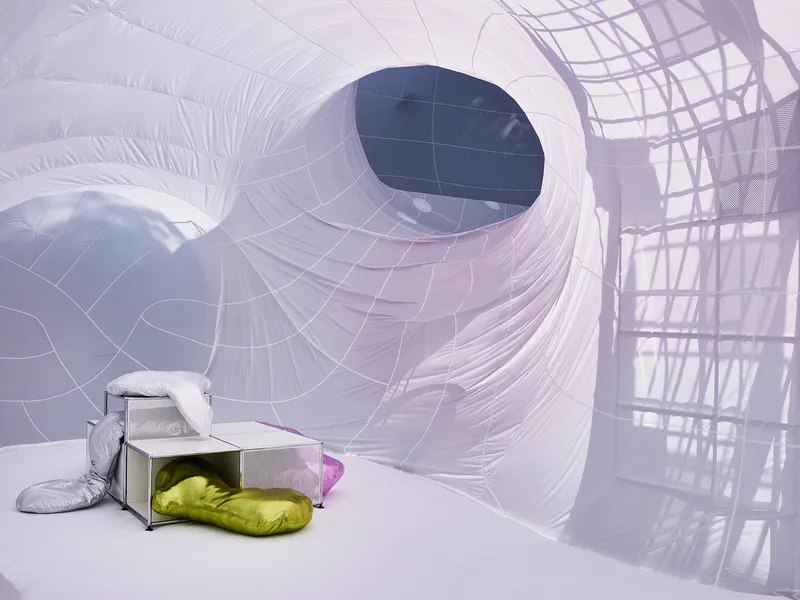
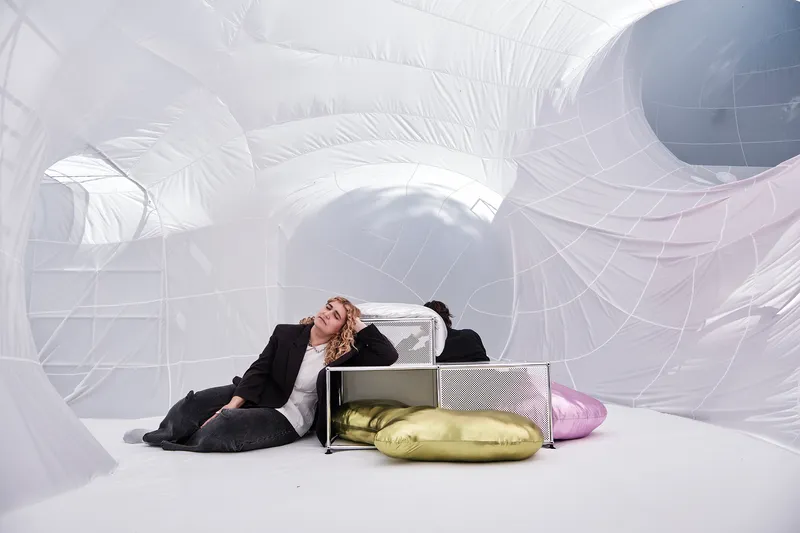
Inside the inflated chambers, the installation becomes explicitly multisensory. Floor and seating elements are arranged using modular blocks; inflated forms in metallic finishes rest across surfaces alongside gold and silver cushions. Visitors are offered a warm towel upon arrival, a ritual cleanse that signals the shift from city to contemplative space. Subtle sound frequencies fill the air, and scent layers complete an environment that is designed to be felt as much as seen.
Devon "OJAS" Turnbull, the analog audio obsessive, hosts daily vinyl listening sessions during the first week, reinforcing the installation's thesis: that physical media and physical space still have something to offer that a Spotify playlist piped through earbuds cannot replicate. It is a pointed curatorial choice, and it works because the architecture supports it. The membrane subdues outside sound; the curved surfaces create a gentle acoustic envelope that rewards sitting still.
Circular Portals and Connected Volumes
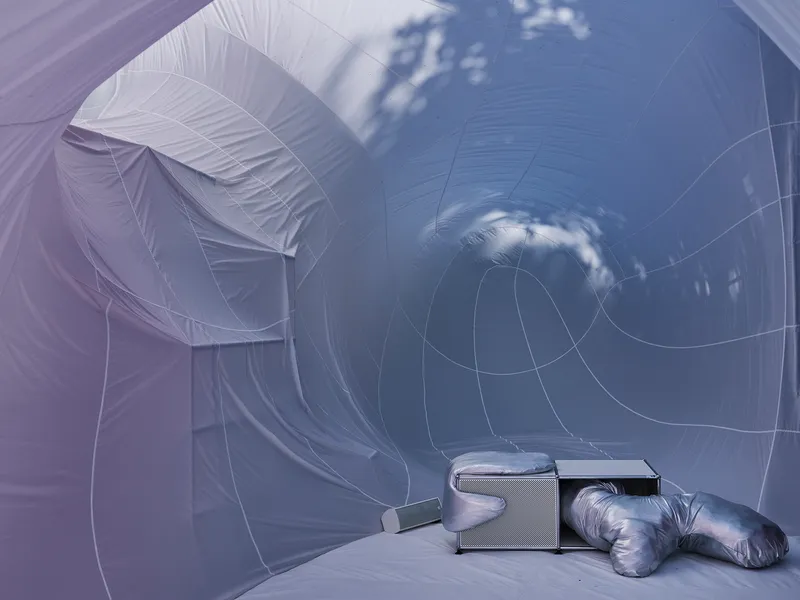
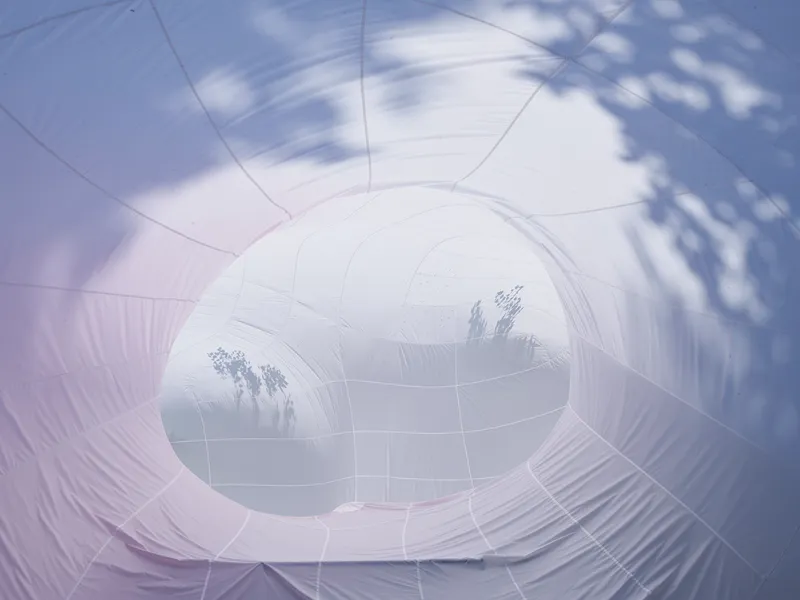
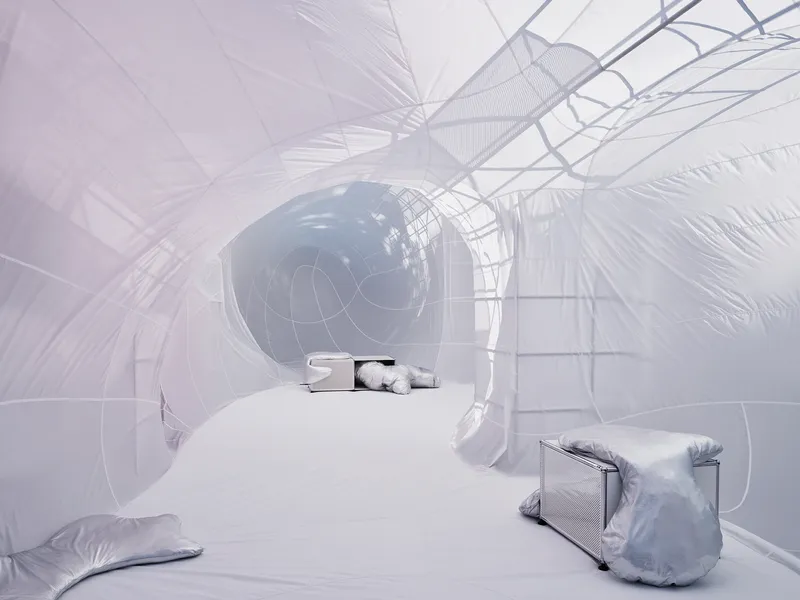
The individual lobes connect through circular openings cut into the membrane, creating a sequence of rooms that reads like a chain of cells in a living organism. Dappled shadows from the garden trees play across the translucent tunnel surfaces, and the transition between chambers offers moments of visual compression and release. The circular portals frame each successive space as a distinct scene, giving the installation a narrative rhythm despite its modest footprint.
Inside, the wire-frame structure is visible through the fabric, a reminder of the USM skeleton holding everything in place. The honesty is welcome. Rather than concealing the mechanism, the design treats the infrastructure as ornament, turning structural logic into visual texture. Clouds reflected on exterior surfaces register as ghostly patterns on the interior, blurring the line between inside and outside.
Object in a Garden
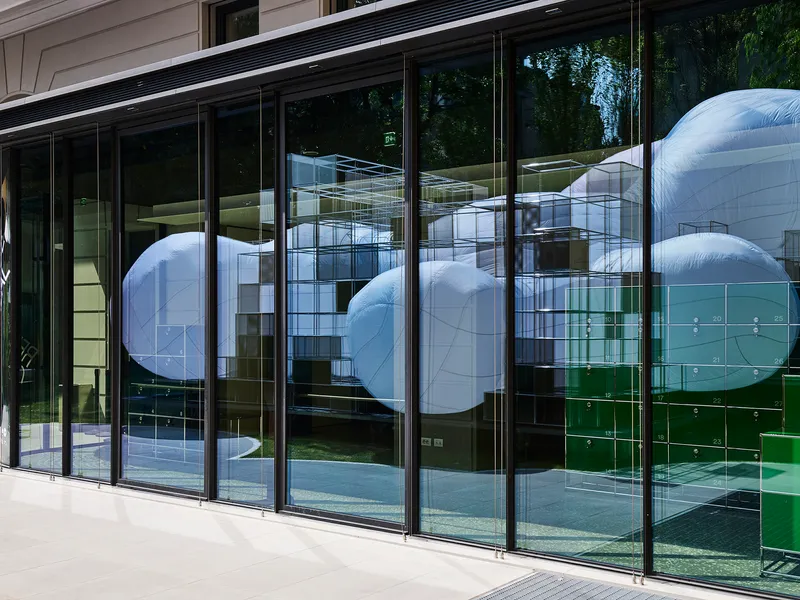
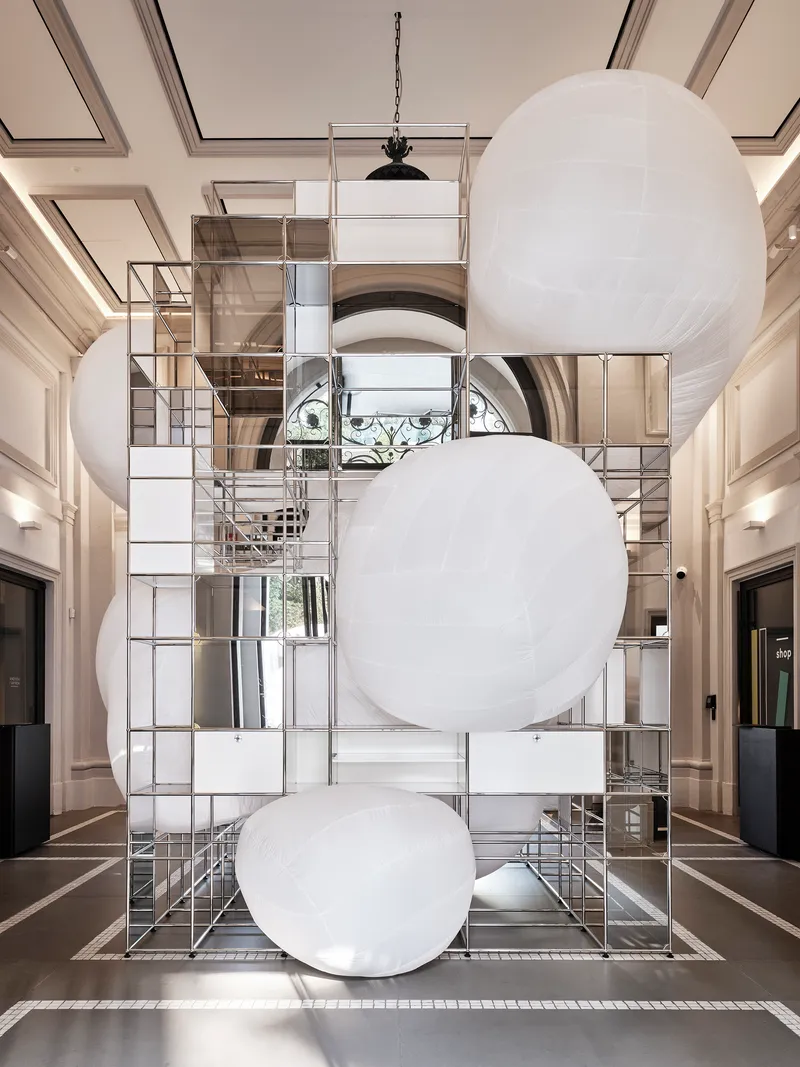
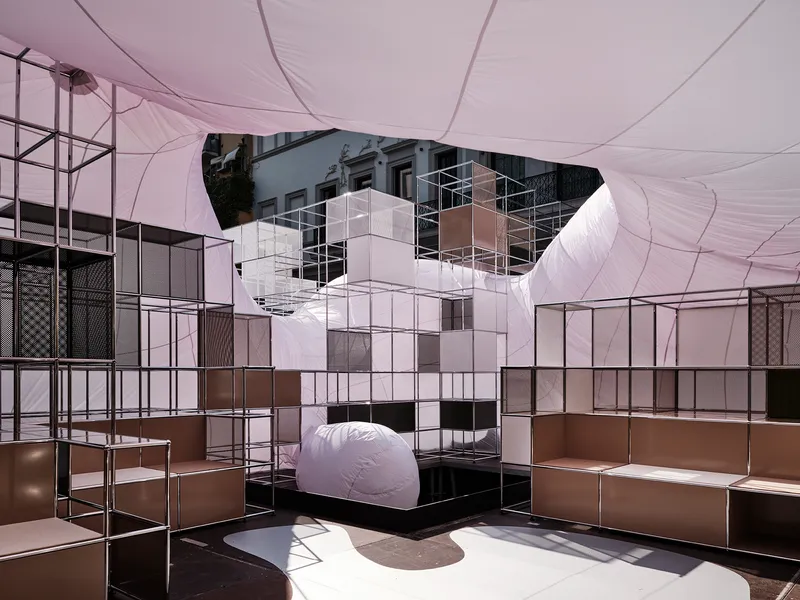
The installation operates simultaneously as an object in the garden and as an interior environment. From the glass facade of the Fondazione, the metal grid and inflatable forms are reflected and doubled, blending with trees visible beyond. Inside the Fondazione's double-height lobby, suspended white spherical balloons echo the pavilion's language, extending the sensory world of the installation into the host building and signaling that Renaissance of the Real is not just a garden folly but a spatial argument that colonizes its context.
The relationship between the modular shelving tower and the inflatable volumes is particularly effective in the interior views, where the chrome grid rises as a precise vertical datum against the billowing white ceiling. White upholstered furniture leans against the grid, and mirror panels bounce the soft light deeper into the space. It is a carefully orchestrated set of contrasts: hard and soft, transparent and opaque, orthogonal and organic.
Why This Project Matters
Milan Design Week has no shortage of brand pavilions, but most of them are elaborate backdrops for product launches, spaces designed to be photographed and then forgotten. Renaissance of the Real earns its ambitious title by doing something more difficult: it uses a commercial furniture system as genuine architectural infrastructure and builds an environment that rewards presence over documentation. The collaboration between Snøhetta and USM is not cosmetic. The architects have taken the modular logic of the Haller system seriously, testing whether a storage product can become a structural system, and the answer is convincing.
More broadly, the project makes a timely case for sensory richness as a design priority. In a cultural moment saturated with screens and algorithmic feeds, the decision to build a space around diffused light, quiet sound, scent, touch, and the slow movement of tree shadows is not nostalgic. It is strategic. If architecture still has something that digital experience cannot replicate, it is the capacity to hold a body in space and make that body notice what it is feeling. That is exactly what this installation does, and it does it with chrome tubes, ball joints, and a textile that breathes.
Renaissance of the Real Multisensory Installation, designed by Snøhetta in partnership with USM Modular Furniture. Fondazione Luigi Rovati, Corso Venezia 52, Milano, Italy. 2026.
About the Studio
Share Your Own Work on uni.xyz
If projects like this are the kind of work you want to make, uni.xyz is a place to publish your own, find collaborators, and enter design competitions.


Popular Articles
Popular articles from the community


Faces of the Soviet Avant-Garde: Turning Moscow's Street Names into an Open-Air Museum
A network of sculptural installations across a Moscow residential district transforms forgotten architect names into spatial encounters with cultural memor

Singing Woman: An Opera House That Performs Before the Curtain Rises
Ovidiu Cristian Pavel's conceptual opera house translates Estonia's choral identity into a sculpted waterfront landmark facing the Baltic Sea.

Opera by the Sea Estonia: Three Shells Dissolving Architecture into Tallinn's Coastline
A winning opera house proposal replaces monumental form with interconnected shells that blur the boundary between building, park and Baltic Sea.

Cloaked Colonization: A Mobile Underwater Habitat That Moves Like a Fish
Micah Abaya's shortlisted EHC Pacific entry reimagines ocean settlement as a dispersed network of self-sustaining architectural organisms.

Similar Reads
You might also enjoy these articles

Pixel Gardens: One Repeated Module Stacked Into a Terraced Social Housing Tower for Famagusta
Salem Bader's shortlisted housing tower builds a vertical neighbourhood from one repeated module, offsetting units to carve terraces, light and air.

Bao Huynh Watercolor Atelier: A Serene Art Retreat in Hội An
Bao Huynh Watercolor Atelier in Hội An blends multifunctional art spaces, sustainable design, local materials, and family-friendly living in a serene environment.

Atelier Macri Concept Store Interior Design by CASE-REAL
Atelier Macri store features a "ko" counter, walnut wood details, cork displays, blending retail, gallery, and seamless customer experiences.

Manuel Vargas Izquierdo Stadium and High-Performance Sports Center: Architectural Excellence in Jalpa de Méndez
The Manuel Vargas Izquierdo Stadium blends sustainable design, inclusive sports facilities, and cultural-inspired architecture, revitalizing Jalpa de Méndez’s public spaces.

Explore Multi-Sensory Architecture Competitions
Discover active competitions in this discipline

Challenge to design a portable theatre

Challenge to design a portable music platform

Challenge to design an open learning module for the elderly
Comments (0)
Please login or sign up to add comments
No comments yet. Be the first to comment!