
Snøhetta, BIG, and MVRDV Shape an 84-Hectare Coastal Neighborhood on Istanbul's Black Sea Edge
A landscape-led masterplan in Beykoz's Riva district weaves 969 courtyard homes, timber landmarks, and ecological corridors into a forested coastline.


Three of the world's most visible practices, Snøhetta, BIG, and MVRDV, have joined forces with local studios KEYM, DB Architects, Rasa, and Bilgin Architects to plan a new residential district on Istanbul's Black Sea coast. Ion Riva occupies 84 hectares of terrain in the Riva area of Beykoz, a site whose identity has been shaped more by geology and ecology than by any prior urban grid. The first phase alone delivers 969 homes for roughly 3,000 residents alongside 100,000 square meters of biodiverse landscape, cultural buildings, and shared amenities. First occupants are expected by 2027.
What makes the project worth watching is not the celebrity roster but the planning logic behind it. Rather than imposing a single architectural language on the coastline, the masterplan distributes authorship across discrete building types and landscape zones, each responding to the convergence of forest, river, and sea. Snøhetta contributes The Ring and a greenhouse district housing approximately 400 residences. BIG adds The Drop, a timber-framed landmark. MVRDV and the local teams fill in the residential fabric with courtyard villas rooted in regional typology. The result is less a monolithic development and more an archipelago of micro-communities stitched together by green corridors, water systems, and a shared material palette of stone and cross-laminated timber.
Landscape as Operating System
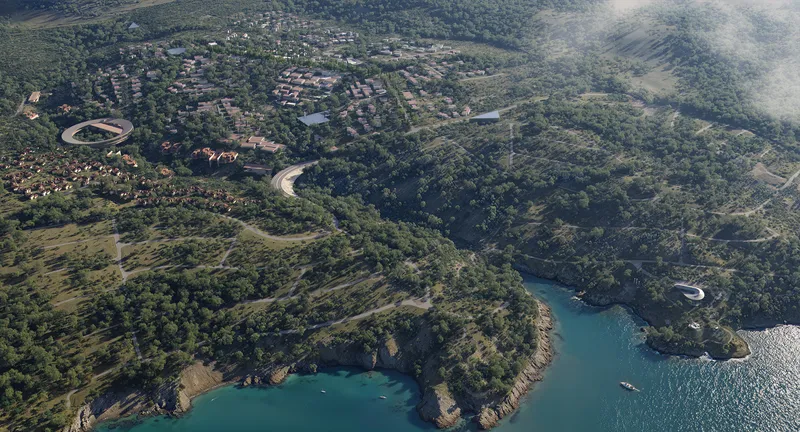
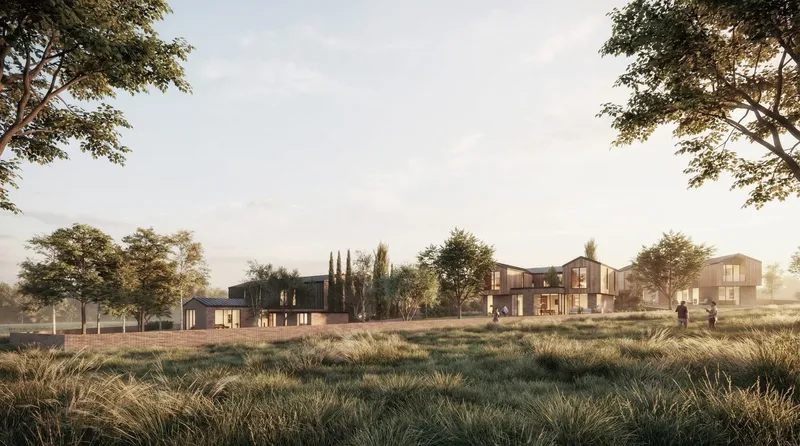
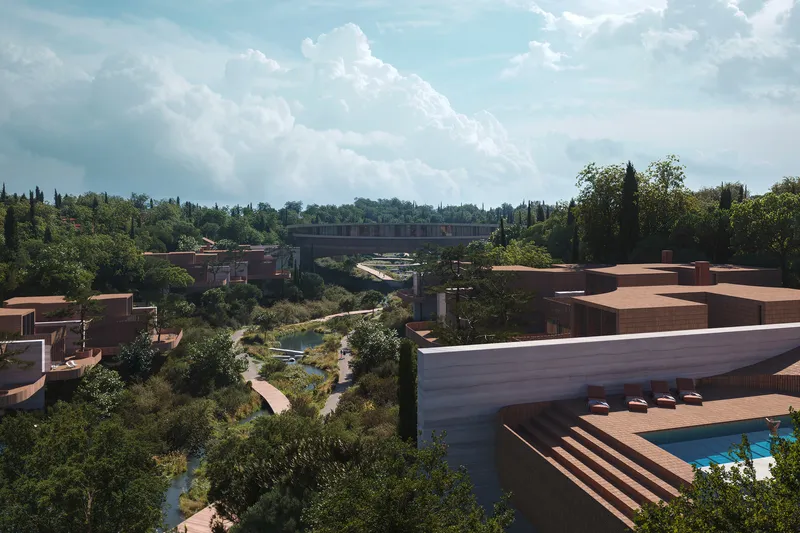
Ion Riva's most consequential design decision happens at the scale of terrain. Buildings, paths, and public spaces follow the contours of the existing topography, preserving sight lines toward the coastline while limiting the extent of earthmoving. Housing clusters of 50 to 80 homes sit within the folds of the hillside rather than flattening them. Each cluster comes with its own swimming pool and community space, creating a village-scale social unit that can function semi-independently.
The aerial views reveal just how porous the built footprint is. Low-rise structures scatter across meadows and forested slopes, leaving generous corridors for stormwater, wildlife, and pedestrian movement. Rainwater harvesting and greywater recycling reduce the demand on drinking water by roughly half. Solar panels feed into the grid. These are not bolt-on sustainability gestures; they are woven into the site strategy from the beginning, which is the only way a development at this scale can credibly claim ecological intent.
The Ring and the River
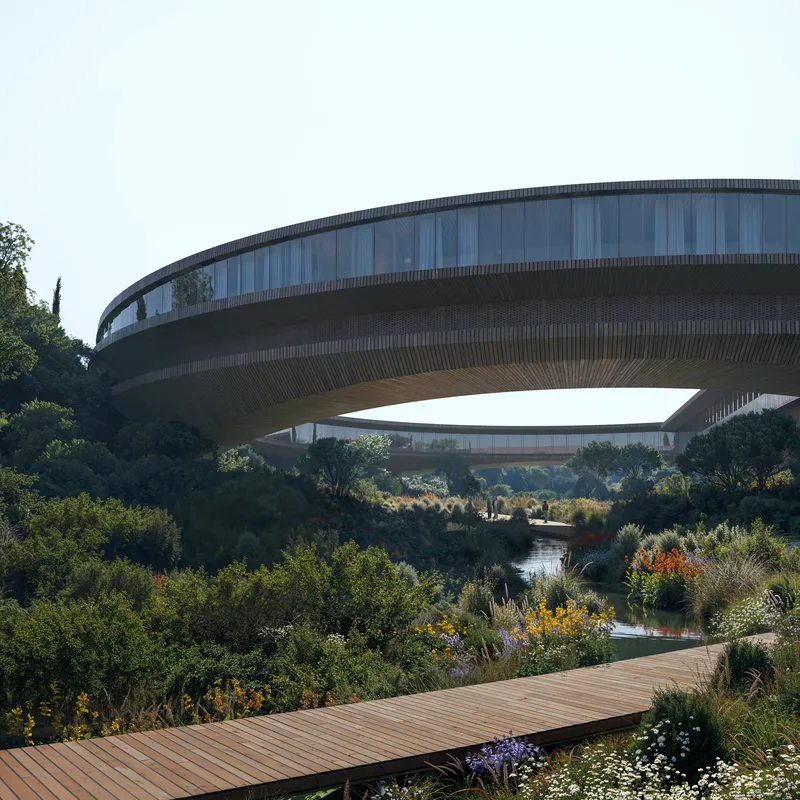
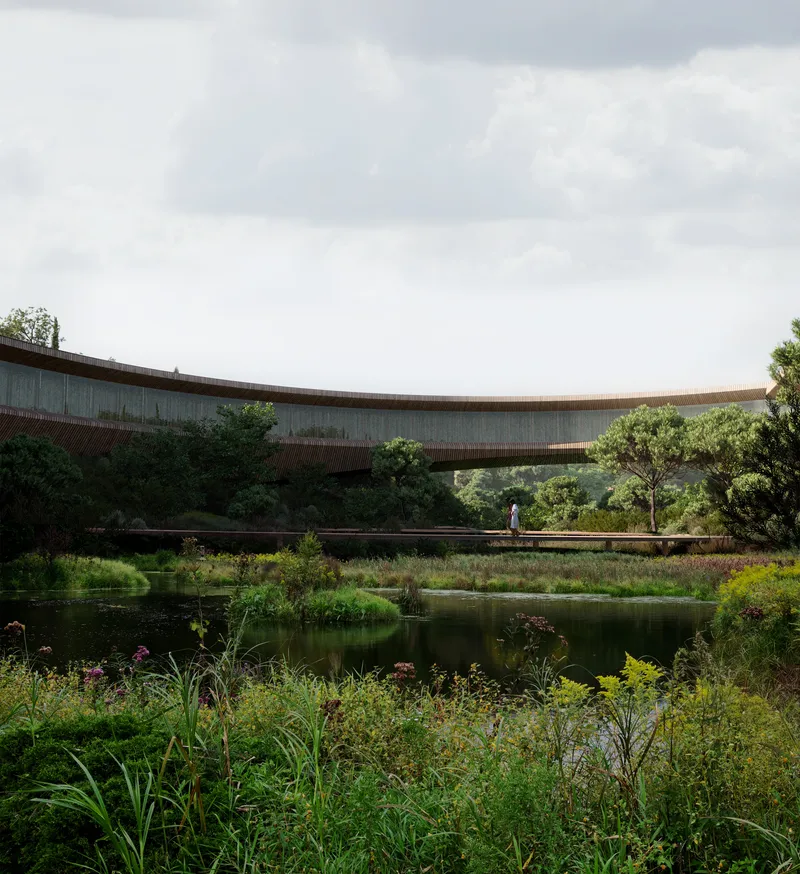
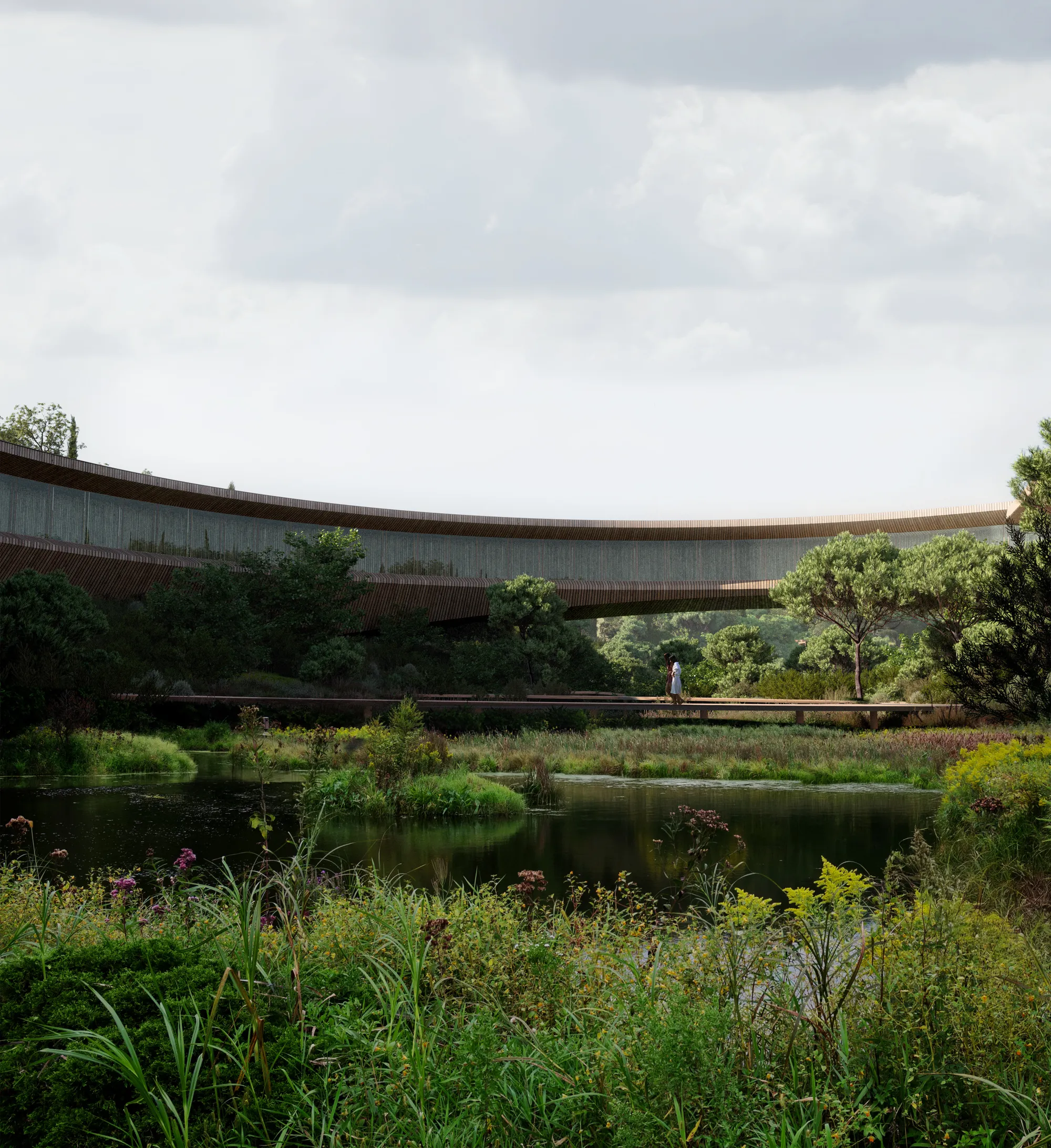
Snøhetta's most visible contribution is The Ring, a circular structure that spans the river running through the site. Clad in vertical timber elements, the bridge doubles as a landmark and a piece of infrastructure, connecting communities on either bank while framing the waterway below. Stables and allotment gardens sit nearby, supporting environmental education and local food production. It is a gesture that could easily tip into spectacle, but the program anchoring it, food, animals, learning, keeps it grounded.
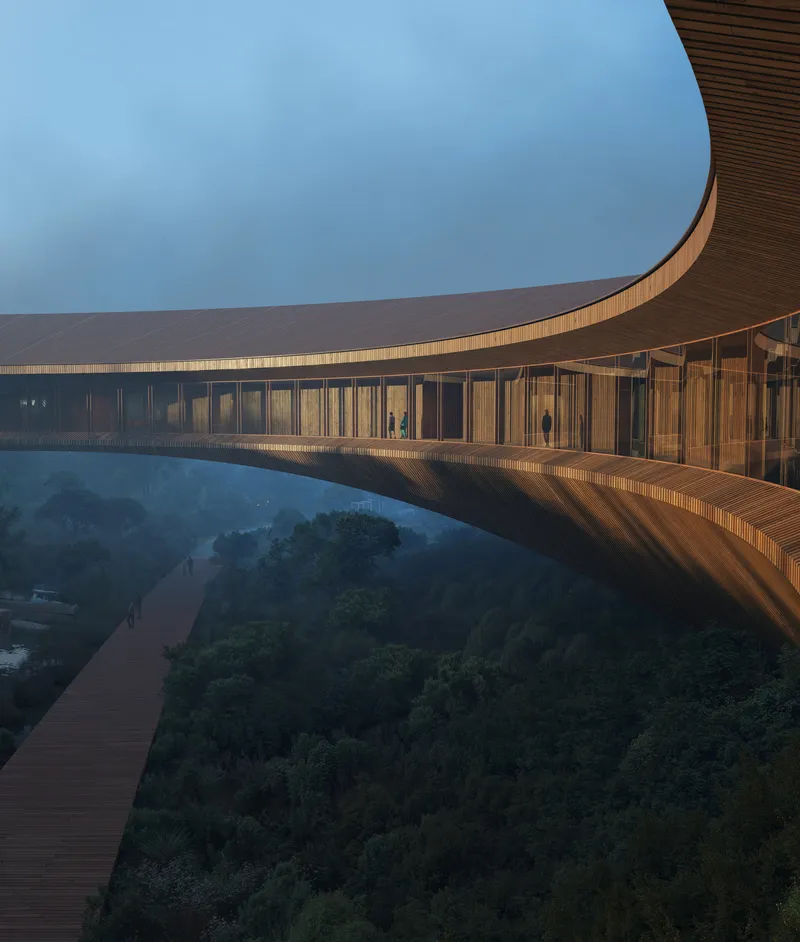
A second pedestrian bridge, curved in plan and lined with glass and ribbed timber soffits, offers a quieter crossing further along the waterway. Native grasses and wildflowers colonize the banks, softening the edges between architecture and hydrology. These crossings do more than move people; they establish the river as the neighborhood's central public space, the thing everything else orbits.
Timber Structure and Local Stone
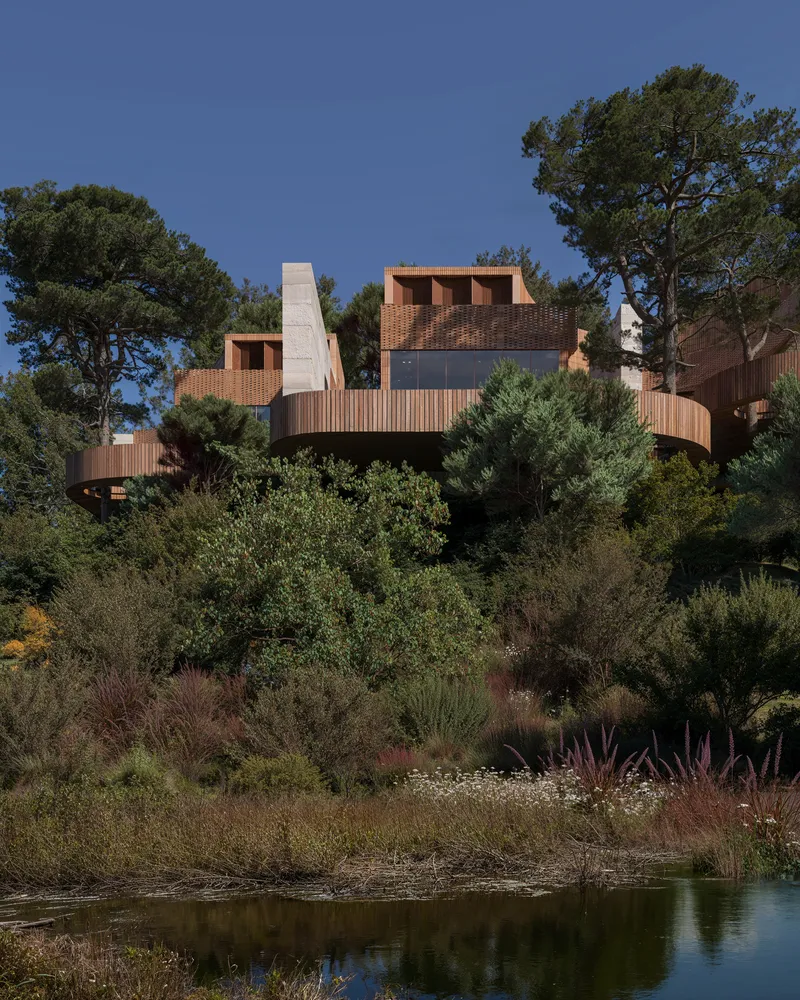
The material strategy across Ion Riva leans heavily on modular timber construction and locally sourced stone. BIG's Drop building uses a timber primary structure, and throughout the residential clusters, cross-laminated timber panels form the bones of a modular system designed to reduce embodied carbon and accelerate assembly. Stone appears in walls, stairs, and paving, connecting new construction to the geological character of the coastline.
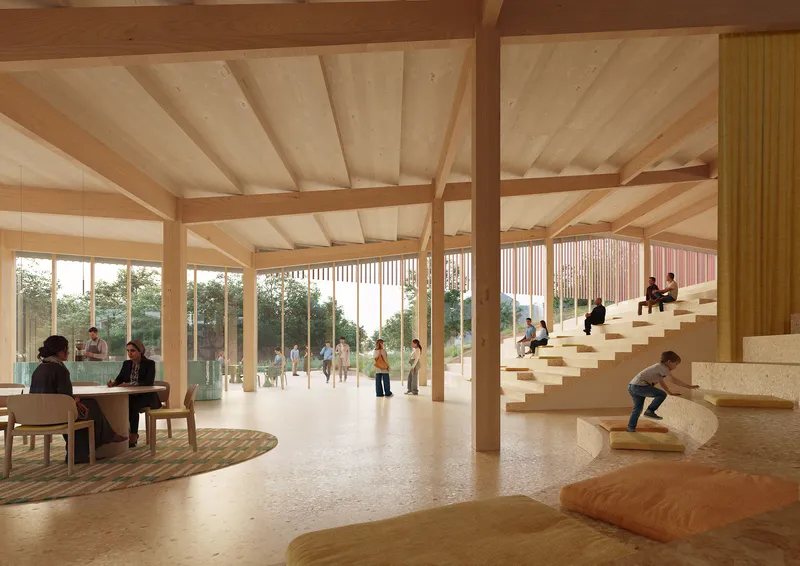
The interior of one public hall reveals exposed timber beams spanning generous volumes, with a sculptural stone staircase anchoring the space. There is a deliberate warmth here that factory-built systems often lack. The timber soffits and structural ribs visible along covered walkways suggest that the architects are treating the modular system as a tectonic language rather than hiding it behind finish layers. When you can see the structure, you tend to trust the building more.
Courtyard Villas and Regional Memory
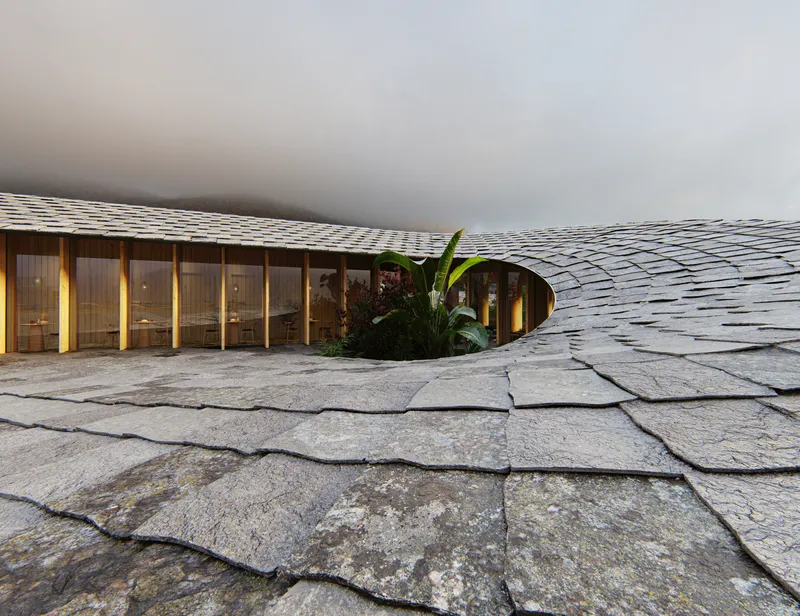
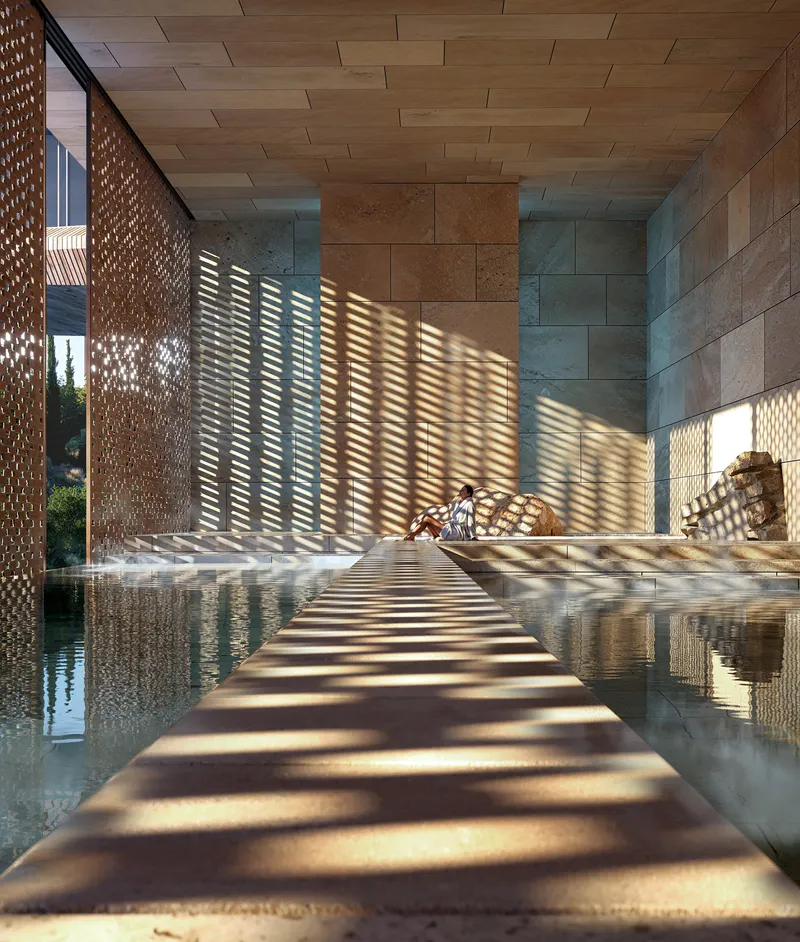
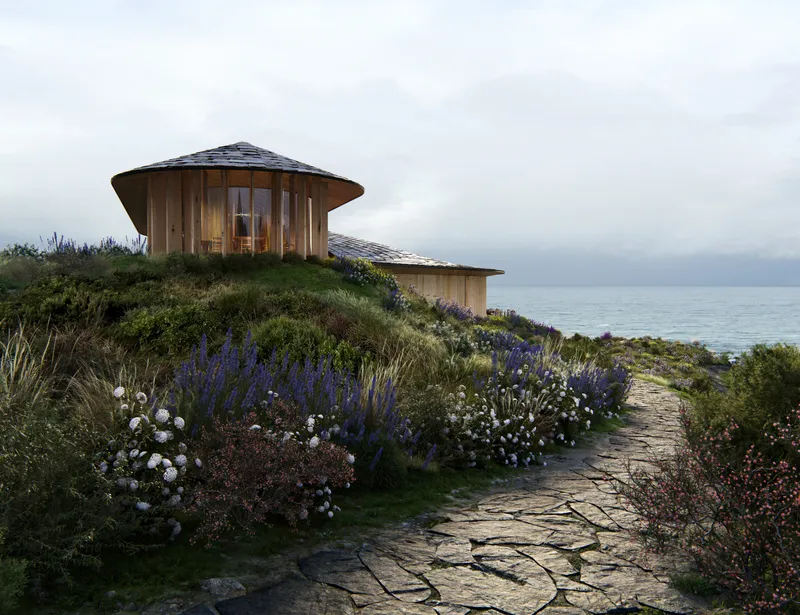
The residential typology at Ion Riva is the courtyard house, a form deeply rooted in the architectural traditions of the broader region. Bilgin Architects designed the villas, which range from three to six bedrooms, and each home is organized around an internal courtyard. The project offers 26 distinct courtyard configurations, which means repetition at the masterplan scale does not translate into monotony at the scale of the individual dwelling.
Undulating stone-shingled roofs fold over planted courtyards that open to glazed timber-framed rooms. Perforated screens along covered walkways cast striped shadows across stone pavers and reflecting pools. One cylindrical timber pavilion sits on a coastal hillside surrounded by lavender and roses, reading almost like a garden folly. The effect, across all these moments, is of architecture that has been calibrated to climate and culture simultaneously: screens that modulate light, courtyards that channel ventilation, materials that weather gracefully.
Cultural Anchors at the Edge
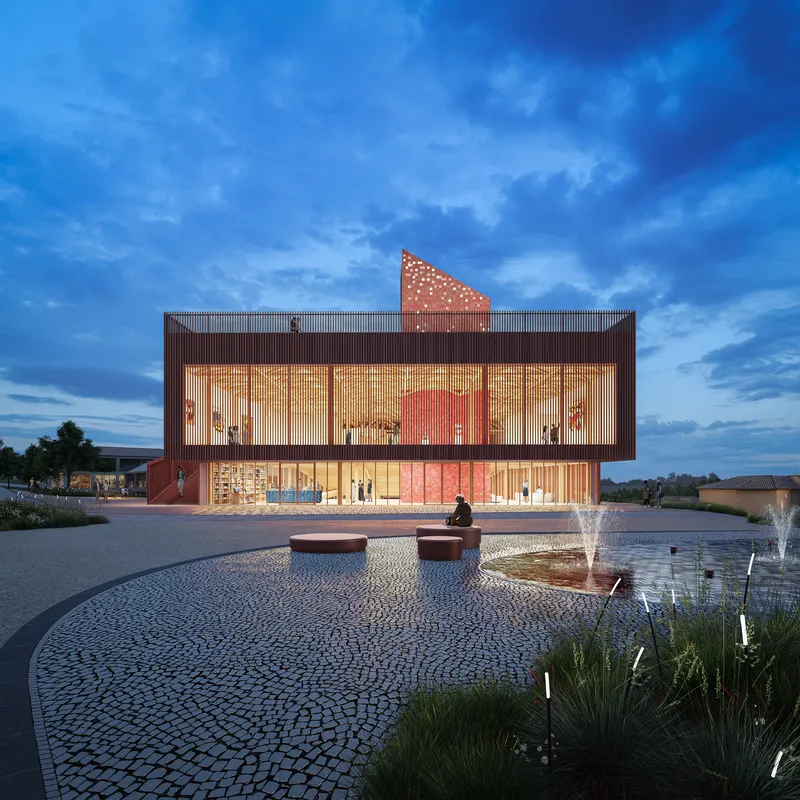
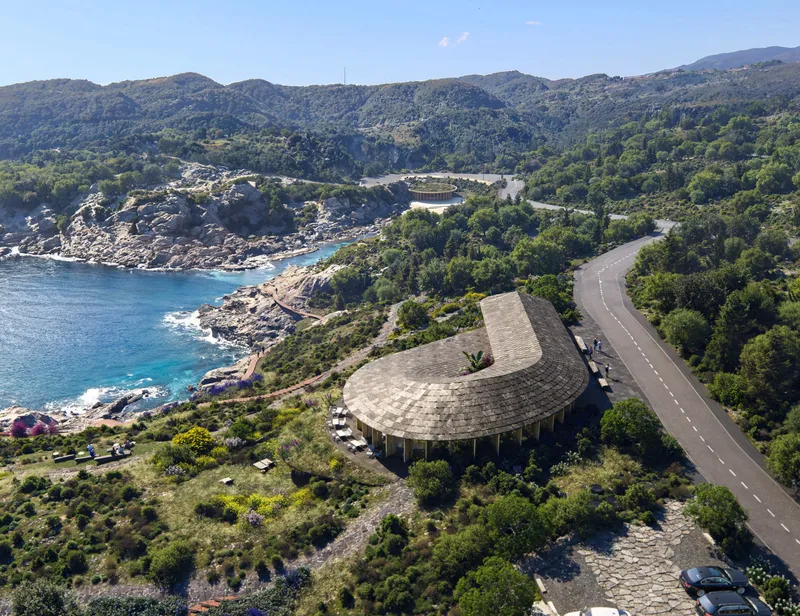
A pair of more assertive buildings mark the coastal edge. One features a perforated red metal screen over a fully glazed facade, topped by a triangular rooftop element that catches light at dusk. The other reads as a curved pavilion with a shingle roof, sitting calmly beside the coastal road and the water. These are likely the cultural and community buildings that Ion Riva's program promises but that so many large-scale residential projects never actually deliver.
The willingness to invest in public-facing architecture at the periphery of the development, rather than concentrating all design energy on the homes themselves, signals that the masterplan team understands a basic truth: a neighborhood is not just houses. It is the spaces between them, the buildings everyone shares, and the moments where private life meets the public realm. Whether Ion Riva achieves this over the full build-out remains to be seen, but the coastal anchors suggest the intent is real.
Why This Project Matters
Ion Riva is, at its core, a test of whether high-profile international collaboration can produce a neighborhood rather than just a collection of signature buildings. The distribution of design responsibility across multiple studios, each assigned a specific scale or program, is a model that large developers increasingly favor but that few projects have executed well. Riva's Byzantine-era roots and its relatively undeveloped coastline make the stakes higher: there is something genuine to protect here, and the landscape-led planning framework suggests the team is aware of that.
The integration of modular timber construction, passive climate strategies, AI-enabled building systems, and traditional courtyard typologies into a single masterplan is ambitious. If the first phase delivers what the renderings promise, it will offer a compelling counter-narrative to the glass-tower coastal developments that have defined Istanbul's recent growth. The question, as always with projects this large, is whether the ecological and communal values embedded in the masterplan survive contact with market pressures. The first residents, arriving in 2027, will be the ones who find out.
Ion Riva, Riva, Beykoz, Istanbul, Türkiye. Masterplan by Snøhetta, BIG, and MVRDV with local practices KEYM, DB Architects, Rasa, and Bilgin Architects. 84 hectares; 969 homes in first phase. First occupancy expected 2027.
About the Studio
Share Your Own Work on uni.xyz
If projects like this are the kind of work you want to make, uni.xyz is a place to publish your own, find collaborators, and enter design competitions.



Popular Articles
Popular articles from the community


The Earth Pod: 3D Printed Homes for Resilient Refugee Communities
The Earth Pod reimagines refugee housing through 3D printed homes made from clay, combining resilience, self-sufficiency, and rapid shelter.

Riyadh For All: Intergenerational Urban Design for Active Aging in Rabat
Riyadh For All reimagines urban design in Rabat with intergenerational co-living, adaptive courtyards, and Moroccan cultural exchange today.

Co-Life: Senior Housing Design That Reconnects Older Adults With the City
Co-Life reimagines senior housing design through healing gardens, shared streets, workshops, and a sustainable community across generations.

Conexión: Biophilic Design Reimagines High-Rise Living in Hong Kong
Conexión reimagines high-rise living in Hong Kong through biophilic design, green facades, shared spaces, daylight, water and nature within.


Similar Reads
You might also enjoy these articles

Bao Huynh Watercolor Atelier: A Serene Art Retreat in Hội An
Bao Huynh Watercolor Atelier in Hội An blends multifunctional art spaces, sustainable design, local materials, and family-friendly living in a serene environment.

Atelier Macri Concept Store Interior Design by CASE-REAL
Atelier Macri store features a "ko" counter, walnut wood details, cork displays, blending retail, gallery, and seamless customer experiences.

Manuel Vargas Izquierdo Stadium and High-Performance Sports Center: Architectural Excellence in Jalpa de Méndez
The Manuel Vargas Izquierdo Stadium blends sustainable design, inclusive sports facilities, and cultural-inspired architecture, revitalizing Jalpa de Méndez’s public spaces.

KAKR Buluh Awar Hall: Revitalizing Community and Ecology Through Bamboo Architecture
Community built bamboo hall revitalizes Buluh Awar village, empowering youth, restoring ecology, celebrating vernacular craftsmanship through sustainable architecture and culture.


Explore Urban Design Competitions
Discover active competitions in this discipline



Challenge to design a barrier free sports center


Challenge to design an outdoor ice-rink and park
Comments (0)
Please login or sign up to add comments
No comments yet. Be the first to comment!