
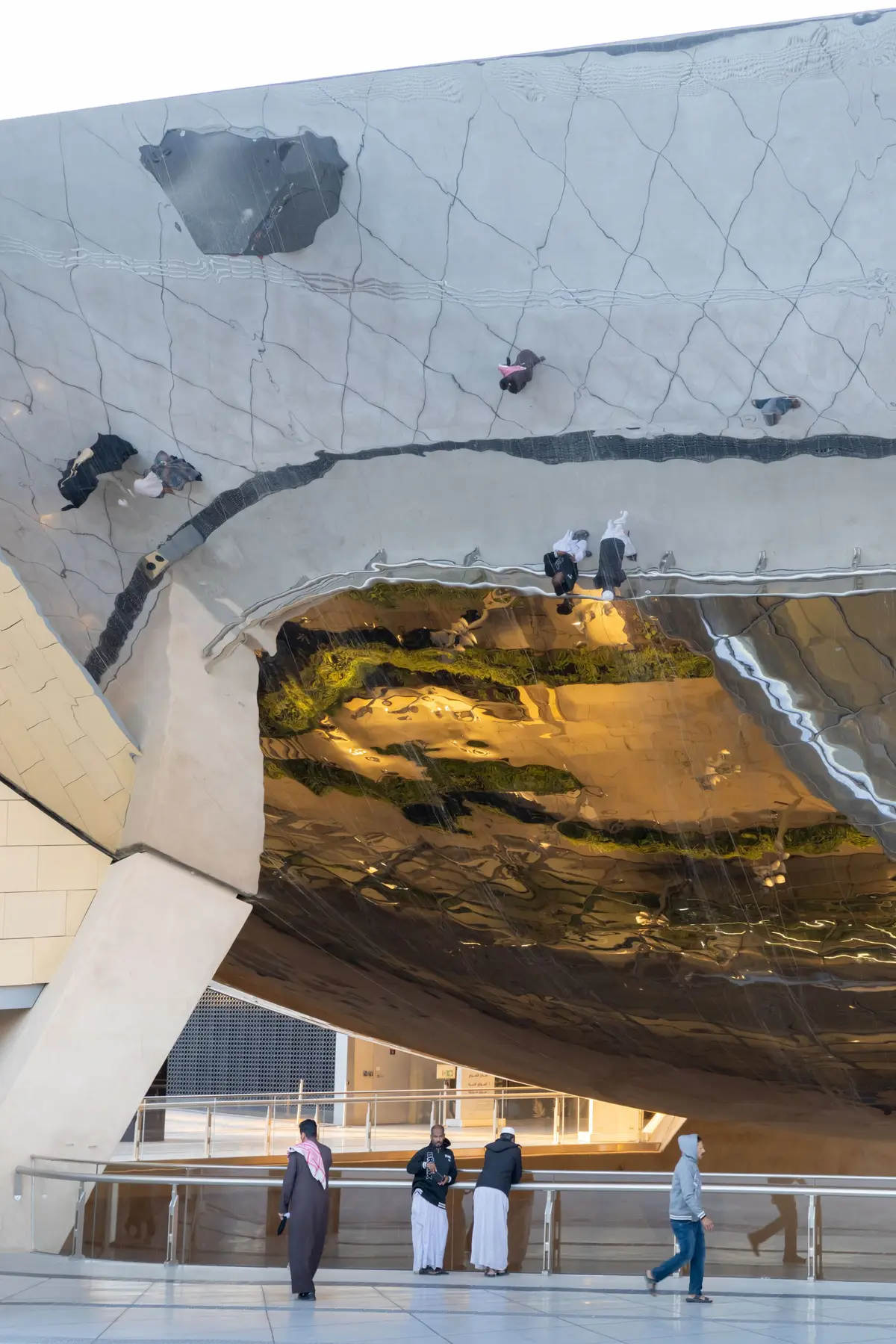
Snøhetta Drops a 70-Meter Reflective Cone into the Historic Heart of Riyadh
Qasr AlHokm Metro Station buries eight levels of transit beneath a mirrored canopy that acts as a periscope for an entire civic plaza.


Most metro stations announce themselves with a sign and a staircase. Snøhetta's Qasr AlHokm station in Riyadh announces itself with a 70-meter-diameter stainless steel cone that swallows the sky and reflects it back up at you. Completed in early 2025 as one of four principal hubs in Saudi Arabia's new metro network, the station sits in the Al-Qiri district, steps from the original Riyadh palace and the prayer field that has hosted Eid gatherings for generations. That context matters. The building is not simply infrastructure; it is a proposition about what a civic interior can be in a city that has, until now, organized public life around cars.
What makes the project genuinely interesting is its inversion of the typical above-ground landmark. Instead of building a tower, Snøhetta carved downward, 40 meters into the earth, and then capped the excavation with a polished canopy that functions like a periscope: light passes in, views pass out, and the boundary between station and city dissolves into a continuous terrazzo plaza. The result is an 88,000-square-meter building that presents almost no facade to the street, yet manages to be the most visible thing in the neighborhood.
The Canopy as Civic Instrument
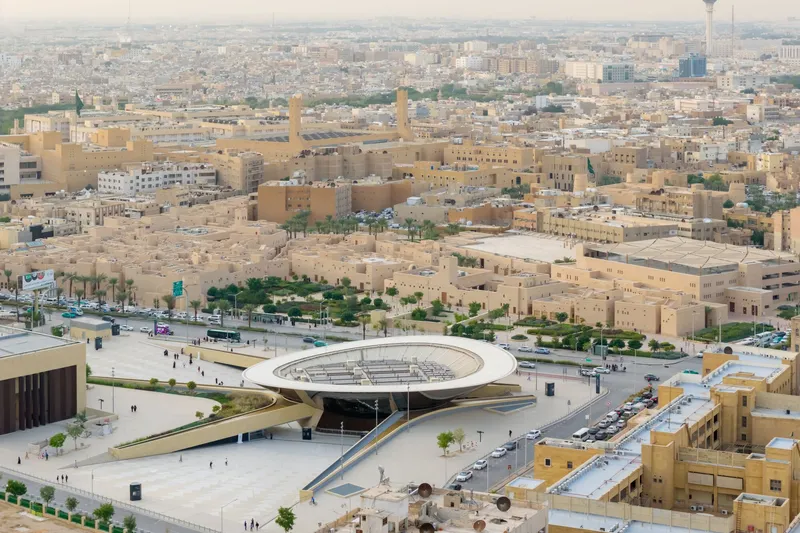
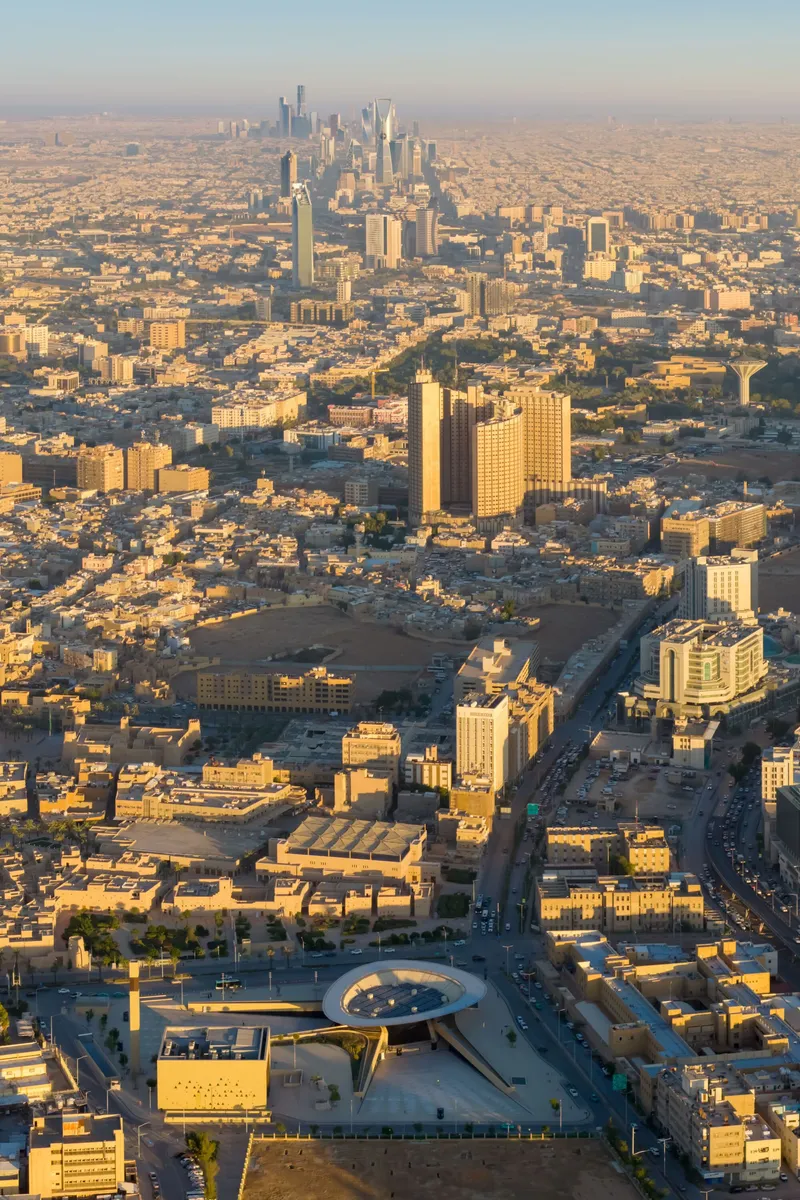

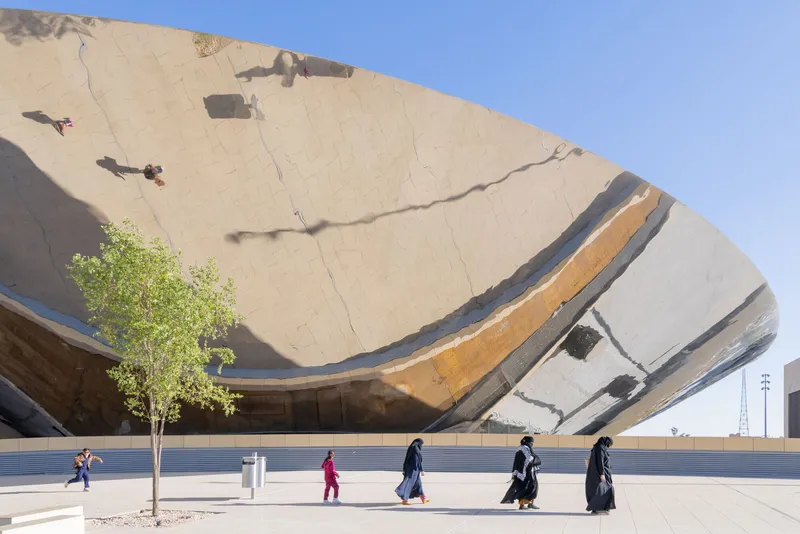
From the air, the station reads as a circular puncture in the urban fabric, a smooth terrazzo field that extends to the edges of the site before dropping into a polished steel funnel. The canopy is not decorative. Its 8mm double-curved stainless steel panels are fully welded and polished to produce a seamless, reflective skin that bounces daylight deep into the subterranean levels while shading the surrounding plaza. The structural trick is a steel spaceframe with adjustable tie rods that allows the canopy to cantilever well beyond its massive concrete cone base.
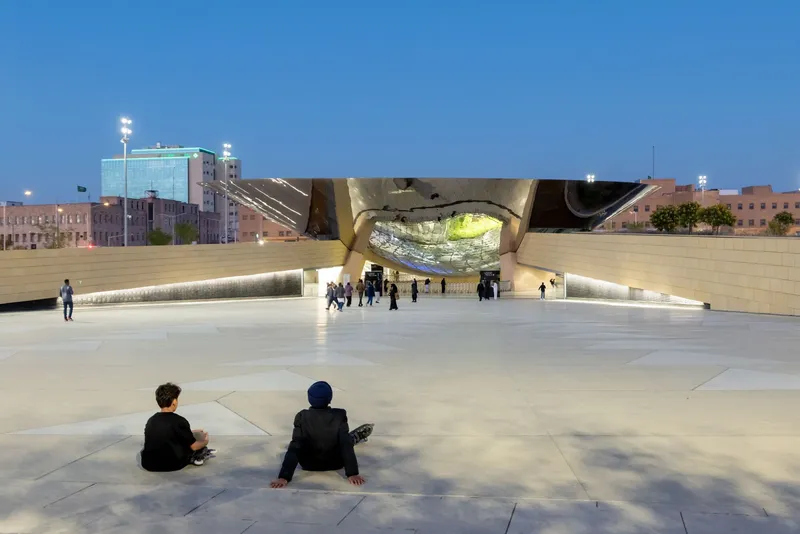
At golden hour, the opening glows against the sandy hues of the surrounding district, and the curved pedestrian ramp that extends from the canopy edge toward the street performs a dual role: it is both an entrance sequence and an invitation to linger. Illuminated drainage channels scored into the terrazzo are aligned with the direction of Makkah, extending the adjacent mosque into the open plaza. The gesture is subtle, but it collapses the distinction between transit infrastructure and sacred ground.
Mirror, Mirror
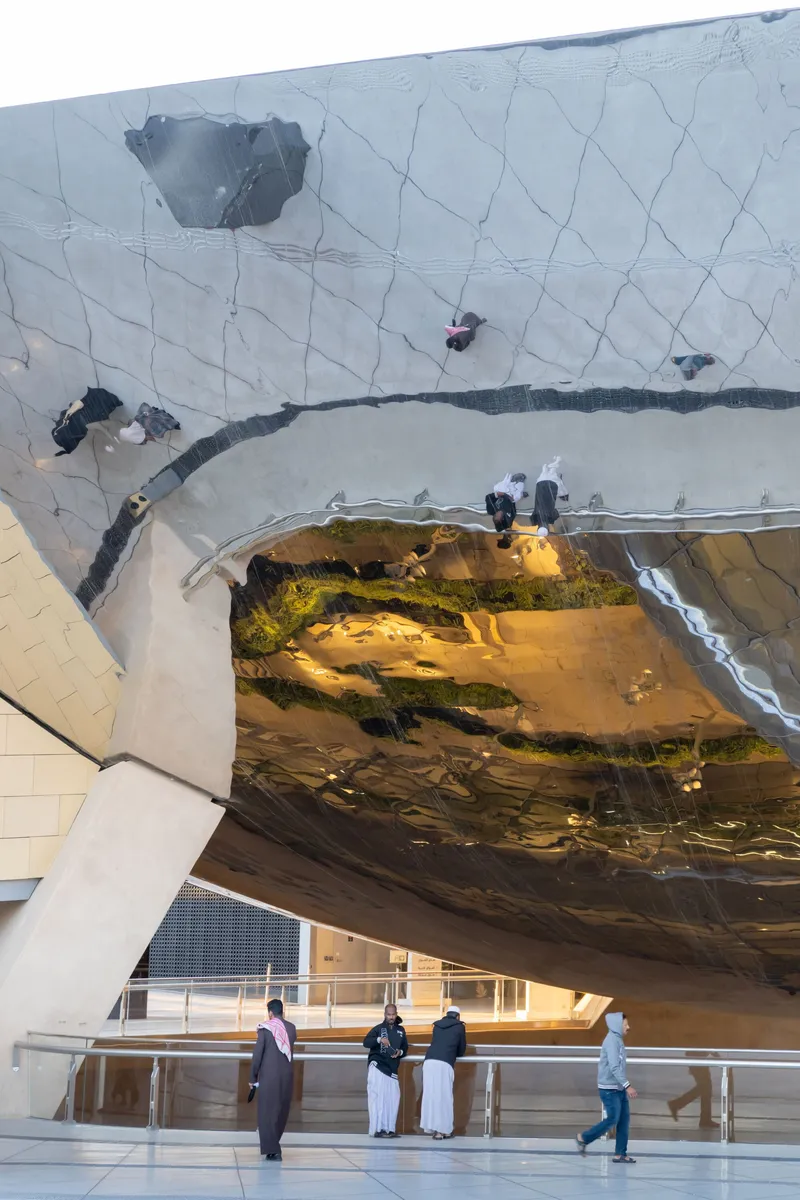
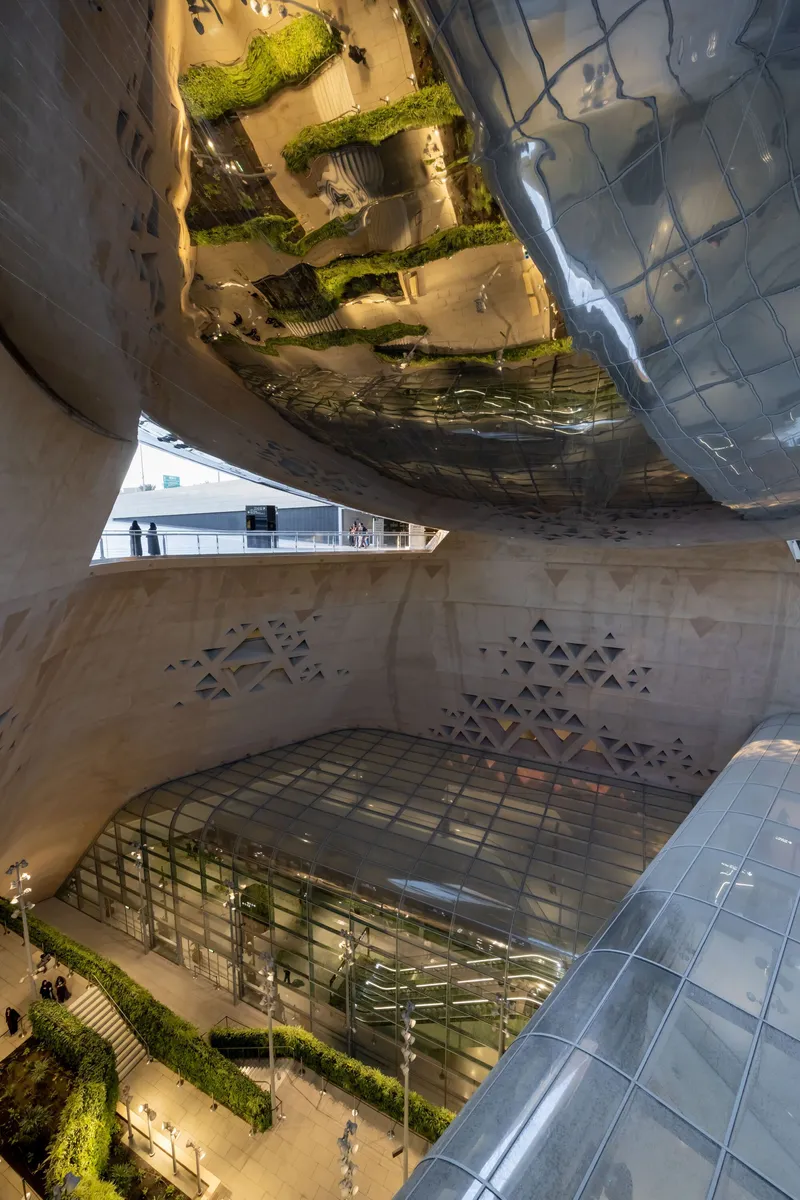

Stand beneath the canopy and look up. The polished underside mirrors the plaza, the visitors, the planted beds of grasses and shrubs, even the surrounding sandstone buildings, into a single warped image. It is architecture as optical instrument, compressing an entire urban scene onto a curved surface. The effect is disorienting and generous at the same time: you see yourself inside the city rather than standing outside a building.
The planted terraces that ring the oculus soften what could have been a brutally hard-edged composition. Curved glass elevator shafts rise through these green banks, their patterned stone bases grounding the steel and glass in something heavier, more mineral. Photovoltaic panels are integrated into elevated structures nearby, a pragmatic nod to the fact that a station this deep consumes serious energy and ought to produce some of its own.
Descending Through Najdi Geometry
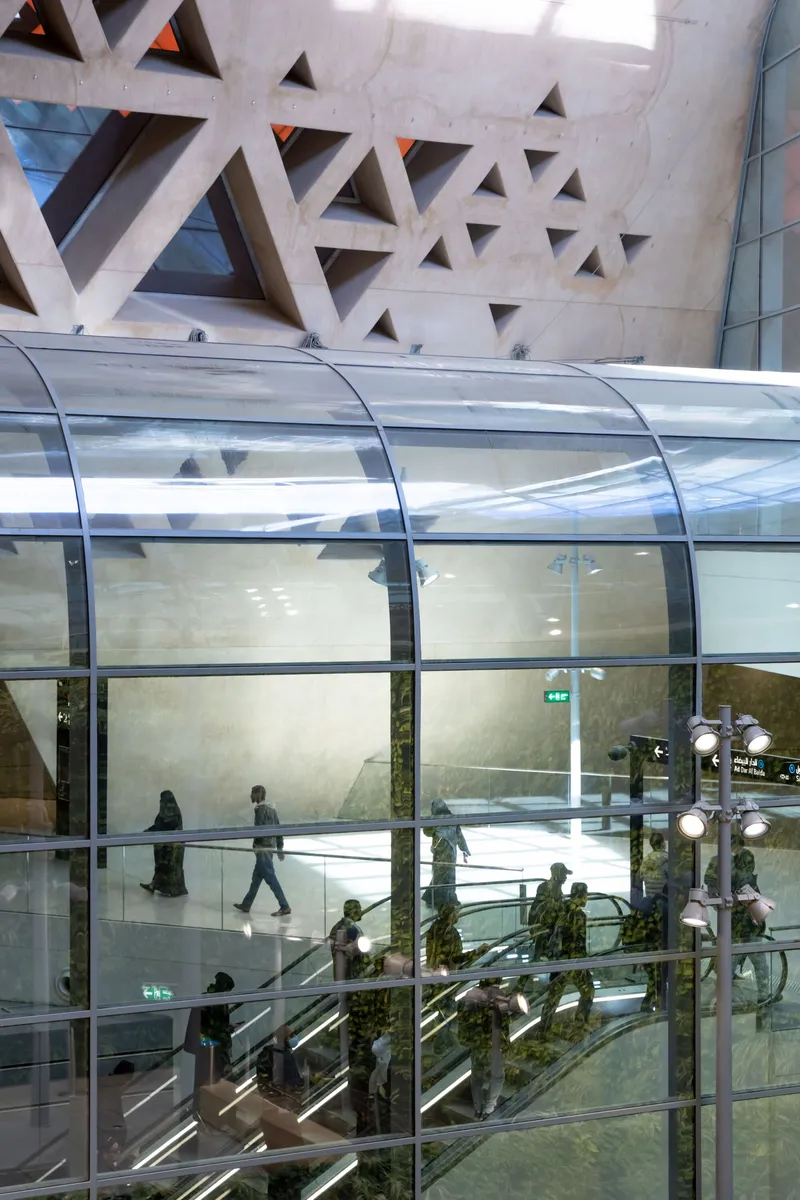

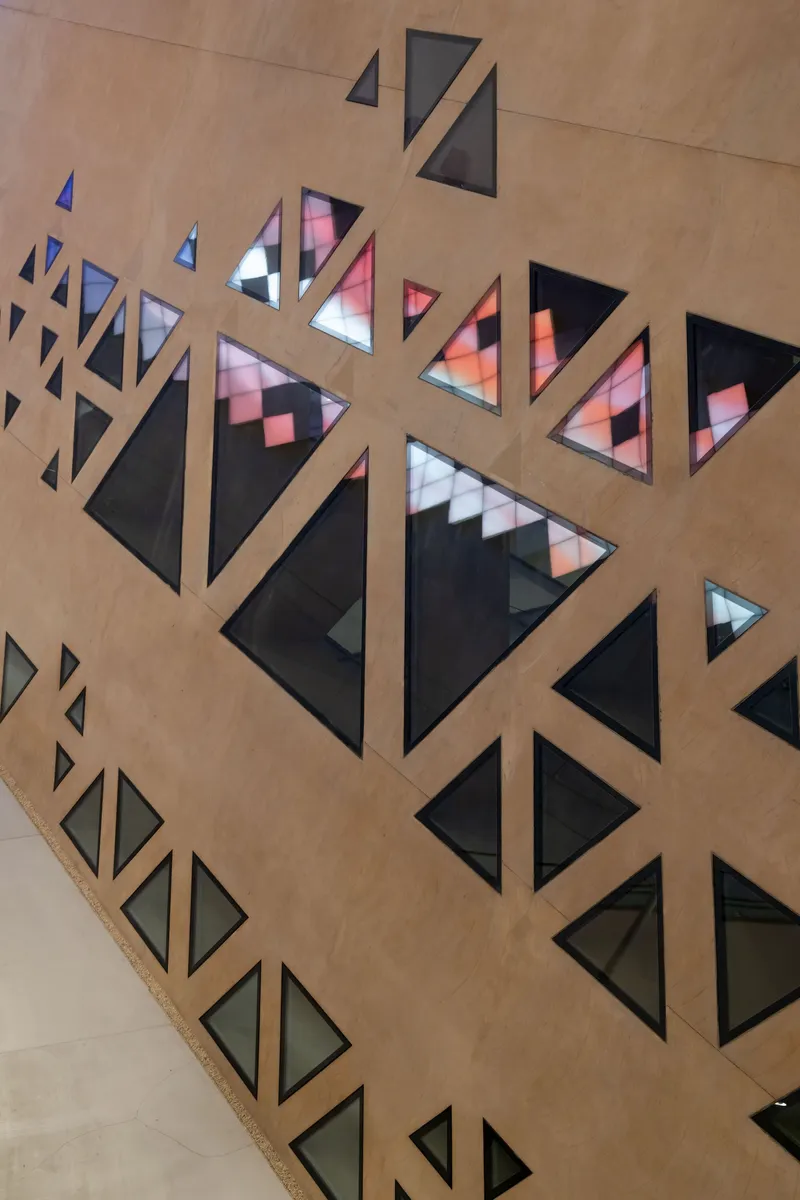
The descent from plaza level to platform is choreographed through a concrete cone perforated with 326 triangular carvings in three distinct sizes. The pattern draws directly on Najdi architectural motifs, the geometric window openings found in the old adobe buildings just blocks away. Colored glass fills some of the triangular apertures, throwing fragments of tinted light across the escalator enclosures and turning what could be a monotonous vertical shaft into something closer to a lantern.
The concrete walls are exposed and unfinished in the best sense of the word: the material is the surface. As you descend, the triangular openings frame progressively deeper views into the atrium void, where glass-enclosed platforms protrude like transparent tubes suspended in open air. It is a long way down, seven floors served by 17 elevators and 46 escalators, but the visual continuity between levels keeps the space legible.
The Underground Garden
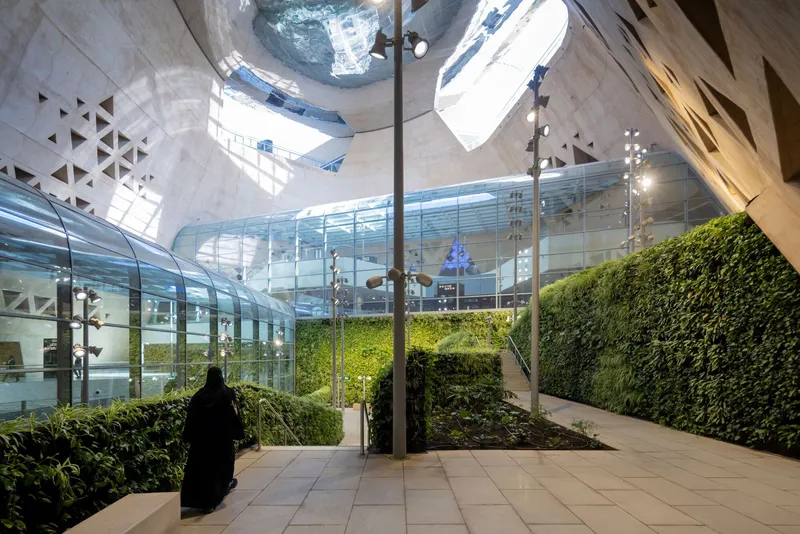
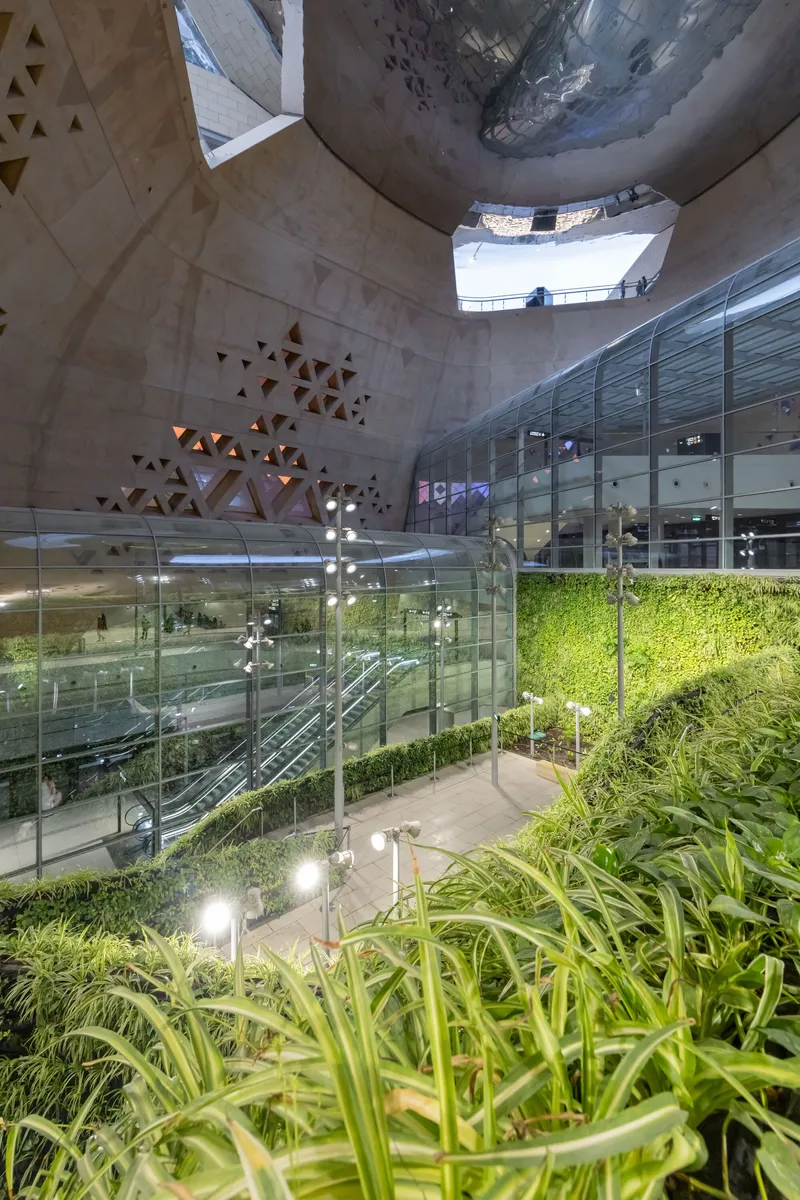
Roughly 35 meters below the plaza sits the station's most counterintuitive space: a lush garden with living green walls, planted beds, and a sculptural concrete dome pierced by skylights. In a city where summer surface temperatures routinely exceed 45°C, the depth itself becomes a passive climate strategy. The garden maintains a temperate environment without heroic mechanical intervention, exploiting the thermal mass of the earth as insulation.
The garden is accessible from two metro lines and the transfer level, positioning it as a social node rather than an ornamental afterthought. Glass balconies overlook the planted terraces, and hanging lights animate the atrium at dusk, pulling the eye upward toward the distant circle of sky visible through the canopy far above. The vertical distance is real, nearly the height of a 12-story building, yet the continuous planted surface and the choreography of light keep the space from feeling like a pit.
The Media Wall and the Liner

Wrapping the outside of the concrete cone at concourse level is a media art installation over 100 meters long, composed of 879 panels that mix acoustic, lighting, and video units. The wall turns the station's circulation ring into a gallery, and it gives the project a temporal dimension that pure architecture cannot: the content changes, the atmosphere shifts, and the station becomes a different place at different times of day.
Adjacent entry pavilions feature cantilevered canopies clad in bronze-weathered panels, a deliberate material contrast to the polished stainless steel of the main cone. The folded geometry of these smaller canopies recalls the layered striping of traditional Riyadh construction, and their warm, oxidized surfaces anchor the station's palette in the desert soil. At dusk, the illuminated pavilions draw pedestrians from the surrounding streets inward, completing the station's role as a gathering space rather than a pass-through.
Plans and Drawings
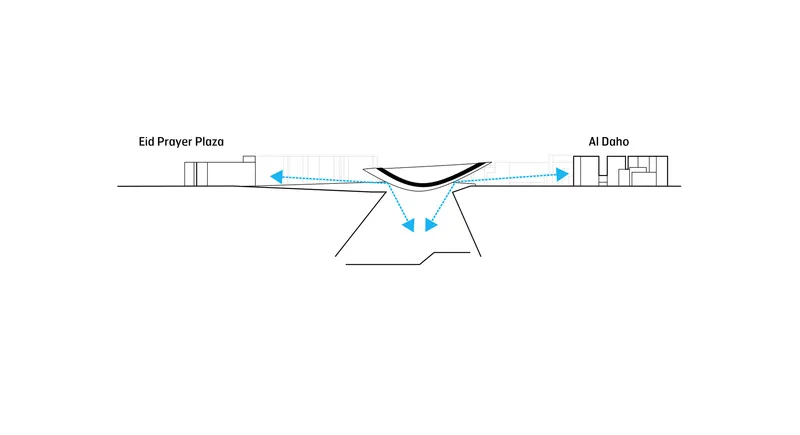
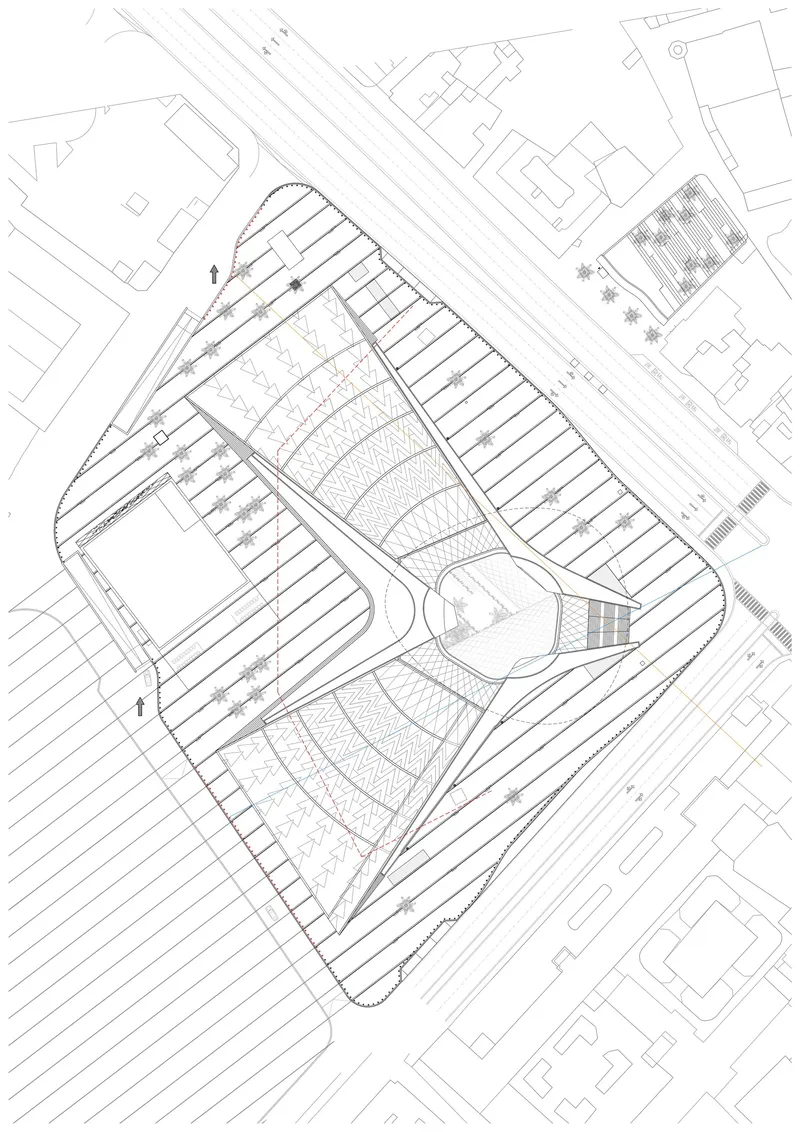
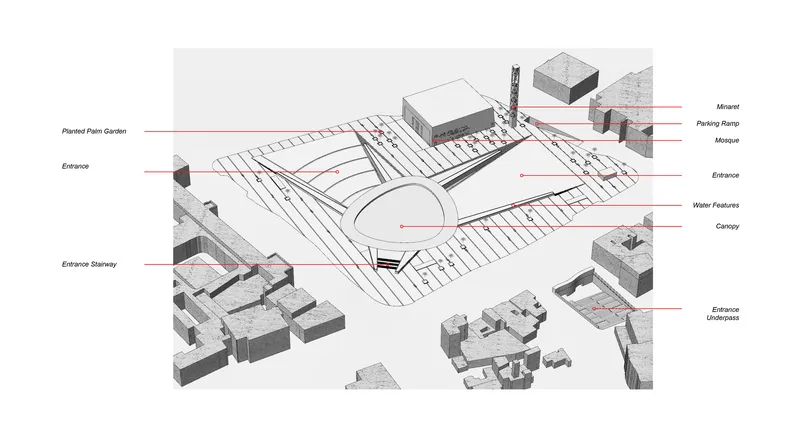
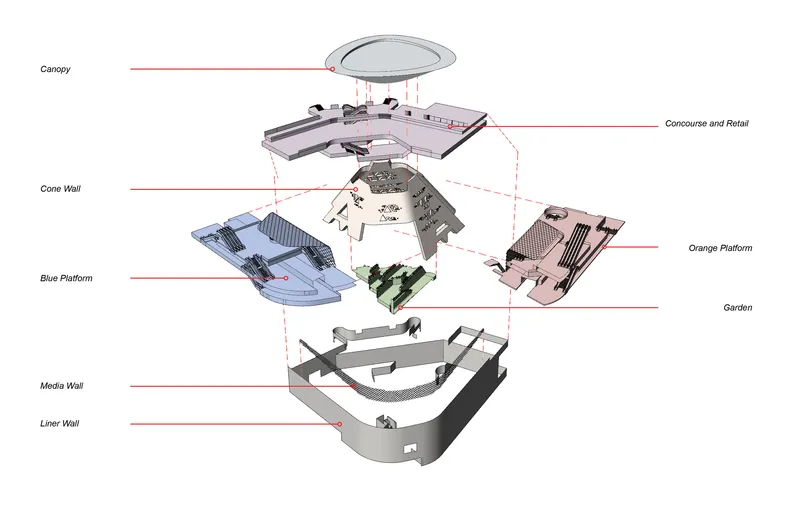
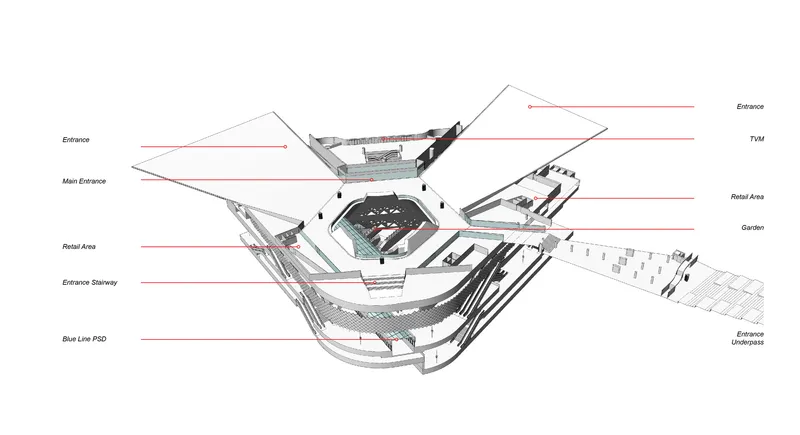

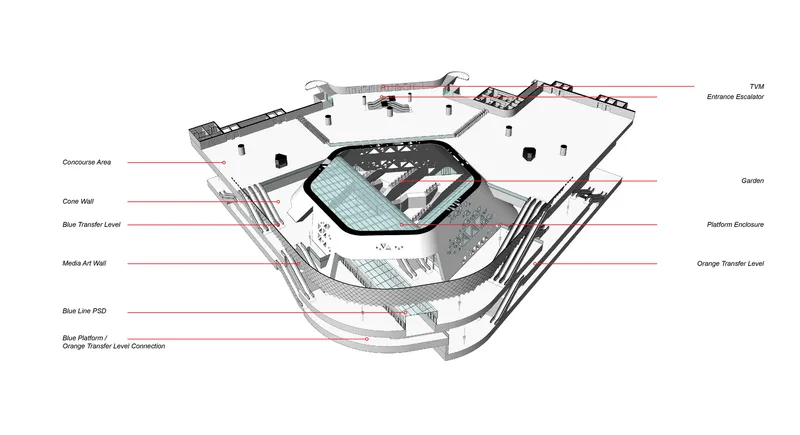

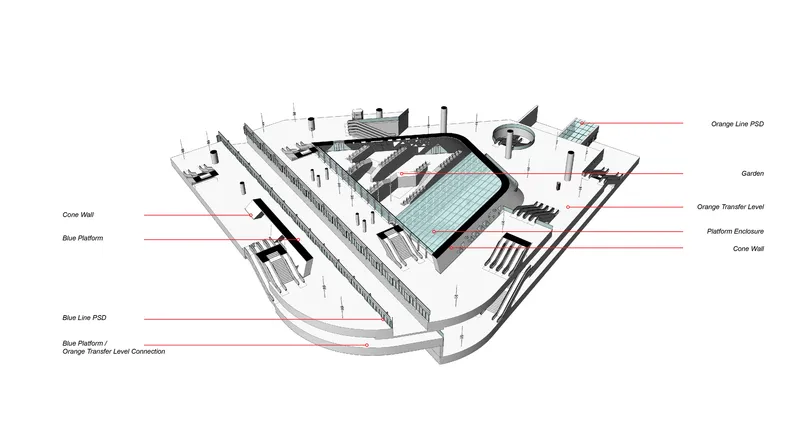
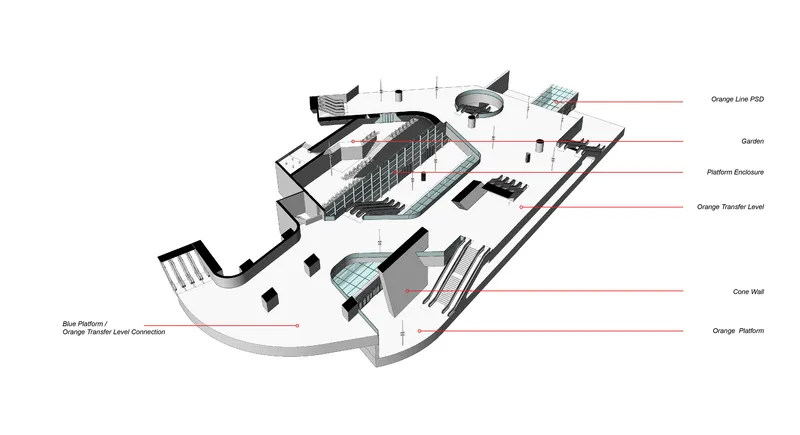
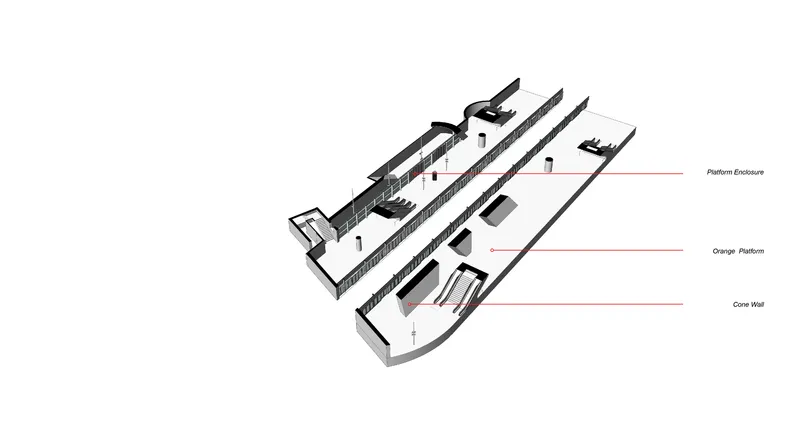
The exploded axonometrics reveal the station's true complexity. From the liner wall at the perimeter through the stacked platform levels to the canopy shell at the top, each layer is a discrete structural and programmatic system that interlocks with the others through the central hexagonal courtyard. The section drawing makes the cantilever of the canopy legible: the steel spaceframe extends far beyond the concrete cone, floating over the adjacent plaza and creating a covered public space without walls.
The site plan shows how the triangular plaza layout negotiates between the existing urban grain, the diagonal striping of the drainage channels, and the circular geometry of the station itself. It is a project that had to reconcile three incompatible geometries, orthogonal city grid, radial station form, and the qibla direction, and the drawings show where those negotiations happened. The axonometric cutaways of the platform levels are particularly instructive: the glass tubes that enclose the platforms cantilever into the central void, turning structural necessity into spatial drama.
Why This Project Matters
Riyadh's metro system is, by any measure, one of the most ambitious urban transit projects of the 21st century. But the hardware of rail and tunnel is only as useful as the public spaces that connect it to the life of the city. Snøhetta's contribution at Qasr AlHokm is an argument that a metro station can be more than a conduit: it can be a park, a gallery, a prayer space, and a plaza, all organized around a single vertical section. In a city still learning how to be pedestrian, that argument carries weight.
The project also demonstrates something about the relationship between material craft and civic ambition. The fully welded, seamless stainless steel canopy is an extravagant piece of fabrication, but it earns its cost by performing as shade structure, light funnel, and urban mirror simultaneously. The Najdi triangular motifs in the concrete cone are not appliqué; they are the structure itself, perforated to admit light and views. When ornament and performance collapse into the same gesture, the result is architecture that does not need to explain itself. It just works.
Qasr AlHokm Metro Station by Snøhetta, Riyadh, Saudi Arabia. 20,000 m². Completed 2025.
About the Studio
Share Your Own Work on uni.xyz
If projects like this are the kind of work you want to make, uni.xyz is a place to publish your own, find collaborators, and enter design competitions.


Popular Articles
Popular articles from the community


U.GA Architects Wraps an Oval Rooftop Pool in Curved Board-Formed Concrete on Busan's Jeollidan-gil
In Busan's Jeonpo-dong, a 454 m² mixed-use block stacks a neighborhood facility, guest rooms and an oval rooftop pool inside spiraling concrete walls.

Cube Design Draws an Ecological Corridor Between Two Shenzhen Hills with the Nankai Building
Beside Shenzhen's container docks, the Nankai Building pairs stacked balconies with a climbing green screen to connect two hillsides across its height.

GROUP A Strips a 1969 Rotterdam Harbor Headquarters to Its Frame and Wraps It in Timber Louvers
In Rotterdam's M4H harbor district, Ferro Offices reuses a 1969 frame, adds one timber storey and reaches BREEAM-NL Outstanding.

David Macias Steps a Doorless Stone and Plaster House Down a Tropical Colombian Hillside
In the humid hills of Colombia, Threshold House replaces the front door with an open void and terraces its 850 m² down the slope instead of fighting it.

Similar Reads
You might also enjoy these articles


LAVA Architecten Gives Vocational Education a Sawtooth-Roofed Face on a Mechelen School Campus
In Mechelen, Belgium, a 2,053 m² STEM school on a 6×6 m grid turns workshops and classrooms into rooms that can be rearranged as teaching changes.

KEMA Studio Turns a Derelict Marvila Attic into a 60 m² Lighthouse Apartment Above Lisbon
In Lisbon's Marvila district, a rebuilt roof, four skylights and two plywood volumes turn an unlivable attic into a bright home facing the Tagus.

Pixel Gardens: One Repeated Module Stacked Into a Terraced Social Housing Tower for Famagusta
Salem Bader's shortlisted housing tower builds a vertical neighbourhood from one repeated module, offsetting units to carve terraces, light and air.

Bao Huynh Watercolor Atelier: A Serene Art Retreat in Hội An
Bao Huynh Watercolor Atelier in Hội An blends multifunctional art spaces, sustainable design, local materials, and family-friendly living in a serene environment.

Comments (0)
Please login or sign up to add comments
No comments yet. Be the first to comment!