
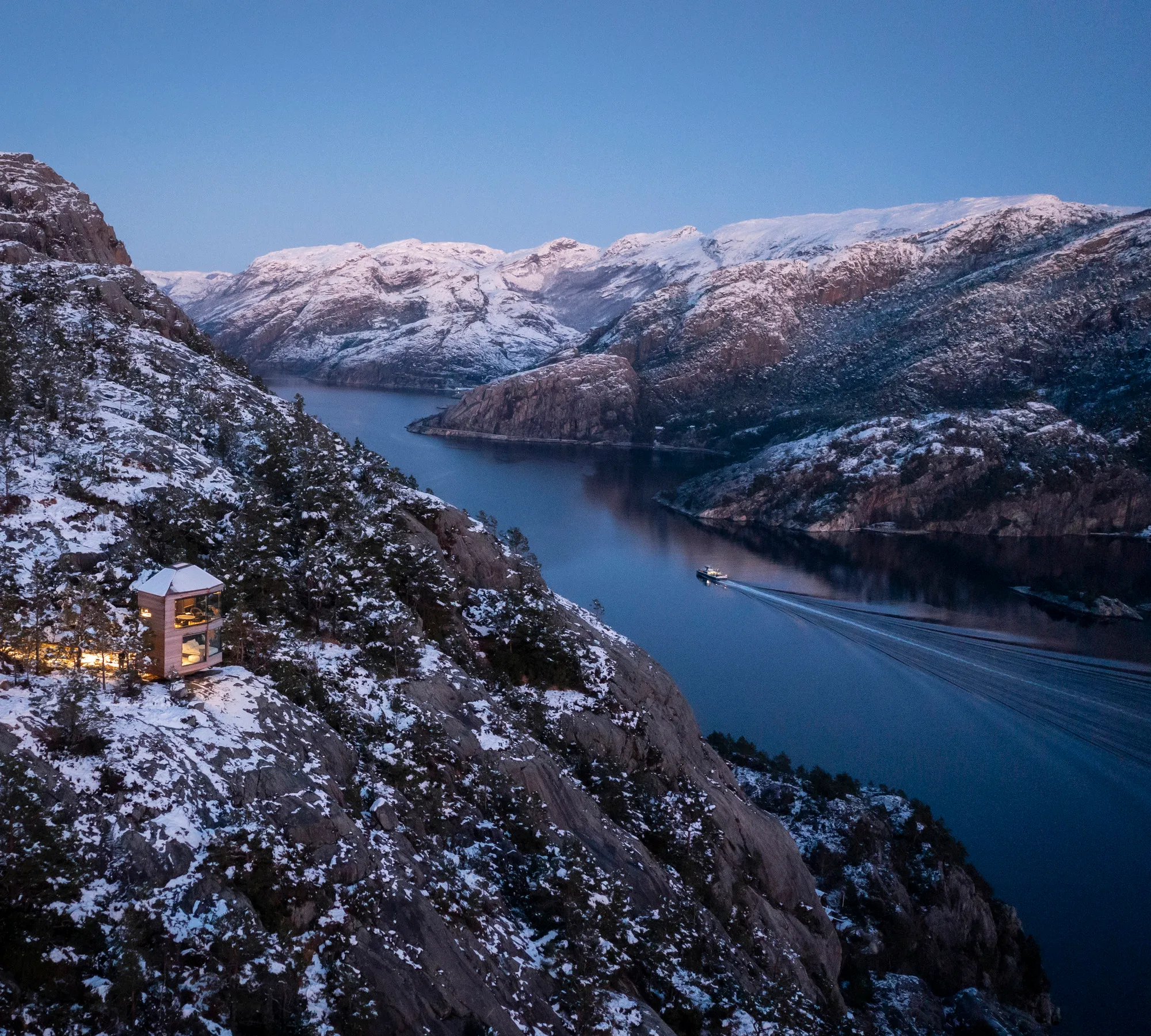
Snøhetta Suspends Four Timber Cabins 170 Meters Above a Norwegian Fjord
Perched on concrete pillars along Lysefjorden's edge, The Bolder Cabins dissolve the boundary between shelter and sky.


There is a particular type of Norwegian cabin culture that prizes restraint, isolation, and a near-spiritual relationship with landscape. Snøhetta's Bolder Cabins, completed in 2023 on the edge of Lysefjorden on Norway's west coast, take that tradition and elevate it, literally, 170 meters above the water. Four cabins sit on concrete pillars, their asymmetric volumes tilted toward the fjord as if leaning into the void. The result is less a lodge and more an optical illusion: structures that appear to float above granite and slow-growing pine, refusing to settle into the terrain even as they are built from it.
What makes the project genuinely interesting is the circularity of its material logic. Granite cut from the site became aggregate for the concrete pillars. Trees cleared during construction were set aside and reused. The untreated red cedar cladding will grey over time, camouflaging the buildings into the rocky landscape. The ambition is not just minimal footprint but a kind of material symbiosis, where the cabin is literally made of the ground it hovers above. That concept is easy to state and difficult to execute, and the details here suggest Snøhetta took it seriously rather than treating it as a branding exercise.
Lifted from the Ground, Built from the Ground


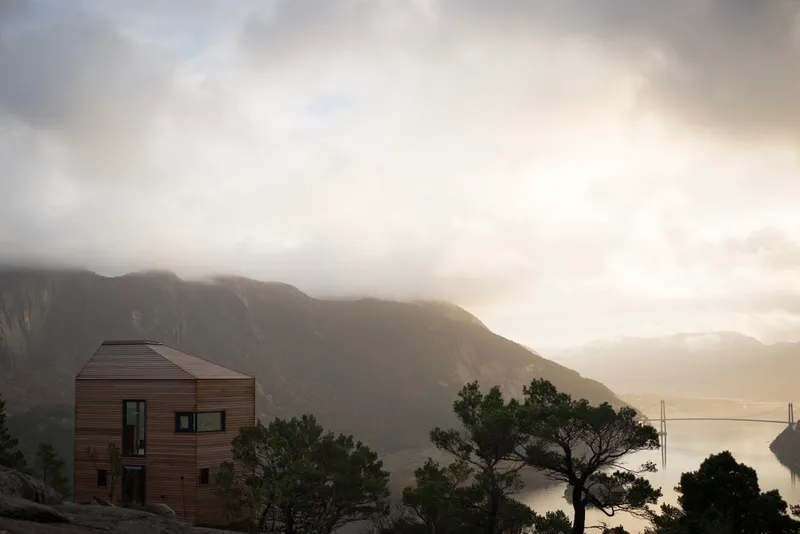
Elevating a building on pillars is a gesture as old as modernism. What separates The Bolder from a generic stilt house is the degree to which the lifting is the architecture. The concrete columns do not merely support; they establish a visual tension between the mass of the cabin and the lightness of its posture. The roof form is mirrored on the underside, so from below the structure reads as a suspended object rather than a box on legs. From certain angles, the asymmetric placement makes the cabins look as though they are tipping forward toward the fjord, heightening a sensation of weightlessness that is both thrilling and slightly unsettling.
The choice to use site-sourced granite as concrete aggregate is a small decision with outsized implications. It means the pillars are not foreign objects driven into the landscape but extensions of it. When Snøhetta talks about harmonizing with nature, this is the kind of specific, material commitment that gives the claim substance. The site sits on 180 hectares of untouched land purchased by developer Tom Bjarte Norland, and the off-grid setup, relying on naturally sourced spring water and minimal electrical connections, reinforces the sense that the cabins are guests here, not colonizers.
Asymmetry as Interior Strategy


Each of the three smaller cabins, named Stylten, Myra, and Stjerna, measures 38 square meters. The fourth, Eldhuset, offers 60. The interiors were designed from the inside out, meaning the asymmetric exterior forms are not sculptural whims but consequences of how each room frames a particular view. Inside and outside walls and roofs merge into one uniform shape, creating what Snøhetta describes as a shallow, solid, nest-like feeling. Oak lines the interiors, treated differently in each cabin to give them individual character despite their shared geometry.
The spatial organization is compact and vertical: upper floors hold kitchen and dining areas while ground floors contain built-in beds and bathrooms. A skylight, sized and placed to match the concrete base below, pulls natural light deep into the section. The result is a space that shifts constantly with weather and time of day. Surfaces are kept deliberately clean and minimal so the view does the work of decoration. In the master bedrooms, the skylight doubles as a stargazing window, a detail that sounds like a marketing line but in practice transforms the experience of lying in bed on a clear Norwegian night.
Corten Bridges and the Architecture of Approach

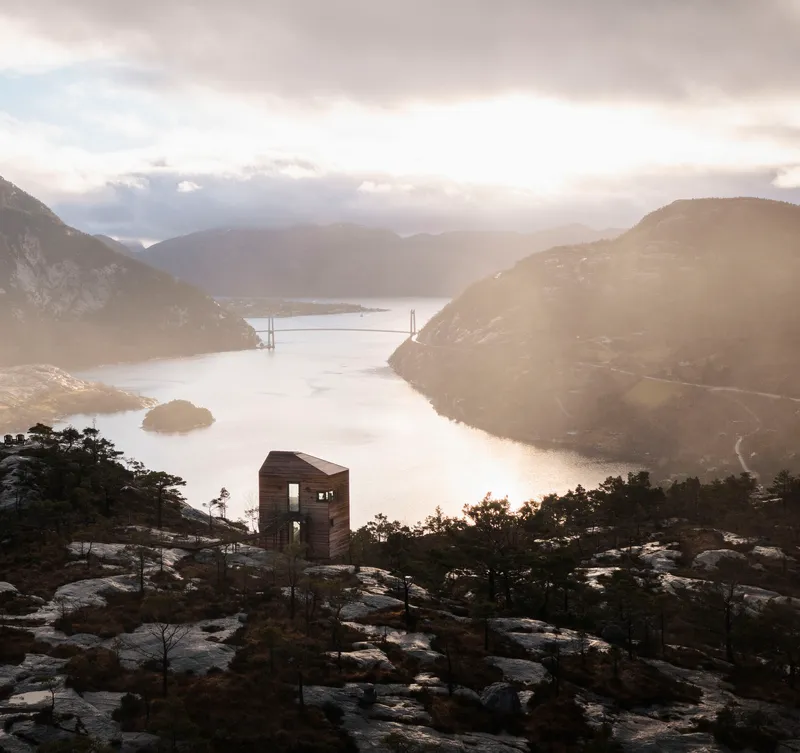
Getting to these cabins is part of the design. Corten steel walkway bridges, also lifted above the ground, connect the structures to the hillside. They weather to a dark rust that reads as a natural extension of the rocky terrain. The bridges carry dimmed, neutral-toned lighting so that at night they guide without blinding, preserving the view and the darkness around them. There is a theatrical quality to approaching a cabin suspended over a fjord via a weathering steel bridge, and it is clearly intentional. Snøhetta understands that architecture is experienced in sequence, not just at the threshold.
The aerial views reveal how sparingly the cabins occupy the landscape. In snow, the volumes become dark faceted objects against a white field, their gabled roofs and angular walls reading almost as geological formations. The restraint of the site plan, with cabins spaced among existing pines and rock outcrops, makes the project feel less like a resort and more like a series of careful insertions.
Weathering as Camouflage


Red cedar was chosen specifically because it greys. That is worth pausing on. Most clients and most architects reach for materials that look their best on opening day. Snøhetta selected a cladding that will look increasingly different over time, fading toward the silver-grey tones of exposed granite and weathered pine bark. The Corten bridges do the same thing, rusting to a stable patina. In ten years, these cabins will be harder to spot from the fjord below. That is the opposite of iconic architecture. It is architecture designed to disappear.
The fog that regularly rolls through these images is not just atmospheric photography. It is the actual operating condition of the site. Structures perched on the edge of a Norwegian fjord spend significant portions of the year wrapped in low cloud, rain, and snow. The material palette, the muted lighting, the minimal ornamentation: all of it makes more sense when you imagine the building not in golden hour but in a January whiteout. The drone views in heavy snowfall are arguably the most honest representations of what living here actually feels like.
Interior Restraint and the View as Furniture


The kitchen image tells you almost everything about the interior philosophy. Dark oak cabinetry with bronze fixtures sits against floor-to-ceiling glass, and the visual hierarchy is unmistakable: the snow-covered trees outside are the primary material of the room. Marble and leather appear in selected furniture pieces, but they are supporting cast. The palette is warm and dark enough to avoid competing with the landscape while preventing the space from feeling cold or austere.
The aerial shot of the gabled roof reveals the central skylight as a precise incision: same footprint as the concrete base, punched through the ridge. It is a simple geometric move that connects the top and bottom of the section with a single datum of natural light. Inside, this light shifts from blue-grey at dawn to warm amber at sunset, giving each cabin an internal clock that runs on weather rather than electricity. For a project that exists off-grid in most respects, that seems like the right kind of timekeeping.
Why This Project Matters
Luxury cabin projects in spectacular landscapes are not rare, and most of them are forgettable. What separates The Bolder from the typical nature-retreat formula is the rigor of its material logic and the honesty of its relationship to site. Using site-sourced granite as concrete aggregate, selecting cladding that will grey into invisibility, lifting walkways and structures to minimize disturbance: these are not gestures aimed at Instagram. They are commitments to a longer timeline, one measured in decades of weathering rather than opening-week photography.
The project also raises a productive tension. It is, at its core, a tourism development on 180 hectares of untouched land. The question of whether any building, however sensitively placed, belongs in an untouched landscape is not one architecture alone can answer. But if you accept the premise that people will seek out these places, Snøhetta's approach offers a serious model for how to build lightly on ground you cannot afford to damage. The cabins hover. The materials return to the earth. The architecture, eventually, will be hard to find. That may be its greatest achievement.
The Bolder Cabins by Snøhetta. Located on the edge of Lysefjorden, Norway. Completed in 2023. Three cabins at 38 m² each, one cabin at 60 m². Photography by Elin Engelsvoll/The Bolder, Henrik Moksnes/Bitmap, and Elisabeth Heier.
About the Studio
Share Your Own Work on uni.xyz
If projects like this are the kind of work you want to make, uni.xyz is a place to publish your own, find collaborators, and enter design competitions.



Popular Articles
Popular articles from the community


The Musturak Paradise: Senior Living Architecture for a Connected Future in Temara, Morocco
The Musturak Paradise reimagines senior living architecture in Temara via private homes, social spaces, culture, community, and shared care.

The Ocean Hive: Sustainable Architecture for a Self-Sufficient Civilization at Sea
The Ocean Hive imagines sustainable architecture at sea, where modular habitats, algae, wave power and ocean waste sustain a growing colony.

Hill & Cross Opera: Sculptural Opera House Architecture Shaped by Tallinn’s Landscape and Identity
Hill & Cross Opera reimagines opera house architecture in Tallinn through its sculptural hill, civic plaza, glass wave and a luminous cross.

Co-Life: Senior Housing Design That Reconnects Older Adults With the City
Co-Life reimagines senior housing design through healing gardens, shared streets, workshops, and a sustainable community across generations.


Similar Reads
You might also enjoy these articles

Bao Huynh Watercolor Atelier: A Serene Art Retreat in Hội An
Bao Huynh Watercolor Atelier in Hội An blends multifunctional art spaces, sustainable design, local materials, and family-friendly living in a serene environment.

Atelier Macri Concept Store Interior Design by CASE-REAL
Atelier Macri store features a "ko" counter, walnut wood details, cork displays, blending retail, gallery, and seamless customer experiences.

Manuel Vargas Izquierdo Stadium and High-Performance Sports Center: Architectural Excellence in Jalpa de Méndez
The Manuel Vargas Izquierdo Stadium blends sustainable design, inclusive sports facilities, and cultural-inspired architecture, revitalizing Jalpa de Méndez’s public spaces.

KAKR Buluh Awar Hall: Revitalizing Community and Ecology Through Bamboo Architecture
Community built bamboo hall revitalizes Buluh Awar village, empowering youth, restoring ecology, celebrating vernacular craftsmanship through sustainable architecture and culture.
Explore Residential Building Competitions
Discover active competitions in this discipline


Challenge to design mud housing for contemporary communities


Challenge to reimagine the Iron Throne


Photograph architecture without architects


Illustrate the lost glory of Angkor Wat - Render Challenge
Comments (0)
Please login or sign up to add comments
No comments yet. Be the first to comment!