
snkh studio Threads Stainless Steel Through Yerevan's Oldest Surviving Interior for Lumen Coffee 1936
A fully reversible intervention turns a 1930s bookstore on Mashtots Avenue into a four-program café without touching a single historic surface.

There is a particular kind of courage in doing almost nothing. On Mashtots Avenue in Yerevan, beside the Matenadaran Museum, a storefront that has cycled through lives as a tobacco shop and a bookstore called "Luys" still holds the city's oldest preserved interior: 36 square metres of handcrafted wood panels, carved wainscoting, coffered ceilings, and painted botanical medallions dating to the 1930s. snkh studio, led by Armine Snkhchyan, chose not to restore this room in the traditional sense. Instead, the studio introduced a parallel material vocabulary, polished stainless steel, that sits among the woodwork without ever touching it.
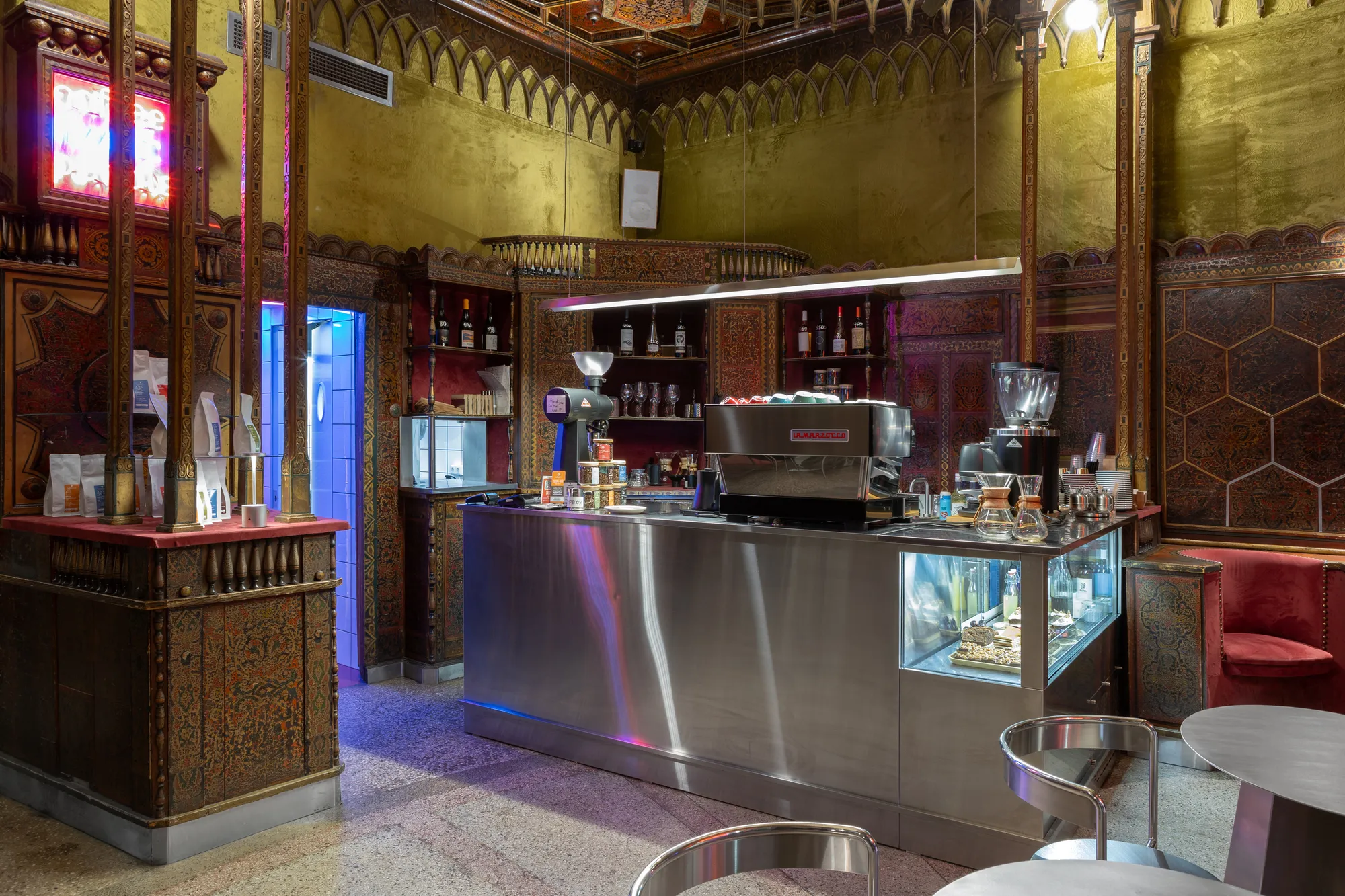
The result, Lumen Coffee 1936, is a 73 square metre café that braids together four programs: reading, listening, coffee, and wine. Every new element, the bar counter, the shelves, the tables, the lighting, is a freestanding steel object unanchored to the walls or floor and designed for complete removal without damage. It is conservation by contrast: the steel does not mimic what was lost; it replaces missing fittings with an honest, reflective material that belongs unambiguously to the present. The approach turns a heritage headache into a legible argument about how contemporary design can coexist with craft traditions rather than embalm them.
A Storefront Between Eras
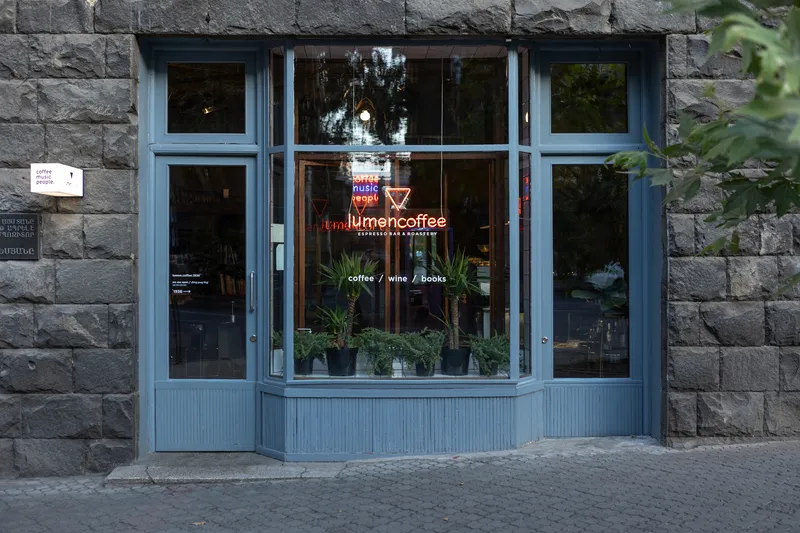
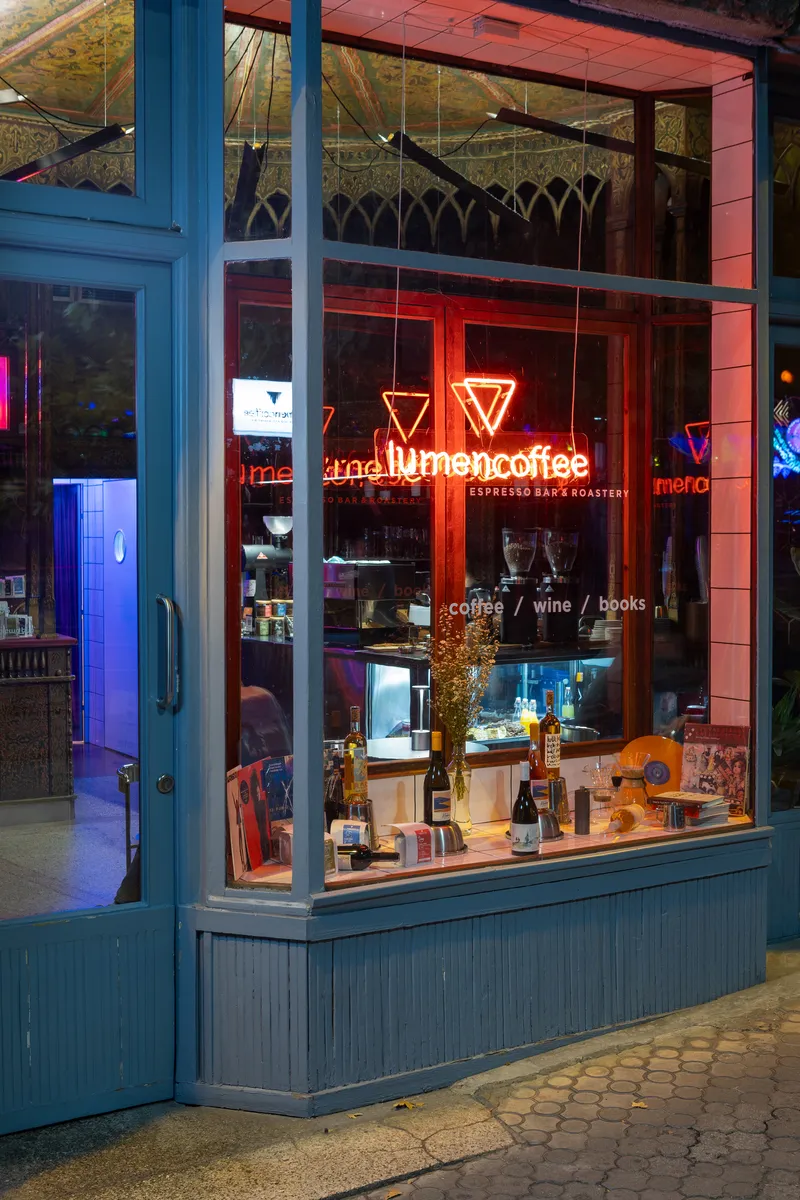
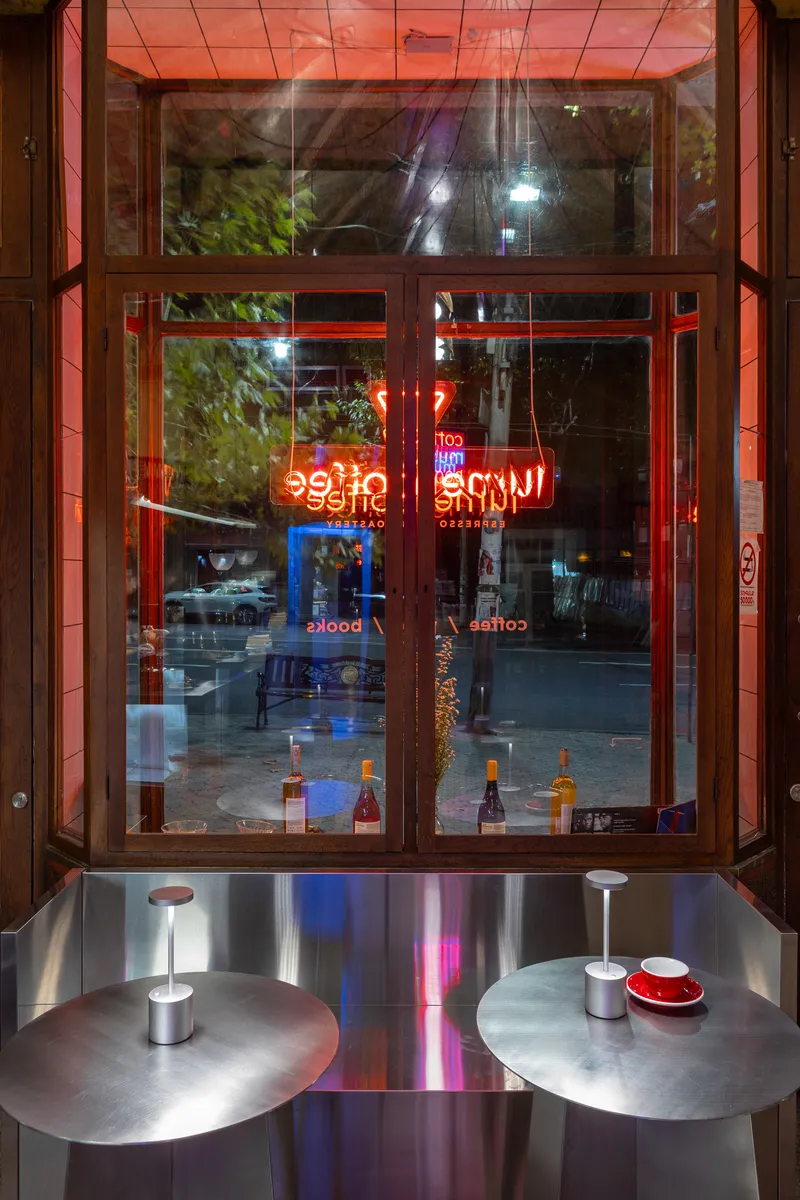
The blue-painted timber storefront is the project's public face, and it walks a fine line. The bay window, neon signage, and potted greenery read as inviting and informal, while the stone facade behind it anchors the building in Yerevan's early twentieth century urban fabric. At dusk, the glass front becomes a vitrine: steel tables catch interior light and broadcast it outward, turning the café into a lantern on the avenue. The decision to retain and restore the original joinery rather than replace it with a frameless shopfront keeps the threshold between street and interior honest.
Oriental Art Nouveau, Untouched
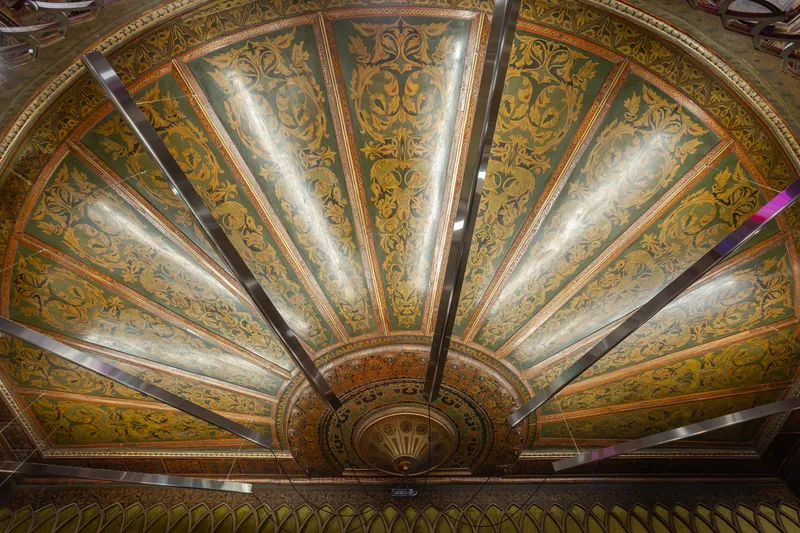

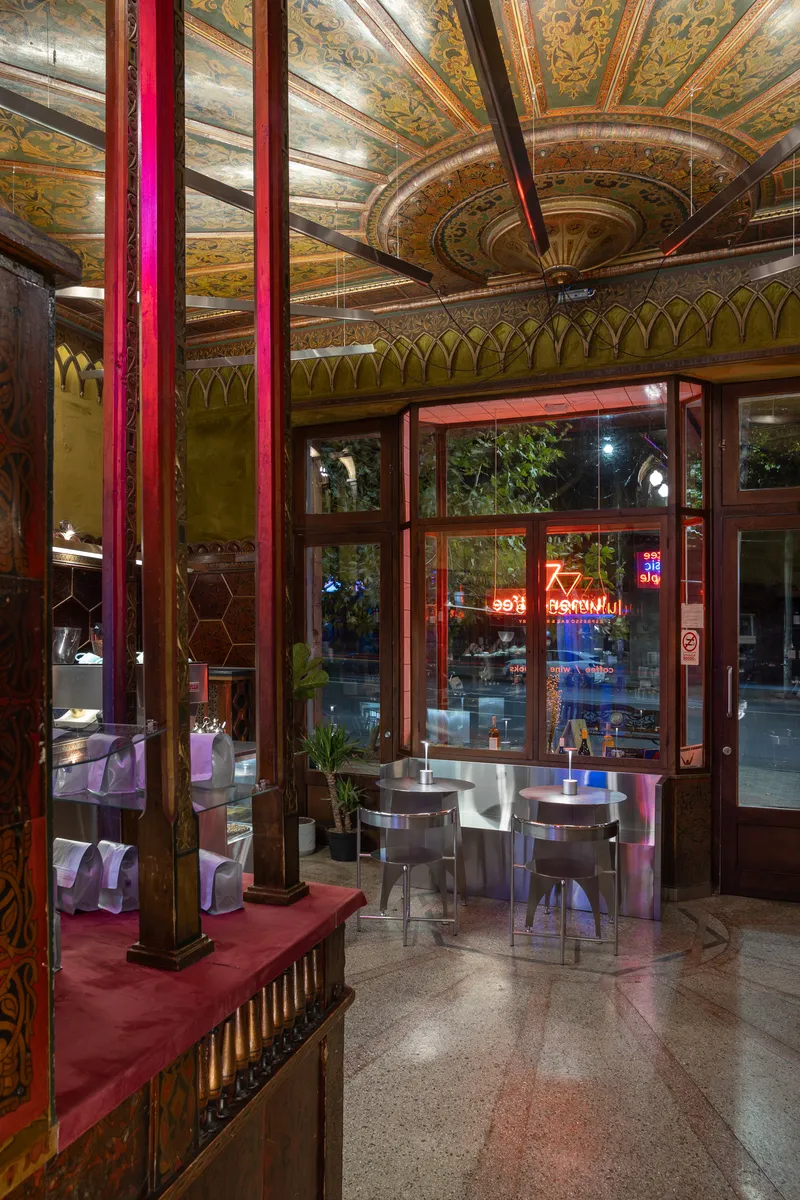
The ceiling is the room's greatest asset and the strongest argument for the studio's hands-off strategy. Painted botanical motifs radiate from a central medallion, gilded borders frame foliate panels between timber beams, and the whole composition belongs to what has been described as an "Oriental Art Nouveau" tradition, originally crafted by the master furniture maker Hovhannes Naghashyan. Restoration here was carried out by local craftsmen using traditional techniques: periodic oiling of the wood, careful cleaning, nothing additive.
What makes the ceiling so effective as architecture, rather than mere decoration, is how the steel elements below it refuse to compete. The reflective surfaces of the new counter and tables pick up fragments of the painted patterns overhead, creating a soft doubling effect. You look down at a steel tabletop and see a ghost image of a ninety-year-old fresco. The room becomes a conversation between two craftsmen separated by a century.
Steel as a Guest, Not an Occupier
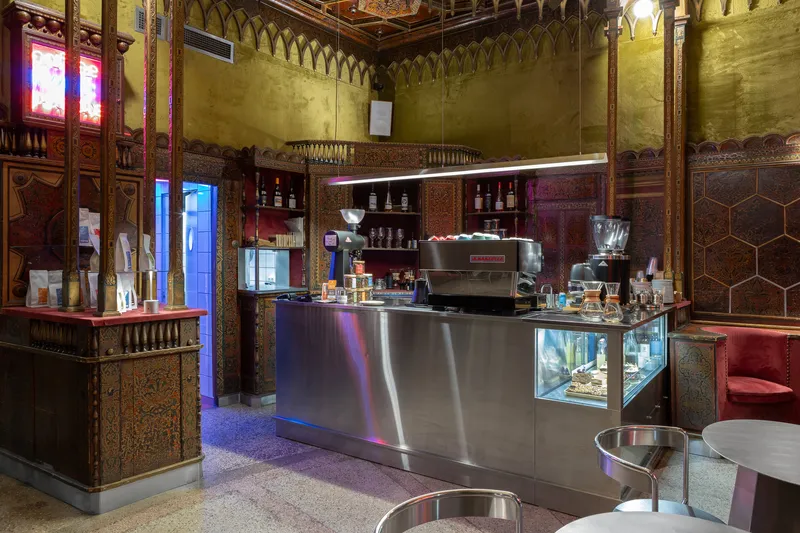
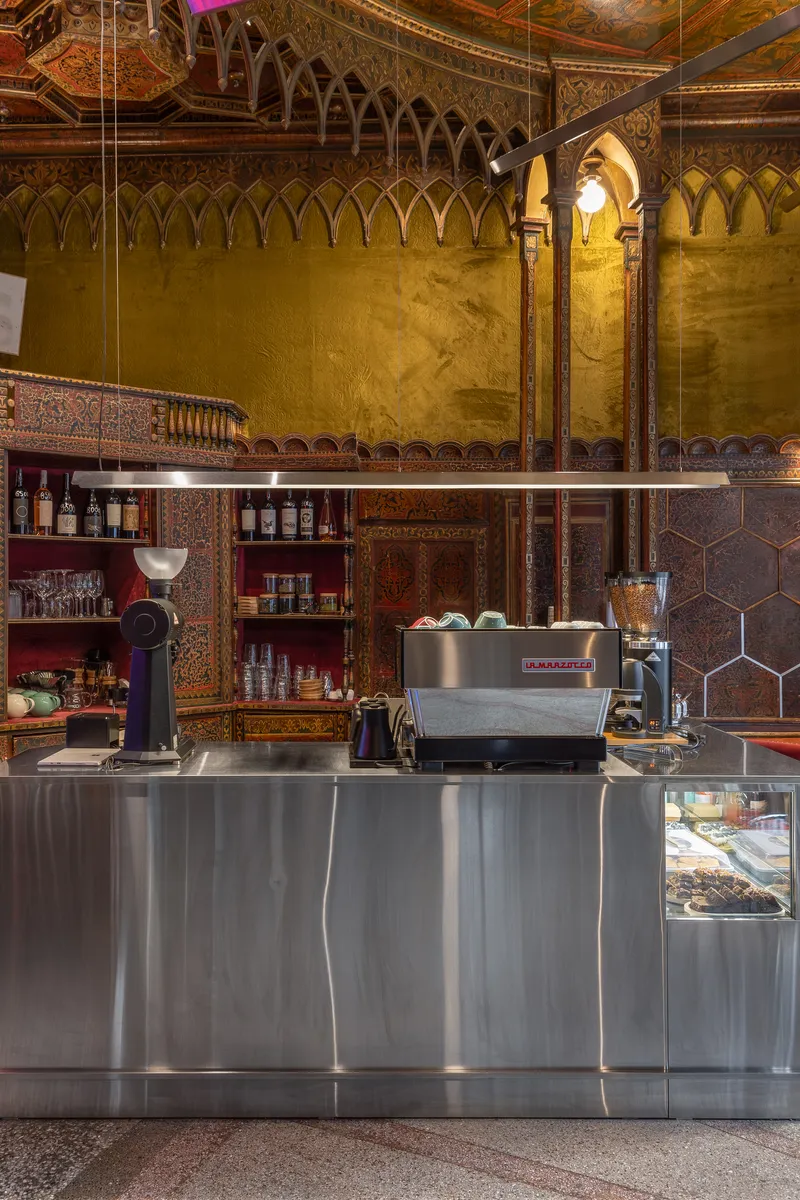
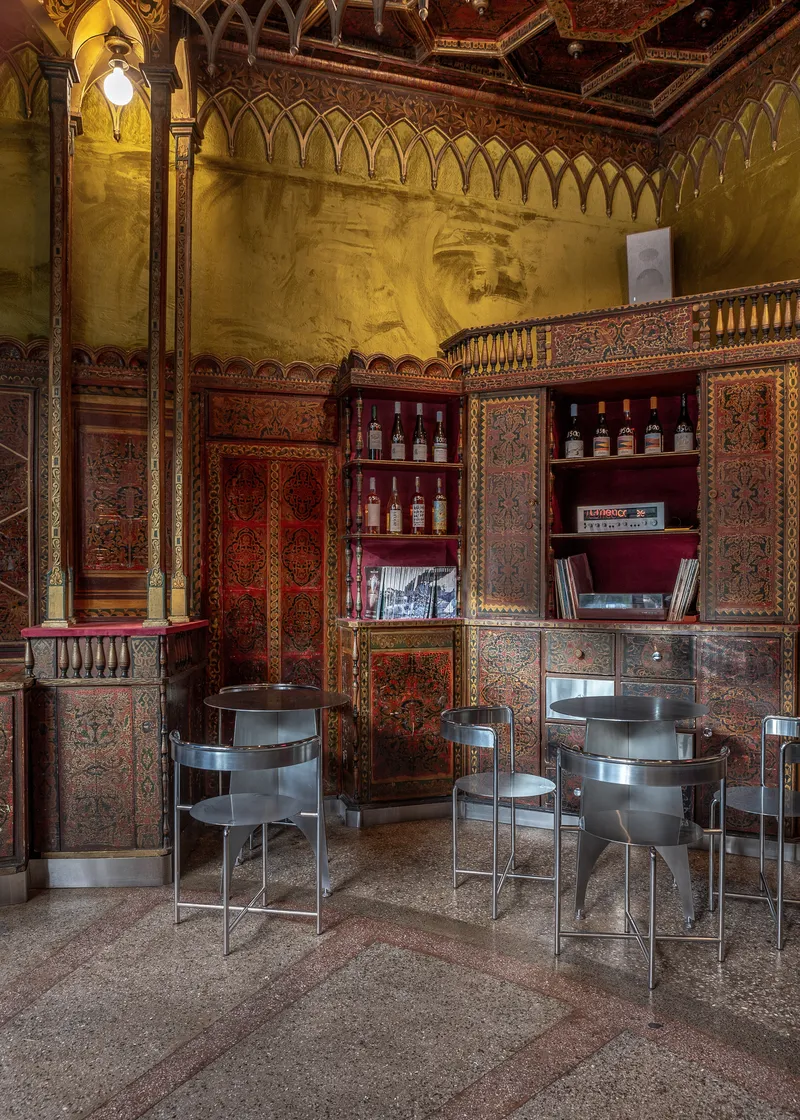
The stainless steel counter beneath the ornate timber wall is the project's signature move. It is thin, precise, and deliberately cool against the warmth of the surrounding wood. An espresso machine, a suspended glass display case, and arched openings behind the bar create a functional service zone that could be lifted out in a day. This is the core of the reversibility concept: not a philosophical abstraction but a structural reality. Nothing is bolted to the heritage fabric.
Tubular steel chairs sit on the original terrazzo flooring without scratching it, and the shelving units read as slim floating structures rather than built-in casework. The material choice was pragmatic as much as symbolic. Steel is neutral enough not to argue with polychrome wood, durable enough to survive café service, and precise enough to be fabricated off-site and slotted into place with minimal construction waste.
Detail and Texture Up Close
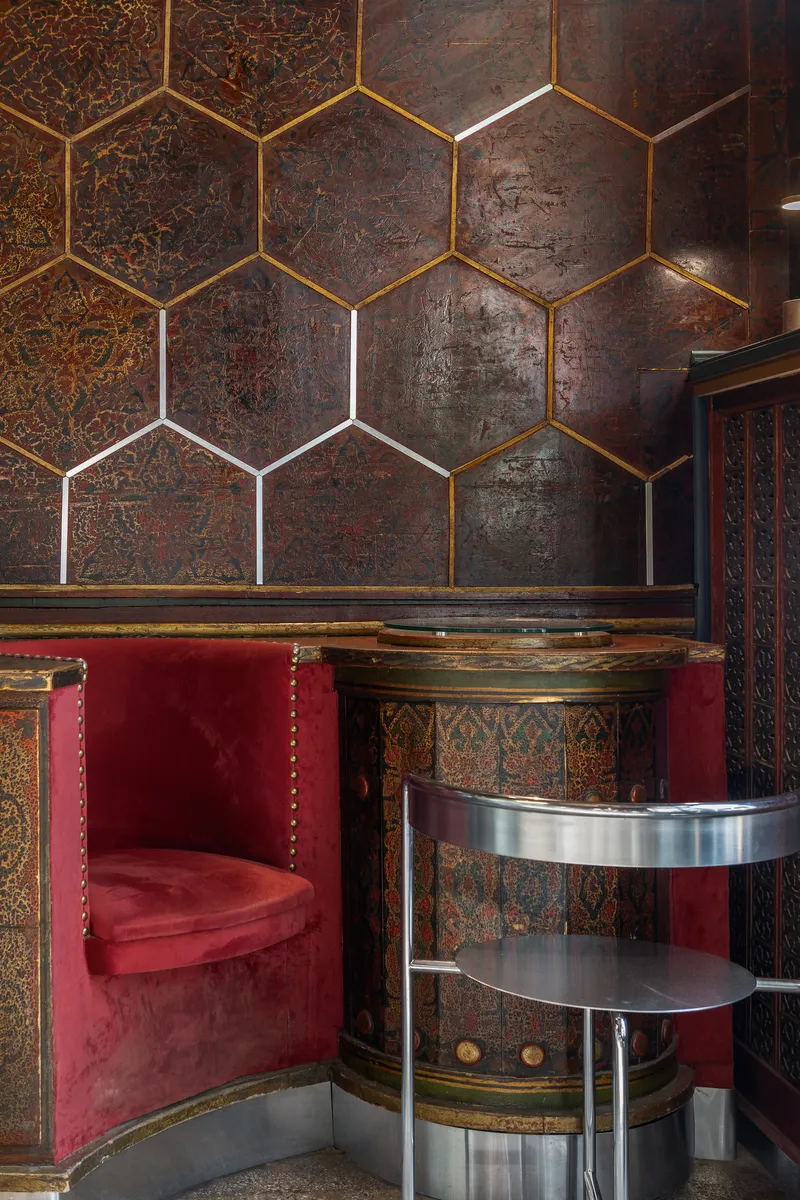
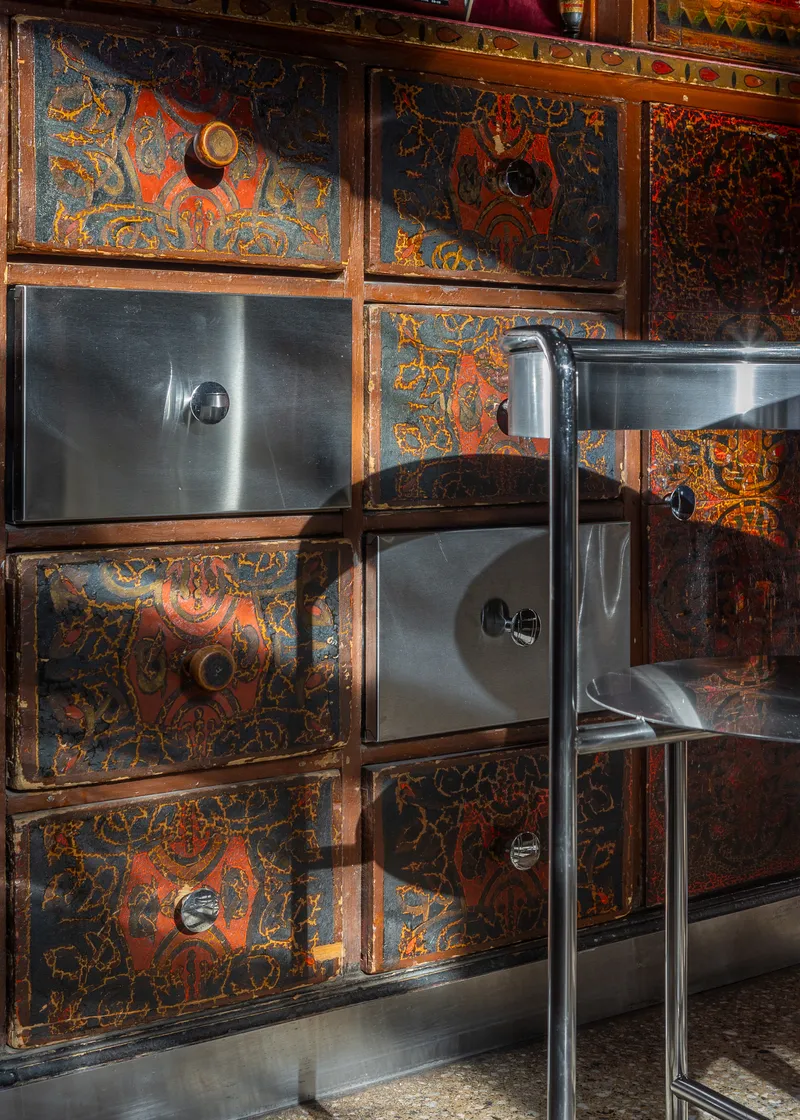
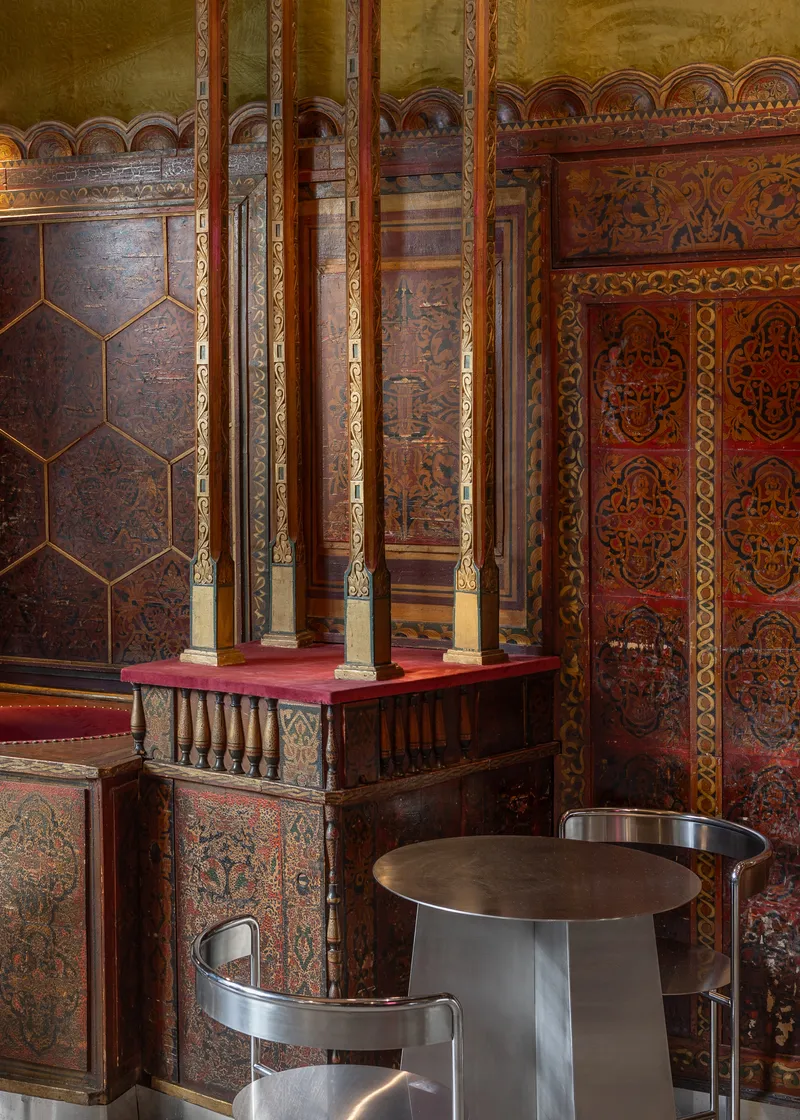
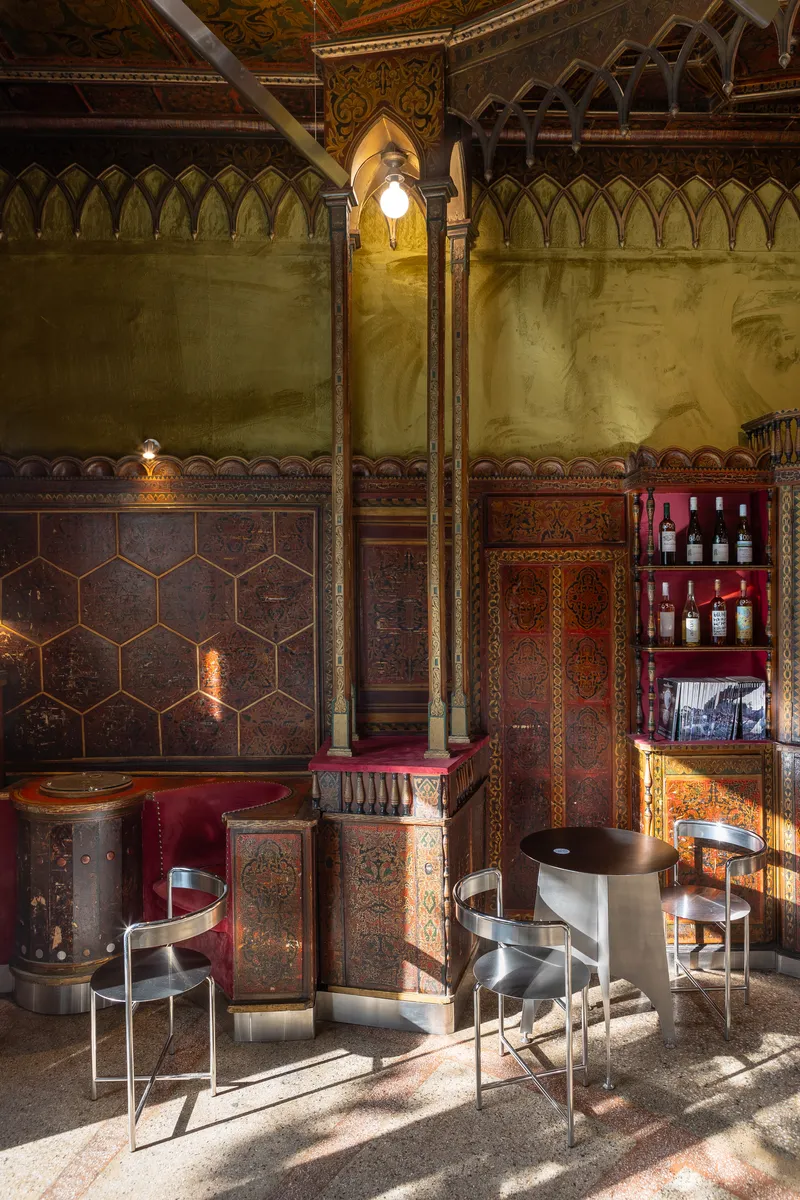
At close range, the material dialogue becomes richer. Hexagonal brass trim divides embossed wall panels above a banquette, and a curved stainless steel table slides in underneath without fasteners. Elsewhere, slim brass columns support a red platform against walls of patterned timber and carved wainscoting. The hardware, the handles, the trims, all original, have been restored and left visible, so the new steel reads against a surface that is fully articulated rather than scraped back to a blank canvas.
The top-down shot of stainless steel basins set into ornate panels is perhaps the most telling image of the project's philosophy. Old and new share a plane, literally coplanar, yet remain materially distinct. There is no transition strip, no gradient. The cut is clean, and that clarity is what gives the intervention its conviction.
The Quiet Room and the Corridor
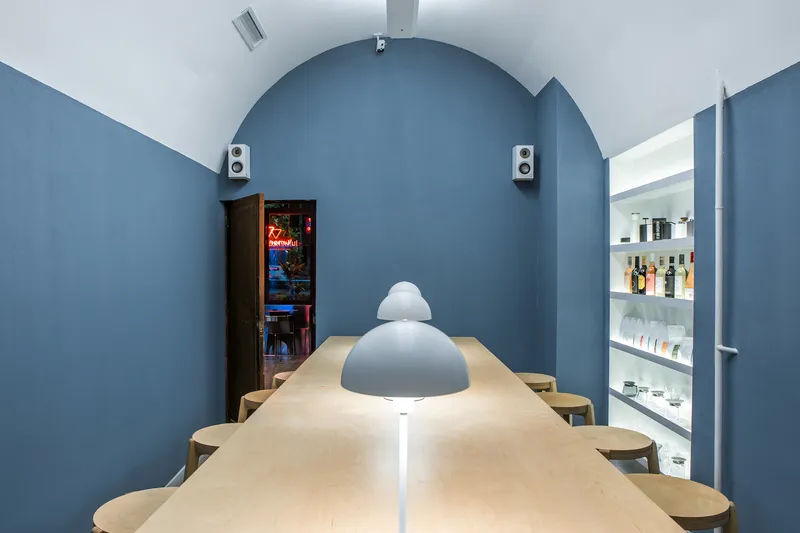
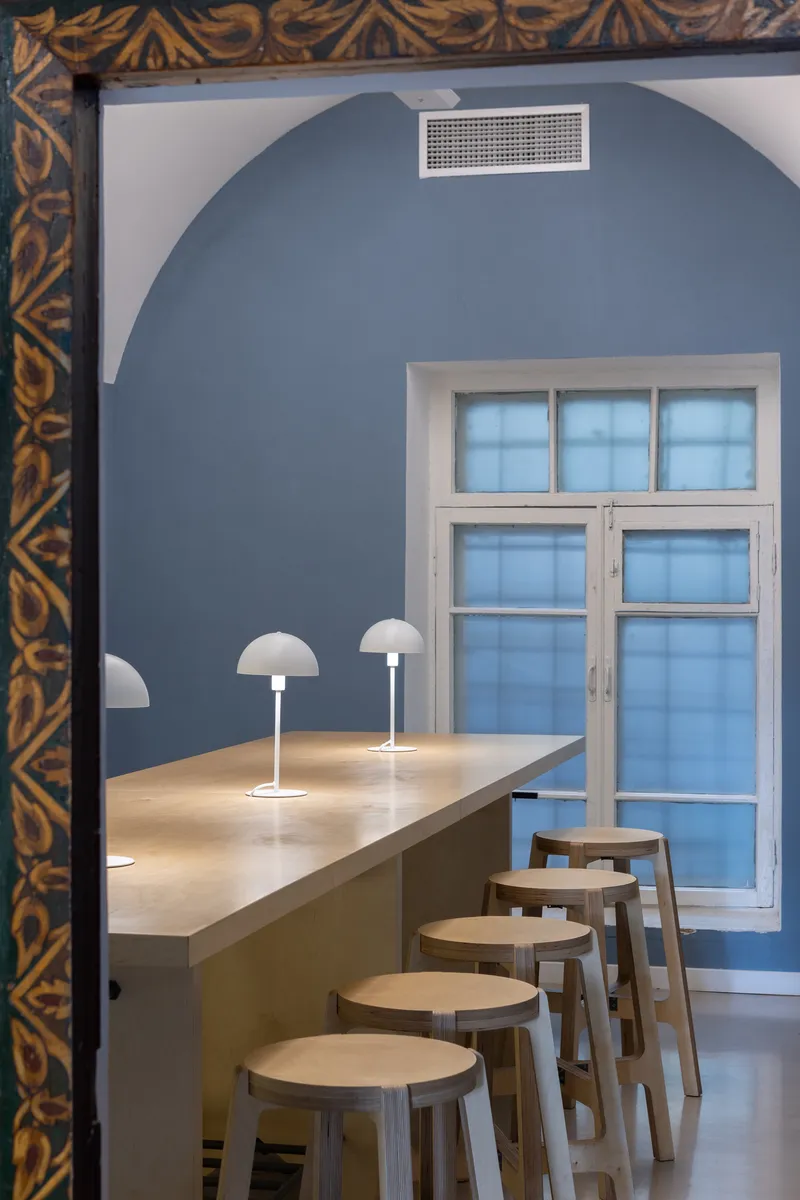
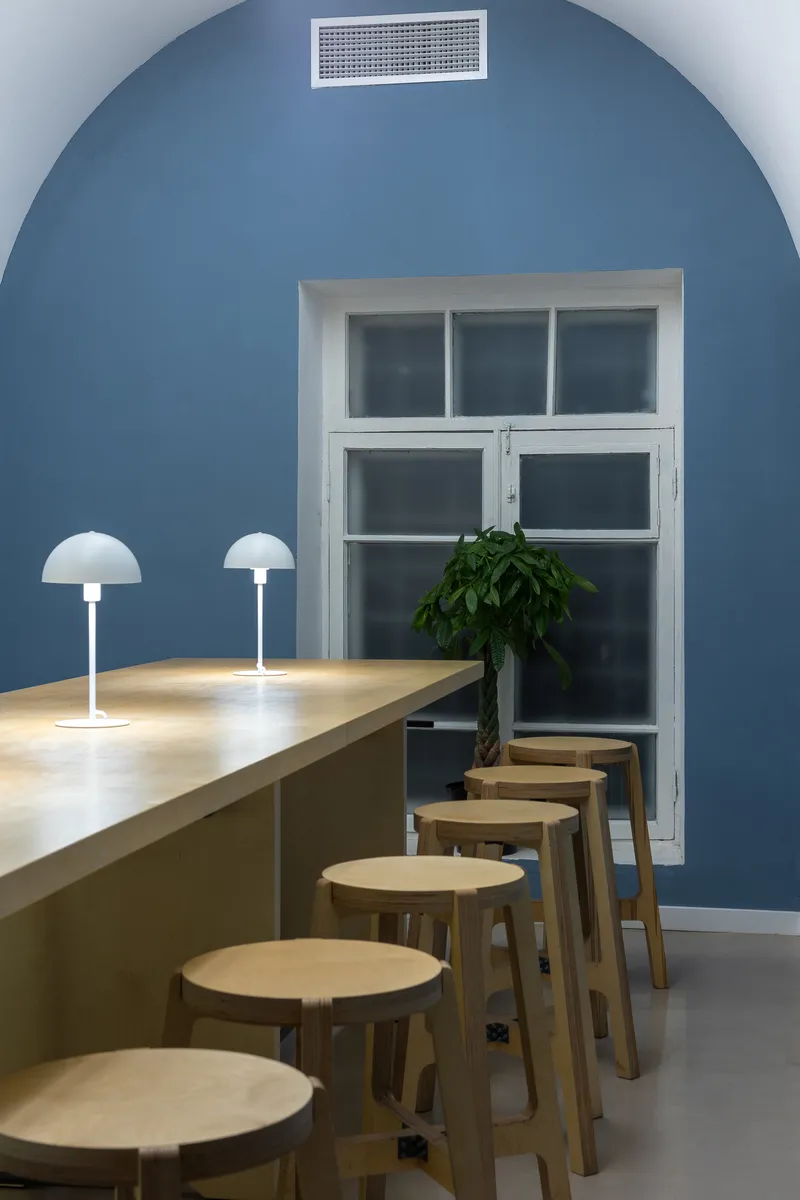
Beyond the main hall, which snkh studio calls the "pleasure zone," an adjoining room operates as a quiet co-working space. Here, the arched blue wall, a plywood table, a single pendant lamp, and a backlit shelving alcove offer a deliberately pared-down atmosphere. The shift from the heritage core's density to this calmer register is managed through a pointed archway that acts as both frame and threshold, lit by wall sconces that glow warmly at dusk.
Viewed through the ornate doorframe, the blue arched dining area with its timber counter and mushroom lamps compresses two centuries of Yerevan's interior design into a single sightline. The transition is not jarring because the palette, blue paint, warm wood, reflected metal, holds together across both rooms.
Neon and Terrazzo in the Back of House
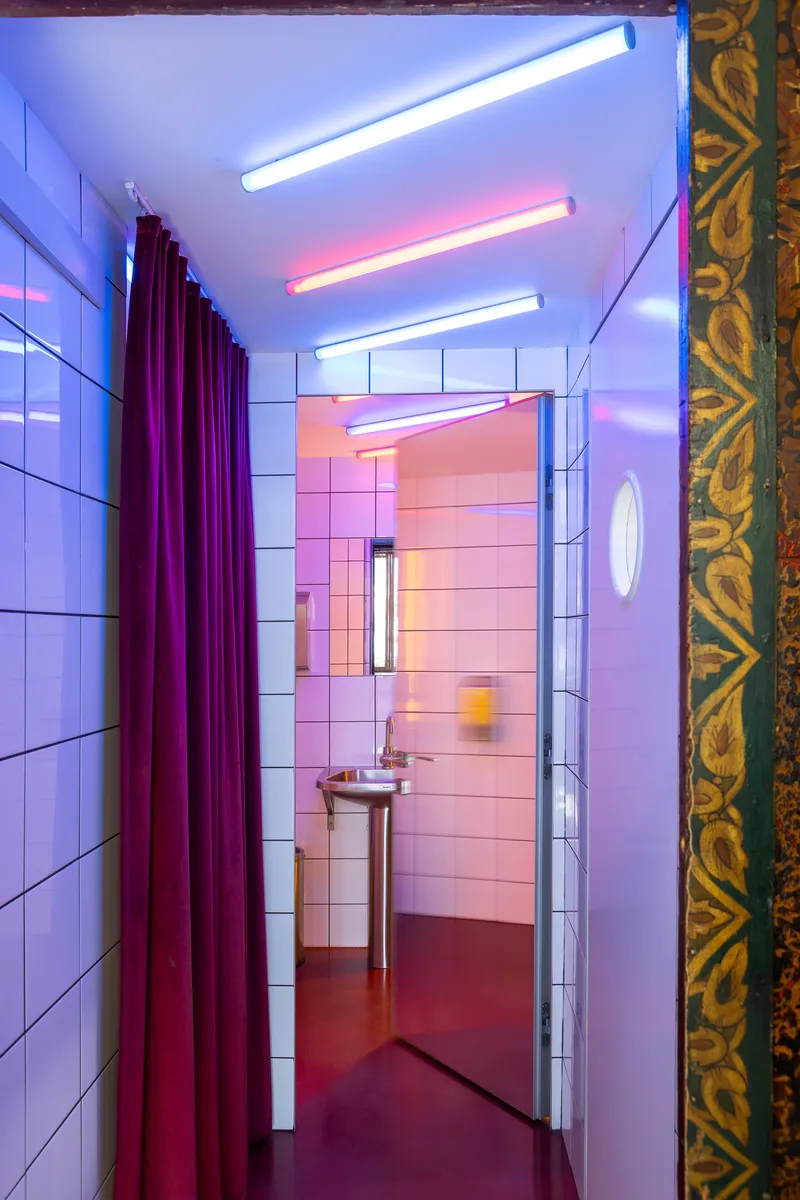
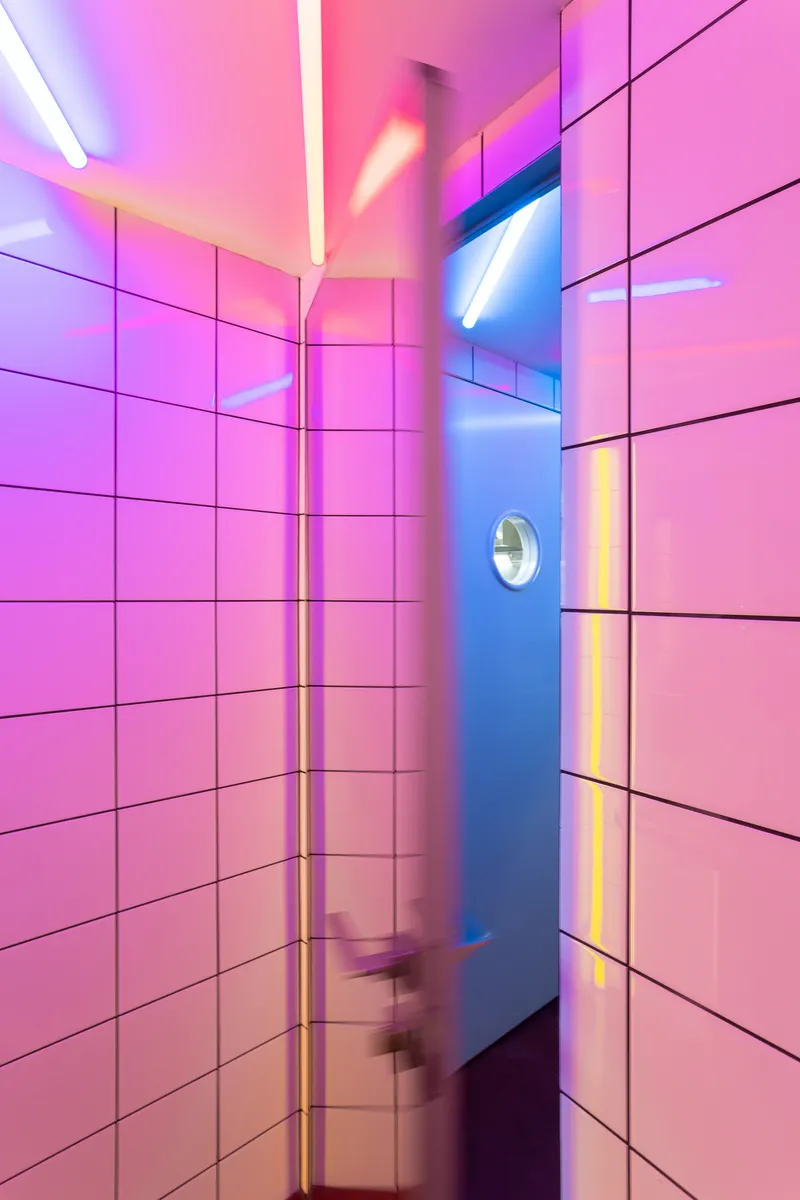
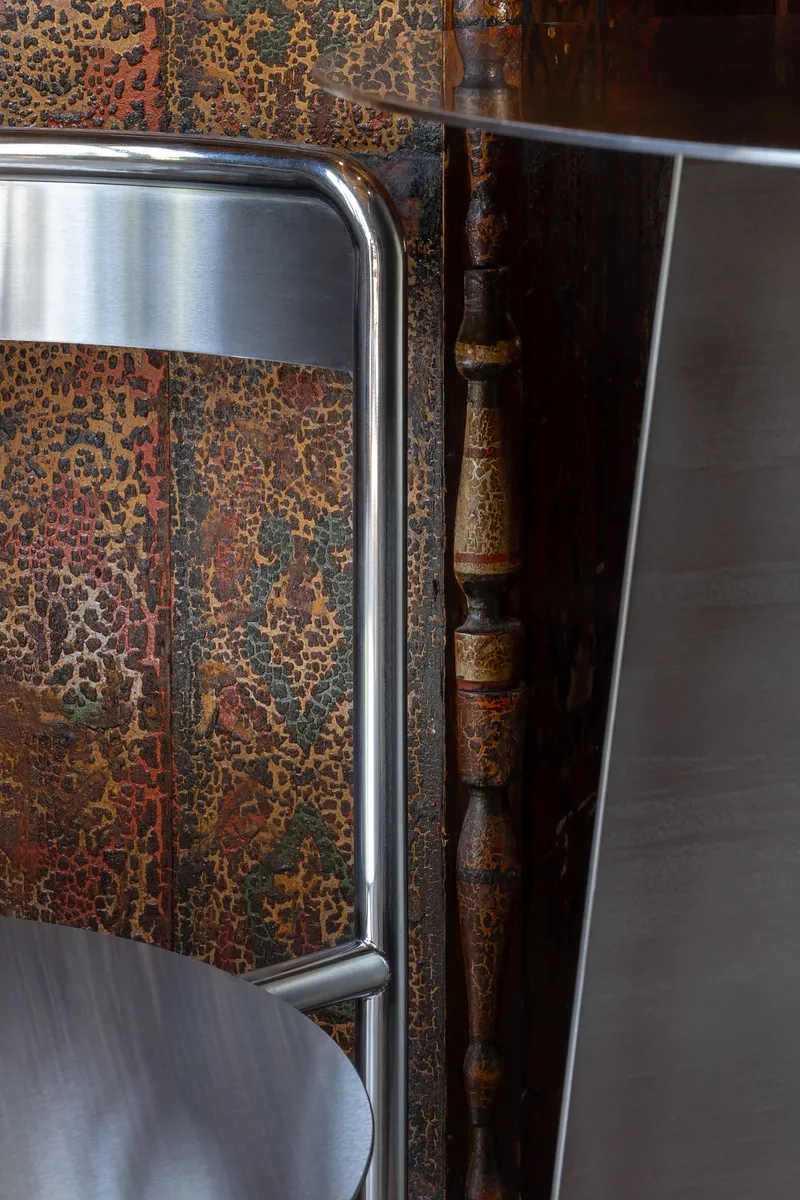
The corridor to the bathroom is the one space where the studio allows itself a moment of exuberance. White tile walls catch pink and blue neon light that shifts as you move, and a motion-blurred figure passing through one of the photographs captures the transitory, almost clubby energy of the passage. It is a deliberate palette cleanser, a decompression chamber between the reverence of the heritage room and the utilitarian needs of a functioning café.
A tubular steel chair back caught against a textured mural wall with an exposed bamboo column rounds out the material inventory. The studio has been disciplined about limiting its toolkit: steel, wood, tile, neon, terrazzo. Nothing more. The restraint makes each material legible and gives the 73 square metres a sense of variety without visual noise.
Furniture as Architecture
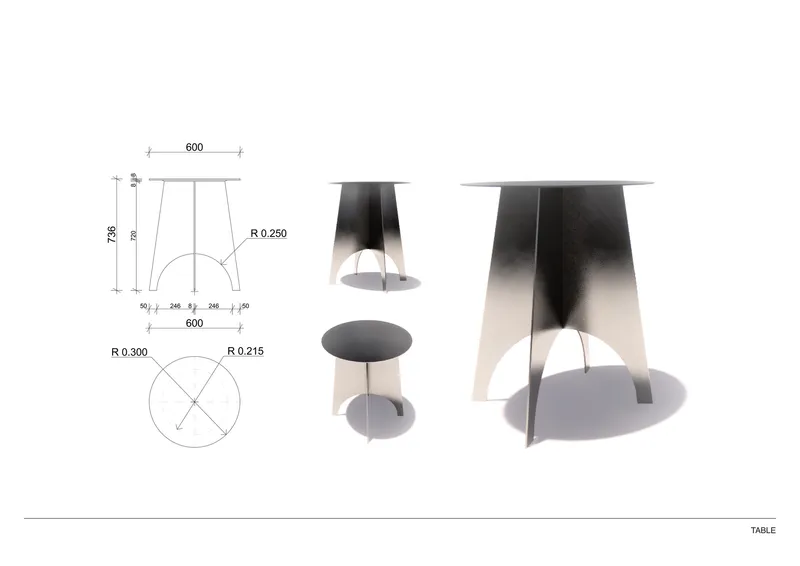
The technical drawing of the round table and curved metal stool reveals how seriously the studio treated furniture as a design problem rather than a procurement decision. The table's base curves in a single sweep to meet the floor, and the circular stool follows the same formal logic. These are custom pieces calibrated to a specific ceiling height and a specific floor finish, and they embody the project's central commitment: that new elements should be precise, lightweight, and removable, authored objects with their own integrity rather than neutral fillers.
Plans and Drawings
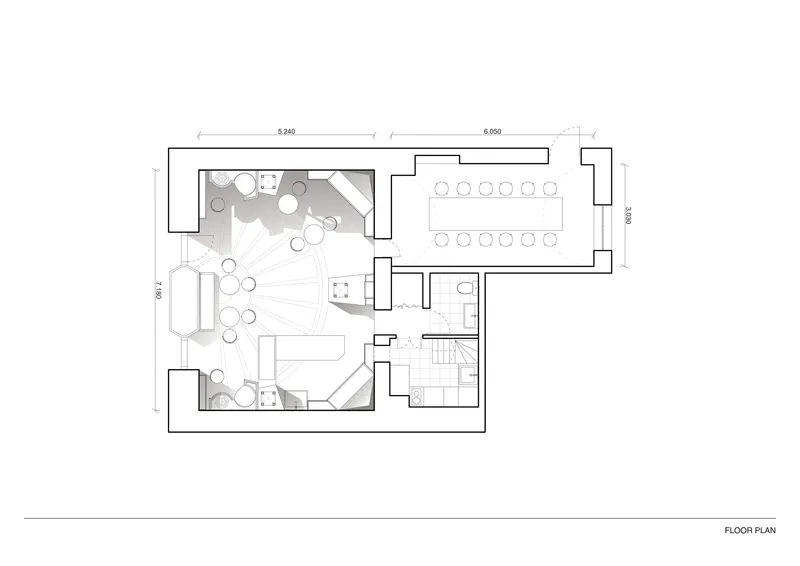
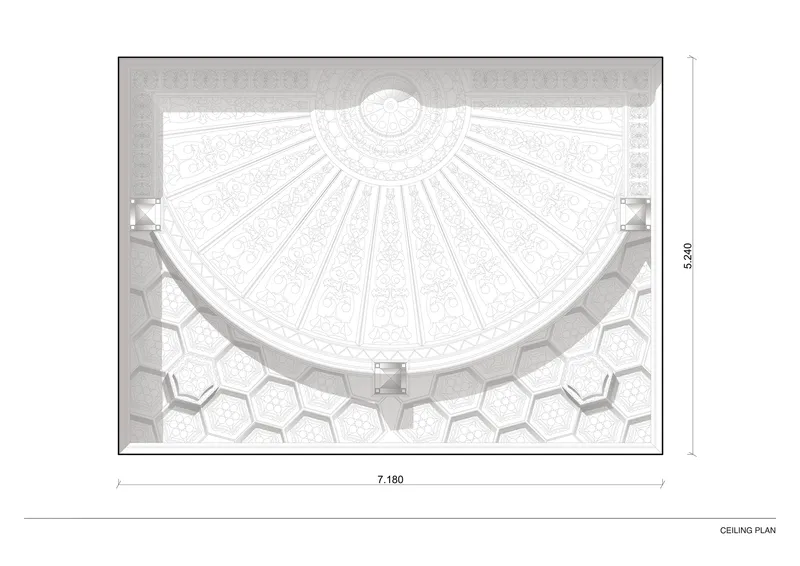
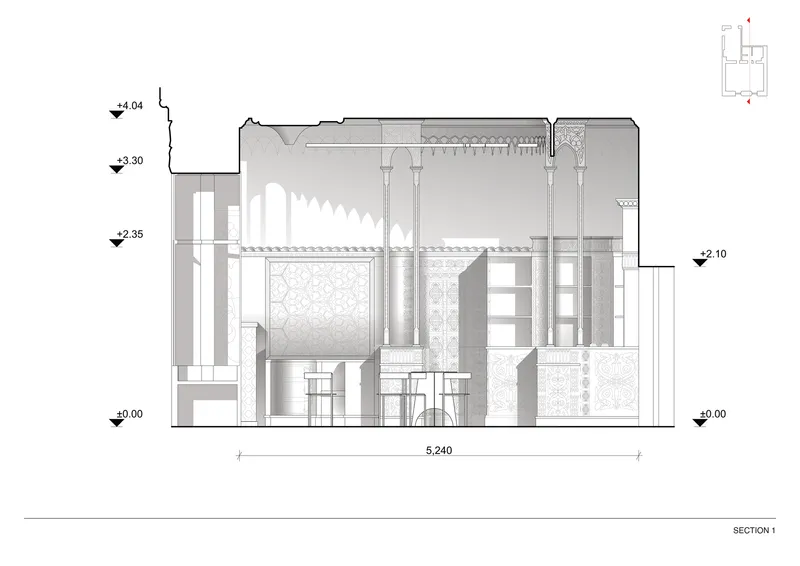
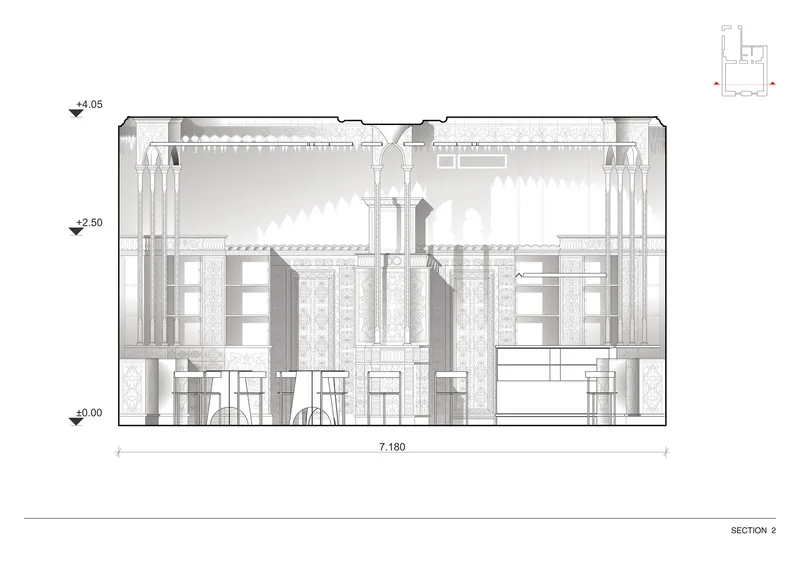
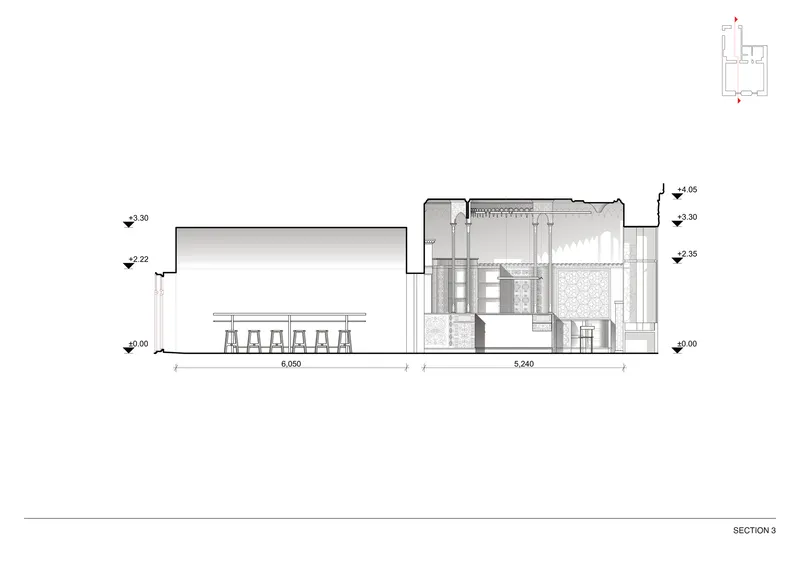
The floor plan confirms just how compact the operation is. Curved seating zones, a conference room, and a central stairwell fit within a footprint that barely exceeds a large apartment. The ceiling plan, with its radiating fan pattern, circular oculus, and hexagonal tile surround, documents the ornamental geometry that the steel furniture was designed to respect. In section, the relationship between the bar counter, the patterned screens, and the double-height volume becomes legible: new insertions hover within the historic shell, never bridging the gap between floor and ceiling in a way that would lock them into the structure.
The symmetrical section through the central ornamental portal and flanking shelving units is especially instructive. It shows how the heritage core is essentially a decorated box, and the studio's strategy was to furnish the box without puncturing it. The bar counter section, with stools on the left and layered interior volumes on the right, illustrates the programmatic density packed into a slender cross-section.
Why This Project Matters
Reversibility is often invoked as a conservation principle and rarely delivered as a spatial experience. Lumen Coffee 1936 manages both. By choosing a single contrasting material, fabricating it off-site, and setting it down without fasteners, snkh studio has produced an interior that is simultaneously a working café, a heritage exhibit, and a prototype for minimal-impact adaptive reuse. The project proves that respecting the past does not require whispering; it requires knowing exactly where to place your voice.
For a city undergoing rapid redevelopment, the lesson is pointed. Yerevan's 1930s interiors are finite and fragile, and the pressure to gut them for contemporary programs is real. snkh studio demonstrates that you can thread a four-program hospitality venue through an irreplaceable room without sacrificing a single carved panel. The stainless steel can leave tomorrow. The wood, oiled and intact, will still be there. That is the most optimistic sentence conservation architecture can write.
Lumen Coffee 1936 by snkh studio (lead architect: Armine Snkhchyan). Located in Yerevan, Armenia, on Mashtots Avenue. 73 m². Completed in 2023. Photography by Daniil Primak.
About the Studio
Share Your Own Work on uni.xyz
If projects like this are the kind of work you want to make, uni.xyz is a place to publish your own, find collaborators, and enter design competitions.




Popular Articles
Popular articles from the community

Wiyoga Nurdiansyah Composes Three Volumes into a Quiet Family Compound in South Jakarta
RJH House splits domestic life across a cube, a cylinder, and a service block, laced together by courtyards and raw concrete.
A.N. Tombazis and K-Studio Bury a Luxury Resort into a Peloponnese Hillside
Mandarin Oriental Costa Navarino scatters 99 earth-sheltered rooms across 140 hectares above the Bay of Navarino in Pilos, Greece.
Terra e Tuma Scatters Four Concrete Pavilions Through the Atlantic Forest in Mairiporã
A fragmented compound of music studio, art studio, chapel, and living quarters preserves every tree on a steep forested hillside near São Paulo.
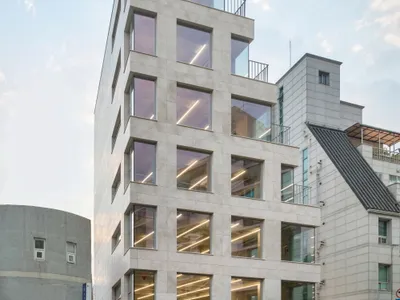
Simplex Architecture Steps a Seoul Mid-Rise Tower to Negotiate Between Low-Rise Commerce and High-Rise Housing
In Seocho-dong, a gridded stone tower of terraces and sunken courtyards mediates between two radically different urban scales.


Similar Reads
You might also enjoy these articles

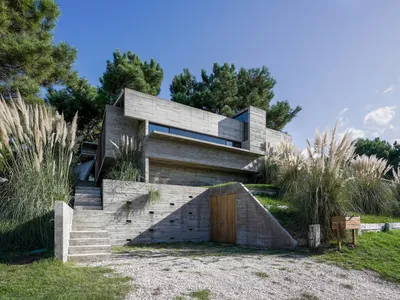
Loma House by Besonias Almeida Arquitectos: Modern Coastal Living in Costa Esmeralda
Loma House by Besonias Almeida Arquitectos is a modern coastal home in Costa Esmeralda, blending exposed concrete, wood, and natural dunes.
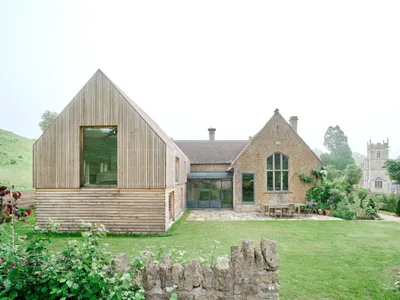
“Pitcombe’s Old School House Renovation by Bindloss Dawes: Blending Heritage and Contemporary Design”
Bindloss Dawes transformed Pitcombe’s 19th-century Somerset schoolhouse with a sustainable timber extension, blending historic charm, contemporary design, and panoramic countryside views.
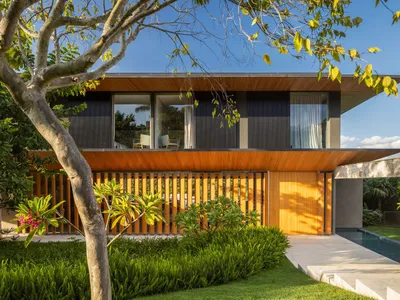
F3 Residence by Belluzzo Martinhão Arquitetos: Contemporary Luxury in São Paulo’s Countryside
F3 Residence in São Paulo blends contemporary design, natural materials, multigenerational living, hillside integration, expansive glass, infinity pool, and seamless indoor-outdoor flow.
Private Villa in Ubud by BAMM ARCHITECTS: Contemporary Design Amidst Bali’s Jungle
Private Villa in Ubud blends contemporary design with tropical landscape, featuring open-air pavilion, stone and wood materials, suspended master bedroom, and jungle pool views.


Explore Commercial Buildings Competitions
Discover active competitions in this discipline




The Global Benchmark for Architecture Dissertation Awards

The Global Benchmark for Graduation Excellence


Bring back Drive In's
Comments (0)
Please login or sign up to add comments
No comments yet. Be the first to comment!