

POLYGOON Architectuur Stacks 22 Social Housing Units to Liberate a Public Square in Diksmuide
Two compact brick volumes on perforated concrete plinths turn a former football field into a communal garden neighborhood in West Flanders.


Diksmuide is a small city in West Flanders that was almost entirely destroyed during the First World War. A century later, its last significant infill site, a former football field at the entrance to the Tuinwijk subdivision, has become the setting for a quietly radical experiment in social housing. POLYGOON Architectuur was tasked with placing 22 affordable apartments, bicycle storage, and car parking on a relatively tight plot, surrounded by a traditional neighborhood of two-storey houses with gardens. Instead of mimicking that suburban grain, the architects chose to go vertical and compact, freeing the ground plane for something the neighborhood lacked: a genuine public square.
What makes the project worth studying is not the stacking itself but the series of disciplined decisions that follow from it. Two brick volumes sit on concrete plinths punched with circular openings. The cars disappear behind those plinths, the open space between the buildings becomes communal territory, and the facades refuse to telegraph the repetitive plans behind them. Every apartment gets private outdoor space and light from multiple orientations, yet the collective reading from the street is of a composed, civic pair of buildings rather than an apartment block. In a landscape still dominated by the Belgian obsession with the detached house, that distinction matters.
Two Volumes, One Courtyard
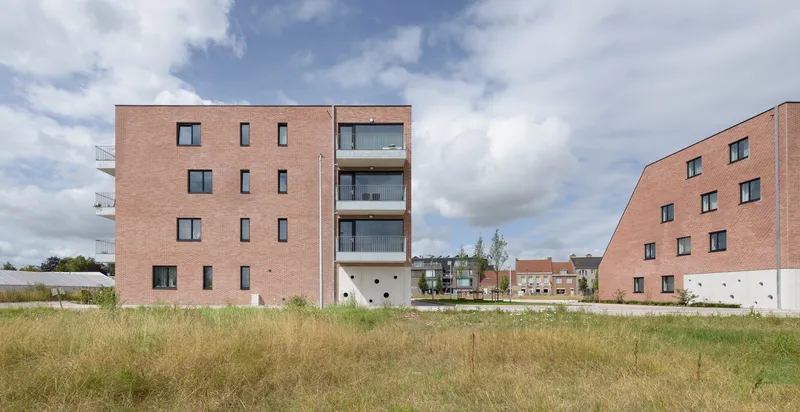
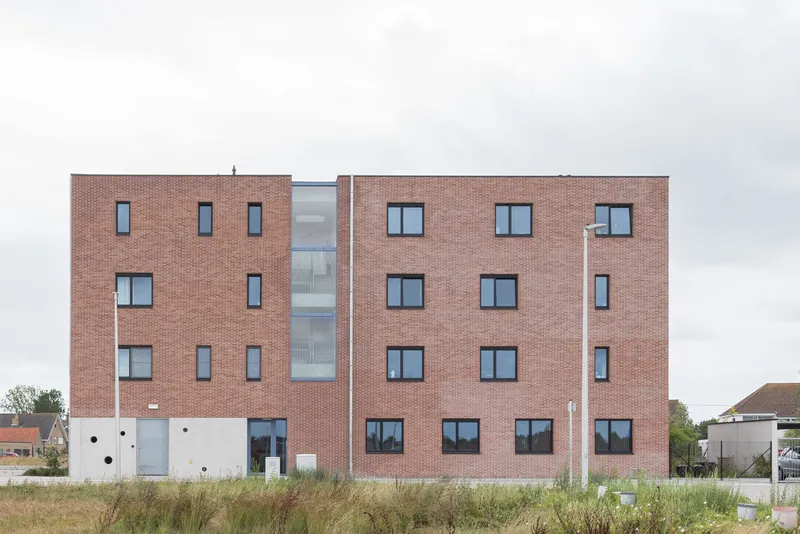
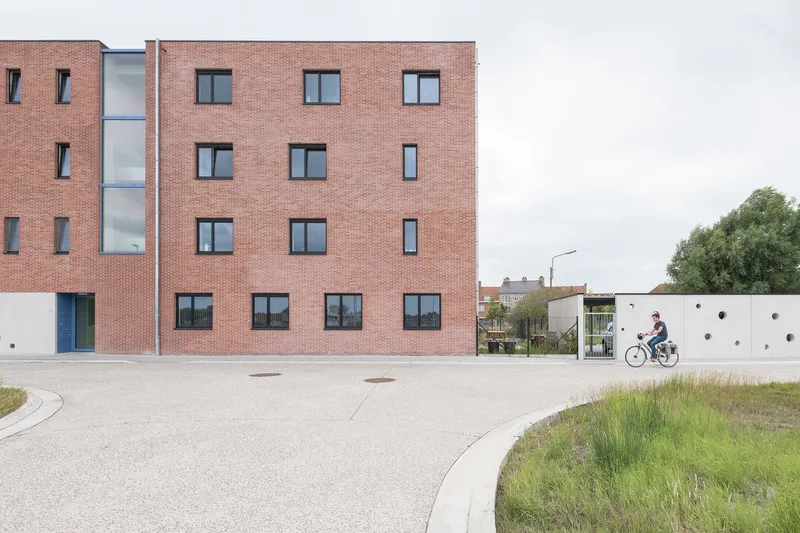
The site plan is disarmingly simple. Two elongated volumes face each other across a courtyard of dry summer grasses and paved paths, establishing a clear public threshold at the entrance to the wider Tuinwijk development. By pulling the buildings apart and concentrating density upward, POLYGOON converts what could have been a claustrophobic plot into an open, permeable space that belongs to the neighborhood as much as to the residents. A cyclist rolls past a white perforated wall on the street side; on the courtyard side, the ground is soft and informal, planted rather than paved.
The glazed circulation core visible in the rear elevation is more than a stairwell. It acts as a hinge between the two volumes, allowing daylight to pass through the building and signaling the entrance to residents and visitors alike. The transparency is deliberate: social housing in Belgium has often been designed to minimize visibility, to tuck residents away. Here, the entrance intersects the building volume and is proudly exposed.
Brickwork That Refuses to Repeat
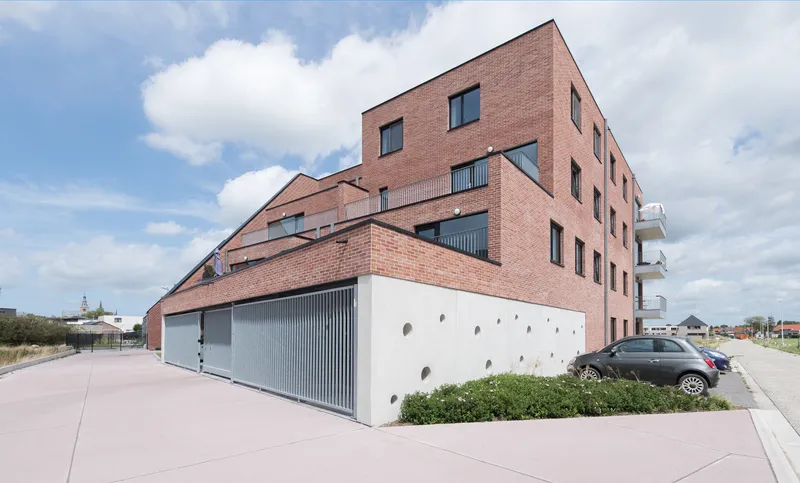
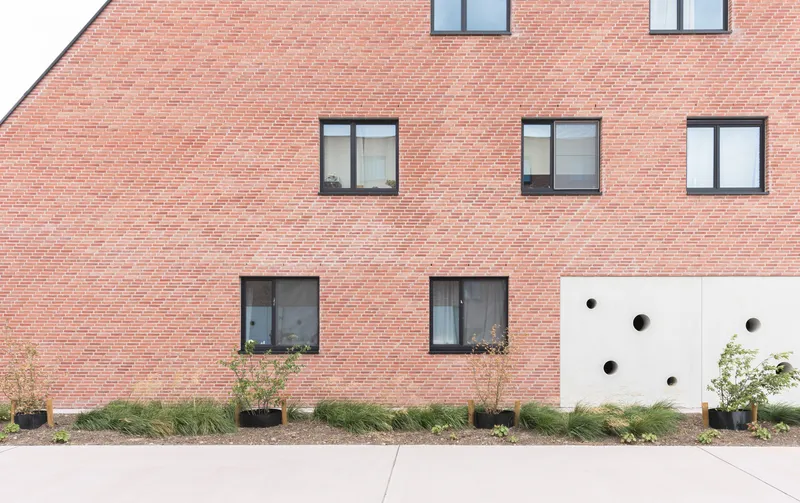
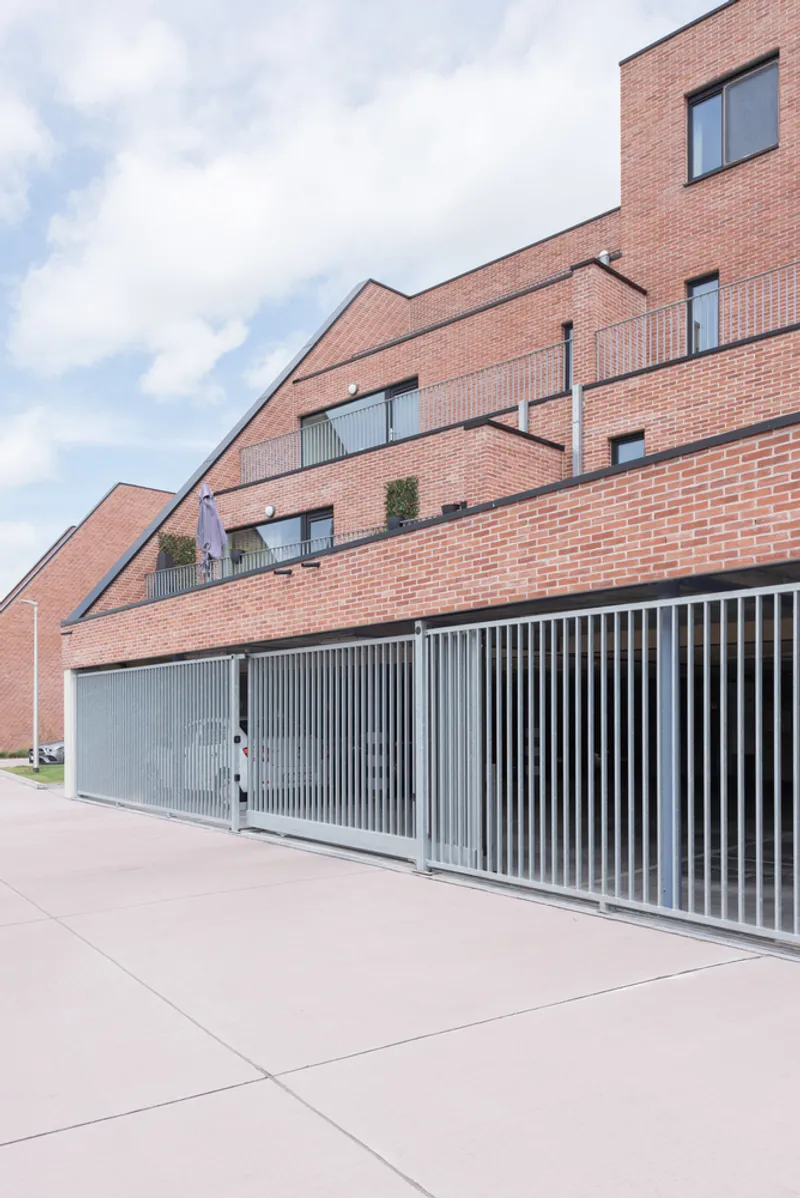
The facades are the project's most visible argument against monotony. Many of the 22 apartments share identical floor plans, but the window compositions are deliberately non-repetitive. Openings shift in size, position, and grouping from one bay to the next, producing facades that feel composed rather than generated. POLYGOON describes this as a "freer and less disciplined" approach, one that declines to make the exterior a literal diagram of the interior. The result reads as a single architectural gesture rather than a stack of identical cells.
Two brick bonding patterns reinforce the volumetric logic. Where the roof edge is flat, the brickwork is laid in a standard stretcher bond. Where the roof line angles, a raking stretcher bond follows the geometry, so the masonry pattern telegraphs the building's silhouette even at close range. The stepped massing along the courtyard side produces a series of inset balconies that break down the scale and give each terrace a sense of enclosure without relying on partition walls.
The Perforated Plinth
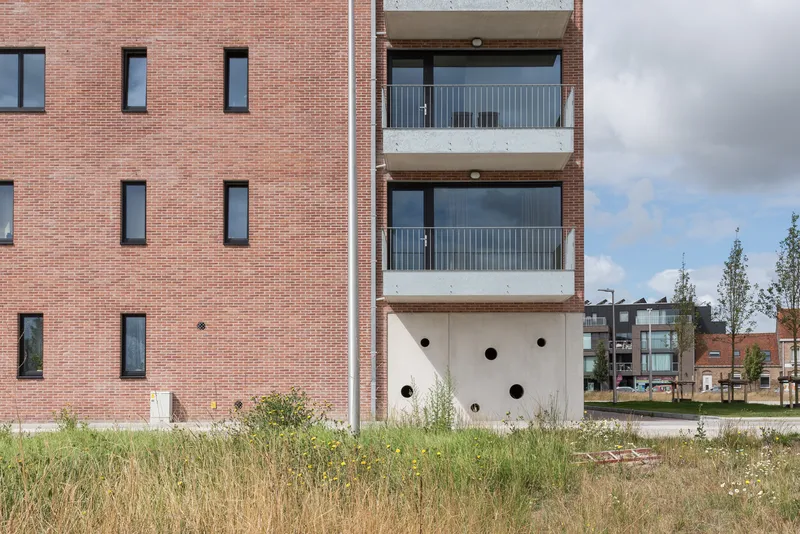
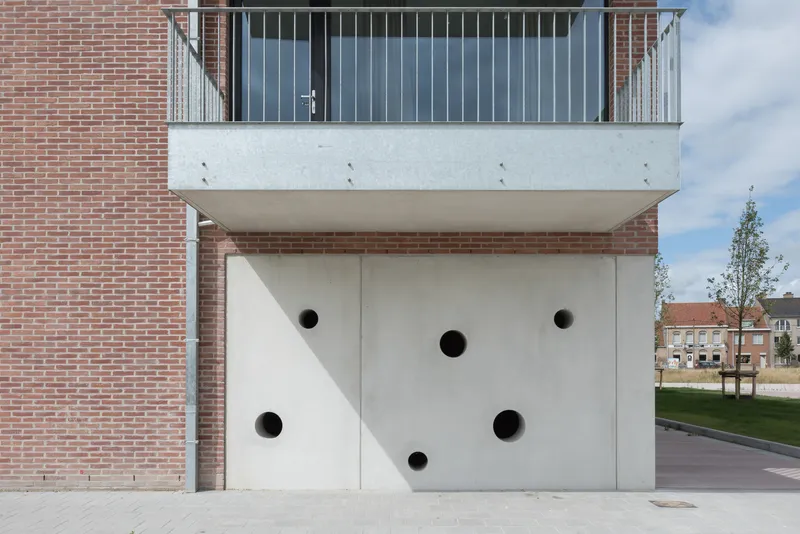

Parking is the perennial villain of suburban housing. Garage doors and carports consume street frontage and deaden the pedestrian experience. POLYGOON's solution is to bury the cars behind a concrete plinth perforated with large circular openings. The circles serve a double purpose: they ventilate the parking area naturally and they transform what would be a blind retaining wall into a playful, almost Pop Art screen. Flowering shrubs grow up against the white surface, softening the edge further.
The circular apertures also frame small, unexpected views. Through one, you catch a glimpse of a parked car, a reminder that the infrastructure is present but deliberately subordinated. Above the plinth, cantilevered balconies with vertical metal railings extend the living space outward, and the contrast between the heavy concrete base and the lighter brick volumes above gives the buildings a clear tectonic hierarchy: ground is public and robust; upper floors are domestic and articulated.
Private Outdoor Life at Every Level
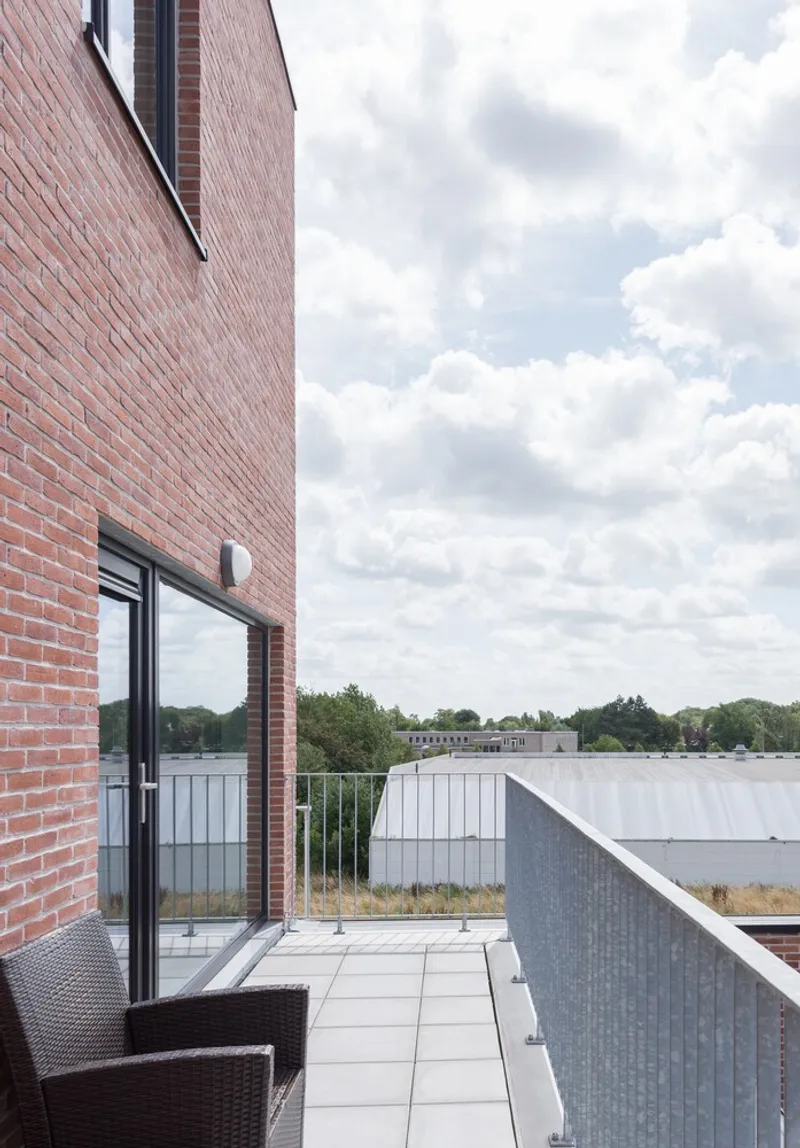
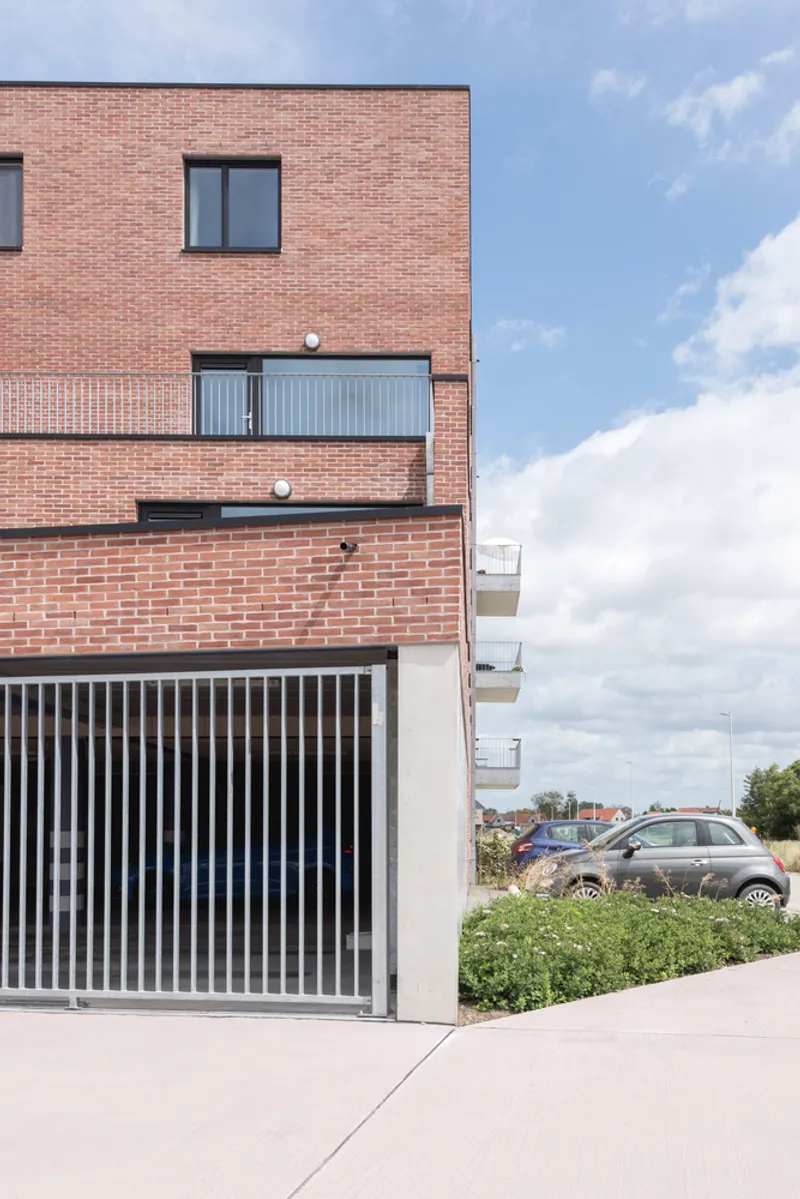
Each apartment extends across several facades, which means every unit receives light from more than one direction and gains access to a private terrace or balcony. The terraces are generous enough to furnish: light grey pavers, metal railings, views out over neighboring rooftops. For social housing, this level of outdoor amenity is rare and signals a commitment to resident well-being that goes beyond floor area calculations.
Vertical-slat metal screens at the base of certain volumes provide semi-transparent boundaries between public and semi-private zones. They filter light and views without creating hard barriers, maintaining the project's ethos of openness while giving ground-floor residents a degree of privacy. The material palette stays restrained: brick, concrete, metal, timber. Nothing competes; everything defers to the spatial idea.
Interiors That Connect Back to the Courtyard
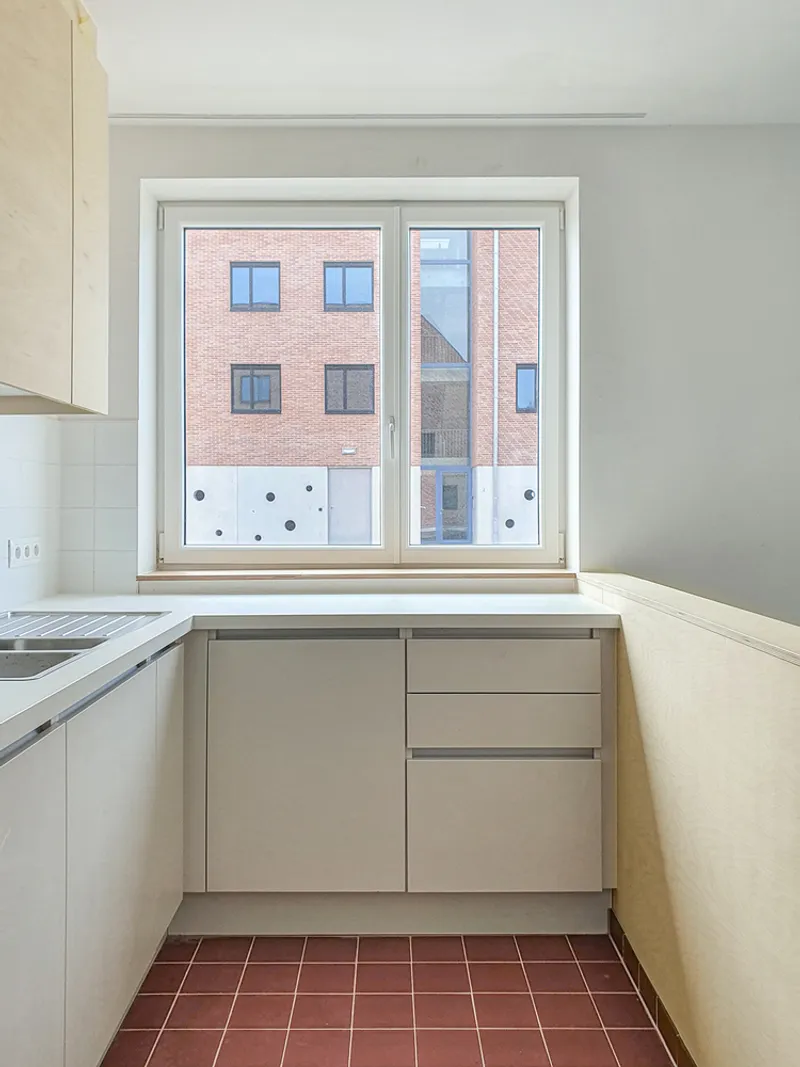
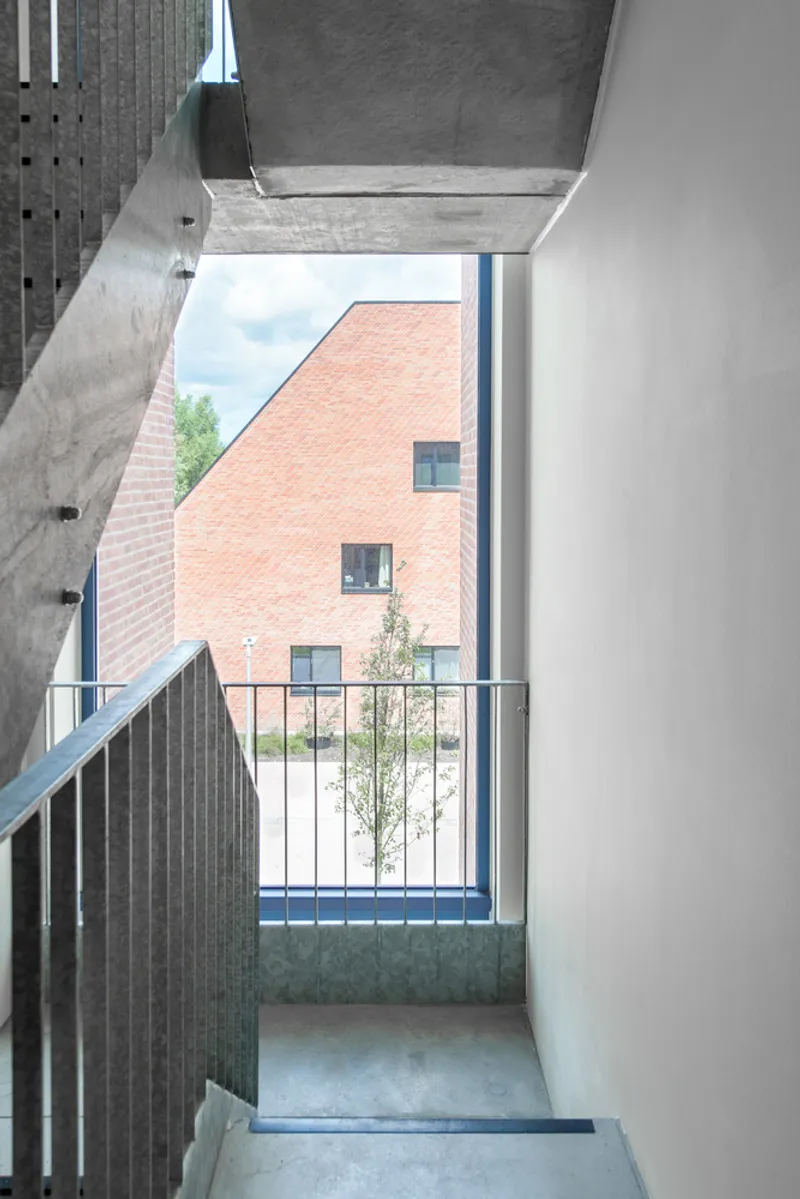
The interior photographs reveal a warm, understated palette of light wood cabinetry, terracotta floor tiles, and red-brown timber accents. A kitchen window frames the brick courtyard facade opposite, collapsing the distance between inside and outside in a single glance. The pigeon blue window joinery, visible from the exterior, reads as a subtle color accent from within, tying the domestic interior to the building's public identity.
The stairwell is treated with the same care as the apartments. A slatted timber guard lines the landing, and the door opens directly onto a view of the pink-toned courtyard brick. Circulation spaces in social housing are often afterthoughts, stripped to minimum code requirements. Here, they are moments of architectural pleasure, where material warmth and framed views reward the daily act of arriving home.
Plans and Drawings
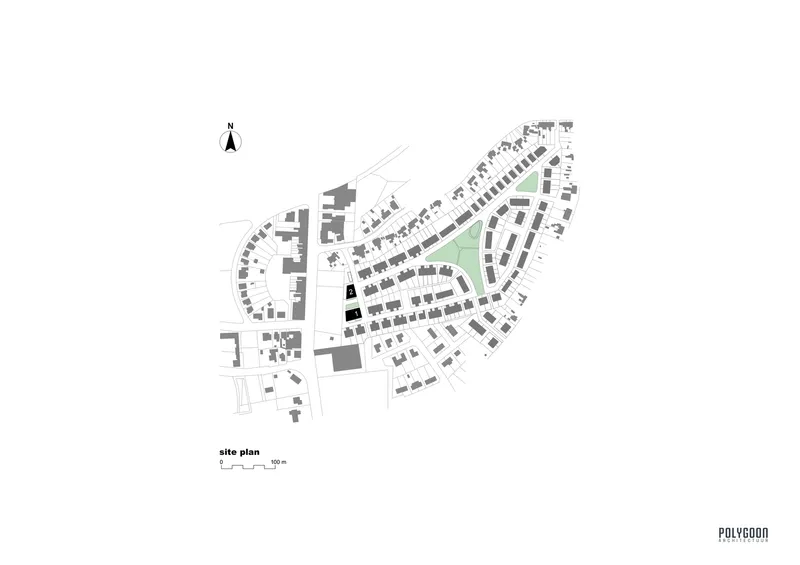
The site plan confirms the project's urban strategy. The two volumes curve gently to follow the street alignment, creating a widening courtyard between them that opens toward a green park to the south. Parking is contained within the building footprint. The surrounding street grid of the Tuinwijk subdivision is visible: rows of detached and semi-detached houses, each on its own plot. Against that fragmented pattern, POLYGOON's paired volumes read as a deliberate act of consolidation, gathering density in order to give space back.
Why This Project Matters
Belgium builds more single-family houses per capita than almost any country in Western Europe, and its social housing stock has long suffered from a perception problem: utilitarian blocks at the edge of town, under-maintained and under-loved. POLYGOON's project in Diksmuide challenges that template on every front. It places social housing at the entrance to a new neighborhood, not its periphery. It stacks compact apartments to generate a public square instead of consuming the plot with sprawl. And it invests in facade composition, material craft, and outdoor space at a level typically reserved for market-rate development.
The real lesson here is proportional. Twenty-two apartments, a courtyard, and a handful of perforated concrete circles do not constitute a manifesto. But they demonstrate that density, affordability, and civic generosity can coexist on a single site when the architect refuses to treat any of them as mutually exclusive. In a region where the last infill plots are disappearing, that refusal is worth more than any stylistic innovation.
Social and Stacked Living (Tuinwijk Diksmuide) by POLYGOON Architectuur. Diksmuide, Belgium. 2,880 square meters. Completed 2022. Photography by Jessy van der Werff.
About the Studio
Share Your Own Work on uni.xyz
If projects like this are the kind of work you want to make, uni.xyz is a place to publish your own, find collaborators, and enter design competitions.



Popular Articles
Popular articles from the community


The Ocean Hive: Sustainable Architecture for a Self-Sufficient Civilization at Sea
The Ocean Hive imagines sustainable architecture at sea, where modular habitats, algae, wave power and ocean waste sustain a growing colony.

The Earth Pod: 3D Printed Homes for Resilient Refugee Communities
The Earth Pod reimagines refugee housing through 3D printed homes made from clay, combining resilience, self-sufficiency, and rapid shelter.

AL-JANNAH: Sustainable Architecture and Permaculture for Afghan Widows
AL-JANNAH uses sustainable architecture and permaculture to create resilient oasis of housing, learning, work and renewal for Afghan widows.

The Musturak Paradise: Senior Living Architecture for a Connected Future in Temara, Morocco
The Musturak Paradise reimagines senior living architecture in Temara via private homes, social spaces, culture, community, and shared care.


Similar Reads
You might also enjoy these articles


Hodi-Mandai Geram
Project Function: Preservation and revitalization of the Intangible heritage and socio-spatial identity of the Hodi by Housing, Cultural Memory Center, Sacred Grove, landscape, local tourism economy


Olio Towers: A Mid-Rise for Performers That Fuses Housing, Rehearsal, and Stage
Located blocks from Houston's Theater District, this modular tower stacks living units around a central performance atrium.

Oasis: Modular Green Housing Carved into Dhaka's Urban Fabric
A shortlisted Plugin Housing entry reclaims unauthorized settlements in Dhaka with stepped concrete volumes, green roofs, and ventilation-driven design.

Black Hole: A Floating Megastructure for the Post-Physical Era
Emiliano Mazzarotto envisions a spherical, self-scaling arena where e-sports, digital hotels, and holographic stadiums replace traditional public space.

Explore Stackable Competitions
Discover active competitions in this discipline



Challenge to reimagine the Iron Throne


Photograph architecture without architects


Illustrate the lost glory of Angkor Wat - Render Challenge


Design challenge to reuse E-waste
Comments (0)
Please login or sign up to add comments
No comments yet. Be the first to comment!