
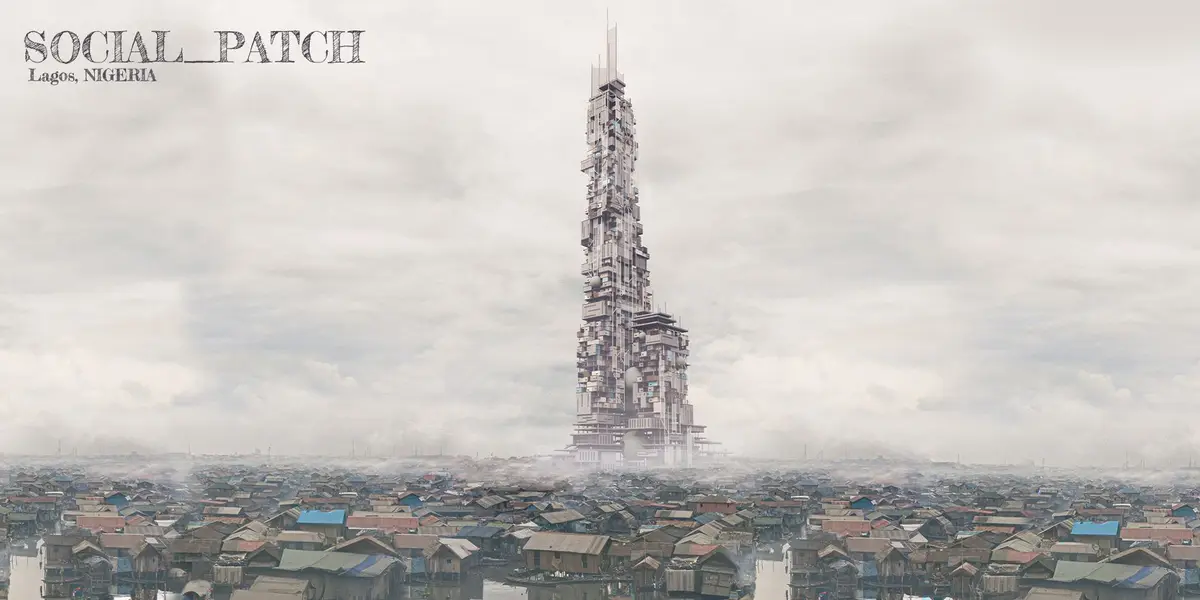
SOCIAL_PATCH: A Vertical Village Prototype for Lagos's Floating Slum of Makoko
A modular skyscraper integrates fog-harvesting facades, communal workshops, and self-built expansion into a replicable urban scaffold for informal settleme


What if a skyscraper could behave less like a sealed tower and more like a neighborhood, one where residents shape their own spaces over time, harvest water from fog, and carry their craft traditions upward floor by floor? SOCIAL_PATCH proposes exactly that: a vertical urban village for Makoko, Lagos's waterborne informal settlement of roughly 25 million inhabitants in the wider metro area. Rather than replacing the organic spatial logic of one of Africa's fastest-growing cities, the project scaffolds it, stacking communal kitchens, timber workshops, education centers, and flexible living platforms into a mixed-use high-rise that treats informality as an asset, not a problem to erase.
Designed by Kutlu Bal, Umut Aslan, and Emre Özcan, SOCIAL_PATCH was selected as an Editor's Choice entry in the CityScraper competition on uni.xyz. The brief asked for visionary skyscraper concepts, and this team responded with a site-specific answer rooted in Makoko's waterscape, where over 40% of Lagos State is covered by wetlands and much of the land sits less than 15 meters above sea level. The result is a prototype that could be replicated across informal settlements facing water scarcity, infrastructure gaps, and community displacement.
From Pen Sketches to Programmatic Logic
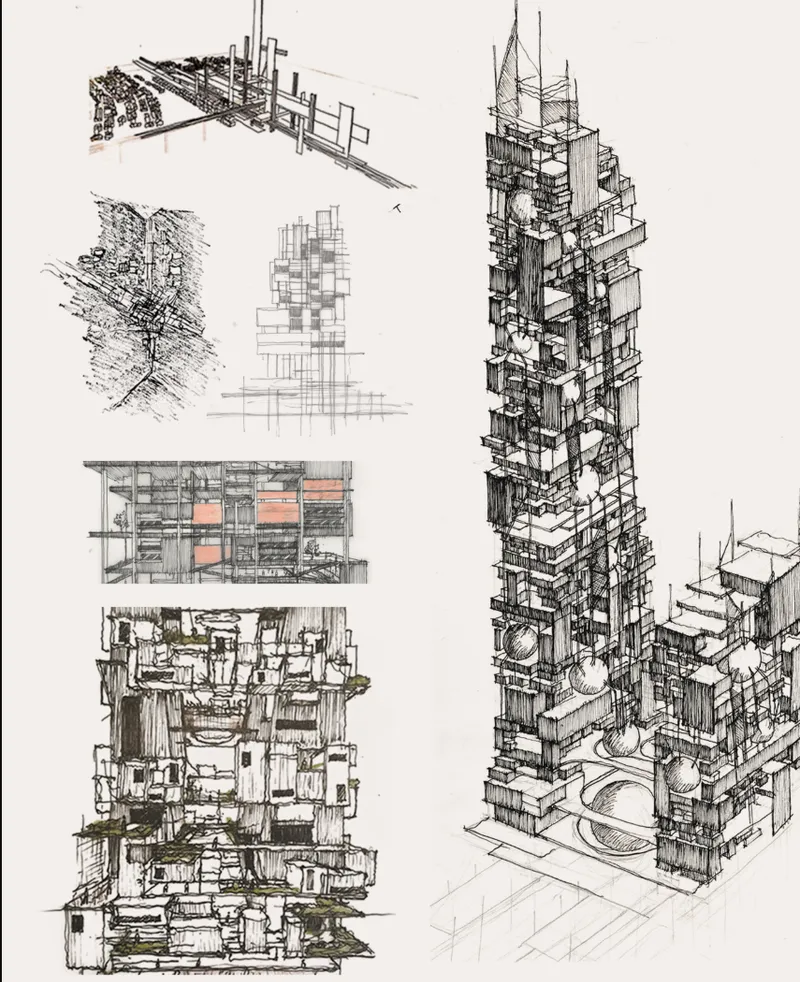
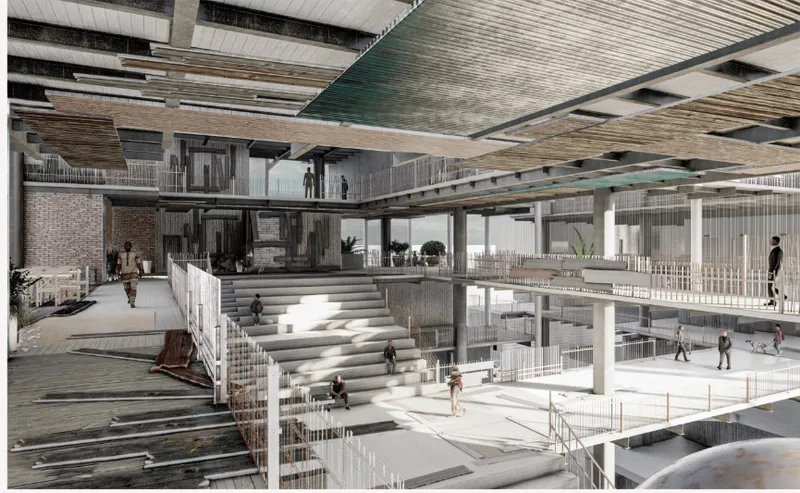
Early sketch studies reveal the project's conceptual DNA: layered platforms held within a structural framework that reads more as scaffolding than as finished enclosure. The pen-and-ink drawings show how the team conceived the tower as a series of inhabited terraces rather than a stack of identical floor plates. Wide, terraced steps connect levels inside a multi-story atrium, visible in the interior rendering where figures move freely between floors. The atrium acts as a vertical public square, channeling daylight deep into the building's core while providing the kind of open, negotiable space that characterizes Makoko's street life at ground level.
Clustered Modules and a Shared Atrium Core
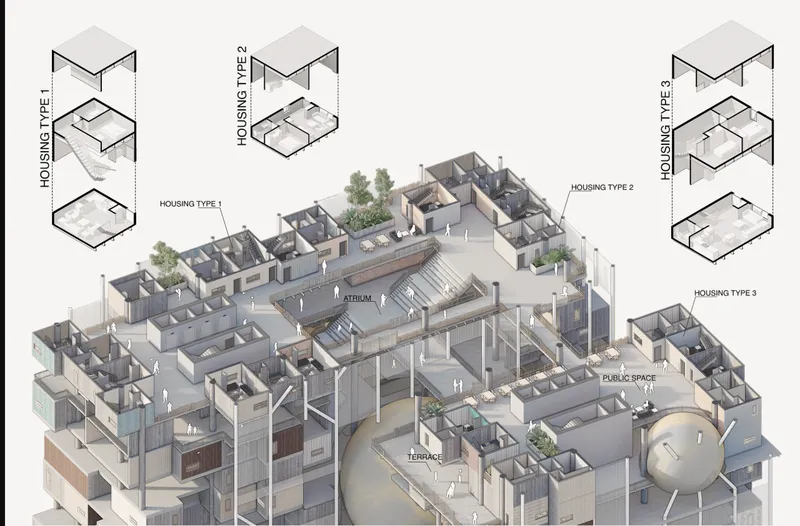
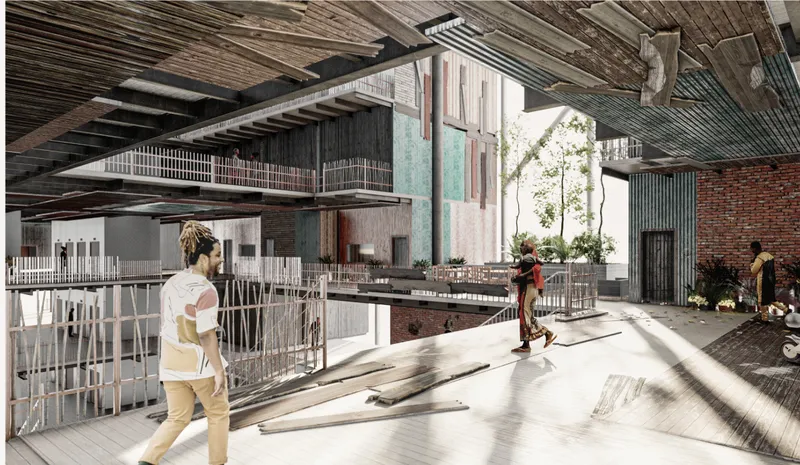
An exploded axonometric breaks the building into its constituent parts: housing unit types stacked above shared atrium and terrace levels, with each cluster reflecting Makoko's dynamic spatial patterns. The modular composition allows for participatory construction methods. Residents can expand their units within the structural grid over time, much as families in the existing settlement incrementally build outward on stilts. The team explicitly proposes that people shape their spaces within the structure, preserving cultural practices vertically.
Interior circulation spaces reinforce this ethos. Exposed timber ceiling beams span sunlit corridors where figures walk through generous, naturally ventilated passages. The material palette, wood, recycled plastic, and reclaimed metal sheeting, aligns with local construction skills and available resources. By building on existing craft techniques, the project avoids the imported-technology trap that undermines so many proposals for informal settlements, keeping construction costs low and circular building strategies at the forefront.
Ground-Level Generosity and Urban Reconnection
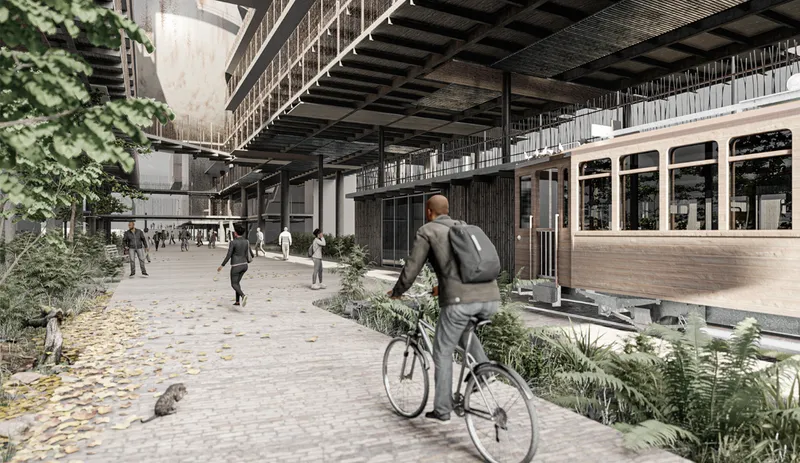
At the base of the tower, cantilevered upper floors create a sheltered public plaza with planted beds and room for cyclists to pass through. The ground plane refuses to be a lobby; it is a continuation of the surrounding streetscape. At the urban scale, the proposal includes an elevated light rail system reconnecting Makoko with Lagos Island, addressing the settlement's chronic isolation from economic opportunity. The plaza rendering suggests how the building meets its context: not as a fortress but as a porous threshold that blurs the boundary between tower and neighborhood.
Fog Harvesting and Vertical Water Infrastructure
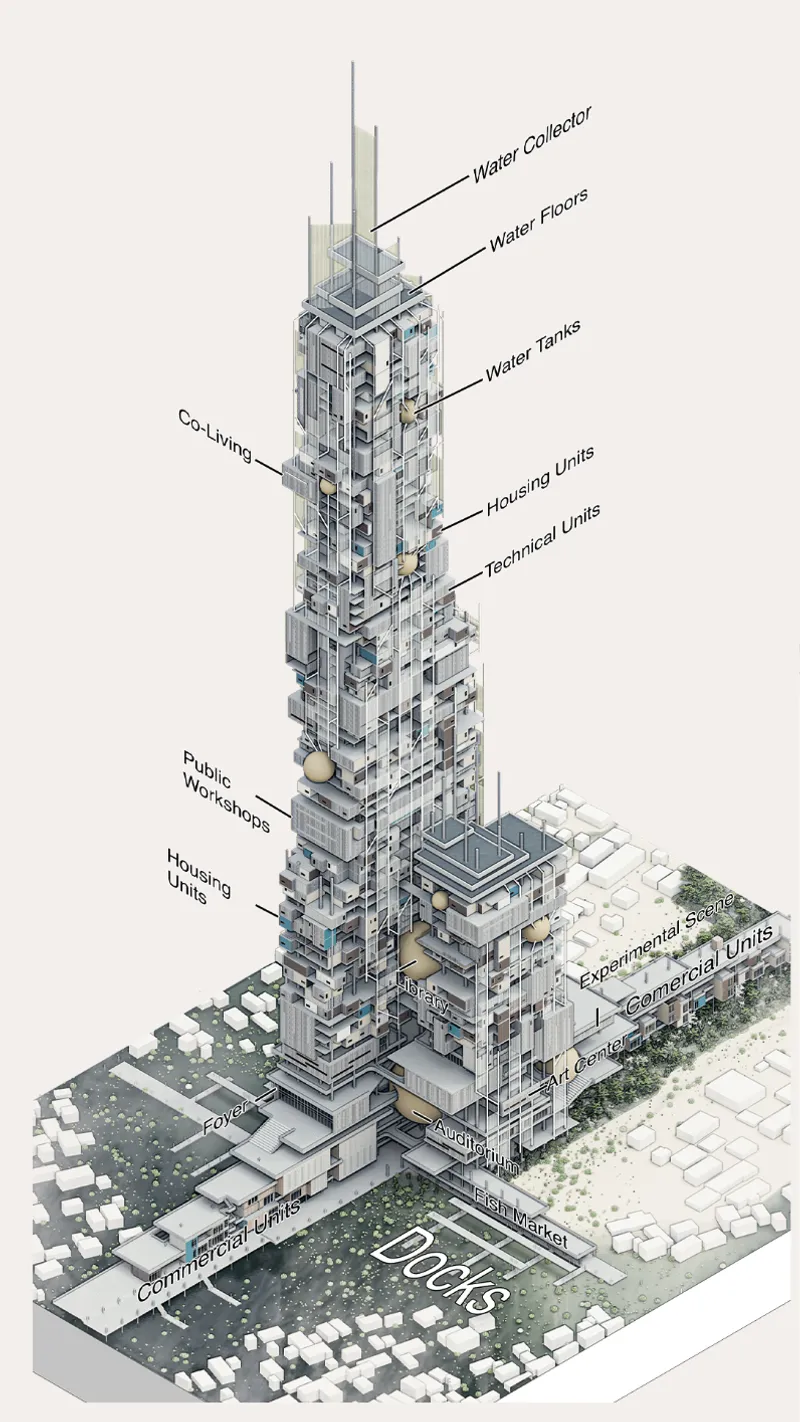
An annotated axonometric maps the full vertical program, from housing units at the upper levels down through communal workshops, education centers, and, critically, water collection systems integrated into the façade. Fog-harvesting mesh technology embedded in the building skin can collect up to 15 liters of water per square meter daily, a direct response to the community's severe lack of clean water access despite being surrounded by wetlands. These collectors double as shading devices for public terraces and green voids, turning an environmental liability into a resource.
The water strategy is not a side note; it is the project's infrastructural backbone. In a context where water pollution has devastated public health, the ability to generate potable water from the building envelope transforms the skyscraper from a housing solution into a piece of civic infrastructure. Combined with the recycled-material construction approach, it positions SOCIAL_PATCH as a genuinely circular proposition for a community that already practices resourcefulness out of necessity.
Why This Project Matters
The majority of visionary skyscraper proposals treat informality as a backdrop for formal intervention. SOCIAL_PATCH inverts that relationship. By designing a structure that accommodates self-determined expansion, uses locally sourced and recycled materials, and embeds critical infrastructure like water harvesting directly into the architectural fabric, the team demonstrates that density and community agency are not mutually exclusive. The building is conceived as a replicable prototype, a scalable scaffold that could adapt to other informal settlements facing similar pressures of water scarcity, infrastructure deficit, and forced displacement.
What gives the project its edge is the refusal to romanticize or erase. Makoko's craft traditions, spatial improvisation, and communal routines are not obstacles to be designed around; they are the program. Bal, Aslan, and Özcan have proposed a skyscraper that is less a monument and more a framework for collective life, one that grows with its inhabitants rather than dictating how they should live. For a competition that asked designers to reimagine the tall building, that is a genuinely radical answer.
View the Full Project
About the Designers
Designers: Kutlu Bal, Umut Aslan, Emre Özcan
Enter a Design Competition on uni.xyz
uni.xyz runs architecture and design competitions year-round that reward proposals with spatial conviction and real site intelligence.
Project credits: SOCIAL_PATCH by Kutlu Bal, Umut Aslan, Emre Özcan CityScraper (uni.xyz).


Popular Articles
Popular articles from the community


FCC Arquitectura Expands a Portuguese Granite House with a Board-Marked Concrete Wing
In Portugal, JV House pairs a cleaned-up whitewashed and granite dwelling with a timber-shuttered concrete extension, courtyards and a garden pool.

longwave studio Reorganizes a 112 m² Tainan Apartment Around the Daily Routines of a Family and Two Cats
In Tainan, Taiwan, birch plywood, rust-red furniture and a freestanding plaster wall link arrival, storage, work and family life in one apartment.

LT2A and OPEN Architectes Thread a Brick and Glass High School Through a Wooded Belgian Campus
In Braine-l'Alleud, a 3,000 m² wing for Collège Cardinal Mercier pairs pale brick with a glazed colonnade, deferring to a small chapel and a dense wood.

Architekt Andreas Gruber Scatters 23 Dark Timber Chalets Across a South Tyrolean Forest Edge
In Molini di Tures, Amonti Chalets breaks a resort into a hamlet of gabled timber houses, with parking, storage and services pushed into the slope.

Similar Reads
You might also enjoy these articles


Vereda Arquitetos Renovates a 40-Square-Meter Apartment Inside Niemeyer's Copan Building
A compact unit in São Paulo's most iconic residential tower gets a material overhaul that pairs exposed concrete with bold blue Formica.

Shakur's House: Exposed Brick as an Interior Organiser in a 168 m² Mashhad Residence
Brick moves indoors in this Mashhad residence, where masonry walls, glass partitions and teal planes sequence a compact home without closing it off.

Day and Night Park: A Time-Based Urban Newsstand in Beijing
A temporary urban newsstand in Beijing blending travel, light, and reading through poetic colors, compact form, and community-focused design.

Modernist Patio Renovation in El Masnou, Barcelona by Oliver Segura Arquitectura + Cebrià Arquitectura
Modernist patio renovation blending tradition and innovation with a movable pool, leveled floors, and Catalan materials in El Masnou.

Explore Public Building Competitions
Discover active competitions in this discipline

Challenge to design locus for the upliftment of human rights

Design challenge to reuse E-waste
Comments (0)
Please login or sign up to add comments
No comments yet. Be the first to comment!