
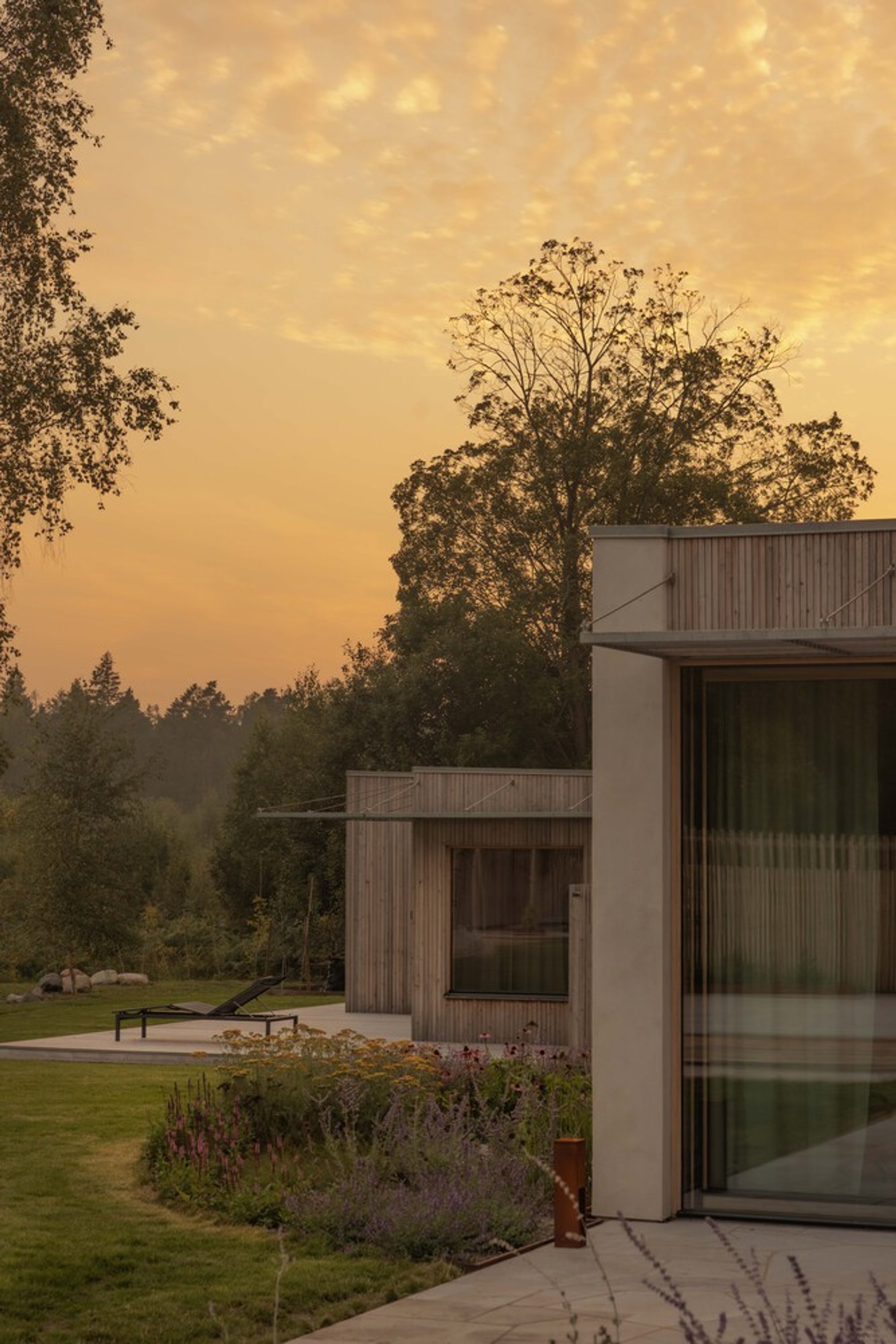
Johan Sundberg Scatters a Family Retreat Across a Forest Glade on Gotland
Sommarhus E uses intersecting timber and plaster volumes to frame courtyards, terraces, and pine canopy views on Sweden's limestone island.

On the Swedish island of Gotland, south of the medieval town of Visby, a clearing in the pine forest holds a house that refuses to announce itself. Sommarhus E, designed by Johan Sundberg arkitektur, is a 280 square metre summer residence composed of several single-storey volumes that splay outward from a skylit kitchen core. A separate guest apartment sits to the east, linked by a winding path rather than a corridor. The result is not one building but a loose constellation: each wing claims a compass direction, frames a terrace, or shelters a courtyard, and the gaps between them let the forest re-enter the composition.
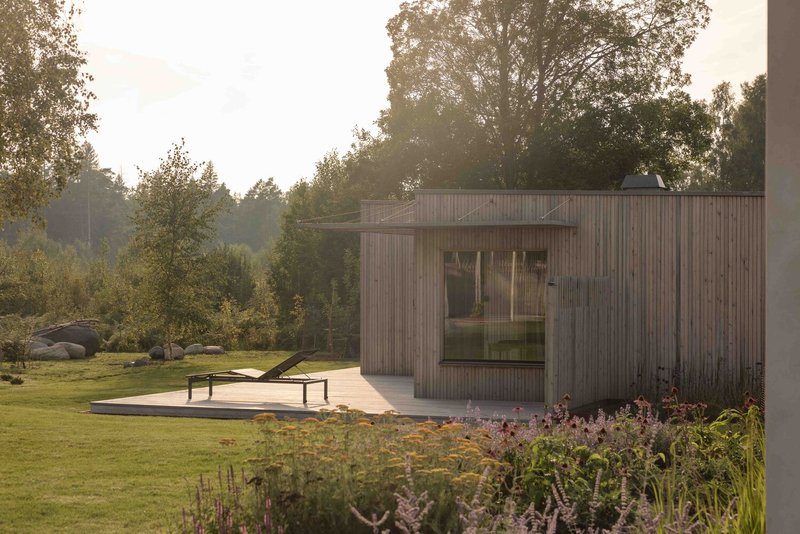
What makes the project genuinely interesting is its refusal to treat materiality as decoration. Every surface shift corresponds to a shift in intimacy. Outward-facing walls wear textured plaster and carry few openings, presenting a quiet, almost fortified face to the road and neighbours. Garden-facing walls switch to vertical larch panels with generous glazing, dissolving the boundary between room and clearing. The house reads differently depending on which side you approach from, and that duality is the whole point: privacy on one face, openness on the other, calibrated by material rather than by plan alone.
Two Faces: Plaster Meets Timber
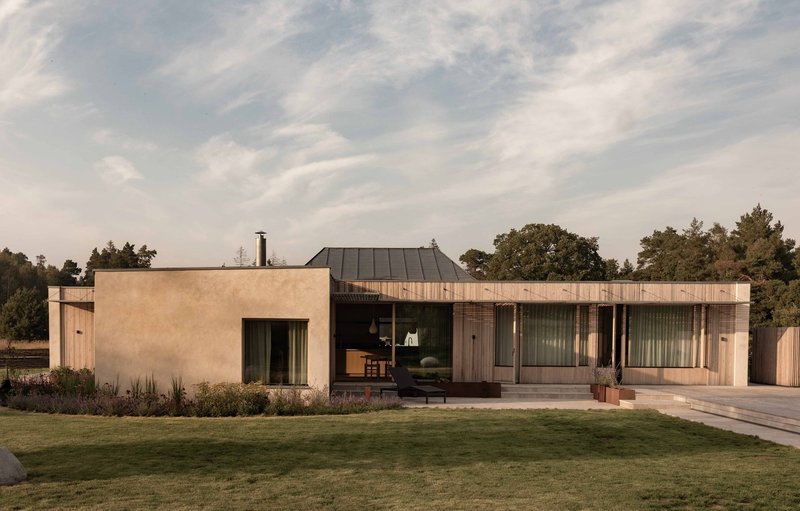
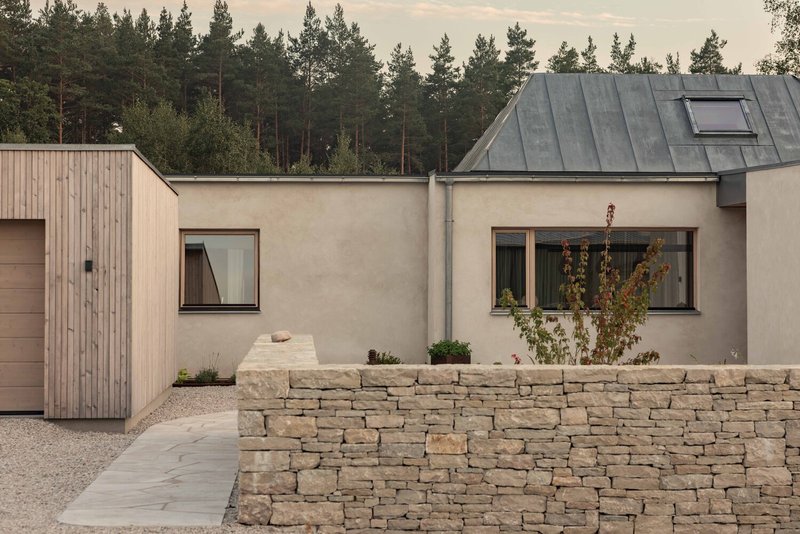
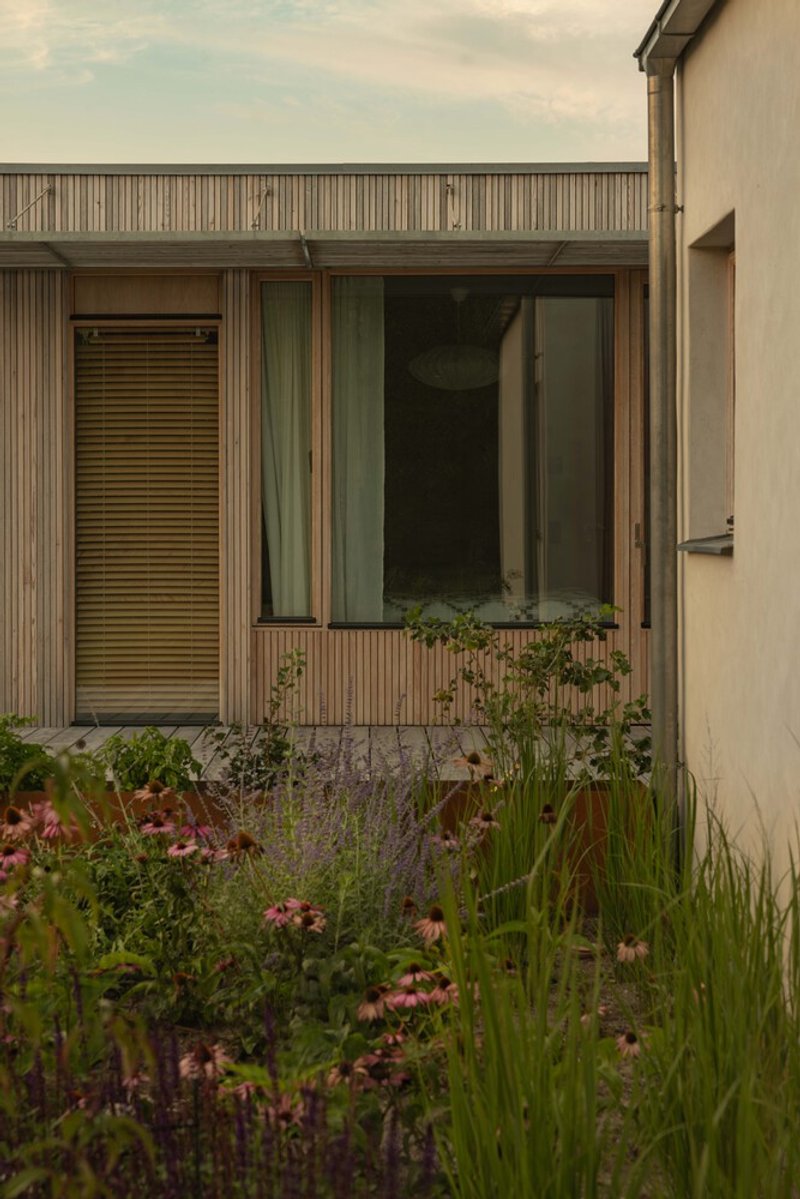
Sundberg's dual-skin strategy is visible the moment you circle the building. The stucco elevations, pale and largely blind, absorb the grey Gotland sky and give nothing away. Walk around to the garden side and the mood flips: narrow vertical larch boards, silver-toning slowly in the salt air, wrap the walls between floor-to-ceiling glass panels. Sliding timber shutters add a third register, letting occupants modulate exactly how much of the forest they want to let in. The standing seam metal roof sits low across all volumes, tying the varied cladding into a single silhouette that barely rises above the treeline.
The material palette draws almost entirely from the island itself. Slow-grown Gotland pine appears as narrow facade slats, limestone quarried locally paves terraces and interior floors, and lime-washed brick surfaces up in places where extra thermal mass helps. None of these choices feel nostalgic; they feel specific, which is a more useful thing.
Courtyards and the Space Between Volumes
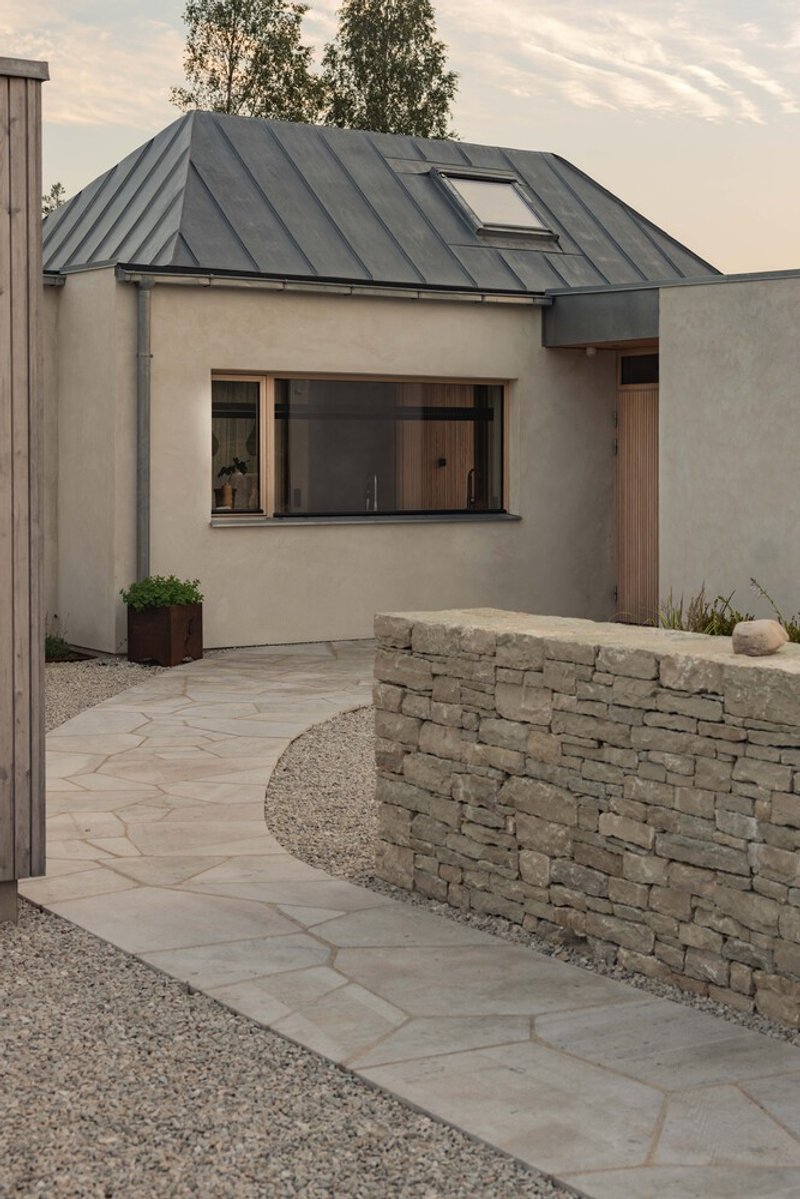
The real architecture here is arguably not in the rooms but in the gaps. Children's rooms and the living room project from opposite corners of the central kitchen volume, and the angles between them define a semi-enclosed courtyard that catches afternoon sun while blocking the prevailing wind. Stacked limestone retaining walls terrace the ground gently, absorbing the slight slope of the site and providing informal seating edges. The courtyard paving is deliberately irregular, an echo of Gotland's own rough stone ground.
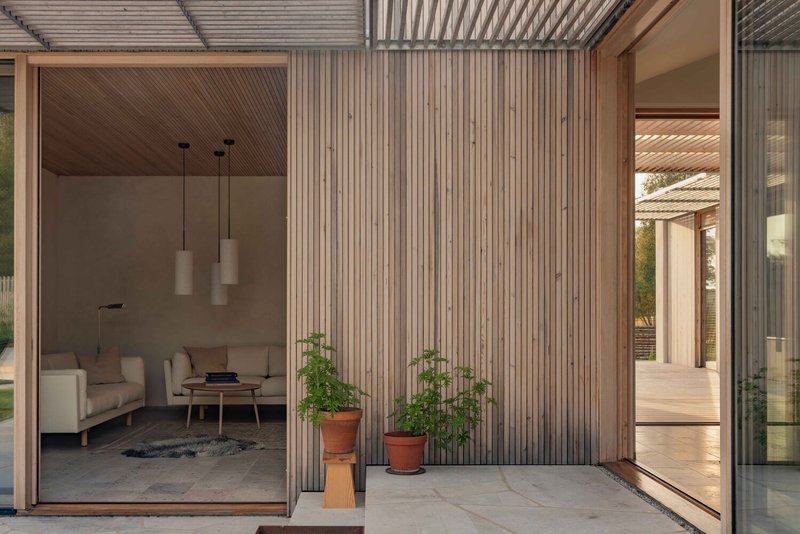
A covered terrace lined with vertical timber slats acts as a threshold zone between full enclosure and open sky. Potted plants and a simple bench occupy this in-between space, which functions less as a porch and more as an outdoor room with a slatted ceiling. It is the kind of space that only makes sense in a climate where summer light is abundant but warmth is not guaranteed, where shelter from wind matters as much as shelter from rain.
The Skylit Kitchen as Social Core
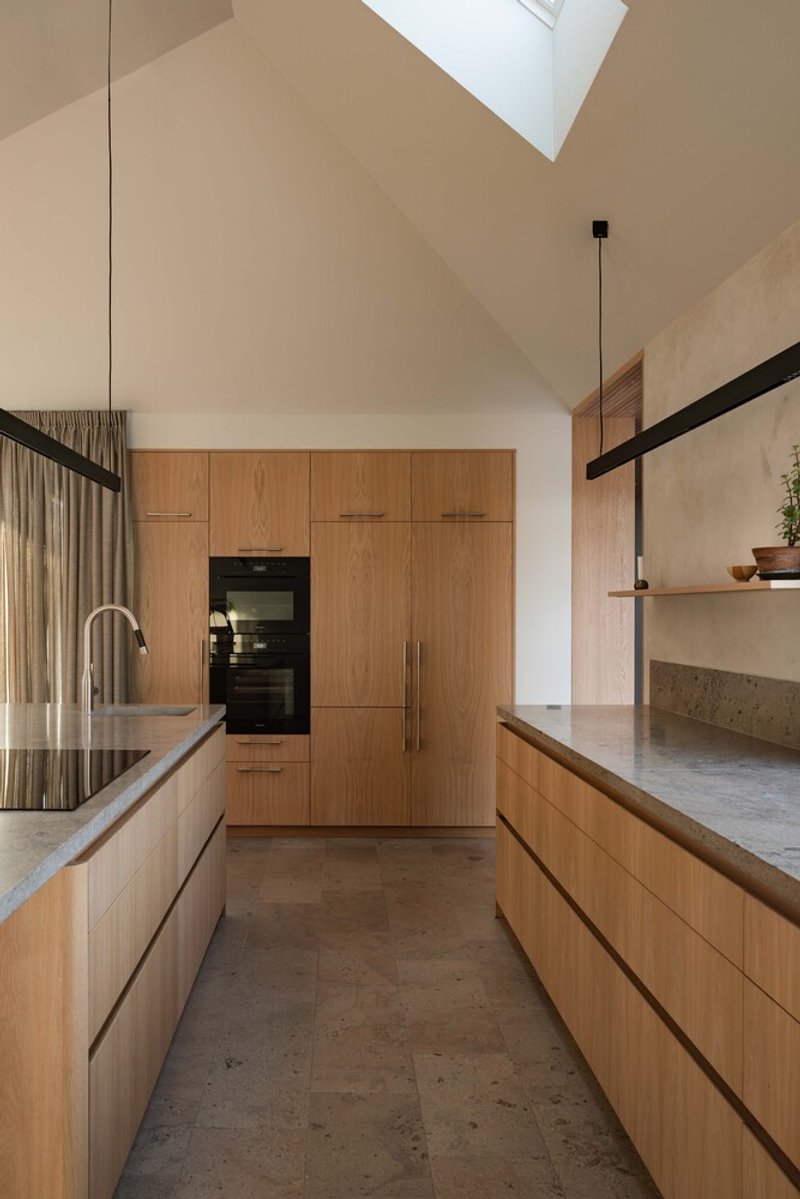
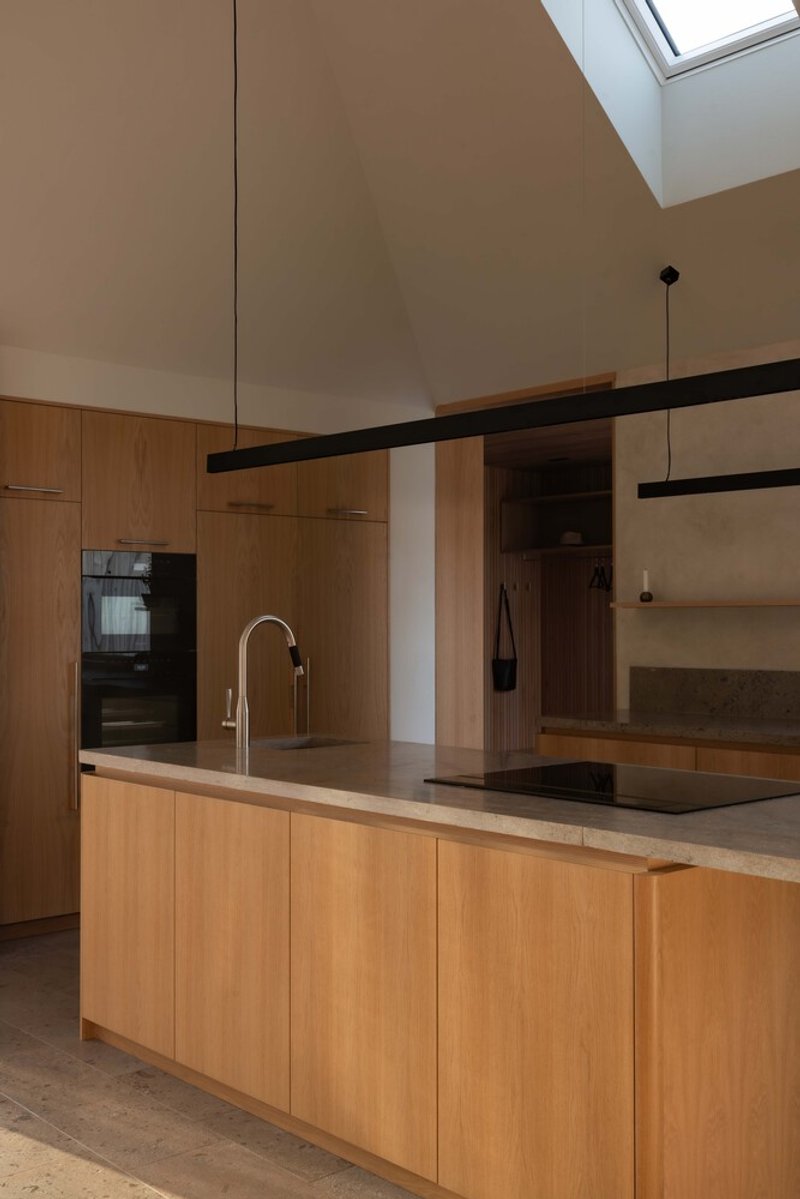
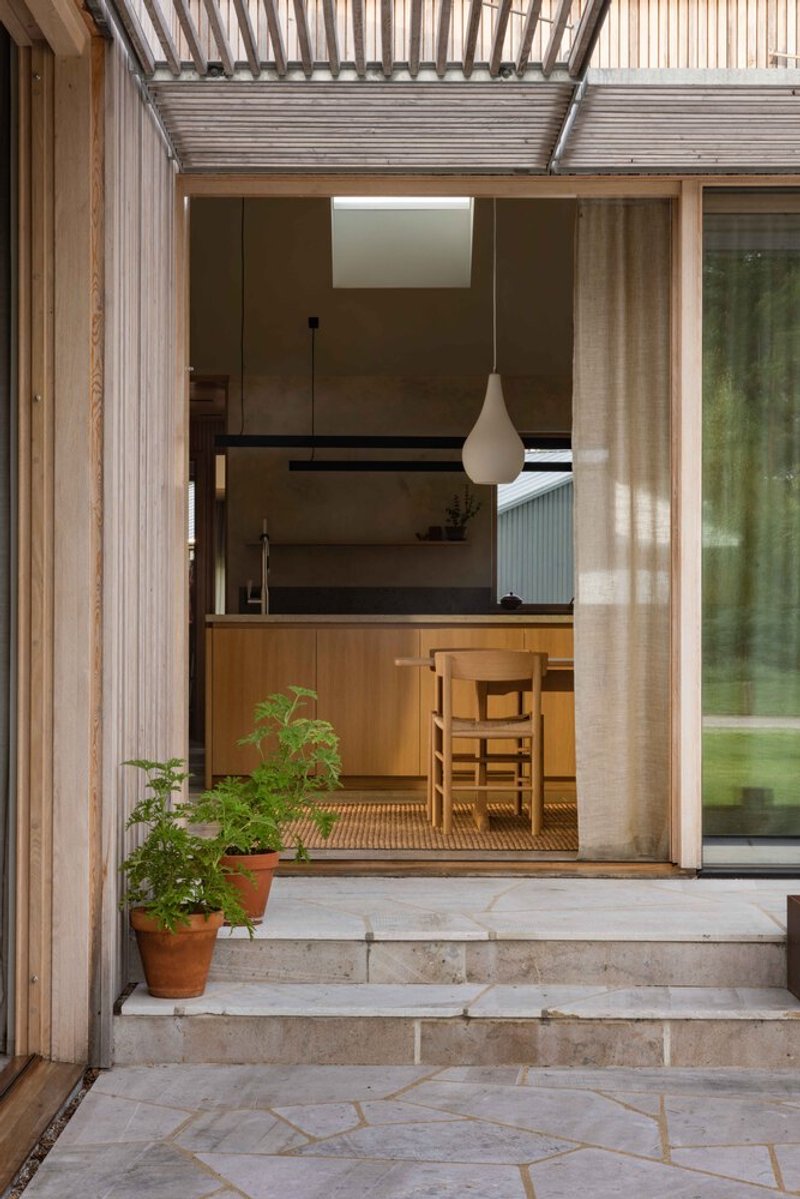
Sundberg places the kitchen and dining area at the geometric and social centre of the plan, then pushes its roof above the surrounding volumes so that a long skylight floods the space with overhead light. The vaulted ceiling, clad in oak treated with white pigmented oil, amplifies and softens that light simultaneously. Stone countertops sit on timber cabinetry with a grain pattern so restrained it borders on monolithic. The effect is warm but not cosy, substantial but not heavy.
From this elevated kitchen core, the living room drops down by a few steps toward the garden, reachable through a large sliding glass door. The section change is subtle but it does real work: it separates cooking from lounging without a wall, and it frames the garden view as something you descend toward, lending it a slight sense of occasion. It is a move borrowed from mid-century Scandinavian houses, where a sunken living room was standard practice, but here it feels earned by the terrain rather than by stylistic allegiance.
Interior Thresholds and Filtered Light
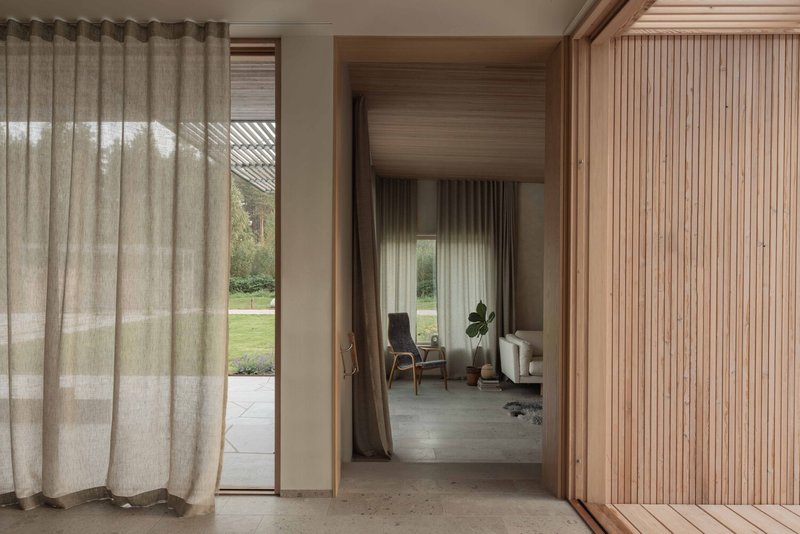
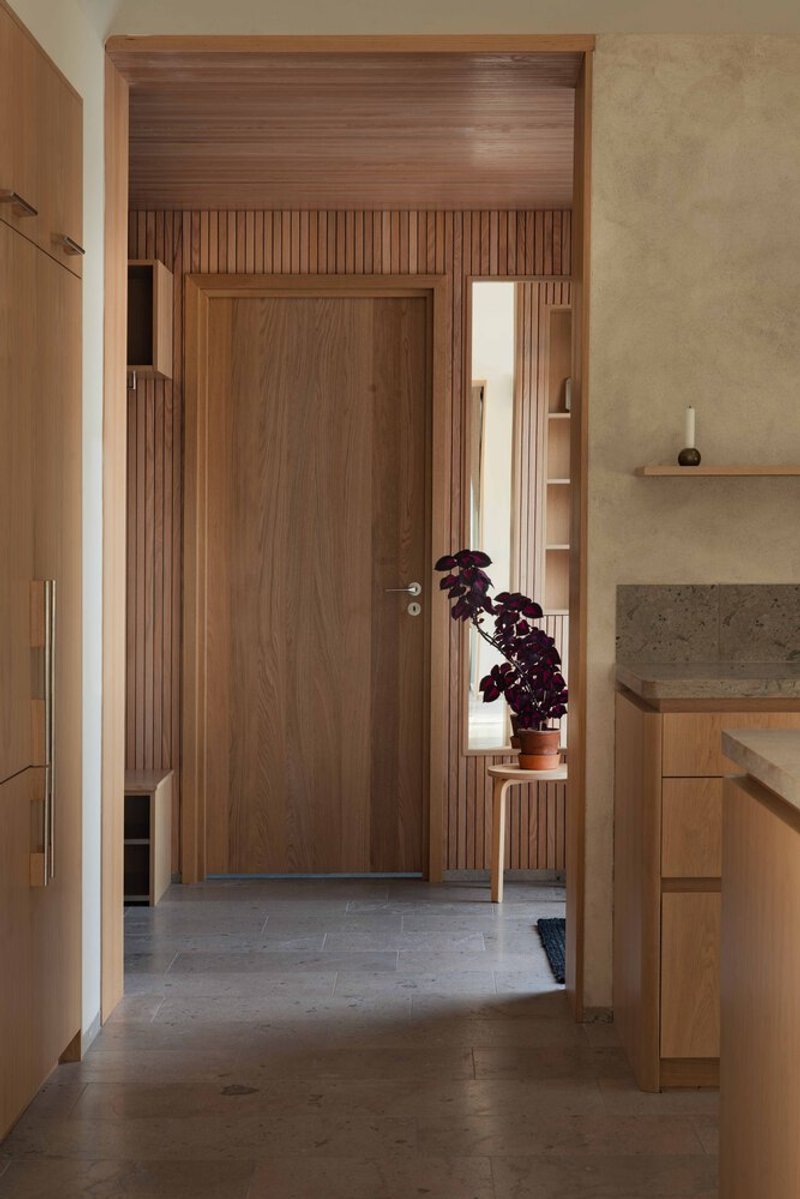
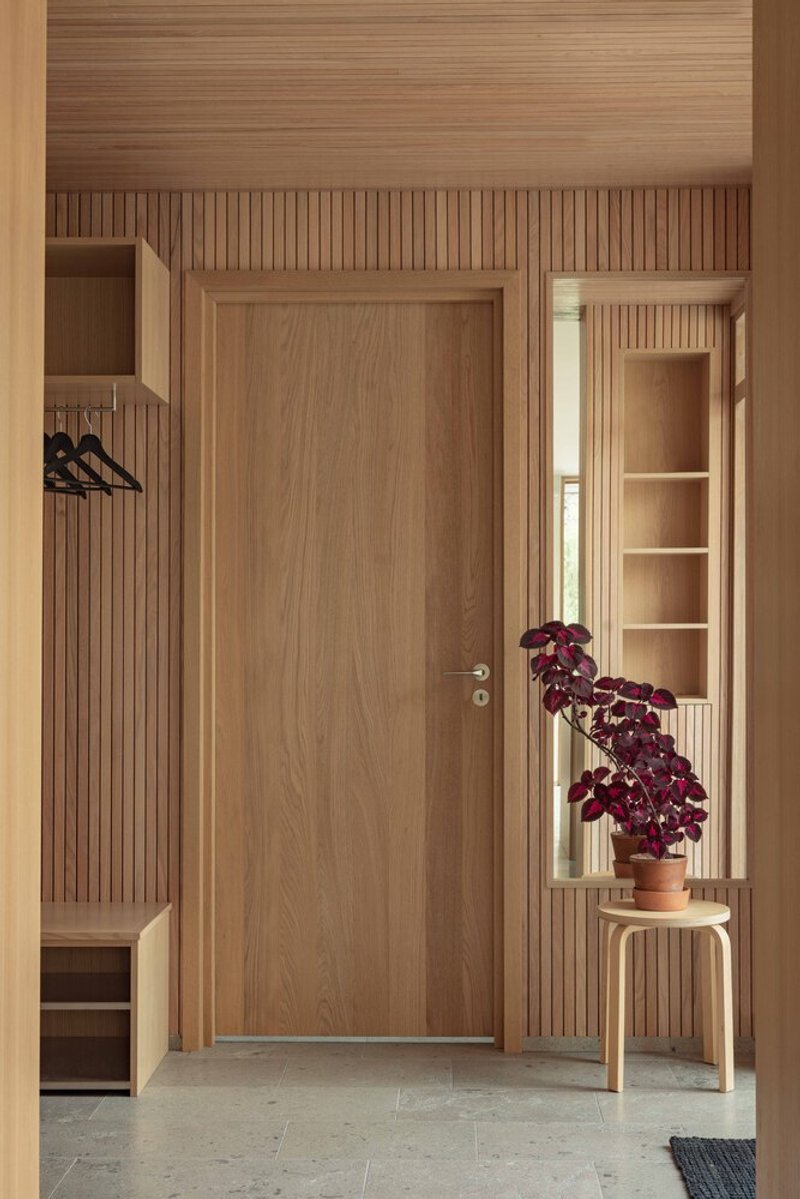
Inside, corridors are not simply passageways but carefully staged transitions. Timber slat walls run alongside linen curtains, creating a layered screen that filters both light and sightlines. A recessed shelving niche near the entry holds a potted plant and a stool, turning a utilitarian zone into a small moment of stillness. These details accumulate into something larger: a sense that every threshold has been considered, that moving through the house involves a series of gentle compressions and releases rather than a single open loft.
The vertical timber cladding that dominates the exterior continues inside at key moments, blurring the line between wall and facade. Where the slats appear indoors, they are backed by solid surfaces to manage acoustics and insulation, but visually they read as continuous with the garden-side skin. The house does not distinguish sharply between inside and outside vocabularies; it graduates between them.
Living with the Compass
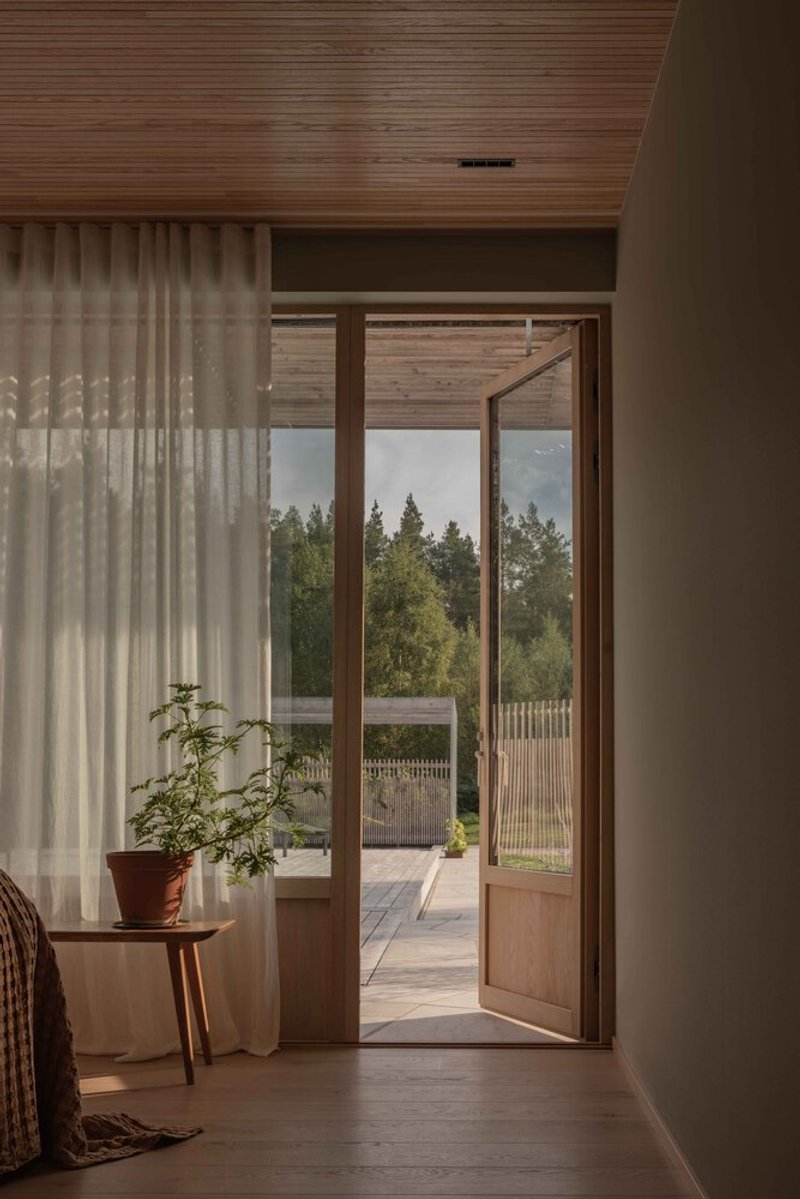
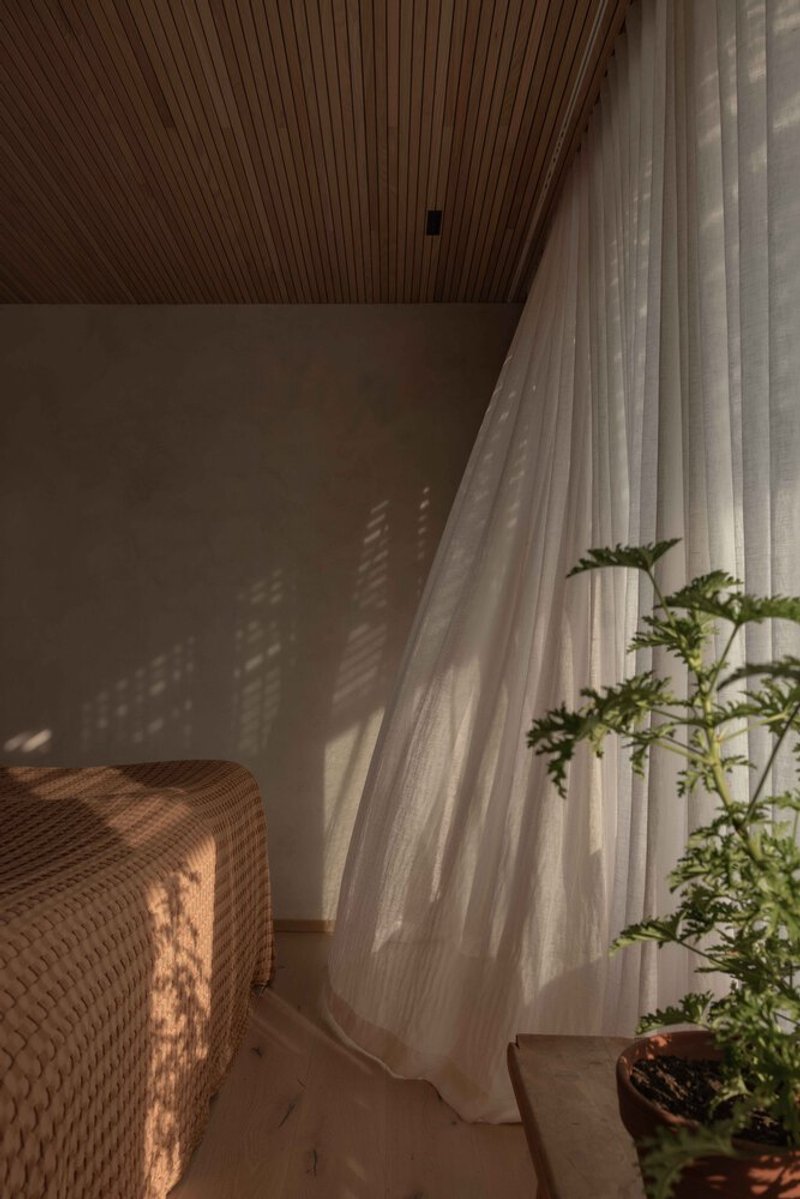
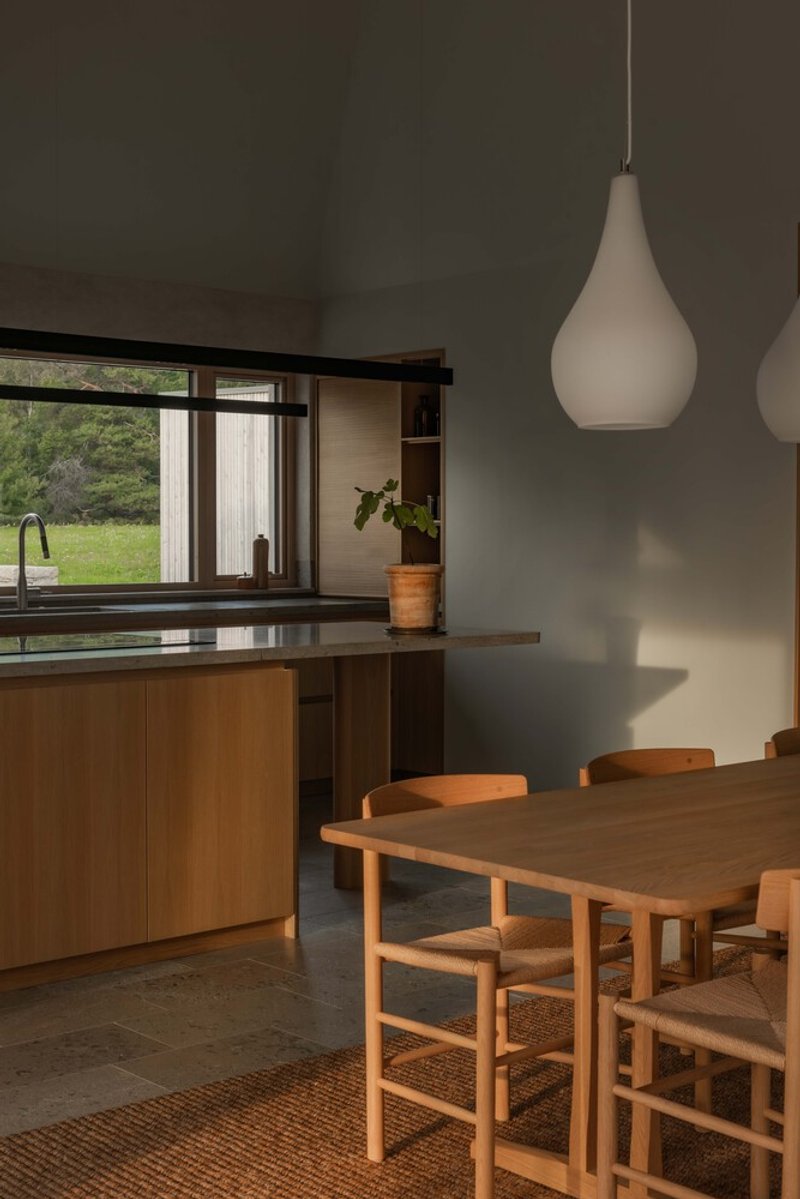
Sundberg has spoken about compass orientation as a driver of daily life in the house, and the images bear that out. The master bedroom faces west to capture sunset views through deep-set openings. The dining area looks east and south, catching morning light through a corner window that frames a slice of the landscape like a painting. Sheer curtains in a corner sitting nook filter long afternoon light onto a woven ottoman and a single plant, producing the kind of quiet scene that makes architecture photography feel redundant: the room is doing the work on its own.
Orienting rooms by sun path rather than by a rigid orthogonal grid is what generates the splayed plan. Each volume angles slightly to find its optimal exposure, and the residual spaces between them become terraces and courts. The geometry looks informal, even casual, but it is driven by a precise reading of latitude and season.
Terrace, Pool, and the Southern Edge
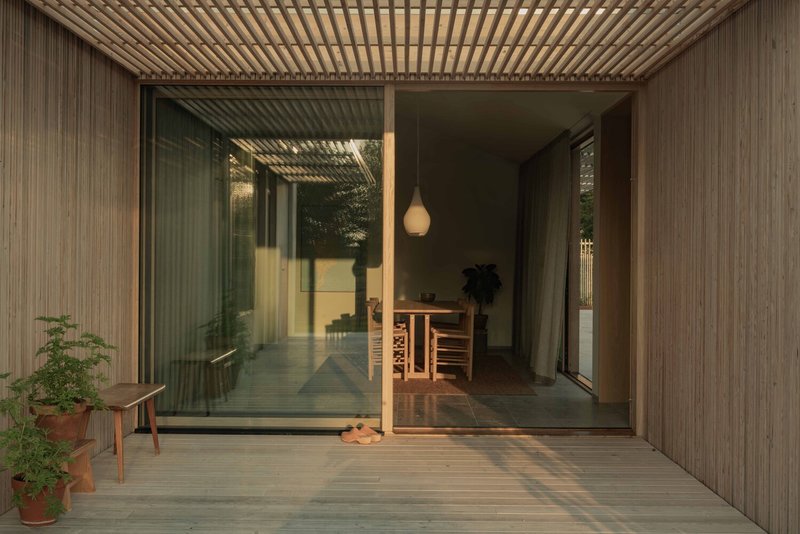
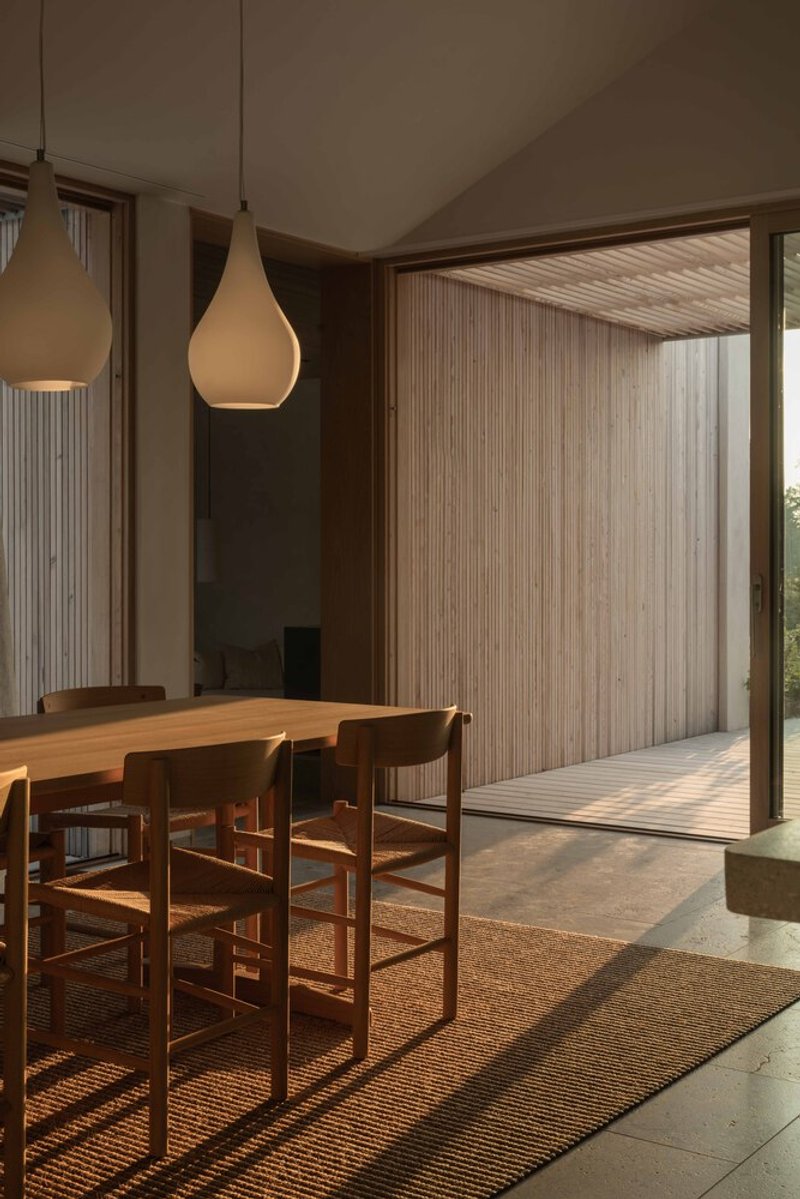
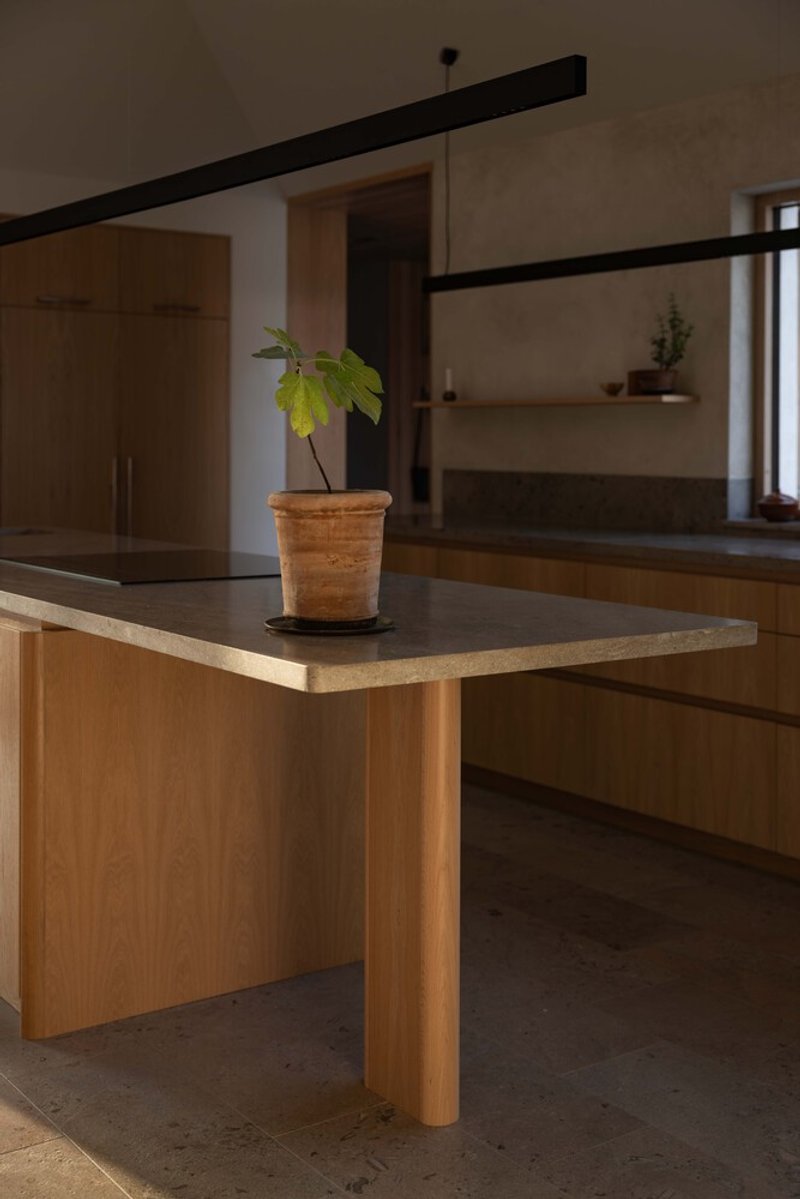
A large decked terrace and pool occupy the southern side of the site, framed by local limestone that doubles as pool coping and retaining wall. The covered deck extends from the dining space through sliding glass doors, its slatted timber ceiling casting parallel shadow lines that shift through the day. When the doors are fully open, the kitchen table and the terrace table share a continuous sightline, collapsing the distinction between meal preparation and outdoor dining.
The limestone paving around the pool ties it materially to the interior floors, so walking from kitchen to water involves no jarring change of surface. It is a small continuity, but it reinforces the project's larger argument: that transitions should be felt in the body rather than seen with the eyes.
The Guest Wing as Satellite
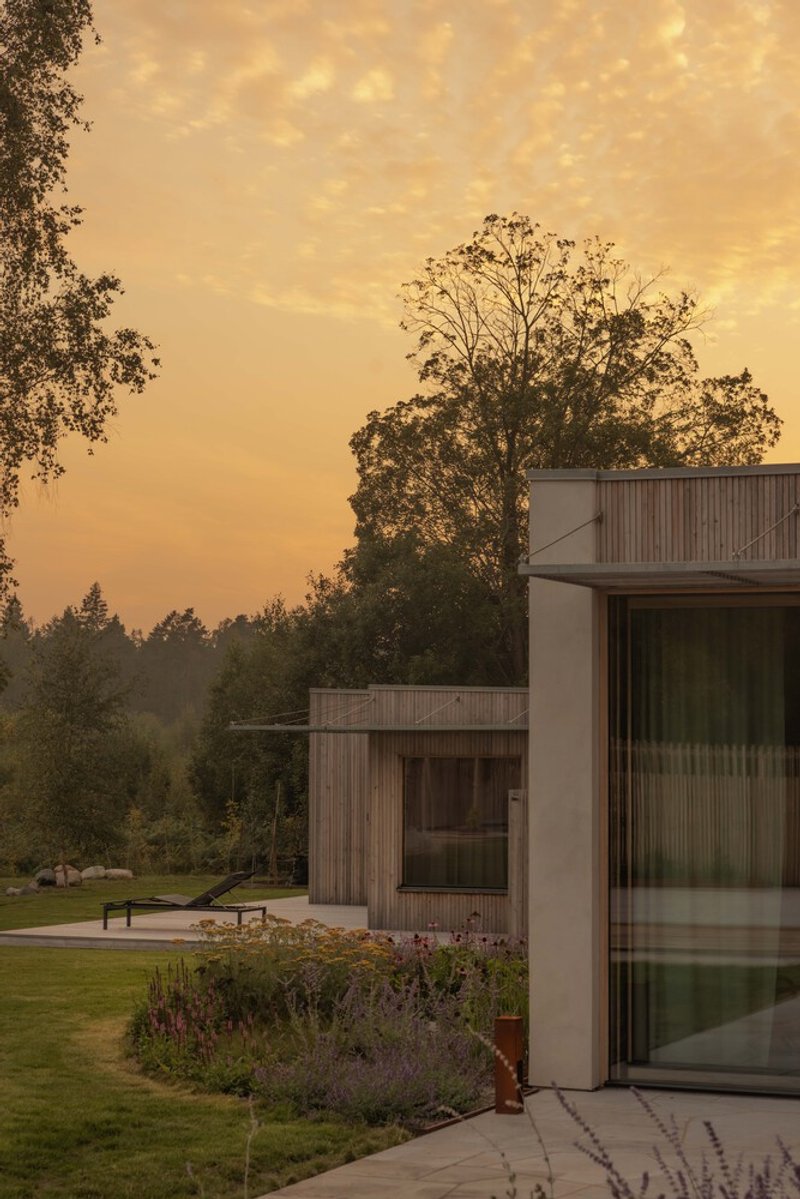
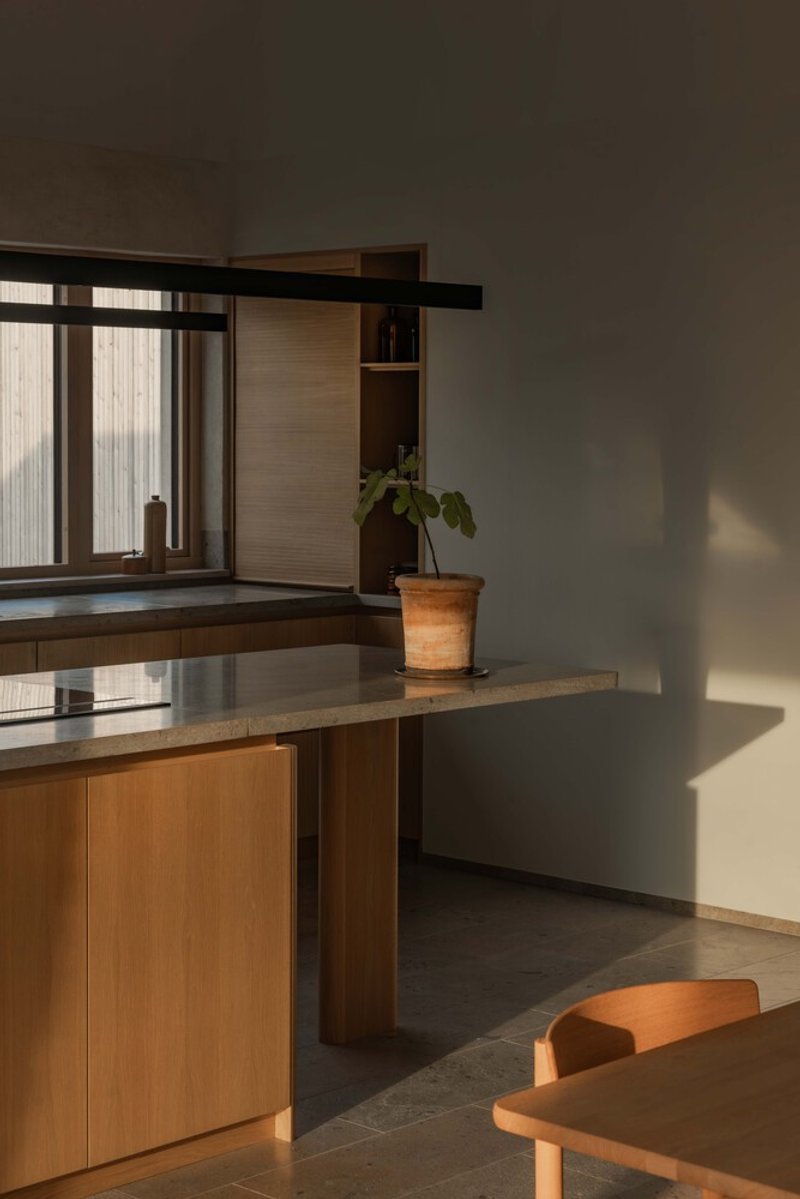
The separate guest apartment to the east follows the same material language as the main house but at a reduced scale, with its own small decked terrace and entrance. By detaching the guest quarters entirely, Sundberg avoids the common problem of summer houses that grow bloated to accommodate visitors. Guests get autonomy; the family gets privacy. A winding path through planted beds connects the two, long enough to create a psychological separation even though the physical distance is modest.
Plans and Drawings
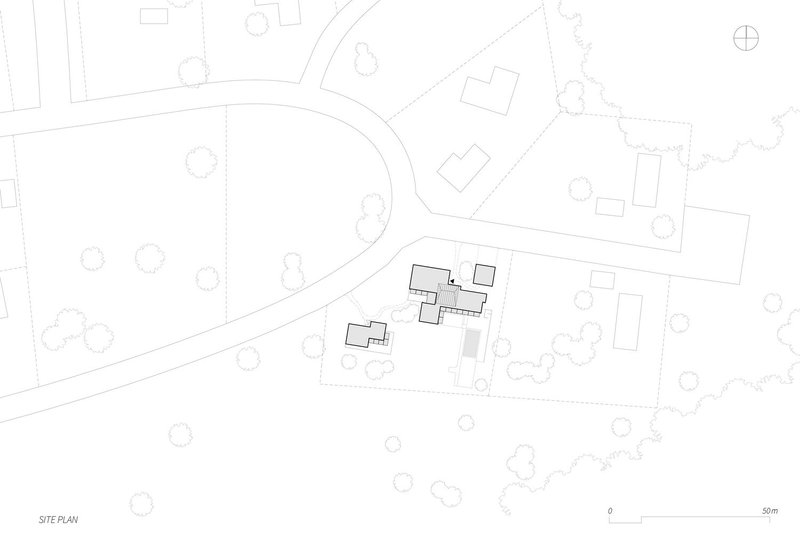
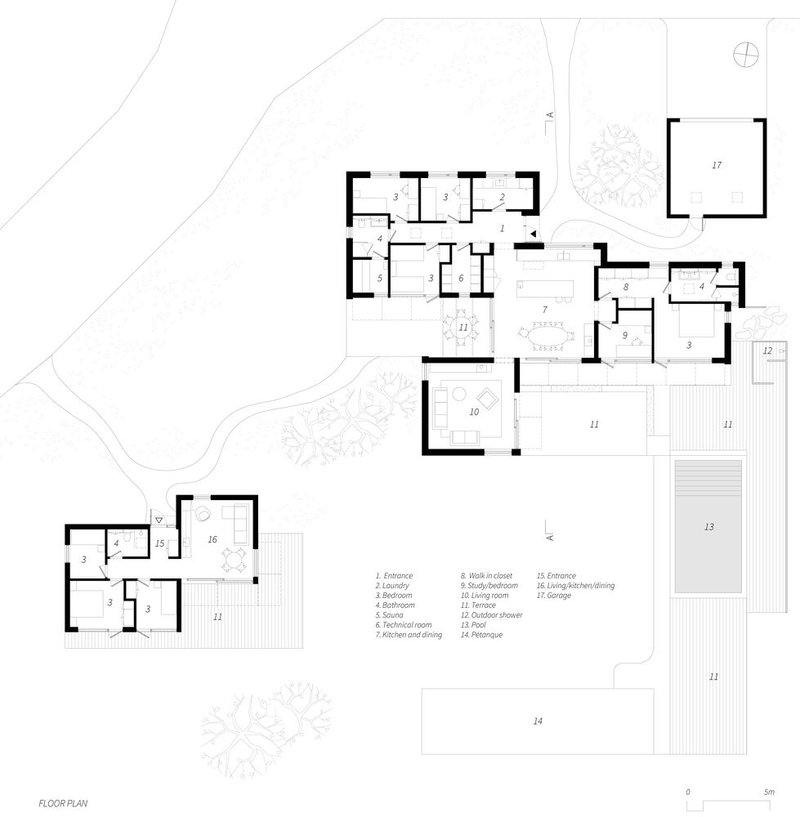
The site plan reveals how deliberately the building footprints are set back from the curving road and tucked among existing trees. Rather than clearing the glade, the volumes are threaded between trunks, preserving the canopy overhead and the root systems below. The floor plan confirms the splayed geometry: the main residence fans out from its central kitchen, with children's rooms to the north-east and the master suite to the west, while the guest wing sits on its own axis entirely. Labelled courtyards between the wings make explicit what the photographs imply, that outdoor space is not leftover but programmed.
Why This Project Matters
Sommarhus E is not revolutionary, and it does not try to be. Its importance lies in the rigour of its ordinariness. Every decision, from the angle of a wing to the species of timber on a facade, traces back to a specific condition of site, climate, or use. The house does not impose an idea on the landscape; it negotiates with it, volume by volume, material by material. In a moment when Scandinavian residential architecture is often reduced to a visual style exportable anywhere, this project insists on being from somewhere.
For architects working on rural residential commissions, the lessons here are practical. A multi-volume plan can create outdoor rooms without fences. A material shift between public and private facades can replace walls and hedges as a privacy device. And a guest wing separated by a garden path can solve the social geometry of a holiday house more elegantly than any number of extra bedrooms. Sundberg's project earns its calm by doing the difficult work of specificity, which is harder than it looks.
Sommarhus E by Johan Sundberg arkitektur. Located in Gotland, Sweden. 280 m². Completed 2023. Photography by Lina E. Adamo.
About the Studio
Share Your Own Work on uni.xyz
If projects like this are the kind of work you want to make, uni.xyz is a place to publish your own, find collaborators, and enter design competitions.




Popular Articles
Popular articles from the community

ure LLC Builds a Timber-Framed Suburban Office That Doubles as a Community Living Room in Hiroshima
KItoNOKO wraps sawtooth roofs and corrugated metal around an exposed timber frame to give a commercial district a new civic anchor.
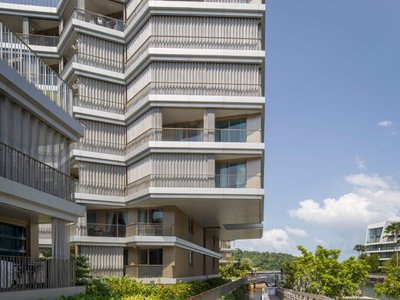
KCAP and DCA Architects Build a Stepped Urban Village on Singapore's King's Dock Waterfront
A 26,000 square meter residential development in Singapore trades tower isolation for terraced courtyards and a planted promenade along the harbor.
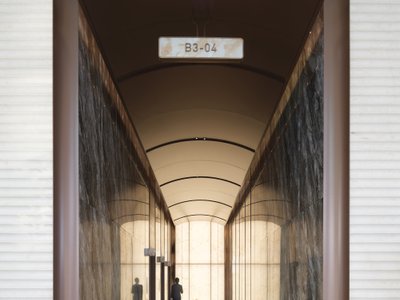
Guangzhou's Twin Towers Interiors Move Like Water
DuShe Architectural Design shapes the lobbies of a massive Guangzhou transit hub with undulating ceilings and deep geological materiality.
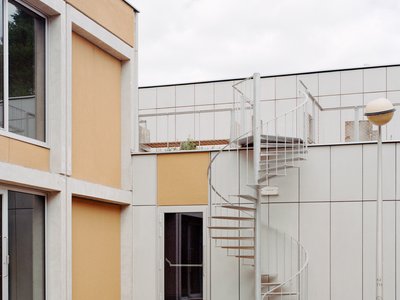
MAKER architecten Rewire a 1972 Brutalist Dormitory on the VUB Campus as a Living Lab
A modular renovation strategy in Belgium breathes new life into Willy Van Der Meeren's modernist student housing without erasing its concrete bones.


Similar Reads
You might also enjoy these articles

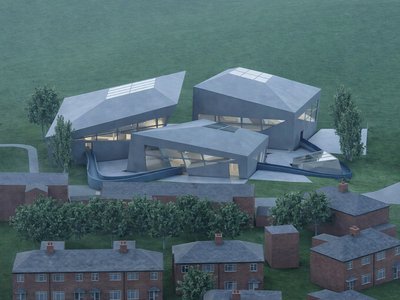
Filtering Space: A Gradual Spatial Experience
From urban intensity to spatial calm.


The Ken Roberts Memorial Delineation Competition (Krob)
As the most senior architectural drawing competition currently in operation anywhere in the world, it draws hundreds of entries each year, awarding the very best submissions in a series of medium-based categories.


Waterfront Redevelopment and Urban Revitalization in Mumbai: Forging a New Dawn for Darukhana
A transformative waterfront redevelopment project reimagining Darukhana’s shipbreaking heritage into an inclusive urban future.

OUT-OF-MAP: A Call for Postcards on Feminist Narratives of Public Space
Rhizoma Design and Research Lab invites artists, designers, architects, researchers, and students to reflect on how feminist perspectives can reshape public space. Selected works will be exhibited in Barcelona, October 2026. Submissions open until 15 April 2026.


Explore Architecture Competitions
Discover active competitions in this discipline




The International Standard for Design Portfolios


The Global Benchmark for Architecture Dissertation Awards


The Global Benchmark for Graduation Excellence


Challenge to reimagine the Iron Throne
Comments (0)
Please login or sign up to add comments
No comments yet. Be the first to comment!