

Sonelo Architects Carves Light and Air into a Narrow Richmond Townhouse
On a busy Melbourne arterial street, Burnley House uses perforated brick, lightwells, and courtyard gardens to find intimacy at urban scale.


Burnley Street in Richmond is not a quiet lane. It is a noisy industrial strip connecting the Monash Freeway to Victoria Street, lined with warehouses and light industrial sheds. Into this context, Sonelo Architects, working in collaboration with Ample Architecture, inserted a 162 m² townhouse that does something counterintuitive: it treats the hostile street as a design asset rather than a problem to wall off. The result is a home that filters the city through perforated brick, timber cladding, and carefully carved voids, arriving at a surprisingly calm interior that never feels sealed from its surroundings.
The clients had lived on this narrow site for more than 20 years in an aging terrace before opting for a complete demolition and rebuild. What replaced it is not a terrace at all but an urban infill townhouse that matches the scale and materiality of its newer neighbors while quietly outperforming them in spatial generosity. The most interesting move here is the linear choreography of the plan: the architects conceived the house as a sequence of social episodes, from arrival and first drinks through dinner party to lounge or garden. Every room along that sequence has at least one connection to daylight, landscape, or sky.
Street Facade as Filter
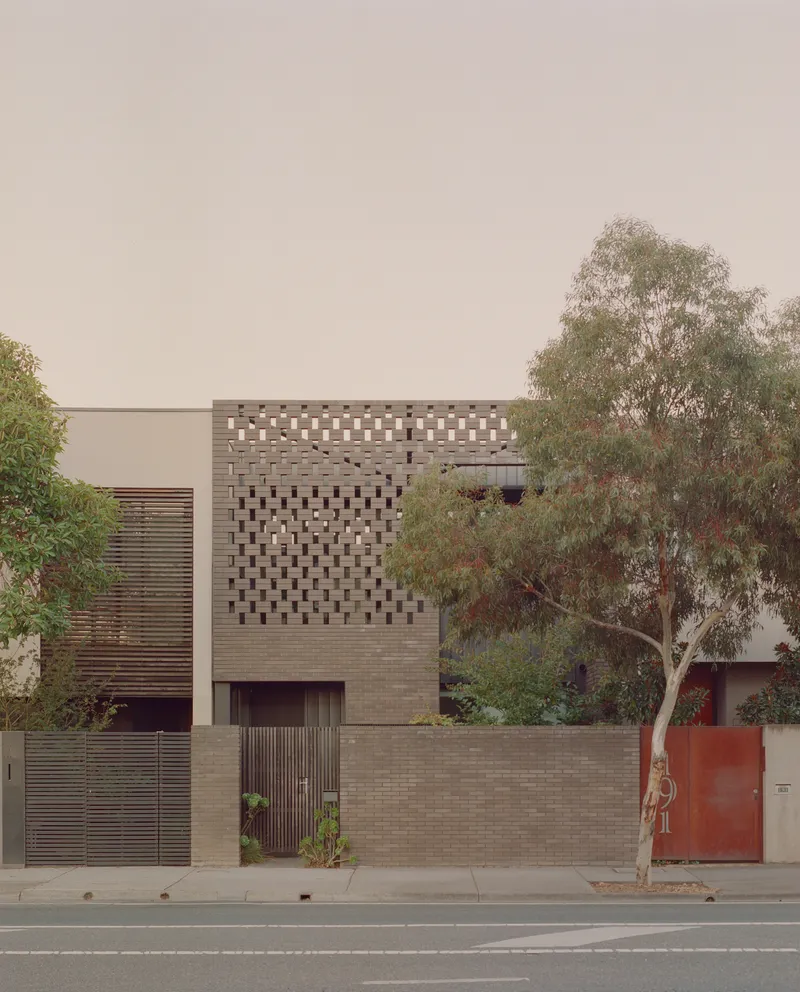

The front elevation is the building's most public statement, and it speaks in dry-pressed Bowral brick laid in a hit-and-miss arrangement. The perforations are not decorative. They serve as a screening device between the master bedroom at the front of the house and the heavy traffic beyond, allowing light and air to pass through while breaking direct sightlines. At dusk, the effect reverses: interior light leaks outward through the brick openings, turning the facade into a lantern that signals domesticity without exposing it.
Below the brickwork, a timber-slatted gate and planted boundary wall establish a threshold that is deliberately unheroic. The main form of the house sits further back into the site, so the facade reads more as a garden wall with a room behind it than as the front of a conventional dwelling. The Colorbond standing-seam metal roof, visible in profile, connects the brick volume to a secondary language of industrial cladding that references the street's warehouse character without mimicking it.
Courtyards and the Garden Threshold
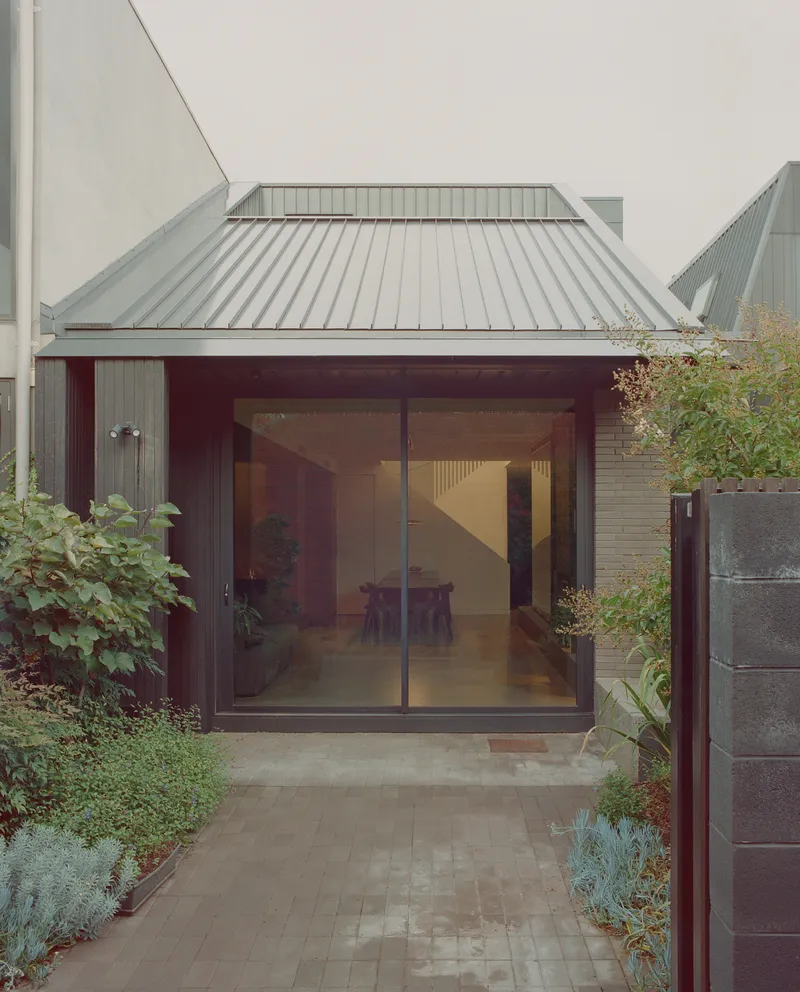
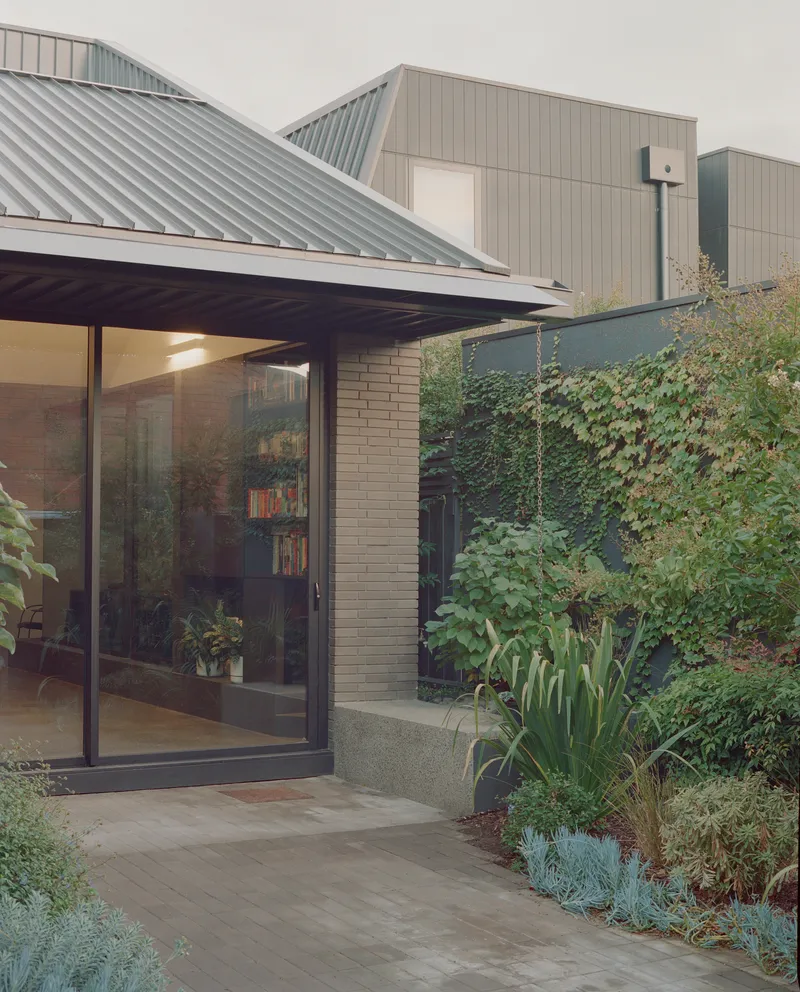
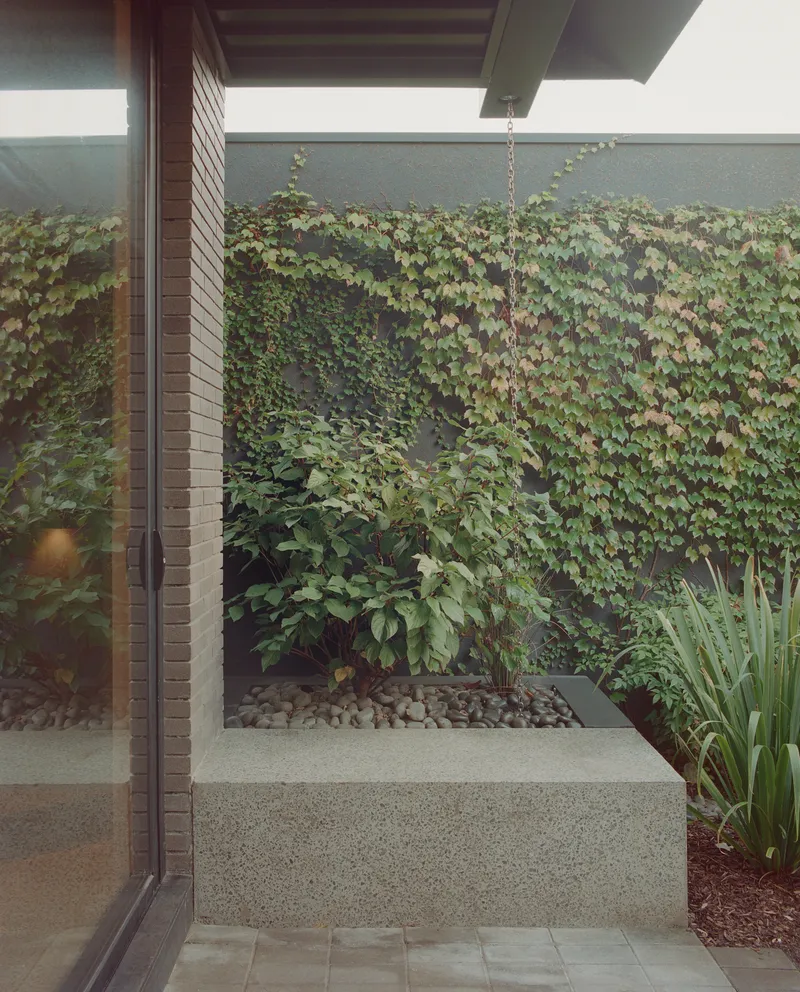
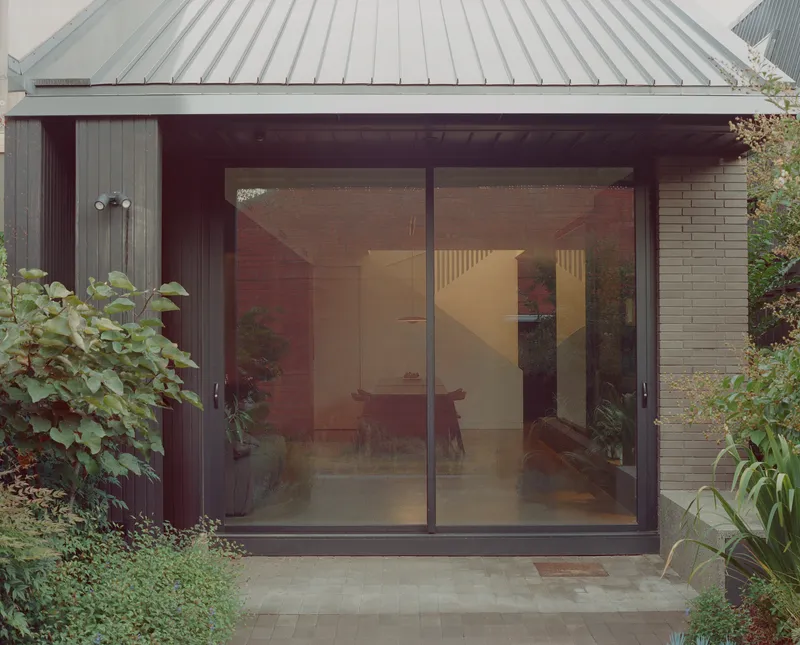
Arriving at Burnley House means passing through planted courtyards before reaching any living space. The entry sequence, sheltered under a deep overhang with timber soffit, places you among climbing vines, exposed aggregate paving, and glazed doors before you cross into the interior. The client's stipulation to capture as many connections to landscape as possible produced a house where exterior planted zones appear on both flanks and at the rear, so that almost every room has at least one green edge.
The courtyards are not leftover space. They are instrumental to the building's climate strategy, delivering cross-ventilation and northern light deep into a plan that would otherwise be a dark tube. The first-floor volume is considerably held back from the rear boundary to prevent it from overwhelming the small courtyard below, a disciplined section move that prioritizes outdoor usability over maximum floor area.
The Entertaining Sequence


The open-plan dining area is the heart of the linear sequence. Glazed doors on both sides open to planted courtyards, turning the room into an indoor-outdoor passage during warm months. Polished concrete floors run continuously from kitchen to dining to lounge, anchoring the spatial flow with a single material datum. The pendant light above the dining table becomes a focal point, casting sharp shadow patterns across white walls in the afternoon and creating an almost theatrical quality to the space at meal times.
Timber cabinetry throughout the dining and kitchen zones has a warm, robust finish that reads as furniture rather than fit-out. The palette of dark timber, concrete, and white plaster is restrained but never austere, and it reflects an honest engagement with the area's industrial past rather than a nostalgic one.
Kitchen and Stairwell Voids
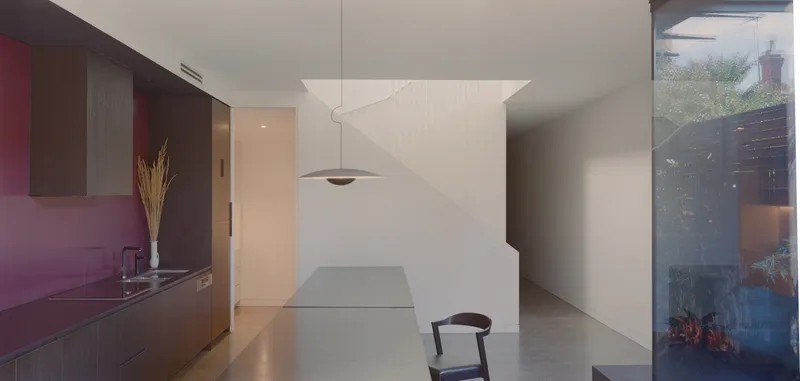

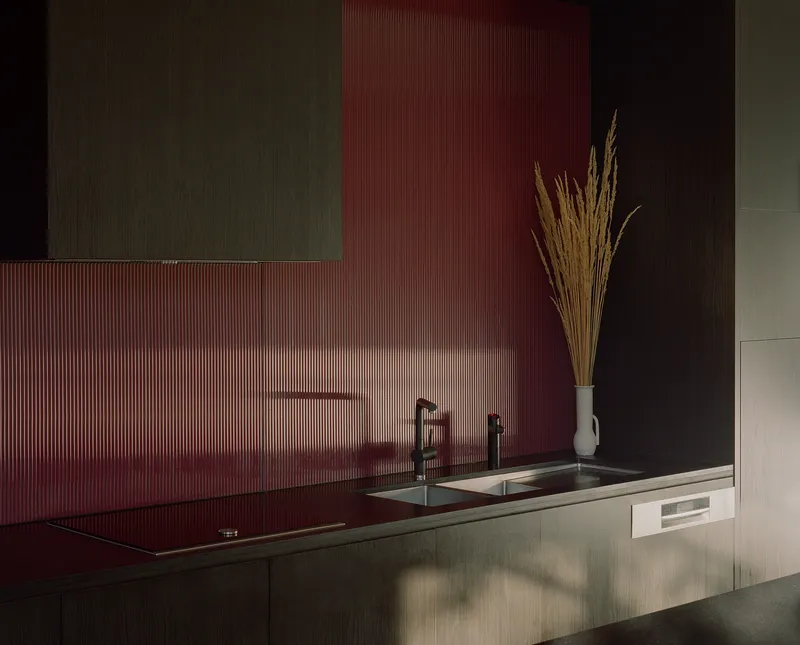
The kitchen occupies a critical position at the midpoint of the plan, flanked by the stairwell and a lightwell that brings natural illumination down onto the counter. A ribbed red glass backsplash introduces an unexpected jolt of color, catching light from the void above and lending the work surface a warmth that softens the steel sink and stone bench. It is a small detail, but it signals that the architects were thinking about material experience at close range, not just from across the room.
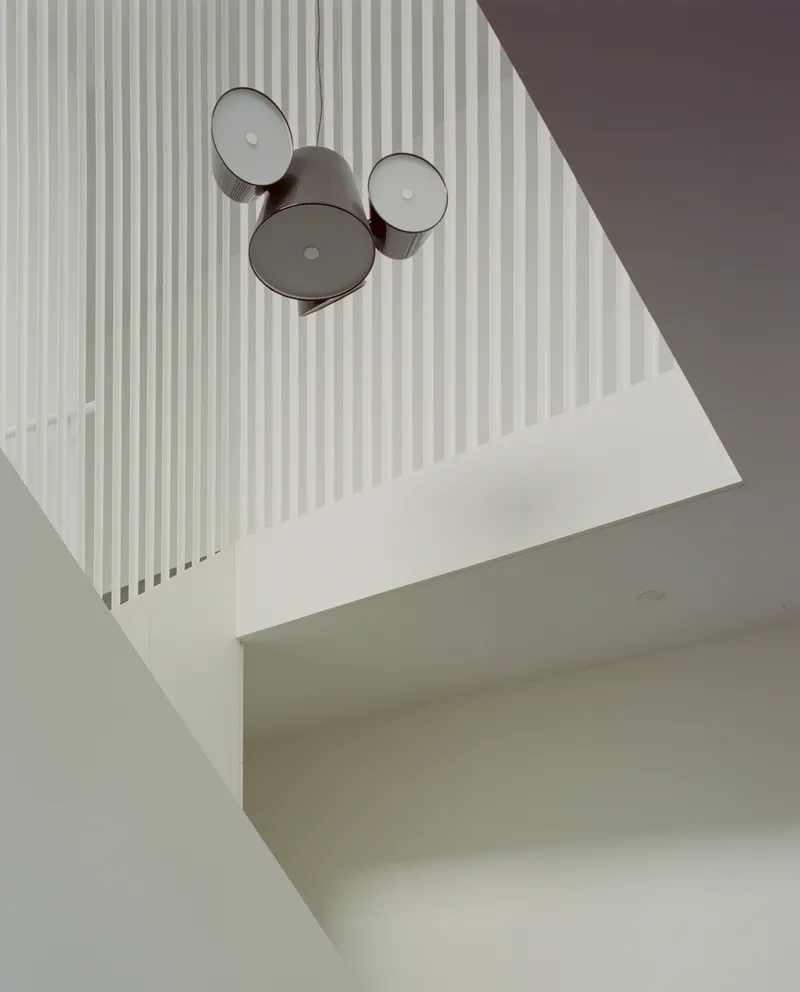
The staircase rises beside a grey kitchen island, its vertical metal rod railings continuing upward through the void to the first floor. Looking up through the stairwell, a cluster of three drum pendant lights hangs against the rods, creating a layered composition that connects the two levels visually. These carved volumes, stairwells and lightwells alike, are the primary mechanism for bringing daylight and spatial drama into a house constrained by narrow party walls.
Living Room and the Dog Door


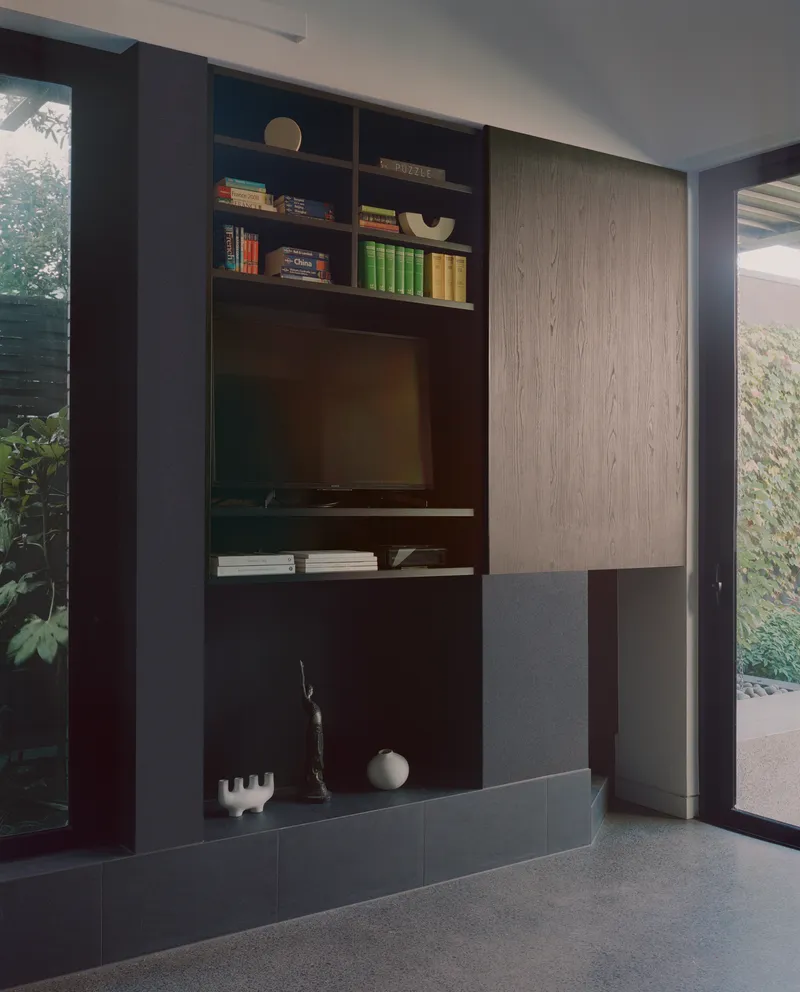
The living area at the rear of the ground floor connects directly to the garden through floor-to-ceiling glazing, with a fluted timber wall adding texture to the interior side. A built-in bookshelf beside the fireplace hearth frames views to the courtyard garden, creating a reading nook that is simultaneously enclosed and exposed. The media unit along the opposite wall pairs dark shelving with light oak cabinetry and runs to the glass doors, forming a continuous storage wall that terminates at the landscape.

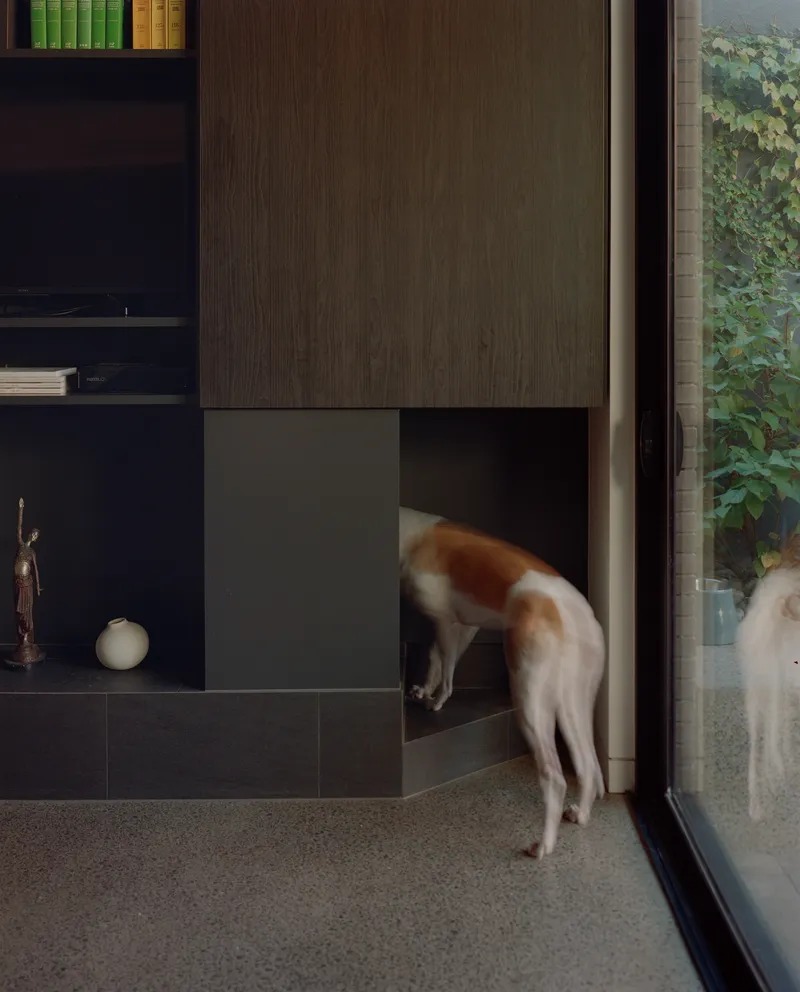

And then there is the dog door. A low opening cut through the tiled base of the media unit gives the family pet its own passage between rooms, a detail that is easy to dismiss as whimsy but actually reveals a deeper design attitude. This is a house built for its occupants' actual daily life, not a photographic ideal. The terrazzo flooring around the opening is robust enough to handle muddy paws, and the proportions of the slot are carefully sized. It is domestic architecture that takes small rituals seriously.
Bedrooms and Bathing Rooms


The master bedroom sits at the street end of the ground floor, protected from noise and gaze by the hit-and-miss brick screen. A recessed shelf and full-height window overlook a brick courtyard wall planted with a single tree, offering a controlled view that feels private without being claustrophobic. Upstairs, the bedrooms occupy a narrow floor plate centered on the staircase, with the first-floor volume held back to create a concealed external patio that captures eastern morning sun.


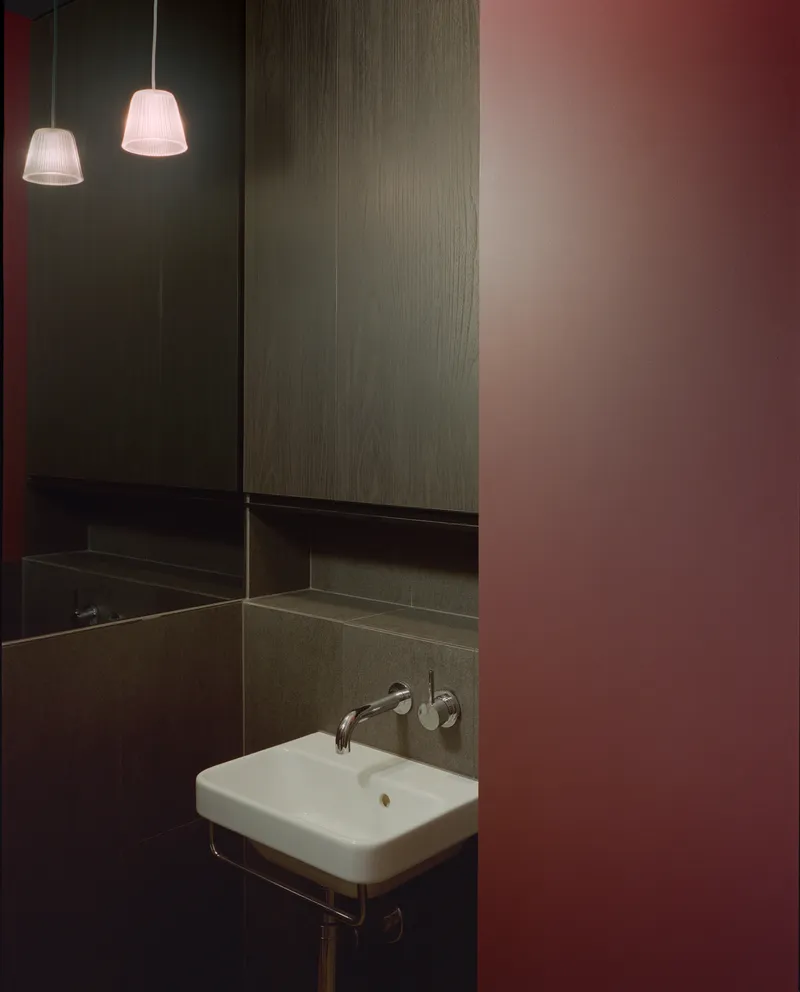
The bathrooms are among the most resolved rooms in the house. A walk-in shower uses large-format grey tile and a terrazzo bench, while the freestanding bathtub is set against a terrazzo niche with a wall-mounted faucet, a composition that treats bathing as an event rather than a utility. The powder room goes further: wall-mounted basins beneath pendant lights are framed by pink and timber-clad surfaces, introducing a color not found anywhere else in the house. It is a confident move in a project that otherwise exercises considerable restraint.
Detail and Material Logic


Burnley House assembles a small palette of materials and then works them hard. The Bowral dry-pressed bricks in Brahman Granite handle the street. Cedar Sales Diamond Clad timber, finished with Woca wood oil, wraps the intermediate volumes. Lysaght Longline and Klip-Lok cladding in Colorbond Monument covers the roof and upper walls. Each material has a clear zone of responsibility, and transitions between them are clean without being fussy. The built-in shelving unit with its sliding timber panel, seen beside the courtyard, exemplifies the approach: simple joinery that earns its presence through proportion and placement.
Looking down through the ceiling aperture to the lower level reveals how the architects used vertical connections as interior events. The void over the living space is not just functional daylight delivery. It compresses and expands the section, making 162 m² feel substantially larger than its footprint suggests. The cluster of pendant lights in the stairwell and the shadow play across white walls become part of the spatial experience rather than decoration applied after the fact.
Plans and Drawings
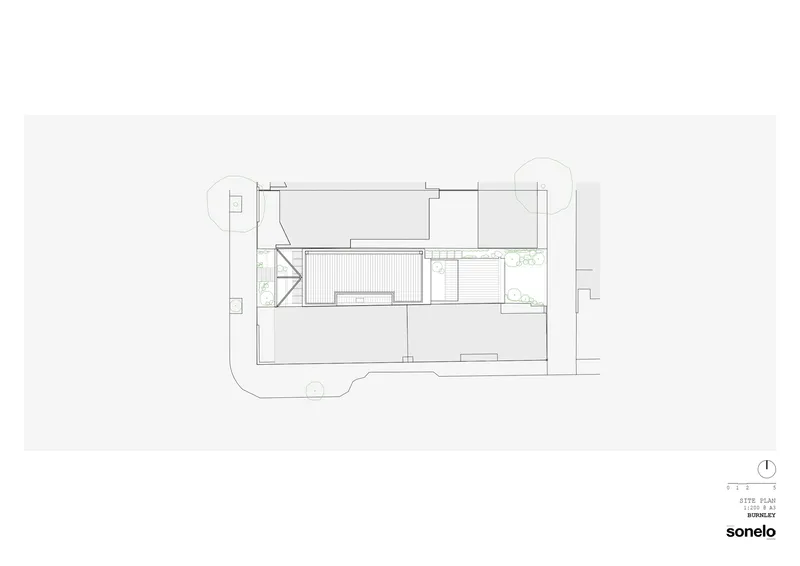
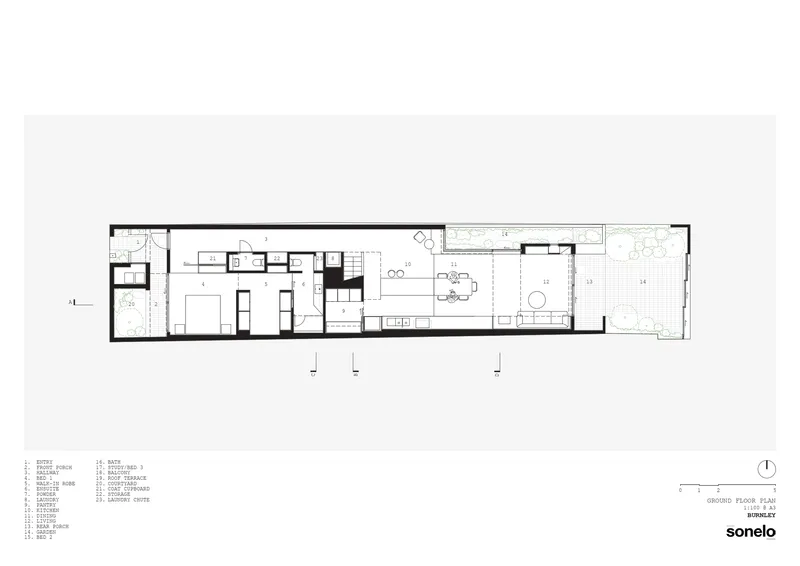

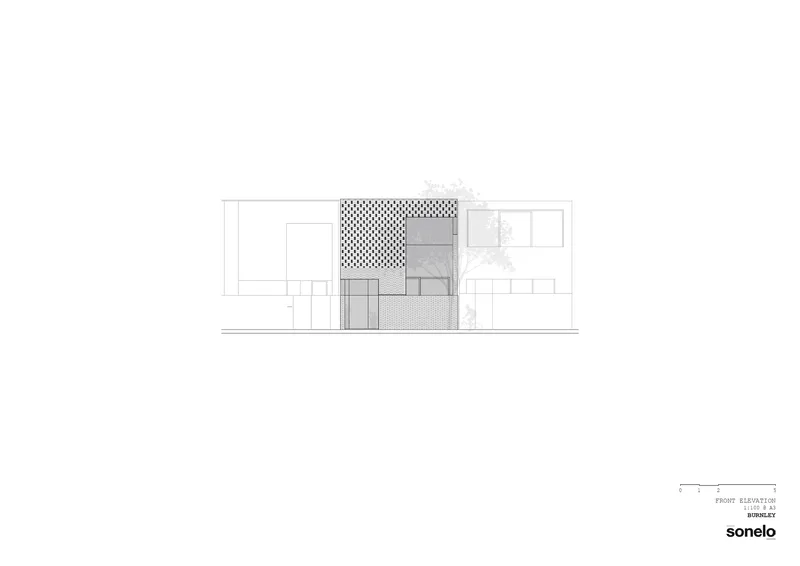
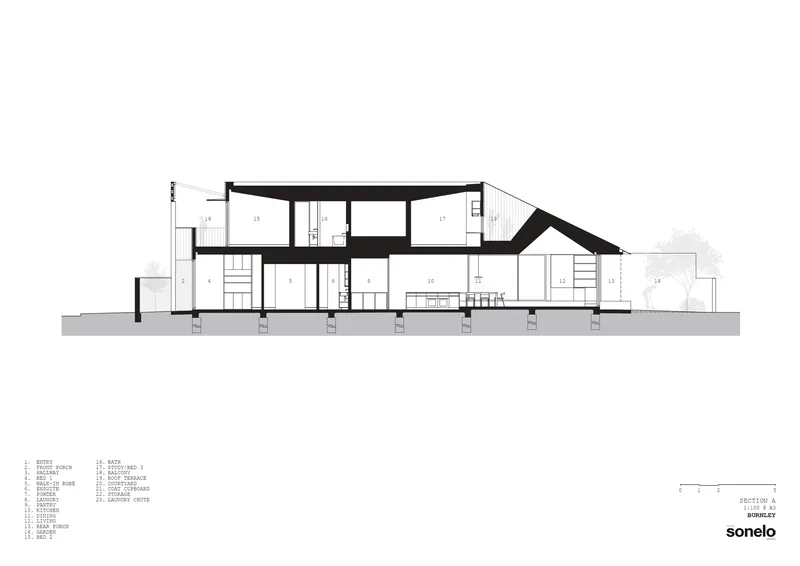
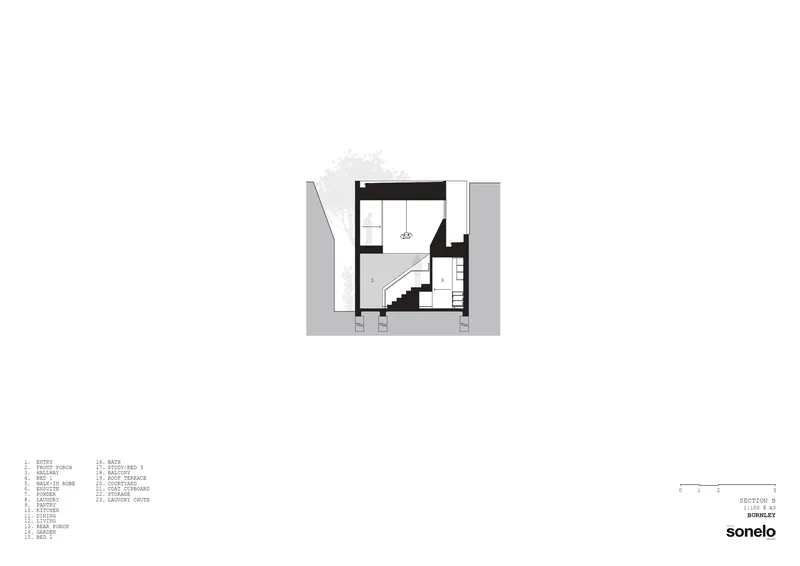
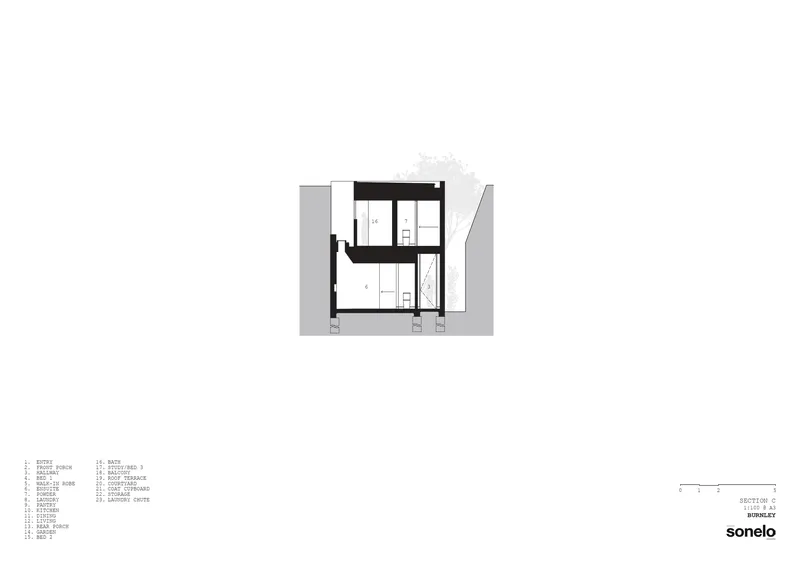

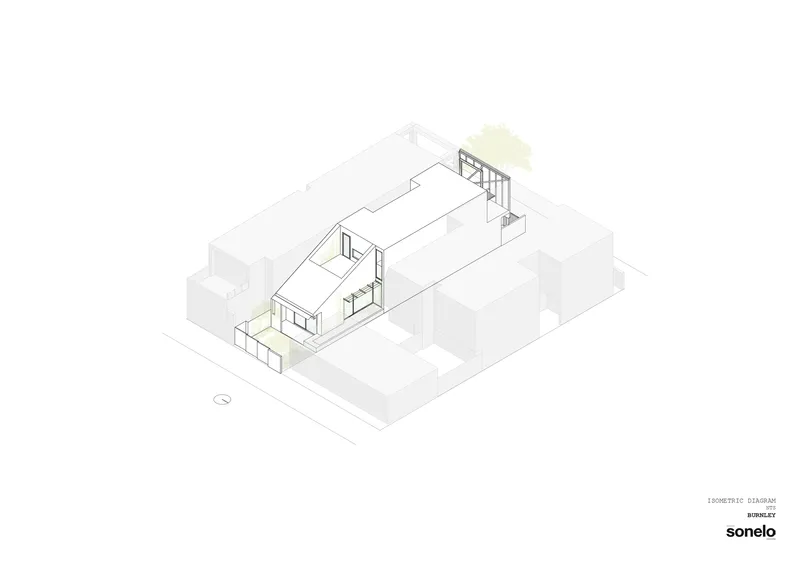

The site plan confirms the building's strategy of embedding courtyards within a tight urban footprint, with planted zones at front, side, and rear creating a continuous green circuit. The ground floor plan reads as a strict linear sequence from bedroom through kitchen and dining to living and garden. Upstairs, the floor plate narrows considerably, pulling back from the rear to open the rooftop terrace and from the front to shelter behind the brick screen. The longitudinal section is the most revealing drawing: it shows the angled roof, the double-height void over the living space, and the way the first floor tucks under the sloping line to conceal the upper patio. Cross sections demonstrate how the staircase stitches the two levels together while allowing light to cascade through adjacent voids. The isometric and axonometric views illustrate the relationship between the two interlocking rectangular volumes and the courtyard spaces wedged between them and their neighbors.
Why This Project Matters
Burnley House is a corrective to two common failures in medium-density residential design. The first is the sealed box: the townhouse that turns its back on the street and relies on artificial light and mechanical ventilation. The second is the overwrought facade: the infill dwelling that tries so hard to distinguish itself from its neighbors that it fractures the streetscape. Sonelo Architects and Ample Architecture avoid both traps by building a house that engages the street through a perforated brick screen, welcomes daylight through carved voids, and meets its row of neighboring townhouses with compatible materials and scale.
The deeper lesson is about program. By organizing the plan as a social sequence rather than a collection of rooms, the architects gave 162 m² a spatial richness that many houses twice its size lack. The courtyards, lightwells, and rooftop terrace multiply the usable environment without adding floor area. And the details, from the dog door to the powder room's pink surfaces, demonstrate that compact living does not require austerity. It requires precision.
Burnley House, designed by Sonelo Architects in collaboration with Ample Architecture. Located in Richmond, Australia. 162 m². Completed in 2019. Photography by Pier Carthew.
About the Studio
Share Your Own Work on uni.xyz
If projects like this are the kind of work you want to make, uni.xyz is a place to publish your own, find collaborators, and enter design competitions.


Popular Articles
Popular articles from the community


longwave studio Reorganizes a 112 m² Tainan Apartment Around the Daily Routines of a Family and Two Cats
In Tainan, Taiwan, birch plywood, rust-red furniture and a freestanding plaster wall link arrival, storage, work and family life in one apartment.

GROUP A Strips a 1969 Rotterdam Harbor Headquarters to Its Frame and Wraps It in Timber Louvers
In Rotterdam's M4H harbor district, Ferro Offices reuses a 1969 frame, adds one timber storey and reaches BREEAM-NL Outstanding.

Cube Design Draws an Ecological Corridor Between Two Shenzhen Hills with the Nankai Building
Beside Shenzhen's container docks, the Nankai Building pairs stacked balconies with a climbing green screen to connect two hillsides across its height.

U.GA Architects Wraps an Oval Rooftop Pool in Curved Board-Formed Concrete on Busan's Jeollidan-gil
In Busan's Jeonpo-dong, a 454 m² mixed-use block stacks a neighborhood facility, guest rooms and an oval rooftop pool inside spiraling concrete walls.

Similar Reads
You might also enjoy these articles


LAVA Architecten Gives Vocational Education a Sawtooth-Roofed Face on a Mechelen School Campus
In Mechelen, Belgium, a 2,053 m² STEM school on a 6×6 m grid turns workshops and classrooms into rooms that can be rearranged as teaching changes.

KEMA Studio Turns a Derelict Marvila Attic into a 60 m² Lighthouse Apartment Above Lisbon
In Lisbon's Marvila district, a rebuilt roof, four skylights and two plywood volumes turn an unlivable attic into a bright home facing the Tagus.

Pixel Gardens: One Repeated Module Stacked Into a Terraced Social Housing Tower for Famagusta
Salem Bader's shortlisted housing tower builds a vertical neighbourhood from one repeated module, offsetting units to carve terraces, light and air.

Bao Huynh Watercolor Atelier: A Serene Art Retreat in Hội An
Bao Huynh Watercolor Atelier in Hội An blends multifunctional art spaces, sustainable design, local materials, and family-friendly living in a serene environment.

Explore Residential Building Competitions
Discover active competitions in this discipline

Comments (0)
Please login or sign up to add comments
No comments yet. Be the first to comment!