

Spacon & X Turns a 200-Year-Old Naval Shed into Copenhagen's Most Thoughtful Bakery
Hart Bakery occupies a listed timber-framed building on Holmen island, where indigo-dyed fabric and solid oak honor craft at every scale.


When Richard Hart, the American baker who built a cult following in Copenhagen, needed a permanent home for his bakery, he chose one of the most historically charged buildings on the city's waterfront. Mærsehuset, a listed timber-framed structure on the island of Holmen, is more than 200 years old and once housed the Danish navy's mast baskets. The building had already been recognized with both the Mies van der Rohe Award and the Københavns Kommunes Architecture Award after a 2009 renovation. Inserting a commercial bakery into a space that carries that kind of institutional memory is a delicate act, and Spacon & X treated the assignment with the seriousness it deserves.
What makes the 128-square-meter project genuinely interesting is the logic that connects its choices. Rather than importing a generic café kit, the studio designed every piece of furniture, every lamp, and every wall treatment to reflect the ethos of the product being sold: handmade bread, made slowly, with honest materials. Solid oak, indigo-dyed French bakers' couche fabric, hemp pendants, and an aluminum-backed shelving system that bounces harbor light across the room. It is a bakery designed the way Hart bakes: nothing superfluous, nothing fake.
A Listed Shell That Sets the Rules


The exterior of Mærsehuset announces itself with falu-red horizontal panels, a color drawn from the building's naval heritage and retained through its various lives. Red-painted timber window frames swing outward on metal hinges, their proportions unchanged, while gridded glass doors open the ground floor to the paved plaza outside. The red-tiled hip roof, the stone sills, the rhythm of the facade: none of this was available for redesign. The building is a cultural artifact, and Spacon & X accepted that constraint as a gift rather than a burden.
Working within a protected structure meant that every interior intervention had to be reversible and respectful. The heavy timber trusses and exposed steel brackets overhead became the defining spatial character, not something to conceal. The design team essentially furnished the shell rather than remodeling it, an approach that both satisfies preservation requirements and produces the kind of atmospheric honesty that a bakery built on craft deserves.
The Counter as Centerpiece
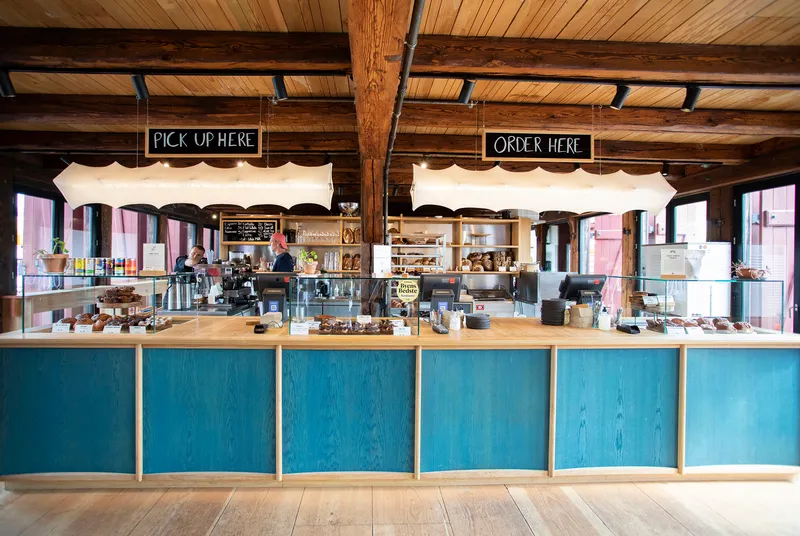


The service counter is where the project's material language is most concentrated. Blue-stained wood panels wrap the base, a color cool enough to offset the warmth of the oak and timber ceiling above without competing with the bread itself. Glass display cases sit at eye level, presenting loaves and pastries as objects worthy of attention. Behind the counter, open shelving backed with aluminum sheets reflects the daylight that streams in from ample windows on each side of the building.
Scalloped fabric pendants made from hemp hang low over the workspace, reinforcing the handmade register. The detailing where light oak framing meets the blue-stained panels is precise but not precious, the kind of joinery that rewards a second look but does not demand one. Everything was handcrafted by Nørrebros Snedkerservice, a Copenhagen-based workshop, making the counter a piece of local craft sitting inside a monument to local heritage.
Bread on Display

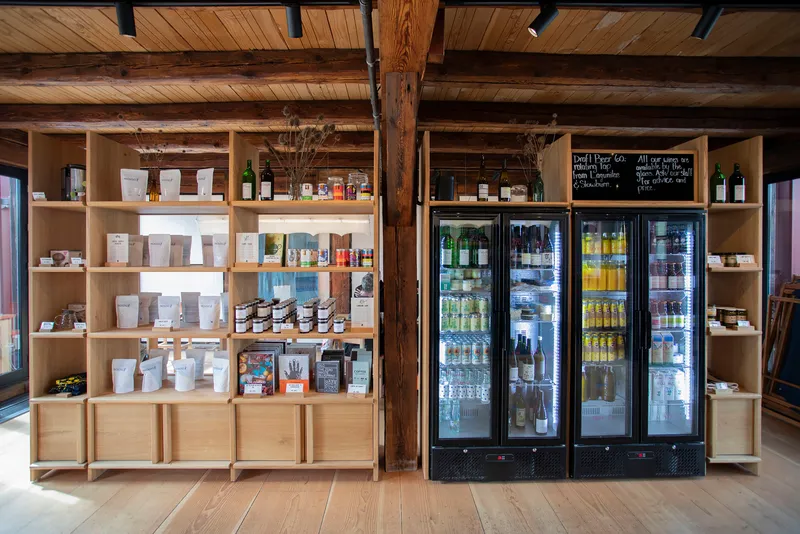

Hart's bread is the reason this space exists, and the shelving system treats it accordingly. Open timber shelves hold loaves at varying heights, each illuminated by integrated strip lighting against a stainless steel backsplash. The effect is closer to a gallery than a grocer: the crust, the scoring, the flour dusting all become visible texture. Adjacent glass-door refrigerators and retail shelving extend the display logic, creating a continuous wall of product that flanks a dark timber column.
The material choice for the shelving backs is practical as much as aesthetic. Aluminum and stainless steel are easy to clean, resistant to flour dust and moisture, and their reflective surfaces amplify the limited interior light. In a narrow space carved from a 200-year-old timber frame, that extra luminosity matters.
Dining Under the Trusses
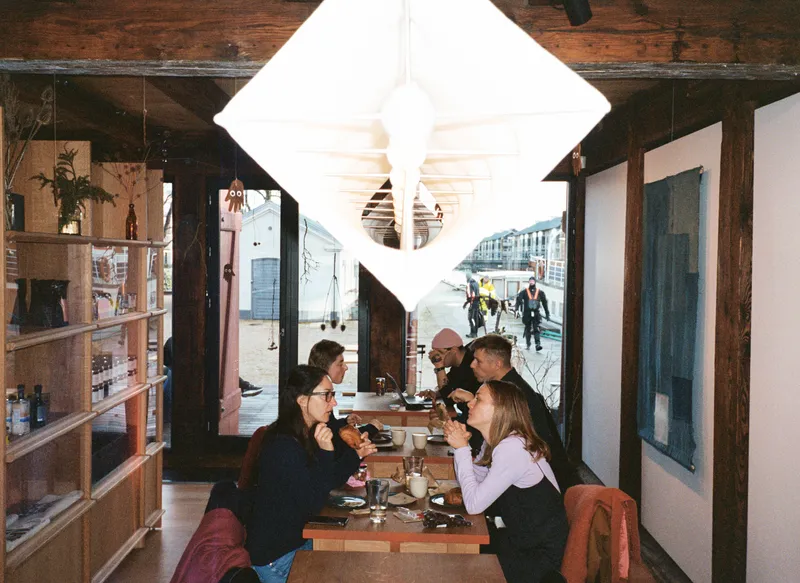

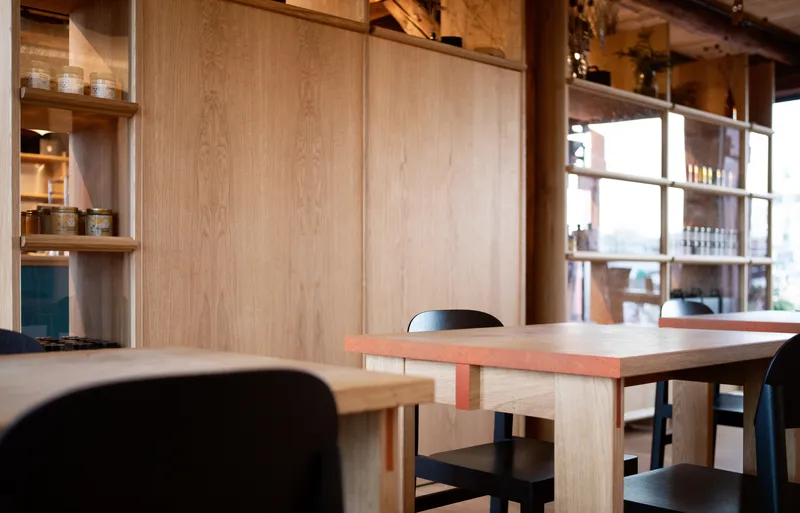
The seating area occupies the full depth of the building's narrow volume, placing diners directly beneath the exposed timber beams that carry the roof. A large diamond-shaped pendant light hangs over a communal zone, its geometry a quiet nod to the angular truss work above. Light wood tables and black chairs are spaced generously enough for a bakery where people linger over coffee and a tartine rather than grab and go.
Textile hangings made from French bakers' couche fabric, hand-dyed with natural indigo, punctuate the space between columns. The couche is the linen cloth traditionally used to support bread dough during proofing. Repurposing it as wall art is a smart conceit: it signals the bakery's craft to anyone who knows, and reads as elegant soft texture to anyone who doesn't. Plywood sliding doors and display shelving along the perimeter keep the circulation tight and the sightlines open, letting the timber structure breathe.
Evening Glow and the Harbor Edge


At dusk the project reveals a second character. Interior lighting warms the timber ceiling to amber, and the glazed facade turns transparent, exposing the arched openings and the neon signage to passers-by along the harbourfront. The building reads simultaneously as heritage landmark and active neighborhood gathering point, a pairing that is difficult to pull off without tipping into either museum solemnity or kitschy nostalgia.
The detail of the oak-to-blue-panel junction, visible in close-up, demonstrates the care embedded in the project. Warm lighting washes down from above, catching the grain of the timber and the matte surface of the stained panel in a way that makes the construction legible. It is the kind of detail that separates a considered interior from an Instagram set.
Plans and Drawings

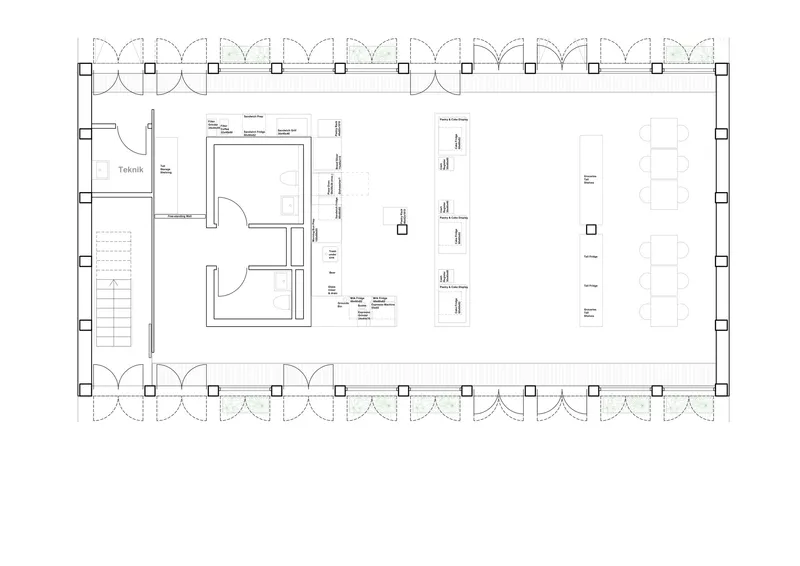
The two floor plans confirm what the photographs suggest: the building is a single rectangular volume with perimeter columns inherited from the original timber frame. The central service core, containing the counter, display cases, and back-of-house functions, divides the space into a public dining zone and a service corridor without ever touching the historic walls. Arched perimeter openings in the second drawing reveal the structural rhythm that gives the interior its cadence. The compactness of the 128-square-meter footprint is striking: there is almost no wasted area, yet the room never feels cramped.
Why This Project Matters
Hart Bakery is a small project by almost every metric: modest budget, modest area, a single room inside a building someone else designed. But it demonstrates something that larger commissions often forget. When the program is craft-based, when the client makes something by hand every day, the architecture should operate on the same terms. Spacon & X did not apply a brand identity over the top of a listed building. They read the building's material language, read the bakery's philosophy, and found the overlap. Solid oak, indigo linen, aluminum reflectors, hemp lamps: each choice reinforces the argument that design and making are the same discipline.
The decision to design all furniture for potential reuse in future Hart locations is worth noting as well. It suggests a model where hospitality interiors are not disposable fitouts but durable systems that travel with the brand. In a city where bakeries and coffee shops cycle through identities faster than the bread goes stale, that durability, both material and conceptual, is the most radical thing on the menu.
Hart Bakery, designed by Spacon & X, København, Denmark. 128 m², completed 2021. Photography by Spacon & X.
About the Studio
Share Your Own Work on uni.xyz
If projects like this are the kind of work you want to make, uni.xyz is a place to publish your own, find collaborators, and enter design competitions.



Popular Articles
Popular articles from the community


Hill & Cross Opera: Sculptural Opera House Architecture Shaped by Tallinn’s Landscape and Identity
Hill & Cross Opera reimagines opera house architecture in Tallinn through its sculptural hill, civic plaza, glass wave and a luminous cross.

Co-life: Sustainable Architecture for Age-Friendly Community Living
Co-life reimagines sustainable architecture for seniors through courtyards, rammed earth, shared gardens, and spaces designed for belonging.

AL-JANNAH: Sustainable Architecture and Permaculture for Afghan Widows
AL-JANNAH uses sustainable architecture and permaculture to create resilient oasis of housing, learning, work and renewal for Afghan widows.

The Ocean Hive: Sustainable Architecture for a Self-Sufficient Civilization at Sea
The Ocean Hive imagines sustainable architecture at sea, where modular habitats, algae, wave power and ocean waste sustain a growing colony.
Similar Reads
You might also enjoy these articles

Bao Huynh Watercolor Atelier: A Serene Art Retreat in Hội An
Bao Huynh Watercolor Atelier in Hội An blends multifunctional art spaces, sustainable design, local materials, and family-friendly living in a serene environment.

Atelier Macri Concept Store Interior Design by CASE-REAL
Atelier Macri store features a "ko" counter, walnut wood details, cork displays, blending retail, gallery, and seamless customer experiences.

Manuel Vargas Izquierdo Stadium and High-Performance Sports Center: Architectural Excellence in Jalpa de Méndez
The Manuel Vargas Izquierdo Stadium blends sustainable design, inclusive sports facilities, and cultural-inspired architecture, revitalizing Jalpa de Méndez’s public spaces.

KAKR Buluh Awar Hall: Revitalizing Community and Ecology Through Bamboo Architecture
Community built bamboo hall revitalizes Buluh Awar village, empowering youth, restoring ecology, celebrating vernacular craftsmanship through sustainable architecture and culture.

Explore Commercial Buildings Competitions
Discover active competitions in this discipline


Challenge to design luxury tourism on rails


VR headsets Storefront design competition

Designing a staircase for a client
Comments (0)
Please login or sign up to add comments
No comments yet. Be the first to comment!