
Sumich Chaplin Architects Scatters a Farmstead of Pavilions Across a Queenstown Plateau
On 35 hectares above the Wakatipu Basin, Speargrass House reinterprets the rural compound as a courtyard-linked modern home for a young family.

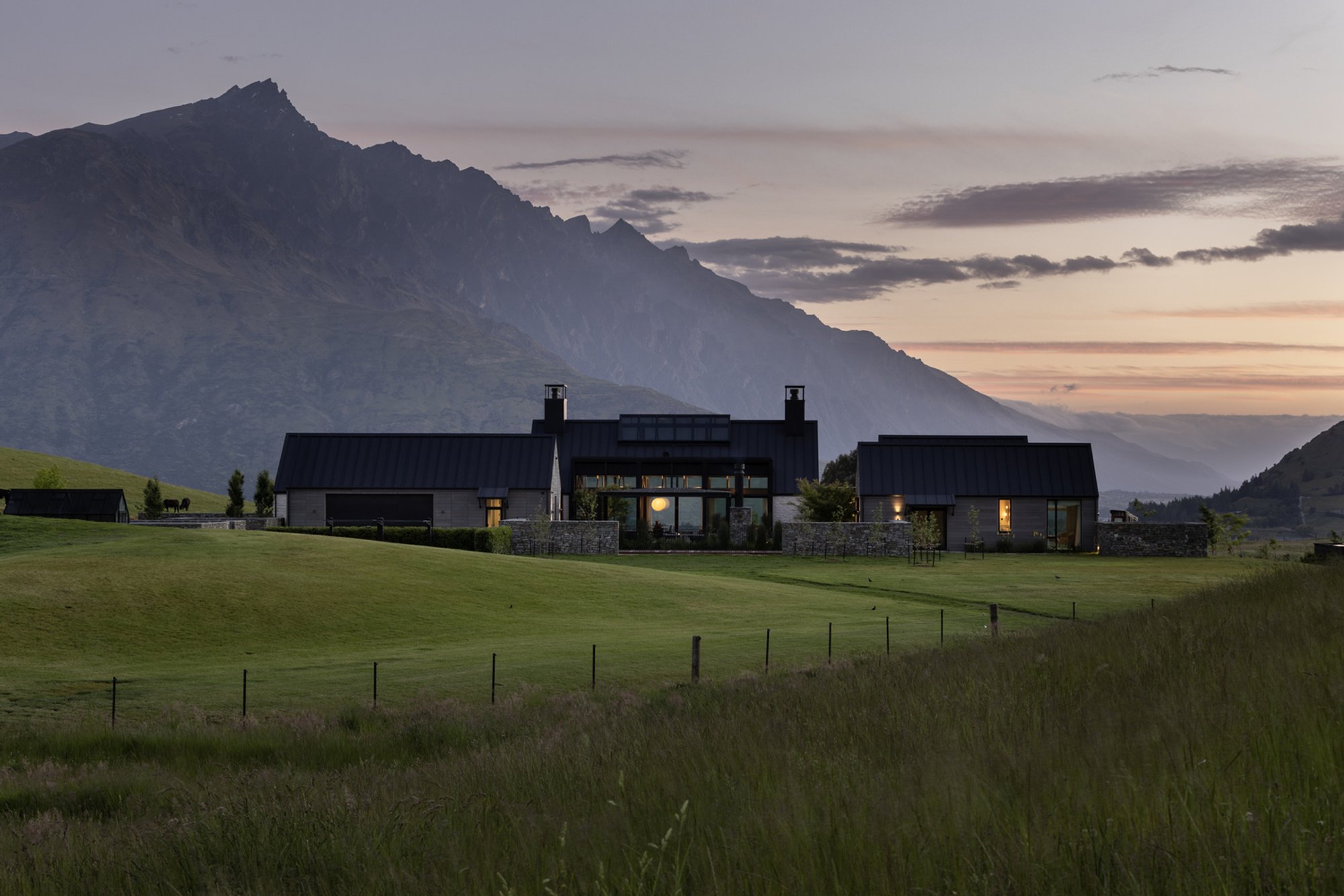
There is a well-worn playbook for building a house in the mountains near Queenstown: pick the highest point on the site, throw up a wall of glass, and let the view do the work. Sumich Chaplin Architects rejected that formula entirely for Speargrass House. Instead of a single monolithic volume competing with The Remarkables and Coronet Peak, principal architect Matt Chaplin broke the 625-square-meter program into a cluster of gabled pavilions that read, from a distance, like a small rural settlement. The strategy is as much about humility as it is about composition: a series of single-level structures gathered around a central north-facing courtyard, each one sized to feel domestic rather than heroic.
The clients, a family with four boys relocating from Sydney, wanted a forever home rather than a weekend retreat. That brief demanded robustness, warmth, and a spatial generosity that could absorb daily life without feeling cavernous. The answer lies in the in-between spaces: flat-roofed glazed galleries that stitch pavilions together, framing landscape on both sides and making every walk from bedroom to kitchen a small encounter with the alpine sky. It is a house that rewards movement, not just arrival.
A Compound in the Pasture
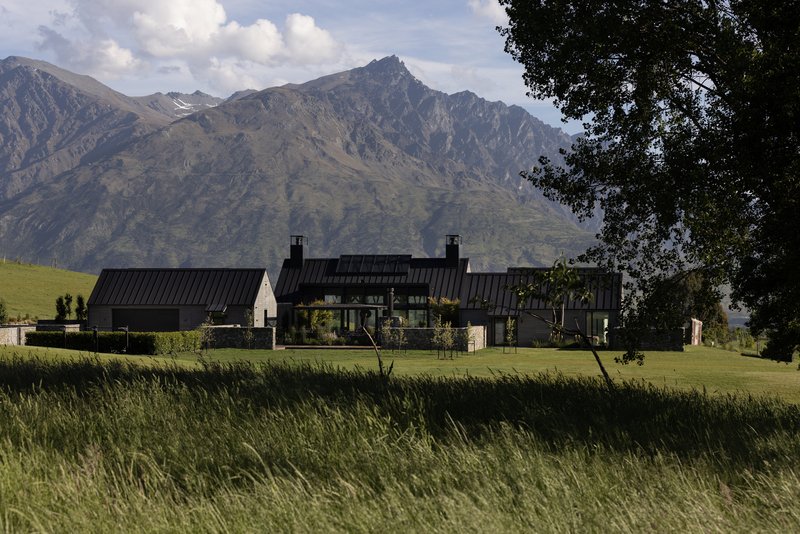
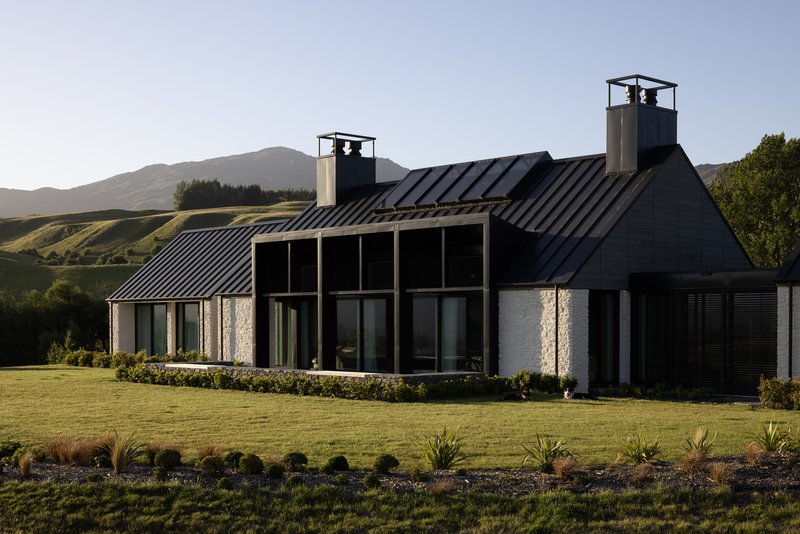
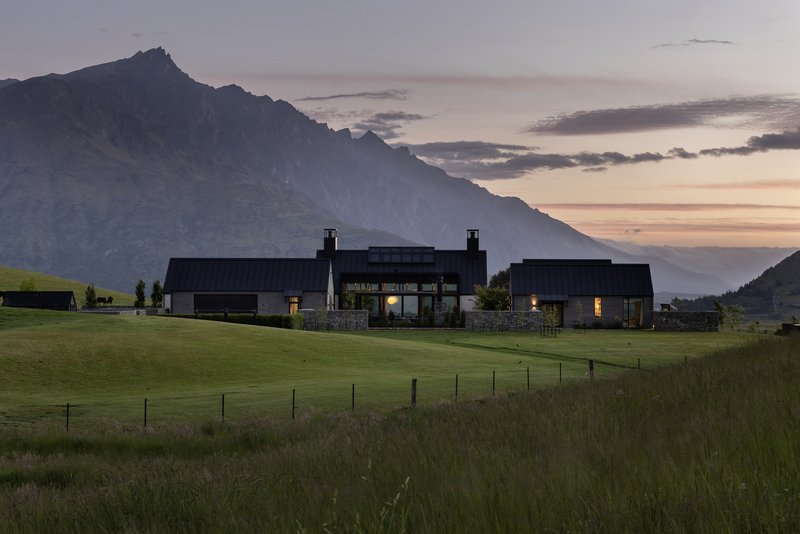
Seen from the surrounding paddocks, Speargrass House dissolves into a family of dark-roofed forms punctuated by paired chimneys. The hierarchy is legible but subtle: the tallest volumes house the main living spaces and bedrooms, while lower connective galleries defer to them. The dark metal roof trays have a low light-reflectance value, kept under 36 percent so they recede against the tussock and cloud rather than flash in the Central Otago sun.
Siting the house on a raised plateau accessed by a steep incline gives it panoramic orientation without aggressive perching. To the north, Coronet Peak fills the frame; to the south, The Remarkables anchor the horizon. The courtyard between the pavilions creates a sheltered microclimate, a useful counter to the winds that sweep across the Wakatipu Basin. It is farmstead logic applied with architectural precision.
Stone, Timber, and the Weight of Local Precedent
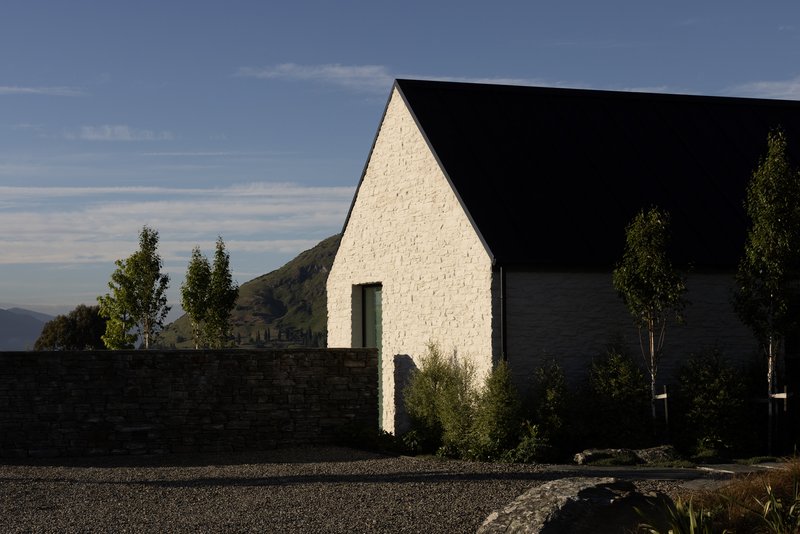
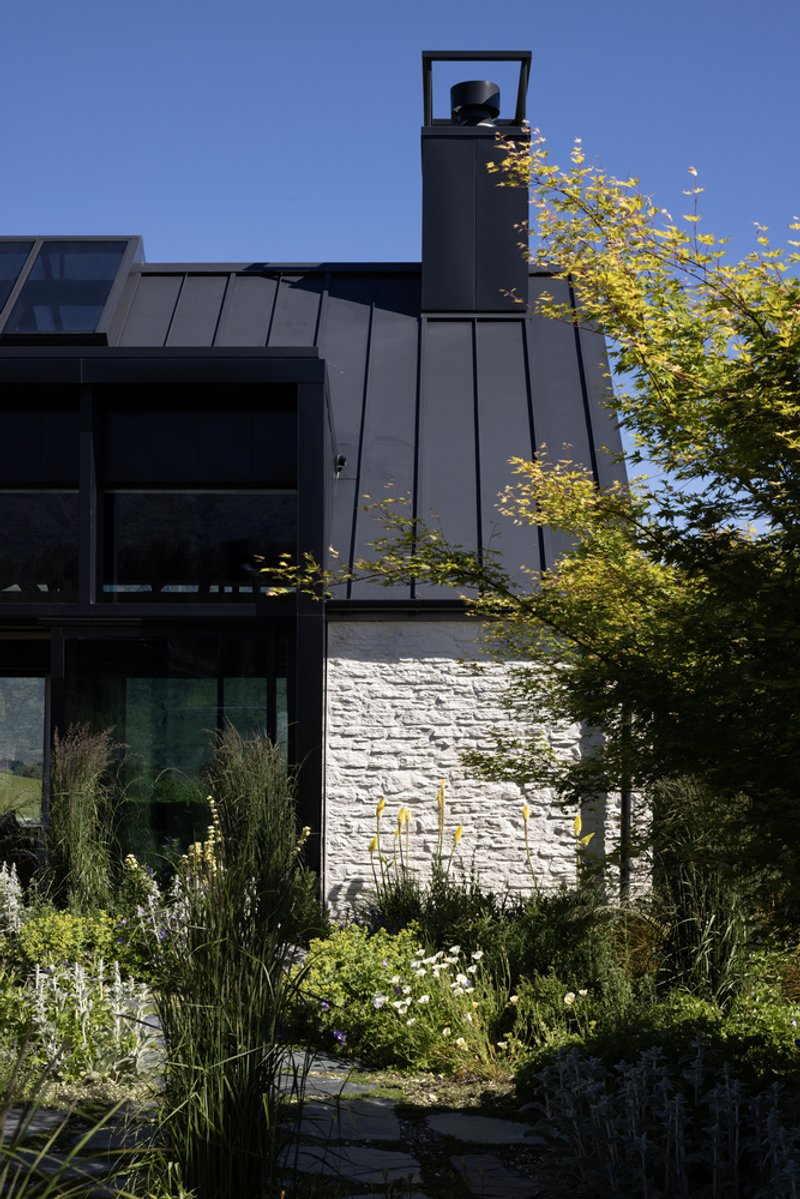
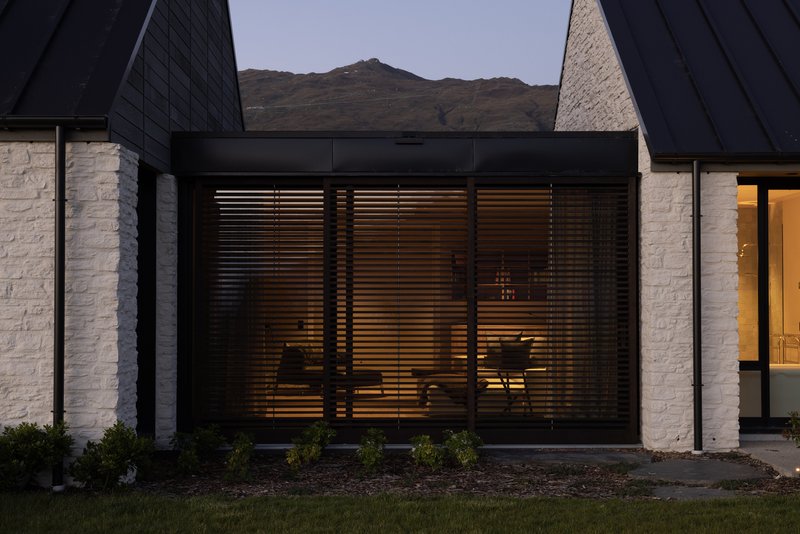
Two exterior materials carry most of the narrative. Schist stone, treated with a mineral whitewash finish, and band-sawn cedar weatherboards stained a washed hue together reference the limewashed cottages of the nearby Thurlby Domain. The whitewash softens the schist without concealing its texture, giving the walls a chalky, time-worn quality that a raw stone facade would lack. Where the cedar meets painted masonry, the joint is clean but not precious: horizontal louvers mediate between the two, adding a ventilation layer and a third tonal register.
The zinc-clad chimneys rising above the roofline are worth noting. They are deliberately oversized relative to domestic convention, scaled to hold their own against the mountain silhouettes behind them. A chimney is always a signal of hearth and habitation; here, doubled and darkened, they function almost as totems marking each pavilion's center of gravity.
Arrival Through the Trees
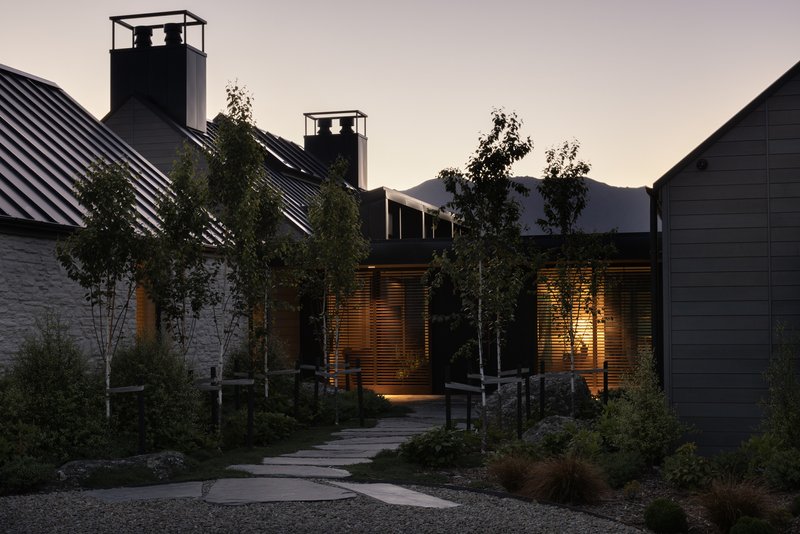
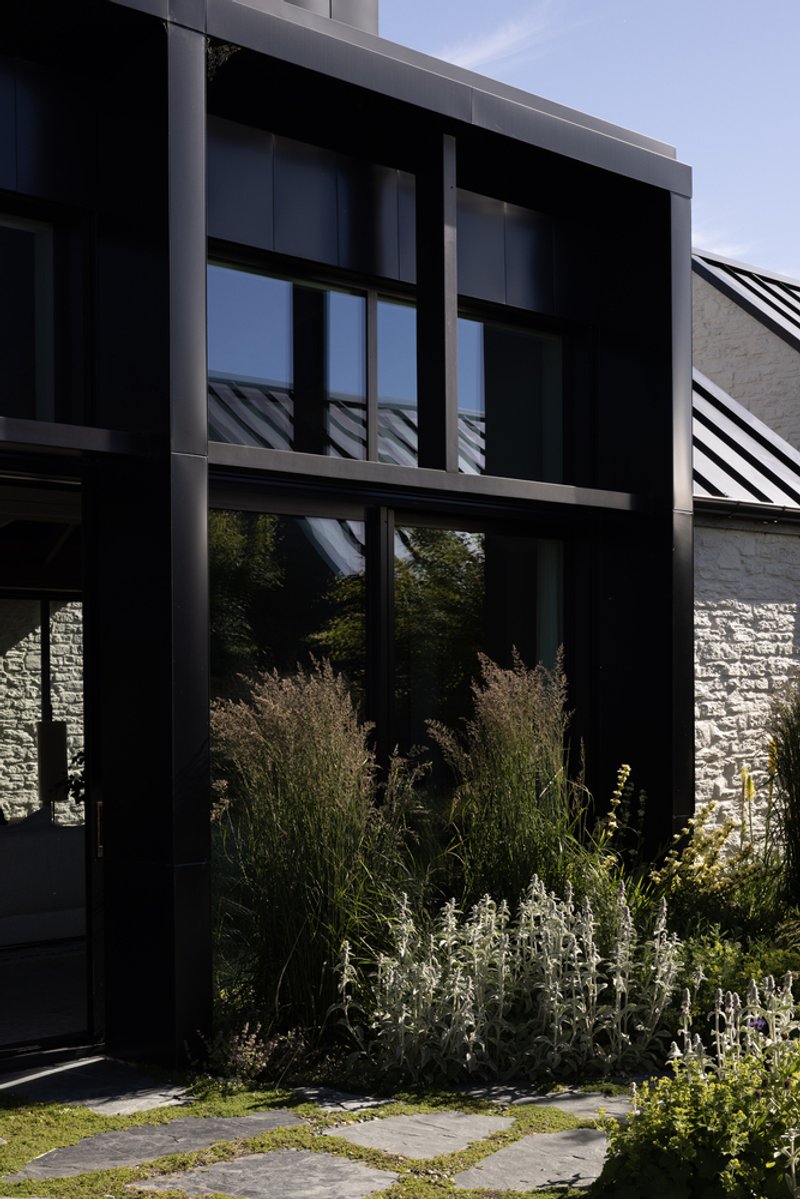
The approach sequence is deliberately understated. A path lined with young birch trees leads to louvered entry doors, compressing the view and quieting the drama of the wider landscape before the house opens up. It is a classic architectural move, borrowed more from Japanese residential tradition than from the grand driveways of Otago homesteads, and it works precisely because the surrounding scenery is so overwhelming. You arrive at a human-scaled threshold, not a panoramic reveal.
At dusk, the black-framed glazed facades glow against the white brick volumes, and tall grasses planted right up to the glass blur the line between garden and architecture. Landscape architect Suzanne Turley's planting strategy is integral here: native flora and large boulders ground the building in its immediate ecology rather than importing an ornamental garden vocabulary.
The Great Room and Interior Warmth
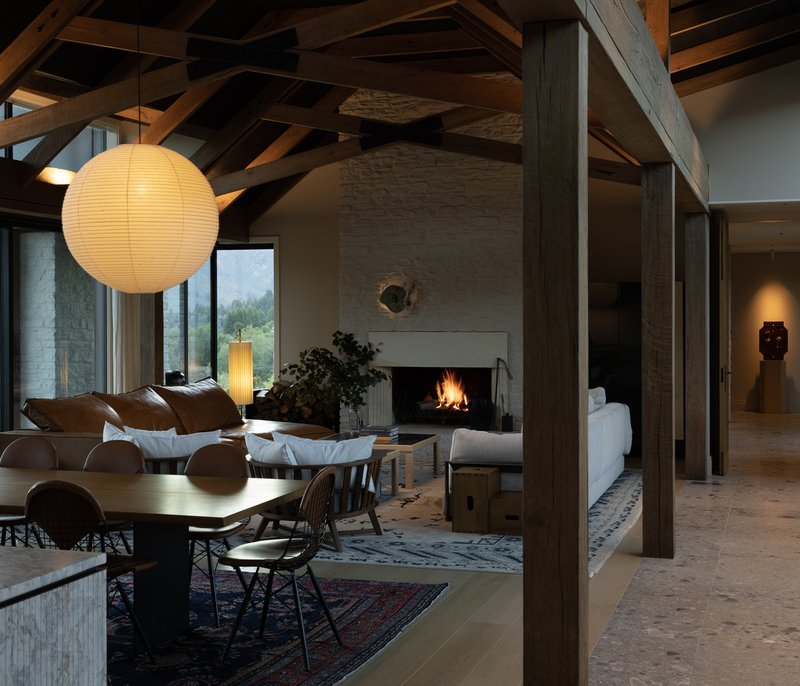
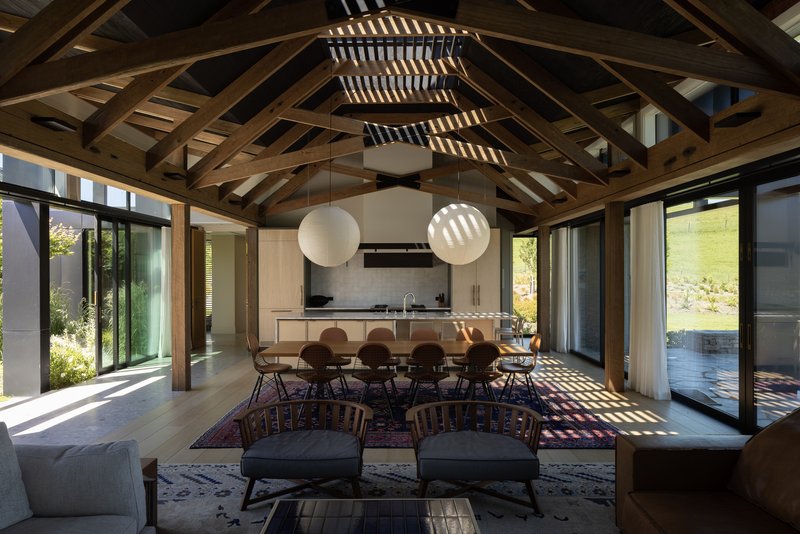
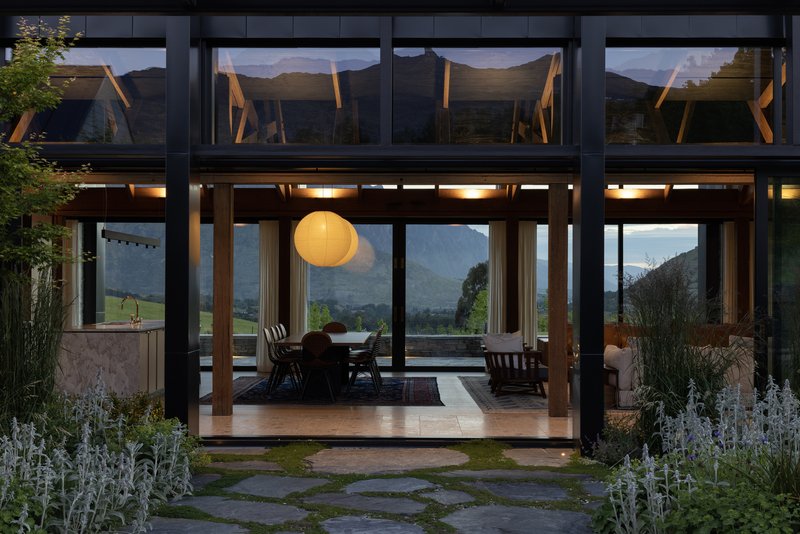
The central living pavilion, dubbed the 'great room,' is the spatial anchor of the house. Exposed timber roof trusses span the width of the space, their rhythm giving structure to what could otherwise read as an undifferentiated open plan. A fireplace set into the schist wall, with a surround of Oamaru native limestone, provides a focal mass. The spherical paper pendant hanging in front of it is a deliberate counterpoint: lightweight, translucent, almost impermanent against the solidity of stone and timber.
Interior designer Sarah-Jane Pyke of Sydney's Arent & Pyke collaborated with Chaplin on finishes, and the palette is restrained but specific. European oak floors, custom maple joinery, travertine and marble in the bathrooms. The effect is layered warmth rather than rusticity. Dappled sunlight crossing the dining floor through the trusses confirms that the inverted gable roof, inspired by an old deer-run structure found on the property, is doing more than formal work: it is orchestrating light.
Linking Galleries as Landscape Frames
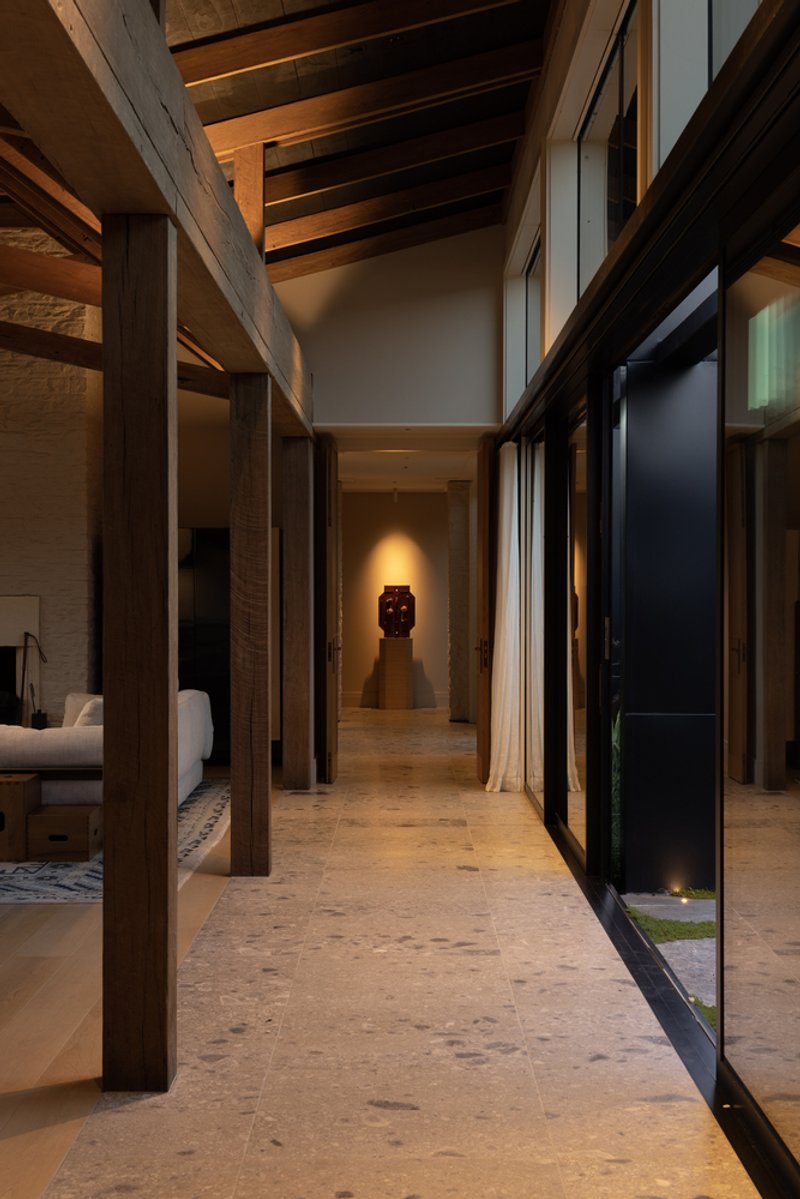
The flat-roofed corridors that connect the pavilions are among the most considered spaces in the house. Full-height glazing on both sides turns each passage into a vitrine for the landscape: mountains on one side, courtyard planting on the other. Exposed timber columns and ceiling beams maintain the structural legibility of the main rooms while signaling that you are in a transitional zone, moving between private and communal programs.
A backlit sculpture niche at the terminus of one corridor gives the circulation a destination beyond the next room. It is a small gesture, but it indicates an attention to the phenomenology of walking through a house that elevates Speargrass beyond competent planning into genuine architectural experience.
Plans and Drawings
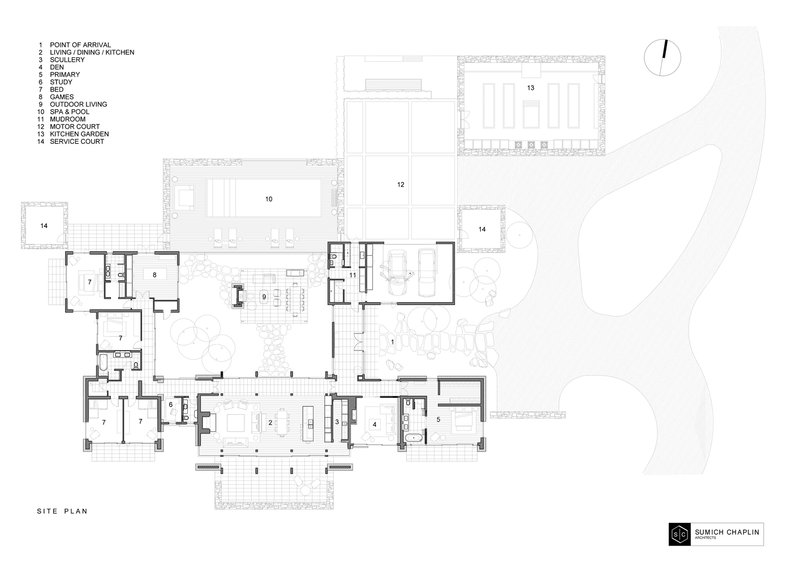
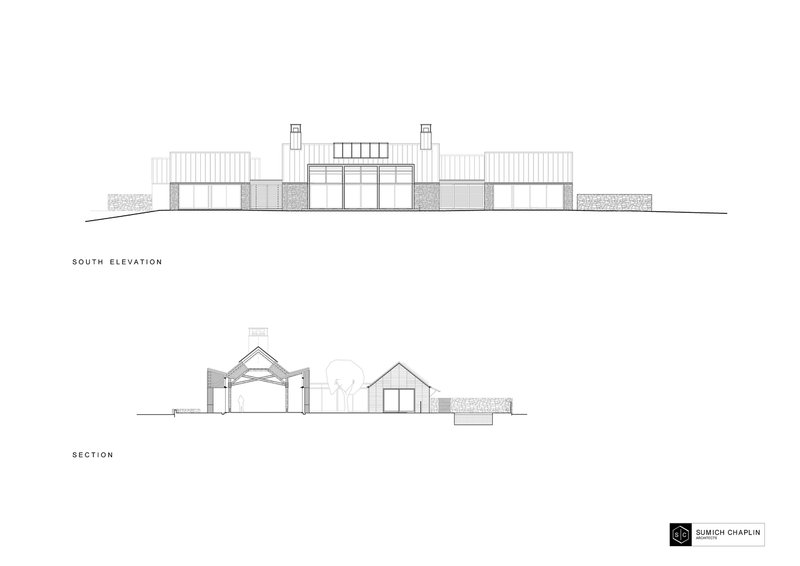
The site plan reveals the courtyard logic clearly: the main residence wraps three sides of a north-oriented outdoor room containing a pool and perennial planting, with service structures, a greenhouse, and an orchard dispersed across the broader 35-hectare property. The south elevation and section drawings confirm just how low the house sits on its plateau. No pavilion reaches a height that would break the horizon line from downhill vantage points, reinforcing the project's commitment to landscape deference over architectural spectacle.
Why This Project Matters
Queenstown's building boom has produced more than its share of glass-and-steel lodges that treat the landscape as a backdrop to be consumed. Speargrass House proposes the opposite relationship: the house is a participant in its terrain, borrowing the language of rural outbuildings and the material palette of historic Otago stone cottages to earn its place on the plateau. That Sumich Chaplin Architects achieved this without retreating into pastiche is the project's real accomplishment. The inverted gable, the glazed galleries, the courtyard plan are all unmistakably contemporary moves, but they serve the same purpose as the dry-stone walls of the neighboring properties: mediating between human occupation and an enormous, indifferent landscape.
For families commissioning rural homes in dramatic settings, the lesson here is one of restraint calibrated to ambition. Six hundred and twenty-five square meters is not a small house, but because the program is distributed across multiple pavilions, no single volume overwhelms its context. The courtyard creates shelter; the linking galleries create rhythm; the material choices create continuity with a regional building tradition that predates the ski resorts. It is a house that will age well, in a place that demands nothing less.
Speargrass House by Sumich Chaplin Architects, with interior design by Sarah-Jane Pyke of Arent & Pyke and landscape by Suzanne Turley Landscapes. Speargrass Flat Road, Queenstown, New Zealand. 625 m². Completed 2024. Photography by Simon Devitt.
About the Studio
Share Your Own Work on uni.xyz
If projects like this are the kind of work you want to make, uni.xyz is a place to publish your own, find collaborators, and enter design competitions.




Popular Articles
Popular articles from the community

3dor Concepts Wraps a Kerala Home in Mirrored Concrete Arcs Around a Courtyard Tree
In the Western Ghats foothills of Thamarassery, a 270 m² single-story house uses two curved volumes to frame nature as its center.
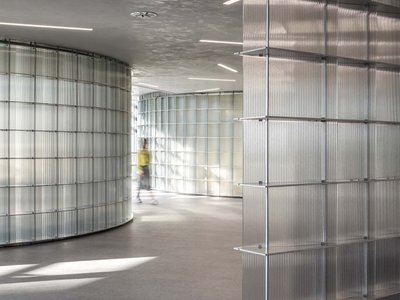
HCCH Studio Wraps a Shanghai High-Rise Office in Curved Walls of Translucent Glass
A 1,000 square meter fit-out in Lujiazui replaces the typical tech-office palette with layered glass, micro-cement, and quiet rigor.
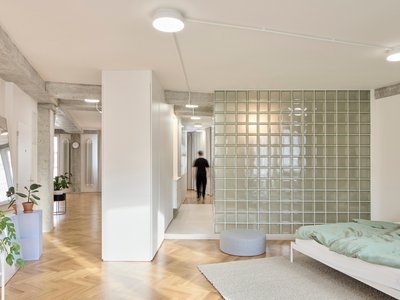
RDTH architekti Rips Out Nearly Every Wall in a Prague Apartment and Replaces Them with Furniture
A 101-square-meter post-war flat in Prague trades rigid partitions for a single rotated furniture block, curtains, and glass concrete.
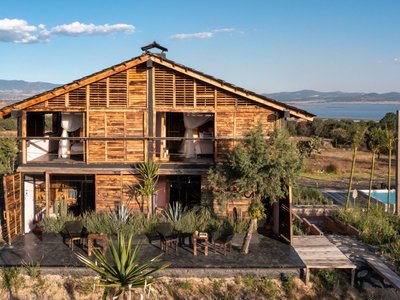
Fausto Terán and Toro Fuse Japanese Craft with Mexican Tradition in a Lakeside Retreat
Nakamura House pairs Shou-Sugi-Ban charred pine with handmade clay tile at the foot of Atlangatepec Lagoon in Mexico.


Similar Reads
You might also enjoy these articles

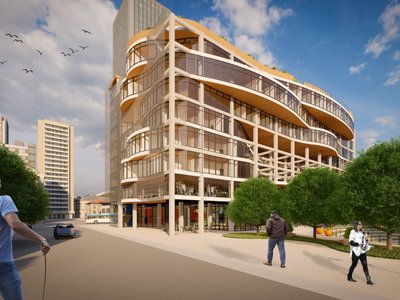
Olio Towers: A Mid-Rise for Performers That Fuses Housing, Rehearsal, and Stage
Located blocks from Houston's Theater District, this modular tower stacks living units around a central performance atrium.

Oasis: Modular Green Housing Carved into Dhaka's Urban Fabric
A shortlisted Plugin Housing entry reclaims unauthorized settlements in Dhaka with stepped concrete volumes, green roofs, and ventilation-driven design.

Black Hole: A Floating Megastructure for the Post-Physical Era
Emiliano Mazzarotto envisions a spherical, self-scaling arena where e-sports, digital hotels, and holographic stadiums replace traditional public space.
Compact & Sustainable Living in Piraeus: A Four-Level Family Home Built Around Light and Air
A narrow townhouse in one of Greece's densest port cities uses a central atrium and passive strategies to house three generations under one roof.


Explore Architecture Competitions
Discover active competitions in this discipline




The International Standard for Design Portfolios


The Global Benchmark for Architecture Dissertation Awards


The Global Benchmark for Graduation Excellence


Challenge to reimagine the Iron Throne
Comments (0)
Please login or sign up to add comments
No comments yet. Be the first to comment!