
Spiritual Journey to Oneness: Sacred Geometry as Architecture in Tokyo
A ritual landscape in Koto City channels chakra systems, crystalline water, and sacred geometry into five phases of spatial healing.


What happens when a building is programmed not for office hours or retail traffic, but for energetic transformation? In Koto City, Tokyo, a circular structure rises around a central sphere, organizing its entire plan around five sequential phases of spiritual experience: Inward, Purify, Reflect, Connect, and Outward. Rather than assigning rooms to functions, the architecture assigns spatial zones to states of consciousness, using curved walls, quartz-infused water channels, and sacred geometric forms to guide visitors through a progressive realignment of body, mind, and spirit.
The project, titled "Spiritual Journey to Oneness," is the work of Yoshie Takeo, who received the People's Choice Award in the Di - Generic Cities: Tokyo competition. It proposes a building that transcends religious and cultural boundaries, drawing on chakra systems, Metatron's Cube, the stellated dodecahedron, and other symbolic forms from multiple belief traditions to create what Takeo describes as a universal platform for healing and connection. In a competition asking designers to confront the homogenization of urban environments, this entry argues that the antidote to the generic city is not more spectacle, but more depth.
A Circular Plan Built for Ritual Movement
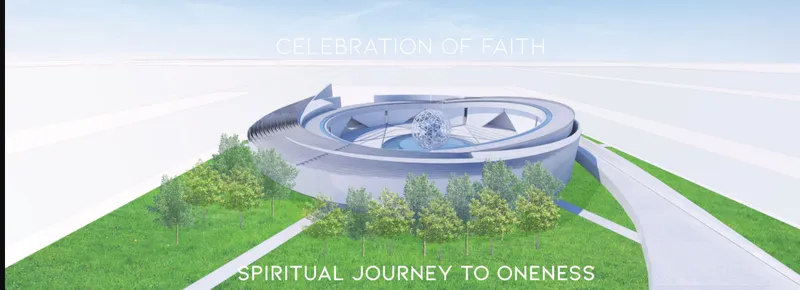
From above, the building reads as a spiral. Ramps wind around a central courtyard, establishing a clear rotational path that visitors follow as they progress through the five experiential phases. The plan rejects corridor logic in favor of continuous movement, wrapping the visitor inward toward the core. Surrounding lawns and trees provide a buffer from the urban context, establishing a threshold between the pace of Tokyo and the tempo of the interior journey.
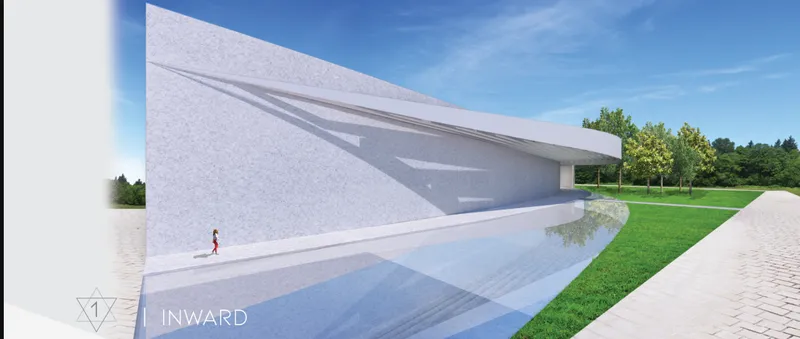
At ground level, the facade reveals a different character entirely. White cantilevered surfaces are perforated with triangular openings, casting patterned shadows that shift throughout the day. A reflecting pool extends along the building's edge, doubling the geometric facade in still water. The architecture channels what Takeo calls the union of Divine Feminine and Masculine energies: soft curves and nurturing forms coexist with angular transitions and crystalline precision. The result is a structure that feels simultaneously monumental and intimate.
Water as Purification, Not Decoration
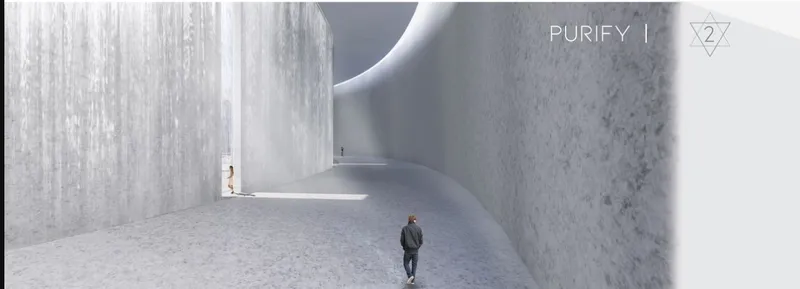
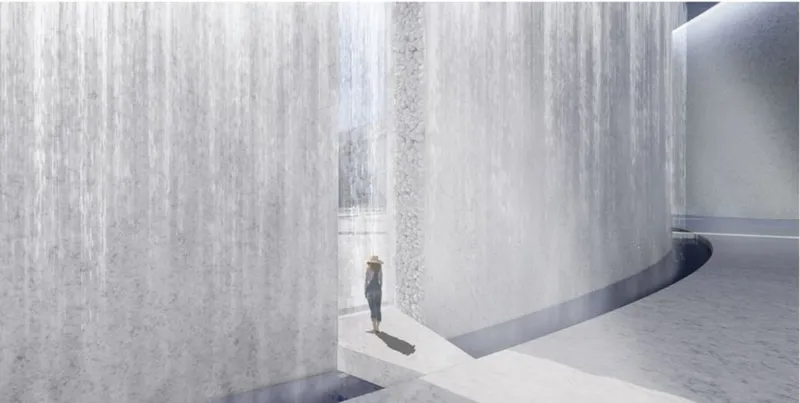
The Purify phase is the project's most visceral moment. Visitors pass through corridors where water cascades down curved white surfaces, creating a spatial envelope of sound and mist. Grey granite lines the lower surfaces while clear quartz elements are integrated into the water channels, selected not only for their material qualities but for their claimed metaphysical resonance. Takeo treats water not as an ornamental amenity but as an active agent of cleansing, using its movement and sound to mark the transition from external awareness to internal focus.
The close-up view of the vertical water feature reveals the careful material choreography at work. Textured white walls direct the cascade into controlled streams, and sunlight penetrates from above to illuminate the figure standing below. The scale of the water wall relative to the human body is striking: it envelops without overwhelming, creating a moment of immersion rather than spectacle. Every surface participates in the sensory sequence, whether by channeling light, directing water, or absorbing sound.
The Sphere at the Center: Unity Made Spatial
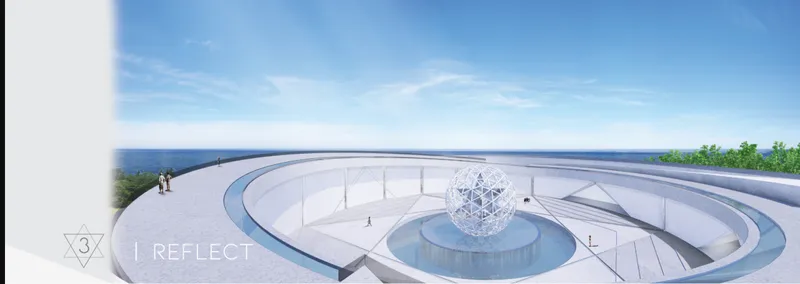
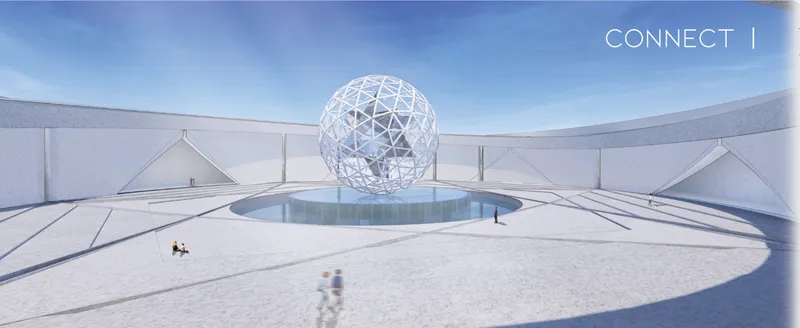
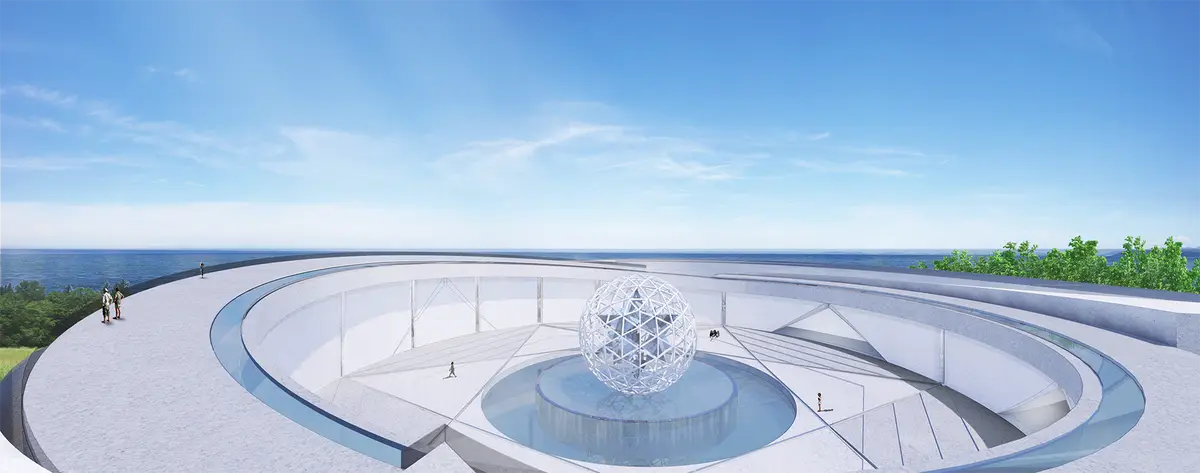
At the culmination of the inward journey sits the Connect phase: a white geodesic sphere hovering above a shallow circular pool. Seen from the rooftop courtyard, the sphere sits against open sky, its triangulated surface echoing the stellated dodecahedron and other sacred geometric forms that recur throughout the building. The reflecting pool beneath it creates a second, inverted sphere, reinforcing the project's central theme of duality resolved into unity. Takeo positions this as the moment where visitors align their inner polarities, a spatial representation of what she calls unity consciousness.
The courtyard-level view amplifies this effect. The sphere appears to float, its weight dissolved by the water below and the pale sky above. There is no ornament, no signage, no programmatic clutter. The space is deliberately emptied to a single object and a single material relationship: sphere, water, light. It is the quietest moment in the building and, by design, the most concentrated. The architecture stops performing and simply holds space, which may be the most radical gesture in the entire project.
Why This Project Matters
The Di - Generic Cities competition asks a pointed question: what can architecture offer when urban environments around the world begin to look and feel the same? Takeo's answer is not formal novelty or programmatic complexity but experiential depth. By structuring a building around a spiritual journey with clearly defined phases, she proposes that architecture's oldest purpose, to elevate and transform human experience, is also its most urgent contemporary task. The building does not need to look different from every angle; it needs to feel different at every step.
What makes "Spiritual Journey to Oneness" compelling is its refusal to treat spirituality as atmosphere. The quartz, the water walls, the sacred geometry, the chakra-aligned spatial sequence: these are not stylistic choices layered onto a conventional plan. They are the plan. The entire organization of the building, from entrance to central sphere, is derived from the logic of energetic transformation. Whether or not one subscribes to the metaphysical framework, the architectural commitment is real. Every material, every turn, every threshold is coded for a specific experiential purpose. In a discipline that often separates meaning from form, that discipline is worth paying attention to.
View the Full Project
About the Designers
Designer: Yoshie Takeo
Enter a Design Competition on uni.xyz
uni.xyz runs architecture and design competitions year-round that reward proposals with spatial conviction and real site intelligence.
Project credits: Spiritual Journey to Oneness by Yoshie Takeo Di - Generic Cities: Tokyo (uni.xyz).


Popular Articles
Popular articles from the community


Juan García Correa, John González and Claudia Rueda Sink a Circular Amphitheater into a Manizales Engineering Building
On the La Nubia campus in Manizales, Colombia, the S1 Building folds labs and offices into a hillside of ramped lawns that double as a campus route.

Jaramillo Van Sluys Arquitectura and Urbanismo Turn a Demolished Registry Lot in Quito into an Orchard Plaza
In Quito's Centro Histórico, a 2,800 m² plaza exposes the San Agustín convent wall and redraws its lost Augustinian orchard in volcanic stone.

David Ortega Stacks a Two-Story Mexico City Penthouse Around a Steel Stair and a Pergola-Shaded Roof Terrace
In Colonia Roma, a 300 m² penthouse uses oak joinery, a planted steel stair and a slatted roof pergola to make a new-build apartment feel like a house.

David Macias Steps a Doorless Stone and Plaster House Down a Tropical Colombian Hillside
In the humid hills of Colombia, Threshold House replaces the front door with an open void and terraces its 850 m² down the slope instead of fighting it.

Similar Reads
You might also enjoy these articles


Vereda Arquitetos Renovates a 40-Square-Meter Apartment Inside Niemeyer's Copan Building
A compact unit in São Paulo's most iconic residential tower gets a material overhaul that pairs exposed concrete with bold blue Formica.

Shakur's House: Exposed Brick as an Interior Organiser in a 168 m² Mashhad Residence
Brick moves indoors in this Mashhad residence, where masonry walls, glass partitions and teal planes sequence a compact home without closing it off.

Day and Night Park: A Time-Based Urban Newsstand in Beijing
A temporary urban newsstand in Beijing blending travel, light, and reading through poetic colors, compact form, and community-focused design.

Modernist Patio Renovation in El Masnou, Barcelona by Oliver Segura Arquitectura + Cebrià Arquitectura
Modernist patio renovation blending tradition and innovation with a movable pool, leveled floors, and Catalan materials in El Masnou.

Explore Sacred Space Competitions
Discover active competitions in this discipline

Design Challenge - Contemporary interpretation of a religious complex

Challenge to design luxury tourism on rails

VR headsets Storefront design competition

Designing a staircase for a client
Comments (0)
Please login or sign up to add comments
No comments yet. Be the first to comment!