
Splinter Society Wraps a Seaside Family Home in Curtains, Concrete, and Pink Steel
A bold material palette and layered courtyards define this large family house on a sloped site in Ocean Grove, Australia.


A house at the coast can default to bleached timber and safe neutrals faster than a wave breaks. Splinter Society clearly has no interest in that reflex. Their Coastal House in Ocean Grove, completed in 2025, wraps a large family home in a collage of concrete, vertical timber cladding, sheer curtain walls, and panels of pink metal that would look at home on an Italian Riviera cabana. The result is a house that reads as unapologetically material-forward while staying deeply rooted in its sloping seaside lot.
What makes the project worth studying is the way it distributes domestic life across grade changes and courtyards rather than stacking it in a single box. The two-story volume addresses the street with a curtained upper mass that floats over a recessed ground level, while the rear opens onto a courtyard sequence of timber deck, dark-bottomed pool, and overhanging tree canopy. There is no single hero facade here. Every elevation deploys a different material strategy, and the section does at least as much work as the plan.
A Street Face Built on Tension
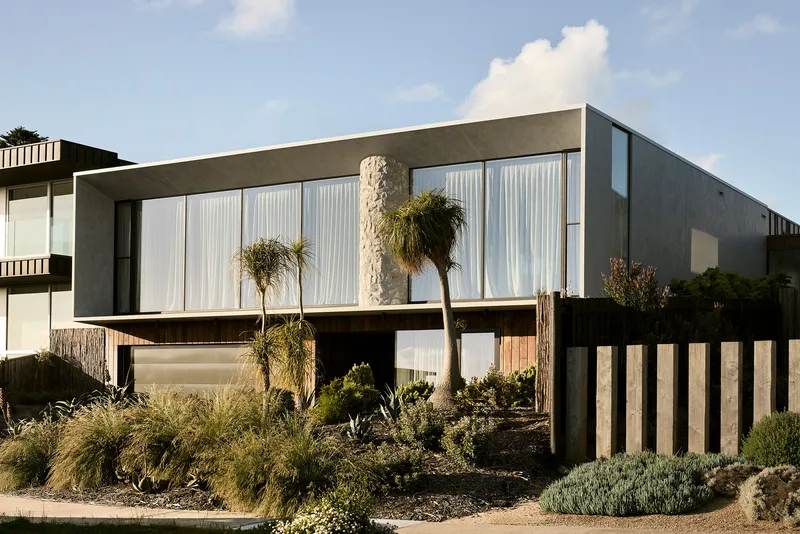
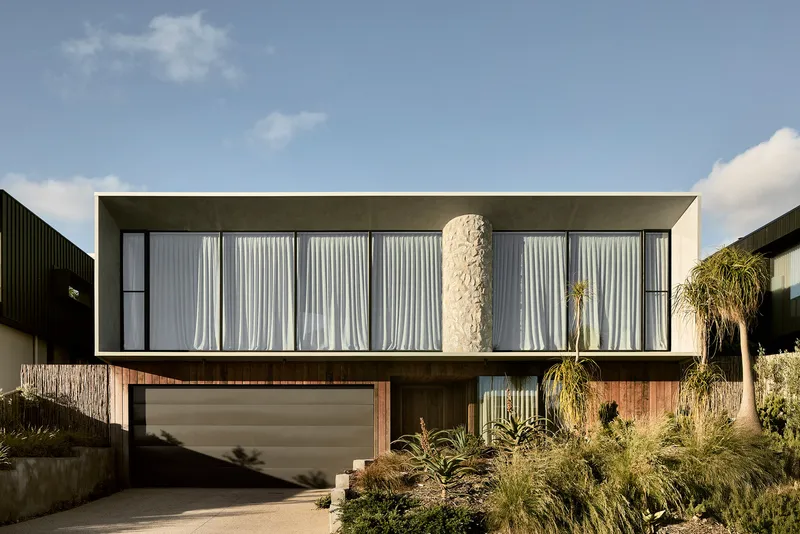
From the street, Coastal House plays a game of weight versus transparency. The upper volume is formed in concrete, solid and cantilevered, yet its full-width glazing is veiled behind floor-to-ceiling sheer curtains that billow softly and catch light. Below, the ground level retreats behind vertical timber cladding and a garage door that nearly disappears into the material rhythm. The forecourt planting of palms and ornamental grasses does real compositional work: it mediates between suburban footpath and private threshold without needing a fence.
The effect is a facade that shifts constantly. In morning light the curtains glow white against raw concrete. By afternoon, as the succulents at the entry porch catch sun, the timber battens throw long shadows and the house feels warmer, almost Californian. It is a front elevation that never quite settles, which is the point.
Entry and the Ground Plane
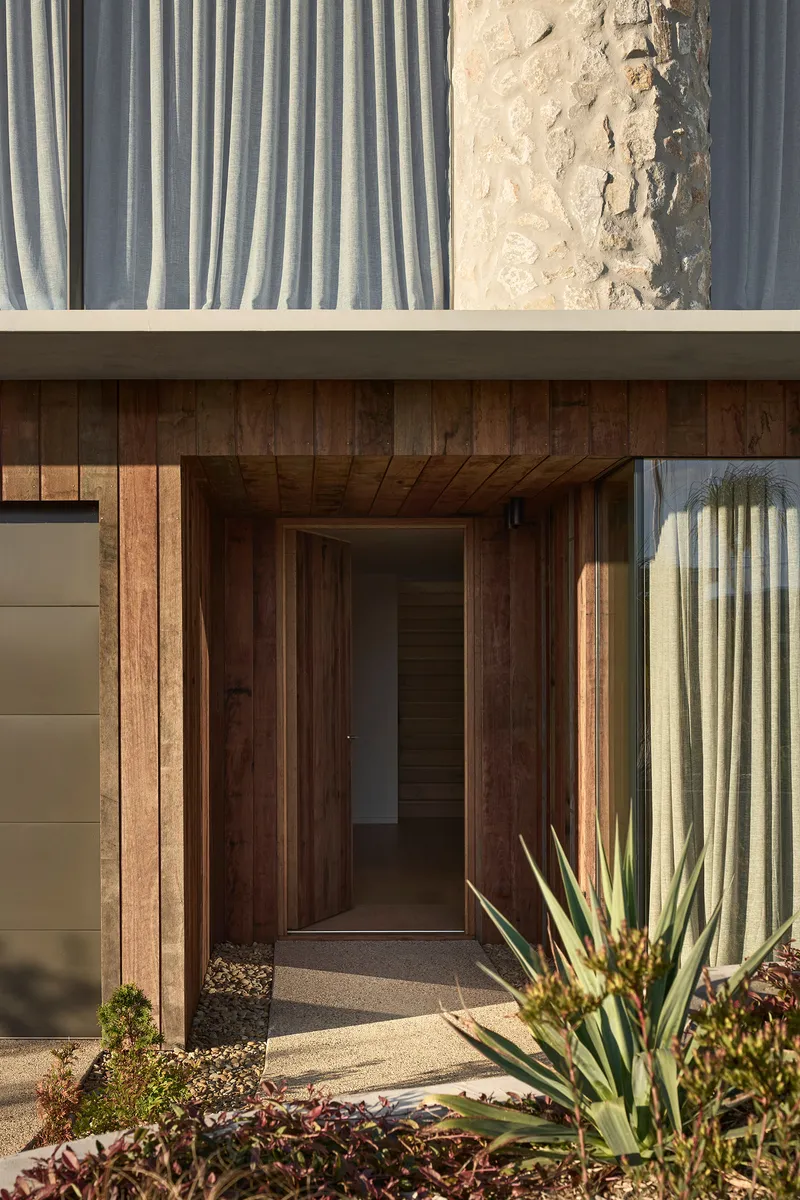
The front porch tucks under exposed rafters and tall vertical timber boards, establishing a threshold that is generous without being grand. Succulents in planters and the low rake of the roof soffit compress the view before you step inside. Splinter Society treats arrival as a transition in light and scale, not just a door.
Spending material budget at the entry is a move more often associated with civic or commercial work. Here it signals that the house takes its public-facing obligations seriously. The timber cladding wraps from the porch into the driveway zone, creating a coherent ground plane that unifies garage, entry, and planted forecourt into a single surface language.
The Courtyard and Pool as a Second Living Room
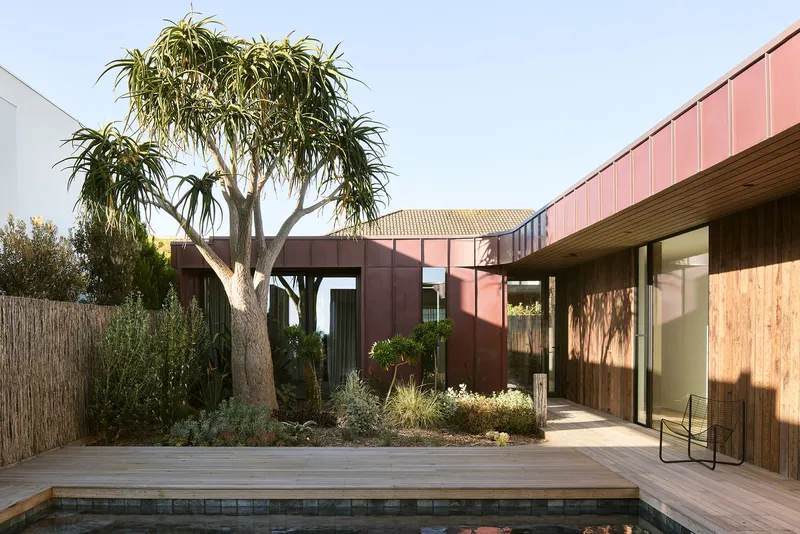
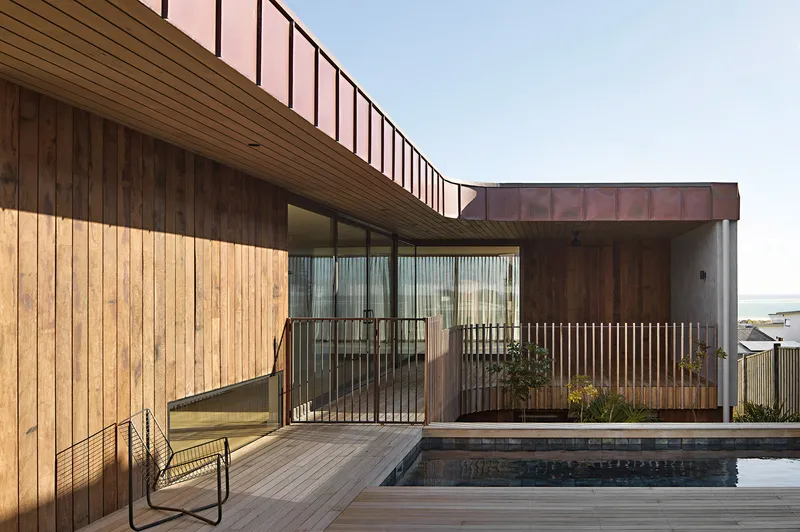
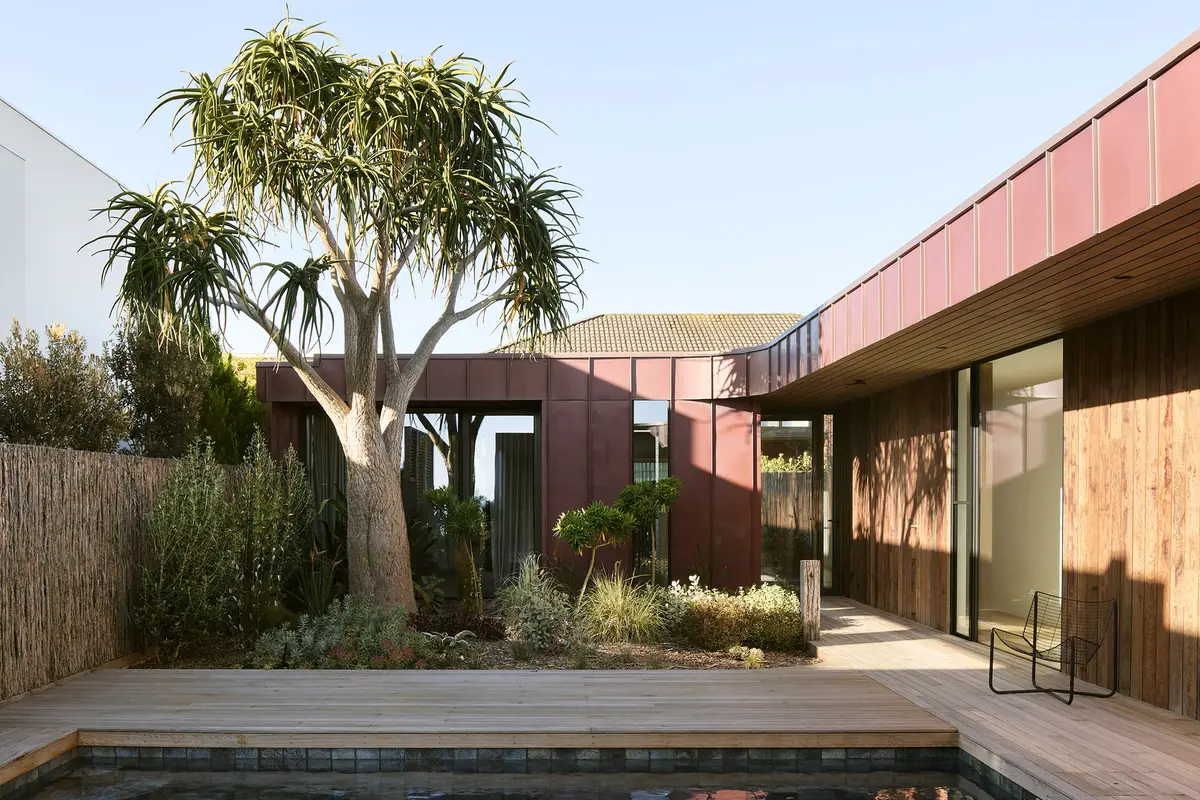
Flip the house around and the character shifts entirely. The rear courtyard is where Coastal House truly lives. A timber deck flows from the interior to the edge of a dark-bottomed pool, and an overhanging tree casts dappled shadows across that pink metal cladding, which reads alternately as blush, salmon, or terracotta depending on the hour. It is a brave color choice for a coastal Australian home, and it works precisely because it bounces warm reflected light into the courtyard space.
The pool sits tight against the building, surrounded by blonde wood on one side and the pink panels on the other. Rather than being an object dropped into a garden, the pool is architecturally integrated: its dark water surface becomes a reflecting device that extends the perceived depth of the outdoor room. The courtyard operates less like a backyard and more like a roofless interior, enclosed on three sides and carefully proportioned.
Interiors Tuned to the Horizon
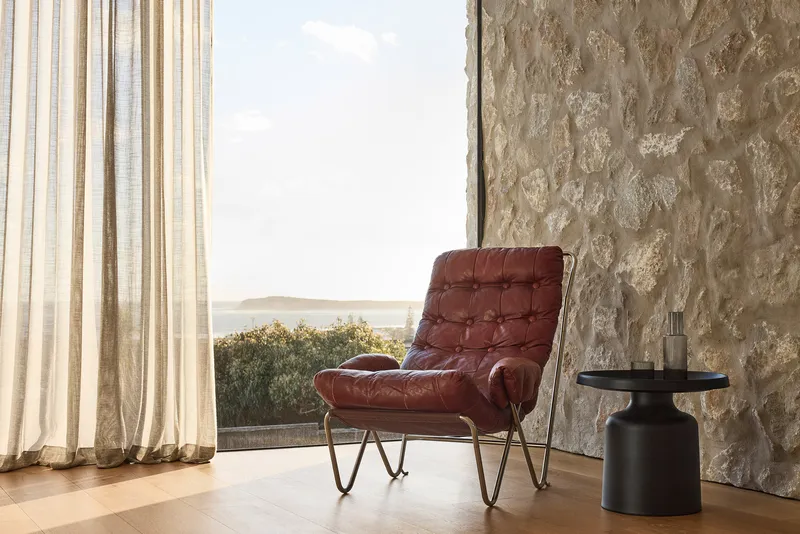
A corner glimpse into the upper living spaces reveals a textured stone wall paired with sheer curtains and a leather armchair angled toward the coast. The interior palette is restrained: warm stone, soft fabric, and a coastal view framed with intention. There is no attempt at maximalism inside; the material fireworks happen on the exterior.
The curtains that define the street facade repeat here as interior devices, filtering daylight and softening the hard-edged concrete and stone. It is a detail that connects inside and outside into a single atmospheric logic. When the afternoon breeze moves through, the curtains animate the interiors the same way the tree canopy animates the courtyard below.
Plans and Drawings
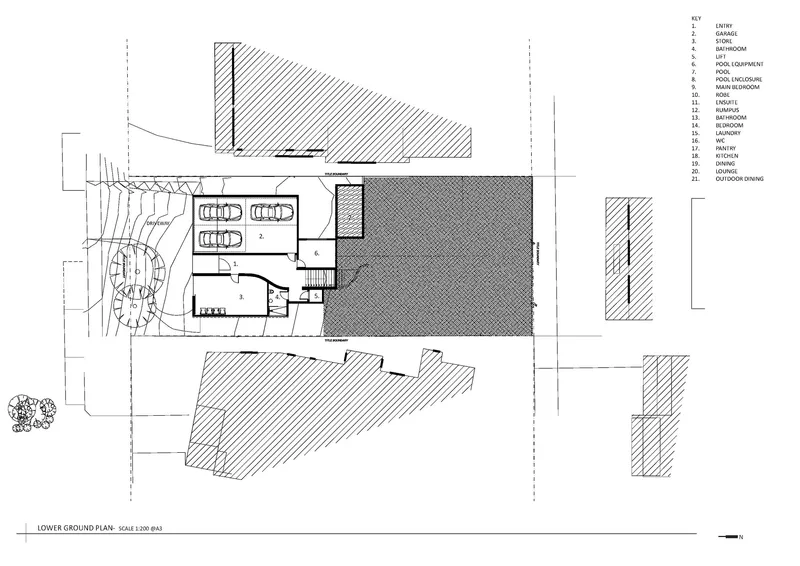
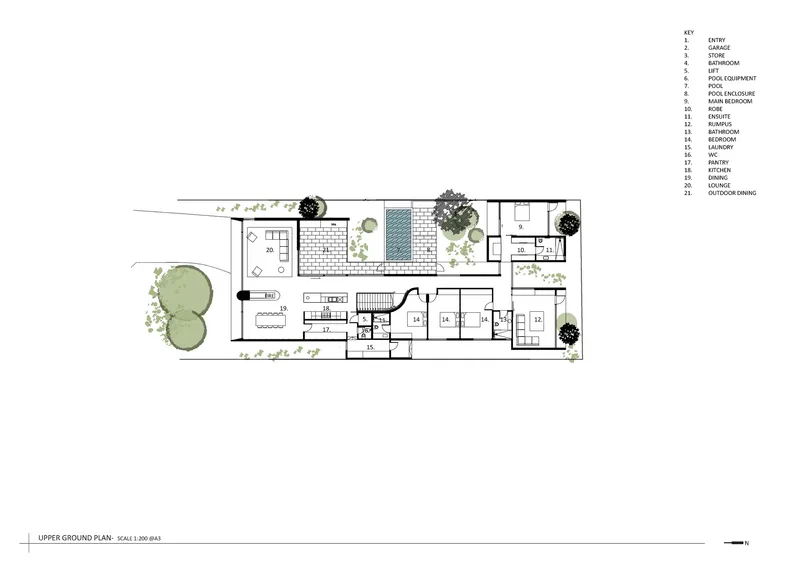
The two plan drawings reveal how the program splits across the slope. At the lower ground level, the garage and service spaces occupy the street side while the pool and rear courtyard extend toward the backyard. The upper ground plan shows the main living spaces organized around internal courtyards, with trees rendered in green watercolor suggesting that landscape was considered from the first sketch, not added as afterthought.
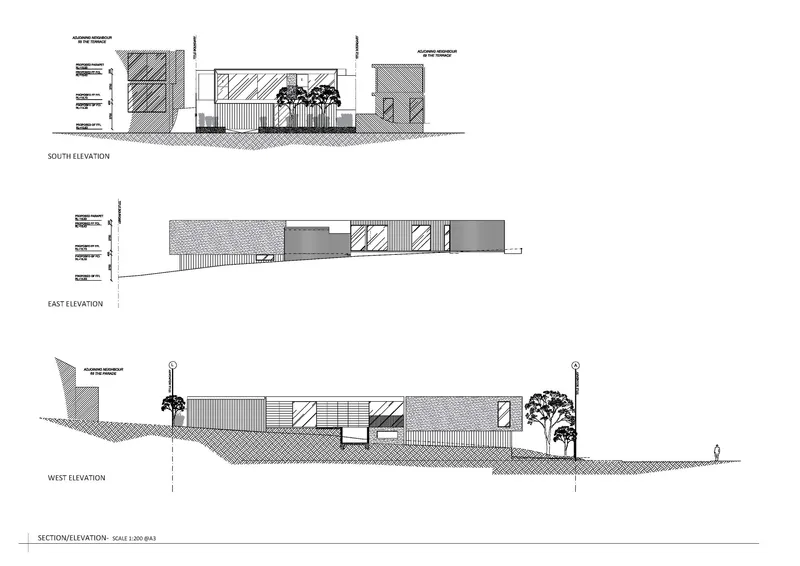
The south, east, and west elevations confirm what the photographs suggest: no two facades share the same material strategy. The sloped site allows the house to present a modest single-story face in one direction and a full two-story composition in another. Contour lines on the site plan show a meaningful grade change that Splinter Society exploits to bury the car and pool level, keeping the upper living spaces at the scale of adjacent houses.
Why This Project Matters
Coastal House matters because it demonstrates that a spec-friendly family home in a beach town does not have to surrender its ambitions. Splinter Society has assembled a material palette that would be risky for a gallery or restaurant, let alone a suburban residence, and they have made it land convincingly. The pink cladding, the curtain-wall facade, the dark pool, and the layered courtyard sequence all point to a practice willing to push developers and homeowners toward something genuinely specific.
More broadly, the project is a lesson in sectional thinking. By working with the slope rather than flattening it, the architects create distinct experiential zones across two levels without inflating the house's street presence. Ocean Grove gets a home that is at once quietly contextual and visually memorable, a combination that is harder to pull off than either quality on its own.
Coastal House by Splinter Society. Ocean Grove, Australia. Completed 2025. Category: Houses.
About the Studio
Share Your Own Work on uni.xyz
If projects like this are the kind of work you want to make, uni.xyz is a place to publish your own, find collaborators, and enter design competitions.


Popular Articles
Popular articles from the community


The Amber Palace Opera: A Geological Fiction Surfaces on Tallinn's Baltic Waterfront
Pierre Brillard reimagines a Baltic legend as a public landscape, opera house, and waterfront promenade rooted in Tallinn's coastal identity.

Opera on the Sea: Driftwood Logic Shapes a Timber Opera House on Estonia's Coast
Trevor Orgill's opera house translates the entangled drift of floating timber into a civic building where wood, water, and music converge.

Cloaked Colonization: A Mobile Underwater Habitat That Moves Like a Fish
Micah Abaya's shortlisted EHC Pacific entry reimagines ocean settlement as a dispersed network of self-sustaining architectural organisms.

Faces of the Soviet Avant-Garde: Turning Moscow's Street Names into an Open-Air Museum
A network of sculptural installations across a Moscow residential district transforms forgotten architect names into spatial encounters with cultural memor

Similar Reads
You might also enjoy these articles

Pixel Gardens: One Repeated Module Stacked Into a Terraced Social Housing Tower for Famagusta
Salem Bader's shortlisted housing tower builds a vertical neighbourhood from one repeated module, offsetting units to carve terraces, light and air.

Bao Huynh Watercolor Atelier: A Serene Art Retreat in Hội An
Bao Huynh Watercolor Atelier in Hội An blends multifunctional art spaces, sustainable design, local materials, and family-friendly living in a serene environment.

Atelier Macri Concept Store Interior Design by CASE-REAL
Atelier Macri store features a "ko" counter, walnut wood details, cork displays, blending retail, gallery, and seamless customer experiences.

Manuel Vargas Izquierdo Stadium and High-Performance Sports Center: Architectural Excellence in Jalpa de Méndez
The Manuel Vargas Izquierdo Stadium blends sustainable design, inclusive sports facilities, and cultural-inspired architecture, revitalizing Jalpa de Méndez’s public spaces.


Comments (0)
Please login or sign up to add comments
No comments yet. Be the first to comment!