

SSP SchürmannSpannel Wraps a Dortmund School in Pink and Rethinks the Corridor
A low-tech, U-shaped comprehensive school in Dortmund Westerfilde trades dark hallways for conical self-learning zones and a rooftop library.


School buildings rarely get to start over. Most accumulate extensions, temporary walls, and compromises until the original logic is completely buried. That was the situation facing Dortmund's Reinoldi Comprehensive School, where decades of piecemeal additions had rendered the main building obsolete. Rather than renovate again, the city commissioned SSP SchürmannSpannel to demolish and rebuild, a decision rooted not in aesthetics but in a genuine shift in how the school teaches. The result, completed in 2020, is a 5,300 square meter building that treats circulation space as learning space and wraps the whole thing in an unapologetically rosy skin.
What makes Reinoldi worth studying is not the color, though the pink facade certainly announces itself across the flat Westerfilde landscape. It is the way the plan uses a U-shaped footprint and a central patio to organize eighteen classrooms into clusters, then transforms the corridors connecting them into conical widenings designed explicitly for self-directed study. The building is low-tech by intent: mechanical ventilation with heat recovery, a green roof carrying a 53 kWp photovoltaic array, and 184 square meters of facade greening. At €27.7 million, it is not cheap, but it is legible. Every decision reads clearly in plan and section.
A Pink Signal on a Flat Campus
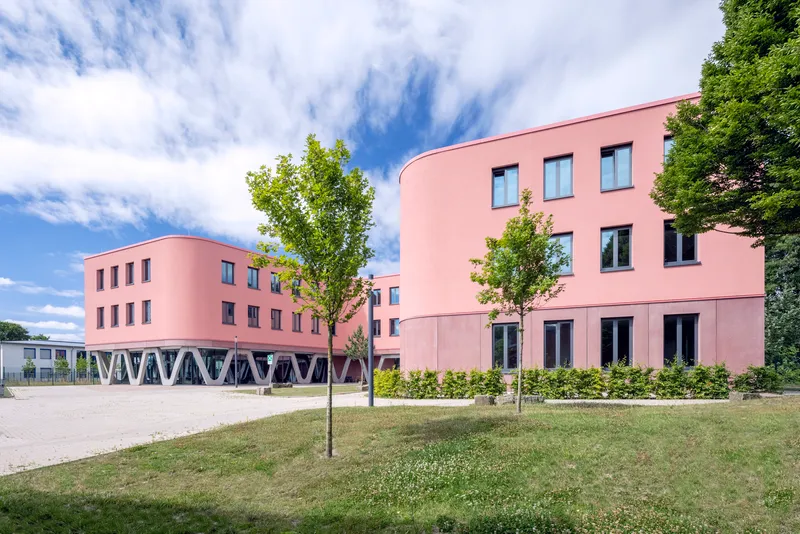
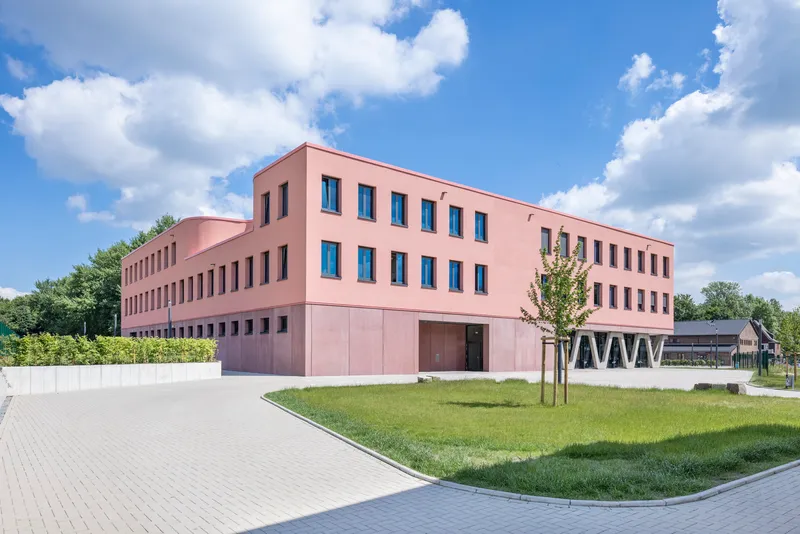
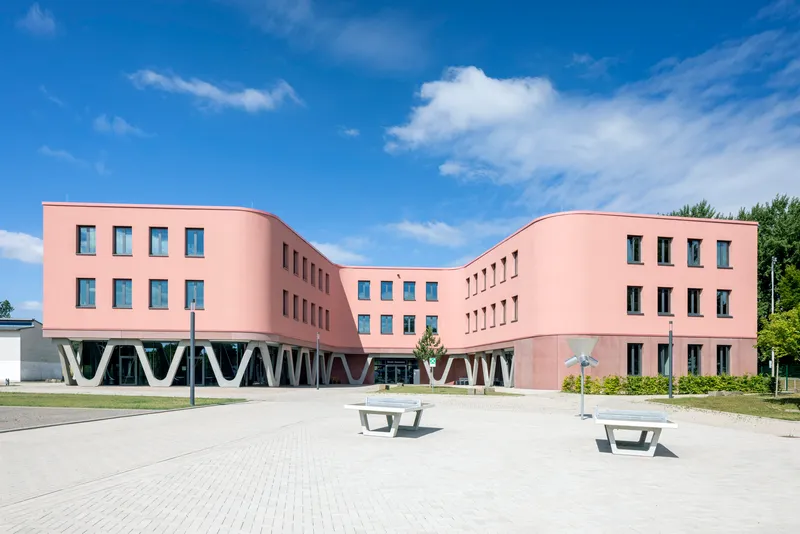
The building pulls away from the street and turns toward the rear of the school campus, forming an urban grouping with the existing gymnasiums and natural sciences wing. Its rendered facade reads as a single warm volume, but the massing is carefully split into two wings visible through shifts in materiality and plane. Rounded corners soften the mass and give the building an almost institutional friendliness, a quality reinforced by the V-shaped concrete columns that lift the ground floor open to the schoolyard. Young trees and simple lawn establish a spare landscape that lets the architecture do the talking.
The color is bold but not arbitrary. Pink sits in a register that is neither authoritative nor juvenile, a useful middle ground for a comprehensive school serving ages ten through eighteen. Against the grey Dortmund sky, it reads as warm and specific. Against the green fields adjacent to the site, it reads as frankly urban. The punctured window grid on the upper floors is regular and calm, while the ground level opens up with larger glazed bays that signal public program.
The Forum as Social Engine
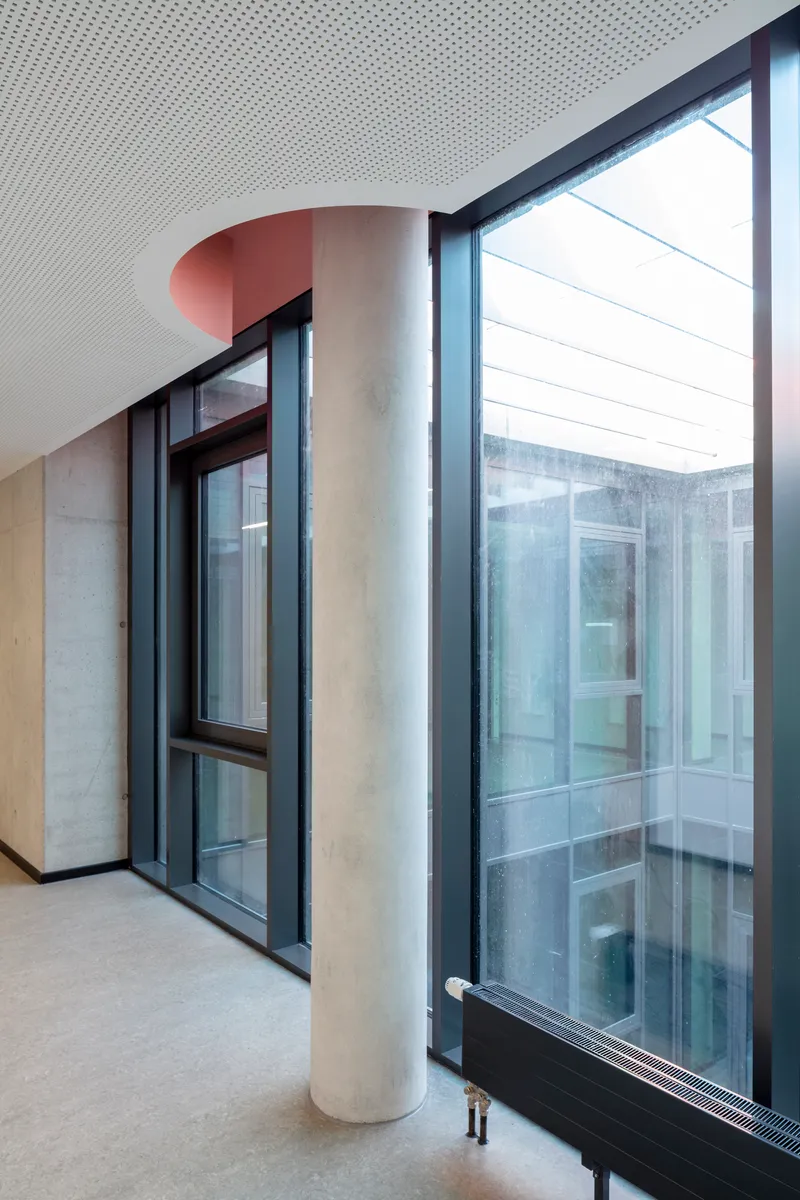
Step inside and the ground floor is organized around what the architects call a communication forum: a foyer, cafeteria, and play center fused into a single multi-purpose hall that occupies the center of the U. School administration flanks this space and connects through two staircase cores. The perforated ceiling panels, visible in the corridor images, manage acoustics in what could otherwise be a reverberant concrete box. Cylindrical columns punctuate the space rhythmically, their scale generous enough to lend the interior a civic quality rather than a purely institutional one.
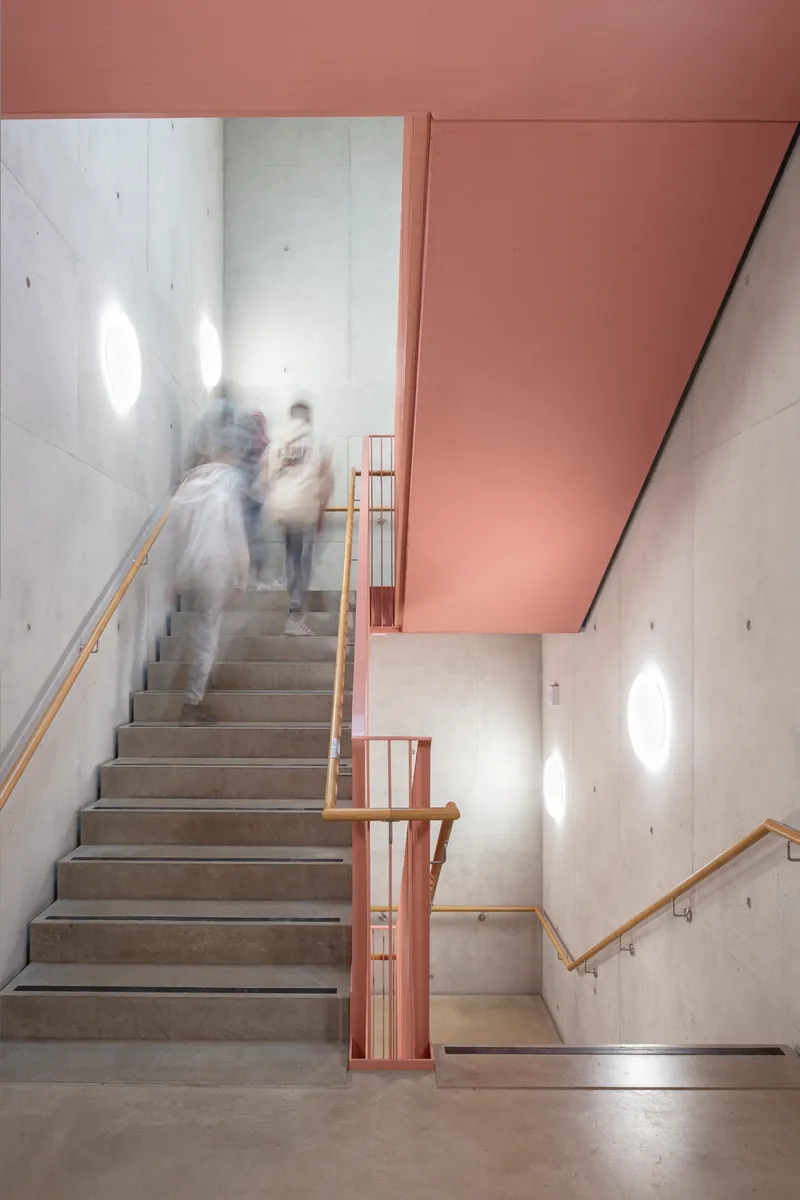
The stairwells deserve attention. Poured concrete with wooden handrails and a pink soffit overhead, they are the moments where the exterior identity penetrates inward. The detailing is restrained but not austere: the wood is warm, the concrete honest, and the color overhead a deliberate callback to the facade. These are high-traffic zones in any school, and here they are treated as worthy architectural moments rather than code-minimum fire escapes.
Corridors That Widen into Classrooms

The real pedagogical argument lives on the two upper floors, where eighteen classrooms are organized into coherent clusters, each with individual and team rooms. What distinguishes the plan from a conventional double-loaded corridor school is the conical widening of the connecting passages. These are not merely wider hallways; they are dimensioned and furnished as self-learning zones, spaces where students can work independently or in small groups outside the formal classroom. It is a spatial response to the shift from lecture-based to project-based teaching that prompted the entire rebuild.
The patio garden at the building's center brings daylight deep into these zones and gives every cluster a view inward as well as outward. At the top floor, the plan opens into a library with views across the campus and a rooftop terrace overlooking the adjacent agricultural fields. Placing the library at the summit is a smart move: it rewards the climb and creates a destination that is quiet by virtue of its remoteness from the ground-floor forum.
Low-Tech with High Ambitions
SSP SchürmannSpannel describes Reinoldi as a low-tech building, and the label is accurate. The climate strategy relies on mechanical ventilation with heat recovery rather than full air conditioning, a green roof with a 53 kWp photovoltaic installation, and 184 square meters of facade greening. The GreytoGreen® method, which informed the design concept, treats vegetated surfaces and rainwater management as integral to the architecture rather than as landscaping afterthoughts. For a school in a mid-density German district, this is a pragmatic and replicable approach.
The emphasis on natural materials and bright, pleasant interior finishes extends the low-tech philosophy into the experiential realm. Concrete, wood, and rendered surfaces dominate. There is no curtain wall gymnastics, no parametric ceiling. The building earns its quality through proportion, light, and the intelligent arrangement of program rather than through technological spectacle.
Plans and Drawings

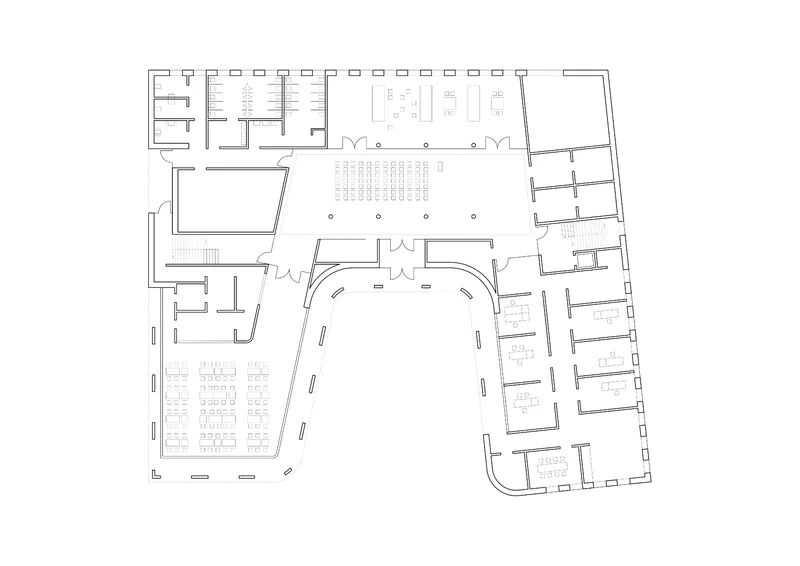

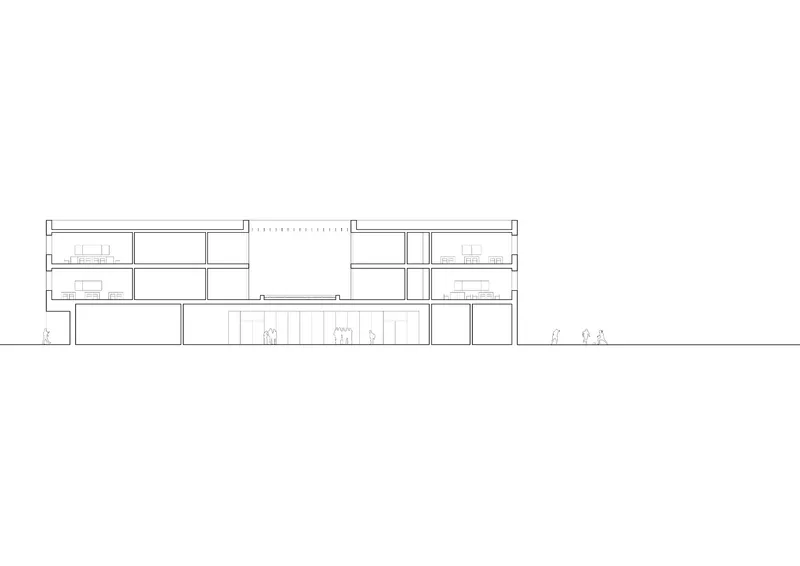

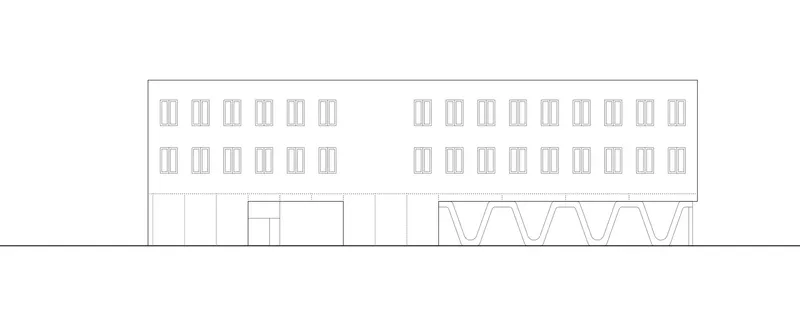


The site plan confirms the building's deliberate retreat from the street edge, carving out a generous forecourt while the U opens toward the schoolyard. The ground floor plan reveals the curved central hall with its integrated seating, flanked by administrative offices. The upper floor plan shows the central atrium surrounded by classroom clusters and the conical corridor widenings that are the project's signature spatial invention.
The section is particularly instructive: it reveals a double-height volume at the forum level and the tight, efficient stacking of the classroom floors above. The elevations demonstrate the disciplined window grid on the upper stories and the undulating V-column rhythm at the base, a structural expression that lifts the mass and creates a covered ground-level zone. The repetition across all four elevations is consistent, suggesting a building that reads similarly from every approach, a quality appropriate for a campus building that must orient multiple user groups.
Why This Project Matters
Reinoldi Comprehensive School is not revolutionary, and that is precisely its value. It demonstrates that a mid-budget public school in a German secondary city can be spatially ambitious without being formally extravagant. The conical corridor, the rooftop library, the patio garden: these are moves that cost relatively little in construction terms but fundamentally change how a school feels and functions. They emerge directly from a pedagogical brief that asked for flexibility, self-directed learning, and communal gathering, and they deliver on all three.
Too many school projects treat architecture as branding, wrapping conventional plans in eye-catching skins. SSP SchürmannSpannel has done the opposite here. The pink facade is memorable, certainly, but the real work is inside: in the widening corridors, the clustered classrooms, and the low-tech environmental systems that will keep operating costs manageable for decades. If your city is debating whether to patch an aging school or start fresh, Reinoldi makes a compelling case for demolition and reinvention.
Reinoldi Comprehensive School by SSP SchürmannSpannel, Dortmund, Germany. 5,300 m², completed 2020. Photography by Detlef Podehl.
About the Studio
Share Your Own Work on uni.xyz
If projects like this are the kind of work you want to make, uni.xyz is a place to publish your own, find collaborators, and enter design competitions.


Popular Articles
Popular articles from the community


Faces of the Soviet Avant-Garde: Turning Moscow's Street Names into an Open-Air Museum
A network of sculptural installations across a Moscow residential district transforms forgotten architect names into spatial encounters with cultural memor
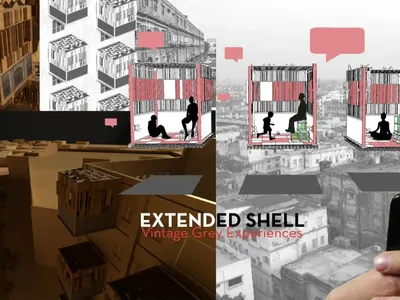
Extended Shell: Retrofitting Kolkata's Balconies as Living Urban Thresholds
A modular retrofit system recovers the social and environmental intelligence of Kolkata's historic verandas for contemporary Park Street residents.
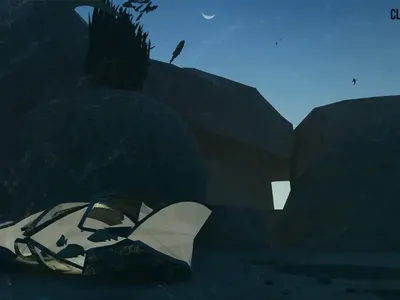
Cloaked Colonization: A Mobile Underwater Habitat That Moves Like a Fish
Micah Abaya's shortlisted EHC Pacific entry reimagines ocean settlement as a dispersed network of self-sustaining architectural organisms.
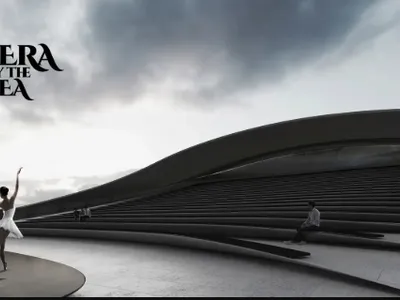
Opera by the Sea Estonia: Three Shells Dissolving Architecture into Tallinn's Coastline
A winning opera house proposal replaces monumental form with interconnected shells that blur the boundary between building, park and Baltic Sea.

Similar Reads
You might also enjoy these articles

Pixel Gardens: One Repeated Module Stacked Into a Terraced Social Housing Tower for Famagusta
Salem Bader's shortlisted housing tower builds a vertical neighbourhood from one repeated module, offsetting units to carve terraces, light and air.

Bao Huynh Watercolor Atelier: A Serene Art Retreat in Hội An
Bao Huynh Watercolor Atelier in Hội An blends multifunctional art spaces, sustainable design, local materials, and family-friendly living in a serene environment.

Atelier Macri Concept Store Interior Design by CASE-REAL
Atelier Macri store features a "ko" counter, walnut wood details, cork displays, blending retail, gallery, and seamless customer experiences.

Manuel Vargas Izquierdo Stadium and High-Performance Sports Center: Architectural Excellence in Jalpa de Méndez
The Manuel Vargas Izquierdo Stadium blends sustainable design, inclusive sports facilities, and cultural-inspired architecture, revitalizing Jalpa de Méndez’s public spaces.


Comments (0)
Please login or sign up to add comments
No comments yet. Be the first to comment!