

Stacked Coffee Table: Three Plywood Layers Composed Like a Loose Pile of Playing Cards
Maple, oak and walnut plywood layers, offset like scattered cards, give a flat-pack coffee table six colour orders and a quietly sculptural presence.


Toss a few playing cards onto a table and they land slightly askew, overlapping without any plan. The Stacked Coffee Table takes that moment of casual disorder and holds it in place. Three tabletop layers sit offset from one another as if they had just slid into position, yet every shift is measured and every layer is precisely fixed. The appeal of the piece lies in this tension: it looks spontaneous, but its proportion, balance and materiality are tightly controlled.
Designed by Hemal Patel and published as a project on uni.xyz, the table is framed as a celebration of wood in its varied expressions. Patel works with a familiar typology, the low central table of a seating arrangement, and gives it a layered language built from veneered plywood in Maple, Oak and Walnut. The result is a compact object, 115 cm long, 60 cm wide and 36 cm high, that aims to read as a small piece of architecture within an interior.
Offset Layers That Read as Movement Frozen in Place
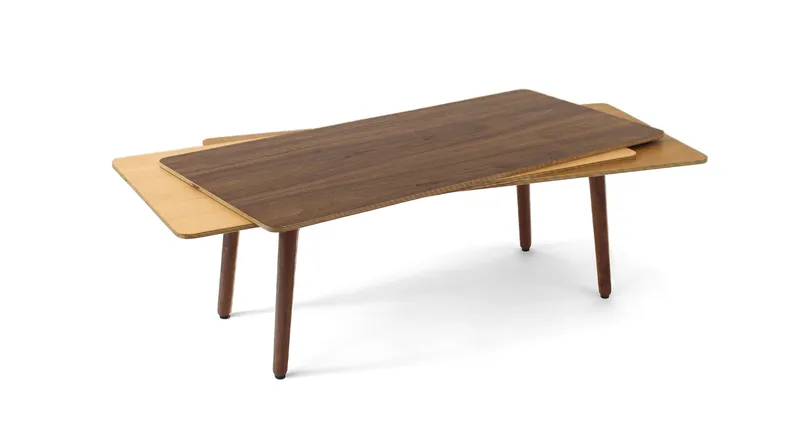
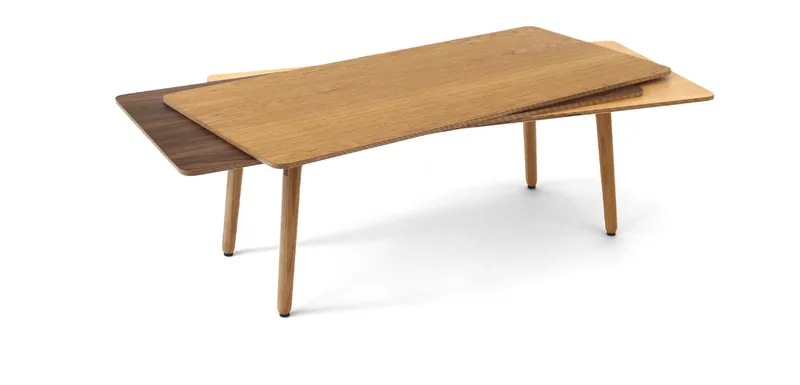
The two studio views show the core move clearly. In one, a walnut top shifts over maple layers below; in the other, an oak top slides across walnut and maple. Each layer keeps its own identity rather than merging into a single slab, so the edge of the table becomes a stratified band of tone and grain. The offsets break the rigid rectangle without abandoning it, giving the silhouette a sense of drift.
Below the top, the structure stays deliberately quiet. Four solid wooden legs, tapered in these renders and matched to the top veneer, carry the composition. That restraint matters: with the visual activity concentrated in the layered surface, the legs provide lightness and let the stacked top read as the subject. The calm rhythm of the layers is engaging without becoming busy.
Six Colour Orders From One Set of Parts
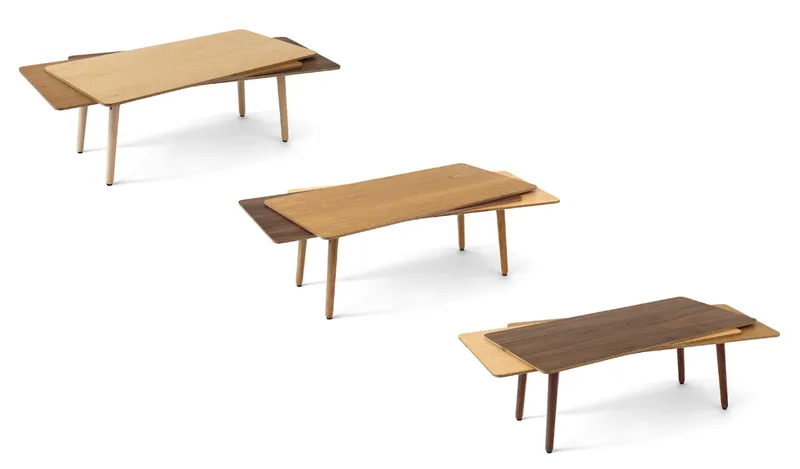
Lined up side by side, the maple, oak and walnut versions reveal the project's most practical idea. Because the three veneered layers are interchangeable in sequence, simply reordering them produces six distinct colour combinations. A maple-led top feels light and airy; a walnut-led one grounds the room in deeper tones. The geometry never changes, only the order of materials, which makes the system efficient to produce while still offering real choice.
This is customisation achieved through arrangement rather than added components. It suits a contemporary market where users expect furniture to adapt to their interiors, and it keeps the design honest: the variation comes directly from the natural tones of the woods themselves, not from applied finishes.
A Low Table Scaled for Reading Rooms and Lounges
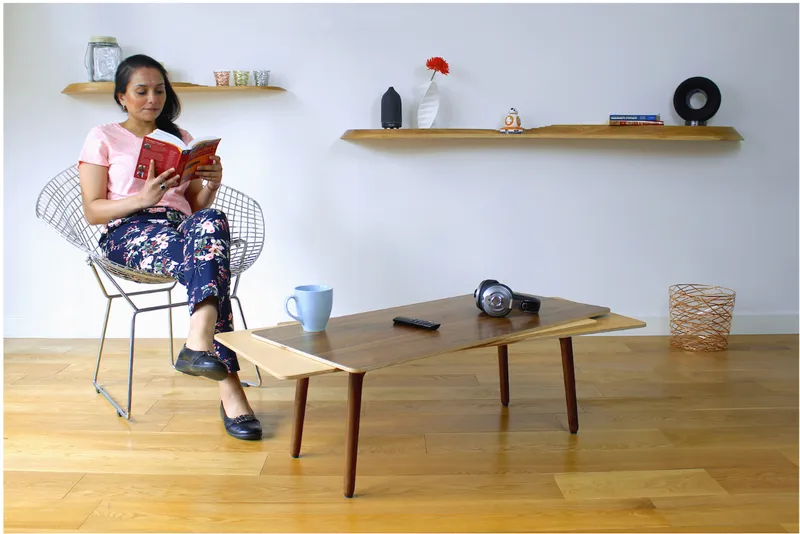
Placed in a lived setting, beside a wire chair with floating shelves behind and a pale oak floor underfoot, the walnut version settles into the room as a measured centrepiece. At 36 cm high, it sits at a comfortable reach from a lounge chair, and its 115 by 60 cm footprint holds a book or a cup without crowding the space around it.
Patel positions the table for living rooms, lounges, offices and commercial interiors alike, and the clean lines support that claim. The flat-pack delivery adds to its everyday logic, allowing easy transport and quick assembly without compromising structural integrity or finish quality. For an object this expressive, that practicality is a welcome discipline.
Plywood Edges Exposed as a Material Record
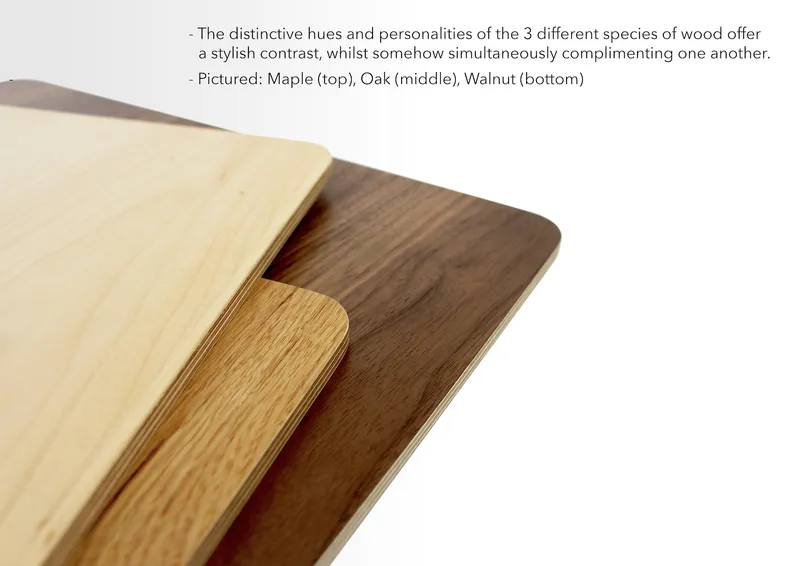
The close-up of the tabletop corners is where the material argument lands. Rounded edges soften each layer, and the exposed plywood edges sit between the veneered faces of maple, oak and walnut, turning the construction method into part of the visual language. Rather than hiding the build-up of the sheet material, the design lets the edge tell you exactly how the table is made.
That honesty is what keeps the playing-card metaphor from becoming a gimmick. The stacked effect is not a surface trick; it is the actual structure of the top, expressed layer by layer, with grain and colour doing the expressive work.
Why This Project Matters
The Stacked Coffee Table shows how much a single, clear idea can carry when it is applied with restraint. One gesture, the offset stack, generates the form, the material contrast and a six-way colour system, all from veneered plywood and four solid legs. Nothing is added that the concept does not need, which gives the piece its clarity.
For young designers working at furniture scale, Patel's project is a useful reminder that architectural thinking does not depend on size. Layering, proportion and the honest expression of construction are as relevant to a 36 cm high table as to a building, and here they combine into an object that shapes the space around it rather than simply occupying it.
View the Full Project
About the Designers
Designer: Hemal Patel
Enter a Design Competition on uni.xyz
uni.xyz runs architecture and design competitions year-round that reward proposals with spatial conviction and real site intelligence.
Project credits: Stacked Coffee Table by Hemal Patel.


Popular Articles
Popular articles from the community


Singing Woman: An Opera House That Performs Before the Curtain Rises
Ovidiu Cristian Pavel's conceptual opera house translates Estonia's choral identity into a sculpted waterfront landmark facing the Baltic Sea.
Temporary Home for Dogs: A Reversed Zoo Rethinks Animal Shelter Architecture
In Bucharest, a sinuous corridor and freed landscape flip the logic of containment, designing a shelter that works to make itself unnecessary.
Opera by the Sea Estonia: Three Shells Dissolving Architecture into Tallinn's Coastline
A winning opera house proposal replaces monumental form with interconnected shells that blur the boundary between building, park and Baltic Sea.
The Amber Palace Opera: A Geological Fiction Surfaces on Tallinn's Baltic Waterfront
Pierre Brillard reimagines a Baltic legend as a public landscape, opera house, and waterfront promenade rooted in Tallinn's coastal identity.

Similar Reads
You might also enjoy these articles


Maya Harvest: A Cacao Resort Village Rooted in Mayan Tradition and Local Craft
Situated within a Tabasco cacao plantation, this shortlisted resort proposal merges vernacular materials with hands-on cultural immersion.
Harmonia: A River-Shaped Community That Grows Over Decades in Boa Vista
Curved pathways and modular grid structures along the Branco River create a phased settlement designed to evolve from 2030 to 2050.

The Architecture of Bathing: A Mughal Hammam Reimagined Across the Yamuna
Charlotte May's honorable mention entry for The Black Taj reinterprets Agra's bathing rituals through red sandstone, water, and framed views of the Taj Mah
Om-1: A Wall-Hung System That Moves Your Workspace Off the Desk
Modular plywood boards, magnetic pegs, and utility elements migrate clutter from the horizontal surface to the vertical plane.

Explore Furniture Design Competitions
Discover active competitions in this discipline

Design challenge to equip cities with modern furniture

Competition to design a workstation for architects

Packaging challenge - Design meets sustainability
Comments (0)
Please login or sign up to add comments
No comments yet. Be the first to comment!