

StarShade: Spacestop
Space Architecture Competition Journal

“Sometimes in the darkest places, we find the brightest light.”
- Jennifer Niven, All The Bright Places
Ever since I was a child, I enjoyed looking up at the vast sea of stars on clear nights. Stargazing is a humbling, yet inspiring, experience; it makes you feel small, insignificant - but it also excites. We will never travel to the vast majority of these distant places; but we are so lucky to be alive in a young universe - where the lights of distant solar systems, nebulae, and galaxies paint our nights, and our imaginations.
The relationship between us and the vast field of stars has always intrigued me. In the day, the light from our sun blots out all but the brightest of stellar objects; at night, the hustle and bustle from our cities accomplishes much the same. In 1994, at 4:30 in the morning, an earthquake knocked out power to much of urban LA. Few residents even called the police - fearful of the strange lights and colored clouds hanging overhead. They were seeing our galactic plane for the first time. As any architect would tell you, context - connection to the bigger picture - is important. We are visually, and spatially, disconnected from what is beyond our thin atmosphere.
I wanted to make this act - this connection between oneself and the 3D universe around them - the central theme of StarShade. In the coming decades, the commercialization and privatization of space appears to be inevitable. This project is a statement, an embodiment of values that I believe should be present and upheld by the coming generation of space explorers. Going to space is unlike any other vacation, prospective spacefarers must be active participants; with the goal of coming back to Earth with a greater understanding of the particularities, and beauty of living beyond our planet.
I wanted the design of StarShade to be as technologically mature as possible - constraining myself to the projected 10m wide SLS cargo fairing (meaning all SHV’s have to fit within those dimensions), and drawing inspiration from existing systems and principles (particularly the James Webb Space Telescope); all whilst still having high growth potential - which is important for a multi-purpose space facility located far from Earth. That size constraint also led me to the modular - hexagonal design. Despite these constraints, as someone who studied architecture, I wanted the station to still present a cinematic, awe-inspiring “facade,” particularly on the Sun-Side. Once I began envisioning spacefarers approaching this golden, gleaming, yet flat structure in space - I was hooked. Combine that with the extreme contrast of Star-side, which is shaded and looking out towards that endless beauty of space. I also wanted to talk about the station - at least in the presentation boards - in a manner similar to how modern resorts and hotels market themselves; whilst still being mindful of the differences between this and traditional “vacations” today.
It is a Crisp Autumn morning, 2033. Your journey begins on Earth - on and off training for six to eight months to ensure that your body and mind are ready for the rigors of space travel. You will also familiarize yourself with the technology of your new home - a thirty meter tall, seven and a half meter wide gleaming vessel. This is the SHV - The StarShade Habitation Vehicle, in addition to generating power, and protecting you from the elements, its design is meant to enhance and augment one’s zero-gravity experience through infinitely variable lighting, visual, and audio displays.
The trip to StarShade will take approximately 30 days - with you and your 1-3 companions traveling a total of 1.5 million kilometers from Earth. At the end, you will reach a point known as Lagrange Point 2 - L2 - for short. It is a gravitationally stable point in space - meaning that the station is highly efficient, using much less fuel to remain stable and stationary. Keeping the Sun, Earth, and the Moon behind makes L2 an ideal place for observing stars; but you are still close enough to the Earth for constant and stable travel and communication. Together with 80 other magnetically connected SHV’s, your module makes up StarShade. The Sun-Side is directly exposed to our sun, generating more than enough power for the station, whilst protecting and dispersing excess heat. The Star-Side is in shade, pointing you and all other inhabitants towards the infinite sea of wonder and mystery that is our universe.
For two weeks, you can explore and work in and around your SHV, going about your daily life, immersed and surrounded by scenes, colors, and sounds directly captured from space - presenting the history of human space exploration, up to this moment. Fall asleep under a truly starry sky, or project visions and scenes of your own choosing. Enjoy playing zero-gravity sports and understanding how the human body adapts to life in space within the station’s many recreational facilities, located in large inflatable structures at the center of the station - and make friends as you do!
Your time at StarShade is coming to an end. We hope you have enjoyed this experience; and hope that you’ve gained a greater understanding of the challenges that come with further space exploration - both biological and mechanical. Additionally, while your time here may be relatively short, we hope that you’ve gained an appreciation for the magic and wonder that surrounds you - take time to look up, travel, and see these sights backdropped by the forests, mountains, and oceans of the wonderful planet we call home. Have a safe trip back to Earth, friends.

Popular Articles
Popular articles from the community


Manzana Morphosis: Stretching Barcelona's Grid into a Living Landscape for 2050
A radical reworking of the Eixample manzana turns density into a tool for generous public space, vertical ecology, and environmental performance.

Opera by the Sea Estonia: Three Shells Dissolving Architecture into Tallinn's Coastline
A winning opera house proposal replaces monumental form with interconnected shells that blur the boundary between building, park and Baltic Sea.

Temporary Home for Dogs: A Reversed Zoo Rethinks Animal Shelter Architecture
In Bucharest, a sinuous corridor and freed landscape flip the logic of containment, designing a shelter that works to make itself unnecessary.

Opera on the Sea: Driftwood Logic Shapes a Timber Opera House on Estonia's Coast
Trevor Orgill's opera house translates the entangled drift of floating timber into a civic building where wood, water, and music converge.

Similar Reads
You might also enjoy these articles
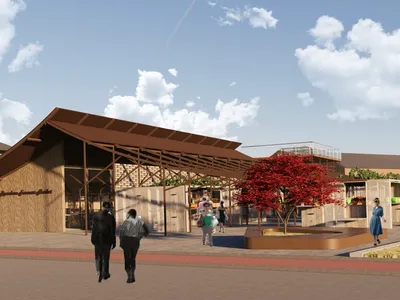
The Rhythm of Seasons
A Farmers' Market Connecting Nature and the City
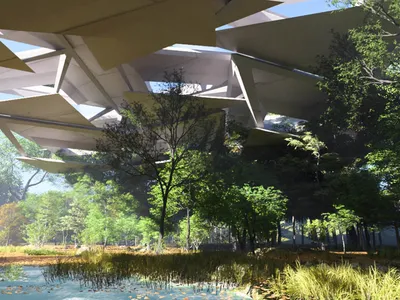

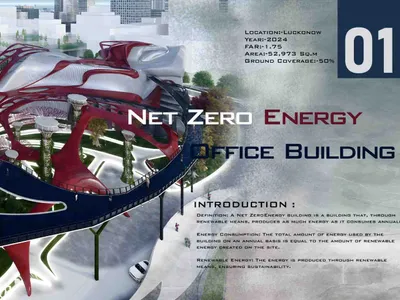
More Than a Building-Designing a Living System
More Than a Building-Designing a Living System
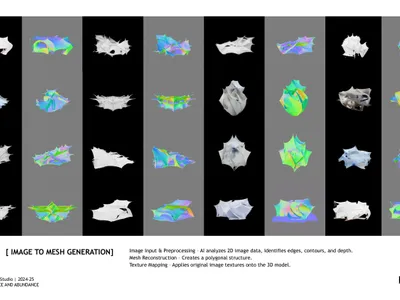
Base Beyond
DESERT COMPOUND ARID: TOURISM OF ABSENCE AND ABUNDANCE

Explore Outer Space Competitions
Discover active competitions in this discipline


Challenge to visualize a collision of the future and past

Challenge to visualize future spaces of waste

Challenge to visualize slums of 2080

Challenge to illustrate the ruins of Petra
Comments (0)
Please login or sign up to add comments
No comments yet. Be the first to comment!