

STOP-MOTION: A Library Built on the Logic of Urban Flow
A vertical stack of modular rooms treats knowledge accumulation as physical movement through fragmented voids and active zones.

What if a library operated less like an archive and more like a city intersection? STOP-MOTION takes that question literally, organizing its programme as a vertical collage of modular volumes where VR rooms, creative labs, collaborative hubs, and short-nap stations coexist within a single tower. The result is a building that treats the accumulation of knowledge the way a city treats the accumulation of people: through constant movement, periodic stillness, and the friction between the two.
Designed by Burçin Pelin Kantaş and Oğuz Kağan Erge, STOP-MOTION was recognized as a Runner-up in Libgen 2019. The competition asked participants to reimagine the library for a contemporary context, and this entry responds with a provocation: the library is not a container of books but a conductor of experience, structured through the principles of flow architecture.
A Pixelated Tower Dissolving into the Sky
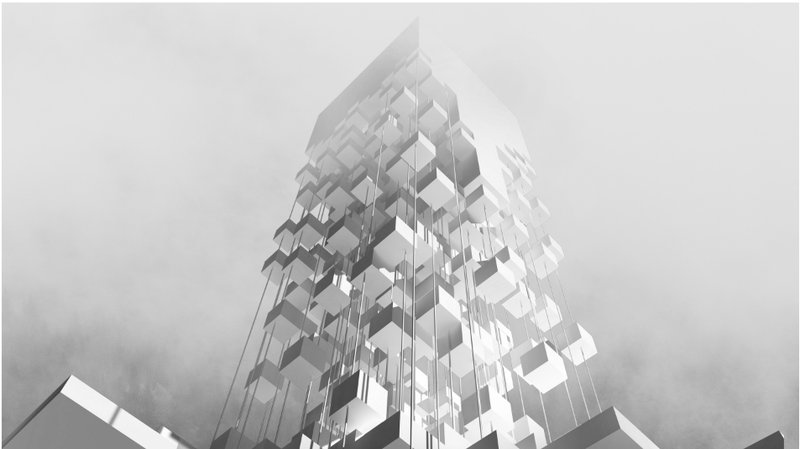
The tower's facade reads as a pixelated glass surface, its edges dissolving into fog as if the building itself resists fixed boundaries. This visual dematerialization is not incidental. It signals the project's core argument: that a library should feel less like a sealed institution and more like an extension of the atmosphere around it. The glass modules stack irregularly, breaking any suggestion of a uniform curtain wall and hinting at the programmatic diversity packed behind each panel.
The Fiction of the Void: Fragmented Volumes as Intellectual Triggers
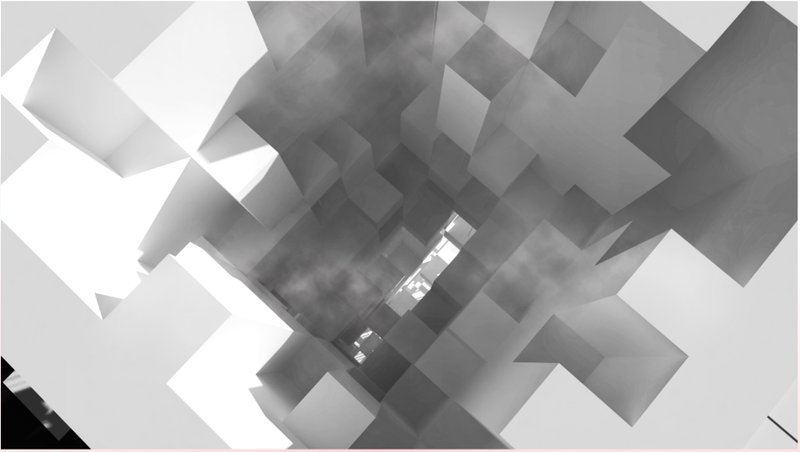
The designers introduce a concept they call the "fiction of the void," and the axonometric drawing makes it legible. Intersecting cubic volumes float in atmospheric haze, each one a discrete spatial episode within the larger structure. Fragmentation here is deliberate: when spaces are divided and motion is constant, the body stays active. When volumes open up and movement slows, the mind takes over. The library calibrates this oscillation between physical flow and intellectual depth across its vertical stack.
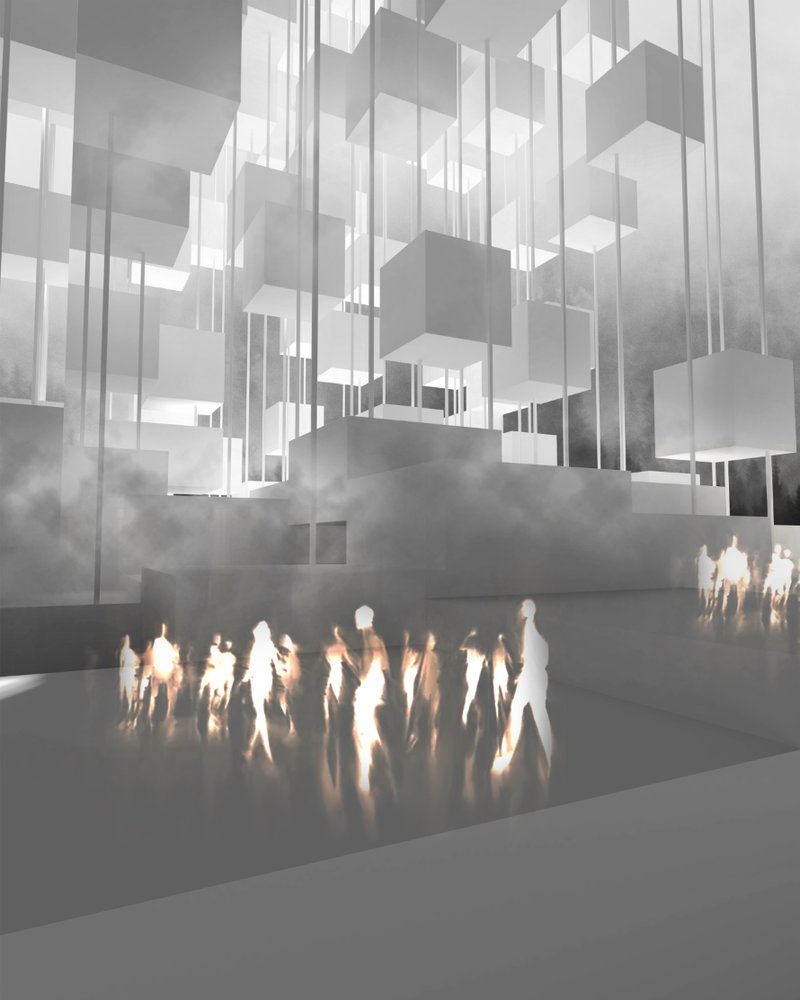
The interior rendering confirms this logic at ground level. Suspended translucent boxes hover above pedestrians in ambient light, creating a layered canopy of programme overhead. The lower levels simulate the energy of a city floor with interactive, high-traffic zones, while the upper regions transition into quieter, cerebral spaces. Walking through STOP-MOTION would feel less like entering a building and more like moving through an urban section compressed into a single vertical slice.
Stacked Modules Mapped Against the City
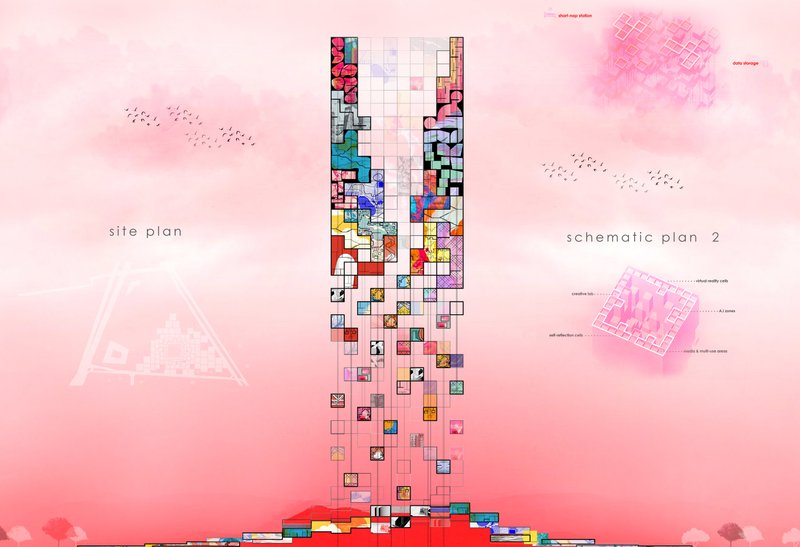
The site plan and schematic elevation strip the project down to its organizational DNA. Colorful stacked units, each representing a distinct programmatic module, arrange themselves across a vertical grid in a pattern that reads more like an urban diagram than a traditional building section. This is the key drawing for understanding the project's ambition: every unit interfaces with its neighbors, allowing VR rooms to sit adjacent to reading nooks, creative labs to border collaborative hubs. The adjacency is the architecture. Programme is not sorted into floors but woven into a three-dimensional lattice where intellectual activities and urban dynamics occupy the same structure.
Why This Project Matters
STOP-MOTION succeeds because it refuses to treat the library as a single-use building type. By importing the logic of urban flow into the building's internal organization, Kantaş and Erge propose a library that is genuinely public in the spatial sense: open to the rhythms, speeds, and encounters of city life rather than sealed off from them. The layered verticality, moving from active street-level zones to contemplative upper volumes, mirrors the daily rhythm of a city dweller in a way that most institutional buildings never attempt.
As a competition entry, it also demonstrates the value of a strong conceptual frame. The "fiction of the void" is not just a tagline; it organizes the entire spatial sequence, giving the designers a rule set for deciding where to fragment space and where to let it breathe. That kind of disciplined speculation, where a single idea governs both the atmosphere and the plan, is what separates a provocative drawing from an architectural argument.
View the Full Project
About the Designers
Designers: Burçin Pelin Kantaş, Oğuz Kağan Erge
Enter a Design Competition on uni.xyz
uni.xyz runs architecture and design competitions year-round that reward proposals with spatial conviction and real site intelligence.
Project credits: STOP-MOTION by Burçin Pelin Kantaş, Oğuz Kağan Erge Libgen 2019 (uni.xyz).




Popular Articles
Popular articles from the community

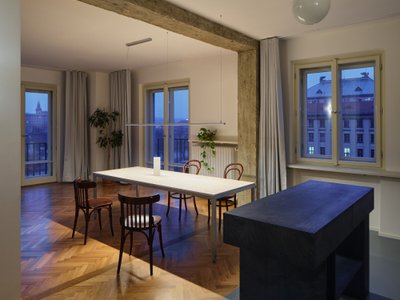
Prokop Hartl Turns a 1930s Prague Corner Apartment into a Lesson in Structural Honesty
A 115 m² renovation on the Vltava River celebrates exposed concrete, restored parquet, and a mirrored column as its centerpiece.
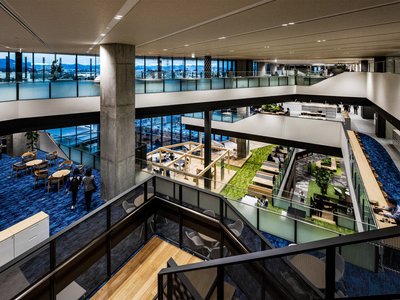
Nikken Sekkei Builds a 560,000 m² Innovation Hub for Subaru around a Giant Social Atrium
A new R&D campus in Ota, Japan, dissolves corporate silos by organizing engineering and office floors around open, interconnected voids.
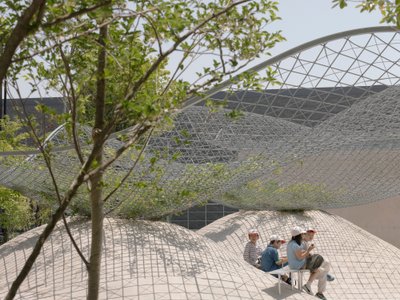
MIDW Casts a Pavilion Roof from the Earth Itself at the 2025 Osaka Expo
On a fragile reclaimed island, excavated soil becomes formwork for a concrete canopy that will eventually disappear into wisteria.

Roman Izquierdo Bouldstridge Turns an Old Barcelona Shop into a Loft Organized by Emptiness
In El Born, three timber torii frames and the Taoist concept of the void reshape 85 square meters of former commercial space into a dwelling.


Similar Reads
You might also enjoy these articles
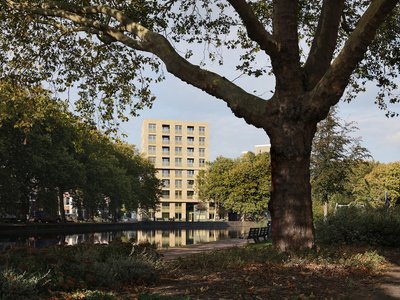
Van Bergen Kolpa Architects Stack 36 Social Homes into a Sculpted Brick Landmark on Rotterdam's River Rotte
A nine-story tower, corner houses, and townhouses in yellow brick form a new social housing landmark on a canal bend in Rotterdam's Oude Noorden.
MIDW Casts a Pavilion Roof from the Earth Itself at the 2025 Osaka Expo
On a fragile reclaimed island, excavated soil becomes formwork for a concrete canopy that will eventually disappear into wisteria.
Znamy się Designs an Optical Salon in Wrocław as a Spatial Map of the Human Eye
Auga Optical Salon translates the biology of vision into material, light, and spatial sequence across 191 square meters in Wrocław, Poland.
Atelier LAI Scatters a Timber Resort Across a Terraced Anhui Valley
Nanshan Junning Resort uses wood joinery and topographic sensitivity to settle 6,700 square meters into a ten-meter slope near Hefei.


Explore Educational Building Competitions
Discover active competitions in this discipline




The Global Benchmark for Architecture Dissertation Awards


Challenge to design public laboratory
Comments (0)
Please login or sign up to add comments
No comments yet. Be the first to comment!